
Reports
The Global Fluoropolymer Coatings Market was valued at USD 345 Million in 2025 and is anticipated to reach a value of USD 417.07 Million by 2033 expanding at a CAGR of 2.4% between 2026 and 2033. Growth is driven by accelerating use of PTFE, PVDF, and ETFE coatings in chemical-processing equipment, semiconductor manufacturing, EV battery systems, and offshore-wind infrastructure where corrosion, thermal stability, and low-friction performance directly extend asset life.
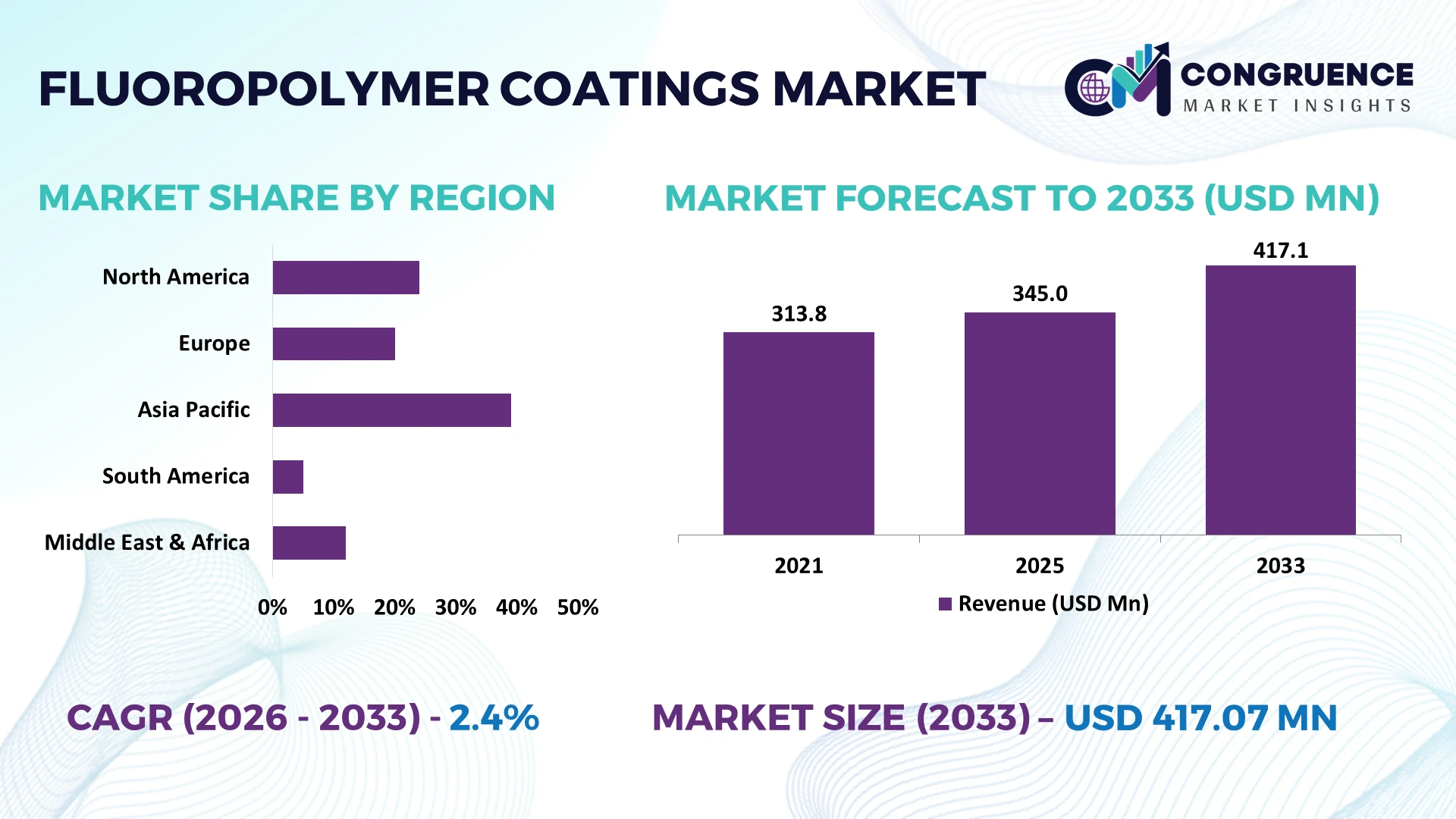
China remains the dominant country hub, consuming about 50% of global PTFE and nearly 60% of other fluoropolymers in 2025, supported by electronics, EV batteries, chemical processing, and renewable-energy investment. Its fluoropolymer consumption substantially exceeds that of individual Western markets, while India is expanding electronics and solar manufacturing capacity. US-China supply-chain diversification is strengthening regional sourcing strategies.
Strategic decisions should prioritize China-linked capacity, India’s manufacturing expansion, and PFAS-compliant coating technologies to protect supply continuity and capture specialized demand.
Market Size & Growth: USD 345 million in 2025 to USD 417.07 million by 2033 at 2.4% CAGR, supported by EV batteries, semiconductor equipment, and corrosion-resistant industrial systems.
Top Growth Drivers: Chemical processing 35.4%; PTFE coatings 40.2%; Asia Pacific 37.5% share, defining the strongest demand anchors.
Short-Term Forecast: By 2028, low-VOC and waterborne formulations target 10–15% lower emissions while improving compliance efficiency.
Emerging Technologies: AI-assisted formulation, automated spray systems, filled PTFE, PVDF, and ETFE technologies are moving premium coating production toward higher precision.
Regional Leaders: Asia Pacific benchmarks USD 3.6 billion by 2033; North America approaches USD 2.7 billion; Europe reaches about USD 2.4 billion, led by low-VOC adoption.
Consumer/End-User Trends: Chemical processing holds 35.4%, while electrical and electronics records 8.4% projected annual expansion, strengthening demand for dielectric and thermal protection.
Pilot/Case Example: In 2025, PPG introduced ENVIROLUXE Plus, a PTFE-free powder formulation, eliminating PTFE use in that formulation while incorporating recycled plastic.
Competitive Landscape: Akzo Nobel leads with approximately 20% share; PPG, Sherwin-Williams, Axalta, and Chemours remain major global competitors.
Regulatory & ESG Impact: PFAS restrictions and low-VOC rules are accelerating reformulation, with waterborne and powder systems gaining priority in regulated markets.
Investment & Funding: Integer Holdings committed USD 152 million for Precision Coating assets in 2025, reinforcing advanced coating capabilities for medical-device applications.
Innovation & Future Outlook: Next-generation PFAS alternatives, high-purity PVDF, automated application, and digitally monitored coating processes are shifting competition toward compliance, performance, and supply-chain resilience.
The fluoropolymer coatings market is concentrating around chemical processing, semiconductor equipment, EV battery manufacturing, aerospace, and renewable-energy infrastructure. PTFE remains the dominant coating technology, while ETFE and PVDF are gaining traction in high-performance applications requiring thermal stability and chemical resistance. Approximately 35.4% of demand is linked to chemical processing, while PFAS regulatory pressure is accelerating formulation innovation and reshaping procurement priorities.
Fluoropolymer coatings are becoming strategically important because chemical resistance, thermal stability, low friction, and equipment longevity increasingly determine operating economics in high-value industries. PTFE represented about 43.35% of coating demand in 2025, while industrial applications accounted for 24.4%, reinforcing the material’s role in chemical processing, semiconductor equipment, and advanced manufacturing.
The market is shifting from conventional coating supply toward performance-engineered and regulation-ready systems. Liquid formulations held 62.1% share in 2025, while powder technologies are advancing as manufacturers target lower emissions and process efficiency. PTFE coatings can operate at temperatures around 260°C, whereas PVDF is gaining traction in battery and semiconductor applications. Asia Pacific held 43.4% share, contrasting with North America’s stronger emphasis on low-VOC formulations.
Over the next 2–3 years, suppliers are expected to increase automated application, formulation optimization, and localized production while customers diversify sourcing. The EU’s evolving PFAS framework, including packaging restrictions effective August 2026, is accelerating reformulation and compliance investment. Companies that combine specialty PVDF, ETFE, and PFAS-compliant technologies with regional technical partnerships will gain stronger positioning through reliability, regulatory readiness, and differentiated performance.
Chemical processing remains a core demand engine, representing 35.4% of end-use demand, while PTFE coatings command about 43.35% share. Their resistance to aggressive chemicals and temperatures around 260°C reduces corrosion-related maintenance and protects process purity. China’s expanding chemical, semiconductor, and battery manufacturing base is reinforcing this requirement. Coating suppliers are responding through filled-PTFE formulations, PVDF capacity, and application partnerships. The non-obvious advantage is lifecycle economics: customers increasingly evaluate coatings by downtime avoided rather than purchase price, favoring suppliers that can validate durability under operating conditions.
Feedstock concentration remains a structural constraint because China controls well over half of mined fluorspar, exposing downstream fluoropolymer producers to raw-material and pricing volatility. PTFE still represents roughly 43% of coating demand, increasing dependence on established fluorochemical supply chains. Regulatory pressure adds another layer, with thousands of scientific and technical submissions influencing PFAS restriction decisions. Companies are responding through multi-year contracts, regional inventory buffers, supplier diversification, and alternative formulations. The strategic pressure is shifting from simple procurement cost control toward feedstock security and compliance assurance.
PVDF represents a high-value opportunity as semiconductor, battery, and electronics manufacturing expands. Its coating applications benefit from chemical compatibility, dielectric performance, and durability, while PVDF-related demand is expanding faster than established PTFE applications. Electrical and electronics applications are projected to record about 8.4% annual expansion, creating opportunities for high-purity coatings, automated deposition, and digitally controlled formulation. India’s electronics and battery manufacturing expansion creates an additional localization opportunity. Suppliers are increasing R&D and forming application-specific partnerships, positioning coatings as engineered components rather than commodity surface treatments.
The central execution challenge is maintaining fluoropolymer performance while regulatory requirements evolve. EU packaging rules introduce PFAS concentration thresholds of 25 ppb for individual PFAS and 50 ppm for total PFAS, creating tighter formulation and documentation requirements from August 2026. Surface-treatment alternatives also remain unevenly validated at industrial scale. Companies therefore face qualification cycles, process revalidation, and potential equipment adjustments. Leading suppliers must invest in PFAS-compliant chemistry, testing infrastructure, traceability, and customer co-development. Competitive advantage will increasingly depend on proving equivalent performance under regulation, not simply introducing a substitute material.
Powder Formulation Expansion: Powder-based fluoropolymer coatings are gaining traction as manufacturers target lower emissions and improved material utilization, while liquid systems retain roughly 62% share. Automated electrostatic application can reduce overspray-related material losses by 10–15%, prompting European producers to expand low-VOC powder lines and upgrade curing workflows.
High-Purity Grades Rising: Semiconductor, battery, and electronics manufacturers are increasing adoption of high-purity PVDF, PFA, and ETFE coatings, with electrical and electronics applications expanding about 8.4%. China is accelerating localized production, while suppliers are forming application-specific partnerships to improve contamination control, coating uniformity, and qualification speed.
Automated Application Scaling: Robotic spraying, digital thickness monitoring, and automated curing are entering more industrial coating lines, reducing rework by approximately 10–15% and improving thickness consistency. U.S. and Japanese manufacturers are integrating machine-vision inspection and process analytics, shifting operational gains from labor reduction toward tighter material control and fewer rejected components.
Supply Chains Regionalize: China accounts for about 50% of global PTFE consumption, encouraging manufacturers in the United States, Europe, and India to diversify fluoropolymer sourcing. PFAS regulatory tightening in Europe is accelerating supplier qualification, localized inventories, and alternative formulation development, making compliance readiness and dual sourcing increasingly important procurement criteria.
PTFE remains the leading type, accounting for approximately 43.35% of fluoropolymer coatings demand. Its combination of chemical inertness, low friction, thermal resistance near 260°C, established processing infrastructure, and broad industrial compatibility keeps it ahead of FEP, PFA, ETFE, and PVDF. FEP and PFA retain strong positions where melt-processability, purity, and continuous-service performance are essential, particularly in demanding chemical and electronics environments. Manufacturers continue refining filled-PTFE grades to improve wear resistance and service life without disrupting established application processes.
PVDF represents the fastest-growing strategic shift, expanding at roughly 5.1% as semiconductor, battery, and advanced electronics applications increase requirements for dielectric stability and chemical resistance. ETFE remains relevant for lightweight, weather-resistant applications. Companies are therefore redirecting R&D and capacity investments toward PVDF while protecting PTFE scale advantages. The result is a two-track market: PTFE remains the volume leader, while PVDF captures higher-value emerging applications.
Chemical Processing leads the application landscape with approximately 35.4% share, supported by extensive use across tanks, pipes, reactors, valves, pumps, and protective linings exposed to corrosive chemicals. Corrosion Protection remains closely connected to this demand because longer coating service intervals reduce maintenance frequency and production interruptions. Non-Stick Cookware remains a mature high-volume application, while Automotive Components are shifting toward specialized thermal, friction, and chemical-protection requirements.
Electrical Insulation is emerging as the fastest-changing application, supported by semiconductor equipment, EV electronics, connectors, and high-performance wiring. Electrical and electronics demand is expanding at approximately 8.4%, creating stronger requirements for high-purity and dimensionally consistent coatings. Companies are responding with automated application systems, customized formulations, and partnerships with component manufacturers. This shift is moving purchasing decisions from coating price toward validated performance, reliability, and production-line compatibility.
The Chemical Industry remains the leading end-user, representing approximately 35.4% of demand through extensive deployment in corrosion-resistant process equipment, vessels, piping, valves, and seals. High chemical exposure and continuous operating cycles make coating durability a direct uptime factor, encouraging buyers to prioritize lifecycle performance over initial procurement cost. Food Processing maintains specialized demand for non-stick, hygienic, and chemically resistant surfaces, while Aerospace requires lightweight, temperature-resistant, and reliability-focused coating systems.
Electrical & Electronics represents the fastest-growing end-user group, driven by semiconductor equipment, EV systems, connectors, insulation components, and high-frequency electronics. Its underlying application base is expanding rapidly, with semiconductor sales increasing 25.6% in 2025. Automotive Industry demand is simultaneously shifting toward electrified powertrains and advanced thermal-management components. Suppliers are responding through customized formulations, qualification partnerships, regional technical centers, and higher-purity product portfolios, positioning themselves closer to OEM and component-development ecosystems.
Asia Pacific accounted for the largest market share at 44% in 2025 however, North America is expected to register the fastest growth, expanding at a CAGR of 6.6% between 2026 and 2033.
Reshoring Strengthens Advanced Coating Capacity
North America holds nearly 30% of global fluoropolymer coating activity, supported by concentrated chemical processing, aerospace, semiconductor, automotive, and advanced manufacturing operations in the United States. Domestic reshoring is increasing demand for localized PTFE, PVDF, and high-purity coating supply, reducing exposure to overseas logistics and raw-material disruptions. In 2025, Arkema announced a 15% PVDF capacity expansion at its Kentucky facility backed by a USD 20 million investment, targeting battery, semiconductor, and cable applications. U.S. manufacturers are also accelerating automated spray and inspection systems to improve coating consistency. The region’s strategic advantage is increasingly tied to domestic material availability and qualification capabilities rather than volume alone.
United States Market Outlook: The United States dominates North American deployment through its extensive chemical-processing, aerospace, electronics, and medical-device manufacturing base. Chemical processing accounts for about 35% of domestic coating demand, while localized PVDF production is strengthening supply resilience. Investment is increasingly directed toward high-purity materials, automated application, and specialized industrial coating capacity.
PFAS Compliance Reshapes Product Portfolios
Europe combines mature industrial coating demand with increasingly stringent environmental requirements. Germany, Italy, France, and the United Kingdom maintain strong demand from chemical processing, automotive manufacturing, aerospace, food equipment, and infrastructure maintenance. PFAS restrictions are forcing formulators to reassess legacy fluoropolymer systems, accelerating low-emission processing, alternative formulations, and tighter substance traceability. Liquid coatings remain important, but powder and advanced application technologies are receiving greater attention where they improve emissions performance. European producers are prioritizing formulation redesign and customer qualification rather than broad capacity expansion. The region’s competitive distinction is regulatory-led innovation: compliance requirements are becoming a product-development filter, pushing suppliers toward documented lifecycle performance and more controlled manufacturing workflows.
Germany Market Outlook: Germany represents Europe’s strongest industrial demand center, supported by automotive manufacturing, chemical processing, machinery, and engineering-intensive production. Its extensive industrial equipment base creates recurring requirements for corrosion and chemical resistance. Manufacturers are increasing automated coating controls and sustainability-focused formulations as PFAS requirements tighten, strengthening demand for technically validated systems.
Manufacturing Scale Drives Coating Localization
Asia Pacific commands approximately 44% of global fluoropolymer coating demand, with China serving as the central production and consumption hub. Electronics, chemical processing, automotive manufacturing, battery production, and semiconductor supply chains generate large-volume requirements for PTFE, PFA, FEP, ETFE, and PVDF systems. China consumes roughly half of global PTFE output, reinforcing its supply-chain influence. India is strengthening its position through electronics, renewable-energy, pharmaceutical, and automotive manufacturing expansion, while Japan and South Korea remain important high-purity technology centers. Suppliers are expanding regional technical support, localizing inventories, and developing application-specific grades. The region’s non-obvious advantage is the ability to combine material scale with rapidly expanding downstream qualification ecosystems.
China Market Outlook: China remains the strategic center of the market because of its integrated fluorochemical supply chain and extensive downstream manufacturing base. Its share of global PTFE consumption is approximately 50%, giving domestic producers significant scale advantages. Battery, electronics, chemical, and semiconductor investment continues to support high-volume coating deployment and local formulation development.
Industrial Modernization Supports Specialized Demand
South America remains a smaller but strategically relevant market, with Brazil accounting for the largest share of regional industrial demand. Chemical processing, food processing, automotive manufacturing, mining, and oil-and-gas infrastructure create recurring requirements for corrosion-resistant and chemically stable surfaces. Brazil’s large industrial equipment base supports adoption of PTFE and FEP systems, while infrastructure modernization is increasing interest in long-service protective coatings. Import dependence for specialized fluoropolymers remains a constraint, making inventory planning and distributor partnerships important for manufacturers. Companies are increasingly prioritizing application engineering and regional service networks instead of building extensive local resin capacity. The strongest opportunity lies in reducing maintenance frequency across harsh operating environments where coating durability directly affects equipment availability.
Brazil Market Outlook: Brazil provides the region’s strongest demand platform through chemical processing, food production, automotive manufacturing, mining, and energy infrastructure. Large-scale industrial facilities create sustained requirements for non-stick, corrosion-resistant, and chemically stable coatings. Local distributors and technical service providers remain important because specialized fluoropolymer grades are still heavily dependent on international supply chains.
Energy Infrastructure Accelerates Protective Coating Adoption
Middle East & Africa demand is increasingly linked to oil and gas, petrochemical processing, desalination, power infrastructure, and large industrial modernization projects. Saudi Arabia and the United Arab Emirates are strengthening advanced manufacturing and energy infrastructure, creating requirements for coatings capable of resisting chemicals, heat, abrasion, and aggressive operating environments. Petrochemical equipment provides a particularly strong use case for PTFE, PFA, and corrosion-resistant fluoropolymer systems. Companies are responding through project-specific technical partnerships, distributor expansion, and localized application services rather than broad manufacturing footprints. The strategic opportunity is concentrated in high-value infrastructure where extended coating service intervals can reduce maintenance shutdowns and improve asset utilization.
Saudi Arabia Market Outlook: Saudi Arabia represents the region’s strongest strategic market because of its extensive petrochemical, refining, energy, and infrastructure investment base. Large processing facilities require durable chemical-resistant surfaces across equipment and piping systems. Industrial diversification under Vision 2030 is also expanding manufacturing activity, creating additional opportunities for specialized fluoropolymer coating suppliers and application partners.
The market pits global coating leaders AkzoNobel, PPG, Sherwin-Williams, Axalta, and Chemours against specialized fluoropolymer suppliers and regional producers. The top five players collectively command roughly 50% of the market, creating moderate concentration while leaving room for niche technology providers. Competition centers on formulation performance, supply security, customization, and regulatory readiness. High-purity and advanced grades command approximately 10–15% pricing premiums where contamination control and thermal stability are critical. PPG, AkzoNobel, and Sherwin-Williams emphasize application technology and distribution reach, while Chemours and Daikin strengthen upstream fluoropolymer integration and material availability. Capacity localization is accelerating as geopolitical disruption raises the value of regional supply. PFAS compliance is becoming an additional entry barrier because qualification and reformulation require specialized testing infrastructure. Winning requires integrated material access, application expertise, reliable delivery, and demonstrable compliance rather than price competition alone.
AkzoNobel N.V.
PPG Industries, Inc.
The Sherwin-Williams Company
Axalta Coating Systems LLC
The Chemours Company
Daikin Industries, Ltd.
Arkema S.A.
Solvay S.A.
Jotun A/S
Hempel A/S
Beckers Group
Dongyue Group Co., Ltd.
Endura Coatings
Nippon Paint Holdings Co., Ltd.
Current fluoropolymer coating lines increasingly combine water-based PTFE/PFA dispersions, solvent systems, and powder application with automated spray, curing, and thickness control. High-transfer powder technology can reach 85% first-pass efficiency, improving material utilization by about 10–15% versus conventional application workflows and reducing rework. These integrated lines also shorten manual inspection cycles and support more repeatable film builds for architectural metals, cookware, chemical equipment, and automotive components.
Emerging technology is shifting toward high-purity PVDF, ETFE, and PFA grades for semiconductor, battery, cable, and chemical equipment. Advanced formulation and automated inspection can improve coating consistency by 5–10%, while PFAS-aware chemistry is accelerating qualification. Suppliers with integrated resin-to-coating capabilities gain faster customization and stronger supply assurance. Waterborne and low-emission systems are also gaining deployment where regulatory compliance, worker exposure, and solvent reduction directly affect operating economics.
Disruptive development through 2026–2028 will center on PFAS-reduced formulations, surfactant-free polymerization, digital process monitoring, and localized PVDF capacity. Surfactant-free production reduces processing-chemical dependence, while regional capacity cuts supply exposure. Companies deploying closed-loop application, predictive quality control, and high-purity materials now will secure faster qualification, lower waste, and stronger competitive positioning. North American localization and Asian manufacturing scale will increasingly determine who can combine compliance, availability, and application performance.
August 2024 AGC developed surfactant-free fluoropolymer production technology, targeting continuous supply with fewer fluorinated processing aids. The process addresses sustainability and regulatory pressure while maintaining high-performance requirements, strengthening AGC’s position in advanced fluoropolymer materials and improving production resilience. Source: agc.com
July 2024 AkzoNobel launched FIDURA, a construction-focused coil coating system designed for roofing, walls, facades, rainwater systems, garage doors, and shutters. The launch expands durable fluoropolymer-related architectural coating options and strengthens application-specific positioning across construction markets. Source: coatingsworld.com
February 2025 Arkema announced a 15% PVDF capacity expansion at Calvert City, Kentucky, backed by a USD 20 million investment. Startup was scheduled for mid-2026, strengthening localized supply for batteries, semiconductors, cables, and advanced coatings applications. Source: arkema.com
August 2025 Chemours and SRF Limited signed strategic agreements to expand fluoropolymer and fluoroelastomer capacity access in India. SRF operates 13 manufacturing plants domestically and exports to over 100 countries, improving Chemours supply flexibility across semiconductor, automotive, aerospace, and chemical markets. Source: chemours.com
The report evaluates the Fluoropolymer Coatings Market across PTFE, FEP, PFA, ETFE, and PVDF, with application coverage spanning Non-Stick Cookware, Chemical Processing, Electrical Insulation, Corrosion Protection, and Automotive Components. End-user analysis covers Chemical Industry, Automotive Industry, Electrical & Electronics, Food Processing, and Aerospace. The assessment tracks segment leadership, adoption intensity, technology positioning, and shifting procurement priorities.
Geographic coverage includes North America, Europe, Asia-Pacific, South America, and Middle East & Africa, with country-level emphasis on major manufacturing and industrial hubs. Technology assessment covers powder, liquid, water-based, high-purity, automated, and PFAS-aware coating systems. The report supports investment planning, capacity localization, product portfolio decisions, partnerships, competitive positioning, and expansion priorities through 2026–2033, highlighting niche opportunities in semiconductor equipment, batteries, advanced electronics, and high-performance industrial protection.
| Report Attribute/Metric | Report Details |
|---|---|
Market Revenue in 2025 | USD 345 Million |
Market Revenue in 2033 | USD 417.07 Million |
CAGR (2026 - 2033) | 2.4% |
Base Year | 2025 |
Forecast Period | 2026 - 2033 |
Historic Period | 2021 - 2025 |
Segments Covered | By Type
By Application
By End-User
|
Key Report Deliverable | Revenue Forecast, Growth Trends, Market Dynamics, Segmental Overview, Regional and Country-wise Analysis, Competition Landscape |
Region Covered | North America, Europe, Asia-Pacific, South America, Middle East, Africa |
Key Players Analyzed | AkzoNobel N.V., PPG Industries, Inc., The Sherwin-Williams Company, Axalta Coating Systems LLC, The Chemours Company, Daikin Industries, Ltd., Arkema S.A., Solvay S.A., Jotun A/S, Hempel A/S, Beckers Group, Dongyue Group Co., Ltd., Endura Coatings, Nippon Paint Holdings Co., Ltd. |
Customization & Pricing | Available on Request (10% Customization is Free) |




