
Reports
The Global Fluid Sensors Market was valued at USD 17,151.8 Million in 2025 and is anticipated to reach a value of USD 27,983.5 Million by 2033 expanding at a CAGR of 6.31% between 2026 and 2033. Growth is anchored in industrial IoT retrofit cycles, tightening water-quality mandates, and the shift toward embedded edge analytics in flow and level measurement.
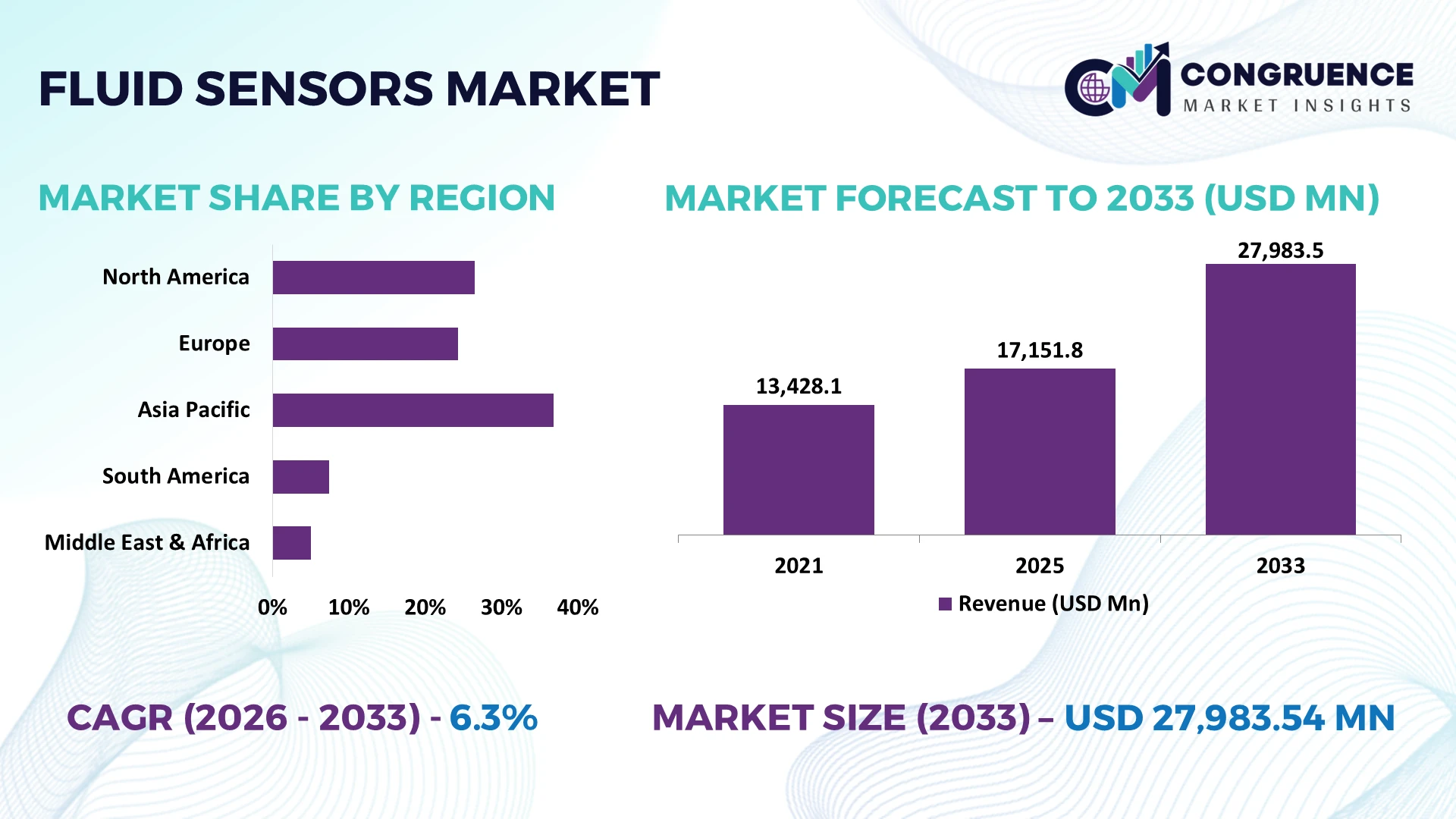
Asia-Pacific commands the dominant position, capturing 36.82% of global revenue in 2025, with China’s Bengbu Sensor Valley targeting CNY 30 billion (USD 4.1 billion) in output by 2027 backed by an 8-inch MEMS line. India’s Sensor Center of Excellence projects a domestic market of INR 31,000 crore (USD 3.7 billion) by 2027, propelled by automotive and IoT programs. North America and Europe together account for roughly half of global revenue, though U.S. Section 301 tariffs doubled to 50% on Chinese semiconductors in late 2024 raised bill-of-materials costs by 15–30%, pushing OEMs to relocate assembly to Mexico, Vietnam, and Eastern Europe. Asia-Pacific’s share exceeds North America’s by nearly 10 percentage points, signaling a decisive shift in both consumption and production gravity.
Strategic implication, Procurement and localization strategies must prioritize Asia-Pacific capacity access while hedging tariff exposure through multi-regional assembly footprints.
Market Size & Growth: Valued at USD 17,151.8 Million in 2025, projected to USD 27,983.5 Million by 2033 at 6.31% CAGR, driven by inline quality validation in food and beverage processing under HACCP and FSMA protocols .
Top Growth Drivers: Industrial IoT penetration at 41% of new sensor deployments, water utility automation at 33% of municipal upgrade budgets, and automotive battery-coolant and hydrogen detection expanding at 28% of new powertrain designs .
Short-Term Forecast: By 2027, MEMS-based flow sensor unit costs decline 18% versus 2024 baselines, while inline diagnostic efficiency rises 22% across chemical and pharmaceutical process lines.
Emerging Technologies: Edge-AI embedded analytics, radiation-resistant sensor prototypes surviving 800°C and neutron flux, and chiplet architectures circumventing EUV lithography constraints in Japan and South Korea .
Regional Leaders: Asia-Pacific at USD 6,314 Million (36.82% share, rapid MEMS line expansion); North America at USD 4,800 Million (oil and gas digital monitoring adoption); Europe at USD 3,900 Million (green deal-driven renewable and carbon capture instrumentation) .
Consumer/End-User Trends: 67% of food and beverage manufacturers now require inline pasteurization and cleaning validation sensors, up from 48% in 2022, reflecting regulatory hardening .
Pilot/Case Example: In 2025, Endress+Hauser’s Greenwood, Indiana facility (USD 50.9 Million investment) began shipping with six-week lead times, a 40% reduction from prior import-dependent cycles .
Competitive Landscape: Honeywell, Siemens, Emerson, and ABB collectively hold approximately 34% share; Honeywell’s USD 2.16 Billion Sundyne acquisition integrates pumps, compressors, and sensors into turnkey packages .
Regulatory & ESG Impact: EU Green Deal funding channels 28% of new sensor demand toward renewable and carbon-capture applications; ATEX certification requirements in Middle East sour gas fields add 12–15% to unit costs.
Investment & Funding: China’s Bengbu Sensor Valley anchors USD 4.1 Billion in regional MEMS investment; onsemi commits USD 1.91 Billion to a silicon carbide site in the Czech Republic .
Innovation & Future Outlook: Lab-on-chip microfluidics and vibration-powered wireless nodes for deep-shaft mining signal a shift from discrete measurement to continuous, self-powered fluid intelligence.
The Fluid Sensors Market is pivoting from discrete measurement hardware to embedded intelligence, with 67% of food and beverage processors now mandating inline validation sensors for pasteurization and cleaning cycles. MEMS and lab-on-chip innovations are compressing form factors while extending operating envelopes to 800°C and radiation-exposed environments. A notable operational shift: U.S. tariffs on Chinese semiconductors doubled to 50% in late 2024, forcing OEMs to restructure assembly across Mexico, Vietnam, and Eastern Europe—a supply-chain reality that now shapes sourcing decisions as much as technical specifications. These dynamics frame the strategic calculus examined below.
Fluid sensors have transitioned from commodity instrumentation to strategic infrastructure for industrial competitiveness. The convergence of water-quality regulation, automotive electrification, and industrial IoT retrofit cycles means measurement accuracy now directly gates operational permits and product release. Supply-chain restructuring amplifies this: U.S. tariffs on Chinese semiconductors doubled to 50% in late 2024, driving OEMs to multi-regional assembly and elevating sensor sourcing from procurement tactic to board-level risk management .
Technology comparison reveals the efficiency gap. Legacy mechanical flow meters require scheduled manual calibration and offer no diagnostic telemetry; MEMS-based smart sensors with edge analytics deliver continuous validation and predictive maintenance, reducing calibration downtime by an estimated 30–40% in process environments. Regionally, Asia-Pacific’s 36.82% revenue share reflects both consumption scale and production capacity expansion—China’s 8-inch MEMS line and India’s automotive IoT programs contrast with North America’s focus on oil and gas digital monitoring and Europe’s regulatory-driven renewable instrumentation .
A practical deployment, Endress+Hauser’s Greenwood, Indiana facility, a USD 50.9 Million investment, began shipping in mid-2025 with six-week lead times, cutting prior import-dependent cycles by roughly 40%. Companies are responding by localizing assembly, acquiring complementary instrumentation assets (Honeywell-Sundyne at USD 2.16 Billion), and partnering with MEMS foundries to secure capacity. The strategic conclusion is unambiguous: fluid sensor capability now determines regulatory compliance velocity, operational uptime, and supply-chain resilience—competitive positioning hinges on treating sensing architecture as core infrastructure, not ancillary hardware.
Industrial IoT adoption is the primary structural driver, with 41% of new sensor deployments now IIoT-connected for continuous process validation. Water utility automation absorbs 33% of municipal upgrade budgets, driven by contamination detection requirements in aging distribution networks. Automotive powertrain diversification adds another vector: battery-coolant flow and hydrogen detection now represent 28% of new sensor specifications in vehicle platforms. The real-world catalyst is regulatory: food and beverage processors face HACCP and FSMA mandates requiring inline pasteurization and cleaning validation, pushing 67% adoption of inline sensors versus 48% in 2022. Companies are responding through localized production—Endress+Hauser’s Indiana facility shortens U.S. lead times to six weeks—and through acquisitions that bundle sensors into turnkey process packages, as Honeywell’s USD 2.16 Billion Sundyne deal demonstrates. The sharp insight: sensing is shifting from component sale to compliance infrastructure, and suppliers who cannot document validation data lose specification leverage.
U.S. Section 301 tariffs doubled to 50% on Chinese semiconductors in late 2024, raising bill-of-materials costs by 15–30% for fluid sensor OEMs reliant on Asian component sourcing. This compounds existing constraints at mature nodes, where capacity remains tight despite new fab announcements, with lead times for IoT-grade MCUs and sensor ASICs still materially above pre-2020 baselines. The direct business impact is margin compression at the entry-level pressure and temperature sensor tier, where commoditization already erodes profitability. Companies are reducing exposure through multi-regional assembly—Mexico, Vietnam, and Eastern Europe absorbing relocated production—and through supplier diversification contracts that split volume across tariff jurisdictions. A non-obvious operational insight: tariff-driven cost dispersion between regions means the same sensor SKU now carries different margin profiles depending on assembly location, forcing finance and procurement to co-own sourcing decisions previously delegated to engineering.
MEMS technology is unlocking demand in environments previously unaddressable by conventional sensors: radiation-resistant prototypes surviving 800°C and neutron flux open next-generation reactor monitoring, while lab-on-chip microfluidics enable point-of-care diagnostic applications. Edge-AI embedded analytics represent a distinct opportunity layer, shifting value from hardware unit sales to subscription-based diagnostic services. India’s Sensor Center of Excellence projects a USD 3.7 Billion domestic market by 2027, driven by automotive and IoT programs that remain underserved by incumbent suppliers. A non-obvious strategic insight: the most defensible opportunity lies not in displacing legacy sensors but in retrofitting intelligence onto installed bases—ABB’s acquisition of Sensorfact added plug-and-play energy monitors that attach to existing motors without engineering downtime, capturing data value without hardware replacement. Companies positioning for ecosystem integration rather than component competition will capture disproportionate margin.
Execution barriers intensify as sensor networks scale: integrating heterogeneous protocols across legacy PLCs and modern IIoT platforms creates deployment friction that extends commissioning timelines by an estimated 25–35% in brownfield industrial sites. Cybersecurity exposure grows proportionally—each connected sensor node becomes an attack surface, and regulatory evolution around critical infrastructure protection imposes compliance burdens that smaller OEMs cannot absorb without partnership. The workforce gap compounds this: instrumentation technicians skilled in both fluid dynamics and embedded analytics remain scarce, limiting deployment velocity in regions outside established industrial hubs. Companies must solve these through modular middleware that abstracts protocol differences, through security-by-design certification (IEC 62443) as a specification differentiator, and through partnerships with system integrators who own the commissioning layer. The strategic insight: interoperability and security are not technical afterthoughts—they are procurement gates, and suppliers who cannot demonstrate certified, plug-and-play integration lose specification before price is discussed.
Non-Contact Radar Displaces Wetted Probes Radar and ultrasonic level sensors are the fastest-growing category at 8.11% CAGR, driven by maintenance avoidance in sterile pharmaceutical vessels and mining silos where fouling erodes measurement precision by 15–20% annually. WIKA’s compact radar launch in March 2026 targets cramped bioreactor geometries, while OndoSense extends reach to 70-meter silos. Companies are responding by engineering self-diagnostic SIL-rated units that feed proof-test data directly into asset management suites, converting maintenance from scheduled labor to condition-based intervention.
EPA PFAS Limits Force Continuous Telemetry The U.S. EPA now caps PFAS at 2–5 ng/L, compelling utilities to abandon grab sampling for continuous pH, turbidity, and dissolved-oxygen telemetry with phased enforcement through 2027. Nanomaterial electrochemical probes paired with machine-learning filters resolve sub-ppb concentrations in turbid matrices where legacy cells saturated. Smaller rural systems face 3–5 times higher per-capita capital costs, accelerating demand for field-serviceable low-cost units and pay-as-you-go cloud analytics rather than capital-intensive lab-grade installations.
Hydrogen Service Drives Embrittlement-Resistant Materials Hydrogen infrastructure specifications now require titanium or gold-plated sensor elements priced 30–50% above stainless equivalents, reflecting embrittlement risks under high-pressure H₂ service. This premium pricing sustains margin resilience in an otherwise commoditizing pressure sensor tier. Vendors are bundling digital temperature elements for density compensation, advancing multiparameter accuracy while justifying the material uplift through documented safety integrity claims rather than performance alone.
India Retrofit Economics Compress Payback Cycles A 2025 retrofit of twelve CNC machines in India trimmed unplanned downtime by 95% with payback under three months, using low-cost microcontrollers paired with pressure and flow probes. Predictive models now forecast pump seal failures two weeks in advance, averting shutdowns costing USD 50,000–200,000 per event. The non-obvious insight: the highest-velocity adoption is not greenfield smart factories but brownfield retrofits where sensing intelligence attaches to installed assets without engineering downtime.
Flow sensors commanded 38.68% of 2025 fluid sensor revenue, underpinned by custody transfer and energy balancing applications where Coriolis and ultrasonic meters deliver ±0.1% accuracy in fiscal oil measurement. The installed base is vast and replacement cycles are predictable, giving flow sensors a structural revenue floor that newer categories cannot yet challenge. Pressure probes remain essential in wellhead and hydrogen applications with 6,000-bar ratings now routine, while temperature and other specialized sensors occupy niche high-margin pockets in pharmaceutical and semiconductor process control.
Radar and ultrasonic level sensors represent the fastest-growing type at 8.11% CAGR, with non-contact designs sidestepping the wear and fouling that erode wetted probe accuracy by 15–20% annually. Adoption is concentrated in sterile manufacturing, mining silos, and water treatment where quarterly calibration labor consumes operational budgets. WIKA’s March 2026 compact radar launch explicitly targets pharmaceutical vessel geometries, signaling vendor recognition that form-factor adaptation, not raw performance, unlocks the next adoption tier. Investment priorities are shifting toward self-diagnostic architectures that generate compliance documentation automatically.
Oil and gas accounted for 27.93% of fluid sensor revenue in 2025, concentrated in custody transfer, pipeline integrity monitoring, and wellhead pressure management where measurement failure carries direct financial and safety consequences . The segment’s demand intensity reflects infrastructure scale: a single refinery deploys thousands of measurement points across process, safety, and environmental monitoring functions. Coriolis and ultrasonic meters dominate fiscal applications where ±0.1% accuracy is contractually specified, creating high barriers for lower-cost alternatives.
Water and wastewater treatment represents the fastest-expanding application, propelled by EPA PFAS caps at 2–5 ng/L and parallel European directives with enforcement through 2027 . Legacy plants are transitioning from grab sampling to continuous pH, turbidity, and dissolved-oxygen telemetry, with nanomaterial electrochemical probes resolving sub-ppb concentrations in matrices that saturated older sensor cells. Food and beverage retains steady demand through HACCP and FSMA inline validation requirements, while chemical and petrochemical applications prioritize ATEX-certified transmitters at three times standard unit cost. Companies are adapting by developing application-specific form factors—compact radar for bioreactors, wedge meters for abrasive slurries—rather than pursuing universal platforms.
Water and wastewater utilities constitute the largest end-user group by deployment volume, absorbing an estimated 24–26% of fluid sensor units shipped globally in 2025. Demand is infrastructure-dependent and regulation-driven: municipal networks require continuous pressure, flow, and quality monitoring across distribution systems where non-revenue water losses average 20–30% in aging grids. The EPA PFAS limits force utility-level investment in analytical-grade sensing that smaller systems cannot absorb without state or federal subsidy, concentrating procurement among larger municipal authorities and engineering contractors.
Automotive and transportation represents the fastest-growing end-user segment, driven by battery-coolant flow monitoring, hydrogen leak detection, and thermal management specifications in electric powertrains. Each new EV platform adds multiple fluid measurement points absent from internal combustion architectures, expanding sensor content per vehicle by an estimated 35–40% for thermal management alone. Oil and gas retains high per-site sensor density but faces capital discipline constraining greenfield instrumentation budgets. Food and beverage processors are standardizing inline validation sensors at 67% adoption, up from 48% in 2022, creating recurring replacement demand tied to hygiene certification cycles. Companies are targeting utilities through framework agreements and automotive OEMs through design-in partnerships that lock specifications years before production.
Asia-Pacific accounted for the largest market share at 36.8% in 2025 however, North America is expected to register the fastest growth, expanding at a CAGR of 7.8% between 2026 and 2033.
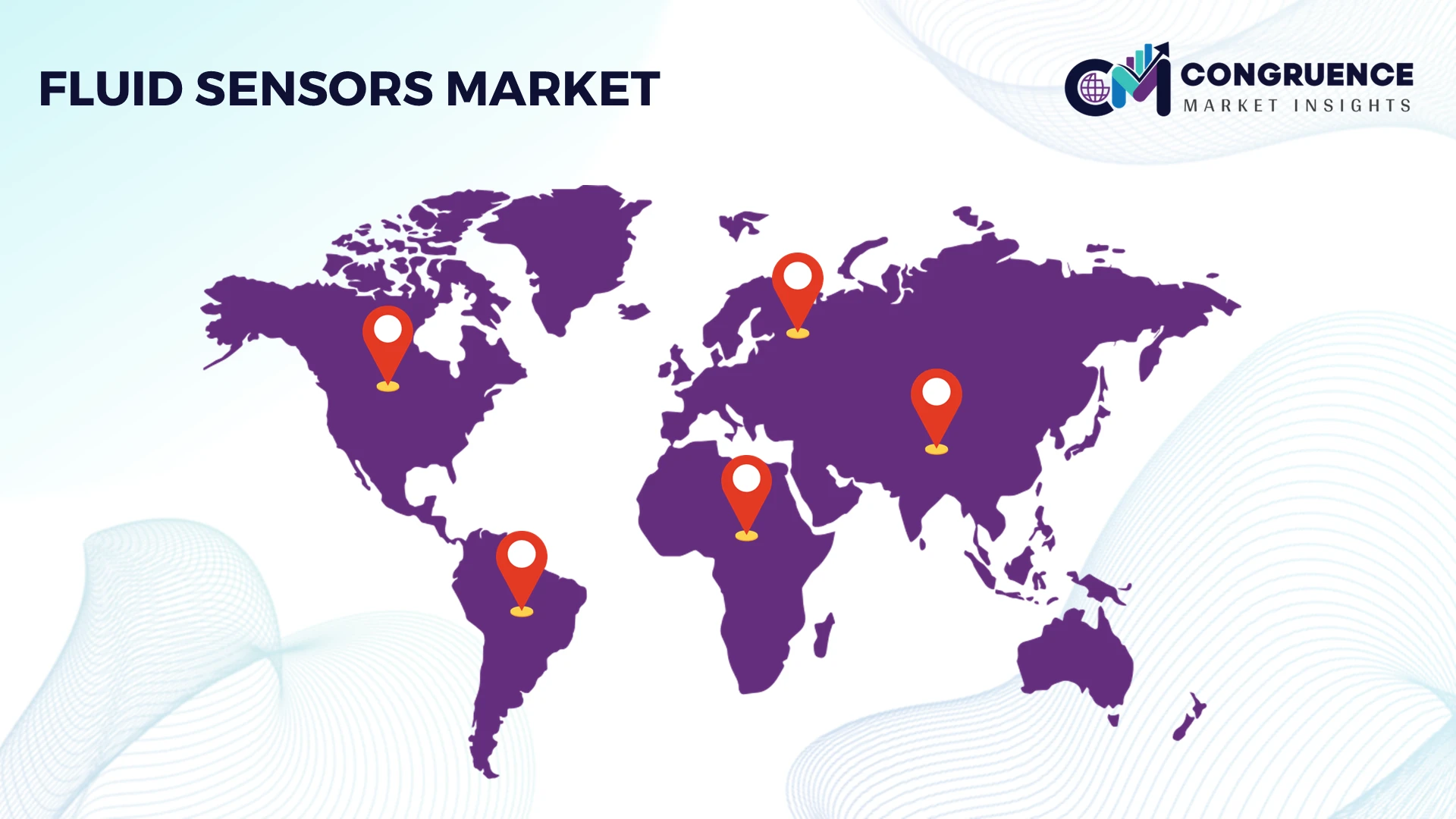
North America holds 26.5% of global fluid sensor value, with the United States anchoring demand through oil and gas digital monitoring, water utility telemetry, and food safety validation. Section 301 tariffs doubling to 50% on Chinese semiconductors in late 2024 inflated bill-of-materials costs by 15–30%, pushing OEMs toward nearshore assembly in Mexico and Central America. Endress+Hauser’s USD 50.9 million Greenwood, Indiana facility began shipping mid-2025 with six-week lead times, a 40% reduction from prior import cycles. Wireless sensor adoption is accelerating in remote oil fields and wastewater plants where wired infrastructure costs are prohibitive.
United States Market Outlook: The U.S. dominates regional demand through shale operations requiring custody-transfer-grade Coriolis and ultrasonic meters, alongside EPA PFAS compliance driving continuous water-quality telemetry. Honeywell’s USD 2.16 billion Sundyne acquisition integrates pumps, compressors, and sensors into turnkey packages, locking specification control at the system level rather than component tier.
Europe commands 24.3% of global value, with demand structurally tied to regulatory compliance and decarbonization investment. The EU Green Deal channels funding toward renewable energy and carbon capture applications, where corrosion-resistant level and flow devices monitor aggressive process media. STMicroelectronics expanded its Agrate fab to 4,000 wafers per week, while onsemi committed USD 1.91 billion to a silicon carbide site in the Czech Republic, anchoring regional semiconductor capacity for sensor ASICs. ATEX certification requirements add 12–15% to unit costs but create specification barriers that favor established vendors over low-cost entrants.
Germany Market Outlook: Germany’s process automation leadership—anchored by Endress+Hauser, Siemens, and ABB—concentrates demand in chemical, pharmaceutical, and food processing applications where SIL-rated measurement integrity is non-negotiable. The country’s engineering workforce and certification infrastructure make it the specification-setting hub for European deployments, with German approvals often cascading into neighboring markets.
Asia-Pacific controls 36.8% of global fluid sensor value, the largest regional share, driven by China’s dual role as consumer and producer. Bengbu Sensor Valley targets CNY 30 billion in MEMS output by 2027, while India’s Sensor Center of Excellence projects a USD 3.7 billion domestic market by 2027. Japanese and South Korean vendors are advancing chiplet architectures to circumvent EUV lithography constraints, reducing dependence on advanced-node imports. Water utility automation absorbs 33% of municipal upgrade budgets across the region, with China’s aging distribution networks requiring continuous pressure and quality monitoring to address non-revenue water losses.
China Market Outlook: China dominates both consumption and production, with the 8-inch MEMS line at Bengbu anchoring domestic capacity for pressure, flow, and level sensor dies. The country’s EV battery thermal management specifications add multiple coolant flow measurement points per vehicle, creating demand volume that no other single market can match.
South America holds 7.4% of global value, with Brazil and Argentina modernizing municipal water treatment to detect pesticides and heavy metals in distribution networks. Demand is concentrated in analytical-grade sensors that withstand turbid matrices and variable power quality, often procured through international development funding rather than domestic capital budgets. Mining operations in Chile and Peru deploy wireless vibration-powered nodes in deep shafts where wired infrastructure is impractical. The region’s execution constraint is not demand but procurement velocity: customs delays and currency volatility extend deployment timelines by 20–30% relative to North American or European benchmarks.
Brazil Market Outlook: Brazil anchors regional demand through water utility modernization and offshore pre-salt oil and gas operations requiring high-pressure, corrosion-resistant flow measurement. The country’s agricultural export infrastructure—grain terminals, ethanol plants, and fertilizer production—creates steady replacement demand for custody-transfer flow meters where fiscal accuracy directly affects trade settlement.
The Middle East & Africa region accounts for 5.0% of global value, with investment concentrated in Saudi Arabia’s desalination capacity and sour gas infrastructure requiring ATEX-certified probes that command 12–15% price premiums over standard units. Hydrogen pipeline specifications in the GCC are accelerating demand for embrittlement-resistant sensor elements, priced 30–50% above stainless equivalents. South African mining operations deploy vibration-powered wireless nodes in deep shafts where battery replacement costs exceed sensor hardware costs. Nigerian pipeline leak detection systems expand despite telecommunications limitations, with satellite backhaul filling connectivity gaps that terrestrial networks cannot address.
Saudi Arabia Market Outlook: Saudi Arabia concentrates regional demand through desalination plants adopting corrosion-resistant level and flow devices, alongside sour gas fields specifying ATEX-certified instrumentation. The Kingdom’s hydrogen export ambitions position it as an early adopter of embrittlement-resistant sensor architectures, creating specification precedents that smaller GCC markets follow.
Honeywell, Siemens, Emerson, ABB, and Endress+Hauser constitute the global leadership tier, holding a combined share of approximately 34%. Competition pits these integrated automation conglomerates against specialized flow and level vendors—Krohne, VEGA, and Yokogawa—that defend niche specifications in custody transfer and safety-instrumented systems. Price competition is muted at the high-accuracy tier, where ±0.1% Coriolis performance commands 25–30% premiums; instead, vendors compete on supply-chain localization (Endress+Hauser’s Indiana facility cuts lead times 40%) and acquisition-driven vertical integration (Honeywell’s USD 2.16 billion Sundyne deal bundles pumps with sensing). Technology disruption is shifting value from hardware to embedded diagnostics, with edge-analytics-capable sensors commanding 15–20% higher ASPs. The decisive barrier is certification depth: SIL and ATEX approvals require years of accumulated test data, locking out low-cost entrants from safety-critical oil and gas and pharmaceutical specifications. Winning requires simultaneous mastery of measurement physics, compliance documentation, and regional assembly footprints—not component cost leadership.
Honeywell International
Siemens
Emerson Electric
ABB
Endress+Hauser
Krohne
VEGA Grieshaber
Yokogawa Electric
Schneider Electric
Azbil Corporation
WIKA Alexander Wiegand
SICK AG
Fortive
TE Connectivity
MEMS-based sensing now anchors 41% of new flow and pressure deployments, delivering ±0.25% accuracy at 60% lower power draw than legacy differential-pressure transmitters. The operational payoff is calibration interval extension from 12 to 24 months, cutting maintenance labor costs by 30–35% in water utility networks.
Edge-AI embedded analytics represent the disruptive layer: sensors with onboard anomaly detection reduce unplanned downtime by 22–28% in chemical process lines by flagging drift before it breaches tolerance. Adoption remains concentrated among Tier-1 pharmaceutical and semiconductor manufacturers, where a single batch failure justifies the 18–22% ASP premium.
The 2026–2028 inflection point is Ethernet-APL and wireless mesh integration, which eliminates marshalling cabinets and cuts installation labor by 40% in brownfield retrofits. Vendors who certify APL-native devices now will control specification access as European and North American process plants standardize on single-pair Ethernet architecture.
March 2025 – Siemens launched the PTFE Eco electromagnetic flowmeter for China’s water, HVAC, and lithium-battery sectors, offering ±0.3% accuracy with HART/Modbus/Profibus compatibility at a localized cost structure. The move locks Siemens into municipal and advanced-manufacturing specifications before domestic competitors scale. Source: mp.weixin.qq.com
May 2025 – Endress+Hauser won the 2025 AMA Innovation Award for its ultrasonic flowmeter, recognized for measurement precision in filling applications. The Dosimag/Dosimass refresh adds IO-Link—a world-first for filling flowmeters—and full food positive-list compliance, tightening specification control in pharmaceutical and food processing. Source: jp.endress.com
June 2025 – Honeywell completed its USD 2.16 billion acquisition of Sundyne, integrating pumps and gas compressors with Honeywell Forge automation. The deal bundles fluid-handling hardware with sensing and control, shifting Honeywell from component supplier to turnkey process equipment provider across refining and LNG value chains. Source: investor.honeywell.com
January 2025 – ABB acquired Netherlands-based Sensorfact, adding plug-and-play energy monitoring sensors and AI-driven SaaS analytics to its digital energy management portfolio. Sensorfact’s 1,900+ European customers and 250 employees extend ABB’s reach into mid-market manufacturers seeking machine-level consumption visibility without capital-intensive retrofit. Source: new.abb.com
This report delivers a complete analytical framework covering flow, pressure, level, and temperature sensor types across oil and gas, water and wastewater, food and beverage, chemical, pharmaceutical, and automotive applications. End-user coverage spans utilities, process industries, OEMs, and infrastructure operators, with regional granularity across Asia-Pacific, North America, Europe, South America, and Middle East & Africa. Quantitative indicators include segment share distribution, adoption rates by application (67% inline validation in food and beverage), deployment concentration by country, and competitive positioning among the top five players holding 34% combined share.
The report supports investment planning through granular segment forecasts, expansion strategy via country-level demand mapping, and competitive positioning through technology adoption benchmarks—MEMS penetration, edge-analytics deployment, and Ethernet-APL readiness. Strategic insights address supply-chain localization decisions, tariff exposure management, and specification windows opening between 2026 and 2033.
| Report Attribute / Metric | Details |
|---|---|
| Market Revenue (2025) | USD 17,151.8 Million |
| Market Revenue (2033) | USD 27,983.5 Million |
| CAGR (2026–2033) | 6.31% |
| Base Year | 2025 |
| Forecast Period | 2026–2033 |
| Historic Period | 2021–2025 |
| Segments Covered |
By Type
By Application
By End-User
|
| Key Deliverables | Revenue Forecast; Market Trends; Growth Drivers & Restraints; Technology Insights; Segmentation Analysis; Regional Insights; Competitive Landscape; Regulatory & ESG Overview; Recent Developments |
| Regions Covered | North America; Europe; Asia-Pacific; South America; Middle East & Africa |
| Companies Profiled | Honeywell International; Siemens ; Emerson Electric; ABB; Endress+Hauser; Krohne; VEGA Grieshaber ; Yokogawa Electric ; Schneider Electric; Azbil Corporation ; WIKA Alexander Wiegand ; SICK AG ; Fortive ; TE Connectivity |
| Customization & Pricing | Available on Request (10% Customization Free) |




