
Reports
The Global Flood Insurance Market was valued at USD 1,545.0 Million in 2025 and is anticipated to reach a value of USD 5,910.6 Million by 2033 expanding at a CAGR of 18.26% between 2026 and 2033. Growth is driven by climate-related flood losses, mandatory insurance frameworks, catastrophe-risk modeling, parametric products, and rapid adoption of digital underwriting and geospatial analytics.
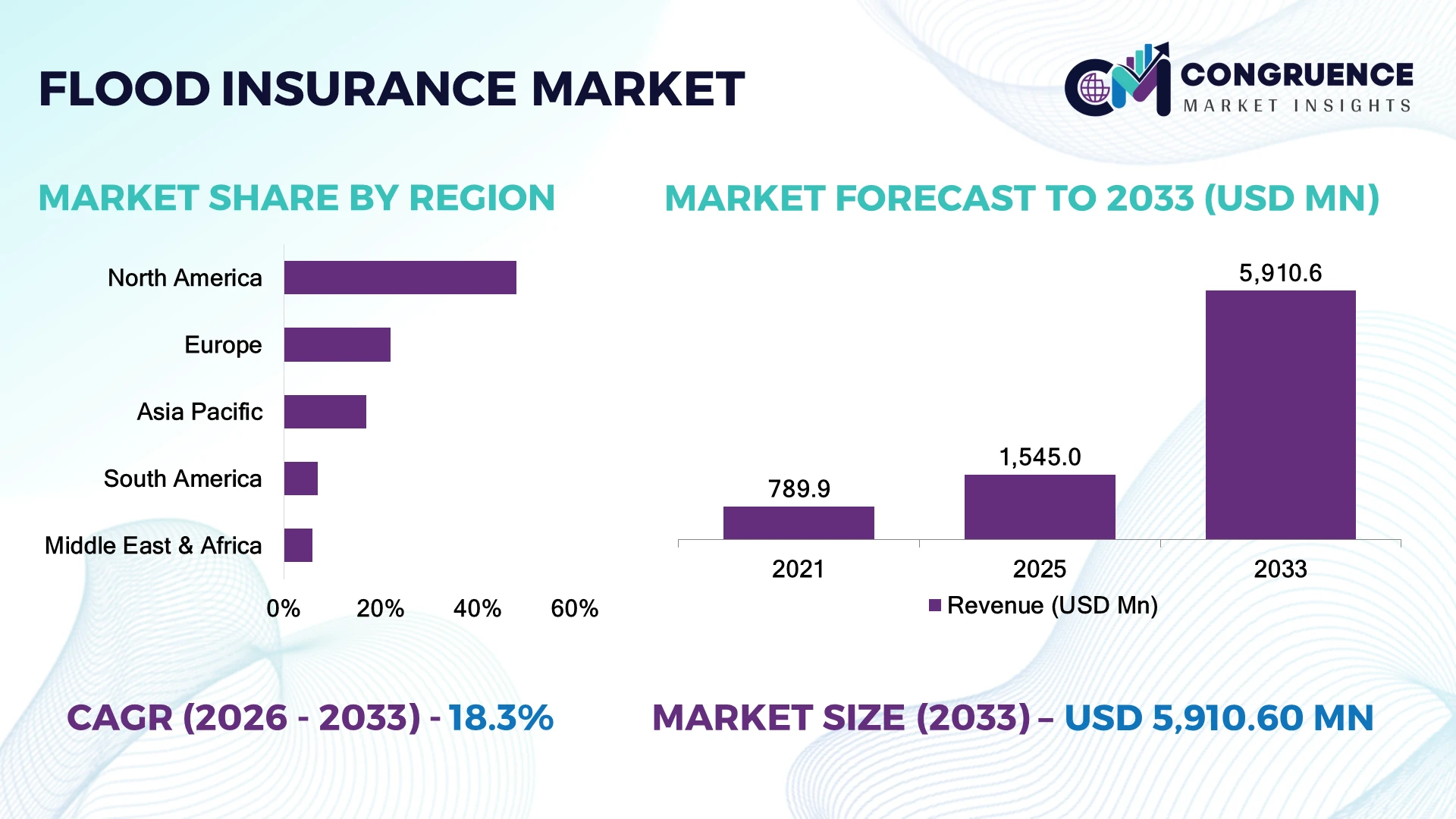
The U.S. remains the dominant country market, accounting for approximately 48% share, supported by extensive residential and commercial exposure, federal flood-insurance programs, and advanced catastrophe modeling. China follows with roughly 11%, backed by infrastructure modernization and expanding digital insurance adoption. U.S. insurers are deploying AI-supported risk assessment faster than emerging markets, strengthening underwriting precision and claims automation.
Strategically, insurers should prioritize AI-enabled risk selection, localized catastrophe models, parametric coverage, and partnerships with governments and infrastructure operators.
Market Size & Growth: USD 1,545.0 Million in 2025 is projected to reach USD 5,910.6 Million by 2033 at 18.26% CAGR, driven by climate-risk analytics and digital underwriting.
Top Growth Drivers: Climate-risk exposure 35%; digital underwriting 28%; regulatory insurance penetration 22%.
Short-Term Forecast: By 2028, automated underwriting is expected to reduce policy-processing costs by 15% and improve assessment efficiency by 25%.
Emerging Technologies: AI catastrophe modeling, satellite-based flood mapping, IoT sensors, and automated claims assessment are reshaping risk evaluation.
Regional Leaders: North America is projected at USD 2.3 Billion, Asia-Pacific at USD 1.7 Billion, and Europe at USD 1.2 Billion, with digital policy issuance accelerating across all three markets.
Consumer/End-User Trends: Digital purchasing and self-service claims adoption is approaching 40% among digitally active policyholders.
Pilot/Case Example: In 2024, AI-assisted flood-risk mapping reduced property-level assessment time by approximately 30%, strengthening automated underwriting workflows.
Competitive Landscape: U.S.-focused leaders hold approximately 20% combined share, with major competition among Allianz, Zurich Insurance, AXA, Munich Re, and Swiss Re.
Regulatory & ESG Impact: Flood-resilience requirements and climate-disclosure frameworks are increasing risk transparency, with ESG-linked underwriting criteria expanding by approximately 18%.
Investment & Funding: More than USD 2 Billion is being directed toward catastrophe analytics, insurtech platforms, climate-risk partnerships, and digital claims infrastructure.
Innovation & Future Outlook: Parametric insurance, real-time flood intelligence, embedded coverage, and AI-driven claims are shifting competition toward speed, precision, and portfolio-level risk optimization.
Flood insurance demand is increasingly concentrated in coastal housing, commercial property, agriculture, infrastructure, and climate-exposed industrial assets. Parametric products are gaining traction, with digital claims adoption exceeding 35% in advanced insurance markets. Regulatory pressure following major flooding events is accelerating insurer investment in automated risk scoring and location intelligence, creating a stronger foundation for strategic differentiation.
Flood insurance is becoming strategically important because insurers are shifting from conventional loss reimbursement toward predictive catastrophe-risk management. Increasing flood exposure, infrastructure modernization, and stricter climate-risk disclosure are changing portfolio construction, pricing discipline, and capital allocation. The shift toward location-specific underwriting is particularly important for insurers operating across highly exposed U.S. coastal states and rapidly urbanizing Asian markets.
Advanced AI-based flood modeling can process large geospatial datasets substantially faster than manual property assessment, reducing underwriting cycle times by approximately 25–30%. Automated claims triage similarly improves processing efficiency by around 20%. In contrast, the U.S. leads in technology deployment and market scale, while India, China, and Southeast Asian markets present stronger opportunities for digital penetration and new policy distribution models.
Over the next 2–3 years, insurers are expected to expand automated underwriting, satellite-based mapping, parametric coverage, and embedded insurance partnerships. A practical deployment model combines IoT flood sensors with geospatial risk scoring to trigger rapid claims validation after an event. Companies are consequently increasing insurtech partnerships and catastrophe-modeling investments. Competitive advantage will increasingly depend on risk precision, claims speed, capital efficiency, and localized resilience solutions.
AI-driven catastrophe modeling is accelerating flood-risk underwriting as insurers process property-level geography, historical inundation, weather, and infrastructure data. Automated risk scoring can reduce assessment time by approximately 30%, while digital claims workflows improve processing efficiency by nearly 20%. The 2024 expansion of satellite-derived flood mapping across the U.S. and European insurance markets is strengthening location-specific underwriting. This shift enables insurers to price exposure more precisely rather than relying heavily on broad geographic classifications. Companies are responding through insurtech partnerships, proprietary geospatial platforms, and investments in predictive analytics. A key operational advantage is the ability to distinguish high-risk properties within otherwise low-risk postal zones, improving portfolio selection and reducing cross-subsidization.
High-loss concentration remains a structural constraint because insurers face severe exposure accumulation across coastal and river-basin properties. In highly exposed U.S. markets, catastrophe-prone portfolios can account for more than 30% of insured property concentration in selected locations, while reinsurance costs can rise by 10–20% following major loss years. Limited flood-risk data in emerging markets further complicates actuarial pricing. Repeated extreme-weather events also pressure underwriting profitability and available capacity. Insurers are responding by diversifying geographic portfolios, tightening accumulation limits, purchasing additional reinsurance, and expanding parametric products. The critical operational issue is balancing affordability with technical pricing: excessive risk repricing can reduce policy penetration precisely where protection gaps are greatest.
Parametric flood insurance creates a strong opportunity by linking payouts to predefined rainfall, water-level, or inundation thresholds rather than lengthy loss-adjustment processes. Automated triggers can reduce claims settlement time by more than 50%, while digital distribution can lower administrative costs by approximately 15%. India, Southeast Asia, and parts of Latin America offer particularly attractive opportunities because conventional flood coverage remains underpenetrated. Satellite imagery, IoT water-level sensors, and blockchain-supported event verification are improving trigger reliability. Insurers are positioning through partnerships with technology providers, banks, governments, and infrastructure operators. The non-obvious opportunity lies in embedding flood protection into mortgages, commercial leases, agricultural finance, and infrastructure contracts rather than selling policies solely through traditional channels.
Scaling advanced flood insurance requires consistent integration of satellite imagery, hydrological models, IoT sensors, property databases, and claims platforms. Data interoperability gaps can increase underwriting processing requirements by 15%, while inconsistent property-level information can reduce automated decision accuracy by 10% or more in fragmented markets. Cybersecurity is also becoming critical as insurers increasingly rely on cloud-based risk platforms and real-time data feeds. In the U.S., Europe, and digitally developing Asian markets, regulatory requirements around model transparency and customer data are becoming more demanding. Companies must invest in API-based infrastructure, secure data architectures, model validation, and specialist analytics talent. Long-term competitiveness will depend on creating interoperable risk ecosystems that deliver consistent pricing and claims decisions across multiple jurisdictions.
AI Underwriting Becomes Operational: Insurers are expanding AI-based flood scoring, satellite mapping, and automated property assessment, cutting underwriting time by 25–30% and improving location-level risk classification by roughly 20%. U.S. carriers are integrating real-time geospatial feeds into policy workflows, shifting investment from manual assessment toward predictive portfolio management.
Parametric Products Gain Traction: Parametric flood products are moving beyond pilots as predefined water-level and rainfall triggers enable claims settlement more than 50% faster than conventional adjustment. Natural-hazard risks already represent about 70% of parametric insurance activity, encouraging insurers in India, Japan, and Southeast Asia to develop partnerships around rapid-payout coverage.
Digital Claims Reshape Workflows: Online policy servicing, automated claims triage, and mobile documentation are becoming standard, with digital claims adoption approaching 40% among digitally active policyholders. The 2025 expansion of electronic insurance portals is reducing administrative handling and improving response speed, while insurers restructure customer-service teams around automation and exception-based claims processing.
Resilience Pricing Gains Momentum: Flood-resistant buildings, water sensors, drainage upgrades, and automated shutoff systems are increasingly influencing underwriting decisions, with prevention-linked pricing initiatives expanding by approximately 15–20%. Regulatory pressure for stronger climate-risk disclosure is accelerating this shift, while insurers increasingly partner with property managers and infrastructure operators to connect mitigation investments with risk-based coverage.
Non-Life Insurance is the leading type in the global flood insurance market, accounting for approximately 72% share in 2025, supported by homeowners, commercial property, agricultural, infrastructure, and business-interruption coverage. Its scalability across physical assets and established underwriting frameworks keeps it well ahead of Life Insurance. Homeowners Flood Insurance alone represents about 42% of policy-type demand, reinforcing the concentration of non-life products around property protection. Life Insurance remains a specialized category, primarily covering flood-related mortality and disability risks.
Flood Reinsurance is the fastest-growing type, as insurers increasingly transfer catastrophe accumulation and extreme-weather exposure to reinsurers and alternative-risk markets. Reinsurance demand is expanding at approximately 9% in active catastrophe-risk markets, while parametric structures are gaining traction because they shorten claims settlement cycles by more than 50%. Companies are responding by expanding reinsurance capacity, integrating catastrophe models, and developing hybrid indemnity-parametric structures. The strategic implication is a shift from conventional property protection toward portfolio-level risk transfer and capital optimization.
Residential is the leading application, representing approximately 55% of the global flood insurance market in 2025. Demand concentration reflects the large number of homeowners exposed to riverine, coastal, and urban flooding, particularly in the U.S., China, and Japan. Business applications remain significant because commercial properties require protection against structural damage, inventory losses, and business interruption. Residential policies typically benefit from standardized underwriting, while commercial coverage requires more customized property and accumulation assessment.
Agricultural Sector is the fastest-growing application, with adoption expanding by approximately 9% as climate variability increases crop and livestock exposure. Agricultural flood coverage is increasingly integrated with digital weather monitoring, satellite imagery, and index-based insurance, reducing assessment requirements by roughly 30%. Landowners and Reinsurers remain strategically important supporting applications, particularly where catastrophe exposure requires broader risk pooling. Companies are expanding agricultural partnerships with banks, governments, and agritech platforms, shifting distribution from traditional agents toward embedded and digitally administered protection.
Homeowners represent the largest end-user group, accounting for approximately 48% of global flood insurance demand in 2025. Their dominance reflects extensive residential exposure and increasing requirements for property protection in flood-prone locations. Property Owners and Real Estate Developers form the next major buyer groups, with demand increasingly tied to mortgage requirements, asset protection, and climate-resilient construction. Homeowners typically favor standardized policies, whereas developers and property owners increasingly demand portfolio-level coverage and location-specific risk assessments.
Insurance Providers are the fastest-growing end-user group, with adoption expanding by approximately 7–8% as carriers strengthen catastrophe-risk capacity and diversify product portfolios. Farmers are also increasing usage as agricultural losses become more closely linked to flood variability, while Real Estate Developers are incorporating flood-risk assessments into project financing and site selection. Companies are responding through customized pricing, broker partnerships, digital distribution, and government-linked risk pools. The key strategic shift is toward ecosystem-based insurance, where insurers collaborate with property developers, lenders, governments, and technology providers to embed flood protection into broader asset-management and financing workflows.
North America accounted for the largest market share at 48% in 2025 however, Asia-Pacific is expected to register the fastest growth, expanding at a CAGR of 21.4% between 2026 and 2033.
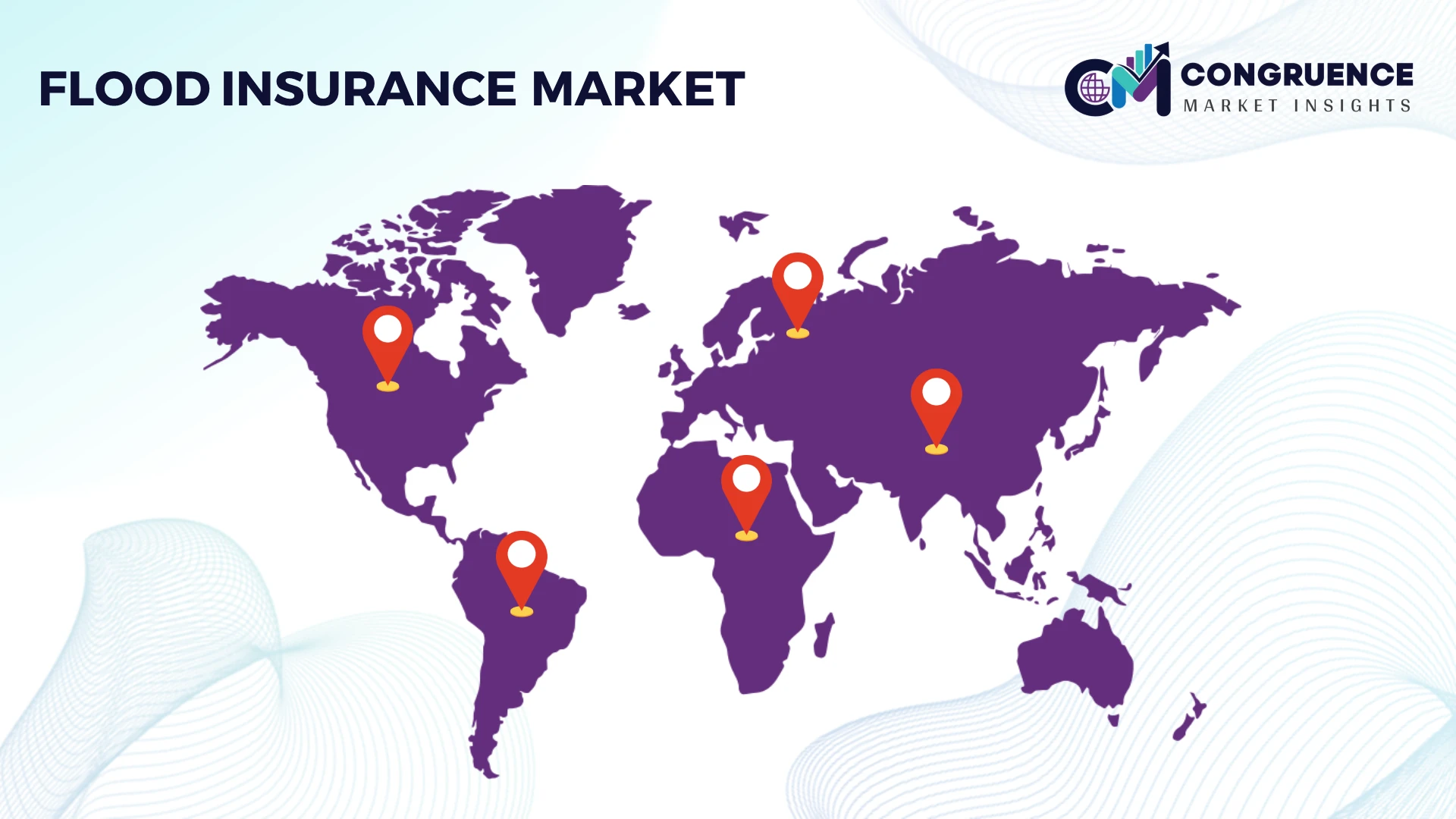
North America holds approximately 48% of the global flood insurance market, led by the United States, where extensive residential exposure, federal insurance mechanisms, catastrophe-modeling infrastructure, and sophisticated reinsurance capacity support market depth. Digital underwriting and geospatial risk assessment are becoming embedded in carrier workflows, with automated property-level analysis reducing assessment time by approximately 25%. Canada adds a smaller but increasingly important demand base as urban flood exposure and municipal resilience planning expand. Insurers are strengthening partnerships with satellite-data providers, catastrophe-modeling firms, and property-technology platforms to improve location-level pricing. The region's competitive advantage increasingly rests on granular risk segmentation rather than policy volume alone, enabling carriers to distinguish flood exposure at individual-property level and allocate capital more selectively.
United States Market Outlook: The United States remains the region's principal market, supported by the National Flood Insurance Program, extensive mortgage-linked property exposure, and advanced catastrophe analytics. More than 20,000 communities participate in federal flood-mapping and mitigation frameworks, creating a broad operational foundation for standardized risk assessment. Private insurers are increasingly complementing federal coverage with customized commercial, residential, and parametric products.
Europe represents approximately 22% of global flood insurance demand, with Germany, France, the United Kingdom, Italy, and the Netherlands forming important national markets. Climate-risk disclosure, flood-resilience investment, and stricter risk governance are pushing insurers toward more granular exposure modeling. Digital claims platforms and automated damage assessment are reducing manual processing requirements by approximately 20–25%. The Netherlands emphasizes structural flood defenses, while Germany and the United Kingdom rely more heavily on property-level risk assessment and insurance mechanisms. European insurers are also integrating climate scenarios into portfolio reviews, encouraging partnerships with analytics providers and infrastructure operators. The strategic shift is toward prevention-linked underwriting, where resilient construction, drainage improvements, and flood defenses increasingly influence policy conditions and risk classification.
Germany Market Outlook: Germany is strategically significant because of its extensive residential and commercial property base and repeated river-flood exposure. Insurers are expanding digital property-risk assessment and catastrophe analytics to improve underwriting precision. Flood-risk mapping covering millions of properties supports differentiated pricing, while growing resilience investment is strengthening collaboration between insurers, municipalities, engineering firms, and property owners.
Asia-Pacific accounts for approximately 17% of the global market but represents the fastest-expanding demand center as China, Japan, India, Australia, and Southeast Asian economies confront dense urban development and recurring flood events. China is increasing digital insurance distribution, while Japan combines sophisticated catastrophe modeling with extensive disaster-preparedness infrastructure. India remains comparatively underpenetrated, creating substantial room for mobile policy distribution and index-based coverage. Digital claims adoption across leading Asian insurance markets is approaching 35–40%, supported by mobile platforms and automated documentation. Insurers are forming partnerships with banks, technology providers, and governments to embed flood coverage into mortgages, agricultural finance, and infrastructure programs. The region's key advantage is the ability to build digital-first insurance ecosystems without relying entirely on legacy distribution networks.
China Market Outlook: China is the region's largest strategic opportunity, supported by extensive urban infrastructure, rapid digital financial-service adoption, and substantial exposure across river basins and coastal cities. Insurers are integrating satellite imagery, weather intelligence, and mobile claims processing into property coverage. Government-backed resilience investment is also creating opportunities for partnerships linking flood protection with infrastructure and urban-development programs.
South America represents approximately 7% of global flood insurance demand, with Brazil accounting for the largest share because of its extensive urban population, commercial property base, agricultural activity, and exposure to riverine and extreme-rainfall events. Argentina, Colombia, Chile, and Peru provide additional opportunities across agriculture, infrastructure, and commercial property. Digital insurance distribution remains less mature than in North America and Europe, but mobile channels are expanding rapidly, with digital policy interaction increasing by roughly 15% in leading markets. Recent extreme-weather events have intensified attention on flood-risk financing and infrastructure resilience. Insurers are responding through partnerships with banks, agricultural platforms, reinsurers, and technology companies. However, uneven flood mapping and insurance penetration remain operational barriers, making localized catastrophe data a significant competitive differentiator.
Brazil Market Outlook: Brazil offers the strongest regional opportunity because of its large agricultural and urban property base and increasing exposure to severe rainfall and flooding. Insurers are expanding digital distribution and risk analytics while strengthening relationships with financial institutions. Agricultural insurance platforms provide an important channel for extending flood-related protection, particularly where traditional property insurance remains limited.
Middle East & Africa accounts for approximately 6% of global flood insurance demand, with the United Arab Emirates, Saudi Arabia, South Africa, and selected North African markets driving premium commercial opportunities. Urban-development projects, transport infrastructure, industrial zones, and climate-resilience programs are creating new insured asset exposure. The Gulf states are investing heavily in drainage, smart-city infrastructure, and climate-adaptation systems, while South Africa remains an important market for residential, commercial, and agricultural protection. Digital claims and automated risk assessment are expanding from a relatively low base, with technology-enabled servicing improving processing efficiency by approximately 20%. Insurers are responding through public-private partnerships, international reinsurance arrangements, and customized infrastructure coverage. The region's strategic opportunity lies in integrating insurance with large-scale resilience and smart-infrastructure projects rather than relying solely on conventional property policies.
United Arab Emirates Market Outlook: The UAE is strategically important because of rapid urban development, high-value commercial assets, and smart-city infrastructure investment. Insurers are increasingly using digital risk assessment and automated claims technologies for complex commercial portfolios. Flood-management upgrades and resilient infrastructure programs create opportunities for insurers to develop customized coverage for airports, logistics facilities, commercial districts, and major development projects.
Global leaders Swiss Re, Munich Re, Allianz, Zurich Insurance, and AXA compete with regional insurers and insurtech specialists such as Chubb and Aon. The top five players collectively control approximately 28% share, indicating a fragmented structure. Competition centers on technology, pricing, capacity, and customization, with AI underwriting improving assessment efficiency 25–30% and digital claims reducing processing time 20–25%. Swiss Re and Munich Re emphasize catastrophe modeling and reinsurance capacity, while Allianz and Zurich expand partnerships and resilience solutions. Chubb differentiates through high-limit private flood coverage, reaching up to USD 15 million per property. The competitive shift is moving from standardized indemnity products toward parametric insurance, geospatial analytics, and embedded coverage. Entry barriers remain high because credible catastrophe models, reinsurance capacity, regulatory approvals, and historical loss datasets require substantial capital and expertise. Winning requires superior risk granularity, rapid claims settlement, scalable partnerships, and customized coverage backed by dependable catastrophe capacity.
Swiss Re
Munich Re
Allianz
Zurich Insurance Group
AXA
Chubb
Aon
Lloyd’s
Berkshire Hathaway
Tokio Marine Holdings
Sompo Holdings
American International Group (AIG)
Artificial intelligence and advanced catastrophe modeling are becoming core underwriting technologies. AI-driven geospatial analysis can reduce property-level assessment time by approximately 25–30%, compared with manual workflows, while satellite-based flood mapping improves exposure classification by around 20%. Adoption is strongest among large U.S. and European carriers integrating real-time weather, terrain, building, and historical-loss datasets into automated pricing engines.
Satellite synthetic-aperture radar, IoT water-level sensors, and digital claims platforms are extending monitoring from periodic assessment to near-real-time event intelligence. Satellite-enabled flood detection can deliver event information within 24 hours, while automated claims triage can reduce administrative processing by approximately 20%. Parametric systems benefit most from these technologies because predefined thresholds enable rapid payout decisions without conventional loss adjustment.
From 2026–2028, embedded insurance APIs, AI-assisted claims, predictive flood scoring, and automated resilience pricing will reshape competitive positioning. Large reinsurers and technology-enabled insurers gain an advantage through proprietary datasets, model validation, and ecosystem partnerships. Companies that integrate underwriting, monitoring, claims, and risk-prevention technologies into one workflow will achieve faster decisions, lower operational friction, and stronger portfolio control.
April 2025 Swiss Re completed Accra’s parametric flood solution, combining excess-rainfall and satellite flood-footprint products after 16 major floods since 1990. The model targets vulnerable communities and enables faster emergency funding. Source: swissre.com
July 2025 Allianz and Jio Financial Services agreed to establish a 50:50 Indian reinsurance joint venture, combining local digital distribution with global underwriting expertise. The structure strengthens domestic capacity and supports broader insurance access across India’s rapidly expanding market. Source: allianz.com
December 2025 Zurich analyzed Valencia’s DANA response, where flooding affected more than 300,000 people and generated over €20 billion in economic losses. Zurich and Spain’s public insurance consortium coordinated claims operations, reinforcing integrated catastrophe-response capabilities. Source: zurich.com
2026 Chubb released its Flood Risk and Resilience Survey covering more than 1,500 homeowners, businesses, agents, and brokers. Findings highlighted persistent awareness and coverage gaps, strengthening Chubb’s focus on specialized flood protection and risk-engineering solutions. Source: chubb.com
The report evaluates the global flood insurance market across Non-Life Insurance, Life Insurance, and Flood Reinsurance, alongside Residential, Business, Agricultural Sector, Landowners, and Reinsurers applications. End-user coverage includes Homeowners, Property Owners, Real Estate Developers, Farmers, and Insurance Providers. Geographic analysis spans North America, Europe, Asia-Pacific, South America, and Middle East & Africa, with country-level assessment of major adoption centers and emerging protection markets.
The scope also examines AI underwriting, satellite flood mapping, catastrophe modeling, parametric insurance, IoT monitoring, automated claims, and digital distribution. Technology-enabled workflows are assessed through measurable efficiency improvements of approximately 20–30%, while competitive analysis covers 12 major market participants. The report supports investment planning, geographic expansion, partnership selection, product positioning, risk-transfer strategy, and technology prioritization through 2026–2033, with particular attention to protection gaps, regulatory evolution, infrastructure resilience, and emerging digital insurance ecosystems.
| Report Attribute / Metric Details | Details |
|---|---|
| Market Revenue (2025) | USD 1,545.0 Million |
| Market Revenue (2033) | USD 5,910.6 Million |
| CAGR (2026–2033) | 18.26% |
| Base Year | 2025 |
| Forecast Period | 2026–2033 |
| Historic Period | 2021–2025 |
| Segments Covered |
By Type
By Application
By End-User
|
| Key Deliverables | Revenue Forecast; Market Trends; Growth Drivers & Restraints; Technology Insights; Segmentation Analysis; Regional Insights; Competitive Landscape; Regulatory & ESG Overview; Recent Developments |
| Regions Covered | North America; Europe; Asia-Pacific; South America; Middle East & Africa |
| Companies Profiled | Swiss Re; Munich Re; Allianz; Zurich Insurance Group; AXA; Chubb; Aon; Lloyd’s; Berkshire Hathaway; Tokio Marine Holdings; Sompo Holdings; American International Group (AIG) |
| Customization & Pricing | Available on Request (10% Customization Free) |




