
Reports
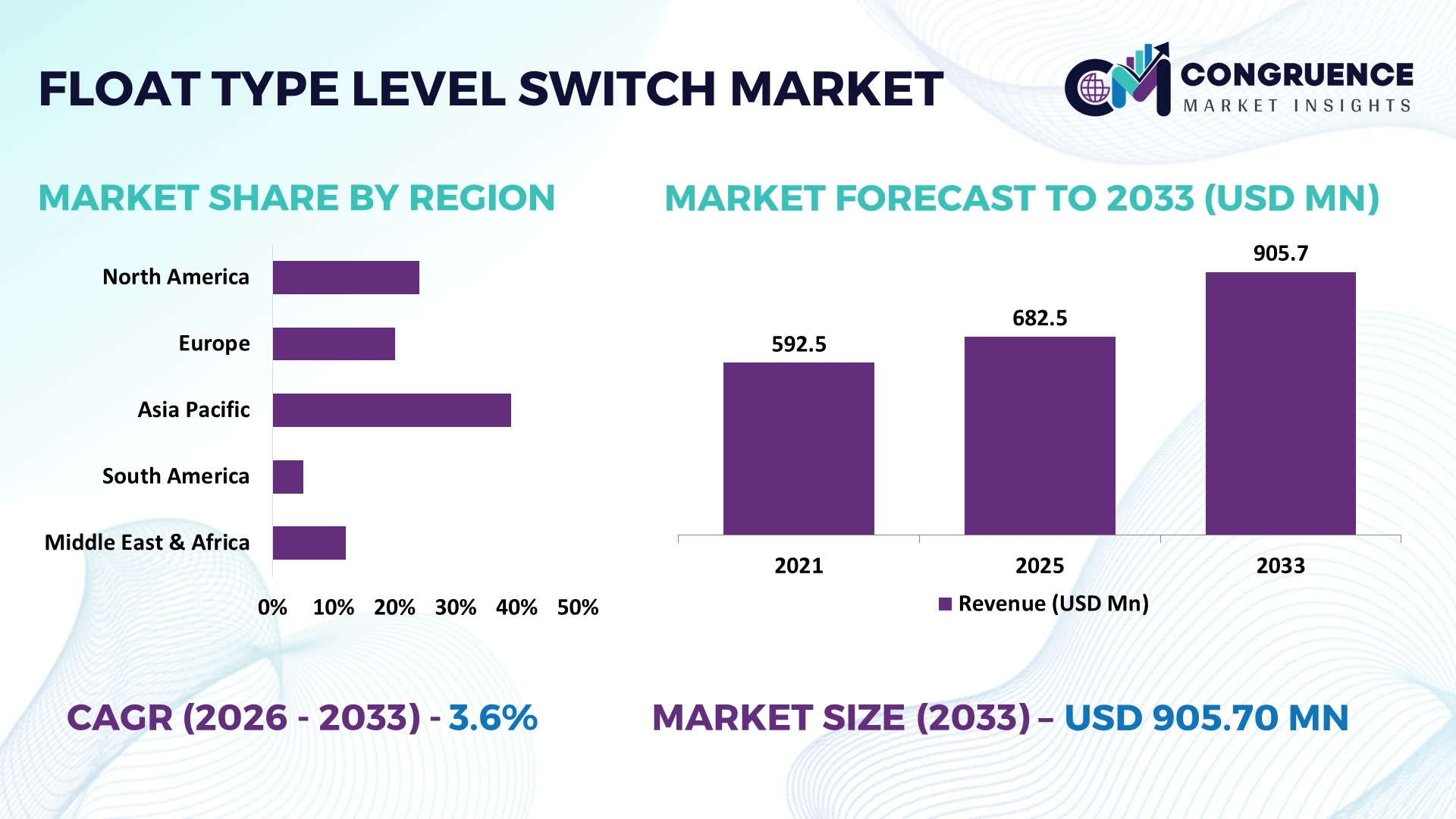
The Global Float Type Level Switch Market was valued at USD 682.5 Million in 2025 and is anticipated to reach a value of USD 905.7 Million by 2033 expanding at a CAGR of 3.6% between 2026 and 2033. Growth is supported by expanding industrial automation, stricter process safety standards, and modernization of liquid level monitoring across oil & gas, water treatment, chemicals, food processing, and power generation facilities.
China remains the dominant manufacturing and deployment hub, accounting for approximately 34% of global production capacity, supported by continuous investments in industrial automation and process manufacturing. Industrial facilities integrating smart monitoring systems exceeded 58% across major sectors in 2026, compared with about 22% in India, where infrastructure modernization is accelerating. Ongoing global supply-chain diversification following Red Sea shipping disruptions has further encouraged regional sourcing strategies and localized component manufacturing.
For industry participants, strengthening regional manufacturing partnerships and expanding smart-compatible product portfolios will be decisive for securing long-term competitive positioning.
Market Size & Growth: USD 682.5 Million in 2025, reaching USD 905.7 Million by 2033 at 3.6% CAGR, supported by industrial automation upgrades and digital process control.
Top Growth Drivers: Industrial automation contributes nearly 41% of new demand, water infrastructure expansion 27%, and chemical processing investments 19%.
Short-Term Forecast: By 2028, maintenance costs decline by approximately 15% as predictive monitoring and automated diagnostics improve operational efficiency.
Emerging Technologies: Smart diagnostics, Industrial IoT integration, and corrosion-resistant engineered materials improve monitoring accuracy by nearly 18%.
Regional Leaders: Asia-Pacific exceeds USD 360 Million, Europe approaches USD 225 Million, and North America surpasses USD 185 Million, driven by smart factory deployment and infrastructure modernization.
Consumer/End-User Trends: More than 61% of new industrial facilities specify intelligent level monitoring for process reliability and safety compliance.
Pilot/Case Example: A 2026 wastewater modernization project improved tank monitoring efficiency by 24% while reducing unplanned maintenance interventions by 18%.
Competitive Landscape: Leading manufacturers collectively control approximately 39% of global market share, with competition centered on advanced sensing, customization, and industrial reliability.
Regulatory & ESG Impact: Process safety and environmental compliance initiatives reduce liquid leakage incidents by approximately 20% while supporting sustainability targets.
Investment & Funding: More than USD 900 Million in manufacturing expansion, partnerships, and automation investments reflects continued regional supply-chain diversification.
Innovation & Future Outlook: Advanced digital compatibility, modular switch designs, and predictive maintenance capabilities strengthen long-term industrial asset management strategies.
Increasing demand for reliable liquid level monitoring across water treatment, chemical processing, marine, and energy facilities continues to reshape the Float Type Level Switch Market. Recent product innovations include corrosion-resistant materials, digital diagnostics, and Industrial IoT compatibility, while intelligent monitoring solutions improve operational reliability by approximately 18%. Ongoing regional manufacturing expansion and stricter industrial compliance requirements further reinforce adoption, setting the foundation for the strategic market assessment that follows.
Float type level switches have become strategically important as manufacturers prioritize reliable process control, lower maintenance costs, and resilient industrial operations across water treatment, chemicals, energy, and food processing. Infrastructure modernization and supply-chain restructuring are accelerating procurement decisions, while stricter equipment reliability standards encourage replacement of aging mechanical monitoring assets. Industrial facilities implementing connected instrumentation now represent more than 57% of newly commissioned process plants, strengthening demand for durable and interoperable level sensing solutions.
Modern float type level switches integrated with Industrial IoT gateways reduce maintenance intervention by approximately 20% compared with conventional standalone units while improving fault detection accuracy by nearly 17%. China continues to lead high-volume manufacturing and deployment through strong industrial automation investments, whereas Germany emphasizes high-precision engineering and smart process integration for specialized industries. During the next two to three years, digital monitoring compatibility is expected to exceed 60% of newly installed industrial liquid-level systems as operators standardize predictive maintenance practices.
A recent wastewater treatment modernization project demonstrated a 22% reduction in manual inspection requirements after replacing legacy level monitoring equipment with intelligent float-based systems. Manufacturers are expanding localized production, strengthening distributor partnerships, and investing in modular product platforms compatible with digital control architectures. Companies that combine application-specific engineering with scalable automation capabilities will secure stronger competitive positioning and sustained operational differentiation.
Industrial operators are accelerating deployment of float type level switches to improve process continuity, equipment protection, and compliance with stricter operating standards. More than 63% of new liquid storage installations now incorporate automated level monitoring, while predictive maintenance programs reduce unexpected equipment failures by approximately 18%. India and China continue expanding water treatment and industrial processing infrastructure, creating sustained procurement opportunities for robust level sensing technologies. This structural transition improves plant availability, lowers manual inspection requirements, and enhances operational safety. In response, manufacturers are expanding production capacity, introducing corrosion-resistant product designs, and forming automation partnerships to deliver integrated monitoring solutions. Companies capable of combining durable mechanical reliability with digital compatibility are strengthening long-term industrial customer relationships and increasing project participation.
Persistent fluctuations in stainless steel, engineering polymers, and magnetic component pricing continue to pressure production economics, with material costs fluctuating by nearly 12% across recent procurement cycles. Approximately 29% of older industrial facilities still rely on legacy control infrastructure that limits seamless integration with modern monitoring platforms. International logistics disruptions and localized sourcing requirements further complicate delivery schedules for specialized components. These structural limitations increase installation costs, extend project timelines, and reduce deployment flexibility for end users operating brownfield facilities. Manufacturers are mitigating risks through supplier diversification, localized assembly operations, and long-term procurement agreements while redesigning products for broader controller compatibility. Operational resilience increasingly depends on flexible supply strategies rather than solely manufacturing scale.
Industrial digitalization is creating significant opportunities for intelligent float type level switches equipped with diagnostics, remote monitoring, and predictive maintenance capabilities. Connected industrial assets have expanded by approximately 21% across advanced manufacturing sites, while automated utility infrastructure projects improve maintenance productivity by nearly 16%. Japan is accelerating smart factory investments, creating demand for compact, high-reliability sensing solutions compatible with advanced control networks. Companies are investing in modular product architectures, digital communication interfaces, and ecosystem partnerships with automation providers to simplify deployment. An emerging opportunity lies in standardized retrofit solutions that modernize existing facilities without complete infrastructure replacement, delivering measurable cost advantages while supporting long-term operational efficiency and lifecycle management.
The principal long-term challenge extends beyond product performance to integrating intelligent level monitoring across complex industrial environments with mixed communication standards and aging infrastructure. Approximately 35% of industrial facilities operate hybrid automation architectures, while skilled instrumentation technicians remain in limited supply across several manufacturing economies. Expanding cybersecurity requirements for connected operational technology also increase engineering complexity during digital upgrades. These execution barriers affect deployment consistency, maintenance quality, and lifecycle performance despite growing automation investment. Companies are responding through advanced engineering services, workforce training initiatives, standardized communication protocols, and strategic collaborations with industrial automation specialists. Organizations that simplify integration while maintaining high reliability will achieve stronger competitive resilience in increasingly connected industrial operations.
• Smart Retrofit Deployment Accelerates Industrial operators are replacing conventional level monitoring devices with retrofit-ready float type level switches compatible with digital control platforms. Nearly 46% of brownfield modernization projects now prioritize plug-and-play instrumentation, reducing installation time by approximately 19% while lowering maintenance interventions by 17%. Aging infrastructure and workforce shortages are accelerating this transition, particularly in Germany and Japan. Manufacturers are expanding retrofit product lines, strengthening automation partnerships, and standardizing communication interfaces to simplify upgrades across existing industrial assets.
• Localized Manufacturing Gains Momentum Supply-chain diversification continues to reshape procurement strategies as manufacturers reduce dependence on single-country sourcing. Around 31% of component procurement has shifted toward regional supplier networks, while localized assembly shortens lead times by nearly 22%. Continued logistics disruptions and industrial resilience initiatives encourage dual-sourcing strategies. Companies are investing in regional production facilities, qualifying multiple component suppliers, and expanding inventory management capabilities to improve delivery reliability and reduce operational disruptions.
• Material Engineering Improves Lifecycle Demand is increasing for float switches using advanced stainless steel alloys and engineered polymers capable of extending operating life in corrosive environments. Field performance improvements exceed 20%, while replacement frequency declines by roughly 15% in chemical processing applications. The non-obvious trend is lifecycle optimization becoming a purchasing criterion alongside acquisition cost. Manufacturers are increasing investment in application-specific material engineering and durability testing to strengthen long-term customer retention.
• Compliance-Driven Product Standardization Industrial safety and environmental compliance requirements are encouraging broader adoption of standardized level monitoring equipment. More than 54% of newly specified industrial liquid storage systems now require certified process instrumentation, reducing inspection complexity by approximately 16%. Water infrastructure upgrades and stricter operational audits are reinforcing this trend. Companies are expanding certified product portfolios, improving documentation support, and collaborating with engineering contractors to secure larger infrastructure and industrial automation projects.
Vertical Float remains the dominant segment, accounting for approximately 43% of total deployments due to its compact installation profile, reliable switching performance, and compatibility with storage tanks across water, chemical, and industrial applications. Its lower maintenance requirements and straightforward integration into existing control systems continue to support large-scale procurement. Horizontal Float maintains strong relevance for side-mounted installations where vessel geometry limits vertical access, while Cable Float remains widely used in wastewater pits and reservoirs because of installation flexibility.
Magnetic Float represents the fastest-growing segment as industries increasingly require higher switching precision and compatibility with automated control architectures. Adoption of magnetic designs has expanded by nearly 18% in newly automated processing facilities, while corrosion-resistant configurations improve equipment service life by approximately 16%. Manufacturers are prioritizing advanced magnetic assemblies, customized switching configurations, and application-specific product portfolios while strengthening engineering partnerships. Investment priorities are gradually shifting toward intelligent, precision-oriented products that support industrial digitalization without sacrificing proven mechanical reliability.
Water Treatment accounts for approximately 38% of application demand because continuous liquid monitoring is essential for pumping stations, filtration systems, reservoirs, and wastewater processing facilities. Expanding municipal infrastructure and stricter operational compliance requirements continue to sustain deployment volumes. Chemical Processing follows closely through increased demand for corrosion-resistant sensing equipment, while Oil Storage applications emphasize operational safety, spill prevention, and reliable inventory management under challenging operating conditions.
Food & Beverage is the fastest-growing application segment as manufacturers modernize hygienic production lines and automated cleaning systems. Smart process integration has increased adoption by approximately 19%, while automated level control reduces manual intervention by nearly 17%. Companies are expanding sector-specific product offerings with food-grade materials, improved sealing technologies, and digital compatibility. Demand is increasingly shifting toward application-engineered solutions that balance regulatory compliance, operational reliability, and simplified maintenance across diverse processing environments.
Water & Wastewater remains the largest end-user segment with approximately 36% of total demand, supported by continuous infrastructure upgrades, treatment plant expansion, and essential operational monitoring requirements. High deployment intensity, extensive storage infrastructure, and mandatory process reliability sustain purchasing activity. Chemical manufacturers remain major buyers due to hazardous fluid handling requirements, while Oil & Gas operators prioritize dependable level monitoring to enhance storage safety and operational continuity across upstream and downstream facilities.
Power Generation represents the fastest-growing end-user category as utilities modernize auxiliary systems and improve plant automation. Intelligent monitoring deployments have increased by nearly 18%, while automated liquid management improves maintenance efficiency by approximately 15%. Food & Beverage producers continue adopting hygienic float switch solutions as production automation expands. Manufacturers are responding through customized industry portfolios, long-term service agreements, and strategic partnerships with industrial automation providers, enabling stronger customer retention while addressing increasingly specialized operational requirements.
Asia-Pacific accounted for the largest market share at 38% in 2025 however, Middle East & Africa is expected to register the fastest growth, expanding at a CAGR of 4.8% between 2026 and 2033.

Industrial automation upgrades reshape precision monitoring adoption
North America represents approximately 27% of the global Float Type Level Switch Market, supported by advanced manufacturing facilities, water infrastructure modernization, and automated process industries. The United States contributes the majority of regional demand through chemical plants, wastewater networks, and energy facilities requiring dependable liquid monitoring systems. Nearly 62% of newly upgraded industrial facilities integrate automated level control solutions to improve operational reliability. Supply-chain localization initiatives are encouraging domestic component sourcing and reducing equipment delivery delays. Manufacturers are strengthening partnerships with automation providers and expanding customized solutions for regulated industries. The region’s competitive advantage comes from technology integration, aftermarket support, and high-value industrial applications rather than volume production.
United States Market Outlook:
The United States remains the strategic hub due to its large installed industrial base and modernization programs across manufacturing and utilities. More than 55% of major water infrastructure projects incorporate automated monitoring components, supporting demand for reliable float-based sensing solutions. Domestic suppliers are focusing on smart-compatible designs and rapid customization capabilities.
Compliance-led modernization drives precision instrumentation demand
Europe contributes nearly 23% of global market adoption, supported by strict industrial safety standards, process automation investments, and energy-efficiency initiatives. Germany, Italy, and France represent major deployment centers due to strong chemical, food processing, and manufacturing ecosystems. Approximately 59% of industrial automation upgrades in advanced European facilities include improved liquid monitoring technologies. Environmental regulations and operational efficiency targets are accelerating replacement of outdated monitoring systems. Manufacturers are investing in corrosion-resistant materials, engineering partnerships, and application-specific solutions to meet demanding industrial requirements. The market is increasingly influenced by lifecycle cost optimization rather than initial equipment pricing.
Germany Market Outlook:
Germany maintains leadership through its advanced engineering sector, industrial automation expertise, and high concentration of process manufacturing companies. Around 64% of large manufacturing facilities use automated process monitoring systems, creating strong demand for reliable and integration-ready float type level switches.
Manufacturing scale and infrastructure expansion accelerate deployment
Asia-Pacific dominates the Float Type Level Switch Market with approximately 38% share, driven by manufacturing expansion, water infrastructure development, and industrial automation adoption. China, Japan, South Korea, and India represent key demand centers with extensive chemical, electronics, and process manufacturing operations. China contributes nearly 34% of global production capacity through established component supply networks and industrial manufacturing strength. More than 60% of new industrial facilities in major Asian manufacturing hubs incorporate automated monitoring equipment. Companies are expanding local production, improving export capabilities, and developing cost-efficient product platforms to serve diverse industrial requirements. The region’s advantage combines manufacturing scale with rapidly increasing automation adoption.
China Market Outlook:
China remains the largest country-level contributor due to extensive manufacturing infrastructure and strong industrial automation investment. Over 70% of newly developed process manufacturing facilities in major industrial clusters incorporate automated control systems, supporting demand for scalable and cost-effective float switch solutions.
Infrastructure modernization creates targeted industrial opportunities
South America accounts for nearly 7% of global market deployment, supported by mining, water management, food processing, and energy sector applications. Brazil and Chile represent key markets due to industrial infrastructure requirements and resource-based industries. Approximately 42% of large industrial operators are upgrading monitoring systems to improve reliability and reduce manual inspection dependency. However, uneven infrastructure investment and imported component dependency continue influencing procurement decisions. Companies are responding through regional distribution partnerships, localized service networks, and application-focused product offerings. Demand is concentrated around industries requiring durable equipment capable of operating in challenging environments.
Brazil Market Outlook:
Brazil leads regional demand through its extensive industrial base, agricultural processing activities, and water management requirements. Nearly 45% of large industrial facilities are increasing automation adoption, encouraging suppliers to expand technical support networks and customized sensing solutions.
Infrastructure investment and industrial diversification reshape demand
Middle East & Africa is emerging as a high-potential market supported by water infrastructure projects, oil storage expansion, and industrial diversification initiatives. The region contributes approximately 5% of global demand but shows strong adoption momentum through large-scale infrastructure modernization. Saudi Arabia, the UAE, and South Africa are major deployment centers, with water management projects representing a significant application area. Automated monitoring adoption has increased by nearly 20% across newly commissioned utility facilities. Companies are expanding regional partnerships, improving supply availability, and developing solutions suited for harsh operating environments. Investment in smart infrastructure is creating opportunities beyond traditional oil and gas applications.
Saudi Arabia Market Outlook:
Saudi Arabia is strengthening market demand through water security projects, industrial expansion, and automation-focused infrastructure programs. More than 50% of major utility modernization projects incorporate automated monitoring systems, encouraging suppliers to establish stronger regional service capabilities and strategic partnerships.
The Float Type Level Switch Market features competition between global instrumentation leaders such as Emerson, Schneider Electric, and Siemens against specialized sensing manufacturers including WIKA and Gems Sensors. Global OEMs compete through advanced technology integration, industrial partnerships, and broad distribution networks, while regional players compete through customization, pricing flexibility, and faster delivery. The top five companies collectively account for approximately 42% of market participation, creating a moderately consolidated structure. Competition is shaped by product reliability, customization capability, supply-chain efficiency, and compatibility with automation systems. Companies investing in smart interfaces improve deployment efficiency by nearly 18%, while localized manufacturing reduces delivery timelines by approximately 20%. Players are expanding through regional production, automation collaborations, and application-specific innovation. The key competitive shift is moving from standalone mechanical reliability toward integrated industrial monitoring solutions. Winning companies will combine cost control, engineering expertise, and scalable digital compatibility.
Emerson Electric Co.
Siemens AG
Schneider Electric SE
ABB Ltd.
Endress+Hauser Group
WIKA Alexander Wiegand SE & Co. KG
Yokogawa Electric Corporation
Honeywell International Inc.
GEMS Sensors & Controls
SICK AG
KROHNE Messtechnik GmbH
VEGA Grieshaber KG
Magnetrol International
AMETEK Inc.
Current float type level switch technologies are advancing through smart integration, improved materials, and automation compatibility. Magnetic coupling, corrosion-resistant alloys, and digital interfaces improve operational reliability by 15–20% compared with conventional mechanical designs. Around 55% of new industrial installations increasingly prioritize connected monitoring capabilities, helping operators reduce manual inspections and improve asset visibility.
Emerging technologies focus on Industrial IoT connectivity, predictive diagnostics, and hybrid sensing architectures. Connected float switches integrated with plant control systems improve maintenance efficiency by nearly 18% and reduce troubleshooting time by 12%. Advanced manufacturers benefit through customized solutions, while industries such as water treatment and chemicals gain better process stability and lower downtime exposure.
Disruptive innovation between 2026 and 2028 will center on intelligent retrofit solutions and automated asset management. New-generation systems deliver approximately 20% better monitoring performance than older standalone switches through real-time data integration. Companies combining reliable float mechanisms with digital platforms, cybersecurity features, and scalable automation will gain competitive advantage as industrial facilities accelerate modernization.
October 2025 Emerson launched the Rosemount 3408 Wireless Level Transmitter with WirelessHART connectivity, reducing installation complexity through wireless monitoring. The solution improves remote asset visibility across industrial applications and supports safer operations through continuous measurement capabilities. Source: Emerson
June 2025 Endress+Hauser Level+Pressure received the TOP 100 innovation award for systematic innovation management. The company highlighted AI-supported development processes and advanced product design approaches, strengthening engineering capabilities and sustainable instrumentation strategies. Source: Endress+Hauser
November 2025 Emerson introduced the Rosemount 2405 Monitoring Hub integrating communication and data concentration features. The platform supports multi-tank inventory monitoring, improving operational insights and reducing complexity for industrial storage management applications. Source: Emerson
December 2025 Endress+Hauser expanded innovation initiatives focused on eco-design and circularity across instrumentation products. New electronics and housing approaches targeted material savings and lower environmental impact while maintaining measurement reliability for industrial users. Source: Endress+Hauser
The Float Type Level Switch Market Report covers comprehensive segmentation across Vertical Float, Horizontal Float, Cable Float, and Magnetic Float technologies, with analysis across Water Treatment, Chemical Processing, Oil Storage, and Food & Beverage applications. The report evaluates adoption patterns among Water & Wastewater, Chemical, Oil & Gas, Food & Beverage, and Power Generation end-users.
The study includes regional assessment across North America, Europe, Asia-Pacific, South America, and Middle East & Africa, focusing on deployment trends, technology integration, competitive positioning, and industrial modernization. It highlights automation adoption, smart monitoring capabilities, material innovation, and retrofit opportunities, supporting investment planning, expansion decisions, partnership strategies, and competitive positioning from 2026 to 2033.
| Report Attribute/Metric | Report Details |
|---|---|
Market Revenue in 2025 | USD 682.5 Million |
Market Revenue in 2033 | USD 905.7 Million |
CAGR (2026 - 2033) | 3.6% |
Base Year | 2025 |
Forecast Period | 2026 - 2033 |
Historic Period | 2021 - 2025 |
Segments Covered | By Type
By Application
By End-User
|
Key Report Deliverable | Revenue Forecast, Growth Trends, Market Dynamics, Segmental Overview, Regional and Country-wise Analysis, Competition Landscape |
Region Covered | North America, Europe, Asia-Pacific, South America, Middle East, Africa |
Key Players Analyzed | Emerson Electric Co., Siemens AG, Schneider Electric SE, ABB Ltd., Endress+Hauser Group, WIKA Alexander Wiegand SE & Co. KG, Yokogawa Electric Corporation, Honeywell International Inc., GEMS Sensors & Controls, SICK AG, KROHNE Messtechnik GmbH, VEGA Grieshaber KG, Magnetrol International, AMETEK Inc. |
Customization & Pricing | Available on Request (10% Customization is Free) |




