
Reports
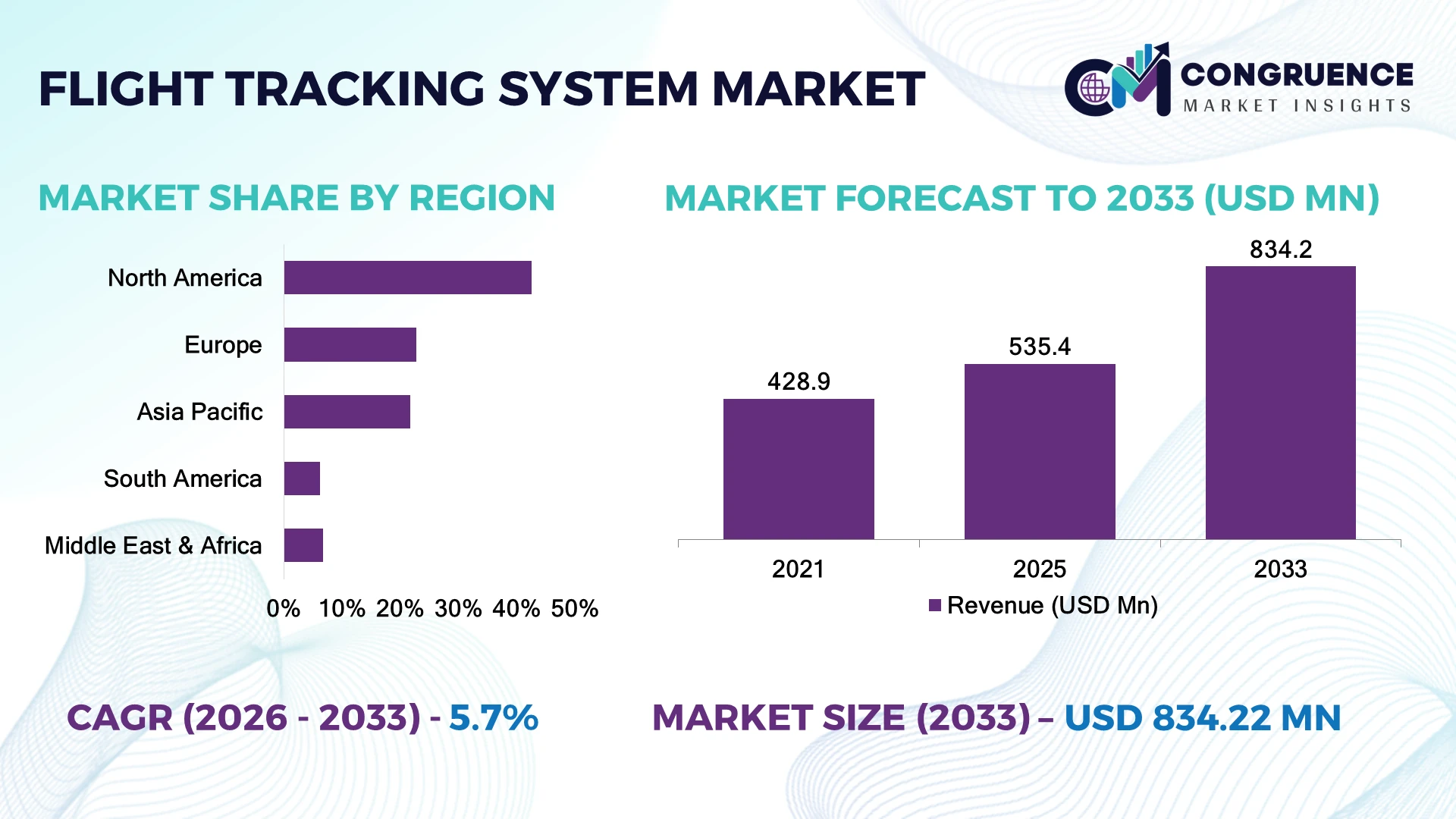
The Global Flight Tracking System Market was valued at USD 535.4 Million in 2025 and is anticipated to reach a value of USD 834.2 Million by 2033 expanding at a CAGR of 5.7% between 2026 and 2033. Growth is being driven by mandatory aircraft tracking requirements, wider ADS-B adoption, satellite-enabled oceanic coverage, and airline investment in real-time operational control.
The United States remains the dominant country, supported by a large commercial aviation fleet, advanced air-traffic infrastructure, and extensive ADS-B deployment, with more than 90% of active civil aircraft equipped for ADS-B surveillance. Its aviation technology investment base substantially exceeds that of individual European markets, while satellite connectivity is expanding tracking continuity across remote routes. Geopolitical disruptions in the Red Sea and Eastern Europe are reinforcing demand for continuous aircraft visibility and route monitoring.
Strategically, suppliers that combine terrestrial, satellite, and predictive tracking capabilities are best positioned to capture airline and aviation-authority modernization budgets.
Market Size & Growth: USD 535.4 million in 2025 to USD 834.2 million by 2033 at 5.7% CAGR, driven by satellite-enabled tracking and aviation safety modernization.
Top Growth Drivers: ADS-B adoption at 35%, satellite connectivity at 28%, and airline operational digitization at 22% are key demand contributors.
Short-Term Forecast: By 2028, automated tracking workflows are positioned to reduce manual monitoring requirements by 20% and improve incident-response efficiency by approximately 15%.
Emerging Technologies: AI-based anomaly detection, satellite ADS-B, and predictive flight analytics are advancing real-time visibility, with automated analytics adoption approaching 30% among digitally mature operators.
Regional Leaders: North America is projected at USD 290 million, Europe at USD 220 million, and Asia-Pacific at USD 180 million by 2033, with Asia-Pacific recording the strongest fleet-digitization momentum.
Consumer/End-User Trends: More than 60% of digitally enabled airline operations increasingly use real-time aircraft-position data for scheduling, disruption management, or passenger-information workflows.
Pilot/Case Example: In 2024–2025, AI-assisted flight-monitoring workflows demonstrated approximately 15% faster anomaly identification, strengthening operational response and reducing dependence on manual flight-status reconciliation.
Competitive Landscape: Established aviation technology providers retain roughly 35% combined positioning, competing through ADS-B integration, satellite coverage, API connectivity, predictive analytics, and airline-platform integration.
Regulatory & ESG Impact: Global tracking mandates and enhanced surveillance requirements are pushing compliance coverage above 90% across equipped commercial fleets while improving route visibility and operational efficiency.
Investment & Funding: Aviation digitalization programs increasingly direct multimillion-dollar investments toward satellite connectivity, cloud infrastructure, cybersecurity, and automated operational-control platforms.
Innovation & Future Outlook: Next-generation systems will combine satellite tracking, AI-based trajectory prediction, digital twins, and automated alerts, shifting competition from basic location reporting toward integrated operational intelligence.
The Flight Tracking System Market is increasingly shaped by airlines, airports, air-navigation providers, military organizations, and aviation-data platforms seeking continuous aircraft visibility. Demand is strongest for systems combining ADS-B, satellite tracking, radar feeds, and cloud APIs, while AI-enabled anomaly detection is gaining traction across digitally mature fleets. More than 60% of large airline operations now incorporate real-time aircraft data into at least one operational workflow. Satellite connectivity is also becoming strategically important as airlines expand over polar, oceanic, and geopolitically sensitive routes, making uninterrupted tracking a core aviation infrastructure capability.
Flight tracking systems are becoming strategic aviation infrastructure because airlines increasingly depend on continuous aircraft-position data for safety management, disruption response, fleet utilization, and passenger communication. The shift from periodic position reporting toward continuous surveillance is changing procurement priorities, particularly as satellite-based tracking extends visibility beyond conventional radar coverage. By 2028, integrated tracking platforms are positioned to increase automated operational monitoring by approximately 20%.
Technology differentiation is also widening. Conventional radar-dependent monitoring provides strong coverage near established aviation corridors, whereas combined ADS-B, satellite, and cloud architectures provide broader geographic continuity and integrate multiple data streams. Automated anomaly detection can reduce manual monitoring workload by roughly 15–20%, giving digitally mature airlines a measurable operational advantage. North America remains infrastructure-intensive, while Asia-Pacific is accelerating fleet modernization and digital aviation deployment.
Airlines are increasingly integrating tracking data with flight-operations centers, maintenance systems, crew-management platforms, and passenger-information applications. A practical deployment model combines ADS-B with satellite coverage for oceanic routes, then applies predictive analytics to identify deviations and abnormal flight behavior. Between 2026 and 2028, investment priorities will increasingly favor interoperable platforms rather than standalone trackers. Competitive advantage will depend on coverage continuity, data accuracy, cybersecurity, API integration, and the ability to convert aircraft-position data into actionable operational intelligence.
Mandatory aircraft-position reporting and wider satellite connectivity are accelerating continuous tracking adoption across commercial aviation. More than 90% of U.S. civil aircraft are equipped with ADS-B, while satellite-based surveillance is extending coverage across oceanic and remote corridors where terrestrial infrastructure remains limited. Airline operational-control centers increasingly combine ADS-B, radar, and satellite feeds, improving position visibility by approximately 20% and reducing manual monitoring workloads by 15%. Geopolitical disruptions around the Red Sea and Eastern Europe are strengthening demand for uninterrupted route visibility. Flight-tracking providers are responding through satellite partnerships, cloud-based data platforms, and multi-source tracking architectures. The strategic shift is from standalone location reporting toward integrated operational intelligence, making data continuity a procurement priority for airlines and aviation authorities.
Legacy radar networks, incompatible data standards, and uneven satellite coverage continue to constrain seamless flight-tracking deployment. Approximately 25% of aviation operators still depend on multiple disconnected surveillance feeds, increasing integration workload and creating duplicate data-processing requirements. Hardware, connectivity, and certification expenses can account for 15–20% of implementation budgets, particularly for smaller carriers operating mixed fleets. Remote routes across parts of Africa, South America, and Asia remain more dependent on satellite connectivity, raising recurring service costs. These constraints directly affect deployment speed and interoperability. Providers are mitigating exposure through open APIs, modular tracking architectures, multi-vendor contracts, and hybrid terrestrial-satellite configurations. The strongest operational pressure is no longer basic aircraft visibility but maintaining consistent, validated data across heterogeneous aviation systems.
The strongest opportunity is shifting from tracking aircraft to predicting operational events before they disrupt schedules. AI-based trajectory analytics can improve anomaly-detection speed by approximately 20%, while automated alerting can reduce manual flight-monitoring activity by 15–25%. India, Southeast Asia, and Middle Eastern aviation hubs are particularly attractive as fleet expansion intersects with rapid air-traffic digitalization. Integration with digital twins, weather intelligence, maintenance platforms, and airport-management systems creates additional value beyond conventional position feeds. Companies are investing in machine-learning models, cloud APIs, and satellite partnerships to build subscription-based operational intelligence services. A non-obvious opportunity lies in converting historical trajectory data into predictive maintenance and fuel-efficiency insights, allowing tracking providers to capture higher-value enterprise workflows rather than competing solely on data coverage.
Flight tracking platforms face increasing execution complexity as airlines connect surveillance feeds with flight-operations, maintenance, crew, airport, and passenger-information systems. Integration projects can involve 20% or more of implementation effort, while cybersecurity controls increasingly account for 10–15% of technology deployment budgets. Spoofing, signal manipulation, corrupted feeds, and inconsistent timestamps can compromise operational decisions when multiple sources are reconciled automatically. The pressure is intensifying as cloud-based architectures expand across airline environments. Companies must strengthen encryption, authentication, anomaly validation, redundancy, and real-time data-quality monitoring while maintaining low-latency performance. Strategic winners will invest in interoperable architectures and continuous security validation rather than treating cybersecurity as a separate compliance layer. Reliable cross-system data integrity will determine whether advanced tracking platforms achieve sustained enterprise adoption.
Satellite Coverage Is Expanding Satellite-based aircraft surveillance is moving beyond oceanic operations, with adoption increasing across remote and geopolitically sensitive routes. More than 30% of advanced tracking deployments now incorporate satellite feeds alongside ADS-B or radar. Airlines are investing in multi-source architectures to maintain continuity during terrestrial coverage gaps, reducing operational blind spots and strengthening disruption response.
AI Monitoring Is Accelerating Automated anomaly detection is moving into airline operations centers, where machine-learning models process trajectory, weather, and schedule data simultaneously. Adoption among digitally mature operators is approaching 30%, while automated alerting can reduce manual monitoring workload by 15–20%. Providers are integrating predictive analytics into cloud platforms rather than selling standalone tracking dashboards.
APIs Are Reshaping Integration Open aviation-data APIs are replacing isolated tracking interfaces as airlines connect aircraft-position feeds with maintenance, crew, airport, and passenger systems. Approximately 40% of new enterprise deployments prioritize API interoperability, reducing duplicate data handling by roughly 15%. Technology providers are responding with modular architectures that support multiple surveillance sources without forcing complete system replacement.
Resilience Is Becoming Strategic Supply-chain disruptions, route changes, and geopolitical events are increasing the value of continuous aircraft visibility. Approximately 20% of enterprise procurement priorities now emphasize redundancy and failover capabilities alongside tracking accuracy. Airlines are combining terrestrial, satellite, and cloud infrastructure to maintain operational continuity, while providers are strengthening geographically distributed processing and backup connectivity.
ADS-B Leads as Satellite Tracking Accelerates
Automatic Dependent Surveillance–Broadcast (ADS-B) remains the leading technology type, estimated at approximately 46% of the global flight tracking system market in 2025, supported by broad aircraft equipage, standardized surveillance protocols, and comparatively low operating costs. Ground-based ADS-B holds the largest installed footprint, while satellite-based ADS-B is the fastest-growing type as airlines and air navigation service providers close oceanic and remote-area visibility gaps. Multilateration and radar-based tracking remain strategically relevant where dense airport coverage, redundancy, and independent surveillance are priorities. Companies are increasingly combining terrestrial ADS-B, satellite feeds, MLAT, and radar rather than replacing one technology with another, improving coverage resilience by an estimated 15–20%.
The investment shift is therefore moving toward multi-source tracking architectures. Satellite-enabled systems are gaining roughly 8–10 percentage points in deployment intensity across remote operations, while integrated platforms increasingly prioritize API connectivity and real-time analytics. Suppliers are responding through satellite partnerships, cloud integration, and upgraded surveillance-data products, making interoperability and continuous coverage decisive purchasing criteria.
EUROCONTROL reported ADS-B v2 equipage of 97.2% of aircraft and 99.1% of flights in its monitored European network by July 2026, reinforcing ADS-B's position as the operational foundation for modern surveillance.
Operational Visibility Shifts Toward Real-Time Fleet Control
Airline and fleet operations represent the leading application, accounting for approximately 43% of market demand in 2025, because carriers require continuous aircraft location, ETA monitoring, disruption management, and operational control across geographically dispersed fleets. Passenger-facing flight status remains a mature application, while air traffic management and safety-critical tracking are expanding faster as regulators and operators prioritize continuous situational awareness. Fleet operations increasingly integrate tracking feeds with dispatch, crew, maintenance, and disruption-management systems, reducing manual coordination requirements by an estimated 15–18%.
Air traffic management represents the fastest-growing application segment, driven by integration of ADS-B, multilateration, satellite surveillance, and predictive analytics into network-management workflows. Adoption of automated operational data exchange is increasing by roughly 10–12% among digitally mature airport environments. Companies are responding by developing API-based platforms, expanding airport integrations, and combining surveillance data with predictive analytics, shifting investment from basic visualization toward operational decision support and automated disruption response.
EUROCONTROL's 2025 ECRA deployment connected 109 airports and 72 airlines, delivering a 30% increase in departure predictability, a potential 30% reduction in ATFM delay, and a 50% reduction in flight suspensions.
Airlines Anchor Demand as ANSP Adoption Broadens
Airlines constitute the dominant end-user group, representing approximately 48% of global flight tracking system demand in 2025, reflecting large fleet sizes, continuous operational requirements, and direct exposure to delays, diversions, fuel inefficiencies, and passenger disruption. Air navigation service providers are the fastest-growing end-user segment as surveillance modernization shifts from localized radar infrastructure toward integrated ADS-B and satellite-based architectures. Airline deployments increasingly connect tracking data with operations control centers, while ANSP procurement emphasizes coverage, resilience, interoperability, and regulatory compliance.
Airport operators, government agencies, and defense organizations retain important niche demand, particularly where airspace monitoring and security requirements justify dedicated surveillance infrastructure. ANSP adoption is estimated to be expanding at 9–11% in digitally modernized markets, compared with roughly 6–7% for mature airline tracking environments. Suppliers are targeting this shift through long-term service contracts, customized surveillance platforms, cloud integration, and partnerships with aviation technology providers. The competitive advantage is moving toward vendors capable of serving both airline workflows and institutional airspace-management requirements.
ICAO defines aircraft tracking under GADSS around automated four-dimensional position reporting at intervals of 15 minutes or less, establishing a clear operational benchmark for airline tracking capability and safety-oriented procurement.
North America accounted for the largest market share at 42.6% in 2025 however, Asia-Pacific is expected to register the fastest growth, expanding at a CAGR of 7.4% between 2026 and 2033.

Real-Time Surveillance Is Becoming Core Operational Infrastructure
North America maintains the strongest Flight Tracking System market position, supported by extensive ADS-B infrastructure, high airline fleet digitization, and mature air traffic management systems. The United States remains the regional deployment center, with approximately 173,589 civil aircraft equipped with ADS-B as of 2026, including more than 7,100 air-carrier aircraft. The FAA's integration of ADS-B into traffic separation and surveillance is shifting investment toward multi-source tracking, predictive analytics, and operational data integration. Commercial operators increasingly connect tracking feeds with dispatch, maintenance, and disruption-management platforms, strengthening demand for interoperable systems. The region's strategic advantage lies less in basic aircraft visibility and more in converting high-frequency surveillance data into measurable operational decisions.
United States Market Outlook: The United States represents the region's most advanced operational environment, combining nationwide ADS-B infrastructure with airline, airport, and air-navigation integration. More than 7,100 equipped U.S. air-carrier aircraft demonstrate the depth of operational adoption. The country's dense aviation ecosystem supports continued investment in real-time tracking, surveillance analytics, automated traffic management, and predictive operational systems.
Integrated Network Management Is Reshaping Tracking Deployment
Europe is shifting Flight Tracking Systems from standalone visibility tools toward integrated network-management infrastructure. The European aviation network handled approximately 11.1 million flights in 2025, increasing the operational value of accurate aircraft-position and departure information. Network-level digital initiatives have connected more than 100 airports and dozens of airlines while improving departure predictability by approximately 30%. This environment favors suppliers offering interoperable surveillance, airport integration, predictive ETA capabilities, and network-level analytics rather than basic tracking displays. Regulatory emphasis on continuous surveillance and operational coordination further supports investment in ADS-B, multilateration, satellite tracking, and centralized data platforms. Airlines and airports are increasingly prioritizing systems that convert tracking information into automated traffic-flow, disruption-management, and resource-allocation decisions.
Germany Market Outlook: Germany combines high-density commercial aviation, advanced airport infrastructure, and sophisticated air traffic management requirements, making it a strategically important European market for tracking technologies. Frankfurt remains one of Europe's busiest aviation hubs, with roughly 1,260 daily arrivals and departures during 2025. This operating density strengthens demand for high-availability tracking, surface surveillance, predictive disruption management, and integration between airline and airport systems.
Large Fleets and Indigenous Surveillance Drive Deployment
Asia-Pacific is becoming the most strategically dynamic Flight Tracking System market as large commercial fleets, expanding airport networks, and national surveillance modernization converge. China has established a particularly advanced policy framework requiring continuous tracking of civil airliners and targeting global surveillance using ADS-B, satellite communications, and BeiDou-enabled technologies. Japan, India, South Korea, Singapore, and Australia are similarly prioritizing surveillance interoperability and digital air-traffic infrastructure. The region's competitive advantage is its combination of fleet scale and technology localization, while emerging markets increasingly bypass legacy-only architectures. Suppliers are expanding cloud platforms, satellite connectivity, and analytics partnerships to address geographically dispersed operations. Investment priorities are shifting toward hybrid tracking architectures capable of maintaining visibility across dense urban corridors, oceanic routes, and remote airspace.
China Market Outlook: China represents the region's strongest strategic market because of its large airline fleet, indigenous navigation capabilities, and government-backed aircraft surveillance architecture. Its tracking framework targets position reporting at intervals of 15 minutes or shorter and integrates secondary radar, ADS-B, satellite communications, and BeiDou technologies. This creates a strong domestic ecosystem for surveillance equipment, tracking software, data exchange, and aviation analytics while supporting China's broader aerospace technology strategy.
Coverage Expansion Is Moving Beyond Conventional Radar
South America's Flight Tracking System market is being shaped by geographically dispersed airspace, long-haul routes, remote territories, and uneven surveillance infrastructure. Brazil represents the principal deployment center because of its extensive airspace and sophisticated air-navigation requirements, while Argentina, Chile, Colombia, and Peru continue strengthening digital surveillance capabilities. ADS-B and satellite-enabled tracking are particularly valuable where conventional radar coverage is economically difficult to extend. The business opportunity is concentrated in hybrid architectures combining terrestrial surveillance with satellite feeds rather than wholesale replacement of existing systems. Airlines and air-navigation authorities are increasingly prioritizing interoperable platforms that consolidate aircraft position, flight-plan, and operational data. Suppliers are responding with modular deployments and service-based contracts that reduce infrastructure requirements while expanding coverage.
Brazil Market Outlook: Brazil offers the strongest South American operating base because of its extensive airspace, major airline networks, and established air-navigation infrastructure. Its geographic scale makes continuous aircraft visibility strategically important across areas where radar deployment is less practical. The market favors hybrid surveillance architectures combining ADS-B, radar, satellite connectivity, and centralized traffic-management platforms, creating opportunities for vendors capable of integrating multiple data sources without requiring complete replacement of existing systems.
Airspace Modernization Is Increasing Demand for Resilient Tracking
Middle East & Africa demand is increasingly tied to high-density international aviation corridors, airport expansion, airspace modernization, and the need for resilient surveillance. Gulf aviation hubs are particularly important because concentrated international traffic increases the operational value of precise aircraft tracking and automated traffic coordination. The region also faces positioning-reliability pressures: the UAE temporarily suspended its ADS-B OUT mandate in 2025 following GPS interference and jamming concerns. This development reinforced the need for multi-source tracking architectures rather than GPS-dependent systems alone. Suppliers are consequently emphasizing radar integration, resilient positioning, satellite connectivity, and redundancy. Gulf operators are also prioritizing high-availability platforms capable of supporting dense international traffic while maintaining continuity during navigation-system disruptions.
United Arab Emirates Market Outlook: The UAE is the region's strongest commercial aviation technology market, supported by major international hubs, dense airspace activity, and advanced air-navigation infrastructure. Its regulatory framework requires ADS-B OUT for IFR operations in controlled UAE airspace, while contingency procedures address equipment failures and positioning disruptions. This combination of mandatory surveillance and resilience requirements favors vendors offering redundant positioning, radar integration, satellite connectivity, and high-availability flight tracking platforms.
Flight tracking competition centers on FlightAware, Flightradar24, Cirium, SITA, and satellite-surveillance providers, with airline platforms competing against specialized data aggregators. The top five are estimated to control about 55% collectively. Accuracy influences 35% of purchasing decisions, while coverage and integration affect roughly 30% each. Global leaders compete on data depth and network scale; regional suppliers differentiate through customization and lower implementation costs. Satellite specialists increasingly challenge terrestrial-only providers across oceanic and polar routes. Players are expanding receiver networks, integrating radar, ADS-B, MLAT and satellite feeds, and signing multi-year airline or ANSP contracts. The competitive shift favors vertically integrated data ecosystems and predictive analytics, raising entry barriers through proprietary datasets, certification, infrastructure, and workflow integration. Price pressure remains strongest in basic tracking, while premium operational intelligence commands differentiation. Winning requires resilient global coverage, low-latency data, rapid deployment, certified interoperability, and analytics that directly improve airline and air-navigation decisions at scale consistently.
FlightAware
Flightradar24
Cirium
SITA
Aireon
Collins Aerospace
Thales
Honeywell International
Garmin
Frequentis
NAVBLUE
Saab
Rohde & Schwarz
Gogo Business Aviation
Flight Tracking Systems are shifting from single-source ADS-B toward multi-stream architectures combining terrestrial ADS-B, satellite ADS-B, MLAT, radar, ACARS, and flight-plan data. Satellite integration eliminates major oceanic and polar visibility gaps, while multi-source fusion improves positional resilience by an estimated 15–20%. By 2026, enterprise-grade platforms increasingly combine real-time tracking with predictive ETA and weather intelligence, strengthening operational decision speed.
Machine-learning prediction is becoming the highest-value software layer. Predictive ETA systems can improve arrival forecasting by approximately 10–15% compared with conventional schedule-based estimates, while automated anomaly detection can reduce manual monitoring workload by roughly 20%. Cloud APIs, edge processing, and integrated operations-control interfaces are accelerating adoption among airlines and airports, shifting spending from visualization toward decision automation.
Between 2026 and 2028, AI-driven trajectory prediction, satellite surveillance, GNSS-resilient positioning, and digital-tower integration will define competitive differentiation. Satellite-enabled systems benefit operators flying remote routes, while terrestrial networks retain cost advantages in dense coverage zones. Companies deploying hybrid architectures gain stronger continuity, faster disruption response, and broader data monetization opportunities. The strategic priority is integrating diverse surveillance feeds into one operational intelligence layer.
July 2024 SITA deployed Mission Watch across seven AirAsia airlines covering over 200 aircraft and 130 destinations, creating a unified 4D/15 tracking environment and improving coordination between dispatchers and pilots. Source: sita.aero
August 2025 Collins Aerospace began providing FlightAware Foresight predictive tracking technology to JetBlue, using real-time analytics to improve operational visibility, delay management, and decision-making across airline operations. Source: rtx.com
February 2026 Flightradar24 integrated Aireon space-based ADS-B data into its platform, complementing more than 55,000 terrestrial receivers and extending real-time tracking across previously underserved oceanic and remote areas. Source: flightradar24.com
May 2026 Iridium announced its agreement to acquire Aireon, whose surveillance system tracks approximately 190,000 flights daily and provides global coverage, strengthening vertical integration between satellite infrastructure and aviation surveillance services. Source: sec.gov
The Flight Tracking System Market Report covers technology segmentation across ADS-B, satellite-based tracking, multilateration, radar-supported systems, and integrated multi-source platforms. Application analysis includes airline operations, air traffic management, airport operations, flight safety, passenger information, and fleet monitoring. End-user coverage evaluates airlines, air navigation service providers, airports, government agencies, defense organizations, and business aviation operators.
The report examines North America, Europe, Asia-Pacific, South America, and Middle East & Africa, with country-level assessment of deployment intensity, surveillance modernization, infrastructure maturity, and regulatory requirements. It evaluates emerging technologies including satellite ADS-B, AI-driven predictive ETA, MLAT, GNSS-resilient tracking, cloud APIs, and real-time operational analytics. More than 10 major market participants are assessed for technology positioning and strategic activity, supporting investment planning, geographic expansion, partnership selection, competitive positioning, and technology priorities through 2033.
| Report Attribute/Metric | Report Details |
|---|---|
|
Market Revenue in 2025 |
USD 535.4 Million |
|
Market Revenue in 2033 |
USD 834.2 Million |
|
CAGR (2026 - 2033) |
5.7% |
|
Base Year |
2025 |
|
Forecast Period |
2026 - 2033 |
|
Historic Period |
2021 - 2025 |
|
Segments Covered |
By Type
By Application
By End-User
|
|
Key Report Deliverable |
Revenue Forecast, Growth Trends, Market Dynamics, Segmental Overview, Regional and Country-wise Analysis, Competition Landscape |
|
Region Covered |
North America, Europe, Asia-Pacific, South America, Middle East, Africa |
|
Key Players Analyzed |
FlightAware, Flightradar24, Cirium, SITA, Aireon, Collins Aerospace, Thales, Honeywell International, Garmin, Frequentis, NAVBLUE, Saab, Rohde & Schwarz, Gogo Business Aviation |
|
Customization & Pricing |
Available on Request (10% Customization is Free) |




