
Reports
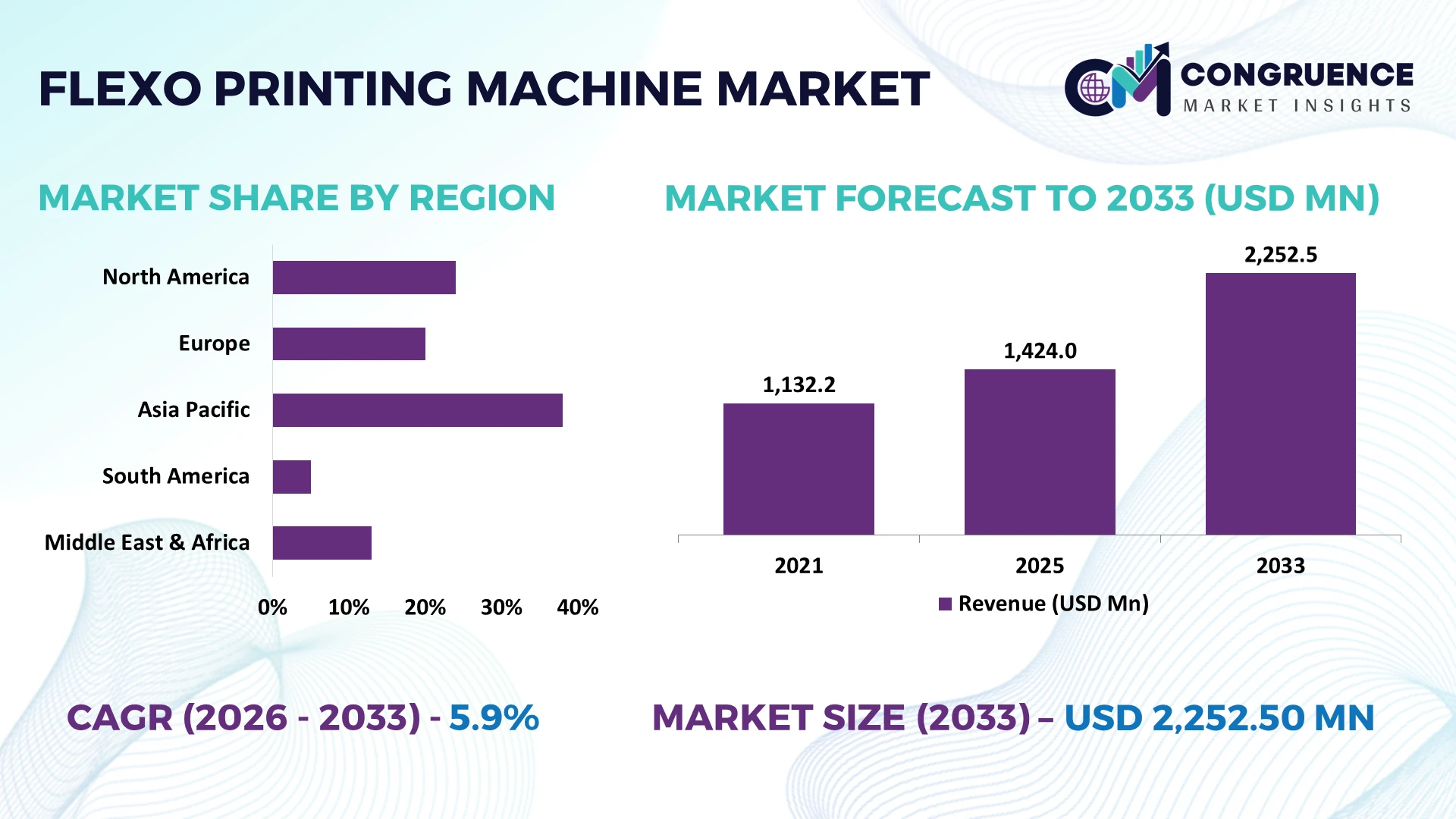
The Global Flexo Printing Machine Market was valued at USD 1424 Million in 2025 and is anticipated to reach a value of USD 2252.5 Million by 2033 expanding at a CAGR of 5.9% between 2026 and 2033. Growth is being accelerated by high-speed servo-driven automation, rising flexible packaging production, and wider deployment of digital workflow integration across food, pharmaceutical, and consumer goods printing operations.
China remains the dominant manufacturing and consumption hub, accounting for approximately 34% of global production capacity, supported by continuous investments in advanced packaging facilities and export-oriented converting industries. More than 58% of newly installed commercial flexographic lines in leading Chinese plants incorporate automated register control and inspection systems, while India records faster installation growth driven by expanding packaged food manufacturing and production-linked industrial initiatives. Trade realignment following Red Sea logistics disruptions has further encouraged regional manufacturing diversification.
Manufacturers investing in automated, energy-efficient, and digitally connected flexo printing platforms are strengthening production resilience while securing long-term competitive positioning across global packaging value chains.
Market Size & Growth: USD 1424 Million in 2025, projected to reach USD 2252.5 Million by 2033 at 5.9% CAGR, supported by advanced packaging automation and flexible substrate demand.
Top Growth Drivers: Servo automation improves productivity by 22%, eco-friendly ink adoption exceeds 35%, and flexible packaging output expands by over 8% annually.
Short-Term Forecast: By 2028, automated press setup reduces changeover time by 28% while overall printing efficiency increases by 20%.
Emerging Technologies: AI-assisted inspection, IoT-enabled predictive maintenance, and cloud-based workflow integration reduce downtime by nearly 18% across advanced production facilities.
Regional Leaders: Asia Pacific approaches USD 980 Million, Europe exceeds USD 610 Million, and North America reaches nearly USD 470 Million, supported by regional manufacturing expansion and packaging modernization.
Consumer/End-User Trends: More than 62% of packaging converters prioritize high-speed flexographic systems for shorter production cycles and improved print consistency.
Pilot/Case Example: During 2026, a smart packaging conversion project achieved 24% faster throughput and reduced material waste by 17% using automated inspection technology.
Competitive Landscape: The leading manufacturer holds approximately 14% global share, with competition driven by Bobst, Windmöller & Hölscher, Mark Andy, Nilpeter, and Comexi.
Regulatory & ESG Impact: Low-VOC printing technologies and energy-efficient systems reduce operational emissions by approximately 19% while supporting evolving sustainability compliance.
Investment & Funding: More than USD 780 Million in manufacturing expansion, strategic partnerships, and automation upgrades reflects continued supply chain regionalization.
Innovation & Future Outlook: Next-generation hybrid flexographic platforms, AI-driven quality control, and fully connected production ecosystems strengthen long-term operational competitiveness.
Increasing investments in sustainable flexible packaging, high-speed label production, and smart converting lines continue to reshape the Flexo Printing Machine Market. Manufacturers are integrating AI-based inspection, automated color management, and energy-efficient drying systems, improving production consistency by nearly 20%. Supply-chain localization and stricter packaging sustainability requirements are accelerating equipment modernization, creating a stronger foundation for strategic investments, technology upgrades, and competitive manufacturing expansion.
The Flexo Printing Machine Market has become strategically important as packaging manufacturers prioritize production flexibility, shorter lead times, and lower operating costs to strengthen competitiveness. Supply-chain restructuring following recent global logistics disruptions has accelerated localized converting capacity, while stricter packaging sustainability standards are encouraging replacement of older printing assets with automated, energy-efficient equipment. These structural shifts are influencing investment priorities across food, pharmaceutical, and industrial packaging value chains.
Modern servo-driven flexographic presses deliver approximately 25% faster setup and reduce material waste by nearly 18% compared with conventional gear-driven systems, improving overall equipment utilization and print consistency. China continues to lead large-scale manufacturing deployment through integrated packaging clusters, whereas Germany focuses on precision engineering, digital workflow integration, and high-value specialty printing. Over the next two to three years, automated inspection and predictive maintenance adoption is expected to exceed 60% among newly commissioned industrial production lines.
A leading packaging converter upgrading to AI-enabled inspection, automatic register control, and cloud-connected production monitoring can reduce unplanned downtime by around 15% while improving production traceability. In response, equipment manufacturers are expanding strategic partnerships with automation providers, increasing localized service networks, and investing in intelligent press platforms, reinforcing long-term operational resilience and competitive differentiation.
The accelerating transition toward automated flexible packaging production remains the strongest structural driver for the Flexo Printing Machine Market. More than 55% of newly installed industrial presses incorporate servo automation, while automated inspection systems improve print quality consistency by approximately 20% and reduce setup time by nearly 25%. India's expanding food processing industry and China's advanced packaging manufacturing ecosystem continue to stimulate high-volume equipment deployment. Increasing environmental compliance requirements are also encouraging adoption of low-waste printing technologies. In response, manufacturers are expanding production facilities, investing in intelligent press platforms, and partnering with software providers to integrate AI-driven workflow management, creating measurable productivity gains and stronger operational competitiveness across commercial printing operations.
High capital investment requirements and continued dependence on specialized motion-control components remain significant structural limitations. Advanced servo systems and precision control electronics account for nearly 30% of total equipment costs, while imported automation components can extend delivery schedules by 15–20% during supply disruptions. European machinery builders have also experienced procurement challenges for selected electronic assemblies, affecting production planning and installation timelines. These pressures directly influence investment decisions for small and mid-sized converters. To reduce operational risk, manufacturers are increasing localized sourcing, negotiating long-term supplier agreements, standardizing component platforms, and expanding regional assembly capabilities to improve supply continuity and stabilize production costs.
The strongest emerging opportunity lies in fully connected production ecosystems combining AI, machine vision, and predictive maintenance. Intelligent production monitoring can reduce maintenance interventions by approximately 22%, while cloud-enabled workflow platforms improve equipment utilization by nearly 18%. Japan is advancing high-precision automation technologies, and India's packaging manufacturing investments are creating demand for digitally connected converting facilities. Sustainability initiatives promoting lower substrate waste and energy optimization further strengthen technology adoption. Equipment suppliers are expanding R&D programs, collaborating with industrial software developers, and introducing modular upgrade packages, enabling converters to modernize existing production assets without complete equipment replacement while strengthening long-term operational efficiency.
Long-term market expansion depends on successful integration of advanced automation with existing production environments. Nearly 40% of printing facilities require workforce upskilling before implementing intelligent production systems, while integrating legacy equipment with modern digital platforms can increase project implementation time by approximately 20%. Germany and the United States continue investing in industrial workforce development to support advanced manufacturing transformation. Inconsistent data interoperability between equipment vendors also limits production visibility and operational optimization. Companies must strengthen technical training, adopt standardized communication protocols, expand cybersecurity capabilities, and build strategic technology partnerships to achieve scalable digital manufacturing while maintaining production reliability and long-term competitive performance.
AI-Driven Print Quality Control Automated vision inspection and AI-assisted defect detection are becoming standard across new flexographic installations, with adoption exceeding 48% in high-volume packaging facilities. Intelligent inspection reduces print rejection by nearly 20% and shortens quality verification time by approximately 30%. Labor shortages and increasing compliance requirements are accelerating deployment, particularly in Germany and Japan. Equipment suppliers are expanding software partnerships and integrating cloud-connected analytics into new press platforms to improve production consistency and lower operating costs.
Localized Manufacturing Expansion Strategies Global supply-chain restructuring has encouraged converters to diversify production footprints, with localized sourcing increasing by nearly 25% since recent logistics disruptions. India and Mexico are attracting new converting investments due to manufacturing incentives and expanding consumer packaging demand. Shorter component supply cycles improve equipment availability by approximately 15%, while regional service hubs reduce maintenance response times. Machinery manufacturers are strengthening local assembly operations, expanding technical support networks, and forming regional distribution alliances to improve customer responsiveness.
Energy-Efficient Press Modernization Packaging producers are replacing conventional drying technologies with energy-efficient UV LED and servo-controlled systems that reduce electricity consumption by approximately 18% while increasing production uptime by nearly 12%. Stricter environmental regulations and corporate sustainability commitments are accelerating modernization programs. A less obvious outcome is improved substrate compatibility, allowing converters to process thinner recyclable films without sacrificing print stability. Manufacturers continue investing in modular retrofit solutions to extend equipment life while reducing modernization costs.
Hybrid Digital Workflow Integration Production facilities increasingly combine flexographic presses with digital prepress automation and cloud-based production management, with integrated workflow adoption surpassing 40% among large converters. Automated scheduling improves machine utilization by approximately 16%, while digital job management reduces setup delays by nearly 22%. China is accelerating deployment through intelligent manufacturing initiatives, while European converters emphasize production traceability. Equipment vendors are introducing open-platform architectures and collaborative automation ecosystems to simplify multi-vendor integration and improve long-term operational flexibility.
Central Impression (CI) presses remain the dominant segment, accounting for approximately 44% of global installations due to superior print registration, high-speed production capability, and efficient processing of flexible packaging substrates. Their centralized impression cylinder delivers consistent print quality while reducing substrate distortion by nearly 18%, making CI systems the preferred choice for food and pharmaceutical packaging. Stack presses continue serving cost-sensitive production environments, while Inline presses remain relevant for specialized multi-process applications requiring finishing integration.
Narrow Web presses represent the fastest-growing segment, supported by expanding demand for premium labels and shorter production runs, with annual installation growth exceeding 10% in several industrial markets. Wide Web systems continue supporting high-volume flexible packaging operations, particularly across China and India, where manufacturing capacity continues expanding. Equipment suppliers are prioritizing servo automation, modular configurations, and digital inspection capabilities across all press categories while increasing partnerships with automation specialists. Investment priorities increasingly favor scalable platforms capable of supporting multiple substrates, faster job changeovers, and higher production flexibility.
Flexible Packaging remains the leading application, representing approximately 52% of total equipment demand because of sustained production requirements across food, personal care, pharmaceutical, and household product packaging. Modern flexographic presses improve throughput by nearly 20% while supporting recyclable film structures and lightweight packaging formats. Labels & Tags form the fastest-growing application as brand owners increase SKU diversification, traceability requirements, and premium product differentiation through shorter production cycles.
Corrugated Packaging continues expanding alongside e-commerce logistics, while Folding Cartons strengthen demand for premium retail packaging requiring high-quality graphics. Paper Printing remains strategically important for commercial and industrial applications but represents a comparatively mature deployment segment. Converters are investing in automated finishing, AI-based inspection, and integrated workflow systems to improve operational efficiency and reduce production waste. Equipment manufacturers are expanding application-specific press portfolios and strengthening customer partnerships to address changing packaging formats and increasingly complex production requirements.
Packaging Companies remain the largest end-user group, accounting for approximately 49% of total equipment deployment because of continuous production requirements across consumer goods, food processing, and healthcare packaging. Their large-scale converting operations benefit from automated press technologies capable of improving production efficiency by nearly 22% while reducing material waste by approximately 15%. Pharmaceutical Companies represent the fastest-growing buyer segment as serialization, compliance printing, and product traceability requirements expand investment in precision printing systems.
Label Converters continue increasing equipment purchases to address growing demand for customized packaging and shorter production runs. Printing Service Providers remain important for diversified commercial production, while Food & Beverage Manufacturers increasingly invest in in-house packaging capabilities to strengthen supply-chain control. Equipment suppliers are responding through customized automation packages, lifecycle service agreements, localized technical support, and collaborative development partnerships that improve customer retention and strengthen long-term competitive positioning across industrial packaging ecosystems.
Asia-Pacific accounted for the largest market share at 42.8% in 2025 however, Middle East & Africa is expected to register the fastest growth, expanding at a 7.4% between 2026 and 2033.
Advanced Automation Strengthens Packaging Production
North America represents approximately 24% of global market demand, supported by extensive flexible packaging capacity, advanced converting infrastructure, and rapid adoption of intelligent manufacturing technologies. The United States and Canada continue replacing legacy presses with servo-driven systems, automated inspection platforms, and cloud-enabled production management to improve throughput and reduce operational waste. More than 60% of newly installed industrial presses integrate digital workflow capabilities, while equipment modernization programs improve production efficiency by nearly 18%. Strategic partnerships between machinery manufacturers and packaging converters continue expanding localized technical services, predictive maintenance offerings, and operator training programs. Demand remains strongest across food, pharmaceutical, and consumer goods packaging, where production consistency and regulatory compliance directly influence investment priorities and long-term operational competitiveness.
United States Market Outlook: The United States remains the region's operational leader due to its extensive packaging manufacturing base, advanced automation adoption, and continuous capital investment in high-performance converting equipment. Nearly 65% of large packaging facilities operate automated press monitoring and digital quality management systems, enabling shorter production cycles and improved print accuracy. Manufacturers continue expanding service centers, investing in AI-assisted inspection technologies, and strengthening partnerships with packaging enterprises to improve productivity while supporting sustainable packaging initiatives.
Sustainability and Precision Manufacturing Drive Modernization
Europe contributes nearly 27% of global deployment, supported by advanced engineering capabilities, strict environmental regulations, and continuous modernization of packaging production facilities. Manufacturers increasingly deploy energy-efficient UV LED curing, intelligent color management, and automated register control to reduce operating costs and improve print consistency. More than 55% of industrial equipment upgrades incorporate digital workflow integration, while sustainable substrate compatibility has become a key procurement requirement. Collaborative innovation between machinery builders, packaging companies, and industrial automation providers is accelerating the deployment of next-generation flexographic systems. Premium food, pharmaceutical, and personal care packaging applications continue driving investment across technologically advanced production hubs.
Germany Market Outlook: Germany leads European innovation through precision engineering, strong machinery manufacturing expertise, and advanced industrial automation. Over 62% of newly commissioned premium flexographic systems include predictive maintenance and intelligent production monitoring capabilities. German manufacturers continue investing in modular equipment platforms, robotics integration, and collaborative technology development, strengthening export competitiveness while supporting highly automated packaging production environments.
Manufacturing Scale and Export Capacity Accelerate Deployment
Asia-Pacific remains the largest regional market, accounting for approximately 42.8% of global demand through its extensive packaging manufacturing ecosystem and expanding industrial infrastructure. China, India, Japan, and Southeast Asian manufacturing hubs continue increasing investments in automated converting facilities to support consumer goods, pharmaceutical, and export-oriented packaging production. Nearly 58% of new industrial installations integrate automated inspection and servo-controlled technologies, while localized equipment manufacturing reduces procurement lead times by approximately 20%. Export expansion, industrial policy support, and growing packaging consumption continue strengthening production capacity. Equipment suppliers are increasing regional manufacturing footprints, technical service capabilities, and localized product customization to address rapidly evolving converter requirements.
China Market Outlook: China maintains the strongest market position through large-scale manufacturing capacity, integrated packaging supply chains, and continuous industrial automation investments. Approximately 34% of global flexographic production capacity is concentrated within the country, supported by intelligent manufacturing initiatives and export-focused converting operations. Domestic manufacturers continue expanding advanced equipment production, strengthening automation partnerships, and increasing digital manufacturing capabilities to improve global competitiveness.
Packaging Modernization Supports Industrial Expansion
South America accounts for approximately 7% of global market activity, with packaging modernization and food processing investments driving equipment demand. Brazil, Argentina, and Chile continue upgrading converting facilities to improve production efficiency and packaging quality. Automated production technologies have increased by nearly 16% across major industrial converters, although infrastructure limitations and imported equipment dependency continue affecting deployment speed. Manufacturers are responding through regional distribution partnerships, expanded technical support, and localized maintenance capabilities to improve equipment availability. Industrial packaging, agricultural exports, and consumer goods production remain the primary demand generators, supporting gradual modernization across commercial printing operations.
Brazil Market Outlook: Brazil represents the region's largest operational market due to its diversified food processing sector, expanding consumer packaging industry, and established converting infrastructure. More than half of industrial packaging investments target production automation and waste reduction initiatives. Equipment suppliers continue strengthening local partnerships, expanding aftermarket services, and introducing flexible financing models to accelerate adoption among medium-sized packaging manufacturers.
Industrial Investment Expands Packaging Infrastructure
The Middle East & Africa market is undergoing steady transformation through industrial diversification, manufacturing localization, and packaging infrastructure expansion. Food processing, pharmaceutical manufacturing, and consumer goods production are increasing demand for advanced printing equipment across major industrial economies. Approximately 18% of recently commissioned packaging facilities include automated flexographic production lines, reflecting growing investment in efficient converting operations. Government-backed industrial development programs and logistics corridor expansion continue supporting localized manufacturing capacity. Equipment manufacturers are strengthening regional partnerships, establishing technical service networks, and introducing energy-efficient press technologies to improve operational reliability while addressing evolving packaging quality requirements.
Saudi Arabia Market Outlook: Saudi Arabia leads regional investment through industrial diversification initiatives, expanding food manufacturing, and advanced packaging infrastructure development. Industrial zones continue attracting packaging equipment suppliers, while automated converting capacity has increased by approximately 20% during recent modernization programs. Companies are prioritizing localized manufacturing partnerships, workforce development, and digital production technologies to strengthen domestic packaging capabilities and reduce dependence on imported finished products.
The competitive landscape is led by Bobst, Windmöller & Hölscher, Mark Andy, Nilpeter, Comexi, and OMET, with global technology leaders competing against regional machinery manufacturers on automation, productivity, and lifecycle service capabilities. The top five players collectively control approximately 48% of the market, while regional manufacturers compete aggressively through cost-efficient equipment and localized support. Technology-driven suppliers differentiate with AI-enabled inspection, reducing setup time by nearly 25% and improving print consistency by about 20%. Cost-focused competitors emphasize faster delivery and localized manufacturing to shorten lead times by approximately 15%. Competition increasingly centers on automation partnerships, modular equipment platforms, digital workflow integration, and vertical service expansion rather than pricing alone. Higher engineering complexity, precision manufacturing requirements, and established global service networks create significant entry barriers. Winning requires intelligent automation, dependable aftermarket support, scalable customization, resilient supply-chain execution, and continuous innovation that delivers measurable operational improvements for industrial packaging converters.
Bobst
Windmöller & Hölscher
Mark Andy
Nilpeter
Comexi
OMET
UTECO Group
PCMC (Paper Converting Machine Company)
Edale
Koenig & Bauer
Weifang Donghang Graphic Technology
Zhejiang Guangchuan Machinery
Taiyo Kikai Ltd.
XIAN AEROSPACE-HUAYANG PRINTING & PACKAGING MACHINERY CO., LTD.
Servo-driven central impression (CI) presses, AI-powered vision inspection, and automated register control define the current technology landscape. More than 60% of newly installed industrial flexographic systems incorporate closed-loop automation, reducing setup time by approximately 25% while improving print consistency by nearly 20%. Cloud-enabled production monitoring is increasingly integrated with manufacturing execution systems, enabling converters to optimize uptime, reduce waste, and improve job traceability across high-volume packaging operations.
Emerging technologies between 2026 and 2028 include machine learning-based predictive maintenance, digital twin production simulation, and UV LED curing platforms. Predictive maintenance lowers unplanned downtime by around 18%, while UV LED systems reduce energy consumption by approximately 15% compared with conventional curing technologies. Adoption of connected workflow platforms has exceeded 45% among large packaging converters, supporting real-time process optimization and faster production scheduling. Equipment manufacturers are strengthening partnerships with industrial software providers to deliver fully integrated printing ecosystems.
Compared with legacy gear-driven presses, modern servo-driven systems improve production efficiency by nearly 30% while reducing substrate waste by approximately 18%. Global technology leaders benefit through premium automation portfolios, whereas regional manufacturers compete by delivering cost-efficient modular upgrades. Companies investing in intelligent automation, cloud connectivity, and sustainable production technologies during 2026–2028 will secure stronger operational resilience, higher productivity, and faster response to evolving packaging requirements.
March 2025 BOBST highlighted customer deployments of its CI Flexo technology, emphasizing intelligent automation, productivity, and sustainable flexible packaging production. The platform supports high-speed industrial converting with enhanced process stability and digital integration for packaging manufacturers.
November 2025 Vitrapack installed a new 10-color BOBST Expert CI flexo press equipped with automation features that reduce production waste and improve operational flexibility, strengthening capacity for premium flexible packaging manufacturing. Source: https://www.flexotechmag.com/topic/flexo-presses/
April 2026 Royal Geostick invested in a 12-color BOBST MASTER M5 flexo press to accelerate high-volume multilayer label production. The 12-color configuration expands production flexibility while supporting higher-value label applications and operational efficiency.
May 2026 BOBST announced that Tecnopack expanded production with a VISION CI flexo press, reinforcing advanced flexible packaging capabilities through modern press technology and automated workflows that improve manufacturing performance and print quality. Source: https://www.bobst.com/gnen/news/
This report provides comprehensive strategic coverage of the Flexo Printing Machine Market across Central Impression (CI), Stack, Inline, Narrow Web, and Wide Web technologies, together with Flexible Packaging, Labels & Tags, Corrugated Packaging, Folding Cartons, and Paper Printing applications. The assessment evaluates Packaging Companies, Label Converters, Printing Service Providers, Food & Beverage Manufacturers, and Pharmaceutical Companies, while examining deployment trends across North America, Europe, Asia-Pacific, South America, and the Middle East & Africa. More than 60% of new industrial installations emphasize automation-enabled production and digital workflow integration.
The report delivers detailed analysis of manufacturing expansion, intelligent printing technologies, sustainability-driven modernization, competitive positioning, and enterprise investment priorities between 2026 and 2033. It evaluates adoption patterns, technology integration, regional deployment dynamics, and company strategies supporting capacity expansion, operational efficiency, and product innovation. The study also identifies emerging opportunities in AI-enabled inspection, predictive maintenance, cloud-connected production, and energy-efficient flexographic systems, helping stakeholders strengthen investment planning, market entry, partnership development, and long-term competitive strategy.
| Report Attribute/Metric | Report Details |
|---|---|
Market Revenue in 2025 | USD 1424 Million |
Market Revenue in 2033 | USD 2252.5 Million |
CAGR (2026 - 2033) | 5.9% |
Base Year | 2025 |
Forecast Period | 2026 - 2033 |
Historic Period | 2021 - 2025 |
Segments Covered | By Type
By Application
By End-User
|
Key Report Deliverable | Revenue Forecast, Growth Trends, Market Dynamics, Segmental Overview, Regional and Country-wise Analysis, Competition Landscape |
Region Covered | North America, Europe, Asia-Pacific, South America, Middle East, Africa |
Key Players Analyzed | Bobst, Windmöller & Hölscher, Mark Andy, Nilpeter, Comexi, OMET, UTECO Group, PCMC (Paper Converting Machine Company), Edale, Koenig & Bauer, Weifang Donghang Graphic Technology, Zhejiang Guangchuan Machinery, Taiyo Kikai Ltd., XIAN AEROSPACE-HUAYANG PRINTING & PACKAGING MACHINERY CO., LTD. |
Customization & Pricing | Available on Request (10% Customization is Free) |




