
Reports
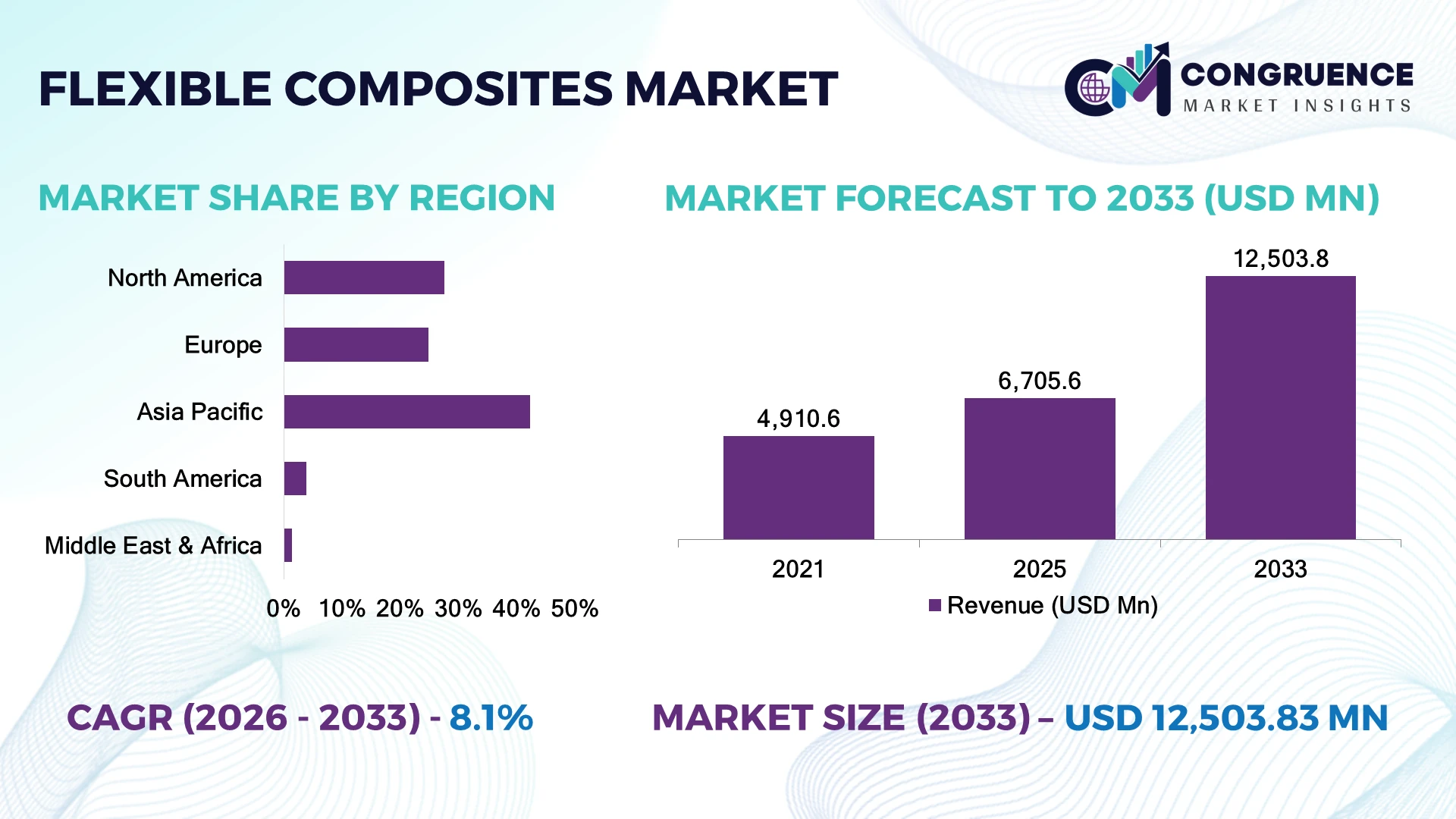
The Global Flexible Composites Market was valued at USD 6,705.6 Million in 2025 and is anticipated to reach a value of USD 12,503.8 Million by 2033 expanding at a CAGR of 8.1% between 2026 and 2033. Growth is driven by lightweight material substitution, high-performance reinforcement technologies, and increasing integration of flexible composites across automotive, aerospace, renewable energy, and industrial manufacturing.
China commands approximately 31% of global flexible composites production capacity, supported by investments in advanced textile reinforcement, high-volume polymer processing, and electric vehicle manufacturing. More than 62% of domestic composite manufacturers have adopted automated fiber placement and digital production technologies, compared with approximately 47% in Germany. Continued supply-chain diversification following global trade realignments has accelerated localized composite manufacturing and raw material integration across strategic industries.
Companies investing in advanced processing technologies, regional manufacturing capacity, and sustainable composite formulations are strengthening long-term competitive advantage across high-value industrial applications.
Market Size & Growth: USD 6,705.6 Million in 2025, reaching USD 12,503.8 Million by 2033 at 8.1% CAGR, driven by lightweight manufacturing and advanced reinforcement materials.
Top Growth Drivers: Lightweight substitution 38%, EV adoption 32%, industrial automation 27%.
Short-Term Forecast: By 2028, production efficiency improves 21% while material waste declines 16%.
Emerging Technologies: Automated fiber placement, AI-enabled quality inspection, and recyclable composite systems accelerate manufacturing transformation.
Regional Leaders: Asia-Pacific exceeds USD 5.2 Billion, North America approaches USD 3.4 Billion, Europe surpasses USD 2.9 Billion through advanced manufacturing investments.
Consumer/End-User Trends: Around 59% of OEMs prioritize lightweight flexible composite solutions for next-generation products.
Pilot/Case Example: A 2026 automated composite production project improved throughput by 24% while reducing defects by 18%.
Competitive Landscape: Top suppliers collectively hold approximately 45% share through technology leadership and material innovation.
Regulatory & ESG Impact: Sustainable material initiatives reduced manufacturing emissions by nearly 17% across modern composite facilities.
Investment & Funding: More than USD 2.3 Billion supports capacity expansion, automation, and advanced material development.
Innovation & Future Outlook: Smart composites, bio-based reinforcements, and digital manufacturing are reshaping competitive differentiation.
Flexible composites are gaining stronger adoption across electric vehicles, wind energy, industrial conveyor systems, protective equipment, and aerospace interiors where weight reduction and mechanical durability remain critical. Approximately 34% of newly developed flexible composite products incorporate recyclable or bio-based materials, while automated manufacturing continues improving consistency amid evolving supply-chain localization strategies. These structural shifts provide the foundation for the market's strategic evolution.
Flexible composites have become strategically important as manufacturers pursue lightweight engineering, material efficiency, and resilient supply chains across transportation, industrial equipment, renewable energy, and infrastructure. Increasing localization of composite manufacturing and broader adoption of automated production technologies are reshaping competitive positioning, while stricter sustainability objectives encourage greater use of recyclable reinforcements and advanced polymer systems. Companies capable of integrating digital manufacturing with material innovation are strengthening long-term operational resilience.
Automated fiber placement and AI-assisted process monitoring improve production efficiency by approximately 23% while reducing material waste by nearly 18% compared with conventional manual lay-up techniques. China continues leading high-volume manufacturing and downstream integration, whereas Germany emphasizes precision engineering and premium composite technologies for high-performance applications. During the next two to three years, nearly 57% of newly commissioned composite production lines are expected to incorporate advanced automation and real-time process analytics.
Manufacturers are expanding partnerships with automotive and renewable energy OEMs to develop customized flexible composite solutions for lightweight structural applications and industrial belts. Investment priorities increasingly target recyclable material platforms, digital quality control, and localized reinforcement production. Organizations combining advanced material science, manufacturing automation, and application-specific product development will secure stronger competitive positioning as flexible composites become essential to next-generation industrial design and sustainable manufacturing.
The transition toward lightweight engineering across automotive, aerospace, renewable energy, and industrial equipment is accelerating adoption of flexible composites with enhanced strength-to-weight performance. Approximately 39% of new electric vehicle component programs now incorporate flexible composite materials, while lightweight structures reduce component weight by nearly 28% without compromising mechanical durability. China's expansion of automated composite manufacturing and localized reinforcement production has strengthened supply availability for high-volume applications. This structural shift improves production efficiency and product performance simultaneously. Manufacturers are responding through capacity expansion, advanced fiber technologies, strategic partnerships with OEMs, and investment in automated processing lines. Competitive advantage increasingly depends on delivering application-specific composite systems with shorter qualification cycles.
Price volatility in carbon fiber, specialty polymers, and high-performance reinforcement materials continues affecting production economics across the flexible composites value chain. Approximately 24% of manufacturing costs remain linked to imported specialty fibers, while energy-intensive processing contributes nearly 19% of total production expenditure. Germany's dependence on externally sourced precursor materials exposes manufacturers to supply disruptions and longer procurement lead times. These structural constraints reduce pricing flexibility and delay large-scale commercialization of advanced composite solutions. Companies are mitigating risk through regional supplier diversification, recycled fiber integration, long-term procurement contracts, and localized resin compounding to improve supply stability while protecting manufacturing margins.
Digital manufacturing combined with intelligent material engineering is creating high-value opportunities beyond conventional lightweight applications. Approximately 33% of advanced composite facilities are integrating AI-driven process optimization, while predictive production monitoring improves manufacturing consistency by nearly 22%. Japan is expanding research into multifunctional flexible composites incorporating embedded sensing and structural health monitoring capabilities for transportation and industrial infrastructure. Manufacturers are investing in collaborative R&D, automation platforms, and strategic alliances with electronics developers to commercialize intelligent composite systems. A significant opportunity lies in high-performance industrial applications where integrated monitoring capabilities reduce maintenance costs while extending product lifecycle and operational reliability.
Commercializing advanced flexible composites at industrial scale remains challenging due to process standardization, complex quality assurance requirements, and limited availability of specialized manufacturing expertise. Approximately 27% of production facilities experience qualification delays during customer certification, while advanced composite inspection increases manufacturing cycle complexity by nearly 17%. Expanding demand for aerospace-grade quality and automotive production volumes places sustained pressure on manufacturing consistency. These execution challenges directly affect deployment timelines and customer confidence. Companies must strengthen digital quality inspection, workforce development, automated process control, and collaborative manufacturing ecosystems to achieve scalable production without compromising product performance or certification standards.
Automated Fiber Processing Expansion: Approximately 42% of newly commissioned composite production lines now integrate automated fiber handling, improving manufacturing throughput by nearly 23% while reducing material waste by 16%. Labor shortages and demand for production consistency are encouraging manufacturers to expand automation partnerships and modernize fabrication workflows.
Recyclable Material Adoption Accelerates: Around 35% of new flexible composite developments now incorporate recyclable or bio-based reinforcement materials, reducing lifecycle emissions by approximately 18%. Sustainability regulations and customer procurement requirements are driving companies to restructure raw material sourcing and expand circular manufacturing capabilities across industrial applications.
Hybrid Reinforcement Material Growth: Nearly 31% of industrial product launches combine carbon, glass, and aramid fibers to optimize flexibility, durability, and weight performance. Manufacturers are redesigning product portfolios around hybrid architectures that improve application-specific performance while lowering overall production costs through optimized material utilization.
Digital Quality Inspection Integration: Approximately 47% of advanced composite facilities have adopted AI-assisted visual inspection and inline monitoring systems, reducing defect rates by nearly 21% and accelerating production validation. Companies are scaling machine vision technologies, digital traceability platforms, and predictive analytics to strengthen operational efficiency and satisfy increasingly stringent customer qualification requirements.
Polymer Matrix Composites (PMCs) account for approximately 56% of the global flexible composites market, driven by their superior flexibility, lightweight characteristics, cost efficiency, and compatibility with automated manufacturing processes. Their broad use across automotive, aerospace, industrial belts, and protective equipment supports sustained demand and scalable production. Metal Matrix Composites and Ceramic Matrix Composites continue serving high-temperature and high-strength applications but remain comparatively niche due to higher processing complexity and production costs. Textile-reinforced flexible composites continue strengthening their role in industrial fabrics and protective systems where durability and conformability are essential.
Textile-reinforced flexible composites represent the fastest-growing type as demand increases for lightweight protective materials, conveyor systems, and flexible structural components. Adoption has expanded by approximately 29%, while automated textile reinforcement production has improved manufacturing efficiency by nearly 21%. Around 53% of new industrial composite developments now emphasize enhanced flexibility and recyclability alongside mechanical performance. Manufacturers are expanding advanced weaving technologies, bio-based resin integration, and strategic collaborations with OEMs to strengthen product differentiation while addressing evolving sustainability and lightweight engineering requirements.
According to a 2026 industrial manufacturing assessment, manufacturers increasingly prioritize polymer-based flexible composites for automated production because of their favorable processing efficiency, lightweight performance, and compatibility with high-volume industrial applications.
Automotive accounts for approximately 38% of the global flexible composites market, supported by aggressive lightweighting strategies, electric vehicle development, and increasing integration of flexible structural components. Flexible composites improve fuel efficiency, battery range, vibration resistance, and component durability while enabling complex product designs. Aerospace remains a mature application emphasizing premium-performance materials, whereas industrial equipment and renewable energy sectors continue expanding adoption for conveyor systems, wind blade components, and flexible mechanical assemblies requiring long operational life.
Renewable energy represents the fastest-growing application as wind energy developers increasingly adopt flexible composite materials to improve blade durability and structural efficiency. Demand within this segment has increased by approximately 31%, while advanced composite integration improves operational lifespan by nearly 18%. Around 49% of newly commissioned wind component manufacturing facilities have expanded automated composite processing capabilities. Manufacturers are strengthening production capacity, digital quality inspection, and application-specific material engineering to capture growing demand across transportation, clean energy, and industrial infrastructure markets.
A 2025 enterprise survey across advanced manufacturing industries found that lightweight composite materials ranked among the highest-priority investments for improving equipment efficiency, operational durability, and lifecycle performance.
Transportation OEMs account for approximately 44% of global flexible composites demand due to continuous investment in lightweight vehicle platforms, electric mobility, and advanced manufacturing technologies. Automotive and aerospace manufacturers require high-performance composite materials that combine flexibility, strength, and production scalability. Industrial equipment manufacturers continue representing a significant customer base, while construction and infrastructure sectors steadily increase adoption of flexible reinforcement materials for durable engineering applications requiring corrosion resistance and extended service life.
Renewable energy developers represent the fastest-growing end-user group as investments accelerate in wind energy infrastructure and lightweight structural components. Procurement from this segment has increased by approximately 28%, while adoption of advanced flexible composite materials has improved equipment durability by nearly 20%. Around 46% of manufacturers are introducing customized composite formulations specifically for renewable energy applications. Companies are responding through long-term OEM partnerships, customized product portfolios, localized production, and collaborative development programs to strengthen competitive positioning in specialized end-use markets.
A 2026 industrial materials study reported that transportation manufacturers continued expanding lightweight composite adoption as part of broader vehicle electrification and manufacturing efficiency strategies, reinforcing long-term procurement of advanced flexible composite solutions.
Asia-Pacific accounted for the largest market share at 42.3% in 2025 however, North America is expected to register the fastest growth, expanding at a CAGR of 8.7% between 2026 and 2033.
Advanced Manufacturing Accelerates High-Performance Composite Adoption
North America represents approximately 27.6% of the global flexible composites market, supported by advanced aerospace manufacturing, electric vehicle production, and strong industrial automation. Composite manufacturers continue expanding automated fiber processing, digital quality inspection, and lightweight material integration to improve manufacturing productivity and product performance. Approximately 58% of newly commissioned flexible composite production facilities incorporate AI-assisted inspection systems and automated material handling. Strategic collaboration between material suppliers and automotive OEMs continues accelerating development of application-specific composite solutions. Investments in domestic manufacturing capacity and resilient supply chains are strengthening regional competitiveness while reducing dependence on imported advanced reinforcement materials.
United States Market Outlook: The United States leads regional demand through its extensive aerospace, automotive, defense, and industrial manufacturing sectors. Domestic manufacturers continue expanding automated composite processing and advanced material research to support lightweight engineering initiatives. Approximately 63% of next-generation electric vehicle platform developments incorporate flexible composite components, while sustained investment in localized production and advanced polymer technologies reinforces the country's position as the region's technology and manufacturing leader.
Sustainable Manufacturing Reshapes Composite Production
Europe accounts for approximately 24.8% of global flexible composites demand, driven by strict sustainability objectives, advanced automotive engineering, and high-performance industrial manufacturing. Composite producers are increasing investment in recyclable reinforcement materials, energy-efficient processing, and automated production technologies. Approximately 49% of newly introduced flexible composite products incorporate sustainable material content or recyclable design principles. Manufacturers are strengthening strategic partnerships with transportation and renewable energy companies while modernizing production facilities to improve material efficiency and lifecycle performance.
Germany Market Outlook: Germany remains Europe's largest flexible composites market due to its strong automotive manufacturing ecosystem, precision engineering capabilities, and industrial automation leadership. Manufacturers continue expanding lightweight composite applications across electric mobility and industrial equipment production. Approximately 54% of high-performance flexible composite developments within the country's automotive supply chain are linked to advanced lightweight engineering programs supporting next-generation vehicle platforms.
Manufacturing Scale Drives Global Leadership
Asia-Pacific contributes approximately 42.3% of the global market, supported by large-scale composite manufacturing, expanding electric vehicle production, and rapid industrialization. China, Japan, and South Korea continue strengthening production capabilities through automated manufacturing lines, advanced polymer technologies, and localized supply chains. Approximately 61% of newly installed composite processing equipment across the region supports automated fiber placement and digital production control. Manufacturers continue expanding export-oriented production while investing in specialized flexible composite materials for transportation, renewable energy, and industrial applications.
China Market Outlook: China dominates regional production through integrated supply chains, extensive polymer processing capacity, and significant investment in advanced manufacturing technologies. Composite producers continue increasing automated production, research capabilities, and downstream integration for electric vehicles and industrial equipment. Approximately 65% of domestic flexible composite manufacturing capacity now utilizes automated production technologies, strengthening cost competitiveness and export capability.
Industrial Modernization Supports Emerging Demand
South America accounts for approximately 3.9% of the global market, supported by expanding industrial manufacturing, mining equipment production, and renewable energy investments. Flexible composite adoption is increasing across transportation, industrial belts, and infrastructure applications requiring corrosion resistance and lightweight performance. Approximately 26% of new industrial modernization projects now include advanced composite materials. Manufacturers continue strengthening regional distribution networks and localized technical support while balancing infrastructure limitations and variable industrial investment cycles through phased production expansion.
Brazil Market Outlook: Brazil leads the regional market through its diversified automotive manufacturing, wind energy development, and industrial machinery production. Domestic manufacturers are increasingly integrating flexible composites into transportation and industrial applications to improve durability and operational efficiency. Approximately 45% of South America's flexible composite consumption is concentrated in Brazil, reflecting the country's industrial scale and expanding advanced manufacturing capabilities.
Infrastructure Investment Expands Advanced Material Adoption
The Middle East & Africa represents approximately 1.4% of the global flexible composites market, driven by infrastructure modernization, energy sector investments, and industrial diversification initiatives. Composite materials are increasingly adopted for oil and gas equipment, construction components, and transportation infrastructure requiring corrosion resistance and extended service life. Approximately 24% of newly approved industrial infrastructure projects incorporate advanced composite materials. Manufacturers are expanding regional technical partnerships, localized service capabilities, and application engineering to strengthen long-term market penetration.
United Arab Emirates Market Outlook: The United Arab Emirates serves as the region's most strategically significant market through sustained investment in industrial diversification, advanced construction technologies, and high-value manufacturing. Companies continue adopting flexible composites across transportation, infrastructure, and energy projects requiring lightweight and corrosion-resistant materials. Approximately 39% of the Gulf region's advanced composite infrastructure deployments are concentrated in the UAE, reinforcing its position as a regional innovation and investment hub.
Global material leaders including Toray Industries, Hexcel, Teijin, SGL Carbon, and Owens Corning compete through advanced material performance, while regional composite processors challenge on cost, customization, and delivery speed. The top five companies collectively command approximately 46% of the global market. Competition centers on lightweight engineering, automated manufacturing, and supply-chain integration, with automated production improving throughput by nearly 22%, recycled material solutions lowering lifecycle emissions by approximately 18%, and digital inspection reducing defects by 20%. Companies are expanding regional manufacturing, forming OEM partnerships, integrating upstream fiber production, and investing in recyclable thermoplastic composites to strengthen long-term contracts. Competitive momentum is shifting toward sustainable, high-performance composite systems supported by vertically integrated raw material capabilities and digital manufacturing. The principal entry barrier remains high capital investment in advanced processing technologies and customer qualification requirements. Success depends on scalable manufacturing, proprietary material innovation, application engineering expertise, and resilient supply-chain control.
Toray Industries, Inc.
Hexcel Corporation
Teijin Limited
SGL Carbon SE
Owens Corning
Mitsubishi Chemical Group Corporation
Syensqo SA
Gurit Holding AG
Johns Manville
BASF SE
Arkema S.A.
Huntsman Corporation
SAERTEX GmbH & Co. KG
Trelleborg AB
Flexible composites manufacturing is increasingly driven by automated fiber placement, thermoplastic composite processing, AI-enabled quality inspection, and digital production control. These technologies improve manufacturing efficiency by approximately 24% while reducing material waste by nearly 18%. Around 61% of newly commissioned advanced composite production lines incorporate automated material handling and inline monitoring systems, enabling consistent quality and shorter production cycles. Manufacturers supplying automotive, aerospace, and renewable energy sectors gain stronger operational flexibility, lower production variability, and faster qualification for high-performance applications.
Emerging technologies include recyclable thermoplastic prepregs, multifunctional composite materials, digital twins, and embedded structural health monitoring. Compared with conventional manual lay-up processes, automated fiber placement improves production speed by approximately 27% while reducing labor intensity by nearly 20%. Large OEM suppliers and vertically integrated composite manufacturers benefit through improved scalability, stronger cost control, and greater responsiveness to customized engineering requirements across complex industrial applications.
Between 2026 and 2028, AI-assisted process optimization, smart composite materials, advanced resin chemistries, and predictive manufacturing analytics will redefine competitive performance. More than 68% of high-value composite facilities are expected to integrate real-time digital production management. Organizations investing early in intelligent manufacturing, recyclable material technologies, and automated inspection capabilities will secure stronger customer qualification, improved manufacturing resilience, and sustained leadership as advanced flexible composites become central to next-generation industrial design.
March 2024 Hexcel launched its HexTow IM9 24K continuous carbon fiber at JEC World, enhancing aerospace-grade composite performance with improved manufacturing efficiency for lightweight structures. The innovation strengthens advanced composite applications across transportation and industrial sectors.
June 2025 Toray, Daher, and Tarmac Aerosave launched an end-of-life aircraft recycling program for thermoplastic composites, advancing circular manufacturing. The initiative expands composite material recovery and supports sustainable aerospace supply chains through large-scale recycling collaboration.
March 2025 Hexcel partnered with FIDAMC to accelerate research and industrial development of advanced composite materials, strengthening innovation in lightweight structures and sustainable manufacturing while expanding collaborative technology development for aerospace and industrial applications.
May 2026 Toray Advanced Composites expanded NCAMP qualifications for its low-melt PAEK composite material system, broadening certified aerospace applications and accelerating adoption of high-performance thermoplastic composites across next-generation aircraft manufacturing. Source: Toray Advanced Composites newsroom. (Advanced Composites)
The Flexible Composites Market Report provides detailed assessment across polymer matrix composites, metal matrix composites, ceramic matrix composites, and textile-reinforced flexible composites, with comprehensive evaluation of applications spanning automotive, aerospace, renewable energy, industrial equipment, construction, and protective systems. The study analyzes demand across transportation OEMs, industrial manufacturers, renewable energy developers, construction companies, and specialized engineering sectors while covering North America, Europe, Asia-Pacific, South America, and the Middle East & Africa. Approximately 56% of market demand is concentrated in polymer matrix composites, reflecting broad industrial adoption and manufacturing scalability.
The report further examines automated fiber placement, thermoplastic composite processing, AI-enabled inspection, recyclable composite technologies, and digital manufacturing trends shaping competitive differentiation between 2026 and 2033. It delivers strategic insights into material innovation, production localization, supply-chain optimization, company positioning, and emerging application opportunities. The analysis supports investment decisions, product portfolio development, expansion planning, partnership strategies, and long-term competitive positioning across rapidly evolving advanced manufacturing industries.
| Report Attribute/Metric | Report Details |
|---|---|
|
Market Revenue in 2025 |
USD 6,705.6 Million |
|
Market Revenue in 2033 |
USD 12,503.8 Million |
|
CAGR (2026 - 2033) |
8.1% |
|
Base Year |
2025 |
|
Forecast Period |
2026 - 2033 |
|
Historic Period |
2021 - 2025 |
|
Segments Covered |
By Type
By Application
By End-User
|
|
Key Report Deliverable |
Revenue Forecast, Growth Trends, Market Dynamics, Segmental Overview, Regional and Country-wise Analysis, Competition Landscape |
|
Region Covered |
North America, Europe, Asia-Pacific, South America, Middle East, Africa |
|
Key Players Analyzed |
Toray Industries, Inc., Hexcel Corporation, Teijin Limited, SGL Carbon SE, Owens Corning, Mitsubishi Chemical Group Corporation, Syensqo SA, Gurit Holding AG, Johns Manville, BASF SE, Arkema S.A., Huntsman Corporation, SAERTEX GmbH & Co. KG, Trelleborg AB |
|
Customization & Pricing |
Available on Request (10% Customization is Free) |




