
Reports
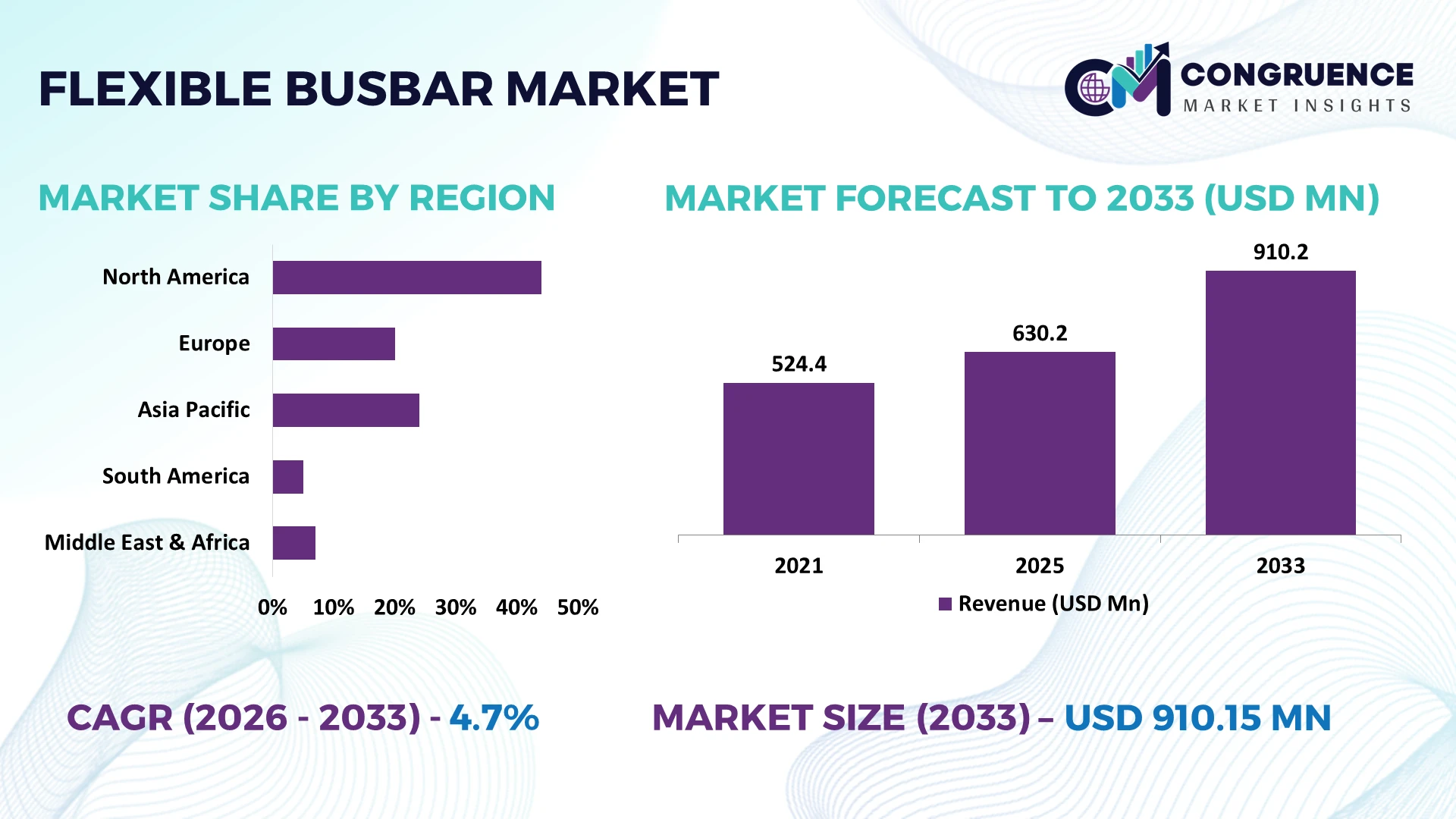
The Global Flexible Busbar Market was valued at USD 630.2 Million in 2025 and is anticipated to reach a value of USD 910.15 Million by 2033 expanding at a CAGR of 4.7% between 2026 and 2033. EV battery-pack miniaturization, high-current charging systems, and compact laminated interconnect designs are driving flexible busbar adoption by reducing wiring complexity and improving space utilization.
China remains the dominant market, supported by approximately 45% of global EV production and extensive battery manufacturing capacity, while India is expanding localized EV and energy-storage manufacturing. Europe is strengthening regional electrical-component supply chains under tighter sustainability and traceability requirements. China therefore maintains the manufacturing advantage, while India offers a stronger localization-growth opportunity.
Strategically, manufacturers should focus on automated joining, lightweight copper-aluminum designs, and regional production capacity to capture expanding EV and energy-storage applications.
Market Size & Growth: USD 630.2 Million in 2025 to USD 910.15 Million by 2033 at 4.7% CAGR, driven by EV battery electrification.
Top Growth Drivers: EV battery integration 45%, energy storage 28%, fast-charging infrastructure 22%.
Short-Term Forecast: By 2028, automated fabrication is expected to reduce assembly costs by 8% and improve efficiency by 12%.
Emerging Technologies: Laser welding, ultrasonic joining, AI inspection, and laminated copper-aluminum structures are improving manufacturing precision.
Regional Leaders: Asia Pacific approximately USD 430 Million, Europe USD 210 Million, and North America USD 190 Million by 2033.
Consumer/End-User Trends: More than 35% of newer battery architectures increasingly specify flexible interconnects for compact power distribution.
Pilot/Case Example: 2026 automated EV busbar programs target a 20% reduction in manufacturing cycle time.
Competitive Landscape: RPK Group, Mersen, Rogers Corporation, and Schneider Electric maintain strong positions across automotive and industrial applications.
Regulatory & ESG Impact: Lightweight and recyclable busbar designs target approximately 10% lower material-related environmental impact.
Investment & Funding: More than USD 1 Billion in battery-manufacturing expansion is strengthening localized flexible busbar supply chains.
Innovation & Future Outlook: Sensor-integrated busbars, automated welding, advanced coatings, and multi-material designs are shifting competition toward thermal management and compactness.
Flexible busbar demand is expanding across EV battery modules, fast-charging infrastructure, renewable-energy storage, and industrial power assemblies. Laminated structures and precision joining improve space utilization and connection reliability, while automated inspection strengthens production consistency. More than 35% adoption across newer battery architectures demonstrates the transition toward flexible interconnects, reinforced by supply-chain localization and tighter material-traceability requirements, creating stronger opportunities for specialized manufacturers.
Flexible busbars are becoming strategically important as EV platforms, battery storage systems, data centers, and industrial electrification demand compact, high-current power distribution. Unlike rigid conductors, flexible designs accommodate vibration, thermal expansion, and constrained layouts, reducing assembly complexity. Supply-chain restructuring in 2026 is also pushing manufacturers toward localized copper processing and application-specific component sourcing.
Modern laminated and braided flexible busbars can reduce connection weight by 10–20% and improve installation productivity by approximately 15% versus conventional rigid interconnect assemblies in space-constrained applications. China maintains the strongest manufacturing scale through EV and battery production, while Germany and the United States emphasize engineering precision, automation, and high-reliability applications. India is accelerating deployment through localized EV and energy-storage manufacturing.
Over the next 2–3 years, automated forming, laser welding, ultrasonic joining, and digital inspection are expected to become increasingly integrated into production, targeting 10–15% shorter assembly cycles. EV battery-pack manufacturers are expanding supplier partnerships for customized busbars, while energy-storage integrators are prioritizing thermal-performance and recyclable-material designs. Competitive advantage will increasingly depend on engineering customization, manufacturing automation, and localized supply resilience.
The strongest growth driver is the shift toward compact EV battery architectures requiring lightweight, vibration-resistant, high-current connections. EV and energy-storage applications together represent an estimated 50%+ of new flexible-busbar design activity, while automated joining can improve production throughput by 10–15%. China’s battery-manufacturing clusters are accelerating customized busbar integration as pack designs become more modular. Companies are responding through localized fabrication, automated welding, and direct partnerships with battery-pack manufacturers. A non-obvious advantage is design flexibility: manufacturers can optimize conductor geometry around cells and cooling channels rather than redesigning the enclosure around rigid connections, improving packaging efficiency and reducing assembly intervention.
Material economics remain a significant constraint because copper-intensive flexible busbars are exposed to raw-material price volatility and fabrication costs. Copper typically represents more than 50% of conductor material value, while specialized insulation, plating, and precision forming can add 10–20% to component costs. European manufacturers also face tighter traceability and sustainability requirements across electrical-component supply chains. These pressures directly affect procurement margins and quotation stability for high-volume EV programs. Companies are responding through aluminum alternatives, recycled copper inputs, multi-year procurement agreements, and localized processing. The key operational issue is balancing conductivity against material cost; excessive substitution can compromise thermal performance and increase lifecycle engineering requirements.
Automation creates a high-value opportunity beyond conventional flexible connections. AI-assisted visual inspection, laser welding, automated bending, and embedded temperature sensing can collectively reduce manual inspection requirements by 15–25% while improving dimensional consistency. India, Mexico, and Southeast Asian manufacturing hubs are gaining attention as companies diversify battery and electrical-component supply chains beyond established Chinese production centers. Next-generation busbars integrating sensing points with power distribution can support predictive thermal monitoring inside battery packs and energy-storage systems. Companies investing in modular tooling and programmable manufacturing platforms can serve multiple vehicle or storage architectures without extensive line redesign. The strategic opportunity lies in selling engineered interconnect systems rather than competing solely on conductor pricing.
Long-term competitiveness depends on managing integration complexity as flexible busbars move into higher-current and increasingly software-monitored electrical systems. Approximately 15–20% of engineering effort in customized assemblies can involve validation of thermal behavior, clearances, joining quality, and electromagnetic compatibility. In the United States and Europe, stricter battery-safety validation adds additional design and testing requirements, while rapidly changing EV architectures increase qualification frequency. Companies must strengthen simulation, automated inspection, and cross-functional engineering capabilities to maintain deployment consistency. A critical challenge is synchronization between busbar geometry, battery cooling, cell configuration, and electronic monitoring. Suppliers that cannot shorten redesign and qualification cycles risk losing programs even when their manufacturing costs remain competitive.
Copper is the leading type, accounting for approximately 58% of flexible busbar demand, supported by high conductivity, thermal performance, and established manufacturing infrastructure. Copper remains dominant across EV battery systems, switchgear, and industrial power distribution, where performance requirements outweigh material-cost pressures. Insulated busbars represent approximately 17%, supporting applications requiring electrical separation and compact routing, while laminated designs are gaining adoption where space optimization is critical.
Aluminum is the fastest-growing type, with adoption increasing approximately 12–15% in newer EV and renewable-energy architectures as manufacturers prioritize lightweighting and material-cost control. Companies are investing in improved surface treatment, joining technologies, and hybrid copper-aluminum configurations. Copper therefore retains performance leadership, while aluminum is shifting investment priorities toward weight-sensitive platforms. Insulated and laminated variants provide differentiation through safety, compactness, and integration flexibility.
Power Distribution leads the application landscape with approximately 34% share, supported by utilities and industrial facilities requiring reliable high-current connections across compact electrical assemblies. Switchgear contributes nearly 25%, reflecting continued modernization of medium- and low-voltage equipment. These established applications emphasize conductivity, mechanical flexibility, and installation reliability, prompting manufacturers to strengthen standardized product portfolios while expanding customized configurations for industrial customers.
Battery Systems is the fastest-growing application, with adoption increasing approximately 15–18% across newer EV and energy-storage architectures. Renewable Energy is also gaining importance as storage integration increases, while Switchgear continues steady replacement-driven demand. Companies are responding through automated joining, customized geometries, and direct partnerships with battery-pack manufacturers. The strategic shift is from general-purpose busbars toward application-specific assemblies engineered around thermal management, cell configuration, and installation constraints.
Automotive is the leading end-user, representing approximately 31% of flexible busbar demand because EV battery packs require lightweight, vibration-tolerant, high-current interconnections. Manufacturing accounts for nearly 24%, supported by industrial controls and electrical equipment. Utilities remain important buyers because grid modernization requires dependable power-distribution assemblies. Companies are increasingly targeting automotive customers through customized geometries, automated fabrication, and long-term supply partnerships.
Data Centers represent the fastest-growing end-user, with demand increasing approximately 16–20% as AI workloads raise power density and backup-power requirements. Renewable Energy is also gaining traction through battery-backed generation and storage projects. Suppliers are adapting with higher-current designs, thermal-management integration, and partnerships with power-system integrators. The competitive shift is toward engineering reliability and rapid customization rather than commodity conductor pricing, particularly for high-density infrastructure.
North America accounted for the largest market share at 40.23% in 2025 however, Asia-Pacific is expected to register the fastest growth, expanding at a CAGR of 7.6% between 2026 and 2033.

Grid modernization and high-density power demand reshape procurement
North America maintains a strong position in flexible busbars, supported by U.S. EV manufacturing, data-center expansion, utility modernization, and industrial automation. Approximately 40% market positioning reflects strong adoption of insulated and application-specific busbars in high-current installations. U.S. manufacturers increasingly prioritize customized copper configurations for battery packs, switchgear, and power-distribution assemblies. Data-center construction is increasing demand for compact interconnections capable of handling higher power density, while aging electrical infrastructure is accelerating replacement activity. Suppliers are responding with domestic production, automated forming, and long-term OEM agreements. The key operational shift is toward shorter qualification cycles and application-specific engineering rather than standardized components.
U.S. Market Outlook: The United States remains the region’s principal demand center, supported by EV battery manufacturing, utility upgrades, and data-center infrastructure. Battery and electrical-equipment manufacturers are expanding domestic sourcing, while suppliers are increasing automated fabrication capacity. High-current applications increasingly favor flexible configurations that simplify installation and accommodate thermal movement, strengthening demand for engineered busbar assemblies.
Electrification regulation accelerates high-efficiency component adoption
Europe is shifting toward flexible busbars through industrial electrification, EV production, renewable-energy integration, and stricter sustainability requirements. Germany, France, and Italy remain important manufacturing centers, with demand concentrated in automotive, switchgear, automation, and energy-storage applications. Approximately 25–30% of regional procurement increasingly emphasizes recyclable materials, traceability, and lower-emission manufacturing. European suppliers are investing in laminated structures, advanced insulation, and automated joining to improve assembly consistency. Germany’s automotive manufacturing ecosystem supports customized busbar development, while European grid modernization is strengthening utility demand. The strategic differentiator is compliance-ready engineering, allowing suppliers to combine electrical performance with material traceability and lifecycle requirements.
Germany Market Outlook: Germany represents Europe’s strongest industrial opportunity because automotive OEMs, electrical-equipment manufacturers, and automation suppliers operate dense domestic production networks. More than 1 million electric vehicles were newly registered in Germany during 2025, reinforcing requirements for compact battery interconnections. Suppliers are strengthening OEM partnerships and localized engineering capabilities to meet platform-specific qualification requirements.
Manufacturing scale drives localized high-current integration
Asia-Pacific combines the strongest manufacturing scale with rapidly expanding EV, battery, renewable-energy, and electronics production. China dominates regional deployment, while Japan, South Korea, and India contribute advanced automotive, semiconductor, and industrial manufacturing capacity. The region represents roughly 35–40% of broader busbar demand, with flexible solutions gaining traction as battery architectures become more compact. China’s high-power EV busbar ecosystem is particularly advanced, with copper remaining dominant in high-current platforms. Suppliers are expanding automated welding, precision forming, and localized material processing to shorten lead times. India is emerging as a secondary manufacturing base as companies diversify component sourcing and establish regional supply partnerships.
China Market Outlook: China remains the strategic manufacturing center, supported by extensive EV, battery-cell, electronics, and power-equipment production. Its high-power EV busbar ecosystem increasingly supports 800V-plus architectures, encouraging laminated copper designs and advanced insulation. Manufacturers are integrating busbar fabrication closer to battery-pack assembly to reduce logistics complexity and improve design responsiveness.
Infrastructure modernization creates selective industrial demand
South America remains a developing flexible busbar market, with Brazil accounting for the largest demand concentration through utilities, industrial facilities, renewable-energy projects, and automotive production. Regional procurement increasingly favors durable copper assemblies for power distribution and switchgear, while renewable projects create additional demand for compact electrical connections. Brazil’s electricity generation capacity includes substantial renewable participation, strengthening requirements for reliable power-management infrastructure. However, imported electrical components remain important, increasing exposure to logistics costs and currency movements. Suppliers are responding through distributor partnerships, localized assembly, and inventory positioning near industrial hubs. The strongest opportunity lies in combining flexible busbars with modernization projects rather than competing solely through commodity pricing.
Brazil Market Outlook: Brazil offers the strongest regional opportunity because of its industrial base, electricity infrastructure, automotive manufacturing, and renewable-energy deployment. Utility and industrial projects increasingly require compact, serviceable electrical assemblies. Local partnerships can reduce import-related lead times and improve project responsiveness, giving suppliers with regional inventory and technical support a competitive advantage.
Mega-project electrification strengthens infrastructure-led demand
Middle East & Africa demand is being shaped by power-grid modernization, industrial diversification, renewable-energy projects, data centers, and large-scale infrastructure programs. Saudi Arabia and the UAE lead regional adoption through high-value electrical infrastructure and energy-transition investments. Flexible busbars are increasingly specified where compact switchgear, power distribution, and battery systems require easier installation and thermal flexibility. Renewable-energy expansion is creating new requirements for high-current connections within storage and power-conversion equipment. Suppliers are responding through project-specific engineering, local distributor networks, and partnerships with electrical-system integrators. The key market distinction is project intensity: procurement is concentrated in large infrastructure contracts rather than broad replacement demand, making specification access and project relationships critical.
Saudi Arabia Market Outlook: Saudi Arabia is the region’s most strategically significant market because large infrastructure, industrial diversification, and renewable-energy programs are increasing electrical-system requirements. The country’s renewable-energy pipeline is expanding rapidly, creating additional demand for power-distribution and storage components. Suppliers with local partnerships, technical support, and project qualification capabilities are positioned to capture specification-driven procurement.
The flexible busbar market is contested by global electrical-equipment leaders including Schneider Electric, Mersen, Siemens, ABB, and Legrand, alongside specialized busbar manufacturers and automotive-interconnect suppliers. The top five players collectively hold an estimated 25–30% share, indicating a fragmented structure where scale competes with engineering specialization. Global leaders compete through integrated electrical portfolios and distribution networks, while specialized suppliers differentiate through 10–15% faster customization and application-specific fabrication. Price remains important, but automated joining and precision forming increasingly deliver 8–12% production-efficiency advantages. Companies are expanding localized manufacturing, partnering with EV and battery OEMs, and integrating copper-aluminum designs to control material exposure. The competitive shift is toward vertical integration and regional supply resilience as customers demand shorter qualification and delivery cycles. High tooling, validation, insulation expertise, and OEM qualification requirements create entry barriers. Winning requires reliable supply, rapid customization, automated production, and proven high-current performance.
Schneider Electric
Mersen
Siemens
ABB
Legrand
Eaton
Rogers Corporation
Methode Electronics
Amphenol Corporation
TE Connectivity
Littelfuse
RHI Electric
Brar Elettromeccanica
Connor Manufacturing Services
Laminated copper busbars are the current technology standard for compact power electronics, reducing assembly time by 10–15% versus multi-cable wiring while lowering parasitic inductance. Adoption is strongest in EV inverters, battery systems, UPS equipment, and industrial drives, where compact routing improves thermal and electrical performance.
Emerging flexible laminated designs combine copper or aluminum conductors with insulation, welded joints, and integrated sensing. Rogers’ ROLINX Flex supports configurations up to 1.5 kV DC, while advanced joining can improve production throughput by 8–12%. Automated forming and laser or ultrasonic welding are gaining deployment as manufacturers target tighter tolerances and lower rework.
Disruptive development centers on integrated busbars that combine power connections, sensors, cooling interfaces, and digital monitoring. Compared with conventional rigid connections, flexible architectures can cut installation effort by 15–20% and accommodate vibration or thermal expansion without redesign. Through 2026–2028, EV battery makers, data-center operators, and energy-storage integrators will benefit most, while suppliers investing in automation, smart diagnostics, and application-specific designs gain competitive differentiation. This integration also supports modular assembly and faster maintenance, particularly where equipment layouts change frequently. Companies that standardize digital inspection and configurable tooling can shorten qualification cycles, improve repeatability, and respond faster to localized battery and power-electronics manufacturing requirements.
February 2024 — Rogers Corporation leased a Monterrey factory for advanced busbar manufacturing and engineering services, with first-phase completion planned for late 2024. The expansion strengthens North American EV/HEV and renewable-energy supply while improving localized prototyping and customer support. Source: rogerscorp.com
June 2024 — Mersen received U.S. Patent 12,015,259 for a laminated busbar connecting prismatic battery cells. The architecture addresses battery-pack interconnection, strengthening engineered energy-storage capabilities and intellectual-property positioning for next-generation electric-battery systems. Source: justia.com
February 2025 — Rogers Corporation documented ROLINX busbar systems reaching 12 kV DC and several megawatts, with operating temperatures up to 130°C. The capability expands suitability for traction, inverters, UPS, and renewable-power applications requiring high-voltage and thermal resilience. Source: rogerscorp.com
June 2026 — Legrand highlighted underfloor busbar systems for changing office layouts, including flexible interlinks and socket outlets every 300–600 mm. The approach improves reconfiguration speed and reduces disruption as commercial workplaces adapt to changing power requirements. Source: legrand.co.uk
The Flexible Busbar Market Report evaluates four major types—Copper, Aluminum, Insulated, and Laminated—across Power Distribution, Switchgear, Renewable Energy, and Battery Systems. End-user coverage includes Utilities, Manufacturing, Automotive, Data Centers, and Renewable Energy, with analysis spanning North America, Europe, Asia-Pacific, South America, and the Middle East & Africa.
The report assesses copper-intensive mature applications alongside emerging aluminum, laminated, and integrated flexible designs. Technology coverage includes automated forming, laser and ultrasonic joining, insulation systems, integrated sensing, and thermal-management interfaces. Regional analysis emphasizes manufacturing concentration, deployment intensity, supply-chain localization, and infrastructure modernization. Competitive assessment covers 10+ major market participants and evaluates technology positioning, customization, partnerships, production expansion, and strategic differentiation. The 2026–2033 outlook supports investment planning, geographic expansion, supplier selection, capacity allocation, competitive positioning, and technology prioritization.
| Report Attribute/Metric | Report Details |
|---|---|
Market Revenue in 2025 | USD 630.2 Million |
Market Revenue in 2033 | USD 910.15 Million |
CAGR (2026 - 2033) | 4.7% |
Base Year | 2025 |
Forecast Period | 2026 - 2033 |
Historic Period | 2021 - 2025 |
Segments Covered | By Type
By Application
By End-User
|
Key Report Deliverable | Revenue Forecast, Growth Trends, Market Dynamics, Segmental Overview, Regional and Country-wise Analysis, Competition Landscape |
Region Covered | North America, Europe, Asia-Pacific, South America, Middle East, Africa |
Key Players Analyzed | Schneider Electric, Mersen, Siemens, ABB, Legrand, Eaton, Rogers Corporation, Methode Electronics, Amphenol Corporation, TE Connectivity, Littelfuse, RHI Electric, Brar Elettromeccanica, Connor Manufacturing Services |
Customization & Pricing | Available on Request (10% Customization is Free) |




