
Reports
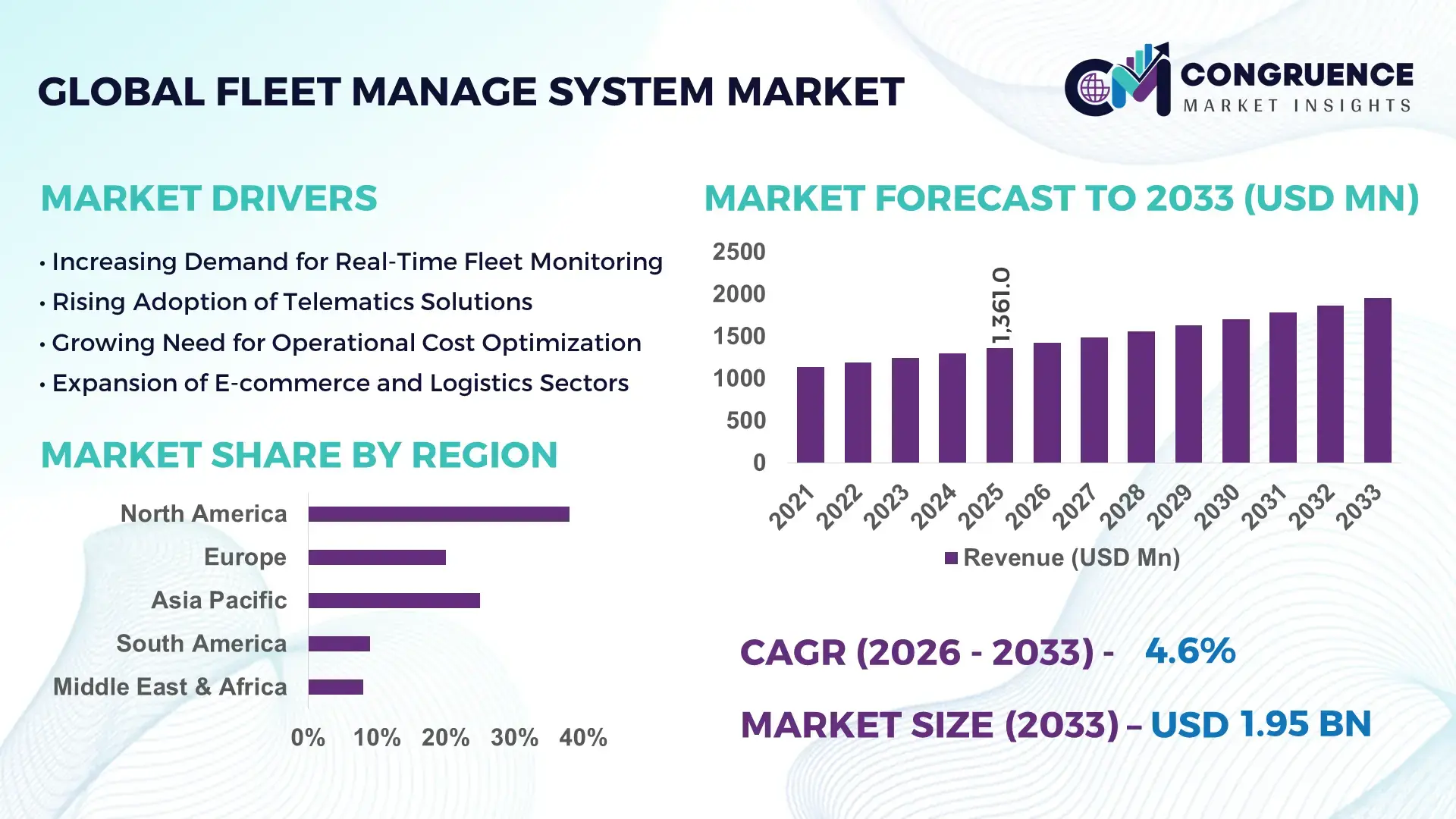
The Global Fleet Manage System Market was valued at USD 1361 Million in 2025 and is anticipated to reach a value of USD 1950.34 Million by 2033 expanding at a CAGR of 4.6% between 2026 and 2033. This growth is primarily driven by increasing demand for real-time vehicle tracking, operational efficiency, and fuel cost optimization across logistics and transportation sectors.
In the United States, which dominates the Fleet Manage System market, over 65% of commercial fleets have already integrated telematics-based fleet management platforms, with more than 15 million connected vehicles actively monitored through advanced GPS and IoT-enabled systems. The country has witnessed significant investments exceeding USD 2 billion annually in smart fleet infrastructure, particularly across logistics, e-commerce delivery, and public transportation sectors. Fleet operators in the U.S. report up to 20–25% improvement in route efficiency through AI-powered optimization tools, while regulatory mandates for electronic logging devices (ELDs) have accelerated system adoption across trucking fleets covering over 3.5 million drivers.
Market Size & Growth: Valued at USD 1361 Million in 2025, projected to reach USD 1950.34 Million by 2033 at a CAGR of 4.6%, driven by increased demand for connected fleet operations and real-time analytics.
Top Growth Drivers: Telematics adoption increased by 38%, fuel efficiency improvements reached 22%, and predictive maintenance adoption grew by 31%.
Short-Term Forecast: By 2028, fleet operators are expected to reduce operational costs by up to 18% through AI-enabled route optimization and fuel monitoring systems.
Emerging Technologies: AI-based predictive analytics, IoT-enabled vehicle diagnostics, and cloud-based fleet management platforms are transforming operations.
Regional Leaders: North America projected at USD 720 Million by 2033 with high telematics penetration; Europe at USD 520 Million with regulatory-driven adoption; Asia-Pacific at USD 480 Million with rapid logistics expansion.
Consumer/End-User Trends: Logistics, transportation, and e-commerce sectors account for over 60% of system usage, with increasing adoption among SMEs.
Pilot or Case Example: In 2024, a logistics operator implemented AI-based fleet analytics and achieved a 27% reduction in idle time and 15% fuel savings.
Competitive Landscape: Market leader holds approximately 18% share, followed by major players including telematics solution providers and fleet software companies.
Regulatory & ESG Impact: Emission regulations and carbon reduction targets are pushing fleet electrification and digital tracking adoption.
Investment & Funding Patterns: Over USD 1.5 billion invested globally in fleet technology startups and telematics innovation platforms in recent years.
Innovation & Future Outlook: Integration of autonomous fleet systems, blockchain-based logistics tracking, and smart mobility ecosystems are shaping long-term growth.
The Fleet Manage System market continues to evolve across key industry sectors including logistics, construction, oil and gas, and public transportation, which collectively contribute over 70% of total system adoption. Recent advancements in AI-powered fleet analytics, edge computing, and vehicle-to-everything (V2X) communication are enhancing real-time decision-making capabilities. Regulatory pressures related to emissions and safety compliance are driving mandatory system implementation across developed markets. Emerging economies are witnessing increased consumption due to rapid urbanization and expanding transportation networks. The integration of electric vehicles and smart mobility platforms is expected to redefine fleet operations, while data-driven insights and automation remain central to future scalability and efficiency improvements.
The Fleet Manage System Market holds significant strategic relevance as organizations increasingly prioritize operational efficiency, cost reduction, and sustainability within transportation networks. Advanced telematics platforms combined with artificial intelligence are enabling real-time fleet visibility, predictive maintenance, and driver behavior monitoring. AI-powered fleet optimization delivers up to 25% improvement compared to traditional manual scheduling systems, significantly enhancing asset utilization and reducing downtime.
North America dominates in volume due to widespread deployment across logistics and commercial fleets, while Europe leads in adoption with over 70% of enterprises integrating fleet management systems driven by stringent environmental and safety regulations. The Asia-Pacific region is rapidly emerging with increasing adoption among small and medium fleet operators, supported by expanding e-commerce and urban delivery networks. By 2028, AI-driven predictive maintenance and route optimization technologies are expected to reduce fleet downtime by 30% and improve fuel efficiency by nearly 20%. Firms are committing to ESG targets such as reducing fleet emissions by 35% by 2030 through the adoption of electric vehicles and intelligent fleet monitoring systems.
In 2024, a large logistics company implemented IoT-enabled fleet tracking and achieved a 28% reduction in maintenance costs alongside a 22% improvement in delivery efficiency. Such measurable outcomes demonstrate the tangible value of digital transformation in fleet operations. The Fleet Manage System Market is increasingly positioned as a critical enabler of resilience, regulatory compliance, and sustainable growth, supporting organizations in navigating complex supply chain demands while optimizing performance through data-driven strategies.
The increasing need for real-time fleet visibility is a major driver accelerating the adoption of fleet management systems across industries. Businesses are leveraging GPS tracking and IoT-enabled telematics to monitor vehicle location, fuel usage, and driver performance in real time. Studies indicate that companies implementing real-time tracking systems achieve up to 25% improvement in route efficiency and reduce fuel consumption by nearly 15%. Additionally, real-time visibility helps in minimizing unauthorized vehicle usage and improving customer service through accurate delivery timelines. The logistics sector, which accounts for a substantial portion of fleet operations, has rapidly adopted these systems to handle growing e-commerce demands. With over 70% of fleet operators planning to upgrade their tracking capabilities, the demand for advanced fleet management solutions continues to expand significantly.
Despite strong growth potential, high initial investment and integration complexities remain key restraints for the Fleet Manage System market. Deploying advanced telematics systems requires substantial capital expenditure on hardware, software, and connectivity infrastructure. Small and medium-sized fleet operators often face challenges in allocating budgets for these systems, especially when upfront costs can increase operational expenses by 10–15% in the short term. Additionally, integrating fleet management solutions with existing enterprise systems such as ERP and supply chain platforms can be technically challenging and time-consuming. Data security concerns also add to the complexity, as fleet systems handle sensitive operational information. These factors collectively slow down adoption rates, particularly in developing regions where cost sensitivity and limited technical expertise are prevalent.
The rapid expansion of electric and connected vehicles presents significant opportunities for the Fleet Manage System market. As global electric vehicle adoption increases, fleet operators require specialized management systems to monitor battery performance, charging schedules, and energy consumption. Reports indicate that electric fleets can reduce operational costs by up to 30% when integrated with intelligent fleet management solutions. Furthermore, connected vehicle technologies enable seamless communication between vehicles and infrastructure, enhancing route optimization and safety. Governments worldwide are offering incentives and subsidies to promote electric fleet adoption, further driving demand for advanced management systems. The integration of renewable energy monitoring and smart charging infrastructure creates additional growth avenues, positioning fleet management systems as a crucial component of next-generation transportation ecosystems.
Data privacy concerns and regulatory compliance requirements pose significant challenges to the Fleet Manage System market. Fleet management systems collect and process large volumes of data, including vehicle location, driver behavior, and operational metrics, raising concerns about data security and misuse. Compliance with data protection regulations such as regional privacy laws requires companies to implement robust cybersecurity measures, increasing operational complexity and costs. Additionally, varying regulatory standards across regions create challenges for global fleet operators, who must adapt systems to meet different compliance requirements. Failure to comply can result in penalties and operational disruptions. As a result, companies are investing heavily in secure data management frameworks and encryption technologies, but the need for continuous updates and monitoring remains a persistent challenge impacting overall market growth.
• Accelerated Adoption of AI-Driven Predictive Maintenance: Fleet operators are increasingly deploying AI-powered predictive maintenance systems, with over 48% of large fleets integrating machine learning algorithms to monitor vehicle health in real time. These systems have demonstrated up to 30% reduction in unplanned downtime and nearly 18% decrease in maintenance costs. Data-driven diagnostics using onboard sensors now generate over 500 data points per vehicle per hour, enabling proactive fault detection and extending vehicle lifespan by 20–25%. This trend is particularly prominent in long-haul logistics and heavy-duty transportation segments.
• Expansion of Electric Fleet Integration and Smart Charging Infrastructure: The transition toward electric fleets is gaining strong momentum, with more than 22% of newly registered commercial vehicles in urban fleets being electric-powered. Fleet management systems now incorporate energy monitoring tools that improve battery efficiency by up to 27% and reduce charging downtime by 15%. Smart charging platforms integrated with fleet software allow operators to optimize charging schedules, resulting in nearly 20% cost savings on energy consumption. Urban delivery and public transit fleets are leading this shift, supported by regulatory incentives and sustainability targets.
• Increasing Deployment of Cloud-Based Fleet Management Platforms: Cloud adoption in fleet management has surpassed 60% among mid-to-large enterprises, driven by scalability, real-time data access, and cost efficiency. Cloud platforms enable centralized fleet monitoring across multiple locations, improving operational efficiency by approximately 25%. Additionally, cloud-based systems support seamless integration with enterprise resource planning tools, enhancing data synchronization and decision-making speed by 35%. Remote diagnostics and over-the-air updates have further reduced system maintenance time by nearly 40%, making cloud deployment a preferred choice.
• Rising Use of Advanced Driver Behavior Analytics and Safety Systems: Driver monitoring technologies are becoming integral to fleet operations, with over 55% of fleets implementing behavior analytics tools to track speeding, harsh braking, and idle time. These systems have contributed to a 32% reduction in accident rates and a 20% improvement in driver performance metrics. Video telematics combined with AI-based analytics can process over 1,000 driving events per vehicle daily, enabling real-time feedback and training interventions. Insurance premiums for fleets adopting such systems have decreased by up to 12%, reflecting improved safety outcomes.
The Fleet Manage System market is segmented based on type, application, and end-user, each contributing distinctively to the overall industry landscape. In terms of types, telematics and tracking solutions dominate due to their widespread use in real-time monitoring and operational control, while advanced analytics and cloud-based platforms are gaining rapid traction. Applications are primarily centered around logistics and transportation, which account for a significant portion of system deployments, followed by construction, public transportation, and emergency services. End-user segmentation highlights strong adoption among large enterprises due to their extensive fleet sizes and operational complexities, while small and medium enterprises are increasingly adopting cost-effective, cloud-based solutions. The market segmentation reflects a shift toward integrated, data-driven fleet ecosystems, supported by advancements in IoT, AI, and connectivity technologies, which are reshaping operational strategies across industries.
The Fleet Manage System market by type includes telematics systems, fleet tracking software, driver management systems, predictive maintenance solutions, and cloud-based fleet platforms. Telematics systems currently account for approximately 44% of total adoption, driven by their ability to provide real-time vehicle tracking, fuel monitoring, and performance analytics. Fleet tracking software holds around 26%, focusing on GPS-based location services and route optimization. However, predictive maintenance solutions are the fastest-growing segment, expanding at an estimated CAGR of 9.2%, as companies increasingly prioritize minimizing downtime and extending vehicle lifespan through data-driven insights.
Cloud-based fleet platforms and driver management systems collectively contribute nearly 30% of the market, offering scalable solutions and enhanced driver safety monitoring capabilities. These systems are particularly valuable for large fleets requiring centralized control and compliance tracking.
Application-wise, the Fleet Manage System market is led by logistics and transportation, which accounts for approximately 52% of total system usage due to the sector’s reliance on efficient route planning, delivery tracking, and fuel optimization. Public transportation and construction sectors follow with around 18% and 14% respectively, leveraging fleet systems for scheduling, asset utilization, and safety compliance. However, the fastest-growing application is last-mile delivery services, expanding at a CAGR of 10.4%, fueled by the rapid growth of e-commerce and urban logistics demands.
Other applications, including emergency services and utilities, collectively contribute about 16%, focusing on real-time response coordination and resource allocation. The increasing need for timely service delivery and operational transparency is driving adoption across these sectors.
End-user segmentation of the Fleet Manage System market is dominated by large enterprises, which account for approximately 58% of total adoption due to their extensive fleet operations and higher investment capacity in advanced technologies. Small and medium enterprises (SMEs) represent around 28%, increasingly adopting cloud-based solutions that reduce upfront costs and improve scalability. Government and public sector organizations contribute roughly 14%, utilizing fleet systems for public transportation, emergency response, and municipal services.
The fastest-growing end-user segment is SMEs, expanding at an estimated CAGR of 8.7%, driven by the availability of subscription-based fleet management platforms and rising awareness of operational efficiency benefits. Large enterprises continue to lead in terms of technological integration, often deploying AI-powered analytics and IoT-enabled systems to optimize fleet performance.
Region North America accounted for the largest market share at 38% in 2025 however, Asia-Pacific is expected to register the fastest growth, expanding at a CAGR of 6.8% between 2026 and 2033.
North America maintains a strong position with over 70% of commercial fleets equipped with advanced telematics systems, while Europe follows with approximately 29% market share driven by regulatory compliance and sustainability mandates. Asia-Pacific holds around 24% share but is witnessing rapid expansion with more than 12 million connected fleet vehicles deployed across China, India, and Japan. South America contributes nearly 6% of global adoption, with Brazil accounting for over 45% of the regional fleet digitization initiatives. The Middle East & Africa region holds approximately 3% share, supported by infrastructure development projects and increasing adoption in oil and gas transportation. Across regions, over 60% of large enterprises have integrated fleet management platforms, while SME adoption has crossed 35%, reflecting a growing shift toward digital fleet optimization globally.
How are advanced telematics and enterprise fleet digitization transforming operational efficiency?
North America Fleet Manage System Market holds approximately 38% of global share, supported by high penetration of connected vehicle technologies and strong enterprise adoption. The logistics and transportation sectors account for over 55% of demand, followed by construction and utilities at nearly 25%. Regulatory mandates such as electronic logging device compliance have driven adoption across more than 3 million commercial vehicles. Technological advancements include AI-driven route optimization, predictive analytics, and cloud-based fleet platforms, which have improved operational efficiency by up to 28%. A notable example is a leading fleet solutions provider deploying AI-enabled telematics across 500,000 vehicles, resulting in a 22% reduction in fuel consumption. Consumer behavior reflects high adoption among large enterprises, with over 68% of companies prioritizing digital fleet transformation to enhance compliance and performance.
What role do sustainability mandates and digital compliance frameworks play in shaping adoption?
Europe Fleet Manage System Market accounts for approximately 29% of global share, with key markets including Germany, the United Kingdom, and France collectively contributing over 65% of regional demand. Regulatory bodies enforcing emission reduction targets have led to more than 60% of fleets integrating monitoring systems for carbon tracking and compliance. The adoption of electric fleet management solutions has increased by 26% in the past three years, supported by sustainability initiatives and government incentives. Emerging technologies such as AI-based driver analytics and IoT-enabled fleet monitoring are widely deployed, improving safety metrics by nearly 30%. A regional fleet technology provider recently implemented cloud-based systems across 8,000 vehicles, achieving a 19% reduction in operational inefficiencies. Consumer behavior indicates strong preference for compliant and transparent systems, with over 70% of enterprises prioritizing regulatory adherence in fleet operations.
How is rapid urban logistics expansion and mobile-first innovation accelerating system adoption?
Asia-Pacific Fleet Manage System Market ranks as the fastest-growing region, with over 24% global share and more than 12 million connected fleet vehicles in operation. China, India, and Japan are the top consuming countries, contributing over 68% of regional demand. Rapid urbanization and expanding e-commerce networks have increased fleet sizes by nearly 35% over the past five years. Infrastructure development and smart city initiatives have further accelerated adoption, particularly in last-mile delivery services. Technological trends include mobile-based fleet management apps and AI-enabled analytics platforms, improving delivery efficiency by up to 25%. A regional telematics company recently deployed smart tracking solutions across 200,000 vehicles, achieving a 20% reduction in delivery delays. Consumer behavior is driven by cost efficiency and scalability, with SMEs accounting for over 45% of new system adoption.
How are logistics modernization and infrastructure investments influencing digital fleet adoption?
South America Fleet Manage System Market contributes approximately 6% to the global share, with Brazil and Argentina accounting for over 70% of regional demand. Infrastructure development projects and expansion of logistics networks have driven fleet digitization across transportation and mining sectors. Fleet operators have reported up to 18% improvement in route efficiency through GPS-based tracking systems. Government policies promoting digital transformation and trade facilitation have supported adoption, particularly in cross-border transportation. A regional fleet solutions provider implemented telematics systems across 50,000 vehicles, achieving a 14% reduction in fuel consumption. Consumer behavior reflects growing demand for localized solutions, with over 40% of fleet operators preferring systems that support regional languages and compliance requirements.
What impact do infrastructure expansion and energy sector demand have on fleet optimization technologies?
Middle East & Africa Fleet Manage System Market accounts for nearly 3% of global share, driven primarily by oil and gas, construction, and logistics sectors. Countries such as the UAE and South Africa represent over 55% of regional demand, supported by large-scale infrastructure and energy projects. Fleet management adoption has increased by approximately 22% in recent years, with companies focusing on fuel monitoring and asset tracking. Technological modernization includes integration of IoT-based telematics and cloud platforms, improving operational visibility by up to 24%. A regional logistics company deployed advanced fleet systems across 10,000 vehicles, resulting in a 17% reduction in operational costs. Consumer behavior highlights a preference for durable and scalable solutions, particularly in harsh operating environments where efficiency and reliability are critical.
United States – 34% share in the Fleet Manage System market, driven by high telematics adoption and strong regulatory compliance across commercial fleets.
Germany – 18% share in the Fleet Manage System market, supported by advanced automotive infrastructure and stringent emission control policies.
The Fleet Manage System market is moderately fragmented, with over 120 active global and regional competitors offering a wide range of telematics, software, and analytics solutions. The top five companies collectively account for approximately 42% of the total market share, indicating a competitive yet innovation-driven landscape. Leading players are focusing on strategic partnerships, with more than 35% of companies entering collaborations with IoT and cloud service providers to enhance product capabilities. Product innovation remains a key differentiator, with over 60% of new product launches incorporating AI-based analytics and predictive maintenance features.
Mergers and acquisitions have increased significantly, with more than 25 notable deals recorded in the past two years, aimed at expanding geographic presence and technology portfolios. Additionally, companies are investing heavily in research and development, with nearly 12% of annual budgets allocated toward developing advanced telematics and autonomous fleet solutions. Competitive strategies also include subscription-based pricing models, which have improved customer retention rates by up to 20%. The market is witnessing increased competition from emerging startups specializing in cloud-native fleet management platforms, further intensifying the innovation cycle and driving continuous improvements in system efficiency and scalability.
Verizon Connect
Geotab Inc.
Trimble Inc.
Teletrac Navman
Omnitracs LLC
Samsara Inc.
Fleet Complete
MiX Telematics
TomTom Telematics
Zonar Systems
Azuga Inc.
GPS Insight
The Fleet Manage System market is undergoing rapid technological transformation driven by the convergence of artificial intelligence, Internet of Things (IoT), and advanced telematics platforms. Modern fleet systems are capable of processing over 1,000 data points per vehicle per minute, enabling real-time monitoring of fuel consumption, engine performance, driver behavior, and route efficiency. AI-powered predictive maintenance solutions are now widely adopted, reducing unexpected breakdowns by up to 30% and extending vehicle lifespan by nearly 20%.
Cloud computing has become a foundational technology, with over 60% of fleet operators deploying cloud-based platforms to achieve centralized data management and scalability. These platforms support real-time analytics dashboards, enabling fleet managers to improve operational efficiency by approximately 25% and reduce administrative workload by 35%. Edge computing is also emerging as a critical enabler, allowing data processing at the vehicle level and reducing latency in decision-making by up to 40%.
IoT-enabled sensors and telematics devices are transforming vehicle connectivity, with more than 75% of new commercial vehicles being equipped with embedded connectivity solutions. These systems facilitate vehicle-to-everything (V2X) communication, enhancing safety and route optimization. Additionally, video telematics integrated with AI-based driver monitoring systems can analyze over 500 driving events per day, contributing to a 32% reduction in accident rates.
Another key innovation is the integration of electric vehicle management technologies, including battery health monitoring and smart charging optimization. Fleet operators using these systems report up to 27% improvement in energy efficiency and a 15% reduction in charging downtime. Blockchain technology is also being explored for secure data sharing and supply chain transparency, with pilot implementations demonstrating up to 18% improvement in data integrity. These technological advancements collectively position fleet management systems as intelligent, data-driven platforms essential for modern transportation ecosystems.
• In February 2025, Samsara Inc. expanded its AI-powered Connected Operations Platform with advanced safety analytics, enabling real-time driver coaching and automated incident detection. The update improved fleet safety performance by analyzing over 10 billion driving events annually. Source: www.samsara.com
• In October 2024, Geotab Inc. launched its next-generation telematics device GO9+, featuring enhanced GPS accuracy and expanded data capture capabilities, supporting over 900 vehicle models globally and improving data processing speed by nearly 30%. Source: www.geotab.com
• In March 2025, Trimble Inc. introduced an upgraded fleet management solution integrating AI-based route optimization and fuel analytics, helping fleet operators achieve up to 18% reduction in fuel consumption and improved delivery scheduling accuracy. Source: www.trimble.com
• In July 2024, Verizon Connect enhanced its Reveal platform with video telematics and AI-driven driver behavior analytics, enabling fleets to reduce accident risks by up to 25% and improve compliance monitoring across more than 500,000 connected vehicles. Source: www.verizonconnect.com
The Fleet Manage System Market Report provides a comprehensive analysis of the global industry, covering a wide range of segments, technologies, and operational applications. The report encompasses detailed segmentation by type, including telematics systems, fleet tracking software, predictive maintenance solutions, and cloud-based platforms, which collectively account for over 90% of system deployments. It also evaluates application areas such as logistics and transportation, construction, public transit, and emergency services, with logistics alone representing more than 50% of overall system usage.
Geographically, the report examines key regions including North America, Europe, Asia-Pacific, South America, and the Middle East & Africa, highlighting regional adoption patterns and technology penetration rates. Over 70% of large enterprises globally are covered in the analysis, along with growing participation from SMEs, which now contribute more than 30% of new system deployments.
The scope further includes an in-depth assessment of emerging technologies such as AI-driven analytics, IoT-enabled telematics, edge computing, and electric vehicle integration, all of which are reshaping fleet operations. Additionally, the report evaluates regulatory frameworks, safety compliance standards, and environmental initiatives influencing market dynamics. It also explores niche segments such as autonomous fleet management and blockchain-based logistics tracking, which are gaining traction in advanced markets. Overall, the report delivers a structured and data-driven perspective on the Fleet Manage System market, enabling stakeholders to understand operational trends, technology evolution, and strategic opportunities across diverse industry verticals.
| Report Attribute/Metric | Report Details |
|---|---|
|
Market Revenue in 2025 |
USD V2025 Million |
|
Market Revenue in 2033 |
USD V2033 Million |
|
CAGR (2026 - 2033) |
4.6% |
|
Base Year |
2025 |
|
Forecast Period |
2026 - 2033 |
|
Historic Period |
2021 - 2025 |
|
Segments Covered |
By Types
By Application
By End-User
|
|
Key Report Deliverable |
Revenue Forecast, Growth Trends, Market Dynamics, Segmental Overview, Regional and Country-wise Analysis, Competition Landscape |
|
Region Covered |
North America, Europe, Asia-Pacific, South America, Middle East, Africa |
|
Key Players Analyzed |
Verizon Connect, Geotab Inc., Trimble Inc., Teletrac Navman, Omnitracs LLC, Samsara Inc., Fleet Complete, MiX Telematics, TomTom Telematics, Zonar Systems, Azuga Inc., GPS Insight |
|
Customization & Pricing |
Available on Request (10% Customization is Free) |




