
Reports
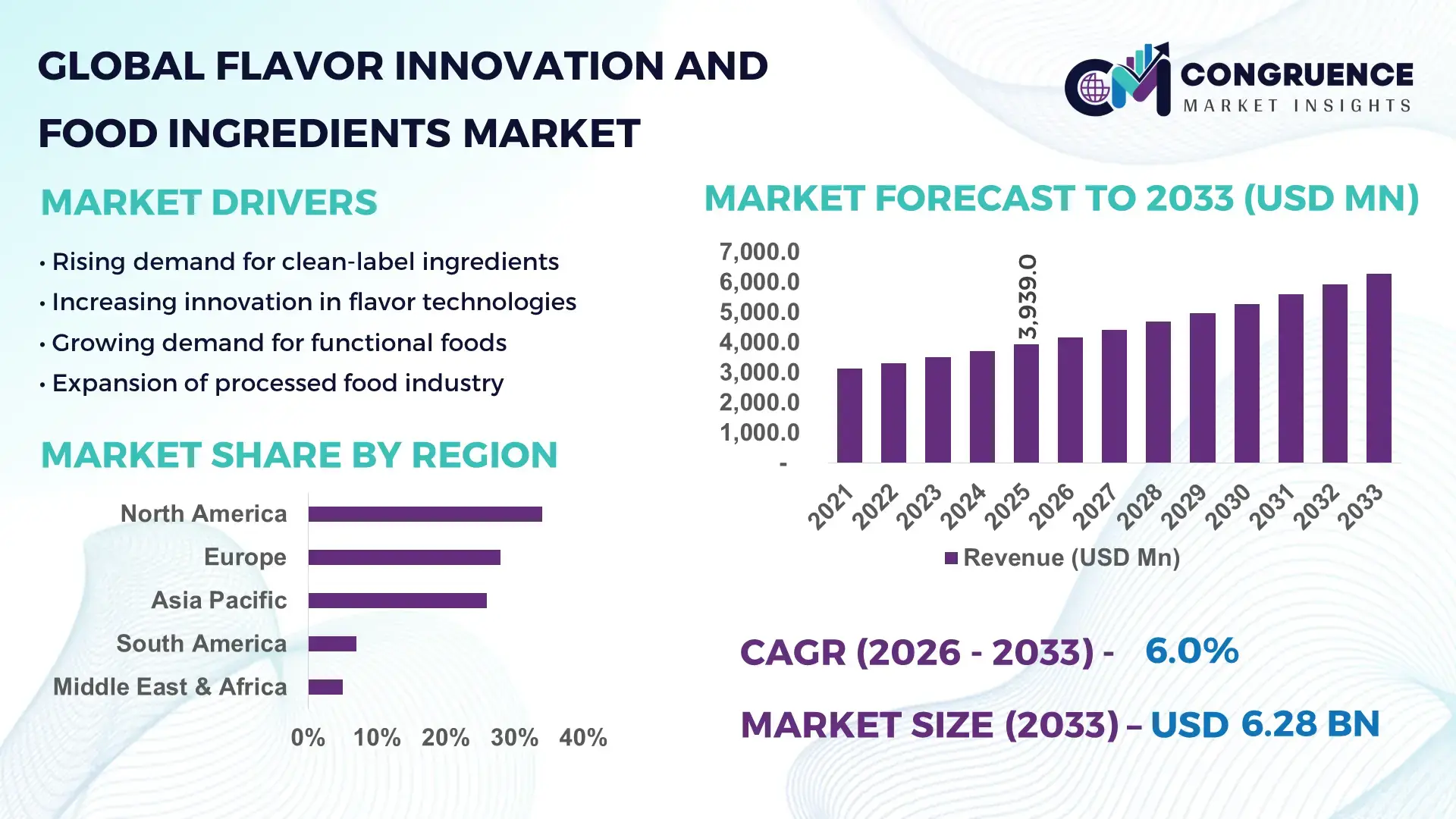
The Global Flavor Innovation and Food Ingredients Market was valued at USD 3,939.0 Million in 2025 and is anticipated to reach a value of USD 6,278.2 Million by 2033 expanding at a CAGR of 6.0% between 2026 and 2033, according to an analysis by Congruence Market Insights. Growth is primarily driven by rising demand for clean-label, plant-based, and functional food products across global consumer markets.
The United States continues to demonstrate strong positioning in the Flavor Innovation and Food Ingredients Market with advanced production infrastructure and high R&D investments exceeding USD 2.5 billion annually in food innovation technologies. Over 65% of food manufacturers in the country are actively incorporating natural and organic flavoring agents into product lines. The processed food sector contributes nearly 70% of ingredient demand, while beverage innovation accounts for over 25% of flavor usage. Additionally, over 40% of new product launches in 2025 included functional ingredients such as probiotics and plant extracts, highlighting strong technological adoption in flavor engineering and ingredient formulation processes.
Market Size & Growth: USD 3,939.0 Million in 2025, projected to reach USD 6,278.2 Million by 2033 at 6.0% CAGR, driven by increasing clean-label and functional food demand.
Top Growth Drivers: Clean-label adoption (68%), plant-based food demand increase (55%), functional ingredient integration (47%).
Short-Term Forecast: By 2028, production efficiency is expected to improve by 22% due to automation and digital ingredient formulation tools.
Emerging Technologies: AI-driven flavor design, fermentation-based ingredient synthesis, precision encapsulation technologies.
Regional Leaders: North America (USD 2.1B by 2033, strong R&D), Europe (USD 1.8B, regulatory-driven innovation), Asia-Pacific (USD 1.9B, rising consumption).
Consumer/End-User Trends: Over 60% consumers prefer natural flavors, while 48% demand low-sugar and functional ingredient products.
Pilot or Case Example: In 2025, a food-tech pilot improved flavor stability by 30% using encapsulation technology, reducing ingredient degradation.
Competitive Landscape: Market leader holds ~18% share; key players include Givaudan, Firmenich, IFF, Symrise, and Kerry Group.
Regulatory & ESG Impact: Over 50% firms comply with clean-label regulations; 35% aim for sustainable ingredient sourcing by 2030.
Investment & Funding Patterns: Over USD 1.2 billion invested in food-tech startups focusing on flavor innovation and biotech ingredients.
Innovation & Future Outlook: Growth driven by bioengineered flavors, AI formulation platforms, and sustainable sourcing practices.
The market is shaped by strong contributions from processed foods (52%), beverages (28%), and nutraceuticals (20%). Innovations in fermentation-based ingredients and sugar-reduction technologies are transforming product development. Regulatory frameworks promoting natural additives and sustainability are accelerating adoption, particularly in Europe and North America. Asia-Pacific shows strong consumption growth due to urbanization and dietary shifts, while future outlook highlights increased integration of AI and biotechnology in flavor formulation.
The Flavor Innovation and Food Ingredients Market holds strong strategic relevance as global food systems transition toward sustainability, health-centric consumption, and advanced manufacturing processes. Businesses are increasingly aligning their strategies with consumer demand for transparency, leading to over 65% of companies reformulating products to include natural or plant-derived ingredients. AI-driven flavor modeling delivers 35% faster product development cycles compared to traditional sensory testing methods, enhancing speed-to-market advantages for manufacturers.
From a regional perspective, North America dominates in production volume, while Asia-Pacific leads in adoption with over 58% of food startups integrating innovative ingredient technologies into their offerings. This divergence highlights the growing importance of emerging markets in driving consumption and experimentation with new flavor profiles. By 2028, AI-enabled ingredient optimization is expected to improve formulation accuracy by 25%, significantly reducing waste and enhancing consistency in food production.
Sustainability commitments are also shaping the market, with firms targeting 30% reduction in carbon emissions and 40% improvement in sustainable sourcing practices by 2030. Regulatory frameworks supporting clean-label initiatives and reduced artificial additives are further reinforcing these commitments.
A notable micro-scenario includes a 2025 initiative in Japan, where a leading food manufacturer achieved a 28% reduction in sugar content using enzymatic flavor enhancement technologies while maintaining taste quality. Such advancements demonstrate the practical application of innovation in meeting health and regulatory goals.
Looking ahead, the Flavor Innovation and Food Ingredients Market is positioned as a critical pillar supporting resilient food systems, regulatory compliance, and sustainable growth, with increasing integration of biotechnology, AI, and precision fermentation shaping its future trajectory.
The Flavor Innovation and Food Ingredients Market is influenced by evolving consumer preferences, technological advancements, and regulatory frameworks promoting healthier and sustainable food production. Increasing demand for natural, organic, and functional ingredients has reshaped product development strategies across the food and beverage industry. Over 62% of global consumers now actively seek clean-label products, prompting manufacturers to eliminate artificial additives and adopt natural flavoring solutions.
Additionally, advancements in biotechnology and fermentation techniques are enabling the development of novel flavor compounds and ingredient alternatives, reducing dependency on traditional sourcing methods. The rise of plant-based diets has further accelerated innovation, with plant-derived ingredients accounting for nearly 45% of new product formulations in 2025. However, supply chain complexities and cost pressures associated with natural ingredient sourcing continue to impact scalability. Regulatory compliance across regions also plays a critical role, with stringent guidelines influencing ingredient approval and labeling standards, thereby shaping overall market dynamics.
The increasing consumer preference for clean-label and functional food products is a significant driver for the Flavor Innovation and Food Ingredients Market. More than 68% of global consumers prefer products with natural ingredients and transparent labeling, leading manufacturers to reformulate existing products. Functional ingredients such as probiotics, plant extracts, and vitamins are now included in over 45% of newly launched food products. Additionally, sugar reduction initiatives have led to a 30% increase in demand for natural sweeteners and flavor enhancers. The beverage sector has witnessed a 25% surge in demand for botanical and herbal flavors, while the dairy industry has adopted enzyme-based flavor enhancement techniques to improve taste and nutritional value. These trends are driving innovation in ingredient formulation and accelerating the adoption of advanced flavor technologies.
The market faces significant challenges due to the high cost of natural ingredient sourcing and volatility in raw material supply chains. Natural flavor extraction processes can cost up to 40% more than synthetic alternatives, impacting profit margins for manufacturers. Climate change has also disrupted agricultural yields, leading to a 20% fluctuation in the availability of key raw materials such as vanilla, cocoa, and citrus extracts. Additionally, compliance with stringent regulatory standards increases operational costs by nearly 15% for companies operating in multiple regions. Smaller manufacturers often struggle to invest in advanced extraction and formulation technologies, limiting their ability to compete. These cost pressures and supply chain disruptions act as key restraints on market expansion and innovation scalability.
Biotechnology and precision fermentation present significant growth opportunities in the Flavor Innovation and Food Ingredients Market. These technologies enable the production of sustainable and cost-efficient flavor compounds, reducing reliance on traditional agricultural sources. Precision fermentation has improved ingredient yield efficiency by up to 35%, while reducing environmental impact by nearly 25%. Additionally, over 50% of food-tech startups are investing in bioengineered flavors and alternative protein ingredients. The demand for plant-based and vegan products has increased by 60% globally, creating new avenues for innovation in flavor formulation. These advancements allow manufacturers to develop customized and scalable solutions, enhancing product differentiation and expanding market reach.
Regulatory complexities and varying global standards pose a significant challenge to the Flavor Innovation and Food Ingredients Market. Companies must comply with diverse labeling, safety, and ingredient approval regulations, increasing compliance timelines by up to 25%. Consumer perception also plays a critical role, as nearly 35% of consumers remain skeptical about bioengineered or synthetic ingredients, even when scientifically validated. Additionally, the lack of standardized global frameworks for emerging technologies such as precision fermentation creates uncertainty for manufacturers. These challenges can delay product launches and limit the adoption of innovative solutions, affecting overall market growth and competitiveness.
Surge in plant-based ingredient adoption: Over 58% of new food product launches in 2025 incorporated plant-based ingredients, reflecting growing consumer demand for sustainable diets. Manufacturers reported a 35% increase in plant-derived flavor applications, particularly in dairy alternatives and meat substitutes, enhancing taste profiles and nutritional value.
Expansion of AI-driven flavor formulation: AI-based tools are now used by nearly 42% of large food manufacturers, reducing product development timelines by 30%. These technologies enable predictive modeling of flavor combinations, improving formulation accuracy and reducing trial-and-error processes in product innovation cycles.
Growth in sugar reduction technologies: More than 50% of beverage manufacturers adopted sugar-reduction solutions, achieving up to 28% reduction in sugar content without compromising taste. Natural sweeteners such as stevia and monk fruit have seen a 33% increase in usage across global markets.
Rising demand for sustainable sourcing: Approximately 48% of companies have implemented sustainable sourcing strategies, with 40% focusing on reducing carbon footprints through eco-friendly ingredient procurement. This trend is particularly strong in Europe and North America, where regulatory pressures and consumer awareness are driving adoption.
The Flavor Innovation and Food Ingredients Market is segmented based on type, application, and end-user industries, each contributing uniquely to market development. Ingredient types include natural flavors, artificial flavors, flavor enhancers, and functional ingredients, with natural variants gaining significant traction due to regulatory and consumer demand. Applications span across food processing, beverages, dairy, bakery, and nutraceuticals, where innovation is driven by taste enhancement and health benefits. End-users include food manufacturers, beverage companies, and nutraceutical firms, each leveraging advanced formulation technologies to improve product quality and consumer appeal. Increasing demand for customized flavor solutions and functional ingredients is further shaping segmentation trends, with measurable adoption across multiple industries.
Natural flavors account for approximately 46% of the market due to increasing demand for clean-label products, while artificial flavors hold around 22%. However, functional ingredients are the fastest-growing segment, expected to grow at a CAGR of 8.2% due to rising health awareness. Flavor enhancers and specialty ingredients collectively contribute nearly 32% of the market, supporting niche applications such as processed foods and beverages. Natural flavors dominate due to their alignment with regulatory standards and consumer preferences for transparency. Functional ingredients are gaining traction as over 40% of consumers seek health benefits in food products, including immunity support and digestive health. Artificial flavors remain relevant due to cost efficiency and scalability in mass production.
Food processing dominates with approximately 48% share, followed by beverages at 27%. Nutraceutical applications are the fastest-growing, with a CAGR of 9.1%, driven by increased demand for functional and fortified products. Bakery and dairy applications collectively account for around 25% of market usage. In 2025, more than 52% of global food manufacturers incorporated advanced flavor technologies into processed foods to enhance taste and shelf life. Additionally, over 45% of beverage companies reported increased adoption of natural and botanical flavors. Consumer trends indicate that 60% of buyers prefer functional beverages with added health benefits.
Food manufacturers hold the largest share at approximately 55%, followed by beverage companies at 30%. Nutraceutical firms are the fastest-growing segment, expanding at a CAGR of 9.4% due to rising demand for health-focused products. Other end-users contribute around 15% collectively. Over 50% of enterprises globally reported investing in advanced ingredient technologies to enhance product differentiation. Additionally, 62% of consumers show increased preference for products enriched with functional ingredients. Nutraceutical companies are leveraging biotechnology to develop innovative formulations, driving rapid growth.
North America accounted for the largest market share at 34% in 2025 however, Asia-Pacific is expected to register the fastest growth, expanding at a CAGR of 7.8% between 2026 and 2033.

North America leads due to advanced food processing infrastructure and high adoption of innovative ingredient technologies. Europe follows with a 28% share, driven by stringent regulatory frameworks and strong demand for clean-label products. Asia-Pacific holds approximately 26% share, supported by rapid urbanization and increasing consumer spending on processed and functional foods. South America and Middle East & Africa collectively account for 12%, with growing demand for packaged and convenience foods. The increasing adoption of plant-based diets and functional ingredients across regions is shaping global consumption patterns.
North America holds approximately 34% market share, driven by strong demand from the processed food and beverage industries. Regulatory frameworks promoting clean-label products and reduced artificial additives are influencing market growth. Over 65% of manufacturers have adopted AI-based formulation tools to enhance product development. The region also sees significant investments in biotechnology and fermentation technologies. A leading company in the region has implemented advanced flavor encapsulation techniques, improving product shelf life by 25%. Consumer behavior indicates higher adoption of functional foods, with over 60% of consumers preferring health-enhancing ingredients.
Europe accounts for around 28% of the market, with key countries including Germany, France, and the UK leading innovation. Regulatory bodies emphasize sustainable sourcing and clean-label compliance, influencing over 50% of product formulations. Adoption of plant-based and organic ingredients is widespread, with 48% of consumers actively choosing sustainable products. Technological advancements in fermentation and natural extraction processes are driving innovation. A regional company recently launched eco-friendly flavor solutions, reducing environmental impact by 30%. Consumer behavior reflects strong preference for transparency and sustainability.
Asia-Pacific ranks as the fastest-growing region, accounting for approximately 26% market share. Major countries include China, India, and Japan, with strong growth in processed food consumption. Manufacturing expansion and urbanization are driving demand, while over 55% of companies are investing in advanced ingredient technologies. Innovation hubs in the region focus on plant-based and functional ingredients. A leading regional manufacturer introduced plant-derived flavor solutions, improving product acceptance by 20%. Consumer behavior is driven by rising disposable income and preference for convenience foods.
South America holds around 7% market share, with Brazil and Argentina as key contributors. Infrastructure improvements and growing food processing industries are driving demand. Government initiatives promoting agricultural exports support ingredient production. A regional player has developed natural flavor extracts, increasing production efficiency by 18%. Consumer behavior shows increasing preference for processed and packaged foods, with rising demand for cost-effective flavor solutions.
The Middle East & Africa account for approximately 5% of the market, with UAE and South Africa as key growth regions. Demand is driven by food processing and hospitality industries. Technological modernization and trade partnerships are enhancing ingredient supply chains. A regional company has adopted advanced flavor extraction techniques, improving output efficiency by 15%. Consumer behavior indicates growing demand for premium and imported food products.
United States – 34% Market share: Strong production capacity and high adoption of advanced food technologies drive the market.
Germany – 18% Market share: Robust food processing industry and strict regulatory frameworks support consistent growth in the market.
The Flavor Innovation and Food Ingredients Market is moderately fragmented, with over 120 active global and regional competitors operating across various segments. The top five companies collectively hold approximately 55% of the market, indicating a semi-consolidated structure with strong competition among leading players. Key companies are focusing on strategic initiatives such as mergers, acquisitions, and partnerships to strengthen their market presence and expand product portfolios.
Innovation remains a key competitive factor, with over 45% of companies investing in research and development to introduce advanced flavor technologies and functional ingredients. Product differentiation through clean-label, natural, and sustainable offerings is a primary strategy among leading firms. Additionally, nearly 38% of companies have adopted digital platforms and AI-based tools to optimize product development and reduce time-to-market.
The market also witnesses increased collaboration between food manufacturers and technology providers, with over 30% of firms engaging in joint ventures to enhance innovation capabilities. Regional players are focusing on cost-effective solutions and local sourcing to compete with global leaders. Overall, the competitive landscape is shaped by continuous innovation, strategic partnerships, and a strong focus on sustainability and consumer preferences.
IFF
Symrise
Firmenich SA
Kerry Group
Sensient Technologies Corporation
Takasago International Corporation
Mane SA
Robertet Group
T. Hasegawa Co., Ltd.
Frutarom Industries
Döhler Group
Archer Daniels Midland Company
Cargill Incorporated
Technological advancements are playing a transformative role in the Flavor Innovation and Food Ingredients Market, enabling enhanced product development, efficiency, and sustainability. Artificial intelligence is increasingly used for predictive flavor modeling, with over 40% of large manufacturers adopting AI tools to optimize formulation processes. These technologies reduce product development cycles by nearly 30% and improve accuracy in flavor combinations.
Biotechnology and precision fermentation are also gaining traction, enabling the production of sustainable and scalable flavor compounds. These methods improve yield efficiency by up to 35% while reducing environmental impact by approximately 25%. Encapsulation technologies are another key innovation, allowing controlled release of flavors and improving product shelf life by 20–25%.
Advanced extraction techniques, such as supercritical CO2 extraction, are widely used to obtain high-quality natural flavors, improving extraction efficiency by 15%. Digital twin technology is emerging as a tool for simulating ingredient interactions, helping manufacturers optimize production processes and reduce waste by 18%.
Additionally, automation in food processing facilities has increased operational efficiency by 22%, enabling consistent quality and scalability. These technological advancements are driving innovation, improving sustainability, and enhancing competitiveness in the market.
• In June 2025, Givaudan announced its participation at VivaTech 2025, showcasing digital innovations such as Myromi™ and Customer Foresight tools designed to translate consumer insights into actionable flavor development, enabling faster product creation and improved commercial success in food and beverage applications. Source: www.givaudan.com
• In January 2026 (reporting FY2025), Givaudan confirmed continued investment in its Taste & Wellbeing segment, with operating income increasing by 4.9% in local currency terms, supported by ongoing digital transformation and innovation initiatives in flavor development platforms and ingredient technologies.
• In January 2025, industry disclosures highlighted that leading companies including IFF, Symrise, Kerry, and Givaudan are actively expanding biotech-based flavor production using fermentation and bioconversion technologies, improving sustainability and enabling scalable replication of natural taste compounds.
• In 2024, Symrise achieved a top “A” rating in supplier engagement for sustainability initiatives, reinforcing its commitment to responsible sourcing and compliance across its flavor ingredient supply chain, with stricter supplier standards being implemented across global operations.
The Flavor Innovation and Food Ingredients Market Report provides a comprehensive analysis of industry dynamics, segmentation, regional insights, and technological advancements shaping the market landscape. The report covers multiple product types, including natural flavors, artificial flavors, functional ingredients, and specialty flavor enhancers, each contributing significantly to product innovation and consumer demand.
The scope includes detailed application analysis across food processing, beverages, dairy, bakery, and nutraceutical sectors, highlighting key usage patterns and industry-specific requirements. End-user analysis focuses on food manufacturers, beverage companies, and nutraceutical firms, providing insights into adoption trends and technological integration.
Geographically, the report examines key regions including North America, Europe, Asia-Pacific, South America, and the Middle East & Africa, offering detailed insights into regional demand patterns, consumer behavior, and regulatory frameworks. The report also explores emerging markets and niche segments, such as plant-based ingredients and biotechnology-driven flavor solutions.
Additionally, the report includes analysis of technological advancements such as AI-driven formulation, precision fermentation, and advanced extraction techniques. It provides insights into competitive landscape, strategic initiatives, and innovation trends shaping the market. This comprehensive scope ensures that decision-makers gain a clear understanding of market opportunities, challenges, and future growth potential.
| Report Attribute / Metric | Details |
|---|---|
| Market Revenue (2025) | USD 3,939.0 Million |
| Market Revenue (2033) | USD 6,278.2 Million |
| CAGR (2026–2033) | 6.0% |
| Base Year | 2025 |
| Forecast Period | 2026–2033 |
| Historic Period | 2021–2025 |
| Segments Covered |
By Type
By Application
By End-User Insights
|
| Key Report Deliverables | Revenue Forecast; Market Trends; Growth Drivers & Restraints; Technology Insights; Segmentation Analysis; Regional Insights; Competitive Landscape; Regulatory & ESG Overview; Recent Developments |
| Regions Covered | North America; Europe; Asia-Pacific; South America; Middle East & Africa |
| Key Players Analyzed | Givaudan; International Flavors & Fragrances (IFF); Symrise; Firmenich; Kerry Group; Sensient Technologies Corporation; Takasago International Corporation; Mane SA; Robertet Group; T. Hasegawa Co., Ltd.; Döhler Group; Archer Daniels Midland Company; Cargill Incorporated |
| Customization & Pricing | Available on Request (10% Customization Free) |




