
Reports
The Global Fitness Training Software Market was valued at USD 10744.38 Million in 2025 and is anticipated to reach a value of USD 34741.61 Million by 2033 expanding at a CAGR of 15.8% between 2026 and 2033. Growth is being driven by AI-personalized coaching, wearable biometric integration, hybrid gym memberships, and software-led automation of workout programming, member engagement, and trainer workflows.
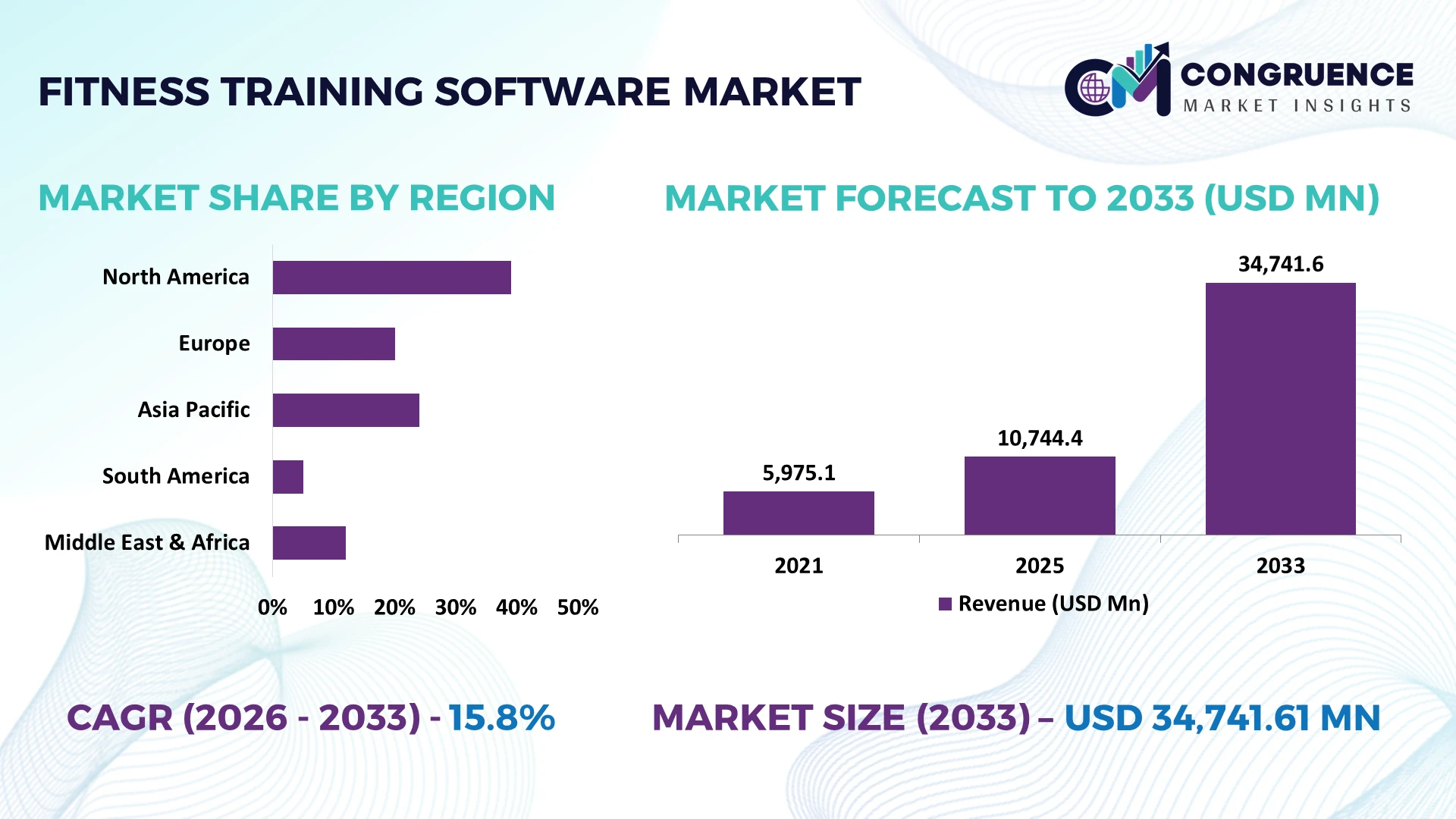
The United States represents the dominant national market, supported by an estimated 24%–27% global share and a mature connected-fitness ecosystem spanning gyms, corporate wellness, rehabilitation, and direct-to-consumer coaching. Approximately 71% of Americans use health-related apps, while 64% use connected health devices, creating a large addressable base for advanced fitness training platforms. By comparison, Europe reached 75.5 million health-club members in 2025, up 5.8%, strengthening software deployment across clubs and trainers. EU data-governance requirements are simultaneously raising the importance of privacy-by-design architecture.
Strategically, vendors should prioritize AI coaching, wearable interoperability, enterprise gym integrations, and privacy-compliant data infrastructure in the United States and high-adoption European markets.
Market Size & Growth: USD 10,744.38 million in 2025 advances to USD 34,741.61 million by 2033 at 15.8% CAGR, supported by AI coaching, wearable connectivity, and hybrid fitness delivery.
Top Growth Drivers: AI-powered personalization, wearable integration, and hybrid training lead expansion, reinforced by nearly 50% daily usage of AI-powered fitness and wellness apps among surveyed consumers.
Short-Term Forecast: By 2027, advanced automation and AI-assisted programming are positioned to reduce routine trainer planning and member-management workloads by approximately 20%–30% across digitally mature operators.
Emerging Technologies: Generative AI coaches, computer-vision form analysis, and continuous biometric processing are shifting software from workout libraries toward adaptive training engines; smartphones already represent 46.5% of AI personal-trainer device deployment.
Regional Leaders: North America leads advanced adoption, Europe benefits from 75.5 million fitness-club members, while Asia-Pacific gains from mobile-first training ecosystems and rapidly expanding wearable-device penetration.
Consumer/End-User Trends: Nearly 50% of surveyed consumers use AI-powered fitness and wellness applications daily, while 55% express data-privacy concerns, making personalization and trusted data handling simultaneous purchase criteria.
Pilot/Case Example: In 2025, ABC Fitness data covering 40 million members and 30,000 facilities showed gym and studio check-ins rising 8% year over year alongside 27% growth in new-member joins.
Competitive Landscape: The market remains fragmented, with no single provider approaching a 20% global share; Peloton, iFIT, Mindbody, ABC Fitness, and Virtuagym compete through coaching intelligence, integrations, analytics, and ecosystem scale.
Regulatory & ESG Impact: Europe’s GDPR framework and phased EU AI Act implementation elevate governance requirements as 55% of surveyed fitness consumers report concern about AI-related data and privacy.
Investment & Funding: Global digital-health funding exceeds USD 10 billion annually, supporting AI, connected wellness, remote coaching, and analytics platforms while strategic partnerships increasingly connect software developers with gyms, wearables, and healthcare ecosystems.
Innovation & Future Outlook: AI-driven adaptive programming, multimodal biometric analytics, and automated retention engines will shift competition toward measurable outcomes; 88% of Americans want the same or greater technology involvement in health management.
Fitness Training Software is evolving from scheduling and workout-delivery infrastructure into an intelligent performance-management layer connecting trainers, members, wearables, gyms, and wellness programs. Demand is concentrated around AI-generated programming, real-time biometric feedback, computer-vision exercise assessment, automated engagement, and integrated nutrition functionality. Nearly 50% of surveyed consumers already use AI-powered fitness and wellness applications daily, validating the commercial transition toward adaptive coaching. At the same time, GDPR and emerging AI governance requirements are pushing vendors toward consent-based data architecture, explainable recommendations, and stronger privacy controls, establishing technology governance as a strategic competitive factor.
Fitness training software is becoming strategic infrastructure for gym operators, coaching businesses, and connected-fitness providers as competition shifts from facility access toward measurable, personalized member outcomes. Hybrid training has accelerated this transition: operators increasingly combine in-club sessions with mobile programming, wearable data, nutrition tracking, and remote coaching. At the same time, GDPR and evolving AI governance are forcing platforms to modernize consent management, biometric-data controls, and algorithmic transparency, making software architecture a competitive consideration rather than a back-office function.
AI-assisted programming and automated member engagement can reduce routine trainer administration by approximately 20–30% compared with spreadsheet-based programming and manual follow-up. The United States leads deployment through large gym networks and mature wearable ecosystems, while Europe’s 75 million-plus health-club membership base supports scale but imposes stricter data-governance requirements. India presents a contrasting mobile-first pathway, where smartphone-led coaching enables operators to reach consumers without extensive physical-club infrastructure. Through 2026–2028, AI personalization, connected devices, and integrated payments will become increasingly standard platform capabilities.
A practical deployment involves combining member check-ins, workout history, wearable metrics, and automated messaging to identify disengagement and trigger trainer intervention. Providers are consequently investing in API ecosystems, AI engines, wearable partnerships, and multi-location management capabilities. Competitive advantage will increasingly depend on converting fragmented fitness data into actionable coaching decisions while maintaining trusted, interoperable digital infrastructure.
AI-led personalization is transforming fitness software from static workout repositories into adaptive coaching systems that continuously adjust programs using activity, recovery, and biometric data. Nearly 50% of surveyed consumers use AI-enabled fitness or wellness applications daily, while approximately 46% of AI personal-trainer interactions occur through smartphones. Hybrid fitness models reinforce adoption as operators connect physical workouts with remote coaching, wearables, and automated engagement. In the United States, digital-first gym chains increasingly integrate member applications directly with club-management infrastructure, reducing dependence on manual trainer workflows. Vendors are responding by investing in generative workout engines, wearable APIs, computer vision, and automated retention tools. The strategic advantage lies in personalization at scale: one software platform can standardize coaching quality across thousands of members without proportionally increasing trainer hours.
Fitness platforms process sensitive biometric, behavioral, location, and health-related information, creating significant compliance and interoperability constraints. Around 55% of surveyed fitness consumers express concern about AI-related data privacy, while approximately 30% of wearable users report concerns surrounding personal-data security. Europe adds structural pressure through GDPR and emerging AI governance requirements governing consent, automated processing, and data transparency. Meanwhile, fragmented APIs across smartwatches, gym equipment, payment systems, and club-management platforms increase integration expenditure and delay enterprise deployments. Vendors are reducing exposure through encrypted data architecture, standardized APIs, consent-management layers, and partnerships with established wearable ecosystems. A critical operational constraint is data portability: platforms unable to consolidate member information across multiple devices risk incomplete training profiles, weakening personalization accuracy and increasing customer switching friction.
Computer vision, multimodal AI, and continuous biometric analytics create an opportunity to extend fitness software beyond workout planning into movement assessment, recovery management, and preventive wellness. Smartphone-based AI trainers already account for approximately 46% of device-based deployments, while nearly 50% of surveyed consumers report daily interaction with AI-powered fitness or wellness applications. India offers particularly attractive mobile-first economics because smartphone delivery allows digital coaching businesses to scale without replicating capital-intensive gym networks. Between 2026 and 2028, camera-based exercise analysis, real-time form correction, adaptive recovery scores, and integrated nutrition engines will broaden monetization beyond subscriptions. Developers are increasing R&D around pose estimation, wearable interoperability, and healthcare partnerships. The non-obvious opportunity is corporate wellness: aggregated performance analytics can support workforce engagement while creating enterprise contracts with substantially lower customer-acquisition dependence than consumer-only models.
Long-term competitiveness depends on delivering reliable personalization across increasingly fragmented hardware, software, and member environments. Approximately 55% of surveyed consumers remain concerned about AI-related privacy, while wearable ecosystems generate continuously changing biometric datasets requiring secure synchronization and consistent interpretation. AI recommendations also depend on data quality; missing heart-rate, recovery, exercise-form, or training-history inputs can produce inconsistent programming even when the underlying algorithm is advanced. In the United States, large multi-location operators compound this problem because platforms must synchronize thousands of devices, trainers, memberships, and third-party applications without disrupting workouts or billing. Companies must invest in model validation, API reliability, cybersecurity, cloud infrastructure, and human-in-the-loop coaching. The decisive execution challenge is therefore not adding more AI features, but maintaining dependable recommendations as user volume, connected-device diversity, and regulatory scrutiny increase simultaneously.
Retention Automation Replaces Acquisition Focus: Fitness operators are shifting software investment toward engagement and churn prevention as 2026 gym check-ins remained broadly flat while new joins declined 9% and cancellations increased 8%. Platforms are deploying automated inactivity alerts, behavioral segmentation, and trainer-triggered messaging. Companies are restructuring CRM workflows around retention probability rather than acquisition volume, improving trainer prioritization and reducing marketing dependence.
Wearable Data Enters Daily Workflows: Connected-device information is moving from passive dashboards into programming decisions, with 36–44% of adults owning wearables and more than 70% of wearable users applying captured data to exercise or recovery decisions. Platforms increasingly ingest HRV, sleep, heart-rate, and recovery metrics automatically. Vendors are expanding device integrations and unified data layers, reducing manual assessment while enabling coaches to modify sessions faster.
Nutrition Becomes Platform-Native Capability: Fitness applications are integrating nutrition directly with training rather than maintaining separate tracking workflows. In 2025, 49% of members used nutrition applications while 61% used AI-driven fitness tracking tools. Integration partnerships are connecting meal logging, supplementation, activity, and coaching records. Software providers are expanding APIs and partner ecosystems, increasing daily platform touchpoints and giving trainers broader behavioral context for programming.
Community Data Shapes Retention Operations: Digital community functionality is becoming measurable operating infrastructure: 57% of active consumers seek connection through fitness communities, one-third engage with them daily, and 47% of 2025 gym joins came from Gen Z. Operators are embedding challenges, messaging, leaderboards, and group engagement into member applications. The non-obvious shift is that community interaction is becoming a retention signal that platforms can operationalize alongside attendance data.
Workout Planning Software accounts for an estimated 30% of Fitness Training Software demand, supported by its central role in exercise prescription, progression management, workout libraries, and trainer-client communication. Its scalability allows gyms and independent professionals to standardize programming while modifying routines across large client populations. Personal Training Software follows as an established segment, combining scheduling, billing, messaging, assessments, and remote coaching. Performance Tracking Software is the fastest-growing type as wearable-derived HRV, sleep, heart-rate, and recovery data increasingly influence training decisions; more than 70% of wearable users report applying device outputs to exercise or recovery.
Class Management Software remains operationally important for studios and multi-location facilities requiring booking, capacity, attendance, and instructor coordination. Nutrition Tracking Software is becoming more integrated with training platforms as 49% of fitness members used nutrition applications in 2025. Vendors are consequently prioritizing unified dashboards, wearable APIs, AI-generated programming, and nutrition integrations, shifting investment from isolated software functions toward interoperable coaching ecosystems.
Strength Training represents an estimated 31% of application demand, reflecting high requirements for structured progression, load tracking, exercise libraries, repetition monitoring, and personalized programming. Traditional strength training ranked fifth in the American College of Sports Medicine’s 2025 fitness trends, reinforcing its established position across gyms and personal-training environments. Cardio Training remains a mature application supported by heart-rate monitoring and connected equipment, while Group Fitness increasingly combines digital booking, attendance management, instructor programming, and member engagement. Approximately 60% of active consumers use a gym, health club, or fitness studio, supporting continued software intensity across these applications.
Sports Training is the fastest-growing application as coaches integrate wearable telemetry, recovery indicators, workload analytics, and individualized performance data into athlete programming. Weight Management is simultaneously becoming more digitally integrated through combined exercise and nutrition workflows. Providers are responding with sport-specific dashboards, automated progression engines, connected-equipment integrations, and configurable group programming, directing product investment toward applications where continuous performance data materially improves coaching decisions.
Fitness Centers hold an estimated 34% share of end-user demand because large facilities require integrated membership management, workout programming, attendance analytics, trainer coordination, payments, and engagement across thousands of recurring users. Gyms represent another established buyer group, particularly multi-site operators standardizing member applications and automated communication. In 2025, fitness facilities recorded 7.2 million new joins, while check-ins increased 11% compared with 2021, reinforcing the operational need for scalable member-management infrastructure. Personal Trainers increasingly favor mobile-first platforms combining programming, billing, communication, and performance tracking.
Corporate Wellness Programs represent the fastest-growing end-user category as employers increasingly connect activity challenges, digital coaching, wearable data, and workforce engagement within centralized wellness platforms. Sports Clubs remain specialized buyers requiring athlete monitoring, team programming, and workload analytics. Vendors are responding with enterprise pricing, multi-location dashboards, coach-specific applications, API integrations, and configurable wellness modules. Competitive positioning is shifting toward platforms capable of serving both facility-based operations and distributed digital users through one ecosystem.
North America accounted for the largest market share at 38.5% in 2025 however, Asia-Pacific is expected to register the fastest growth, expanding at a CAGR of 18.2% between 2026 and 2033.

AI-Integrated Fitness Ecosystems Drive Deployment
North America accounts for approximately 38.5% of global Fitness Training Software demand, anchored by high smartphone penetration, established health-club networks, connected fitness equipment, and enterprise-scale software deployments. U.S. operators increasingly consolidate workout programming, membership administration, payments, wearable telemetry, and retention analytics within unified platforms. Digital infrastructure is particularly mature among multi-location chains, where automation reduces trainer administration and standardizes member experiences. ABC Fitness reported an ecosystem spanning more than 40 million members, 30,000 fitness businesses, and 650,000 coaches, illustrating the scale at which software platforms now operate. Canadian operators are similarly adopting mobile booking and hybrid coaching, although deployment remains more concentrated among urban fitness networks. Vendors are responding through AI personalization, open APIs, embedded payments, and acquisitions that broaden club-management capabilities.
United States Market Outlook: The United States leads through extensive gym infrastructure, high wearable ownership, and a dense technology-provider ecosystem. Approximately 36%–44% of adults use wearable devices, strengthening demand for platforms capable of processing heart-rate, sleep, recovery, and activity data. Enterprise buyers increasingly prioritize integrated software stacks that reduce application fragmentation while improving trainer productivity and member retention.
Digital Modernization Meets Stricter Data Governance
Europe represents approximately 27.0% of global demand, supported by large health-club networks, sophisticated boutique studios, digital membership models, and accelerating integration of mobile training platforms. The European fitness sector exceeded 75 million club members in 2025, creating a substantial installed base for scheduling, workout programming, payments, engagement, and performance analytics. Germany, the United Kingdom, France, and Spain concentrate enterprise deployment, while GDPR and phased AI regulation make consent architecture, biometric-data governance, and explainable automation increasingly important procurement criteria. Operators are replacing fragmented point solutions with integrated platforms capable of connecting member applications, access control, coaching, and financial workflows. Software vendors are consequently investing in EU-hosted infrastructure, multilingual functionality, standardized integrations, and privacy controls. This regulatory environment favors platforms capable of combining personalization with demonstrable data governance.
Germany Market Outlook: Germany combines one of Europe’s largest fitness-club populations with a highly organized operator base and strong consumer adoption of connected health technologies. More than 11 million fitness memberships provide substantial deployment potential for automated programming and club-management platforms. German operators emphasize secure data processing, interoperability, recurring membership administration, and measurable member engagement, benefiting vendors with enterprise-grade compliance capabilities.
Mobile-First Coaching Reshapes Fitness Delivery
Asia-Pacific represents approximately 24.5% of global Fitness Training Software demand, with deployment increasingly shaped by smartphone-first coaching, wearable ecosystems, super-app integration, and rapidly digitizing fitness chains. China, India, Japan, South Korea, and Australia offer distinct adoption models: China combines connected hardware with digital content, while India enables trainers to serve distributed users without equivalent physical-club expansion. Smartphone penetration exceeds 70% across several major markets, giving software providers an efficient distribution channel for subscription coaching, nutrition tracking, and performance monitoring. Operators are integrating QR access, digital payments, automated renewals, and app-based programming to reduce front-desk dependency. Domestic technology ecosystems also lower integration barriers for wearables and payment platforms. Vendors are prioritizing localized interfaces, lower-cost subscriptions, AI coaching, and partnerships with gyms and device manufacturers to capture mobile-native users.
China Market Outlook: China combines extensive smartphone usage, domestic wearable manufacturing, digital-payment infrastructure, and connected-equipment development, creating a tightly integrated fitness technology ecosystem. With more than 1 billion internet users, digital platforms can scale training services beyond physical facilities. Local providers increasingly connect smart hardware, workout content, community engagement, and performance analytics, intensifying competition around ecosystem integration rather than standalone software functionality.
Gym Digitization Accelerates Membership Automation
South America contributes approximately 5.5% of global Fitness Training Software demand, with Brazil representing the principal deployment center and Argentina, Colombia, and Chile supporting expanding digital fitness ecosystems. Large gym chains are accelerating adoption of mobile check-in, recurring payments, class scheduling, workout programming, and member-engagement automation as operators manage geographically distributed facilities. Brazil has more than 30,000 fitness facilities, creating a sizeable addressable base for SaaS deployment and trainer-facing applications. Mobile-first delivery also allows independent coaches to serve clients outside conventional gyms, widening software utilization without equivalent facility investment. However, payment fragmentation, currency volatility, and uneven enterprise digitization complicate standardized deployments. Providers are responding with localized billing, Portuguese and Spanish interfaces, flexible subscription tiers, and partnerships with regional payment processors, enabling more resilient software economics.
Brazil Market Outlook: Brazil provides the strongest country-level opportunity through its extensive gym base, large urban population, and deeply established fitness culture. Operators increasingly require centralized software to coordinate multiple facilities, instructors, subscriptions, and digital workouts. High instant-payment adoption through Pix strengthens recurring digital transactions, giving fitness platforms an efficient infrastructure layer for memberships, coaching packages, and ancillary services.
Premium Fitness Investment Accelerates Digitization
Middle East & Africa accounts for approximately 4.5% of global Fitness Training Software demand, with deployment concentrated in the UAE, Saudi Arabia, South Africa, and digitally connected urban centers. Gulf markets are distinguished by premium fitness facilities, government-backed wellness initiatives, high smartphone penetration, and investment in technology-enabled leisure infrastructure. Saudi Arabia’s Vision 2030 transformation is expanding participation infrastructure and commercial fitness capacity, increasing requirements for membership platforms, digital coaching, class scheduling, and engagement analytics. UAE operators are integrating wearable connectivity, cashless payments, mobile access, and personalized training within premium club experiences. Africa presents a more fragmented environment, where mobile-first platforms reduce dependence on extensive physical infrastructure. Vendors are targeting the region through cloud deployments, localized payments, Arabic-language interfaces, franchise partnerships, and configurable enterprise platforms suited to rapidly expanding gym networks.
Saudi Arabia Market Outlook: Saudi Arabia is emerging as the region’s strategic deployment market as Vision 2030 increases investment in sport, wellness, and active-lifestyle infrastructure. Female participation and commercial fitness availability have expanded materially from historical levels, broadening the addressable user base. Software providers benefit from new facilities adopting digital membership, scheduling, coaching, payments, and performance management from inception rather than replacing entrenched legacy systems.
Fitness Training Software competition pits integrated platform leaders ABC Fitness, Mindbody, and Virtuagym against coaching-focused innovators Trainerize and TrueCoach and connected-fitness ecosystems such as Peloton. The top five players collectively hold approximately 32% of global demand, leaving substantial scope for specialized platforms. Technology is the primary battleground: AI-assisted programming can reduce routine coaching administration by 20–30%, while integrated billing and scheduling can eliminate roughly 15–25% of manual front-desk workflows. Wearable connectivity also differentiates platforms as more than 35% of adults in digitally mature markets use connected health devices. Players are expanding through acquisitions, API partnerships, embedded payments, AI personalization, and vertically integrated member applications. Competition is shifting from standalone scheduling toward unified operating systems combining coaching, commerce, engagement, and analytics. Data portability, cybersecurity, and integration depth create significant entry barriers because enterprise operators cannot tolerate fragmented member records or platform downtime. Winning requires scalable infrastructure, measurable automation, broad interoperability, and demonstrably stronger member retention capabilities.
ABC Fitness
Mindbody
Virtuagym
TeamUp
TrueCoach
Exercise.com
Zen Planner
PushPress
GymMaster
TrainHeroic
My PT Hub
Vagaro
Peloton Interactive
EGYM
Current fitness training platforms combine wearable APIs, automated programming, and embedded payments. Real-time synchronization of sleep, heart-rate, activity, and nutrition data can cut manual client-data handling by roughly 20%, while workflow automation reduces scheduling and follow-up administration by 15–25%. Adoption is mainstreaming: nearly 50% of surveyed consumers used AI-powered fitness or wellness applications daily in 2025, strengthening demand for integrated coaching ecosystems.
Emerging technology centers on generative AI, computer vision, and multimodal biometric analytics. AI workout engines can generate individualized plans in about 20 seconds, versus several minutes of manual template construction, delivering more than 80% faster initial programming. Computer-vision form assessment and recovery-aware algorithms combine movement data with wearable metrics. Operators with large trainer networks benefit most because automation expands personalized service without matching increases in coaching headcount.
Disruptive development is shifting toward agentic AI that handles lead qualification, booking, member communications, retention outreach, and coaching assistance across unified workflows. Between 2026 and 2028, open APIs, AI agents, connected equipment, and predictive engagement will increasingly converge into fitness operating systems. Platforms integrating these layers can reduce fragmented software workflows by 20–30%, improving response speed and member continuity. Acting now matters because proprietary datasets and integration depth compound competitive advantage.
March 2024 ABC Fitness unveiled AI churn prediction, generative-AI decision tools, offline Trainerize payments, and scheduling upgrades at IHRSA 2024, extending automation across a platform supporting 40 million members and strengthening retention, personalization, and efficiency. Source: Health & Fitness Association.
August 2025 Virtuagym launched MAX AI Coach, enabling personalized workout plans within 20 seconds using more than 6,000 animated exercises. Deployment across 10,000+ business clients gives trainers faster programming capacity while preserving human control over personalized plan customization. Source: Virtuagym.
December 2025 Mindbody partnered with Attentive to embed AI-driven SMS and email personalization into its platform. Early adopter The Tox recorded a 60% lift in first-time visits, demonstrating automated marketing’s direct impact on customer acquisition and member engagement. Source: Mindbody.
July 2026 ABC Fitness acquired Replify, adding agentic AI for lead capture, booking, scheduling support and member communications across four channels: voice, text, email and chat. The acquisition shifts gym operations toward automated service and proactive engagement. Source: ABC Fitness.
The report evaluates Fitness Training Software across Workout Planning, Personal Training, Class Management, Nutrition Tracking, and Performance Tracking Software, alongside Strength Training, Cardio Training, Weight Management, Sports Training, and Group Fitness applications. End-user coverage includes Fitness Centers, Personal Trainers, Gyms, Sports Clubs, and Corporate Wellness Programs. Analysis spans North America, Europe, Asia-Pacific, South America, and Middle East & Africa, with North America representing approximately 38.5% of 2025 demand.
Technology coverage examines generative AI, computer vision, wearable integration, biometric analytics, cloud platforms, embedded payments, automation, and agentic AI. The report additionally tracks mobile-first coaching, hybrid fitness delivery, connected equipment, enterprise APIs, and privacy architecture. Competitive benchmarking, deployment patterns, segment shifts, and country-level opportunities support investment planning, geographic expansion, product positioning, partnership selection, and technology priorities through 2033.
| Report Attribute/Metric | Report Details |
|---|---|
Market Revenue in 2025 | USD 10744.38 Million |
Market Revenue in 2033 | USD 34741.61 Million |
CAGR (2026 - 2033) | 15.8% |
Base Year | 2025 |
Forecast Period | 2026 - 2033 |
Historic Period | 2021 - 2025 |
Segments Covered | By Type
By Application
By End-User
|
Key Report Deliverable | Revenue Forecast, Growth Trends, Market Dynamics, Segmental Overview, Regional and Country-wise Analysis, Competition Landscape |
Region Covered | North America, Europe, Asia-Pacific, South America, Middle East, Africa |
Key Players Analyzed | ABC Fitness, Mindbody, Virtuagym, TeamUp, TrueCoach, Exercise.com, Zen Planner, PushPress, GymMaster, TrainHeroic, My PT Hub, Vagaro, Peloton Interactive, EGYM |
Customization & Pricing | Available on Request (10% Customization is Free) |




