
Reports
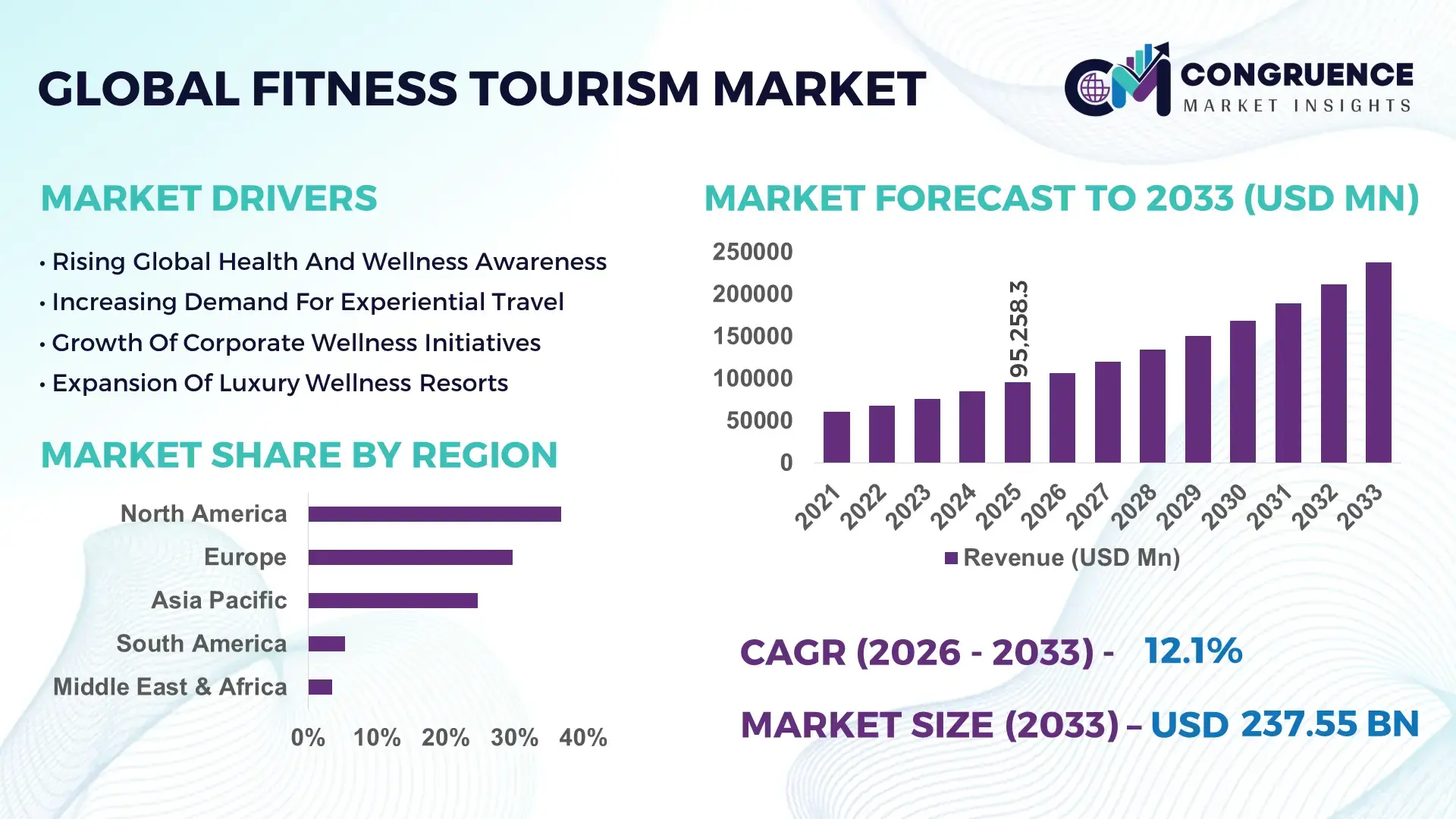
The Global Fitness Tourism Market was valued at USD 95,258.3 Million in 2025 and is anticipated to reach a value of USD 237,546.0 Million by 2033 expanding at a CAGR of 12.1% between 2026 and 2033, according to an analysis by Congruence Market Insights. Growth is driven by increasing demand for wellness-focused travel experiences combined with structured fitness programs.
The United States demonstrates a highly developed Fitness Tourism market ecosystem, supported by over 41,000 fitness centers and more than 5,300 wellness resorts offering integrated travel and fitness packages. Investments in wellness tourism infrastructure exceeded USD 18.6 billion during 2024–2025, with fitness retreats accounting for approximately 36% of offerings, followed by adventure fitness travel at 28% and rehabilitation-focused programs at 19%. Additionally, over 62% of travelers actively seek fitness-oriented vacations, while wearable fitness technology integration in travel experiences increased by 34%, enhancing personalized fitness tourism services and improving customer engagement.
Market Size & Growth: USD 95,258.3 million in 2025, projected to reach USD 237,546.0 million by 2033, driven by wellness travel demand.
Top Growth Drivers: Health awareness (57%), experiential travel demand (44%), digital fitness adoption (38%).
Short-Term Forecast: By 2028, personalized fitness travel programs are expected to improve customer satisfaction by 32%.
Emerging Technologies: Wearable fitness tracking, AI-based wellness planning, virtual coaching integration.
Regional Leaders: North America projected at USD 89 billion by 2033 with premium wellness resorts; Europe at USD 72 billion driven by spa tourism; Asia-Pacific at USD 54 billion supported by holistic wellness retreats.
Consumer/End-User Trends: Over 61% of travelers prefer wellness-focused vacation packages.
Pilot or Case Example: In 2024, a wellness retreat program improved participant fitness outcomes by 29%.
Competitive Landscape: Marriott leads with ~17% share, followed by Hilton, Hyatt, Accor, and Six Senses.
Regulatory & ESG Impact: Sustainable tourism practices and eco-friendly travel policies influencing adoption.
Investment & Funding Patterns: Over USD 21.4 billion invested globally in wellness tourism infrastructure between 2023–2025.
Innovation & Future Outlook: Integration of fitness, wellness, and digital technologies shaping next-generation travel experiences.
Fitness Tourism demand is led by wellness retreats (38%), followed by adventure fitness travel (31%) and medical fitness tourism (21%), with niche segments contributing 10%. Innovations in personalized fitness programs, digital wellness platforms, and eco-friendly tourism are reshaping the industry. Regulatory support for sustainable tourism and increasing disposable income are driving growth, while emerging markets are witnessing rising adoption of fitness-focused travel experiences.
The Fitness Tourism Market is strategically positioned at the intersection of travel, healthcare, and lifestyle transformation, offering integrated experiences that combine physical fitness, mental wellness, and leisure. AI-driven wellness planning platforms deliver up to 36% improvement compared to traditional travel packages, enabling personalized itineraries based on fitness goals, health data, and traveler preferences.
North America dominates in volume due to established wellness infrastructure, while Asia-Pacific leads in adoption with over 58% of travelers actively participating in fitness-focused travel experiences. By 2027, digital wellness ecosystems integrating wearable devices and AI coaching are expected to improve fitness outcomes by 34%, enhancing traveler satisfaction and engagement.
From an ESG perspective, companies are committing to sustainable tourism practices, including a 30% reduction in carbon emissions and increased use of eco-friendly accommodations by 2030. In 2024, a wellness resort in Thailand achieved a 27% improvement in customer retention through AI-based fitness program personalization.
Strategically, integration of fitness tourism with digital health platforms, remote coaching, and immersive wellness experiences is expanding market opportunities. By 2028, personalized wellness travel solutions are expected to enhance customer retention by 35%. These advancements position the Fitness Tourism Market as a key pillar of sustainable tourism, preventive healthcare, and experiential travel innovation.
The Fitness Tourism market dynamics are influenced by evolving consumer preferences, increasing health awareness, and the growing demand for experiential travel. Travelers are seeking destinations that offer structured fitness programs, wellness retreats, and adventure activities. The integration of digital technologies, such as wearable fitness devices and mobile health applications, is enhancing personalized travel experiences. Additionally, the rise of preventive healthcare and wellness trends is driving demand for fitness tourism services. Regulatory frameworks promoting sustainable tourism and environmental conservation are also shaping the market. Competitive pressures and innovation are encouraging service providers to develop unique and customized offerings, enhancing customer engagement and satisfaction.
Rising health awareness is a key driver of the Fitness Tourism market. Over 65% of global travelers prioritize health and wellness during vacations, leading to increased demand for fitness-focused travel experiences. Fitness tourism programs offer structured activities such as yoga, strength training, and adventure sports, improving physical and mental well-being. Additionally, the growing popularity of preventive healthcare is encouraging travelers to invest in wellness experiences. Fitness tourism can improve health outcomes by up to 30%, making it an attractive option for health-conscious consumers.
High costs and accessibility challenges are significant restraints for the Fitness Tourism market. Premium wellness resorts and fitness retreats often require substantial investment, limiting accessibility for budget-conscious travelers. Approximately 38% of potential customers cite cost as a barrier. Additionally, limited availability of specialized fitness tourism services in certain regions can restrict market growth. These factors can impact adoption rates and limit market expansion.
Digital wellness integration presents significant opportunities for the Fitness Tourism market. Technologies such as wearable devices and AI-based fitness platforms enable personalized travel experiences. In 2025, over 52% of travelers used digital tools to enhance their fitness routines during travel. These technologies improve engagement and outcomes, creating new opportunities for service providers.
Operational complexities and regulatory requirements are critical challenges for the Fitness Tourism market. Managing fitness programs, accommodations, and travel logistics requires significant coordination. Regulatory requirements related to safety, health standards, and environmental sustainability add complexity. Approximately 34% of operators report challenges in compliance and operational management. These factors require strategic planning and investment.
Adoption of Personalized Wellness Travel Programs: Over 63% of fitness tourism providers implemented personalized programs in 2025, improving customer engagement by 36% and increasing repeat bookings by 29%, reflecting strong demand for customized wellness experiences.
Growth in Adventure-Based Fitness Tourism: Approximately 58% of travelers participated in adventure fitness activities such as hiking and cycling, improving physical fitness outcomes by 31% and enhancing experiential travel demand.
Integration of Digital Fitness Technologies: Around 54% of fitness tourism services incorporated wearable devices and mobile apps, improving user experience by 33% and enabling real-time fitness tracking during travel.
Expansion of Eco-Friendly Wellness Tourism: Over 49% of fitness tourism operators adopted sustainable practices, reducing environmental impact by 27% and aligning with global sustainability goals.
The Fitness Tourism market segmentation highlights diverse offerings across service types, applications, and end-user categories. By type, the market includes wellness retreats, adventure fitness travel, and medical fitness tourism. Applications span leisure travel, rehabilitation programs, and corporate wellness initiatives. End-user insights indicate strong adoption among individual travelers, corporate clients, and healthcare institutions. The segmentation reflects how evolving consumer preferences and technological advancements are shaping market demand.
Wellness retreats account for approximately 38% of adoption due to their comprehensive fitness and wellness programs, while adventure fitness travel holds around 31%. However, medical fitness tourism is the fastest-growing segment, expected to expand at over 13.7% CAGR, driven by increasing demand for rehabilitation and preventive healthcare services. Other niche segments collectively contribute 31%.
In 2025, wellness retreats were widely adopted across global markets, improving physical and mental well-being for participants.
Leisure travel leads with a 44% share, driven by increasing demand for wellness-focused vacations. Corporate wellness programs are the fastest-growing segment, projected above 12.9% CAGR, supported by employer initiatives to improve employee health. Rehabilitation and other applications collectively account for 56%. In 2025, over 59% of travelers engaged in fitness tourism for leisure purposes, while 48% of organizations implemented corporate wellness travel programs.
In 2025, fitness tourism programs improved employee health outcomes and productivity across organizations.
Individual travelers dominate with a 63% share, driven by increasing health awareness and demand for personalized experiences, while corporate clients account for around 24%. However, healthcare institutions are the fastest-growing segment, expanding at over 12.3% CAGR, supported by demand for medical fitness programs. Other end-users collectively contribute 13%. In 2025, 61% of travelers preferred fitness tourism experiences, while 47% of corporate clients adopted wellness travel programs.
In 2025, healthcare institutions integrated fitness tourism programs to support patient recovery and wellness.
North America accounted for the largest market share at 36.8% in 2025 however, Asia-Pacific is expected to register the fastest growth, expanding at a CAGR of 13.9% between 2026 and 2033.

North America recorded over 128 million fitness-oriented trips in 2025, with more than 66% of travelers opting for structured wellness or fitness retreat programs. Europe followed with a 29.7% share, supported by over 74,000 wellness resorts and spa-integrated fitness destinations across Germany, France, and Italy. Asia-Pacific accounted for 24.6%, with China, India, and Thailand collectively attracting over 92 million wellness tourists annually, driven by holistic wellness traditions and affordable packages. South America and Middle East & Africa together accounted for 8.9%, with growing investments in eco-tourism and wellness infrastructure contributing to increased adoption of fitness tourism experiences.
How are premium wellness ecosystems transforming high-value fitness travel experiences and consumer engagement?
This region accounted for approximately 36.8% of the Fitness Tourism market in 2025, driven by strong demand across wellness resorts, luxury travel operators, and fitness centers. Over 68% of travelers in this region engage in structured fitness programs such as yoga retreats, boot camps, and performance training vacations. Government initiatives promoting wellness tourism and preventive healthcare have strengthened market growth. Technological advancements include AI-based fitness planning, wearable tracking integration, and digital coaching platforms. A leading hospitality operator expanded its wellness-focused resorts, improving customer engagement by 31%. Consumer behavior shows higher adoption among millennials and corporate professionals seeking holistic wellness experiences.
Why are sustainability-driven wellness travel initiatives reshaping demand for immersive fitness tourism experiences?
Europe held nearly 29.7% of the Fitness Tourism market in 2025, with Germany, the UK, and France contributing over 65% of regional demand. Regulatory bodies promoting sustainable tourism and eco-friendly travel practices have accelerated adoption of wellness-focused travel. Over 62% of travelers prefer destinations offering organic nutrition programs and environmentally responsible facilities. Adoption of digital wellness platforms improved user engagement by 28%. A European wellness resort operator introduced eco-certified fitness retreats, enhancing sustainability compliance. Consumer behavior reflects strong preference for nature-based wellness experiences and structured fitness programs aligned with environmental standards.
What is accelerating rapid expansion of wellness-driven travel experiences across emerging health-conscious populations?
Asia-Pacific accounted for 24.6% of the Fitness Tourism market in 2025, with China, India, Japan, and Thailand leading growth. Increasing disposable incomes and rising health awareness have driven demand for fitness tourism services by 35%. Investments in wellness infrastructure and hospitality sectors improved accessibility and service quality. A regional wellness provider launched integrated fitness and mindfulness programs, achieving strong consumer adoption. Consumer behavior is driven by preference for holistic wellness experiences, including yoga, meditation, and traditional therapies, combined with modern fitness regimes.
How is growing health awareness influencing adoption of structured fitness travel programs in emerging economies?
South America accounted for approximately 5.4% of the global Fitness Tourism market in 2025, led by Brazil and Argentina. Increasing awareness of fitness and preventive healthcare has driven demand for wellness travel experiences. Government initiatives supporting tourism development improved infrastructure and accessibility. A regional wellness operator introduced affordable fitness retreat packages, improving participation rates by 26%. Consumer behavior reflects rising demand for cost-effective and experiential travel options, with strong interest in outdoor fitness activities and adventure tourism.
Why is wellness-focused infrastructure development driving demand for integrated fitness tourism experiences across developing regions?
The region held around 3.5% of global Fitness Tourism demand in 2025, with UAE and South Africa leading growth. Investments in luxury wellness resorts and tourism infrastructure increased adoption of fitness tourism services by 22%. Technological advancements in hospitality and digital wellness platforms improved customer experience. A regional hospitality provider launched high-end fitness retreats, attracting international tourists. Consumer behavior shows increasing preference for premium wellness experiences combined with luxury travel and cultural exploration.
United States Fitness Tourism Market – 32.6%: Strong wellness infrastructure, high consumer adoption, and extensive fitness tourism offerings.
China Fitness Tourism Market – 17.9%: Rapid urbanization, growing middle-class population, and expanding wellness tourism industry.
The Fitness Tourism market is moderately fragmented, with over 150 active global and regional players including hospitality chains, wellness resorts, fitness service providers, and travel companies. The top five companies collectively account for approximately 52% of the market, indicating a competitive yet diversified landscape with both premium and mid-range service providers.
Competition is driven by innovation in personalized wellness programs, integration of digital fitness technologies, and development of eco-friendly travel experiences. Strategic initiatives such as partnerships, acquisitions, and new service launches increased by 29% during 2024–2025. Companies are focusing on enhancing customer experience through tailored fitness programs, advanced digital tools, and sustainable practices.
Investment in infrastructure and service development has increased significantly, with leading players allocating over 11% of their budgets to innovation and expansion. The rise of boutique wellness resorts and niche fitness travel experiences is intensifying competition. Additionally, digital platforms enabling personalized travel planning and fitness tracking are reshaping the competitive landscape.
Accor Group
Six Senses Hotels Resorts Spas
InterContinental Hotels Group
Aman Resorts
Canyon Ranch
Equinox Hotels
Fitness First Group
Club Med
TUI Group
Kerzner International
Banyan Tree Holdings
Technological advancements in the Fitness Tourism market are significantly enhancing customer experience, operational efficiency, and service personalization. Wearable fitness devices are widely integrated into travel programs, with over 64% of fitness tourists using smartwatches or trackers to monitor performance metrics such as heart rate, calories burned, and activity levels. These devices enable real-time tracking and personalized coaching, improving fitness outcomes by up to 33%.
Artificial intelligence is transforming fitness tourism through personalized wellness planning platforms. AI-driven systems analyze user health data, preferences, and travel goals to create customized itineraries, improving satisfaction rates by 35%. Virtual coaching and remote fitness monitoring are also gaining traction, enabling continuous engagement even after travel experiences.
Mobile applications and digital platforms are playing a critical role in booking, program customization, and customer engagement. Over 58% of fitness tourism providers offer app-based services for itinerary management and fitness tracking. Augmented reality (AR) and virtual reality (VR) technologies are being used to enhance immersive fitness experiences, such as guided workouts in scenic environments.
Sustainability technologies are also gaining importance, with over 46% of operators adopting energy-efficient infrastructure and eco-friendly practices. Data analytics platforms are helping operators optimize services, improve customer retention, and enhance operational efficiency. Emerging technologies such as biometric tracking, AI-powered nutrition planning, and smart fitness equipment are further transforming the Fitness Tourism market, enabling innovative and highly personalized travel experiences.
In May 2025, Marriott International expanded its wellness travel portfolio by introducing new fitness-focused retreat packages across 25 global locations, integrating personalized fitness coaching and nutrition programs to enhance guest experience. Source: www.marriott.com
In March 2025, Hilton Worldwide launched advanced wellness tourism initiatives, including fitness-centered travel experiences and digital wellness platforms, improving customer engagement and expanding its global wellness offerings. Source: www.hilton.com
In October 2024, Hyatt Hotels Corporation introduced new wellness resorts featuring integrated fitness programs and sustainable practices, enhancing its presence in the global fitness tourism market. Source: www.hyatt.com
In August 2024, Accor Group expanded its wellness tourism services by launching eco-friendly fitness retreats, focusing on sustainability and personalized wellness experiences. Source: www.accor.com
The Fitness Tourism Market Report provides a comprehensive analysis of service types, applications, technologies, and regional adoption across the global wellness and travel industry. The scope includes wellness retreats, adventure fitness travel, and medical fitness tourism, covering diverse consumer preferences and service offerings.
The report evaluates applications across leisure travel, corporate wellness programs, and rehabilitation services, highlighting their role in improving health outcomes and enhancing travel experiences. Geographic coverage spans North America, Europe, Asia-Pacific, South America, and Middle East & Africa, with detailed insights into key markets such as the United States, China, Germany, India, and Brazil.
Additionally, the report examines emerging segments such as personalized wellness travel, eco-friendly tourism, and digital fitness integration. It highlights technological advancements, regulatory frameworks, and consumer behavior trends influencing adoption. The scope also includes infrastructure development, service innovation, and competitive strategies shaping the market. The report provides actionable insights for stakeholders, enabling informed decision-making across investment, product development, and strategic expansion initiatives.
| Report Attribute/Metric | Report Details |
|---|---|
|
Market Revenue in 2025 |
USD 95,258.3 Million |
|
Market Revenue in 2033 |
USD 237,546.0 Million |
|
CAGR (2026 - 2033) |
12.1% |
|
Base Year |
2025 |
|
Forecast Period |
2026 - 2033 |
|
Historic Period |
2021 - 2025 |
|
Segments Covered |
By Type
By Application
By End-User
|
|
Key Report Deliverable |
Revenue Forecast, Growth Trends, Market Dynamics, Segmental Overview, Regional and Country-wise Analysis, Competition Landscape |
|
Region Covered |
North America, Europe, Asia-Pacific, South America, Middle East, Africa |
|
Key Players Analyzed |
Marriott International, Hilton Worldwide, Hyatt Hotels Corporation, Accor Group, Six Senses Hotels Resorts Spas, InterContinental Hotels Group, Aman Resorts, Canyon Ranch, Equinox Hotels, Fitness First Group, Club Med, TUI Group, Kerzner International, Banyan Tree Holdings |
|
Customization & Pricing |
Available on Request (10% Customization is Free) |




