
Reports
The Global Fish Sauce Market was valued at USD 1,692.0 Million in 2024 and is anticipated to reach a value of USD 2,085.8 Million by 2032 expanding at a CAGR of 2.65% between 2025 and 2032, according to an analysis by Congruence Market Insights. This growth is driven by increasing global demand for umami‑rich condiments and rising popularity of traditional Asian cuisines in international markets.
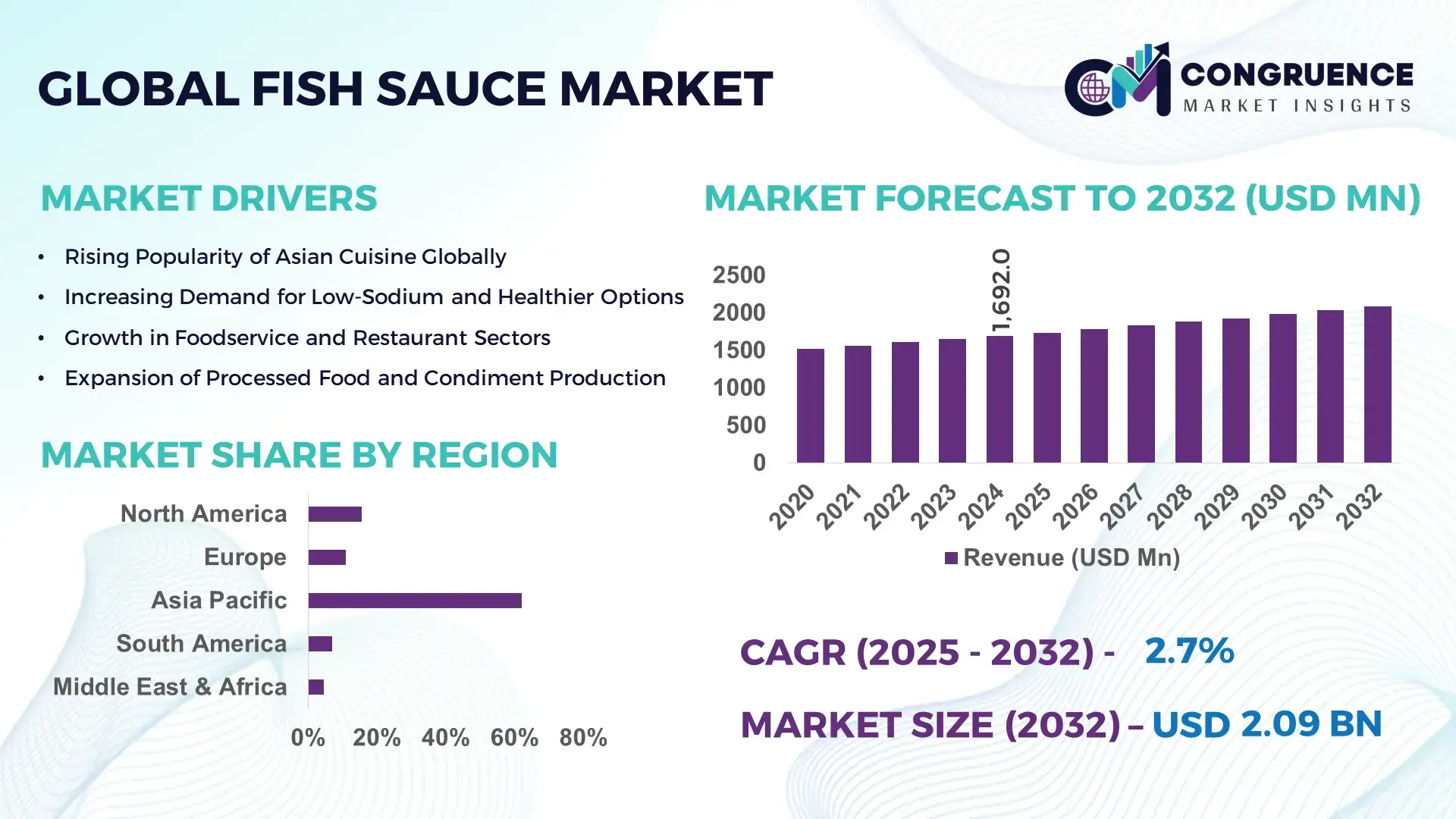
Thailand remains the dominant country in the global fish sauce landscape. Thailand’s fish sauce industry comprises both large‑scale coastal manufacturing clusters and long‑established small‑batch fermenters. The country exports over 28,000 tons annually (2024) and maintains robust production infrastructure with high‑throughput facilities capable of handling thousands of liters per day, supporting global distribution and consistent supply to key export markets.
Market Size & Growth: Global market valued at USD 1,692.0 Million in 2024, projected to reach USD 2,085.8 Million by 2032 at a CAGR of 2.65%, supported by rising demand for authentic fermented condiments.
Top Growth Drivers: Increasing global adoption of Asian cuisines (≈ 45%), growing preference for natural and fermented condiments (≈ 38%), expansion of foodservice and HoReCa channels (≈ 32%).
Short-Term Forecast: By 2028, production efficiency is expected to improve, reducing processing costs by ≈ 12% through adoption of optimized fermentation and supply‑chain methods.
Emerging Technologies: Use of enzyme‑assisted fermentation to shorten maturation time; adoption of smart label traceability systems; development of low‑sodium & clean‑label fish sauce variants.
Regional Leaders: Asia-Pacific projected to reach ~USD 1,350 Million by 2032 (driven by traditional use and export demand); North America ~USD 250 Million (rising adoption of Asian condiments); Europe ~USD 200 Million (increasing consumer interest in ethnic cuisines).
Consumer/End-User Trends: Growing demand in households for authentic cuisine seasoning; increasing use in restaurants and ready‑to‑eat meal kits; rising interest in premium, clean-label fish sauce variants.
Pilot or Case Example: In 2024 a major Southeast Asian exporter launched a low‑sodium fish sauce line rolled out to over 5,000 retail outlets, achieving a 20% uplift in sales volumes within six months.
Competitive Landscape: Market leader holds approximately 40–45% share, with major competitors including several regional producers and exporters across Southeast Asia.
Regulatory & ESG Impact: Increasing regulatory scrutiny on sustainable sourcing of anchovies, coupled with incentives for eco‑friendly fishing practices and salt‑reduction initiatives across exporting countries.
Investment & Funding Patterns: Recent investments in production expansion and supply‑chain optimization exceed USD 50 million globally, with rising funds directed toward sustainable sourcing and modernizing fermentation facilities.
Innovation & Future Outlook: Growing integration of traceability technologies, enzyme‑assisted fermentation, and clean‑label product lines; emerging markets beyond Southeast Asia expected to adopt fish sauce as a culinary staple, expanding global reach.
Global market activity in 2024 also saw a shift toward artisanal and premium fish sauce variants, increased investment in sustainable fishing and production methods, growing demand in hospitality and food‑service sectors, and expansion into emerging markets in North America and Europe — indicating a future of diversified markets and product innovation.
The strategic relevance of the Fish Sauce Market lies in its ability to combine traditional culinary heritage with modern supply‑chain efficiencies and evolving consumer preferences. As global cuisine becomes increasingly diversified, fish sauce — particularly when produced via advanced fermentation or clean‑label processes — delivers a significant advantage: enzyme‑assisted fermentation, for example, can reduce production time by up to 30% compared to traditional methods, enabling faster turnaround and lower inventory holding costs for producers. Asia-Pacific continues to dominate in production volume, while North America and Europe are leading in adoption: North America sees a rising penetration among foodservice outlets and home cooks, with an estimated 33% of restaurants having integrated fish sauce into their menu formulations.
In the next 2–3 years, the adoption of traceability and smart‑label technology is expected to improve supply‑chain transparency by ~25%, reduce waste by ~15%, and enhance consumer trust — especially in export markets with stringent food‑safety regulations. Firms are increasingly committing to ESG standards; many plan to reduce overfishing and improve sourcing sustainability, aiming for a 20% reduction in bycatch‑related waste by 2027. In 2024, a leading Southeast Asian producer achieved a 0 ppm heavy‑metal compliance record after upgrading to standardized filtration — a measurable milestone in regulatory compliance and quality assurance.
Moving ahead, the Fish Sauce Market is poised to become a pillar of resilience and sustainable growth, bridging traditional food culture with global culinary demand, while aligning with ESG and regulatory mandates to support long‑term supply‑chain integrity and expanding global reach.
The Fish Sauce Market is experiencing dynamic shifts fueled by evolving global dietary trends, culinary globalization, and technological advancements in production and supply chain. Traditional fermented fish sauces remain foundational, especially in Southeast Asia, where fish sauce is a cultural staple. Simultaneously, rising demand in Western markets — driven by growing interest in Asian and fusion cuisines — is encouraging producers to expand output, innovate with product variants (such as low‑sodium or clean‑label sauces), and invest in modern production techniques. Increasing global interest in natural ingredients and umami-rich condiments positions fish sauce as a key seasoning in both household kitchens and commercial foodservice. On the supply side, producers are scaling capacity, modernizing fermentation, and improving distribution networks to meet growing global demand. At the same time, supply‑chain traceability and sustainable sourcing are gaining importance due to regulatory and environmental pressures. This interplay of tradition, innovation, and globalization defines the current dynamics of the Fish Sauce Market.
Global culinary trends increasingly favor ethnic and Asian cuisines with authentic flavors. As more consumers incorporate dishes from Southeast Asia into their regular diet, the demand for traditional condiments like fish sauce rises accordingly. Restaurants, food‑service operators, and home cooks seeking to replicate authentic taste drive consistent growth. With urbanization and rising disposable incomes, especially in Western and urbanizing Asian markets, consumers are choosing fish sauce as a versatile, umami‑rich seasoning. This escalating acceptance of fish sauce beyond its traditional geographies is significantly expanding its global footprint, prompting producers to scale production and diversify product lines to cater to different consumer preferences.
Fish sauce production depends heavily on availability of small pelagic fish (such as anchovies) and traditional fermentation processes. Overfishing, climate change, and fluctuating fish stock populations create supply risk, leading to raw‑material scarcity or price volatility. Additionally, long fermentation durations (often several months) limit rapid scale‑up and create storage and quality‑control challenges. In regions where regulation is tight, sourcing sustainably may increase costs. These constraints can hinder consistent supply, limit production scalability, and restrict the growth pace of the market.
Growing consumer interest in healthier, clean‑label condiments presents a strong opportunity for the fish sauce market. Demand for low‑sodium, preservative‑free, and naturally fermented sauces is rising globally, particularly among health‑conscious and younger consumers. Producers can capitalize by developing premium, artisanal, and organic fish sauce variants. Additionally, expansion into non‑traditional markets — where umami-rich condiments are still a novelty — offers growth potential. This shift toward clean‑label and premium variants may also attract investments in controlled fermentation technologies, quality assurance processes, and sustainable sourcing practices, opening doors for new product lines and market segments.
As fish sauce exports expand globally, producers must comply with varying food‑safety, labeling, and environmental regulations across markets. Inconsistent standards — especially regarding heavy‑metal content, sanitation, traceability, and sustainable sourcing — pose a hurdle for exporters and manufacturers. Lack of transparent supply‑chain traceability often raises concerns among importers and regulators. Harmonizing these standards requires additional investment in quality‑control infrastructure, certification, and traceability systems, which can increase costs and complicate operations, thereby impeding smooth market expansion.
Rise in Premium & Clean‑Label Fish Sauce Variants: Premium and clean‑label fish sauce offerings have increased by more than 28% during 2024, as consumers gravitate towards naturally fermented, low‑additive condiments. Clean‑label variants with reduced salt and no artificial preservatives now represent over 22% of new fish sauce SKUs launched globally, reflecting growing demand for healthier and transparent ingredient sourcing.
Expansion of Export‑Oriented Production Capacity in Southeast Asia: Production capacity in leading Southeast Asian exporters increased by roughly 15% in 2024, with new high‑throughput facilities—capable of producing several thousand liters per day—being commissioned to meet rising international demand. Bulk‑drum industrial fish sauce output surged, catering to HoReCa and large‑scale food processing requirements beyond domestic consumption.
Growing Adoption in Non‑Traditional Markets: In 2024, imports of fish sauce into North America and Europe rose by approximately 24%, driven by expansion of Asian restaurants and rising home‑cooking interest in global cuisines. Online retail channels contributed to a 31% year‑over‑year rise in sales volumes, reflecting increased accessibility and consumer willingness to experiment with umami‑rich condiments.
Integration of Traceability and Food‑Safety Technologies: Several manufacturers introduced smart‑label systems and batch traceability in 2024, improving transparency and compliance with international food‑safety regulations. Adoption of such technologies increased by nearly 18%, enhancing consumer trust in exported products and enabling easier access to regulated markets.
The global Fish Sauce Market is divided into multiple segments based on product type, application end‑use, distribution channel and end‑user categories. This segmentation reveals how the market adapts to varying culinary traditions, health trends and commercial demands. Product types vary from traditional, naturally fermented sauces to low‑sodium, organic or industrial‑grade variants — catering to both household kitchens and mass‑production needs. Applications range from home cooking and household consumption to commercial foodservice, processed foods and large‑scale institutional kitchens. End‑users include individual retail consumers, restaurants, food manufacturers and processed‑food producers. Distribution channels — supermarkets/hypermarkets, specialty stores, online retail and convenience stores — further influence availability and adoption globally. This structured segmentation enables manufacturers and distributors to tailor products and marketing strategies to different demand pockets, from artisanal‑food lovers to health‑conscious consumers and large‑scale food chains.
The global fish sauce market is commonly segmented into Traditional Fish Sauce, Low-Sodium Fish Sauce, and Organic / Premium Fish Sauce. Traditional Fish Sauce remains the leading type, with an estimated share of around 55 % of global consumption, owing to its authentic fermentation process, deep umami flavour and widespread acceptance in core Asian cuisines. Low‑Sodium Fish Sauce is the fastest‑growing sub‑segment, driven by rising health awareness and demand for reduced-salt condiments; its growth pace outstrips that of traditional variants. Organic / Premium Fish Sauces — often using wild-caught fish, extended fermentation, and cleaner ingredient lists — represent a niche but steadily growing portion, appealing particularly to gourmet and health-conscious consumers.
Application segmentation of fish sauce includes Foodservice/Commercial use, Household cooking, and Processed Foods / Industrial use. The leading application is Foodservice/Commercial use, which accounts for the highest share — restaurants, catering services, and institutional kitchens rely heavily on fish sauce for authentic flavor profiles in dishes. Household cooking is increasing rapidly as global consumers adopt Asian and fusion cuisines; home‑use demand is rising steadily as more people experiment with global flavors. Processed Foods / Industrial use — where fish sauce serves as a flavor enhancer ingredient in ready‑to-eat meals, sauces, and processed food products — constitutes a smaller but significant niche, especially in markets exploring ethnic flavors.
End‑users of fish sauce comprise Restaurants/Hotels & Foodservice Enterprises, Retail Consumers / Households, and Food Manufacturers / Processed‑Food Producers. The leading end‑user segment is Restaurants and Foodservice Enterprises, which command the largest share due to consistent demand for bulk supply, menu variety, and authentic flavor in commercial kitchens. Retail Consumers and Households represent the fastest-growing end‑user segment globally, as adoption of Asian and fusion cooking rises in non‑traditional markets; many households in Western and non‑Asian regions are increasingly using fish sauce as a staple umami condiment. Food Manufacturers and Processed-Food Producers serve as a stable but smaller segment, sourcing standardized or industrial-grade fish sauce for inclusion in sauces, ready meals, and convenience foods.
Asia-Pacific accounted for the largest market share at 62% in 2024; however, North America is expected to register the fastest growth, expanding at a CAGR of 3.2% between 2025 and 2032.

In 2024, Asia-Pacific consumed approximately 1,050 million liters of fish sauce, with Vietnam, Thailand, and Indonesia leading production. North America recorded 280 million liters in the same year, showing growing adoption in foodservice and household segments. Europe accounted for 220 million liters, while South America and Middle East & Africa contributed 150 million liters and 90 million liters respectively. Consumer preferences, technological upgrades in manufacturing, and increasing retail penetration are reshaping regional dynamics. Infrastructure modernization in production plants, growing e-commerce channels, and rising health-conscious consumption patterns are key factors influencing regional market performance, highlighting significant growth opportunities for manufacturers, distributors, and investors worldwide.
North America accounted for roughly 16.5% of the global fish sauce market in 2024. Restaurants, foodservice chains, and households are the primary drivers of demand, especially in the US and Canada, where adoption of Asian and fusion cuisines has increased by nearly 30% over the past five years. Regulatory agencies encourage low-sodium and clean-label product offerings, prompting manufacturers to innovate accordingly. Digitalization in production and distribution, including e-commerce platforms and automated quality monitoring, is accelerating market penetration. Local players such as Red Boat have expanded retail distribution and introduced low-sodium and organic product lines to meet consumer demand. Regional consumer behavior shows higher adoption in urban centers, particularly among younger demographics and healthcare/foodservice enterprises seeking authentic flavor solutions.
Europe accounted for approximately 13.0% of the global fish sauce market in 2024. Key markets include Germany, the UK, and France, driven by rising interest in authentic Asian cuisines and gourmet food products. Stringent regulatory requirements for sodium content and labeling are encouraging manufacturers to focus on clean-label and organic offerings. Adoption of modern fermentation technologies, automated bottling, and IoT-enabled production lines is increasing across Europe. Local players such as Blue Elephant have introduced premium, naturally fermented fish sauces to comply with EU standards and attract health-conscious consumers. Consumer behavior shows increasing preference for sustainable, traceable products, with urban households leading adoption of imported fish sauce varieties.
Asia-Pacific held 62% of the global fish sauce market in 2024. Top-consuming countries include Vietnam, Thailand, and Indonesia, which dominate both production and domestic consumption. Manufacturing plants are modernizing with automated fermentation tanks and advanced quality control systems, processing up to 200,000 liters per day. Technological innovation hubs in Bangkok and Ho Chi Minh City focus on sustainable sourcing, improved packaging, and low-sodium product variants. Companies like Three Crabs have expanded production and digitalized supply chain operations to support export markets. Regional consumer behavior shows high household and restaurant adoption, with rising e-commerce penetration facilitating broader availability of artisanal and premium fish sauces.
South America accounted for around 9% of the global fish sauce market in 2024. Brazil and Argentina are the largest contributors, with growing adoption in restaurants and households. Manufacturing infrastructure is expanding, with investments in automated fermentation and packaging lines to meet rising demand. Government trade incentives and import policies support the availability of imported premium fish sauces. Local players like Fish Brasil have begun producing value-added fish sauce blends to cater to fusion cuisine trends. Regional consumer behavior reflects increased usage tied to media exposure, culinary shows, and international travel experiences, leading to gradual adoption in urban centers.
Middle East & Africa accounted for 5% of the global fish sauce market in 2024, with the UAE and South Africa driving growth. Demand is rising in hospitality, foodservice, and convenience food sectors. Technological modernization, including automated bottling and temperature-controlled storage, is enhancing product quality. Regulatory frameworks and trade partnerships encourage the import of premium, low-sodium fish sauces. Local players such as Gulf Gourmet have started distributing imported artisanal sauces in high-end retail channels. Regional consumer behavior shows a preference for ethnic cuisine adoption in cosmopolitan cities and luxury dining sectors, driving steady market expansion.
Vietnam - 35% Market Share: High production capacity with modernized fermentation facilities and large-scale export infrastructure.
Thailand - 22% Market Share: Strong end-user demand supported by widespread culinary usage and investment in premium and artisanal fish sauce products.
The global Fish Sauce Market remains moderately consolidated — while there are dozens of active producers worldwide, the top five firms collectively hold an estimated 35–40% of the market — reflecting both strong leading players as well as a large number of small to mid‑size regional manufacturers ensuring fragmentation.
Approximately 20–30 major competitors are actively operating internationally, with another 50–60 smaller or regional firms supplying local and niche markets. The major global participants engage in strategic initiatives such as product diversification (e.g., low‑sodium, organic, vegan), acquisition or export expansion, and brand positioning to gain global reach. For instance, one prominent Vietnamese player has recently expanded its export‑oriented fish sauce product line and invested in premium glass‑bottle packaging to appeal to Western consumers.
Innovation also plays a growing role — producers are introducing fermentation‑process upgrades, clean-label and additive‑free sauces, vegan alternatives, and export‑ready quality control systems to meet stringent international standards.
Competition is driven by brand reputation, product authenticity, quality consistency, distribution and export capabilities, and responsiveness to evolving global tastes (e.g., increasing demand for ethnic Asian flavours, healthy/clean-label condiments). The presence of both large-scale exporters and many small artisanal producers ensures that while a handful of leaders shape global dynamics, fragmentation allows room for niche or regional brands to thrive, especially in markets focused on traditional or specialty products.
Tang Sang Ha Co., Ltd.
Rayong Fish Sauce Industry Co., Ltd.
Pichai Fish Sauce Co., Ltd.
Halcyon Proteins Pty Ltd.
Technology adoption is increasingly shaping the fish sauce industry, especially among forward‑looking producers aiming at global export markets, improved efficiency, and sustainable practices. Traditional fermentation methods are being enhanced with modern process controls: automated fermentation tanks, controlled temperature and salinity systems, and real-time monitoring to ensure consistent product quality batch-to-batch. Advanced filtration and clarification technologies help produce low‑impurity sauces suitable for export standards, reducing off‑flavours and enabling longer shelf life.
Emerging technological trends include enzyme‑assisted or accelerated fermentation, which shorten maturation periods significantly — some firms report reducing fermentation times by 20–30% compared to traditional 6–12 month cycles. This enables faster throughput, lower inventory holding costs, and quicker market responsiveness. There is also growing experimentation with vegan or plant‑based “fish” sauces, leveraging mushrooms, soybeans or seaweed extracts, aimed at health-conscious and vegetarian/vegan consumer segments, broadening the product base beyond traditional anchovy‑based sauces.
Digital transformation is influencing distribution and traceability: blockchain-based supply‑chain tracking, smart‑labeling to verify origin and fermentation data, and IoT‑enabled sensors that monitor storage conditions (temperature, humidity) during shipping — all increasingly important for export compliance and food-safety regulation in developed markets. Packaging innovation is another technological front: shifting to eco‑friendly, recyclable containers and introducing portion‑controlled sachets or pouch formats suitable for retail and foodservice.
Overall, technological innovation is transitioning the market from artisanal, small‑batch fermentation toward scalable, quality‑controlled, export‑ready manufacturing, supporting global expansion, regulatory compliance, and diversified consumer demand.
In 2023 – Squid Brand (Thai Fishsauce Factory) Introduced new variants: “Truffle Fish Sauce” and “Mala Spicy Fish Sauce”Squid Brand announced at THAIFEX–Anuga Asia 2023 that it would launch these flavour‑infused sauces, expanding beyond traditional fish sauce offerings to target evolving taste and “personalised healthy” preferences. Source: www.squidbrand.com
In 2023 – Squid Brand Launched a 100% plant‑based “Vegan Fish Sauce”. The vegan version (made with shiitake extract and kelp) was certified vegan, free from MSG, colourants, preservatives — aiming at health‑conscious and vegetarian/vegan consumers. Source: www.squidbrand.com
In 2024 – Masan Consumer Corporation (Vietnam) Achieved sales of over 5 million bottles of “Nam Ngu Ly Son chili garlic fish sauce” within one year of launch. This demonstrates strong consumer uptake and product acceptance for innovation beyond traditional fish sauce; also reflects successful integration of a local specialty (Ly Son garlic) into mass‑market condiment offerings. Source: www.masanconsumer.com
In 2024 – Masan Consumer Corporation Expanded its core brands (including fish sauce) into major global retail chains (e.g. U.S. Costco, Australia’s Woolworths). This marks a strategic push for export growth, global distribution, and international market penetration of Vietnamese fish‑sauce products under mainstream retail settings. Source: www.masanconsumer.com
This Fish Sauce Market Report comprehensively covers global production, consumption, trade, technological evolution, and consumer trends across all major regions — North America, Europe, Asia‑Pacific, South America, and Middle East & Africa. It examines segmentation by product types (traditional, low‑sodium, organic/vegan, industrial-grade), by application (household cooking, foodservice, processed foods, condiments production), and by end‑users (households, restaurants/HoReCa, food‑manufacturers, exporters).
The report encompasses both large-scale commercial producers and artisanal/traditional manufacturers, and tracks innovations such as clean‑label sauces, vegan alternatives, accelerated fermentation, and advanced packaging. Distribution channels — supermarkets/hypermarkets, specialty stores, online retail, and e‑commerce — are analyzed for reach, penetration, and consumer behavior.
Geographically, the report provides in-depth regional analysis, country‑level insights for major producing nations, and export/import flows. It further explores regulatory, sustainability and ESG aspects — including raw‑material sourcing, environmental impact of fishing, traceability, packaging waste reduction, and compliance with food‑safety standards.
The market‑competition section evaluates leading global players, their strategic initiatives (product launches, export expansion, acquisitions, sustainable sourcing), and competitive positioning. Technology‑adoption trends, manufacturing modernization, and supply‑chain digitization are also covered.
Finally, the report addresses future outlook and niche segments — premium/organic fish sauces, plant‑based alternatives, clean-label & health-conscious variants — and assesses growth potential, challenges, and strategic pathways for investors, manufacturers, and distributors targeting global and regional markets.
| Report Attribute / Metric | Details |
|---|---|
| Market Revenue (2024) | USD 1,692.0 Million |
| Market Revenue (2032) | USD 2,085.8 Million |
| CAGR (2025–2032) | 2.65% |
| Base Year | 2024 |
| Forecast Period | 2025–2032 |
| Historic Period | 2020–2024 |
| Segments Covered |
By Type
By Application
By End-User Insights
|
| Key Report Deliverables | Revenue Forecast, Market Trends, Growth Drivers & Restraints, Technology Insights, Segmentation Analysis, Regional Insights, Competitive Landscape, Recent Developments, Regulatory & ESG Overview |
| Regions Covered | North America, Europe, Asia-Pacific, South America, Middle East & Africa |
| Key Players Analyzed | Masan Consumer Corporation, Red Boat Fish Sauce, Thai Fishsauce Factory (Squid Brand), Tang Sang Ha Co., Ltd., Rayong Fish Sauce Industry Co., Ltd., Pichai Fish Sauce Co., Ltd., Halcyon Proteins Pty Ltd. |
| Customization & Pricing | Available on Request (10% Customization Free) |




