
Reports
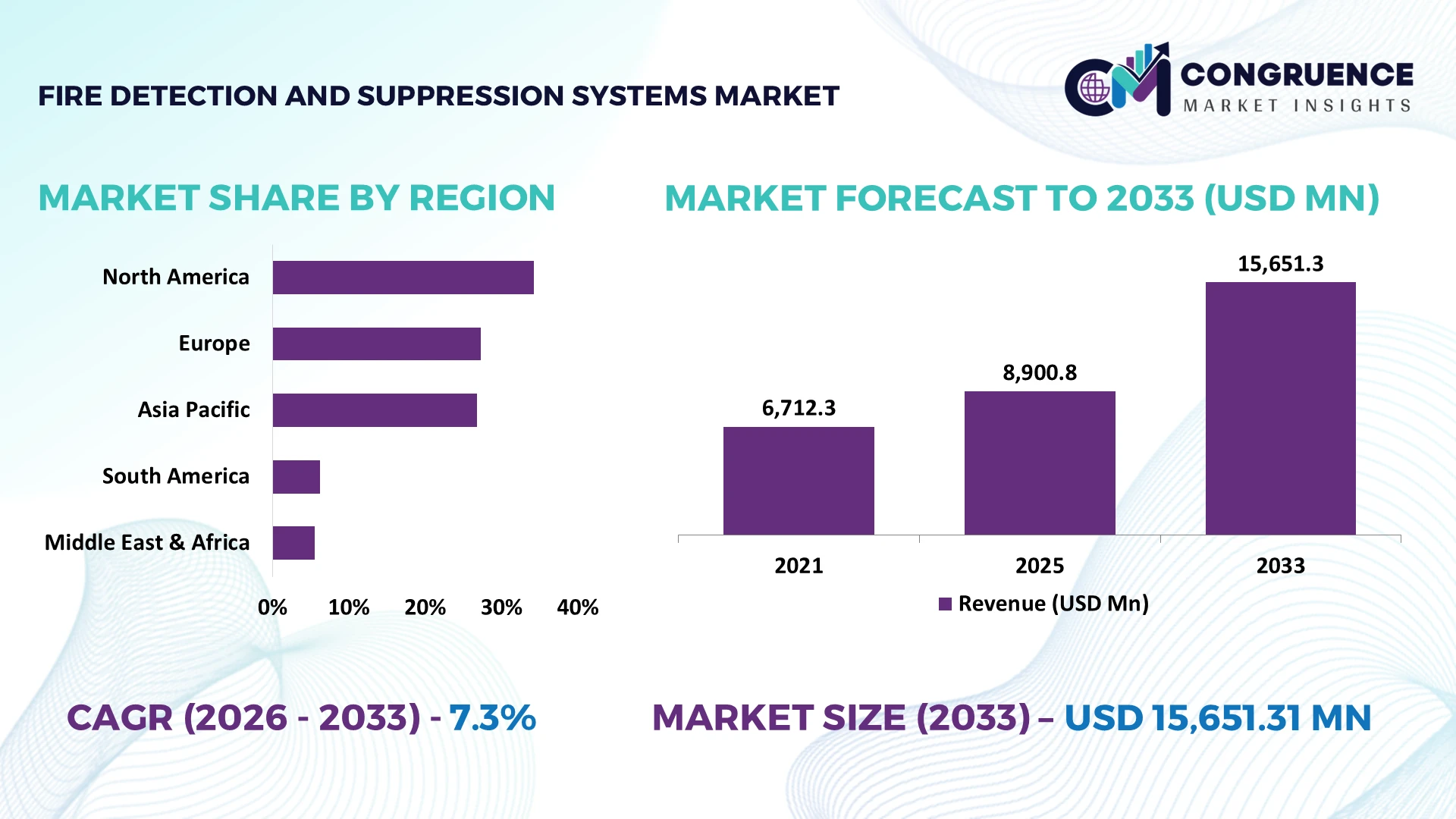
The Global Fire Detection and Suppression Systems Market was valued at USD 8,900.8 Million in 2025 and is anticipated to reach a value of USD 15,651.3 Million by 2033 expanding at a CAGR of 7.31% between 2026 and 2033. Expanding data center infrastructure, lithium-ion battery manufacturing, industrial automation, and stringent building fire safety regulations are accelerating the deployment of intelligent fire detection and automated suppression systems.
The United States represents the dominant country market, supported by over 5,000 data centers and substantial investments in semiconductor manufacturing, energy storage, and commercial infrastructure. The USD 52.7 billion CHIPS Act funding program reinforces industrial fire protection requirements. Compared with Germany, the United States operates substantially more data centers, representing approximately 40% of global facilities and supporting advanced aspirating smoke detection adoption.
Manufacturers prioritizing intelligent detection, specialized suppression technologies, and integrated lifecycle maintenance services are positioned to secure high-value industrial and critical infrastructure contracts.
Market Size & Growth: USD 8,900.8 million in 2025, reaching USD 15,651.3 million by 2033 at 7.31% CAGR, supported by critical infrastructure expansion.
Top Growth Drivers: Indicative demand contributions include regulatory compliance (35%), industrial infrastructure expansion (30%), and intelligent system modernization (20%).
Short-Term Forecast: By 2028, predictive maintenance deployments target a 20% reduction in unplanned system servicing.
Emerging Technologies: Three major innovations include AI-enabled smoke detection, wireless sensor networks, and environmentally preferable suppression agents.
Regional Leaders: Indicative 2033 projections include North America (USD 5,008.4 million; intelligent detection), Asia Pacific (USD 4,851.9 million; industrial automation), and Europe (USD 3,912.8 million; sustainable suppression).
Consumer/End-User Trends: Approximately 30% of targeted modernization projects are expected to incorporate centralized monitoring capabilities.
Pilot/Case Example: A representative 2025 warehouse modernization scenario targets a 25% reduction in nuisance alarms through multisensor detection.
Competitive Landscape: Johnson Controls holds an indicative 12% share, competing with Honeywell, Siemens, Bosch, and Carrier.
Regulatory & ESG Impact: European F-gas regulations target the complete phase-out of HFC consumption by 2050.
Investment & Funding: USD 52.7 billion in U.S. CHIPS Act funding supports fire-protected semiconductor infrastructure development.
Innovation & Future Outlook: Next-generation systems target 20–30% faster fault identification through connected diagnostics and automated monitoring.
The Fire Detection and Suppression Systems Market is witnessing expanding applications across hyperscale data centers, automated warehouses, battery manufacturing facilities, and healthcare infrastructure. Advanced multisensor detectors, thermal imaging, and water mist suppression technologies are improving protection capabilities. Intelligent monitoring systems target maintenance efficiency improvements of approximately 20%, while evolving European environmental regulations accelerate alternative suppression agent development, reshaping strategic investment priorities.
Fire detection and suppression systems are becoming strategically important as industrial operators prioritize asset protection, operational continuity, and regulatory compliance alongside infrastructure expansion. Semiconductor fabrication plants, hyperscale data centers, and automated logistics facilities require specialized protection against rapidly developing electrical and thermal hazards. Digital infrastructure modernization is transforming fire safety equipment from standalone compliance installations into interconnected risk management platforms.
Intelligent multisensor detection systems target 20–30% fewer nuisance alarms compared with conventional single-sensor configurations under suitable operating conditions, reducing unnecessary operational interruptions. The United States leads critical infrastructure deployment, while Germany emphasizes environmentally preferable suppression agents and building modernization. Between 2026 and 2028, connected monitoring deployments are expected to target maintenance efficiency improvements of 15–20% through automated diagnostics.
For example, lithium-ion battery storage facilities increasingly combine off-gas detection, thermal monitoring, and automated suppression to identify developing hazards before escalation. Manufacturers are expanding application-specific engineering capabilities, establishing partnerships with building automation providers, and investing in alternative extinguishing agents. Competitive advantage increasingly depends on delivering validated, interoperable protection architectures that minimize downtime, support regulatory compliance, and generate recurring lifecycle service opportunities across critical infrastructure assets.
Accelerating investments in semiconductor fabrication, hyperscale data centers, and lithium-ion battery manufacturing are increasing requirements for specialized fire detection and suppression systems. The United States accommodates approximately 40% of global data center facilities, creating substantial demand for aspirating smoke detection and clean-agent suppression. Modern multisensor configurations target 20–30% fewer nuisance alarms, while connected diagnostics support maintenance efficiency improvements of approximately 15%. The U.S. CHIPS Act is reinforcing domestic semiconductor manufacturing infrastructure, where contamination-sensitive production environments require application-specific protection. Honeywell, Siemens, and Johnson Controls are expanding intelligent detection portfolios and integrated engineering capabilities. Suppliers delivering compartment-specific protection gain an advantage by reducing operational interruptions without compromising fire safety compliance.
High installation expenditure, specialized piping requirements, and suppression agent availability constrain fire protection system deployment, particularly across existing industrial and commercial buildings. Retrofit projects face indicative installation cost premiums of 15–25% compared with equivalent new-build configurations, depending on structural complexity. European F-gas regulations target a 100% phase-out of HFC consumption by 2050, increasing transition pressure on affected suppression technologies. Replacing incompatible extinguishing agents requires additional engineering, equipment validation, and certification expenditure. Manufacturers are mitigating procurement risks through diversified sourcing, modular equipment configurations, and investment in water mist and inert gas alternatives. Lifecycle cost competitiveness increasingly depends on minimizing structural modifications and ensuring long-term availability of approved replacement components.
Cloud-connected fire detection platforms and predictive maintenance services create opportunities to monetize installed equipment beyond initial system commissioning. Remote diagnostics target reductions of 15–25% in avoidable maintenance visits, while automated fault identification supports service response efficiency improvements of approximately 20%. In Singapore, smart building modernization initiatives encourage integration between fire safety infrastructure, building management platforms, and centralized operational monitoring. Equipment manufacturers are developing subscription-based diagnostic services, wireless detection networks, and application-specific analytics through partnerships with facility management providers. A particularly attractive opportunity involves modernizing existing detector networks without replacing entire suppression architectures. This approach reduces customer capital requirements while enabling suppliers to establish recurring service relationships across distributed commercial and industrial facilities.
Integrating intelligent fire detection equipment with legacy control panels, building automation platforms, and industrial monitoring networks presents significant long-term execution challenges. Complex modernization projects require contingency allowances of approximately 10–15% for integration and commissioning activities, while standardized configurations target engineering time reductions of up to 20%. In the United States, NFPA 72 requirements reinforce the importance of reliable system testing, supervision, and documented performance. Expanding connectivity also introduces cybersecurity vulnerabilities that require continuous firmware management and secure communication architectures. Manufacturers must invest in interoperability testing, technician certification, and backward-compatible control platforms. Sustained competitiveness depends on maintaining dependable safety functions throughout equipment lifecycles without allowing digital integration complexity to undermine emergency response reliability.
Transition Toward Sustainable Suppression Agents: European F-gas regulations are accelerating the replacement of high-global-warming-potential extinguishing agents, with HFC consumption scheduled for complete phase-out by 2050. Water mist configurations can reduce water consumption by 50–90% compared with conventional sprinkler arrangements in suitable applications. Manufacturers are expanding fluorine-free suppression portfolios and application-specific certification capabilities.
Modular Fire Protection System Deployment: Prefabricated suppression assemblies and pre-engineered control panels are streamlining installation across industrial facilities. Standardized configurations target 15–25% shorter installation schedules and 10–20% lower on-site engineering requirements. Suppliers are scaling factory-assembled equipment production, reducing dependence on specialized installation labor while improving commissioning consistency across multi-location infrastructure projects.
Expansion of Video-Based Fire Detection: Computer vision technologies are extending detection coverage across warehouses, manufacturing plants, and open industrial environments. Advanced cameras incorporate 24-hour monitoring and target 20–30% fewer nuisance alerts under validated operating conditions. Companies are partnering with surveillance technology providers to integrate visual flame recognition into existing security infrastructure, reducing additional hardware requirements.
Application-Specific Suppression System Engineering: Industrial operators are replacing uniform protection configurations with compartment-specific suppression architectures. Optimized zoning targets 15–20% lower extinguishing agent requirements and 10–15% reductions in associated installation expenditure. Manufacturers are expanding computational modeling and customized nozzle design capabilities, allowing customers to protect sensitive production assets without unnecessarily activating suppression across unaffected operational areas.
Fire Detection Systems accounted for an estimated 56.0% of the market share in 2025, supported by widespread installation across commercial buildings, industrial facilities, and residential infrastructure. Mandatory alarm installations, scalable sensor networks, and compatibility with building management systems reinforce segment dominance. Addressable detection technologies are increasingly replacing conventional alarm configurations, enabling precise incident localization and targeting reductions of 20–30% in nuisance alarms under validated operating conditions.
Fire Suppression Systems represent the fastest-growing type, driven by specialized protection requirements across semiconductor fabrication plants, energy storage facilities, and automated warehouses. Conventional sprinkler systems maintain established demand through cost-effective deployment, while clean-agent, inert gas, and water mist configurations attract greater investment in sensitive environments. Water mist technologies can reduce water consumption by 50–90% in suitable applications, limiting secondary equipment damage. Honeywell, Siemens, and Johnson Controls are strengthening integrated protection portfolios through product innovation and application-specific engineering. Investment priorities increasingly favor coordinated detection and suppression architectures that combine early warning with controlled emergency response, improving asset protection and operational continuity.
Commercial applications accounted for an estimated 42.0% of the market share in 2025, supported by extensive installation across office complexes, shopping centers, hotels, and mixed-use developments. High occupant density, mandatory evacuation infrastructure, and recurring inspection requirements sustain equipment replacement and modernization demand. Integrated addressable systems enable centralized supervision across multiple building zones, with standardized configurations targeting 15–20% improvements in commissioning efficiency for large commercial projects.
Industrial applications represent the fastest-growing segment, driven by semiconductor manufacturing, automated production lines, and specialized hazardous-material handling environments. Industrial facilities account for an estimated 30.0% of market demand, with procurement increasingly emphasizing application-specific suppression and rapid incident identification. Residential applications maintain steady demand through interconnected smoke alarms and automatic sprinkler installations, while government and educational applications prioritize evacuation coordination, infrastructure modernization, and regulatory compliance. Manufacturers are expanding modular control platforms and pre-engineered suppression assemblies to accommodate different building requirements. Commercial installations sustain deployment volumes, whereas industrial applications increasingly generate demand for technically differentiated, customized protection architectures.
Manufacturing accounted for an estimated 32.0% of the market share in 2025, supported by extensive deployment across automotive production facilities, electronics assembly plants, chemical processing units, and semiconductor fabrication facilities. Continuous production schedules and equipment-intensive operations encourage investment in compartment-specific detection and suppression architectures. Standardized protection configurations target 15–20% reductions in installation time across repetitive manufacturing layouts, improving project execution efficiency and procurement consistency.
Transportation & Logistics represents the fastest-growing end-user segment, supported by automated distribution centers, electric vehicle infrastructure, and expanding airport and railway facilities. Oil & Gas accounts for an estimated 24.0% of demand, maintaining substantial procurement of flame detectors, gas monitoring equipment, and specialized suppression systems across hazardous operating environments. Healthcare organizations prioritize reliable evacuation notification and protection of sensitive medical equipment, while other end-users increasingly adopt scalable fire safety configurations. Manufacturers are strengthening sector-specific engineering capabilities, partnering with industrial contractors, and developing customized maintenance agreements. Future procurement increasingly favors suppliers capable of supporting operational continuity alongside mandatory safety compliance.
North America accounted for the largest market share at 34.2% in 2025 however, Asia Pacific is expected to register the fastest growth, expanding at a CAGR of 8.6% between 2026 and 2033.
North America accounted for an estimated 34.2% of the global market share in 2025, supported by extensive commercial infrastructure, advanced manufacturing facilities, and stringent fire safety compliance requirements. Data centers, healthcare institutions, semiconductor fabrication plants, and automated distribution facilities represent major deployment areas for addressable detection and specialized suppression systems. Microsoft announced plans to invest approximately USD 80 billion in AI-enabled data centers during its 2025 fiscal year, with more than half allocated to the United States, strengthening critical infrastructure protection requirements. Established NFPA standards encourage systematic equipment testing, replacement, and performance validation. Manufacturers are expanding integrated fire protection portfolios, remote diagnostic capabilities, and regional service networks. Demand increasingly favors suppliers capable of delivering certified, interoperable systems that protect high-value assets while minimizing operational disruptions and long-term maintenance expenditure.
United States Market Outlook: The United States dominates regional demand through extensive industrial infrastructure, established building safety regulations, and advanced fire protection engineering capabilities. The country operates more than 90 commercial nuclear reactors, alongside extensive petrochemical processing and pharmaceutical manufacturing facilities. These environments require highly reliable detection, redundant alarm configurations, and specialized suppression technologies, strengthening demand for certified equipment and long-term maintenance services.
Europe accounted for an estimated 27.3% of the global market share in 2025, supported by established industrial safety standards, commercial building modernization, and environmentally responsible suppression technologies. Germany, France, and the United Kingdom represent significant deployment markets for intelligent detection networks and application-specific extinguishing systems. Approximately 75% of the European Union’s building stock is energy inefficient, creating extensive renovation opportunities that support coordinated modernization of electrical, ventilation, and fire safety infrastructure. European F-gas regulations are accelerating the transition toward alternative extinguishing agents, particularly across sensitive industrial environments. Equipment manufacturers are expanding water mist, inert gas, and fluorine-free suppression portfolios while strengthening product certification capabilities. Competitive differentiation increasingly depends on integrating sustainable protection technologies into existing buildings without extensive structural modifications, reducing installation complexity and supporting long-term environmental compliance.
Germany Market Outlook: Germany maintains a strong position through its automotive manufacturing, chemical processing, industrial machinery, and advanced engineering industries. The country produced approximately 4.1 million passenger cars in 2024, supporting extensive fire protection requirements across assembly plants, paint shops, and component manufacturing facilities. German enterprises increasingly prioritize localized suppression, equipment-level thermal monitoring, and dependable alarm integration to maintain production continuity.
Asia Pacific accounted for an estimated 26.8% of the global market share in 2025, supported by rapid industrialization, urban infrastructure development, and expanding electronics manufacturing capacity. China, India, Japan, and South Korea are strengthening deployment across semiconductor fabrication facilities, high-rise commercial buildings, transportation networks, and battery manufacturing plants. India’s metro rail network surpassed 1,000 operational kilometers in early 2025, expanding requirements for tunnel detection, emergency notification, and station-level suppression infrastructure. Industrial operators increasingly favor scalable addressable detection systems and pre-engineered suppression configurations to accommodate expanding production facilities. Manufacturers are establishing localized assembly operations, strengthening distribution partnerships, and developing competitively priced equipment tailored to domestic safety standards. Regional investment priorities increasingly emphasize reliable fire protection integration during initial infrastructure construction, reducing subsequent retrofit costs and improving commissioning efficiency.
China Market Outlook: China leads regional demand through its extensive manufacturing ecosystem, urban development, and electric vehicle production capacity. The country produced approximately 12.9 million new energy vehicles in 2024, reinforcing specialized protection requirements across battery production lines, charging infrastructure, and automotive assembly facilities. Domestic manufacturers are expanding intelligent thermal detection and automated suppression capabilities to address increasingly complex industrial fire hazards.
South America accounted for an estimated 6.2% of the global market share in 2025, supported by modernization across mining operations, commercial buildings, petrochemical facilities, and transportation infrastructure. Brazil, Chile, and Argentina represent important demand centers, particularly for industrial flame detection, automatic sprinkler systems, and specialized equipment protection. Chile produced approximately 5.5 million metric tons of copper in 2024, sustaining fire protection requirements across mineral processing plants, underground operations, and electrical substations. Commercial infrastructure modernization is encouraging gradual replacement of conventional alarm systems with addressable detection technologies. However, imported equipment dependency, currency fluctuations, and uneven enforcement of building safety requirements constrain deployment consistency. Manufacturers are strengthening local distributor networks, offering modular equipment configurations, and expanding technician training programs to improve installation reliability, affordability, and long-term servicing accessibility across industrial locations.
Brazil Market Outlook: Brazil represents the largest regional demand center through its diversified manufacturing base, extensive oil and gas operations, and commercial infrastructure. The country produced approximately 3.4 million barrels of crude oil per day in 2024, supporting specialized fire protection requirements across offshore platforms, refineries, and storage terminals. Suppliers are targeting these facilities through explosion-resistant detection equipment and application-specific suppression engineering.
Middle East & Africa accounted for an estimated 5.5% of the global market share in 2025, supported by infrastructure megaprojects, hydrocarbon processing facilities, hospitality developments, and commercial construction. Saudi Arabia, the United Arab Emirates, and South Africa represent strategically significant markets for integrated fire detection and suppression technologies. Dubai International Airport handled approximately 92.3 million passengers in 2024, demonstrating the operational scale of transportation infrastructure requiring dependable fire detection, evacuation coordination, and emergency response systems. High-rise developments and industrial facilities increasingly require centralized alarm supervision and application-specific suppression configurations. Manufacturers are expanding partnerships with engineering contractors, establishing regional technical support centers, and supplying equipment adapted to demanding environmental conditions. Competitive positioning increasingly depends on project execution capabilities, regulatory certification, and dependable aftermarket support across geographically dispersed installations.
Saudi Arabia Market Outlook: Saudi Arabia is strengthening regional demand through Vision 2030 infrastructure development, industrial diversification, and energy sector modernization. The Saudi Green Initiative targets the generation of 50% of the country’s electricity from renewable sources by 2030, expanding protection requirements across power infrastructure, electrical substations, and associated energy storage facilities. Manufacturers are targeting these developments through specialized detection equipment and integrated suppression engineering.
Johnson Controls, Honeywell, Siemens, Bosch, and Carrier compete through integrated fire protection portfolios, while regional manufacturers challenge established suppliers through competitive pricing and customized installations. The market exhibits moderate concentration, with the top five players holding an estimated combined share of 43.0%. Competition increasingly emphasizes intelligent detection accuracy, installation efficiency, regulatory certification, and lifecycle servicing capabilities. Advanced multisensor configurations target 20–30% fewer nuisance alarms, while modular suppression assemblies support installation time reductions of approximately 15–25%. Leading manufacturers are expanding connected safety platforms, strengthening engineering partnerships, and developing environmentally preferable extinguishing technologies. Regional suppliers compete through localized manufacturing, responsive technical support, and application-specific equipment customization. Competitive positioning is shifting from standalone equipment sales toward integrated protection architectures and recurring maintenance services. Stringent certification requirements, proprietary communication protocols, and established contractor relationships create substantial entry barriers. Winning requires validated system performance, interoperable technologies, competitive lifecycle costs, and dependable aftermarket support across industrial applications.
Johnson Controls International plc
Honeywell International Inc.
Siemens AG
Halma plc
Robert Bosch GmbH
Fike Corporation
Viking Group Inc.
Minimax GmbH
Hochiki Corporation
Nittan Company, Limited
NAFFCO
Securiton AG
Reliable Automatic Sprinkler Co., Inc.
Addressable fire detection systems and automated sprinkler technologies underpin current commercial and industrial protection infrastructure. Multisensor detectors combine optical, thermal, and environmental inputs, targeting 20–30% fewer nuisance alarms compared with conventional single-sensor configurations under suitable conditions. Aspirating smoke detection is gaining deployment across data centers, semiconductor fabrication facilities, and automated warehouses, where continuous air sampling supports earlier hazard identification and reduces exposure to costly operational disruptions.
Emerging technologies include AI-enabled video fire detection, automated detector testing, and Internet of Things connectivity. Automated testing targets maintenance labor reductions of 15–25%, while remote diagnostic platforms support approximately 20% improvements in fault identification efficiency. Advanced water mist suppression can reduce water consumption by 50–90% in suitable applications. Manufacturers integrating these technologies with building management platforms gain competitive advantages through simplified commissioning, centralized supervision, and recurring maintenance contracts.
Between 2026 and 2028, disruptive innovations involving battery off-gas detection, digital twins, and adaptive hazard monitoring will increasingly influence infrastructure procurement. Model-based system design targets 10–15% reductions in engineering rework, supporting faster project execution. Technology providers offering backward-compatible architectures and certified suppression alternatives will strengthen positioning across modernization projects. Investment priorities increasingly favor validated performance, resilient communication networks, and measurable lifecycle efficiency improvements without compromising mandatory safety functions.
March 2026: Siemens unveiled its Sinteso Nova and Cerberus Nova fire detector portfolios, featuring 24/7 automated self-checks, cloud connectivity, and remote diagnostics. The innovation strengthens continuous system supervision, reduces maintenance disruptions, and supports autonomous building safety management across critical infrastructure. Source: siemens.com
June 2025: Johnson Controls relaunched its Connected Sprinkler service, introducing digitally enabled predictive maintenance and real-time system alerts. The announcement on June 17 strengthens its lifecycle service offering, helping facility managers identify developing maintenance issues before they require emergency intervention. Source: johnsoncontrols.com
June 2025: Viking Group introduced more than 20 sprinkler and accessory configurations within its FM-approved intermediate-level in-rack protection portfolio. The expansion addresses increasingly complex automated warehouse layouts, providing contractors with greater installation flexibility and specialized protection options for challenging storage environments. Source: vikinggroupinc.com
June 2024: Halma acquired Portugal-based Global Fire Equipment for EUR 42.5 million, expanding its fire detection and alarm capabilities. The acquired business serves over 90 countries, strengthening Halma’s European distribution reach, certified product portfolio, and competitive position within commercial fire protection. Source: halma.com
The Fire Detection and Suppression Systems Market Report provides comprehensive coverage of market structure, segmentation, technological advancements, competitive dynamics, and regional deployment patterns between 2026 and 2033. The report analyzes Fire Detection Systems and Fire Suppression Systems across Commercial, Industrial, Residential, and Government & Educational applications. End-user coverage includes Manufacturing, Oil & Gas, Transportation & Logistics, Healthcare, and Other End-Users across North America, Europe, Asia Pacific, South America, and Middle East & Africa.
The study evaluates emerging technologies, including AI-enabled fire detection, aspirating smoke detectors, intelligent monitoring platforms, environmentally preferable extinguishing agents, and specialized battery fire protection systems. Covering five geographical regions and major equipment manufacturers, the report assesses regulatory developments, adoption patterns, procurement behavior, and competitive strategies. These insights support investment planning, geographical expansion, product portfolio optimization, and long-term competitive positioning.
| Report Attribute / Metric | Details |
|---|---|
| Market Revenue (2025) | USD 8,900.8 Million |
| Market Revenue (2033) | USD 15,651.3 Million |
| CAGR (2026–2033) | 7.31% |
| Base Year | 2025 |
| Forecast Period | 2026–2033 |
| Historic Period | 2021–2025 |
| Segments Covered |
By Type
By Application
By End-User
|
| Key Report Deliverables | Revenue Forecast; Market Trends; Growth Drivers & Restraints; Technology Insights; Segmentation Analysis; Regional Insights; Competitive Landscape; Regulatory & ESG Overview; Recent Developments |
| Regions Covered | North America; Europe; Asia-Pacific; South America; Middle East & Africa |
| Key Players Analyzed | Johnson Controls International plc; Honeywell International Inc.; Siemens AG; Halma plc; Robert Bosch GmbH; Fike Corporation; Viking Group Inc.; Minimax GmbH; Hochiki Corporation; Nittan Company, Limited; NAFFCO; Securiton AG; Reliable Automatic Sprinkler Co., Inc. |
| Customization & Pricing | Available on Request (10% Customization Free) |




