
Reports
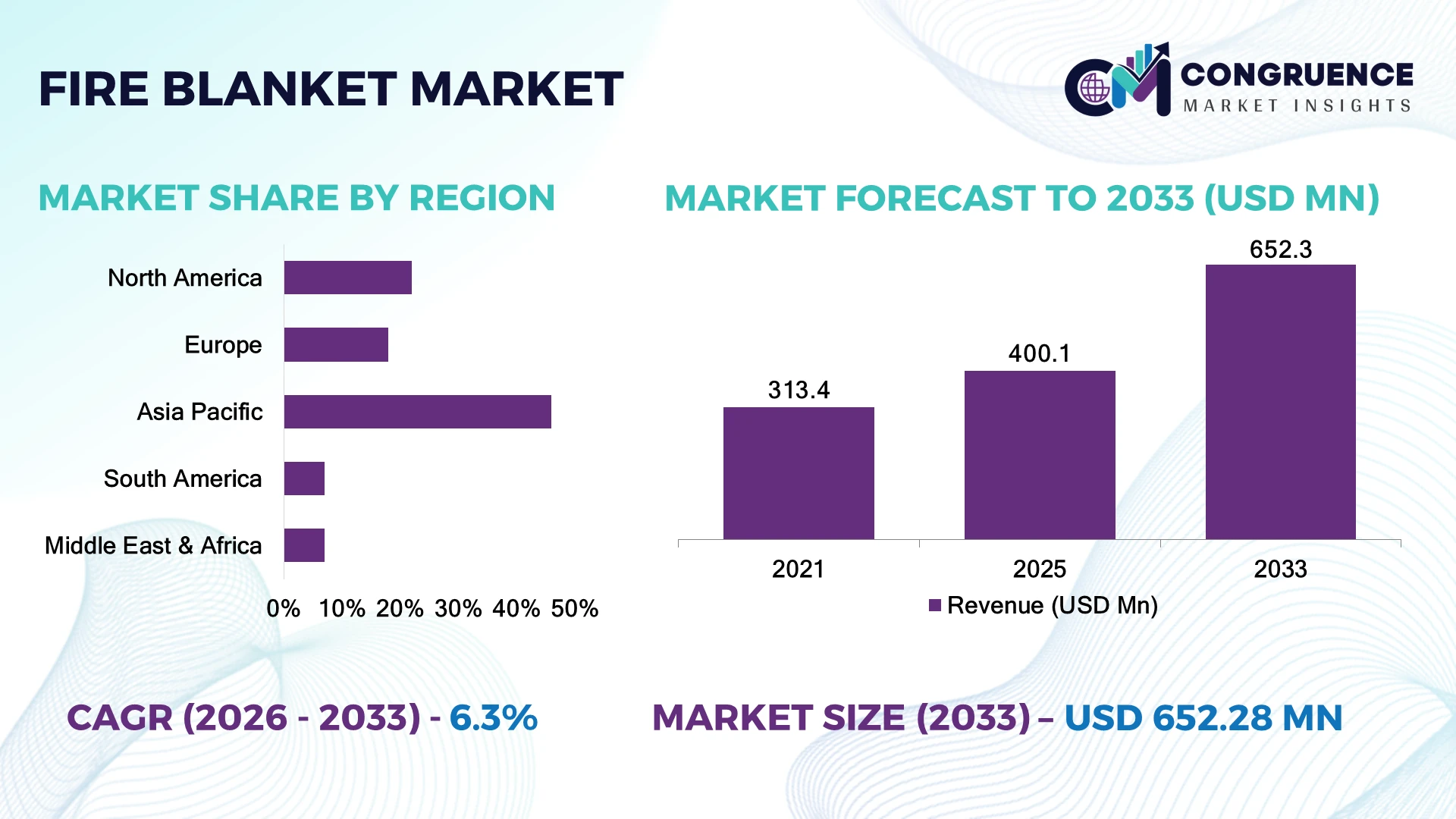
The Global Fire Blanket Market was valued at USD 400.1 Million in 2025 and is anticipated to reach a value of USD 652.3 Million by 2033 expanding at a CAGR of 6.3% between 2026 and 2033. Growth is being driven by stricter workplace fire-safety practices, wider installation of kitchen and industrial fire blankets, and increasing adoption of certified flame-resistant textiles for lithium-ion battery and electrical-fire response.
China remains the dominant manufacturing hub, supplying an estimated 35% of global fire blanket output through established fiberglass, silica, and coated-fabric production. The country benefits from large textile-processing capacity and exports serving construction, hospitality, automotive, and industrial buyers. Germany and the United States emphasize certified, higher-performance products, while China maintains a cost advantage of roughly 15–20% in large-volume manufacturing. Lithium-ion battery safety programs following global EV and energy-storage expansion are also increasing demand for specialized thermal protection products.
Strategically, manufacturers should prioritize certified materials, industrial customization, and supply-chain localization to capture higher-value fire blanket applications.
Market Size & Growth: The market rises from USD 400.1 Million in 2025 to USD 652.3 Million by 2033 at a 6.3% CAGR, supported by industrial fire-safety upgrades and lithium-ion battery protection.
Top Growth Drivers: Industrial safety contributes 32% of incremental demand, commercial kitchens 27%, and battery-related applications 18%.
Short-Term Forecast: By 2028, automated cutting and coating processes can reduce manufacturing costs by 8–12% while improving dimensional consistency by approximately 15%.
Emerging Technologies: Silica-fiber fabrics, ceramic-fiber composites, and coated fiberglass are advancing thermal resistance, durability, and application-specific performance.
Regional Leaders: Asia-Pacific is projected to reach approximately USD 280 Million by 2033, Europe USD 155 Million, and North America USD 145 Million, supported by stronger certification and workplace-safety adoption.
Consumer/End-User Trends: Commercial and industrial users account for more than 60% of demand, with hospitality and manufacturing buyers increasingly specifying certified blankets rather than basic consumer-grade products.
Pilot/Case Example: Battery-fire containment programs deployed during 2024–2025 recorded approximately 20% faster initial-response readiness where fire blankets were integrated into designated emergency equipment stations.
Competitive Landscape: Leading suppliers hold an estimated 25% combined share, with brands and manufacturers including Safelincs, Jactone, ULINE, Bristol Uniforms, and Newtex competing through certification, material performance, customization, and distribution reach.
Regulatory & ESG Impact: Updated workplace and product-safety requirements are increasing preference for certified products, while reusable fire blankets can reduce disposable suppression-material consumption by approximately 10–15%.
Investment & Funding: More than USD 35 Million is being directed toward advanced textile production, coating lines, battery-safety products, and industrial fire-protection distribution, with partnerships strengthening specialized product portfolios.
Innovation & Future Outlook: Next-generation blankets will combine high-temperature fibers, protective coatings, compact deployment formats, and application-specific designs, shifting competition toward performance certification and specialized industrial protection.
The Fire Blanket Market is increasingly shaped by commercial kitchens, manufacturing facilities, laboratories, electrical installations, and battery-handling environments. Advanced silica and ceramic-fiber constructions are gaining traction where higher thermal resistance and repeated-use capability justify premium specifications. Approximately 60% of professional demand is concentrated in commercial and industrial applications, while lithium-ion battery incidents are accelerating specialized product development. Supply-chain diversification is also encouraging buyers to qualify secondary textile and coating suppliers, creating a clear transition toward specification-driven procurement.
Fire blankets are becoming a strategic component of localized fire protection as businesses seek immediate containment tools that complement extinguishers and fixed suppression systems. Their importance is increasing in commercial kitchens, manufacturing plants, laboratories, electrical workspaces, and battery-handling facilities where seconds of response time can limit equipment damage and operational interruption. The expansion of lithium-ion batteries has further broadened the addressable application base.
Material engineering is changing performance economics. Modern silica and ceramic-fiber blankets provide substantially higher temperature resistance than conventional fiberglass products, while advanced coatings improve abrasion resistance and service life by approximately 10–20%. Europe places stronger emphasis on certification and standardized testing, whereas China concentrates on scalable manufacturing and North America increasingly targets specialized industrial and battery-safety applications.
During 2026–2028, procurement is expected to shift toward application-specific specifications, including larger industrial formats, wall-mounted emergency stations, and battery-response kits. Manufacturers are expanding coated-fabric capacity, developing customized products, and partnering with fire-safety distributors to reach industrial accounts. Companies integrating certified materials with faster deployment and clearer maintenance protocols will gain an operational advantage. Competitive positioning will increasingly depend on verified thermal performance, product reliability, and the ability to serve specialized fire-risk environments rather than competing solely on unit price.
Lithium-ion battery handling is becoming a significant demand catalyst for specialized fire blankets across manufacturing, logistics, laboratories, and energy-storage facilities. Battery-related applications are estimated to contribute 15–18% of incremental professional demand, while industrial users account for more than 60% of purchases. In the United States, EV and battery-storage expansion is increasing requirements for localized emergency containment equipment. Advanced silica and ceramic-fiber products can withstand temperatures above 1,000°C, enabling deployment around higher-risk operations. Manufacturers are responding by developing larger formats, reinforced edges, and application-specific kits. The strategic shift is toward engineered containment products rather than basic household blankets, creating higher-value opportunities for suppliers with validated thermal performance.
Material certification and performance testing remain significant constraints, particularly for suppliers targeting industrial and regulated buyers. Certified products can carry premiums of 15–25% over basic fiberglass alternatives, while testing and documentation requirements can increase product-development costs by 10–15%. European buyers face particularly stringent expectations for fire-performance documentation and traceability. Smaller manufacturers therefore face difficulty competing against established textile and safety-equipment producers with existing certification infrastructure. Procurement teams also increasingly require documented thermal resistance, fabric composition, and quality consistency before approving suppliers. Companies are reducing pressure through standardized product platforms, longer-term fiber contracts, and localized manufacturing. The operational priority is controlling certification costs without compromising specification compliance or narrowing the addressable customer base.
Battery-fire containment creates an attractive opportunity for next-generation fire blanket manufacturers as EV servicing, energy-storage facilities, and electronics production expand. Specialized products incorporating silica, ceramic fibers, and reflective coatings can deliver approximately 20–30% higher thermal protection than conventional fiberglass constructions. Demand for battery-specific formats is estimated to increase professional product adoption by 12–15% in targeted industrial settings. Manufacturers are developing oversized blankets, reusable containment covers, and integrated emergency kits for workshops and storage facilities. Germany, the United States, and China are key innovation centers for battery-safety applications. The non-obvious opportunity is bundling blankets with inspection, training, and replacement programs, creating recurring commercial relationships rather than relying exclusively on one-time equipment sales.
Maintaining uniform thermal performance across large production batches remains a major execution challenge as manufacturers expand into industrial-grade applications. Variations in fiber density, weave structure, coating thickness, and stitching can produce 5–10% differences in effective heat resistance between production lots. Larger blankets also introduce handling and packaging complexity, increasing material usage by approximately 15–20% compared with standard formats. Battery and industrial customers increasingly demand consistent specifications across multi-site deployments, placing greater pressure on quality-control systems. Companies are investing in automated fabric inspection, controlled coating processes, and batch-level testing to stabilize output. Long-term competitiveness will depend on scaling specialized products without allowing manufacturing variability to undermine certification, durability, or field performance.
Silica Fabrics Gain Industrial Traction: Silica-based fire blankets are gaining adoption in higher-temperature environments, with thermal resistance exceeding 1,000°C and professional demand estimated to rise 10–15% across industrial applications. Manufacturers are expanding reinforced designs and larger formats for welding, foundry, and battery-handling operations, where conventional fiberglass products provide less performance headroom.
Battery Blankets Become Specialized: Fire blankets are increasingly designed specifically for lithium-ion battery incidents, with oversized formats and multilayer constructions improving containment coverage by approximately 20–30%. EV workshops and energy-storage operators are adding dedicated response stations rather than relying solely on conventional extinguishers. Suppliers are responding with reusable kits, storage cases, and training-linked product packages.
Compact Designs Improve Deployment: Foldable construction and improved packaging are reducing storage volume by approximately 15–25%, allowing more emergency units to be positioned near high-risk workstations. Commercial kitchens, laboratories, and maintenance areas are adopting wall-mounted or rapid-access formats. Manufacturers are redesigning handles, carrying cases, and deployment mechanisms to reduce response time without materially increasing material consumption.
Traceability Enters Procurement: Industrial buyers are increasingly requesting batch documentation, material specifications, and certification records, with specification-driven purchasing estimated to cover more than 50% of professional procurement. Supply-chain disruptions have encouraged companies to qualify secondary textile and coating suppliers, while manufacturers are introducing digital batch records and standardized quality checks to improve consistency across geographically distributed production.
Fiberglass fire blankets remain the leading type, accounting for approximately 58% of global demand because of their cost efficiency, broad availability, flexible handling, and established use across commercial kitchens, workshops, welding areas, and industrial facilities. Silica fire blankets represent roughly 24% of demand and are the fastest-growing type, supported by higher-temperature applications and lithium-ion battery protection. Ceramic-fiber blankets account for about 11%, serving specialized high-temperature industrial environments, while wool and other materials retain niche positions.
The shift toward silica and ceramic constructions is strengthening premium product demand, with advanced-material adoption increasing approximately 12–15% annually in specialized applications. China maintains a cost-oriented manufacturing advantage, while Germany and the United States emphasize certified, high-performance products. Manufacturers are expanding coated-fabric capacity, developing reinforced formats, and partnering with industrial safety distributors. The investment priority is moving from commodity fiberglass volume toward higher-margin thermal-performance products, although fiberglass remains essential for broad deployment.
In 2025, the National Fire Protection Association reported that U.S. fire departments responded to approximately 1.3 million fires, reinforcing the continuing operational requirement for accessible first-response fire-safety equipment across commercial and residential environments.
Commercial kitchens represent the leading application, accounting for approximately 34% of global fire blanket demand because blankets provide rapid localized response to cooking-oil and pan fires. Industrial and manufacturing applications follow at around 28% and are the fastest-growing segment, with adoption increasing approximately 14–16% as welding, fabrication, battery assembly, and maintenance operations introduce higher localized thermal risks. Household applications remain significant at approximately 22%, while laboratories and other specialty settings account for the balance.
Industrial deployment is increasingly shifting toward application-specific formats rather than standardized household products. Battery-handling facilities are adopting larger thermal barriers, while manufacturing plants are integrating blankets into designated emergency-response stations. Companies are expanding industrial product lines, customizing dimensions, and strengthening distributor partnerships. The business implication is clear: commercial kitchens sustain volume, but industrial buyers generate stronger premium opportunities through larger specifications, higher-temperature materials, and recurring replacement requirements.
In 2025, the National Restaurant Association reported that the U.S. restaurant industry was projected to reach approximately USD 1.5 trillion in sales, supporting continued investment in commercial kitchen safety equipment across a large operating base.
Commercial and industrial establishments form the leading end-user group, accounting for approximately 62% of global fire blanket demand because of larger deployment footprints, workplace-safety requirements, and recurring replacement cycles. Industrial manufacturers are the fastest-growing buyer group, with adoption increasing approximately 15–18% as battery production, metalworking, welding, and maintenance activities require higher-performance thermal protection. Households represent roughly 25% of demand, while laboratories, emergency services, and specialty facilities occupy smaller but technically demanding niches.
Buying behavior is becoming increasingly specification-driven. Commercial establishments prioritize certified, easy-access products, whereas industrial buyers increasingly require higher-temperature materials, customized dimensions, and documented performance. Approximately 30% of large industrial procurement programs are estimated to specify application-specific blankets rather than standard consumer formats. Companies are responding through differentiated product portfolios, volume contracts, distributor alliances, and customized industrial kits. Future demand is therefore shifting toward institutional and industrial procurement, where suppliers can capture greater value through performance, customization, and multi-site deployment.
In 2025, the International Labour Organization estimated that nearly 3 million workers die annually from work-related accidents and diseases, reinforcing the importance of preventive workplace safety systems and accessible emergency-response equipment.
Asia-Pacific accounted for the largest market share at 46% in 2025 however, Middle East & Africa is expected to register the fastest growth, expanding at a CAGR of 7.1% between 2026 and 2033.
Industrial safety procurement shifts toward higher-performance protection
North America accounted for approximately 22% of global Fire Blanket demand in 2025, supported by established workplace-safety procurement, commercial kitchens, manufacturing facilities, welding operations, and emergency-response programs. The United States represents the majority of regional consumption, while Canada contributes through industrial, energy, and construction applications. Demand is increasingly shifting from basic fiberglass products toward silica and multilayer blankets for higher-temperature environments, with premium-material adoption estimated to have increased 12–15% across specialized industrial applications. Suppliers are responding through larger-format products, distributor partnerships, and application-specific kits. The region's mature procurement infrastructure favors vendors capable of providing certification documentation, consistent batch quality, and rapid replenishment rather than competing solely on price.
United States Market Outlook: The United States remains the region's principal demand center because of its extensive commercial, industrial, and emergency-response infrastructure. NFPA reported 1.39 million fires in the country during 2024, highlighting the scale of fire-response requirements. Manufacturers are increasingly targeting industrial facilities with certified, high-temperature blankets and integrated emergency stations.
Certification and industrial modernization strengthen premium demand
Europe represented approximately 18% of global Fire Blanket demand in 2025, with Germany, the United Kingdom, France, and Italy accounting for much of regional procurement. Mature commercial-kitchen usage is being complemented by industrial applications requiring certified thermal protection, particularly metalworking, automotive, laboratories, and battery-related operations. Premium silica and ceramic-fiber products represent an estimated 35% of European industrial demand, reflecting stronger emphasis on temperature resistance and documented performance. EU industrial modernization and decarbonization programs are supporting investment in upgraded production environments, encouraging suppliers to emphasize traceability, material consistency, and compliance. Manufacturers are also strengthening European distribution networks to reduce lead times and protect customers from supply interruptions.
Germany Market Outlook: Germany is the region's most strategically significant market because of its dense manufacturing base and advanced industrial-safety practices. Automotive, machinery, metalworking, and chemical facilities create sustained demand for specialized thermal protection. The European Commission approved €920 million in 2025 for a new semiconductor manufacturing facility in Dresden, illustrating continued investment in high-value industrial infrastructure where specialized fire-response equipment can be integrated into facility safety systems.
Manufacturing scale and industrial deployment accelerate product adoption
Asia-Pacific held the largest regional position with approximately 46% of global Fire Blanket demand in 2025, led by China, Japan, South Korea, and India. China combines large-scale textile and industrial-fabric manufacturing with strong domestic consumption, making the region a major production and export base. Industrial applications account for an estimated 55% of regional demand, supported by construction, automotive, electronics, welding, and battery manufacturing. India is emerging as an important secondary manufacturing and consumption center as industrial infrastructure expands. Suppliers are increasing localized production, expanding fiberglass and silica-fabric capacity, and developing lower-cost customized formats. Regional competition increasingly favors manufacturers combining material availability with high-volume conversion, rapid fulfillment, and application-specific engineering.
China Market Outlook: China remains the region's strongest manufacturing base because of integrated textile, fiberglass, chemical, and industrial supply chains. Its scale supports competitive pricing and rapid customization across standard and industrial blanket formats. Export-oriented manufacturers increasingly combine automated cutting and stitching with batch-level quality controls, enabling larger-volume contracts while maintaining approximately 10–15% cost advantages over smaller production networks.
Industrial diversification broadens demand beyond commercial kitchens
South America accounted for approximately 7% of global Fire Blanket demand in 2025, with Brazil representing the dominant consumption and production center. Demand is concentrated in commercial kitchens, mining, manufacturing, agriculture-processing facilities, and construction sites, while industrial applications are gradually gaining importance. Brazil's mining and manufacturing activity supports demand for heavier-duty thermal protection, although import dependence for specialized fabrics can lengthen procurement cycles. Industrial buyers increasingly favor standardized emergency-response kits, with customized products estimated to command 10–15% higher purchasing value than basic formats. Suppliers are therefore strengthening local distributor relationships and maintaining regional inventory rather than relying exclusively on direct imports.
Brazil Market Outlook: Brazil offers the strongest market opportunity through its diversified industrial base, extensive food-processing sector, mining operations, and large commercial infrastructure. Local buyers increasingly require products suited to demanding operating environments rather than household-grade blankets. Suppliers with regional warehousing and customized industrial formats can reduce replenishment delays and capture institutional contracts across manufacturing and resource-intensive industries.
Industrial megaprojects create new safety-equipment demand
Middle East & Africa represented approximately 7% of global Fire Blanket demand in 2025, with Saudi Arabia, the United Arab Emirates, South Africa, and Qatar serving as important demand centers. Large construction programs, petrochemical facilities, hospitality developments, logistics hubs, and industrial modernization are expanding requirements for localized fire-response equipment. Petrochemical and heavy-industrial applications increasingly favor high-temperature silica and ceramic products, while commercial developments continue using fiberglass formats. Saudi Arabia's industrial ecosystem had more than 12,700 active plants in 2025, strengthening the addressable base for industrial safety products. Suppliers are responding through local distribution, project-based procurement, and partnerships with facility-safety contractors.
Saudi Arabia Market Outlook: Saudi Arabia has the strongest strategic position in the region because Vision 2030 is accelerating industrial localization, manufacturing expansion, and large-scale infrastructure development. The country is targeting more than SAR 1.3 trillion in industrial-sector investment value, creating a substantial pipeline of industrial facilities requiring integrated safety equipment. Local sourcing partnerships and project-specific product specifications are becoming increasingly important competitive levers.
The Fire Blanket Market pits Bridgehill and Fire Isolator against Chinese cost leaders such as Jiangxi Suihua Fiberglass, while industrial safety suppliers including Steel Guard Safety and regional manufacturers compete on customization and delivery. The top five players are estimated to hold 28% combined share, indicating a fragmented structure. Price remains decisive for standard fiberglass products, where Chinese suppliers can undercut premium offerings by 15–20%; advanced EV blankets instead compete through thermal performance, certification, and reusable construction. Premium products command approximately 20–30% higher pricing, while localized inventory can cut delivery times 25–35%. Players are expanding high-silica capacity, forming distributor partnerships, adding third-party testing, and integrating coating, weaving, and finishing to control quality. Competition is shifting toward certified EV containment as DIN SPEC 91489 raises qualification requirements. Entry pressure comes from testing costs, technical validation, and established emergency-response channels. Winners will combine certified performance, scalable supply, rapid deployment, and application-specific engineering.
Bridgehill
Fire Isolator
Jiangxi Suihua Fiberglass Co., Ltd.
Steel Guard Safety Corp.
Jactone Products
Prosol UK / Fire Cloak
Tulmar Safety Systems
Safeprotex
Amini Industries / Amitech
Vardan Safety
Sheffer Industries
Firetex Protective Technologies
Montex Glass Fibre Private Limited
Advanced silica and multilayer fabric systems are reshaping premium fire blankets, with high-silica constructions delivering roughly 15–20% better thermal endurance than standard fiberglass in demanding EV and industrial applications. Adoption is strongest in professional fleets and emergency services, where approximately 30% of specialized procurement increasingly specifies higher-temperature materials. Companies are integrating silicone coatings, breathable structures, reinforced stitching, and reusable designs to extend service life by 20–30% and reduce replacement pressure.
Digital manufacturing is improving consistency through automated cutting, tension control, coating application, and batch inspection. Automated production can reduce dimensional variation by 10–15% and improve throughput by about 8–12%. The competitive advantage favors vertically integrated manufacturers controlling weaving, coating, assembly, and certification rather than distributors dependent on external converters. More suppliers are also pairing blankets with deployment kits, thermal monitoring, and response training.
From 2026–2028, EV-specific containment technology will remain the disruptive focus. New breathable, multilayer blankets can improve heat management and gas release versus older sealed designs, while independent testing determines procurement acceptance. Companies investing now in DIN SPEC 91489-aligned testing, high-silica materials, and modular product platforms will capture institutional contracts as fire departments, charging facilities, and fleet operators move toward standardized emergency-response systems.
January 2025 Bridgehill partnered with CheckFire Ltd to integrate EV fire blankets into lithium-ion battery safety solutions, broadening responder-channel access. The move strengthened bundled containment offerings for high-risk facilities and accelerated commercial deployment emergency-service markets. Source: International Fire & Safety Journal
May 2025 Fire Isolator confirmed certification of all its fire blanket models under DIN SPEC 91489, strengthening qualification for EV battery-fire containment. The certification covered three models, improving procurement credibility as standardized performance requirements gain increasing importance globally. Source: fireisolator.com. (Fire Isolator)
June 2025 Bridgehill’s Car Pro X underwent independent DIN SPEC 91489 testing by Kiwa MPA Dresden, advancing third-party validation of reusable EV fire-blanket performance. The testing supports institutional procurement and strengthens differentiation against competing uncertified alternatives globally.
August 2026 Tulmar continued development of KOVA, a Canadian-made EV fire blanket, through an engineering internship focused on design, testing, documentation, manufacturing planning, budgeting, and packaging. The program strengthened commercialization readiness for lithium-ion emergency-response applications and manufacturing scale-up. Source: Tulmar (Tulmar)
The Fire Blanket Market Report covers fiberglass, silica, ceramic-fiber, wool, and other material types across commercial kitchens, industrial facilities, households, laboratories, and specialized applications. End-user analysis includes commercial and industrial establishments, households, manufacturing operations, emergency-response organizations, and specialty facilities. Geographic coverage spans North America, Europe, Asia-Pacific, South America, and Middle East & Africa, with country-level assessment of the United States, China, Germany, India, Brazil, Saudi Arabia, and other priority markets.
The study evaluates conventional and advanced thermal fabrics, silicone coatings, multilayer constructions, reusable designs, EV battery containment, and high-temperature industrial solutions. Approximately 60% of demand is concentrated among commercial and industrial users, while specialized EV and battery applications represent a rapidly expanding niche. Competitive assessment covers major manufacturers, regional suppliers, technology differentiation, certification positioning, distribution strategies, and customization. The findings support investment planning, manufacturing expansion, supplier selection, market-entry decisions, competitive positioning, and product strategy through 2033.
| Report Attribute/Metric | Report Details |
|---|---|
|
Market Revenue in 2025 |
USD 400.1 Million |
|
Market Revenue in 2033 |
USD 652.3 Million |
|
CAGR (2026 - 2033) |
6.3% |
|
Base Year |
2025 |
|
Forecast Period |
2026 - 2033 |
|
Historic Period |
2021 - 2025 |
|
Segments Covered |
By Type
By Application
By End-User
|
|
Key Report Deliverable |
Revenue Forecast, Growth Trends, Market Dynamics, Segmental Overview, Regional and Country-wise Analysis, Competition Landscape |
|
Region Covered |
North America, Europe, Asia-Pacific, South America, Middle East, Africa |
|
Key Players Analyzed |
Bridgehill, Fire Isolator, Jiangxi Suihua Fiberglass Co., Ltd., Steel Guard Safety Corp., Jactone Products, Prosol UK / Fire Cloak, Tulmar Safety Systems, Safeprotex, Amini Industries / Amitech, Vardan Safety, Sheffer Industries, Firetex Protective Technologies, Montex Glass Fibre Private Limited |
|
Customization & Pricing |
Available on Request (10% Customization is Free) |




