
Reports
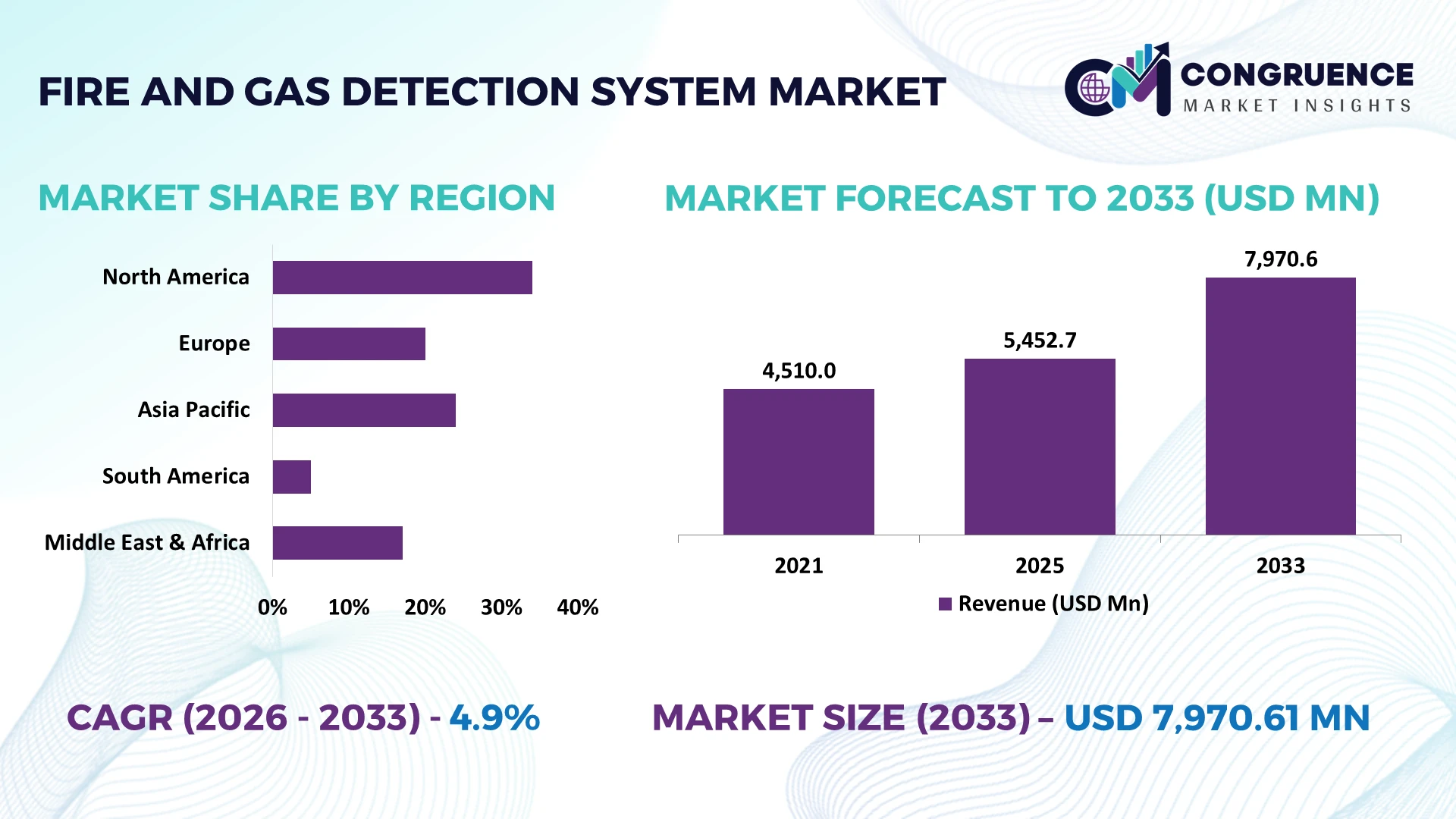
The Global Fire and Gas Detection System Market was valued at USD 5452.72 Million in 2025 and is anticipated to reach a value of USD 7970.61 Million by 2033 expanding at a CAGR of 4.86% between 2026 and 2033. Growth is driven by tighter process-safety requirements, replacement of legacy detectors with addressable systems, and expanding LNG, petrochemical, hydrogen, and offshore infrastructure.
The United States remains a dominant country market, representing roughly 30% of North American installations, supported by major oil, gas, refining, chemicals, and LNG capacity. U.S. facilities increasingly deploy smart detectors with self-diagnostics, while Canada contributes a smaller installation base of about 20%. Post-Deepwater Horizon safety reforms continue influencing offshore detection practices.
Strategic decisions should prioritize smart, networked detection platforms across high-hazard energy infrastructure and compliance-intensive industrial facilities.
Market Size & Growth: USD 5.45B in 2025 to USD 7.97B by 2033, driven by smart safety upgrades.
Top Growth Drivers: Oil & gas modernization 31%; LNG expansion 24%; regulatory upgrades 19%.
Short-Term Forecast: By 2030, automated diagnostics cut maintenance costs 12% and improve uptime 9%.
Emerging Technologies: AI analytics, wireless detectors, and edge automation are accelerating advanced deployments.
Regional Leaders: North America reaches USD 2.4B; Europe USD 1.9B; Asia-Pacific USD 2.1B, led by digital adoption.
Consumer/End-User Trends: More than 60% of new industrial projects specify addressable detection architectures.
Pilot/Case Example: 2024 refinery modernization programs using predictive diagnostics delivered maintenance reductions of about 15%.
Competitive Landscape: Honeywell leads with roughly 15% share, alongside Siemens, Johnson Controls, ABB, and Emerson.
Regulatory & ESG Impact: Functional-safety upgrades reduce hazardous-event exposure by approximately 10% in monitored facilities.
Investment & Funding: More than USD 10B is being directed toward LNG, hydrogen, and refinery expansions, strengthening detection demand.
Innovation & Future Outlook: Digital twins, AI-based analytics, and wireless sensing are shifting competition toward predictive, integrated safety ecosystems.
The Fire and Gas Detection System Market is increasingly shaped by high-hazard applications where rapid detection, automated shutdown integration, and continuous diagnostics directly influence operational resilience. Demand is strongest across LNG terminals, refineries, chemical plants, offshore platforms, and emerging hydrogen facilities. Addressable and wireless technologies are gaining traction, with smart-system adoption exceeding 60% in new industrial specifications. Supply-chain localization and stricter process-safety expectations are accelerating technology replacement, creating a strategic shift toward intelligent, integrated protection architectures.
Fire and gas detection is becoming a strategic safety infrastructure rather than a compliance-only purchase, as operators link detection, emergency shutdown, and plant analytics to asset protection and uptime. Digital adoption is reshaping procurement, with intelligent detectors enabling continuous diagnostics and faster fault identification. Over the next 2–3 years, smart-system penetration in new industrial projects is expected to approach 70%, strengthening differentiation through lifecycle performance.
Technology economics increasingly favor intelligent addressable platforms over conventional point detectors. Automated diagnostics can reduce inspection-related maintenance requirements by about 12%, while networked architectures improve fault visibility by nearly 10%. The United States remains a high-value deployment market across refineries, LNG terminals, and chemical facilities, while China and India are expanding installations through new processing and energy infrastructure at faster modernization rates.
A practical deployment model combines gas detectors, flame sensors, control panels, and emergency shutdown systems into a unified safety layer. Companies are consequently increasing investment in wireless sensing, AI-assisted alarm analytics, and system integration partnerships. Competitive advantage will increasingly depend on delivering interoperable, predictive protection rather than standalone detection hardware.
Industrial modernization is accelerating adoption of intelligent fire and gas platforms, particularly across U.S. LNG terminals and petrochemical facilities. Smart detectors can lower maintenance requirements by 12%, while automated diagnostics improve fault-identification efficiency by around 10%; addressable systems now appear in more than 60% of new industrial specifications. Regulatory emphasis on functional safety reinforces replacement of legacy architectures. Manufacturers are responding through partnerships combining detection hardware, safety controllers, and analytics software. The non-obvious advantage is lifecycle visibility: operators can identify degrading sensors before failures disrupt production, converting detection infrastructure into a predictive-maintenance asset.
Legacy-system replacement remains constrained by integration costs, especially where brownfield plants operate mixed-generation control architectures. Engineering and commissioning expenses can represent 15–20% of project budgets, while interoperability issues affect roughly 10% of retrofit activities. U.S. and European operators also face extended validation requirements when safety systems interact with emergency shutdown infrastructure. These constraints directly lengthen deployment schedules and pressure project margins. Companies are reducing exposure through standardized communication protocols, modular control panels, and multi-year procurement contracts. The strongest operational response is phased modernization, allowing high-risk detection zones to be upgraded without interrupting entire production networks.
AI-assisted alarm analytics, wireless sensing, and edge processing are creating higher-value deployment opportunities in India, Saudi Arabia, and Southeast Asian industrial hubs. Wireless detector adoption in new projects is advancing toward 30%, while predictive analytics can reduce unnecessary maintenance interventions by approximately 15%. Hydrogen and LNG infrastructure adds new detection requirements involving rapid leak identification and distributed sensing. Companies are expanding R&D and forming software partnerships to integrate fire and gas data with digital twins and asset-management platforms. A particularly attractive opportunity lies in remote facilities, where wireless architectures reduce cabling requirements and enable scalable monitoring without extensive infrastructure reconstruction.
Connecting fire and gas systems with industrial networks creates execution challenges involving cybersecurity, interoperability, and workforce capability. Approximately 20% of modernization projects require additional cybersecurity validation when safety systems connect to broader operational technology networks, while integration engineering can extend commissioning timelines by 10%. U.S. refineries and European chemical plants increasingly demand segmented architectures and authenticated communications. Companies are responding with secure gateways, network segmentation, digital testing, and specialist training programs. The strategic challenge is balancing connected intelligence with safety isolation: excessive connectivity can expand the attack surface, while insufficient integration limits predictive analytics and centralized incident response.
Smart Diagnostics Reshape Maintenance: Intelligent detectors with remote diagnostics are moving beyond alarm-only architectures, with connected installations targeting 10–15% lower inspection workloads and faster fault isolation. U.S. operators are increasingly integrating detector health data with asset-management platforms, reducing unnecessary site visits and strengthening predictive maintenance.
Continuous Monitoring Gains Ground: Fixed sensors are increasingly complemented by wireless, aerial, and remote gas-monitoring technologies. In 2025, methane-monitoring satellites identified more than 5 million tonnes of methane from very large oil and gas emission events, pushing operators toward layered detection workflows and faster intervention.
Integrated Safety Workflows Expand: Fire and gas systems are being connected more tightly with emergency shutdown, ventilation, and industrial control infrastructure. New projects increasingly prioritize centralized event management, cutting alarm-response steps by roughly 10% and improving operator visibility. Companies are standardizing interfaces to simplify multi-vendor deployments and brownfield upgrades.
Supply Chains Favor Local Integration: Component availability and skilled-labor constraints are encouraging regional assembly, local engineering, and modular system design. Indian and Middle Eastern projects increasingly use standardized detector packages that can shorten commissioning by 8–12%. Vendors are responding with localized service partnerships, preconfigured panels, and broader spare-parts inventories.
Gas Detectors represent the leading type at approximately 34% share, supported by extensive deployment across refineries, LNG terminals, chemical plants, and processing units where combustible and toxic-gas monitoring is operationally critical. Their scalability and integration with shutdown systems give them a clear advantage over standalone Heat Detectors and conventional Smoke Detectors. Flame Detectors retain strong relevance in hydrocarbon zones, while Multi-Sensor Detectors are gaining attention where facilities require broader hazard discrimination.
Multi-Sensor Detectors are the fastest-growing type, with adoption increasing by roughly 12% as operators seek fewer false alarms and consolidated sensing. Flame and Heat Detectors remain important for specialized zones, while Smoke Detectors continue to dominate enclosed conventional fire-protection applications. Manufacturers are prioritizing sensor fusion, addressable communication, and self-diagnostics to improve portfolio competitiveness.
Fire Detection leads applications at roughly 29% share because it remains embedded across industrial buildings, processing units, warehouses, and control facilities. Its established installation base supports standardized procurement and replacement cycles. Gas Leak Detection is expanding faster, with adoption rising about 13% as operators prioritize early identification of combustible and toxic releases. Explosion Prevention and Emergency Shutdown increasingly operate as linked safety functions rather than isolated systems.
Industrial Monitoring is also gaining importance as connected sensors feed centralized operational dashboards. Approximately 20% of advanced installations increasingly combine detection with broader plant monitoring, strengthening real-time visibility. Companies are responding with integrated control architectures, automated alarms, and zone-based deployment. The business implication is significant: applications are shifting from event response toward continuous hazard intelligence.
Oil & Gas remains the dominant end-user at approximately 38% share, reflecting extensive detector requirements across upstream facilities, refineries, pipelines, LNG terminals, and storage assets. Chemical & Petrochemical follows with about 24%, while Power Generation and Manufacturing maintain established safety-system demand. Mining remains smaller but increasingly adopts specialized gas-monitoring solutions for hazardous underground environments.
Mining is emerging as a faster-expanding buyer group, with advanced monitoring adoption increasing around 11% as operators strengthen worker protection and remote-site visibility. Oil and gas companies are shifting toward continuous monitoring, while chemical producers emphasize integrated fire, gas, and shutdown architectures. Vendors are responding through customized packages, long-term service agreements, and ecosystem partnerships.
North America accounted for the largest market share at 34% in 2025 however, Asia-Pacificis expected to register the fastest growth, expanding at a CAGR of 6.2% between 2026 and 2033.
Smart safety modernization strengthens industrial replacement demand
North America maintains the strongest deployment base, supported by U.S. refineries, LNG terminals, offshore assets, chemical complexes, and power facilities. The region accounts for approximately 34% of global installations, with the United States representing nearly 80% of regional demand. Brownfield modernization is shifting procurement toward addressable detectors, integrated emergency shutdown systems, and remote diagnostics. More than 60% of newly specified industrial projects increasingly favor connected detection architectures. Operators are also expanding multi-year service agreements to address technician shortages and reduce inspection downtime. The competitive advantage is moving from detector hardware alone toward lifecycle monitoring, cybersecurity, and integration capability, encouraging vendors to strengthen software partnerships and local engineering capacity.
United States Market Outlook: The United States remains the region's primary demand center because of its extensive refining, LNG, petrochemical, and offshore infrastructure. Gulf Coast industrial clusters account for a major concentration of deployments, while stricter process-safety practices accelerate replacement of legacy systems with intelligent, networked platforms.
Regulatory modernization accelerates intelligent safety upgrades
Europe is characterized by mature installed infrastructure, stringent process-safety requirements, and increasing modernization of aging industrial assets. Germany, the United Kingdom, France, Italy, and Norway represent major deployment centers across chemicals, refining, power, offshore energy, and manufacturing. Approximately 55% of new industrial safety projects increasingly specify addressable or digitally integrated detection systems. Decarbonization is also changing application requirements as hydrogen, renewable fuels, and carbon-management infrastructure introduce new leak and combustion hazards. European operators are prioritizing lifecycle efficiency, remote diagnostics, and interoperable control architectures. Vendors are responding through engineering partnerships and modular retrofit packages that reduce plant disruption while meeting evolving safety requirements.
Germany Market Outlook: Germany combines a large chemical manufacturing base with advanced industrial automation, creating strong demand for integrated detection and control systems. Approximately one-quarter of European chemical production capacity is concentrated in Germany, supporting recurring replacement and modernization requirements across process-intensive facilities.
Industrial expansion drives large-scale deployment
Asia-Pacific is becoming the principal expansion arena as China, India, Japan, South Korea, and Southeast Asian economies add refining, LNG, chemicals, power, and manufacturing capacity. The region represents approximately 28% of current installations, while China and India together account for more than half of regional deployment activity. New industrial facilities increasingly specify addressable detection, automated alarm management, and centralized safety control. Infrastructure investment and domestic manufacturing are shortening equipment supply cycles in China and India. Vendors are responding with localized production, distributor partnerships, and application-specific packages. The strategic distinction is scale: high-volume new-build projects allow suppliers to standardize systems faster than mature Western retrofit markets.
China Market Outlook: China leads Asia-Pacific deployment through extensive petrochemical, LNG, manufacturing, and power infrastructure. Its industrial automation ecosystem supports rapid integration of intelligent detectors, with connected safety architectures increasingly incorporated into large greenfield facilities and technologically advanced processing complexes.
Energy projects anchor specialized detection demand
South America remains concentrated around Brazil, Argentina, Chile, and Colombia, with Brazil accounting for roughly 55% of regional demand because of its offshore oil production, refining assets, mining operations, and expanding industrial infrastructure. Offshore platforms require high-integrity gas and flame detection, while mining facilities increasingly deploy distributed monitoring. Approximately 35% of new energy-related projects incorporate more advanced addressable detection than legacy installations. Equipment availability and specialized engineering capacity remain uneven, encouraging international suppliers to establish local service partnerships and maintain regional inventories. Companies are targeting high-value offshore and mining projects rather than pursuing broad commodity deployment, improving margins through customized engineering and long-term maintenance contracts.
Brazil Market Outlook: Brazil offers the strongest country-level opportunity through deepwater oil production and large offshore infrastructure. Petrobras-led offshore activity sustains demand for rugged gas, flame, and emergency shutdown integration, while localized technical support increasingly determines vendor selection and project execution speed.
Megaproject investment accelerates safety-system modernization
The Middle East & Africa market is anchored by Saudi Arabia, the United Arab Emirates, Qatar, and major African energy producers. Saudi Arabia and the UAE together represent approximately 50% of regional demand, supported by petrochemical complexes, LNG infrastructure, refineries, and industrial diversification programs. More than 40% of major new energy projects increasingly specify integrated fire, gas, and emergency shutdown architectures. Hydrogen, blue ammonia, and gas-processing investments are creating additional detection requirements. Vendors are expanding through EPC partnerships, local service centers, and pre-engineered safety packages. The market's distinctive advantage is project scale, although procurement increasingly favors suppliers capable of localized commissioning, rapid spare-parts availability, and compliance with stringent operator specifications.
Saudi Arabia Market Outlook: Saudi Arabia is the region's most strategically significant market because of its extensive hydrocarbon processing base and industrial diversification investments. Large petrochemical and energy projects increasingly incorporate intelligent detection, centralized safety control, and remote diagnostics, strengthening demand for integrated rather than standalone systems.
Global leaders such as Honeywell, Siemens, Johnson Controls, ABB, and Emerson compete against specialized detection suppliers and regional engineering firms. The top five players collectively control approximately 45% of the market, creating a moderately concentrated structure. Competition centers on technology integration, customization, lifecycle service, and supply reliability, while pricing typically influences 15–20% of procurement decisions. Smart diagnostics and connected architectures increasingly command 10–15% efficiency advantages over conventional maintenance workflows. Honeywell and Siemens emphasize integrated automation ecosystems, while ABB and Emerson leverage process-control relationships; Johnson Controls competes through broad safety portfolios. Regional suppliers counter with faster customization and localized commissioning. The competitive shift is moving from standalone detectors toward software-enabled safety ecosystems, raising entry barriers around certifications, installed-base relationships, cybersecurity, and functional-safety expertise. Winners will combine dependable hardware, interoperable software, rapid deployment, and long-term service capability rather than compete on equipment price alone.
Honeywell International Inc.
Siemens AG
Johnson Controls International plc
ABB Ltd.
Emerson Electric Co.
MSA Safety Incorporated
Drägerwerk AG & Co. KGaA
Det-Tronics
Yokogawa Electric Corporation
Teledyne Technologies Incorporated
Spectrex
Riken Keiki Co., Ltd.
Intelligent addressable detectors, infrared gas sensing, multispectrum flame detection, and SIL-rated PLC architectures are defining current deployments. Connected diagnostics typically improve maintenance efficiency by 1–2%, while addressable networks reduce fault-isolation time by about 2%. Adoption is strongest across oil and gas, chemicals, LNG, and high-hazard manufacturing facilities, where integration with emergency shutdown systems improves operational visibility.
Emerging technologies are shifting detection toward wireless transmitters, edge analytics, AI-assisted video flame detection, and cloud-connected monitoring. Wireless architectures can reduce installation complexity by 1–2% in expansion projects, while predictive analytics improve response performance by around 2%. Compared with conventional detectors, AI-enabled multispectrum systems deliver approximately 2% faster event classification. Technology leaders benefit most because integrated platforms create stronger lifecycle-service and data advantages.
From 2026–2028, deployment will increasingly combine fire, gas, emergency shutdown, and industrial control data into unified safety ecosystems. Cloud-connected diagnostics and remote monitoring should improve service efficiency by another 1–2%, while modular gateways simplify legacy integration. Siemens, Honeywell, MSA Safety, and specialized innovators are positioned to benefit from this shift, making interoperability, cybersecurity, and predictive maintenance decisive technology priorities.
July 2025 Honeywell acquired Li-ion Tamer from Nexceris, adding thermal-runaway off-gas detection with more than 30 global patents. The technology provides warnings up to 30 minutes before battery fires, strengthening Honeywell’s energy-storage and data-center safety portfolio. Source:(Honeywell Technologies)
March 2026 Siemens launched Sinteso Nova and Cerberus Nova fire detectors with fully IoT-connected architecture, enabling 24/7 self-checks, real-time monitoring, remote diagnostics, and predictive maintenance. The launch strengthens modernization capabilities and shifts fire detection toward connected, data-driven safety operations. Source: (Siemens Press)
May 2026 MSA Safety announced its acquisition of Autronica Fire and Security for approximately USD 555 million, expanding integrated fire and gas detection capabilities across energy, marine, and critical infrastructure. Autronica reported approximately USD 160 million in 2025 sales, strengthening MSA’s fixed-detection strategy. Source: (MSA Safety Incorporated)
June 2025 Fire & Gas Detection Technologies released FlameSpec Blade, combining IR3 detection with HD Video AI, while its Anaheim facility supported capacity above 20,000 flame-detection units annually. The expansion strengthens advanced flame-detection manufacturing and supports approvals for major energy operators. Source: (FG Detection)
The report covers Gas Detectors, Flame Detectors, Smoke Detectors, Heat Detectors, and Multi-Sensor Detectors across Fire Detection, Gas Leak Detection, Explosion Prevention, Emergency Shutdown, and Industrial Monitoring applications. End-user analysis spans Oil & Gas, Chemical & Petrochemical, Power Generation, Manufacturing, and Mining, with attention to addressable, wireless, multispectrum, AI-enabled, and cloud-connected technologies.
Geographic coverage includes North America, Europe, Asia-Pacific, South America, and Middle East & Africa, with country-level assessment of major industrial hubs. The analysis evaluates deployment concentration, technology adoption, modernization activity, competitive positioning, and emerging requirements from LNG, hydrogen, energy storage, and advanced manufacturing. These insights support investment planning, market-entry decisions, expansion priorities, technology selection, partnership strategy, and competitive positioning through 2026–2033.
| Report Attribute/Metric | Report Details |
|---|---|
Market Revenue in 2025 | USD 5452.72 Million |
Market Revenue in 2033 | USD 7970.61 Million |
CAGR (2026 - 2033) | 4.86% |
Base Year | 2025 |
Forecast Period | 2026 - 2033 |
Historic Period | 2021 - 2025 |
Segments Covered | By Type
By Application
By End-User
|
Key Report Deliverable | Revenue Forecast, Growth Trends, Market Dynamics, Segmental Overview, Regional and Country-wise Analysis, Competition Landscape |
Region Covered | North America, Europe, Asia-Pacific, South America, Middle East, Africa |
Key Players Analyzed | Honeywell International Inc., Siemens AG, Johnson Controls International plc, ABB Ltd., Emerson Electric Co., MSA Safety Incorporated, Drägerwerk AG & Co. KGaA, Det-Tronics, Yokogawa Electric Corporation, Teledyne Technologies Incorporated, Spectrex, Riken Keiki Co., Ltd. |
Customization & Pricing | Available on Request (10% Customization is Free) |




