
Reports
The Global Finasteride Market was valued at USD 130.6 Million in 2025 and is anticipated to reach a value of USD 168.0 Million by 2033 expanding at a CAGR of 3.2% between 2026 and 2033. Growth is driven by persistent benign prostatic hyperplasia treatment, androgenetic alopecia management, expanding generic production, and increasing availability through digital prescription channels.
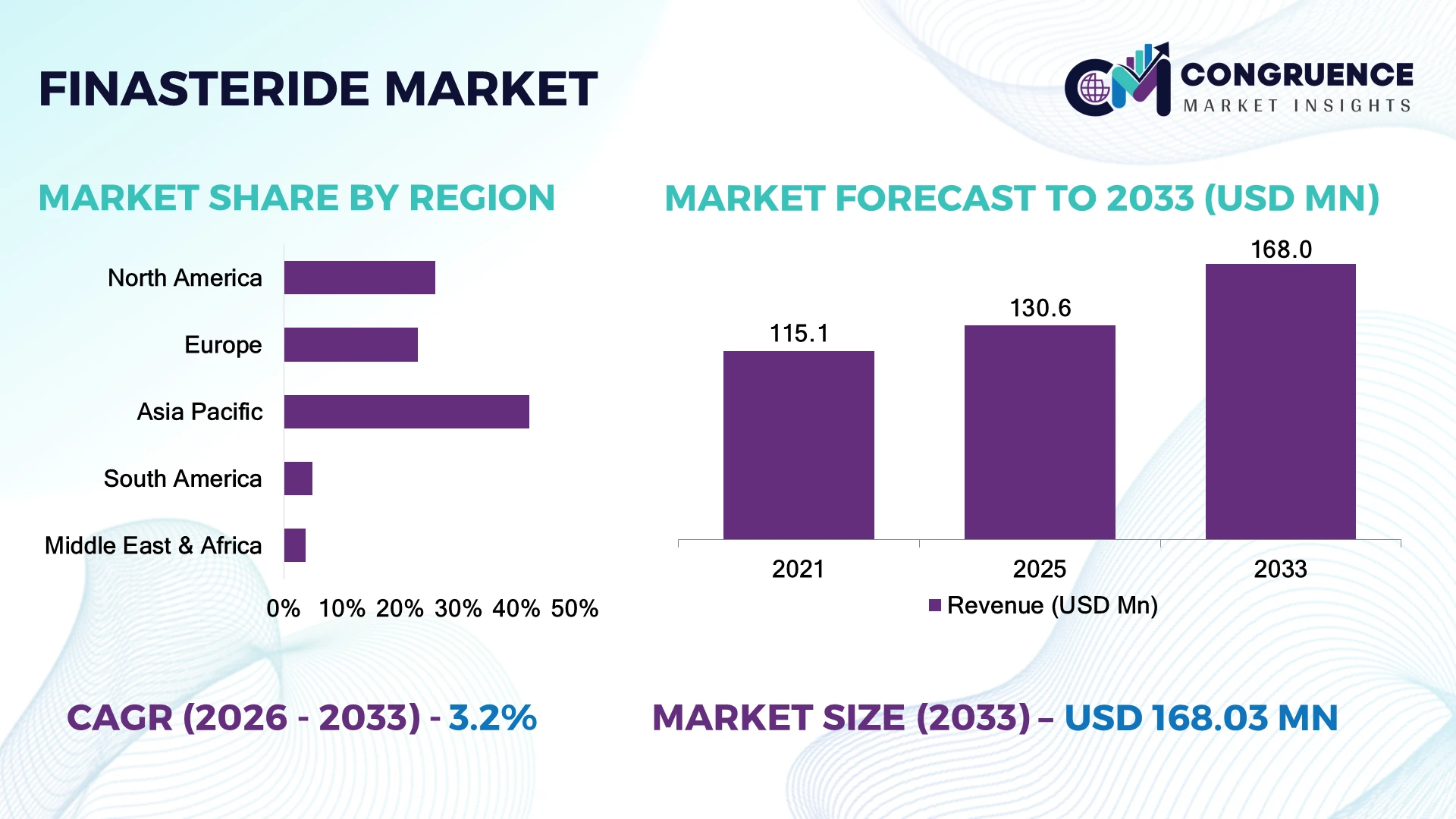
The United States remains a leading commercial market, representing approximately 26% of global finasteride demand, supported by established urology, dermatology, pharmacy, and telehealth infrastructure. India holds a stronger manufacturing position, with approximately 44% of global API manufacturing capacity versus around 9% in the U.S. This supply-chain imbalance has gained importance under 2026 U.S. policy efforts to strengthen domestic pharmaceutical production.
Strategic priority is shifting toward API security, localized manufacturing, differentiated formulations, and digitally enabled distribution.
Market Size & Growth: USD 130.6 million in 2025 to USD 168.0 million by 2033 at 3.2% CAGR, supported by generic production and digital prescribing.
Top Growth Drivers: BPH treatment 80%; androgenetic alopecia 43%; generic availability 65%.
Short-Term Forecast: By 2028, automated fulfillment and digital prescribing can improve prescription-processing efficiency by 10–15%.
Emerging Technologies: Topical delivery, combination formulations, electronic adherence tools, and digitally managed prescribing are reshaping product access.
Regional Leaders: Asia-Pacific approximately USD 55 million, North America USD 34 million, and Europe USD 30 million, with Asia-Pacific gaining through localized manufacturing.
Consumer/End-User Trends: Oral 1 mg formulations account for approximately 64% of dosage demand, reinforced by hair-loss treatment adoption.
Pilot/Case Example: 2024 combination-product commercialization strengthened differentiated BPH treatment, with 180-day generic exclusivity supporting faster market penetration.
Competitive Landscape: Merck retains approximately 16% share, competing with Teva, Sandoz, Viatris, and Sun Pharma across branded and generic segments.
Regulatory & ESG Impact: U.S. pharmaceutical policy is increasing domestic-supply emphasis, intensifying pressure to diversify API sourcing beyond concentrated overseas production.
Investment & Funding: Approximately USD 100 million-scale manufacturing investments across major Indian pharmaceutical expansion programs are strengthening API and finished-dose capacity.
Innovation & Future Outlook: Topical finasteride, combination therapies, localized API production, and digital care pathways will shift competition beyond conventional oral-tablet pricing.
The Finasteride Market is concentrated around BPH and androgenetic alopecia treatment, with approximately 64% of dosage demand associated with oral 1 mg formulations. Manufacturers are increasingly emphasizing topical delivery, combination products, and supply-chain localization as generic competition intensifies. Regulatory attention on pharmaceutical manufacturing resilience in the U.S. is also encouraging geographically diversified API sourcing, setting up a more strategic competitive environment.
The Finasteride Market is becoming strategically important as a mature generic category evolves toward formulation differentiation, digital access, and supply-chain resilience. BPH remains the principal therapeutic demand area, while hair-loss treatment creates a distinct consumer-driven pathway supported by dermatology and telehealth channels. This dual-use structure allows manufacturers to diversify beyond traditional urology-focused commercialization.
Supply-chain restructuring is becoming more consequential in 2026 as pharmaceutical procurement places greater emphasis on API availability and manufacturing resilience. India remains a major API production hub, while the U.S. is increasing attention on domestic pharmaceutical capacity. Companies therefore have stronger incentives to establish dual sourcing, regional inventories, and qualified alternative manufacturing partners.
Technology is shifting commercialization efficiency rather than transforming the active ingredient itself. Automated packaging and electronic prescription workflows can reduce manual processing requirements by approximately 10–15% compared with conventional workflows. North America leads in digital access, while Asia-Pacific combines faster manufacturing localization with expanding pharmaceutical distribution. Over the next 2–3 years, topical formulations, combination products, and digitally managed treatment pathways will receive greater investment. Companies that secure reliable APIs while differentiating formulations and distribution will hold the strongest competitive position.
Finasteride demand is supported by BPH and androgenetic alopecia, with BPH representing roughly 58% of therapeutic demand and hair-loss treatment about 43% of applications in major commercial markets. Oral 1 mg products account for approximately 64% of dosage demand, reinforcing large-scale generic production. In the U.S., telehealth prescribing is also broadening access to dermatology-led treatment. Manufacturers are responding with broader dosage portfolios, combination products, and digitally integrated prescription fulfillment. A non-obvious advantage is manufacturing flexibility: the same API platform can serve urology and dermatology portfolios, improving capacity utilization and reducing dependence on one therapeutic channel.
Finasteride manufacturing remains exposed to concentrated API sourcing, particularly across Asian production hubs. India accounts for approximately 44% of global API manufacturing sites, compared with about 9% in the U.S., creating geographic concentration in pharmaceutical supply chains. API and formulation inputs can represent roughly 20–30% of finished-product manufacturing costs for smaller suppliers, while generic price competition can compress margins by 10–15%. U.S. policy emphasis on domestic pharmaceutical production is increasing qualification requirements. Companies are mitigating exposure through dual sourcing, longer procurement contracts, regional inventory buffers, and qualified secondary manufacturers. The strategic constraint is no longer API availability alone, but maintaining competitive cost structures while diversifying supply.
Topical finasteride represents an important product-development opportunity because it separates manufacturers from increasingly commoditized oral tablets. Oral 1 mg products hold approximately 64% of dosage demand, leaving substantial room for differentiated delivery systems. Topical and combination formulations can command stronger dermatology positioning, while digital prescribing channels already influence roughly 15–20% of hair-loss treatment pathways in digitally mature markets. India offers an additional opportunity through low-cost formulation development and contract manufacturing capabilities. Companies are increasing formulation R&D, partnering with specialty pharmacies, and expanding direct-to-consumer treatment ecosystems. The non-obvious opportunity is portfolio reuse: established finasteride API infrastructure can support multiple delivery formats without requiring an entirely new active-ingredient supply chain.
Manufacturers face increasing execution complexity as finasteride products diversify across oral, topical, and combination formats. Regulatory requirements can extend development timelines by 10–20% for differentiated formulations compared with established generic tablets, while quality-control requirements across manufacturing batches can add approximately 5–10% to operational workload. U.S. and European regulatory scrutiny increasingly emphasizes product consistency, pharmacovigilance, and manufacturing controls. Companies must strengthen analytical development, electronic quality systems, and regulatory partnerships to maintain commercialization speed. A critical long-term pressure is scaling differentiated formulations without losing the cost advantage of mature generic production, making standardized manufacturing platforms and modular quality-control processes increasingly important.
Digital Prescribing Reshapes Access: Telehealth-led finasteride prescribing is expanding, particularly for androgenetic alopecia, with digitally managed pathways estimated to represent 15–20% of treatment access in digitally mature markets. Automated prescription review and pharmacy fulfillment can reduce administrative processing by roughly 10–15%. U.S. providers and manufacturers are responding through integrated digital-care partnerships and direct pharmacy connectivity.
Combination Products Gain Traction: Finasteride is increasingly incorporated into combination therapies, particularly alongside tadalafil for BPH management. Combination products can consolidate two treatment pathways into one prescription, reducing medication-management complexity by approximately 15–20%. Regulatory approvals for fixed-dose combinations are encouraging manufacturers to expand formulation portfolios rather than compete exclusively through standalone generic tablets.
API Sourcing Becomes Strategic: India represents roughly 44% of global API manufacturing locations, while U.S. domestic capacity remains near 9%, increasing attention to geographic supply concentration. Pharmaceutical procurement policies in 2025–2026 are accelerating dual-sourcing strategies, regional inventories, and supplier qualification. Manufacturers are restructuring contracts and adding secondary sources to protect production continuity without materially increasing unit costs.
Topical Development Targets Differentiation: Topical finasteride is receiving greater formulation attention as companies seek alternatives to heavily commoditized oral products. Early commercial pathways are increasingly linked with dermatology platforms, specialty pharmacies, and personalized treatment programs. Although oral products retain roughly 64% of dosage demand, differentiated topical delivery is becoming a strategic route for improving product positioning and reducing direct price competition.
Oral tablets lead the Finasteride Market with approximately 82% of product demand, supported by established manufacturing processes, broad regulatory familiarity, predictable dosing, and low unit economics. Within oral products, 1 mg tablets account for roughly 64% of dosage demand, primarily serving androgenetic alopecia, while 5 mg formulations remain concentrated in benign prostatic hyperplasia treatment. Their mature supply chains and extensive generic availability keep oral products dominant across the U.S., India, and European markets.
Topical finasteride is the fastest-growing formulation segment, although it remains substantially smaller than oral products. Its adoption is being driven by dermatology-focused commercialization, interest in localized delivery, and product differentiation. Topical formulations are estimated to represent around 8–10% of emerging formulation demand, while combination products account for approximately 5–7%. Manufacturers are expanding formulation R&D, partnering with specialty pharmacies, and pursuing differentiated regulatory pathways. The strategic implication is a two-track investment model: preserve cost leadership in oral generics while selectively funding topical and combination platforms.
In 2025, the International Society of Hair Restoration Surgery reported that medication-based hair-loss management remained a major nonsurgical treatment pathway, reinforcing the commercial importance of finasteride within contemporary hair-restoration care.
Benign prostatic hyperplasia represents approximately 58% of Finasteride Market application demand, reflecting long-established use in male lower urinary tract symptom management and prostate-volume reduction. Its demand is concentrated among older male populations and urology-led treatment pathways, where 5 mg dosing remains established. Androgenetic alopecia follows at approximately 43% of demand and has a broader digitally accessed consumer base, particularly among younger men. The overlap in active-ingredient manufacturing allows suppliers to serve both therapeutic markets efficiently.
Androgenetic alopecia is the fastest-changing application because teledermatology, subscription prescribing, and direct-to-consumer pharmacy fulfillment are reducing access friction. Digital channels now influence an estimated 15–20% of hair-loss treatment pathways in digitally mature markets. BPH remains more clinically standardized, while hair-loss treatment increasingly favors personalized counseling and recurring fulfillment. Manufacturers are responding through topical development, combination products, patient-support programs, and digital pharmacy partnerships. The commercial implication is increasing segmentation between stable urology demand and faster-moving consumer dermatology channels.
The American Urological Association’s 2024 guideline framework continues to recognize 5-alpha-reductase inhibitors, including finasteride, as established pharmacological options for appropriately selected men with benign prostatic hyperplasia, reinforcing the product’s entrenched urology application.
Retail and community pharmacies represent approximately 61% of Finasteride Market distribution demand, supported by established generic dispensing infrastructure, recurring prescriptions, and broad availability of 1 mg and 5 mg tablets. Hospitals and clinics account for roughly 24%, where finasteride is typically incorporated into physician-directed BPH and dermatology treatment. Online pharmacies and digital-care platforms represent approximately 15% but are the fastest-changing end-user channel, driven by telehealth consultations and automated recurring fulfillment.
Online and digitally enabled providers are reshaping purchasing behavior by compressing consultation-to-dispensing timelines and reducing physical pharmacy dependence. Their adoption is strongest in the U.S., while India and China remain more pharmacy- and physician-led. Traditional pharmacies retain the strongest volume advantage, but digital providers are gaining strategic importance because they combine consultation, prescription management, payment, and fulfillment. Manufacturers are responding with e-pharmacy partnerships, digital patient-support programs, smaller fulfillment packs, and channel-specific commercial agreements. Future competitive positioning will increasingly depend on controlling both pharmaceutical supply and the patient-access pathway.
A 2025 U.S. enterprise health-benefits analysis found that virtual care utilization remained substantially above pre-pandemic levels, supporting continued investment in digitally enabled prescription and medication-management pathways.
Asia-Pacific accounted for the largest market share at 42.2% in 2025 however, Middle East & Africa is expected to register the fastest growth, expanding at a CAGR of 2.7% between 2026 and 2033.
North America represented approximately 26% of the global Finasteride Market in 2025, with the United States accounting for nearly 84% of regional demand. The market is characterized by high generic penetration, established urology networks, and rapidly integrated teledermatology services. U.S. pharmacies and mail-order providers support recurring prescriptions, while digital platforms increasingly connect consultation, prescription issuance, and fulfillment. Generic price competition remains intense, limiting pricing flexibility despite strong treatment continuity. Manufacturers are therefore emphasizing supply reliability, portfolio rationalization, and digital-channel partnerships rather than capacity expansion alone. The region's strategic value lies in its combination of high prescription maturity and comparatively sophisticated digital patient-access infrastructure.
United States Market Outlook: The United States generated approximately USD 28.6 million in 2025 and represented the dominant North American country market. Its mature urology and dermatology infrastructure supports both 5 mg BPH prescriptions and 1 mg hair-loss treatment. Direct-to-consumer platforms are particularly important for younger users, while mail-order pharmacy networks strengthen recurring fulfillment. Companies are prioritizing generic scale, digital partnerships, and dependable distribution to defend established positions.
Europe accounted for approximately 23% of the global Finasteride Market in 2025, supported by established reimbursement systems, aging male populations, and mature generic distribution. Germany represented the region's largest country market at approximately USD 5.3 million. Western European markets are increasingly incorporating telemedicine into hair-loss treatment, while BPH prescribing remains anchored in primary care and urology. Regulatory attention to pharmacovigilance encourages more selective prescribing, particularly among younger alopecia patients. Manufacturers are responding with cost-efficient generic portfolios, regulatory compliance investment, and pharmacy-channel optimization. The commercial priority is protecting volume in mature markets while selectively expanding digitally enabled dermatology access.
Germany Market Outlook: Germany generated approximately USD 5.3 million in 2025, making it a strategically important European market. Strong social-insurance coverage and established guideline-based urology practice sustain prescription volumes, while competitive generic pricing limits differentiation through conventional oral products. Manufacturers benefit from sophisticated pharmacy infrastructure and predictable reimbursement mechanisms. Investment priorities therefore center on supply continuity, regulatory compliance, and efficient generic distribution rather than aggressive capacity additions.
Asia-Pacific held approximately 42% of global Finasteride Market demand in 2025, making it the largest regional market. China alone generated about USD 24.8 million, while India adds substantial manufacturing and generic-distribution capacity. Rising diagnosis of BPH, greater awareness of male-pattern hair loss, and expanding specialist access are broadening prescription volumes. Chinese and Indian manufacturers compete through cost-efficient production and extensive retail availability, while online channels are gaining relevance in major cities. Companies are strengthening local manufacturing, distributor networks, and formulation portfolios. The region's strategic advantage is the combination of large patient pools and established low-cost pharmaceutical manufacturing, allowing suppliers to address both domestic demand and export opportunities.
China Market Outlook: China is the leading Asia-Pacific country market, generating approximately USD 24.8 million in 2025. Urbanization, expanding health-insurance coverage, and stronger access to urology and dermatology services are supporting treatment uptake. Local generic manufacturers provide cost advantages that facilitate distribution beyond premium urban centers. Companies are expanding retail, hospital, and online availability while leveraging domestic production to compete effectively against imported products.
South America represented approximately 5% of global Finasteride Market demand in 2025, with Brazil serving as the principal commercial center. Brazil generated about USD 2.0 million, supported by private clinics, urban pharmacies, and increasing availability of low-cost generics. Finasteride imports into Brazil are sourced from countries including China, India, Italy, Mexico, and the Netherlands, creating a diversified but import-dependent supply structure. Demand remains concentrated in major metropolitan areas where urology and dermatology access is stronger. Manufacturers are emphasizing distributor relationships, affordable generic formulations, and reliable import logistics. The key business opportunity is improving secondary-city access without creating excessive inventory exposure across fragmented distribution networks.
Brazil Market Outlook: Brazil is the largest South American market, with approximately USD 2.0 million in 2025. Private pharmacies and specialist clinics provide the strongest commercial channels, while generic products improve affordability. Import diversification across five major supplier countries strengthens sourcing flexibility but leaves manufacturers exposed to freight, regulatory-clearance, and currency conditions. Companies with established local distributors and dependable replenishment systems are better positioned to expand beyond Brazil's largest urban centers.
Middle East & Africa accounted for approximately 4% of global Finasteride Market demand in 2025 and represents the fastest-growing regional opportunity from a smaller installed base. Saudi Arabia generated approximately USD 1.7 million, supported by private healthcare expenditure, specialist networks, and rising awareness of men's health and aesthetic treatments. Gulf markets are increasingly dependent on imported pharmaceutical products, making distributor quality and regulatory execution central to commercial performance. Manufacturers are strengthening local partnerships, hospital-pharmacy access, and online distribution while maintaining compliant import channels. The strategic opportunity is concentrated in wealthier urban healthcare systems rather than broad regional coverage, favoring suppliers with strong regulatory and specialist relationships.
Saudi Arabia Market Outlook: Saudi Arabia is the leading country market in the Middle East & Africa, reaching approximately USD 1.7 million in 2025. High private healthcare spending and established specialist networks support both BPH and male-pattern hair-loss treatment. Urban consumers are increasingly engaged with aesthetic and men's-health services, creating additional demand through dermatology channels. Companies are positioning through pharmacy partnerships, specialist engagement, and dependable imported-generic supply while adapting portfolios to local regulatory requirements.
Global branded and generic suppliers compete in a mature structure led by Merck & Co., Teva, Sandoz, Viatris, and Sun Pharma, with Indian manufacturers such as Dr. Reddy’s, Cipla, and Lupin competing on cost and supply reach. The top five players collectively hold about 51% of market share, leaving room for regional generic challengers.
Competition centers on price, API security, regulatory speed, formulation breadth, and channel access. Generic suppliers can gain advantage through 10–15% lower manufacturing costs, while reliable multi-source procurement can reduce supply disruption exposure by roughly 15–20%. In practice, Zydus secured 180-day competitive-generic exclusivity for finasteride/tadalafil, while Dr. Reddy’s supports differentiated API supply through multiple finasteride forms and international filings. The competitive shift is toward supply control and differentiated formulations as oral tablets commoditize. Entry barriers include regulatory filings, validated manufacturing, pharmacovigilance, and pharmacy access. Winning requires scale, dependable APIs, fast commercialization, and differentiated delivery or channel execution.
Merck & Co.
Teva Pharmaceutical Industries Ltd.
Sandoz Group AG
Viatris Inc.
Sun Pharmaceutical Industries Ltd.
Dr. Reddy’s Laboratories Ltd.
Cipla Limited
Aurobindo Pharma Limited
Lupin Limited
Torrent Pharmaceuticals Ltd.
Hikma Pharmaceuticals PLC
Apotex Inc.
Current finasteride technology remains centered on high-throughput oral tablet manufacturing, automated quality control, and digitally connected dispensing. Oral 1 mg products represent about 64.3% of dosage demand, favoring standardized processes and scale. Automated packaging and electronic batch controls can reduce manual handling by 10–20%, improving consistency and lowering labor intensity for large generic manufacturers.
Emerging development is moving toward topical and combination formulations, supported by telehealth-linked dispensing. A 2025–2026 real-world telehealth study covered 638,629 men prescribed compounded topical finasteride/minoxidil, demonstrating substantial digital deployment despite regulatory limitations. Among follow-up respondents, 80.4% reported treatment satisfaction and 2.7% reported side effects. Compared with conventional oral-only portfolios, differentiated topical platforms offer manufacturers new channel positioning, while combination products can simplify treatment pathways.
From 2026–2028, the disruptive edge will come from formulation engineering, digital adherence infrastructure, and data-enabled pharmacovigilance rather than molecule discovery. Topical systems benefit specialty dermatology and digital-care operators; established generic leaders retain scale advantages in oral products. Companies acting now can build validated formulations, automated controls, and compliant digital workflows before channel and regulatory requirements tighten further. API analytics and predictive inventory tools can improve replenishment accuracy by 5–10%, helping suppliers balance regional stocks, avoid shortages, and protect margins amid generic price competition.
March 2024 Zydus received U.S. approval for finasteride/tadalafil 5 mg/5 mg capsules and 180-day competitive-generic exclusivity. Manufactured at Ahmedabad SEZ II, the launch expanded combination-product capacity and gave Zydus a temporary differentiation advantage in benign prostatic hyperplasia treatment markets worldwide. Source: Zydus Lifesciences
April 2025 FDA warned about compounded topical finasteride after receiving 32 adverse-event reports covering 2019–2024. The action increased regulatory scrutiny of telehealth-linked formulations and strengthened the commercial case for validated manufacturing, clearer risk communication, and compliant patient-management processes across providers. Source: FDA
March 2026 Dr. Reddy’s reported a U.S. regulatory filing for Finasteride Form-I, alongside an existing Form-III API portfolio. Maintaining multiple crystalline forms broadens formulation flexibility and strengthens customer support, while reinforcing the company’s position in regulated generic pharmaceutical supply chains. Source: Dr. Reddy’s Laboratories
2026 A real-world study published in JMIR Dermatology analyzed 638,629 men prescribed compounded topical finasteride/minoxidil through Hims & Hers. Among 151,352 follow-up respondents, 80.4% reported satisfaction and 2.7% reported side effects, informing digital-care formulation oversight and patient monitoring practices nationally. Source: jmir.org
The Finasteride Market Report covers product types including oral tablets, topical formulations, and combination products; applications spanning benign prostatic hyperplasia and androgenetic alopecia; and end-user channels including retail pharmacies, hospitals and clinics, and online or digitally enabled providers. Coverage spans North America, Europe, Asia-Pacific, South America, and Middle East & Africa, with country-level analysis of major demand and manufacturing centers.
The report evaluates formulation development, automated manufacturing, digital prescribing, pharmacy integration, API sourcing, and pharmacovigilance trends shaping commercialization through 2026–2033. Quantitative coverage includes the approximately 64.3% share of 1 mg dosage demand and 61% contribution from retail/community distribution. Competitive analysis profiles global branded and generic manufacturers, regional suppliers, regulatory positioning, and emerging topical pathways, supporting investment planning, market-entry decisions, supply-chain diversification, channel expansion, competitive positioning, and portfolio strategy.
| Report Attribute/Metric | Report Details |
|---|---|
|
Market Revenue in 2025 |
USD 130.6 Million |
|
Market Revenue in 2033 |
USD 168.0 Million |
|
CAGR (2026 - 2033) |
3.2% |
|
Base Year |
2025 |
|
Forecast Period |
2026 - 2033 |
|
Historic Period |
2021 - 2025 |
|
Segments Covered |
By Type
By Application
By End-User
|
|
Key Report Deliverable |
Revenue Forecast, Growth Trends, Market Dynamics, Segmental Overview, Regional and Country-wise Analysis, Competition Landscape |
|
Region Covered |
North America, Europe, Asia-Pacific, South America, Middle East, Africa |
|
Key Players Analyzed |
Merck & Co., Teva Pharmaceutical Industries Ltd., Sandoz Group AG, Viatris Inc., Sun Pharmaceutical Industries Ltd., Dr. Reddy’s Laboratories Ltd., Cipla Limited, Aurobindo Pharma Limited, Lupin Limited, Torrent Pharmaceuticals Ltd., Hikma Pharmaceuticals PLC, Apotex Inc. |
|
Customization & Pricing |
Available on Request (10% Customization is Free) |




