
Reports
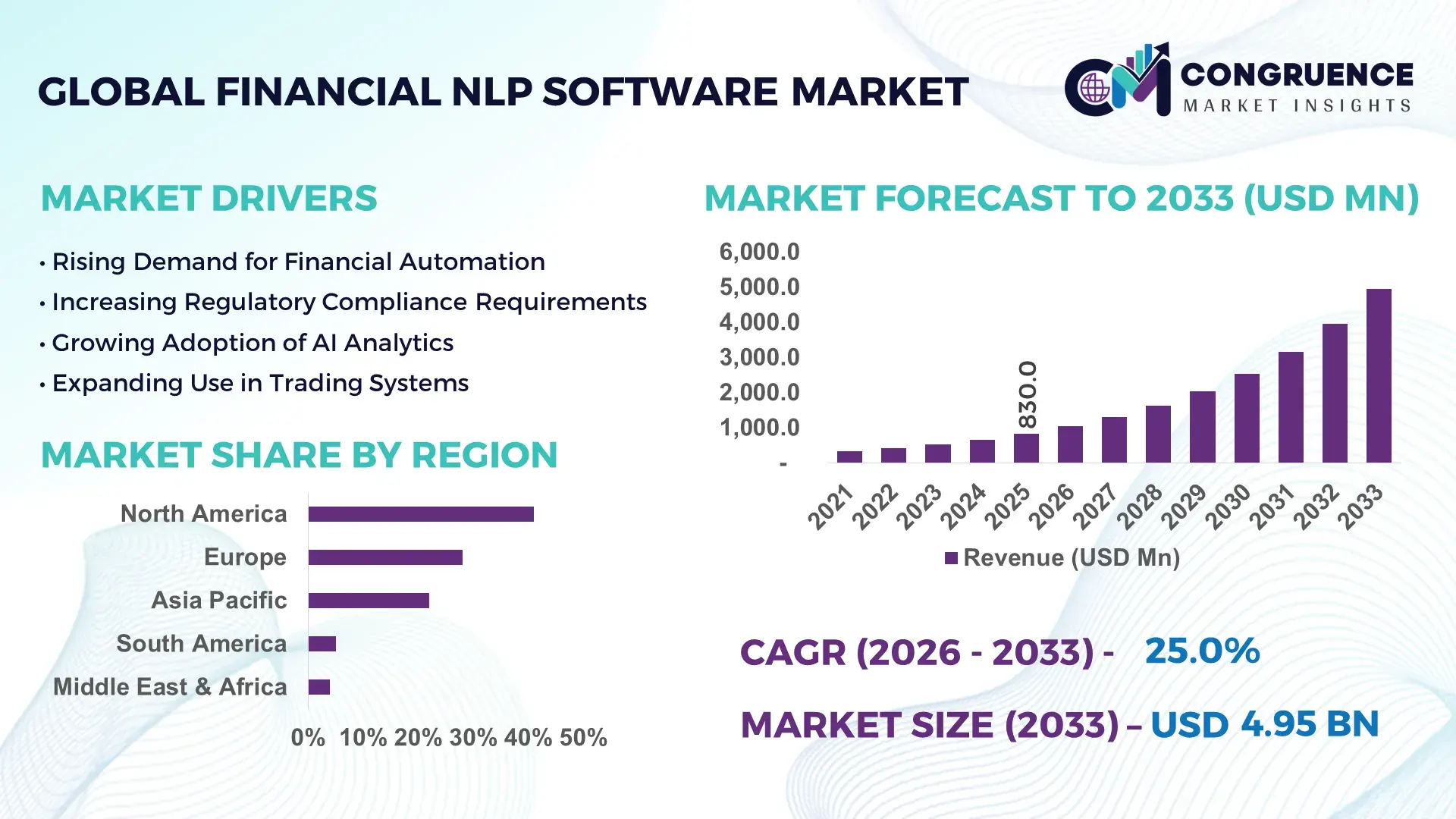
The Global Financial NLP Software Market was valued at USD 830.0 Million in 2025 and is anticipated to reach a value of USD 4,947.2 Million by 2033 expanding at a CAGR of 25.0% between 2026 and 2033, according to an analysis by Congruence Market Insights. Growth is driven by rising automation in financial data analysis and regulatory compliance requirements.
The United States dominates the Financial NLP Software Market with over 42% enterprise-level AI adoption in financial services institutions, supported by more than 5,000 fintech startups actively deploying NLP-driven solutions. Over 68% of Tier-1 banks in the country have integrated NLP tools for fraud detection, risk assessment, and customer sentiment analysis. Investment in AI across U.S. financial services exceeded USD 35 billion in 2025, with NLP-specific deployments contributing significantly to document automation and trading analytics. Additionally, more than 60% of hedge funds leverage NLP-based sentiment models for real-time decision-making, while over 45% of insurance providers use NLP for claims processing automation.
Market Size & Growth: USD 830.0 Million in 2025, projected to reach USD 4,947.2 Million by 2033, growing at 25.0% CAGR driven by automation in financial analytics and compliance.
Top Growth Drivers: AI adoption in BFSI at 64%, automation efficiency gains of 45%, fraud detection improvement rates of 38%.
Short-Term Forecast: By 2028, NLP deployment is expected to reduce operational costs by 30% and improve decision accuracy by 25%.
Emerging Technologies: Transformer-based models, generative AI in financial reporting, and real-time sentiment analytics tools.
Regional Leaders: North America projected at USD 2.1 Billion by 2033 with strong fintech integration, Europe at USD 1.4 Billion driven by compliance automation, Asia-Pacific at USD 1.1 Billion fueled by digital banking expansion.
Consumer/End-User Trends: Over 58% of financial institutions prioritize NLP for customer engagement and automated advisory services.
Pilot or Case Example: In 2025, a major global bank achieved 35% faster document processing using NLP automation systems.
Competitive Landscape: Market leader holds approximately 18% share, followed by major players such as IBM, Microsoft, Google, AWS, and SAS Institute.
Regulatory & ESG Impact: Increasing adoption due to regulatory mandates like automated reporting and ESG risk analytics integration.
Investment & Funding Patterns: Over USD 12 billion invested in AI-driven financial technologies in 2025, with NLP receiving significant venture funding.
Innovation & Future Outlook: Integration of multimodal AI, real-time analytics platforms, and cross-language processing capabilities shaping future growth.
Financial NLP Software Market demonstrates strong integration across banking (45%), insurance (25%), and capital markets (20%), with innovations such as multilingual AI models and automated compliance tools reshaping operations. Regulatory mandates are accelerating adoption, particularly in Europe and North America, while Asia-Pacific shows rising consumption driven by digital banking expansion and fintech ecosystems, positioning the market for sustained technological evolution.
The Financial NLP Software Market holds significant strategic importance as financial institutions increasingly rely on data-driven decision-making and automated compliance systems. The integration of advanced NLP capabilities into banking, insurance, and capital markets enables institutions to process unstructured financial data at scale, improving operational efficiency and regulatory adherence. Transformer-based NLP models deliver 40% improvement in document processing accuracy compared to rule-based systems, enhancing analytics precision and reducing manual intervention.
Regionally, North America dominates in volume due to extensive fintech infrastructure, while Asia-Pacific leads in adoption with over 62% of digital-first financial institutions deploying NLP-powered solutions. This shift reflects the increasing need for real-time analytics in high-growth digital economies. By 2028, generative AI-powered NLP systems are expected to reduce compliance processing time by 35%, significantly improving operational agility.
From a compliance and ESG perspective, firms are committing to measurable improvements such as 28% reduction in reporting errors by 2027 through automated NLP-based auditing systems. These advancements align with regulatory frameworks requiring transparent and auditable financial processes. In 2025, a leading U.S.-based bank achieved a 32% reduction in fraud detection response time through AI-driven NLP implementation, demonstrating tangible operational benefits.
Looking ahead, the Financial NLP Software Market is poised to evolve as a critical pillar supporting resilience, regulatory compliance, and sustainable growth. Continued investment in multilingual processing, sentiment analytics, and real-time data integration will further strengthen its strategic role across global financial ecosystems.
The Financial NLP Software Market is shaped by rapid advancements in artificial intelligence, increasing volumes of unstructured financial data, and the growing need for real-time analytics. Financial institutions generate over 80% of their data in unstructured formats, including reports, contracts, and customer interactions, driving demand for NLP-based automation tools. The rise of digital banking and fintech ecosystems has accelerated the integration of NLP technologies into customer service, fraud detection, and risk management workflows. Additionally, regulatory pressures across global financial markets are compelling organizations to adopt automated compliance solutions, where NLP plays a critical role in extracting, interpreting, and reporting financial information accurately. The market is also influenced by cloud adoption, with more than 65% of financial NLP deployments now occurring on cloud-based platforms, enabling scalability and cost optimization. Furthermore, increasing cybersecurity concerns and the need for real-time monitoring are reinforcing the importance of NLP-driven anomaly detection systems in financial operations.
The increasing demand for automated financial analytics is a primary driver of the Financial NLP Software Market, as institutions seek to process vast amounts of unstructured data efficiently. Over 70% of financial data exists in text-heavy formats such as earnings reports, contracts, and regulatory filings, requiring advanced NLP tools for interpretation. Financial institutions adopting NLP-driven analytics have reported up to 45% improvement in decision-making speed and 30% reduction in manual processing efforts. Additionally, more than 60% of banks globally have implemented NLP-based chatbots and virtual assistants to enhance customer engagement and reduce service costs. The growing reliance on algorithmic trading has further accelerated NLP adoption, with over 50% of hedge funds using sentiment analysis tools to interpret market news and social media data. These capabilities enable faster insights, improved risk assessment, and enhanced operational efficiency across financial ecosystems.
Data privacy and security concerns present significant challenges for the Financial NLP Software Market, particularly due to the sensitive nature of financial data. Approximately 72% of financial institutions cite data security as a major barrier to adopting AI-based solutions, including NLP systems. The risk of data breaches, unauthorized access, and compliance violations has led to stricter regulatory requirements, increasing the complexity of deploying NLP technologies. Additionally, nearly 40% of organizations report difficulties in ensuring compliance with global data protection regulations such as GDPR and regional financial data policies. The integration of NLP systems with legacy infrastructure also introduces vulnerabilities, as outdated systems may not support modern encryption or security protocols. These challenges result in increased implementation costs and slower adoption rates, particularly among smaller financial institutions with limited cybersecurity resources.
The rapid expansion of digital banking presents substantial opportunities for the Financial NLP Software Market, driven by the need for enhanced customer experience and real-time analytics. Over 65% of global banking customers now prefer digital channels for financial transactions, creating a demand for NLP-powered chatbots, voice assistants, and automated advisory platforms. Financial institutions leveraging NLP for customer interaction have achieved up to 35% increase in customer satisfaction and 25% reduction in service response times. Additionally, the rise of fintech startups has accelerated innovation, with more than 4,000 fintech firms globally integrating NLP technologies into their platforms. Emerging markets, particularly in Asia-Pacific, are witnessing a surge in mobile banking adoption, with over 70% of users engaging through AI-driven interfaces. These trends create a favorable environment for NLP solutions to enhance accessibility, personalization, and operational efficiency in financial services.
Integration complexity remains a significant challenge in the Financial NLP Software Market, as financial institutions operate on diverse and often outdated IT infrastructures. Approximately 55% of organizations report difficulties in integrating NLP solutions with existing systems, leading to delays in deployment and increased costs. The need to process multilingual and domain-specific financial data further complicates implementation, requiring customized models and extensive training datasets. Additionally, nearly 48% of financial institutions face challenges in aligning NLP systems with regulatory requirements, particularly in regions with stringent compliance standards. The lack of skilled professionals capable of managing advanced NLP technologies also contributes to slower adoption, with over 35% of firms reporting talent shortages in AI and data science roles. These factors collectively hinder the seamless integration and scalability of NLP solutions across financial operations.
Increased Adoption of Generative AI Models: Over 62% of financial institutions have integrated generative NLP models into reporting and advisory systems, improving document generation efficiency by 40% and reducing manual workload by 35%. These models are increasingly used in automated financial summaries and predictive analytics workflows.
Expansion of Multilingual NLP Capabilities: Around 55% of global banks are deploying multilingual NLP systems to support cross-border operations, improving customer engagement rates by 28% and enabling real-time translation across more than 20 languages in financial services environments.
Growth in Real-Time Sentiment Analysis: More than 50% of hedge funds and trading firms now rely on NLP-driven sentiment analysis, achieving 30% faster market response times and improving predictive accuracy by 25% in high-frequency trading strategies.
Integration with Cloud-Based Platforms: Approximately 68% of NLP deployments in financial services are cloud-based, enabling scalability improvements of 45% and reducing infrastructure costs by 32%, particularly in large-scale data processing environments.
The Financial NLP Software Market is segmented based on type, application, and end-user, reflecting diverse use cases across financial ecosystems. Type segmentation includes rule-based NLP, machine learning-based NLP, and hybrid models, each catering to different analytical requirements. Machine learning-based NLP dominates due to its ability to process large volumes of unstructured financial data with higher accuracy. Application segmentation highlights areas such as fraud detection, customer service automation, risk management, and algorithmic trading, with fraud detection leading due to increasing cybersecurity concerns. End-user segmentation includes banks, insurance companies, fintech firms, and asset management companies, where banks represent the largest adoption segment due to their extensive data processing needs. The segmentation landscape indicates strong alignment with digital transformation trends and increasing demand for automation across financial services.
Machine learning-based NLP systems currently account for approximately 52% of adoption, driven by their ability to process complex financial datasets and improve analytical accuracy. Rule-based NLP systems hold around 28%, primarily used in compliance and structured data extraction tasks. However, hybrid NLP models are emerging as the fastest-growing segment, expected to grow at over 27% CAGR due to their ability to combine rule-based precision with machine learning adaptability. These models are particularly effective in handling regulatory compliance and multilingual financial data. Other types, including domain-specific NLP engines and open-source frameworks, contribute a combined share of nearly 20%, supporting niche applications such as legal document analysis and financial forecasting. The increasing complexity of financial data and demand for real-time insights are driving the adoption of advanced NLP models across the industry.
Fraud detection and risk management applications account for approximately 38% of adoption, as financial institutions prioritize security and regulatory compliance. Customer service automation holds around 26%, driven by the deployment of AI-powered chatbots and virtual assistants. Algorithmic trading applications are the fastest-growing segment, with an expected growth rate exceeding 29% CAGR, supported by increasing reliance on real-time sentiment analysis and predictive analytics. Other applications, including compliance monitoring and financial reporting, collectively contribute around 36% of the market. In 2025, more than 42% of enterprises globally reported piloting NLP systems for customer experience platforms, while over 60% of financial firms indicated improved trust through AI-driven interactions. These trends highlight the expanding role of NLP across financial workflows.
Banks represent the leading end-user segment, accounting for approximately 48% of adoption due to their extensive need for data processing and regulatory compliance. Fintech companies hold around 22%, leveraging NLP for innovation in digital financial services. Insurance companies are the fastest-growing segment, expected to grow at over 26% CAGR, driven by increasing use of NLP in claims processing and risk assessment. Other end-users, including asset management firms and credit agencies, contribute a combined share of approximately 30%. In 2025, more than 50% of financial institutions reported deploying NLP solutions for operational efficiency, while over 45% of customers preferred AI-driven financial advisory services. These trends indicate strong adoption across diverse financial sectors.
North America accounted for the largest market share at 41% in 2025 however, Asia-Pacific is expected to register the fastest growth, expanding at a CAGR of 27% between 2026 and 2033.
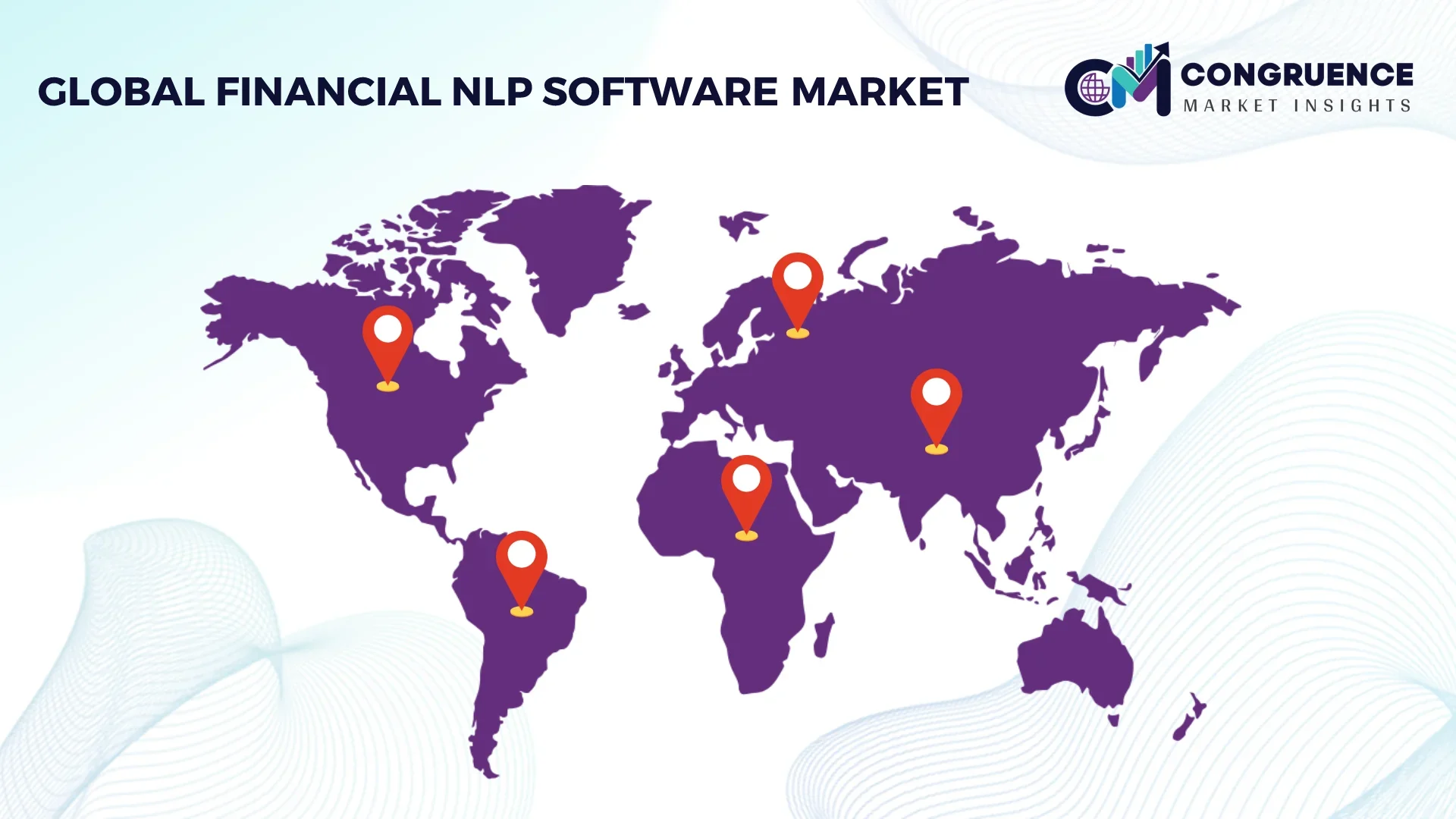
North America’s dominance is driven by high enterprise AI adoption, with over 65% of financial institutions implementing NLP solutions. Europe follows with approximately 28% share, supported by strong regulatory frameworks and digital transformation initiatives. Asia-Pacific holds around 22% share, with rapid growth in countries such as China, India, and Japan, where over 70% of digital banking users engage with AI-driven platforms. South America and the Middle East & Africa collectively account for nearly 9%, showing increasing adoption due to fintech expansion and government-led digital initiatives.
North America holds approximately 41% of the Financial NLP Software Market, driven by strong demand from banking, insurance, and capital markets sectors. The region benefits from advanced AI infrastructure and regulatory support for digital transformation. Over 65% of financial institutions have integrated NLP tools for compliance and fraud detection. Regulatory frameworks emphasizing transparency and reporting accuracy are accelerating adoption. Companies such as IBM are actively developing advanced NLP platforms for financial analytics, enhancing efficiency and decision-making. Consumer behavior in the region reflects high adoption of AI-driven financial services, particularly in digital banking and automated advisory platforms.
Europe accounts for approximately 28% of the Financial NLP Software Market, with key markets including Germany, the UK, and France driving adoption. Strict regulatory requirements, including data protection and financial reporting standards, are promoting the use of explainable NLP systems. Over 58% of financial institutions in Europe have adopted AI-driven compliance solutions. Technological advancements in multilingual NLP are supporting cross-border financial operations. Companies such as SAP are investing in NLP-based financial analytics tools. Consumer behavior indicates a strong preference for transparent and compliant AI solutions in financial services.
Asia-Pacific ranks as the fastest-growing region, with over 22% market share and rapid adoption in China, India, and Japan. The region’s growth is driven by expanding fintech ecosystems and increasing mobile banking penetration, with over 70% of users engaging with AI-powered platforms. Infrastructure development and government initiatives supporting digital transformation are key growth factors. Companies such as Baidu are advancing NLP technologies for financial applications. Consumer behavior reflects strong adoption of AI-driven services, particularly in mobile and digital banking environments.
South America holds approximately 5% of the Financial NLP Software Market, with Brazil and Argentina leading adoption. The region is experiencing growth in fintech and digital banking sectors, supported by government incentives and trade policies promoting technology adoption. Over 45% of financial institutions are exploring NLP solutions for customer engagement and compliance. Companies such as Nubank are leveraging NLP for personalized financial services. Consumer behavior highlights demand for localized and language-specific AI solutions in financial applications.
The Middle East & Africa region accounts for around 4% of the market, with growth driven by digital transformation in countries such as the UAE and South Africa. Financial institutions are adopting NLP solutions for fraud detection and customer analytics. Over 40% of banks in the region are investing in AI technologies. Government initiatives supporting smart city development and digital finance are accelerating adoption. Companies such as Emirates NBD are implementing NLP-driven analytics platforms. Consumer behavior indicates increasing adoption of AI-powered financial services, particularly in urban centers.
United States – 41% Market share: Driven by advanced fintech ecosystem and high enterprise AI adoption
China – 18% Market share: Supported by rapid digital banking expansion and government-backed AI initiatives
The Financial NLP Software Market is moderately consolidated, with the top five companies accounting for approximately 48% of the overall market share. The competitive landscape includes over 120 active players ranging from global technology giants to specialized AI startups. Leading companies are focusing on strategic initiatives such as partnerships, mergers, and product innovation to strengthen their market position. For instance, collaborations between financial institutions and AI vendors have increased by over 35% in recent years, enabling faster deployment of NLP solutions.
Product innovation remains a key differentiator, with more than 60% of companies investing in advanced AI models and cloud-based platforms. The market is characterized by intense competition in areas such as fraud detection, compliance automation, and customer analytics. Additionally, the rise of open-source NLP frameworks is enabling new entrants to compete effectively, further intensifying competition.
Microsoft
Amazon Web Services
SAS Institute
Oracle
SAP
OpenAI
Baidu
Nuance Communications
Verint Systems
FIS
Refinitiv
Bloomberg
Palantir Technologies
The Financial NLP Software Market is driven by rapid advancements in artificial intelligence and machine learning technologies, enabling more accurate and efficient processing of financial data. Transformer-based models, including large language models, have significantly improved text analysis accuracy by over 40% compared to traditional NLP techniques. These models are capable of handling complex financial documents, including contracts, earnings reports, and regulatory filings.
Additionally, the integration of generative AI into financial workflows has enabled automated report generation and predictive analytics, reducing manual effort by up to 35%. Cloud computing plays a critical role, with approximately 68% of NLP deployments occurring on cloud platforms, enabling scalability and cost optimization. Real-time data processing technologies are also gaining traction, allowing financial institutions to analyze market trends and customer sentiment instantly. Furthermore, advancements in multilingual NLP are enabling global financial institutions to operate seamlessly across different languages and regions.
• In January 2025, IBM highlighted advancements in its Watson AI portfolio for financial services, focusing on hybrid cloud and AI-driven automation to modernize banking workflows, improve decision-making, and enhance regulatory compliance processes across enterprise financial systems. Source: www.ibm.com
• In July 2025, IBM showcased Watson Studio and NLP-powered voice AI capabilities enabling financial institutions to automate up to 80% of customer support operations and reduce call center costs by 45%, demonstrating measurable efficiency gains in banking environments.
• In 2024, Amazon Web Services expanded its AI and NLP services portfolio within AWS to support financial institutions with scalable text analytics, enabling real-time fraud detection, sentiment analysis, and automated compliance workflows across cloud-native financial platforms.
• In 2024, Microsoft strengthened its Azure AI ecosystem by integrating advanced NLP capabilities into enterprise solutions, allowing financial firms to automate document processing, enhance risk analytics, and improve data extraction accuracy across large-scale financial datasets.
The Financial NLP Software Market Report provides a comprehensive analysis of technologies, applications, and industry-specific use cases shaping the adoption of natural language processing within financial services. The scope includes detailed segmentation across types such as rule-based, machine learning-based, and hybrid NLP systems, highlighting their deployment in areas such as fraud detection, compliance monitoring, customer engagement, and algorithmic trading. The report also covers end-user industries including banking, insurance, fintech, and asset management, which collectively account for over 90% of NLP adoption in financial services.
Geographically, the report evaluates market dynamics across North America, Europe, Asia-Pacific, South America, and the Middle East & Africa, with a focus on regional adoption patterns, regulatory environments, and technological infrastructure. North America leads in enterprise adoption, while Asia-Pacific demonstrates strong growth driven by digital banking expansion. The report further examines technological advancements such as transformer-based models, generative AI, and cloud-based NLP platforms, which are transforming financial data processing and analytics.
Additionally, the scope includes analysis of emerging trends such as multilingual NLP, real-time sentiment analysis, and AI-driven compliance systems. It also highlights key industry challenges, including data privacy concerns, integration complexities, and talent shortages. The report provides strategic insights into competitive dynamics, investment patterns, and innovation trends, offering a holistic view of the market landscape for decision-makers and industry professionals.
| Report Attribute / Metric | Details |
|---|---|
| Market Revenue (2025) | USD 830.0 Million |
| Market Revenue (2033) | USD 4,947.2 Million |
| CAGR (2026–2033) | 25.0% |
| Base Year | 2025 |
| Forecast Period | 2026–2033 |
| Historic Period | 2021–2025 |
| Segments Covered |
By Type
By Application
By End-User Insights
|
| Key Report Deliverables | Revenue Forecast; Market Trends; Growth Drivers & Restraints; Technology Insights; Segmentation Analysis; Regional Insights; Competitive Landscape; Regulatory & ESG Overview; Recent Developments |
| Regions Covered | North America; Europe; Asia-Pacific; South America; Middle East & Africa |
| Key Players Analyzed | IBM Corporation; Microsoft Corporation; Google LLC; Amazon Web Services; SAS Institute; Oracle Corporation; SAP SE; OpenAI; Baidu Inc.; Nuance Communications; Verint Systems; FIS; Bloomberg LP; Palantir Technologies |
| Customization & Pricing | Available on Request (10% Customization Free) |




