
Reports
The Global Financial Close Software Market was valued at USD 1150 Million in 2025 and is anticipated to reach a value of USD 2052.52 Million by 2033 expanding at a CAGR of 7.51% between 2026 and 2033. Growth is being driven by AI-enabled reconciliation, continuous accounting, cloud ERP migration, and stricter audit-trail requirements that are pushing finance teams away from spreadsheet-heavy month-end processes.
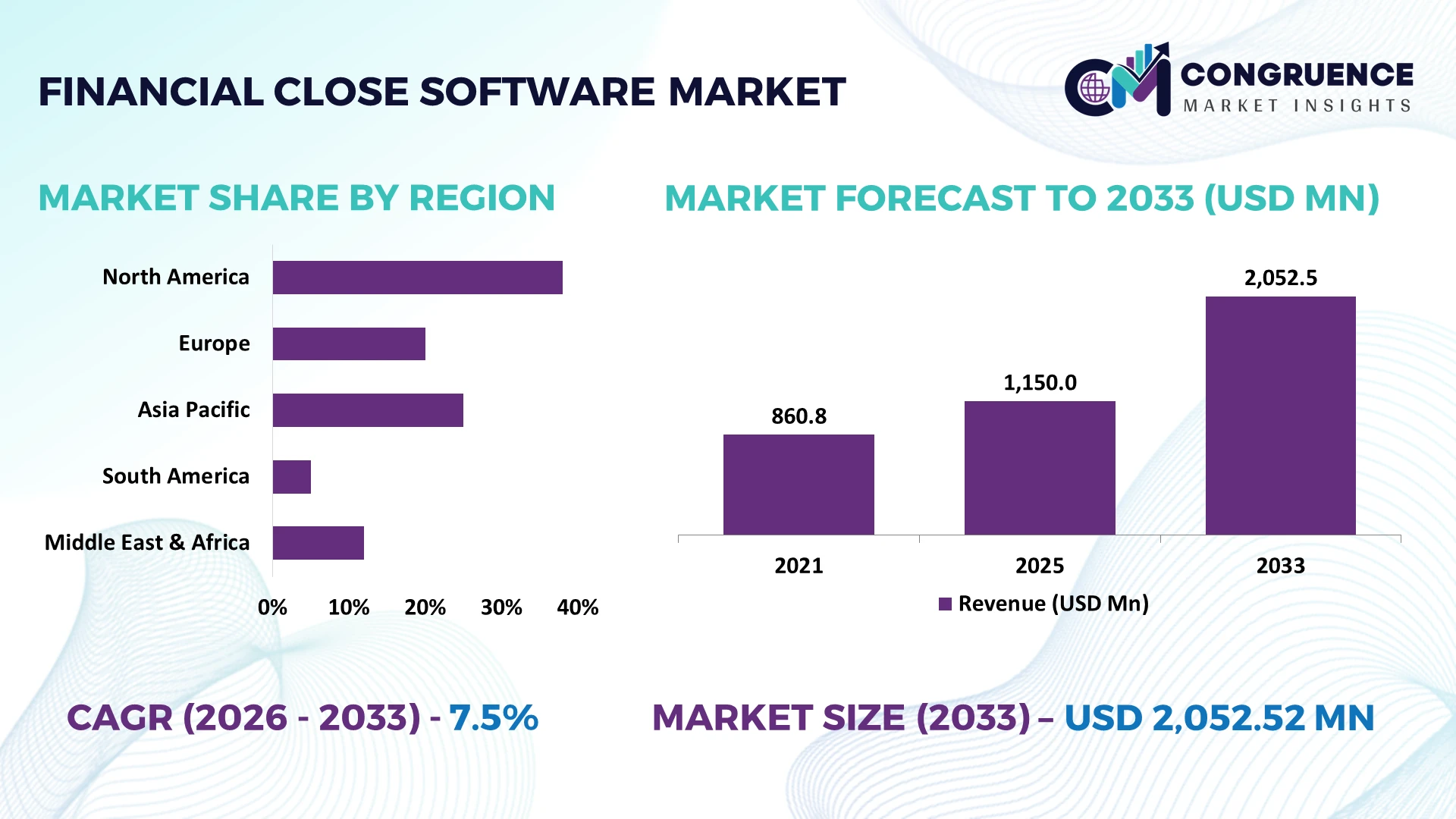
The United States remains the dominant national market, representing approximately 54% of global financial close management activity, supported by SOX compliance, mature SaaS procurement, and high adoption across BFSI, technology, manufacturing, and retail. Cloud deployment already represents more than 70% of U.S. ERP installations, while finance and accounting accounts for nearly 29% of U.S. ERP spending. Western Europe holds roughly 22% share, highlighting a substantial adoption gap despite tighter IFRS and EU reporting requirements.
Geopolitical volatility, cross-border operating complexity, and regulatory scrutiny are accelerating investment in governed financial data workflows; enterprises prioritizing automated reconciliation and continuous-close architectures will gain faster reporting visibility and stronger audit readiness.
Market Size & Growth: USD 1.15 billion in 2025 is projected to reach USD 2.05 billion by 2033 at 7.51%, supported by cloud-based close automation.
Top Growth Drivers: AI-enabled reporting adoption stands at 74%, data automation and governance prioritization at 79%, and U.S. cloud financial-reporting prioritization at 67%.
Short-Term Forecast: By 2028, advanced financial close platforms are positioned to reduce repetitive reconciliation workload by approximately 25–30%, improving controller productivity and reporting speed.
Emerging Technologies: Agentic AI, anomaly detection, continuous reconciliation, and natural-language workflow automation are shifting close management from scheduled processing toward exception-based accounting.
Regional Leaders: A 2033 planning scenario places North America near USD 0.88 billion, Europe around USD 0.62 billion, and Asia-Pacific near USD 0.47 billion as cloud adoption broadens.
Consumer/End-User Trends: 85% of accounting teams identify AI as a strategic priority, although only 10% currently use it extensively, leaving significant implementation headroom.
Pilot/Case Example: In 2026, advanced AI-native accounting teams recorded close cycles of 6.7 days versus 8.7 days for low-maturity teams, a two-day improvement.
Competitive Landscape: BlackLine holds an estimated 10.8% specialist market share, competing closely with Oracle, OneStream, Workiva, and FloQast across enterprise close automation.
Regulatory & ESG Impact: Approximately 84% of financial-services firms have adjusted cloud strategies in response to frameworks including DORA and GDPR, strengthening demand for governed finance infrastructure.
Investment & Funding: AI-native finance vendor Rillet raised USD 100 million in August 2026, taking total funding above USD 200 million and reinforcing investor confidence in continuous-close architectures.
Innovation & Future Outlook: AI-native workflows can automate up to 80% of reconciliations, shifting finance teams toward continuous close, human-reviewed exceptions, and real-time financial control.
Financial close software demand is concentrating around automated reconciliations, multi-entity consolidation, audit controls, and real-time reporting. Agentic AI and continuous-close platforms increasingly replace manual task orchestration, while 55% of finance professionals identify reconciliations as a leading automation opportunity. Regulatory scrutiny and fragmented multinational data environments are accelerating governed cloud adoption, setting up a broader strategic shift toward autonomous financial operations.
Financial close software is becoming strategic infrastructure as CFOs shift from periodic reporting toward continuous, audit-ready financial operations. Regulatory scrutiny, geopolitical instability, and fragmented enterprise data are accelerating modernization: 79% of executives now prioritize data automation and governance, while 71% have dedicated transformation budgets. The competitive advantage increasingly rests on producing trusted financial intelligence faster without weakening controls.
AI-native close environments are establishing a measurable performance gap over spreadsheet-heavy workflows. Advanced teams spend 34% of working time on manual activities versus 63% for low-maturity organizations and complete closing in 6.7 days compared with 8.7 days. U.S. and UK enterprises lead AI-enabled deployment, while European organizations place greater emphasis on governed automation as DORA, CSRD, and data-control requirements reshape technology selection.
Over the next two to three years, adoption will move toward agentic reconciliation, automated journal preparation, anomaly detection, and continuous controls monitoring. Already, 95% of AI-mature accounting organizations embed AI within month-end close processes. Hospitality operators, for example, are automating multi-property journal entries previously entered line by line. Vendors are consequently directing investment toward ERP integrations, AI governance, and ecosystem partnerships. Competitive leadership will depend on converting financial close from a compliance deadline into a continuously available decision-support capability.
Enterprise finance transformation is shifting financial close software from workflow coordination toward intelligent accounting automation. Around 85% of accounting organizations identify AI as a strategic priority, 92% of decision-makers expect AI investment to increase over the next two years, and 95% of highly mature teams already embed AI into month-end closing. In the United States and United Kingdom, finance departments are deploying automated reconciliations, journal-entry preparation, variance detection, and exception routing to reduce accountant-intensive processing. This shift responds directly to rising reporting complexity and pressure for faster management information. Software providers are expanding agentic AI capabilities, ERP connectors, and controlled automation environments. The non-obvious advantage is capacity: automation enables accounting teams to absorb transaction growth without proportionally expanding close-cycle headcount.
Fragmented financial architecture remains a structural barrier to scalable close automation. More than 60% of reporting professionals identify deficiencies in data quality, governance policies, or role-specific resources, while 39% of accounting professionals cite data security and privacy as a leading AI adoption obstacle. Another 31% report insufficient AI skills and training. U.S. multinational companies face particular complexity where acquired businesses operate different ERP instances, charts of accounts, and reconciliation structures. This fragmentation increases integration costs and limits straight-through automation because unreliable source data still requires human validation. Vendors are responding with governed data layers, standardized connectors, permission controls, and configurable model access. Strategically, successful deployments increasingly depend less on adding automation features and more on establishing trusted financial-data architecture before scaling intelligent close workflows.
Agentic AI creates an opportunity to transform financial close platforms from task-management systems into autonomous accounting orchestration layers. Although 85% of accounting organizations prioritize AI, only 10% currently use it extensively, leaving a substantial deployment gap. Mature adopters already reclaim roughly 25% of total working time from manual processes, while 69% actively execute structured AI roadmaps. In the United States, emerging platforms are applying AI agents to accruals, reconciliations, expense allocation, variance investigation, and supporting-document validation. The next technology step is persistent financial intelligence that learns from approved policies, prior filings, and historical close activity while preserving traceability. Vendors are investing in no-code agent builders, model interoperability, and ERP ecosystems. The strategic opportunity lies in monetizing exception management rather than simply digitizing traditional close checklists.
The central long-term challenge is scaling AI-driven close processes without weakening accountability, auditability, or deployment consistency. Only 17% of accounting teams report being fully prepared to operationalize rising AI investment, while 57% of close cycles still require seven days or longer and nearly 20% of accountants spend more than 60% of their working week on manual activities. Large U.S. multinational organizations compound this challenge through decentralized subsidiaries, heterogeneous ERP environments, and differing control frameworks. As AI agents assume preparer-level tasks, finance leaders must preserve human sign-off, data lineage, segregation of duties, and explainable exception handling. Vendors are responding with permission-aware AI, traceable outputs, model testing, and governance frameworks. Competitive durability will depend on proving that automation remains reliable across entities, jurisdictions, reporting periods, and increasingly complex enterprise architectures.
Continuous Close Replaces Calendar Cycles: Finance teams are shifting reconciliation and validation earlier in the reporting cycle rather than concentrating work at month-end. Around 57% of close cycles still exceed seven days, yet digitally mature teams operate near 6.7 days. Companies are introducing daily transaction matching, rolling certifications, and exception-based review to compress reporting latency without adding accounting headcount.
Controls Become Automation Architecture: Financial controls are increasingly embedded directly into close workflows instead of being tested after processing. Around 51% of organizations still report informal or inconsistently applied controls, while only 27% strongly believe current AI tools satisfy enterprise governance requirements. Companies are redesigning approval matrices, evidence capture, audit trails, and segregation-of-duties workflows before expanding automated processing.
Finance Talent Shifts Toward Review: Automation is changing accounting operating models rather than simply reducing task volumes. Six in ten accountants still spend at least 40% of their time on manual activities, while advanced teams reduce this burden to 34%. Enterprises are redesignating experienced staff toward variance review, control ownership, analytics, and exception management while automating transaction preparation and repetitive documentation.
ERP Modernization Reshapes Vendor Selection: Financial close purchasing is increasingly tied to broader ERP modernization and application consolidation. Approximately 87% of organizations with ERP deployments plan upgrades or replacement within three years, while cloud ERP represents 38% of planned core-finance technology investment. Vendors are expanding native connectors and unified data models as buyers increasingly reject isolated close tools requiring extensive middleware.
Cloud-Based solutions account for approximately 58% of Financial Close Software Market deployments, reflecting their advantages in rapid implementation, centralized upgrades, remote access, and integration with modern ERP ecosystems. Enterprises increasingly favor subscription-based environments that standardize reconciliation, certification, and reporting across subsidiaries without maintaining dedicated infrastructure. Large U.S. corporations are particularly active adopters as finance technology stacks migrate from locally hosted applications toward SaaS architectures. On-Premises solutions retain roughly 20% share, remaining strategically relevant for organizations with highly restrictive data residency, cybersecurity, or customized legacy-system requirements.
Integrated Platforms represent the fastest-growing type, accounting for approximately 15% of current deployments as enterprises consolidate close management, reconciliation, journal workflows, reporting, and compliance into unified finance operating environments. Standalone Solutions retain about 7%, primarily serving narrower departmental requirements or organizations seeking targeted automation without broader platform replacement. Vendors are responding by expanding cloud-native APIs, ERP partnerships, embedded AI, and modular platform capabilities. Investment priorities are therefore moving away from isolated point solutions toward interoperable financial operations platforms capable of supporting continuous close and enterprise-wide control standardization.
Account Reconciliation leads the Financial Close Software Market with approximately 31% share because transaction matching, balance certification, intercompany reconciliation, and exception handling remain among the most labor-intensive close activities. Financial Reporting follows at roughly 24%, supported by rising demand for standardized management reporting, consolidated statements, and traceable disclosure workflows. Journal Management represents approximately 17%, with adoption increasingly tied to recurring journal automation, supporting-document validation, approval routing, and ERP posting controls. Enterprises are integrating these workflows to reduce fragmented handoffs between accountants, controllers, and auditors.
Compliance Management is the fastest-growing application as companies strengthen evidence retention, audit trails, control testing, and policy-driven workflow execution. Close Task Management remains strategically important for orchestration, accounting for approximately 13% of deployment activity, particularly among organizations coordinating numerous subsidiaries and distributed finance teams. Software providers are expanding automated certifications, AI-assisted matching, configurable controls, and connected reporting functionality. Demand is consequently shifting from simple task tracking toward applications that eliminate manual accounting preparation while maintaining defensible audit evidence and standardized financial governance.
Banking & Finance represents approximately 34% of Financial Close Software Market demand, reflecting large transaction volumes, complex legal-entity structures, stringent control environments, and intensive regulatory reporting requirements. Banks, insurers, asset managers, and payment institutions require frequent reconciliations across ledgers, settlement platforms, treasury systems, and regulatory reporting environments. Manufacturing accounts for roughly 23%, supported by multi-plant consolidation, inventory accounting, intercompany transactions, and complex ERP estates. Professional Services maintains strong adoption where project accounting, multi-entity consolidation, and partner-level reporting create recurring close complexity.
Retail & E-Commerce is the fastest-growing end-user category as omnichannel sales, marketplace settlements, payment gateways, refunds, inventory movements, and international entities increase reconciliation volumes. Healthcare organizations are also expanding adoption to manage decentralized facilities, payer transactions, and compliance-heavy financial workflows. Vendors are targeting these industries with vertical templates, API integrations, multi-entity pricing models, and partnerships with ERP and payment platforms. Competitive investment is shifting toward sectors where transaction fragmentation creates greater automation value than accounting headcount alone would suggest.
North America accounted for the largest market share at 42% in 2025 however, Asia-Pacific is expected to register the fastest growth, expanding at a CAGR of 9.4% between 2026 and 2033.
Cloud Finance Modernization Accelerates Enterprise Close Automation
North America accounts for approximately 42% of global Financial Close Software Market activity, supported by dense enterprise software deployment, mature cloud infrastructure, complex reporting requirements, and extensive ERP modernization. U.S. and Canadian organizations increasingly connect reconciliation, consolidation, journal management, and close orchestration with Oracle, SAP, Workday, and Microsoft environments. Financial services represent a particularly concentrated deployment base as regulated institutions strengthen auditability and automated controls. Across financial services, 87% of firms have increased cloud investment during the past two years, while 82% operate hybrid or multi-cloud environments. Finance organizations are consequently prioritizing API-based integration, AI-assisted exception management, and continuous accounting rather than adding isolated workflow applications. Vendor competition increasingly centers on reducing implementation complexity and supporting multi-entity enterprises through preconfigured connectors, configurable controls, and automated transaction matching.
United States Market Outlook: The United States anchors regional adoption through its concentration of multinational corporations, publicly listed companies, banks, technology enterprises, and SaaS vendors. SOX control requirements reinforce demand for documented approvals and audit-ready reconciliations, while 91% of surveyed financial-services organizations are advancing AI through cloud infrastructure. Enterprises increasingly combine financial close modernization with broader ERP and finance transformation programs.
Regulation Reshapes Governed Finance Automation
Europe represents approximately 27% of global market activity, with Germany, the United Kingdom, France, and the Netherlands forming major enterprise deployment centers. Financial close modernization increasingly combines automation with data sovereignty, cybersecurity, auditability, and third-party technology governance. DORA has sharpened technology-control requirements for financial institutions, making resilient cloud architecture and vendor-risk management more important in software selection. In Germany, 59% of surveyed accounting organizations use cloud systems, while 32% deploy robotic process automation and 28% have embedded machine learning into processes. Enterprises are therefore replacing fragmented spreadsheet-based close activities with controlled digital workflows spanning reconciliation, journal approval, consolidation, and evidence management. Vendors are adapting through localized cloud architectures, governance functionality, ERP integration, and implementation partnerships. The competitive advantage increasingly belongs to platforms that automate accounting processes while preserving traceability across jurisdictions and subsidiaries.
Germany Market Outlook: Germany combines a large industrial enterprise base with accelerating finance digitization. Around 53% of surveyed companies already use AI in accounting or are preparing implementation, while 61% consider AI a decisive finance success factor. Manufacturers and financial institutions are prioritizing governed automation that integrates complex SAP estates with reconciliation, reporting, and control workflows.
Enterprise Scale Drives Automation Deployment
Asia-Pacific holds approximately 21% of Financial Close Software Market activity and is experiencing the strongest deployment momentum as large enterprises modernize finance operations across Japan, China, India, Australia, and Singapore. Multi-entity manufacturing groups, digital commerce businesses, financial institutions, and shared-service centers create substantial demand for automated reconciliation and standardized reporting. Around 78% of surveyed Asia-Pacific CFOs planned to embed additional automation and digital technologies into operations, with Japan reaching 89%. China is simultaneously expanding finance centers of excellence, with 48% of surveyed organizations increasing internal shared-service utilization. These operating-model changes favor platforms capable of managing multiple currencies, subsidiaries, ERP environments, and accounting standards. Software companies are strengthening local implementation ecosystems, cloud partnerships, multilingual functionality, and ERP connectivity as buyers shift from departmental close tools toward scalable financial operations platforms supporting centralized governance.
Japan Market Outlook: Japan stands out for disciplined enterprise processes, large manufacturing groups, and aggressive finance automation. Approximately 89% of surveyed Japanese CFO organizations prioritize greater automation and digital technology deployment. Complex corporate groups increasingly use close modernization to standardize subsidiary reporting, reduce manual consolidation effort, and improve finance productivity amid persistent skilled-labor constraints.
Brazil Leads Cloud Finance Transition
South America represents approximately 6% of global Financial Close Software Market activity, with Brazil accounting for the majority of enterprise deployments and Chile, Colombia, and Argentina forming secondary adoption centers. Demand is concentrated among banks, retailers, industrial groups, telecommunications companies, and multinational subsidiaries managing complex tax and reporting environments. Brazil's extensive electronic tax-document ecosystem creates a strong operational case for connecting transactional data with automated accounting controls and reconciliation. Cloud ERP migration is also lowering infrastructure barriers for mid-market enterprises that previously relied on spreadsheet-heavy close procedures. Deployment remains constrained by uneven IT maturity, currency volatility, integration costs, and shortages of specialized finance-technology skills. Vendors are responding through localized implementation partners, modular subscriptions, Portuguese-language capabilities, and connectors to domestic ERP environments, making implementation economics increasingly important alongside advanced automation functionality.
Brazil Market Outlook: Brazil dominates regional enterprise technology deployment through its large banking, retail, manufacturing, and digital-commerce sectors. Its electronic invoicing and tax-reporting infrastructure processes transactions at national scale, increasing demand for traceable ledger integration and automated reconciliation. Vendors targeting Brazilian companies increasingly combine cloud financial close tools with local tax, ERP, and implementation ecosystems.
Digital Investment Modernizes Finance Infrastructure
Middle East & Africa accounts for approximately 4% of global Financial Close Software Market activity, with the United Arab Emirates, Saudi Arabia, South Africa, and Israel forming the principal enterprise technology hubs. Gulf economies are accelerating cloud migration as governments and large corporations modernize finance infrastructure, expand digital services, and strengthen governance across diversified business groups. Saudi Arabia's Vision 2030 transformation and the UAE's digital-economy agenda are increasing enterprise investment in ERP modernization, shared services, analytics, and automated reporting. Demand is particularly visible across banking, energy, aviation, construction, sovereign-linked enterprises, and diversified conglomerates. African adoption remains more uneven because cloud readiness, integration capabilities, and enterprise IT budgets vary significantly between markets. Vendors are responding with regional cloud infrastructure, implementation partnerships, Arabic localization, and scalable subscription models designed for multi-entity finance environments.
United Arab Emirates Market Outlook: The UAE provides a strong deployment base through multinational headquarters, financial centers, aviation groups, real-estate enterprises, and diversified holding companies. Corporate tax implementation has increased the importance of structured financial records and controlled reporting. Enterprises are consequently integrating close automation with cloud ERP, consolidation, compliance management, and analytics to strengthen reporting consistency across complex legal-entity structures.
BlackLine, Oracle, OneStream, Workday, SAP, and FloQast shape competition, with specialist close-automation vendors challenging broad ERP and enterprise performance management platforms. The top five players collectively control approximately 46% of market activity, leaving meaningful space for specialized platforms. Technology is the primary differentiator: advanced automation can reduce manual close workloads by 25–35%, while integrated reconciliation can shorten closing cycles by roughly 20–30%. Cloud-native vendors compete through deployment speed, usability, AI-assisted matching, and ERP-neutral connectivity; established enterprise providers leverage installed ERP bases, procurement relationships, and unified data architectures. BlackLine and FloQast are expanding AI-driven accounting workflows, while Oracle, SAP, Workday, and OneStream embed close capabilities deeper into finance suites. Competition is shifting from task management toward autonomous reconciliation, continuous controls, and agentic accounting. Integration complexity remains the strongest entry barrier because multinational buyers require secure connectivity across heterogeneous ledgers. Winning requires automation depth, trusted governance, rapid implementation, and interoperability across enterprise finance ecosystems.
BlackLine
Oracle
OneStream
SAP
Workday
FloQast
Trintech
HighRadius
Wolters Kluwer
Prophix
Vena Solutions
Anaplan
Board International
Planful
Current financial close technology centers on cloud orchestration, API-led ERP connectivity, automated reconciliation, transaction matching, and rules-based journal workflows. AI-assisted matching can automate 80–90% of complex reconciliation activity, while preparation agents reduce manual reconciliation preparation time by up to 92%. Cloud platforms connect SAP, Oracle, Workday, and heterogeneous ledgers, giving controllers standardized controls, faster exception handling, and audit-ready evidence without rebuilding ERP estates.
Emerging technology is shifting from predictive assistance toward generative and agentic accounting. Natural-language agents prepare journals, transform unstructured data, investigate variances, and assemble reconciliation packages, while human reviewers retain approval authority. AI-enabled reconciliation can match up to 98% of transactions. Compared with spreadsheet-led preparation, governed multi-agent systems improve preparation efficiency by roughly 90%, materially expanding accountant capacity. Adoption is moving beyond pilots as finance teams prioritize auditable AI, embedded controls, and continuous-close workflows.
Disruptive architectures combine specialized AI agents, unified financial data layers, confidence scoring, and centralized governance consoles. By 2028, embedded AI in cloud ERP environments is positioned to make financial close approximately 30% faster. Vendors with deep accounting datasets, ERP-neutral integration, and explainable controls benefit most. Companies acting during 2026–2028 can establish data foundations and automation governance before agentic close becomes a competitive operating standard.
April 2026 — BlackLine launched Agentic Financial Operations and an AI Innovation Hub, with Verity Prepare delivering over 90% reconciliation-creation time reduction for early adopters. The initiative moves financial close toward governed, continuously orchestrated AI operations. Source: BlackLine.
October 2025 — SAP considered renewing its BlackLine acquisition approach after an earlier offer carried a 31% premium to BlackLine’s 60-day average share price. The move highlighted strategic consolidation pressure around cloud financial automation capabilities. Source: Reuters.
November 2024 — Trintech joined Built on Workday, achieving Workday’s highest innovation-partnership tier and extending reconciliation and financial-close automation directly through Workday. The integration expanded scalable deployment options and reduced fragmented finance workflows for joint enterprise customers. Source: Trintech.
January 2026 — OneStream agreed to a Hg-led acquisition valuing the company at $6.4 billion, with shareholders receiving $24 per share, a 31% premium. The transaction strengthens investment capacity for AI innovation and Office-of-CFO platform scaling. Source: SEC.
The Financial Close Software Market report evaluates Cloud-Based, On-Premises, Integrated Platforms, and Standalone Solutions across Account Reconciliation, Financial Reporting, Journal Management, Compliance Management, and Close Task Management. It examines deployment across Banking & Finance, Manufacturing, Retail & E-Commerce, Healthcare, and Professional Services, alongside adoption patterns across North America, Europe, Asia-Pacific, South America, and Middle East & Africa. Cloud-based solutions represent approximately 58% of deployment activity, highlighting the transition toward scalable finance architectures.
Technology coverage includes AI-driven reconciliation, agentic accounting, continuous close, transaction matching, automated journals, anomaly detection, and ERP integration. The report also evaluates niche opportunities around governed AI, multi-entity orchestration, and autonomous controls. Competitive benchmarking, deployment shifts, regulatory influences, and evolving enterprise purchasing priorities support investment planning, geographic expansion, product positioning, partnership strategy, and assessment of market direction between 2026 and 2033.
| Report Attribute/Metric | Report Details |
|---|---|
Market Revenue in 2025 | USD 1150 Million |
Market Revenue in 2033 | USD 2052.52 Million |
CAGR (2026 - 2033) | 7.51% |
Base Year | 2025 |
Forecast Period | 2026 - 2033 |
Historic Period | 2021 - 2025 |
Segments Covered | By Type
By Application
By End-User
|
Key Report Deliverable | Revenue Forecast, Growth Trends, Market Dynamics, Segmental Overview, Regional and Country-wise Analysis, Competition Landscape |
Region Covered | North America, Europe, Asia-Pacific, South America, Middle East, Africa |
Key Players Analyzed | BlackLine, Oracle, OneStream, SAP, Workday, FloQast, Trintech, HighRadius, Wolters Kluwer, Prophix, Vena Solutions, Anaplan, Board International, Planful |
Customization & Pricing | Available on Request (10% Customization is Free) |




