
Reports
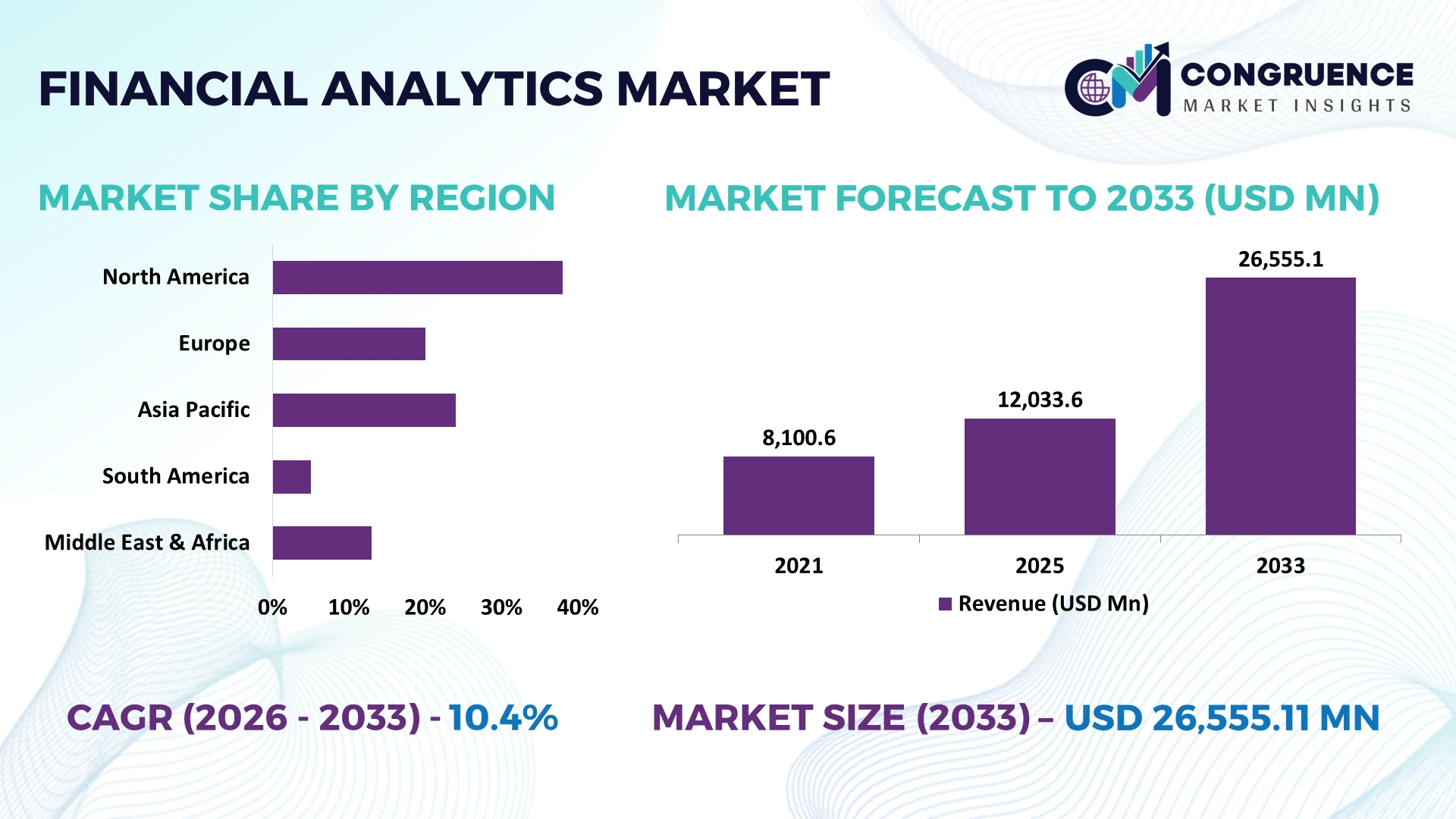
The Global Financial Analytics Market was valued at USD 12033.6 Million in 2025 and is anticipated to reach a value of USD 26555.11 Million by 2033 expanding at a CAGR of 10.4% between 2026 and 2033. Growth is driven by AI-powered fraud detection, automated regulatory reporting, real-time risk analytics, and the migration of financial institutions from fragmented legacy systems toward integrated cloud data platforms.
The United States remains the dominant country market, supported by deep banking, insurance, investment-management, payments, and capital-markets ecosystems and substantially higher AI deployment than many international peers. In 2026, 65% of U.S. financial institutions reported active AI deployment, compared with 61% globally, while 42% planned to increase AI investment by more than 50%. U.S. financial institutions also reported 47% adoption of AI for data analysis and reporting, versus 40% globally. The Federal Reserve’s 2025 monitoring further showed that AI-related banking job postings reached 6.8%, compared with 3.2% across nonbank financial services, reinforcing the country’s technology-intensive position. Regulatory scrutiny is simultaneously increasing as U.S. banking regulators examine AI governance, model risk, data access, and third-party controls. Europe is advancing through DORA implementation, while Asia-Pacific is expanding through digital banking and payment infrastructure.
Strategic implication: Financial analytics vendors should prioritize AI-native risk intelligence, automated compliance, and real-time decision infrastructure, with the U.S. serving as a critical benchmark for enterprise product development and investment allocation.
Market Size & Growth: USD 12.03 billion in 2025 is projected to reach USD 26.56 billion by 2033 at a 10.4% CAGR, supported by AI-driven financial decision-making and automated analytics.
Top Growth Drivers: AI adoption contributes 30%+, cloud modernization 25%+, and automated compliance 20%+ to technology-led demand expansion.
Short-Term Forecast: By 2028, integrated analytics platforms are positioned to reduce manual financial-processing costs by 15–20% and accelerate reporting cycles by 20%+.
Emerging Technologies: Generative AI, predictive analytics, machine learning, and agentic AI are expanding analytics from descriptive reporting toward automated forecasting, fraud detection, and decision orchestration.
Regional Leaders: North America approaches USD 10 billion, Europe exceeds USD 7 billion, and Asia-Pacific moves toward USD 6 billion, supported by cloud adoption and digital-finance infrastructure.
Consumer/End-User Trends: 59% of finance leaders reported AI use in their finance function in 2025, with knowledge management accounting for 49% of implemented finance AI use cases.
Pilot/Case Example: In 2025, banking GenAI deployment reached 47%, up from 10% in 2023, while 90% of surveyed banks reached at least the beta-testing stage.
Competitive Landscape: IBM, SAS, Oracle, SAP, Microsoft, and FICO compete through AI modeling, cloud integration, fraud analytics, forecasting, and enterprise data management.
Regulatory & ESG Impact: 89% of U.S. banking executives prioritized security and fraud prevention for near-term investment, increasing demand for auditable, explainable, and continuously monitored analytics.
Investment & Funding: U.S. financial institutions planning to increase AI investment by more than 50% reached 42% in 2026, strengthening demand for scalable analytics infrastructure and strategic technology partnerships.
Innovation & Future Outlook: Agentic AI, real-time risk engines, graph analytics, and autonomous financial workflows are shifting competition toward integrated decision intelligence, governance, and faster enterprise execution.
The Global Financial Analytics Market is increasingly concentrated around high-value applications including fraud detection, credit decisioning, financial forecasting, treasury optimization, regulatory compliance, and customer profitability analysis. In 2025, 59% of finance leaders reported AI use within finance functions, demonstrating a transition from experimental analytics toward operational deployment. Generative AI is also moving deeper into banking workflows, while agentic systems are beginning to connect analysis with automated actions. U.S. regulators are simultaneously increasing scrutiny of AI governance, data controls, and third-party risks, making explainability and auditability increasingly important alongside analytical performance.
Financial analytics is becoming a strategic control layer for banks, insurers, and investment firms as AI shifts financial decisions from periodic reporting toward real-time risk, liquidity, and profitability management. In 2025, 59% of finance leaders reported using AI, up from 37% in 2023, making analytics increasingly central to operating-model redesign. Regulatory modernization is reinforcing this shift, particularly through Europe’s DORA requirements for ICT resilience and third-party risk management.
Technology economics are also changing. AI-enabled analytics can automate high-volume reconciliation, forecasting, and anomaly-detection workflows that traditionally depend on manual review, while 47% of surveyed banks had already rolled out GenAI applications in 2025, compared with 10% in 2023. North America maintains greater enterprise-scale deployment, whereas India remains earlier in core financial-services AI implementation, creating different commercialization priorities.
Over the next 2–3 years, deployment will move toward integrated decision systems, with fraud detection, credit risk, AML/KYC, and treasury analytics receiving greater automation. AI-supported fraud and onboarding workflows are already connecting customer service, fraud detection, loan processing, and onboarding. Companies are therefore shifting investment from standalone dashboards toward governed data platforms, AI partnerships, and interoperable analytics infrastructure. Competitive advantage will increasingly depend on turning financial data into faster, auditable decisions.
AI-led automation is the primary structural driver as financial institutions move analytics from reporting toward continuous decision support. Financial-services AI deployment reached 54% in January 2025, up from 40% a year earlier, while fraud detection, credit risk, and AML/KYC represent leading financial AI use cases. U.S. banks are prioritizing predictive risk engines and automated monitoring, while Indian institutions are building foundational AI capabilities. Companies are redirecting technology budgets toward machine-learning platforms, governed data environments, and specialized AI partnerships. The non-obvious shift is that analytics value is moving toward operational actions rather than dashboard visibility, allowing institutions to intervene earlier in fraud, credit deterioration, and liquidity events.
Fragmented data architecture and regulatory implementation constrain financial analytics deployment by increasing integration and governance costs. In Europe, only 25% of surveyed financial entities considered themselves compliant with DORA’s ICT-risk-management requirements, while just 8% reported full compliance for digital-resilience testing and third-party-risk management. Legacy core systems further complicate standardized data pipelines across banks operating multiple platforms and jurisdictions. Companies are responding through cloud modernization, API-based integration, data-governance layers, and multi-year technology contracts. The immediate operational issue is not analytics availability but trusted data accessibility: institutions with duplicated customer, transaction, and risk records face slower model deployment and higher validation workloads.
Agentic AI creates a distinct opportunity by connecting analytics with automated financial workflows rather than limiting systems to recommendations. In 2025, 31% of banking respondents had started implementing agentic AI, while 99% were familiar with the technology; 47% had already rolled out GenAI applications. Specialized applications in fraud, treasury, underwriting, and financial planning offer greater value than generic enterprise assistants because they directly influence financial outcomes. U.S. institutions are positioned for scaled deployment, while India offers substantial whitespace as only 21% of financial institutions had begun implementing or building AI for core operations. Companies are increasing R&D, forming technology partnerships, and developing governed agent architectures to capture this deployment gap.
Scaling advanced analytics across heterogeneous banking infrastructure remains a long-term execution challenge. Financial-services organizations reported 54% AI deployment in early 2025, yet the sector also experienced comparatively high rates of AI-project abandonment, highlighting the gap between experimentation and repeatable production deployment. Data quality, technical skills, model governance, cybersecurity, and integration complexity can disrupt consistent model performance across business units. Companies must therefore invest in MLOps, model-monitoring controls, cybersecurity architecture, and workforce training while establishing partnerships with specialized technology providers. The strategic challenge is maintaining analytical consistency as transaction volumes, regulatory requirements, and AI models evolve simultaneously; scalable governance becomes as important as model accuracy for sustainable deployment.
Finance AI Moves Into Production: AI use in finance reached 59% in 2025, while 56% of finance functions plan to increase AI investment by at least 10% over two years. Companies are shifting from isolated pilots toward integrated forecasting, reconciliation, and reporting workflows, increasing processing speed and reducing manual intervention.
Fraud Controls Become Continuous: Nearly 99% of financial organizations now use machine learning or AI in fraud controls, while 64% plan further investment in identity-risk solutions. Rising digital-payment fraud is pushing banks toward continuous transaction monitoring, behavioral analytics, and automated case prioritization rather than periodic rule-based screening.
GenAI Deployment Accelerates: Banking GenAI rollouts increased from 10% in 2023 to 47% in 2025, while 90% of banks reached at least beta-testing maturity. Institutions are moving investment toward production-grade copilots, document intelligence, and workflow automation, with governance increasingly embedded directly into deployment architecture.
Analytics Shifts Toward Outcomes: 63% of surveyed CFOs reported that AI significantly improved payment automation, while nearly 60% cited easier fraud detection. The non-obvious shift is toward outcome-linked analytics, prompting companies to connect financial models directly with payment, treasury, and control workflows instead of standalone dashboards.
Predictive Analytics holds the leading position at approximately 31% share, supported by established forecasting, credit-risk modeling, cash-flow prediction, and customer behavior applications. Its scalability and compatibility with existing machine-learning infrastructure keep adoption ahead of Diagnostic and Descriptive Analytics. Descriptive Analytics remains mature at about 23%, primarily supporting management reporting and historical performance analysis, while Diagnostic Analytics accounts for roughly 15% as organizations use root-cause analysis to investigate anomalies. Banks and insurers increasingly combine these established capabilities with automated data pipelines, shifting investment toward integrated predictive platforms.
Real-Time Analytics is the fastest-growing type, representing about 14% of current deployment but gaining momentum as payment volumes, fraud exposure, and liquidity requirements demand immediate decisions. Prescriptive Analytics, at approximately 17%, is also strengthening as institutions move from prediction toward recommended actions. Companies are expanding streaming-data infrastructure and partnering with cloud analytics providers to shorten decision latency.
Risk Analysis represents approximately 24% of market demand, reflecting its broad deployment across credit, liquidity, market, and operational-risk workflows. Its dominance stems from regulatory requirements, enterprise-wide applicability, and integration with existing risk-management systems. Financial Forecasting follows at around 17%, while Credit Scoring and Investment Analysis maintain established usage across lending and capital allocation. Companies are increasingly integrating these applications with centralized data platforms, reducing fragmented model environments and improving risk visibility across business units.
Fraud Detection is the fastest-growing application, accounting for approximately 18% and gaining operational importance as digital transactions increase. Customer Analytics represents about 14%, while Compliance Analytics reaches nearly 13% as automated monitoring expands. Fraud teams are combining behavioral models, identity intelligence, and real-time transaction scoring, while banks are increasing investment in automated investigation workflows. Risk functions are consequently moving from periodic assessment toward continuous monitoring, strengthening demand for analytics capable of acting within transaction-level timeframes.
Banks represent the largest end-user group at approximately 38% share, reflecting their extensive transaction volumes, complex risk infrastructure, regulatory reporting requirements, and broad analytics workloads. Insurance Companies account for nearly 17%, while Investment Firms represent about 13% as portfolio analytics, market intelligence, and risk modeling remain core applications. Asset Managers and Accounting Firms maintain specialized demand, while Government Agencies increasingly deploy analytics for financial oversight, fraud monitoring, and public-sector resource allocation.
Fintech Companies are the fastest-growing end-user group, representing approximately 12% of current demand but expanding deployment rapidly through cloud-native architectures and API-driven financial services. Their shorter technology cycles support faster analytics integration than many legacy institutions. Companies are targeting fintech buyers through modular pricing, embedded analytics, API partnerships, and specialized fraud or credit products. Banks are simultaneously modernizing core platforms to defend their data and service advantages, creating a more competitive buyer landscape.
North America accounted for the largest market share at 34.7% in 2025 however, Asia-Pacific is expected to register the fastest growth, expanding at a CAGR of 12.3% between 2026 and 2033.
AI-driven analytics strengthens real-time financial decision-making
North America remains the largest deployment center for financial analytics, supported by mature banking infrastructure, deep capital markets, cloud capacity, and extensive enterprise-software adoption. The United States represents the majority of regional activity, with financial institutions increasingly integrating predictive analytics, fraud monitoring, treasury intelligence, and automated reporting into core workflows. Finance AI adoption reached 59% among surveyed finance leaders in 2025, strengthening demand for governed data platforms and machine-learning infrastructure. Large banks are shifting spending from standalone dashboards toward integrated decision systems connecting transaction, customer, risk, and liquidity data. Technology providers are responding through cloud partnerships, embedded AI functionality, and industry-specific analytics packages. The competitive shift favors vendors that combine analytical performance with cybersecurity, explainability, and regulatory controls.
United States Market Outlook:
The United States is the region’s primary technology and deployment hub, supported by major banks, investment firms, fintech platforms, and advanced cloud infrastructure. Financial institutions are expanding AI-based fraud detection, credit analytics, forecasting, and regulatory reporting. Increasing emphasis on model governance and cybersecurity is encouraging investment in auditable analytics platforms and specialized technology partnerships.
Regulatory modernization accelerates governed analytics deployment
Europe maintains a highly developed financial analytics ecosystem supported by established banking institutions, sophisticated capital markets, and strong enterprise-software penetration. Germany, the United Kingdom, France, and the Nordic markets represent important deployment centers, while regulatory modernization is reshaping technology priorities. DORA became applicable in January 2025, increasing requirements for ICT-risk management, resilience testing, and third-party oversight. Financial institutions are consequently integrating analytics into compliance monitoring, operational-risk management, cybersecurity, and vendor-risk workflows. Banks are also increasing AI deployment for fraud detection, credit assessment, customer intelligence, and financial forecasting. Companies are responding with centralized data governance, cloud modernization, and partnerships focused on explainable AI. The region increasingly rewards analytics providers that can connect automation with regulatory evidence, auditability, and controlled data access.
Germany Market Outlook:
Germany combines a large banking ecosystem with advanced enterprise technology and industrial digitization capabilities. Financial institutions are strengthening analytics infrastructure across risk, compliance, accounting, and customer operations. DORA implementation is increasing demand for third-party risk visibility and continuous monitoring, encouraging banks to invest in integrated data platforms, model governance, cybersecurity controls, and specialized analytics partnerships.
Digital finance infrastructure accelerates analytics integration
Asia-Pacific is shifting rapidly toward cloud-native financial analytics as digital banking, instant payments, fintech platforms, and automated lending expand. India, China, Japan, Singapore, and Australia represent major deployment centers, although technology maturity differs substantially between markets. Financial institutions are increasingly applying analytics to fraud detection, credit assessment, customer segmentation, liquidity management, and automated compliance. India’s digital financial infrastructure provides a strong foundation for high-volume analytics, while China and Singapore continue advancing AI-enabled financial platforms. Companies are prioritizing API-based architecture and modular cloud deployment rather than extensive legacy replacement. This creates a distinct competitive advantage for vendors capable of integrating analytics directly into digital financial ecosystems. Technology partnerships, localized product development, and AI-specialist hiring are becoming central deployment strategies.
India Market Outlook:
India offers substantial financial analytics potential through its digital payments infrastructure, expanding fintech ecosystem, and large technology workforce. Banks and fintech companies are applying analytics across credit assessment, fraud monitoring, customer segmentation, and compliance. AI adoption in core financial operations remains comparatively early, encouraging greater investment in cloud infrastructure, specialized talent, machine-learning platforms, and strategic technology partnerships.
Digital payments strengthen transaction-level analytics demand
South America is developing its financial analytics ecosystem through digital-payment expansion, fintech adoption, and banking modernization. Brazil represents the region’s principal deployment center because of its large financial system, sophisticated banking infrastructure, and extensive fintech activity. Financial institutions are expanding analytics across credit scoring, fraud prevention, customer intelligence, liquidity management, and payment monitoring. The rapid expansion of real-time transactions is increasing demand for low-latency analytics, while smaller institutions continue facing data-quality, cybersecurity, and specialist-talent constraints. Companies are responding through cloud partnerships, modular analytics platforms, and fintech-bank collaborations instead of disruptive core-system replacement. The resulting market structure favors providers that can deliver scalable analytics while accommodating fragmented infrastructure and different levels of digital maturity.
Brazil Market Outlook:
Brazil has the strongest financial analytics base in South America, supported by sophisticated banking infrastructure, rapid fintech development, and the Pix instant-payment ecosystem. High transaction volumes create extensive demand for real-time fraud detection, customer analytics, credit scoring, and liquidity monitoring. Banks and fintechs are therefore increasing machine-learning investment and deploying cloud-based decision engines.
Financial modernization drives data-intensive banking transformation
The Middle East & Africa market is being shaped by banking modernization, government digitization, fintech development, and expanding technology infrastructure. Saudi Arabia and the United Arab Emirates are leading deployment activity through advanced financial centers, cloud investment, digital banking initiatives, and national technology programs. Financial institutions are integrating analytics into fraud monitoring, risk management, customer intelligence, treasury operations, and regulatory reporting. Adoption remains uneven across African markets because of infrastructure, data-quality, cybersecurity, and specialist workforce constraints. Companies are responding through cloud migration, localized data infrastructure, technology partnerships, and modular deployment models. The strategic shift is toward analytics architectures designed for rapidly digitizing financial ecosystems rather than direct replication of legacy banking platforms, creating opportunities for providers with strong localization and governance capabilities.
United Arab Emirates Market Outlook:
The UAE combines advanced financial infrastructure, international banking activity, fintech development, and government-led digital transformation. Dubai and Abu Dhabi are expanding AI-enabled financial services, creating demand for predictive risk analytics, automated compliance, customer intelligence, and fraud monitoring. Financial institutions are investing in cloud-native platforms, cybersecurity, data governance, and partnerships with global technology providers to support increasingly automated financial operations.
IBM, Oracle, SAS, SAP, Microsoft, and specialized financial-technology providers compete across enterprise analytics, AI, risk intelligence, and financial planning. Global software leaders compete through platform breadth, while specialist vendors emphasize domain expertise, faster deployment, and modular architecture. The top five players collectively account for approximately 30% of market activity, leaving meaningful space for specialized providers. AI-enabled automation can improve workflow efficiency by roughly 15–20%, while cloud architectures can reduce infrastructure-management requirements by 20% or more. Companies are competing through cloud partnerships, embedded AI, acquisitions, banking-platform integrations, and specialized risk solutions. Competitive pressure is shifting toward explainability, cybersecurity, interoperability, and regulatory-grade governance as financial institutions scale AI deployment. Access to trusted financial data and established enterprise relationships remains a major entry barrier. Winning requires scalable AI, interoperable architecture, strong governance, and rapid deployment across mission-critical financial workflows.
IBM
Oracle
SAP
Microsoft
SAS
FICO
Teradata
Qlik
TIBCO Software
Tableau
Accenture
Deloitte
Capgemini
Moody’s Analytics
Cloud-native analytics, machine learning, and automated data pipelines now form the core technology stack, with 58% of finance functions using AI in 2024. Intelligent process automation improves workflow efficiency by 1–2%, while anomaly detection cuts manual review effort by 1–2%. Modern cloud architectures improve data-access performance by 1–2% versus fragmented legacy environments. Banks benefit through faster reporting, continuous risk monitoring, and scalable analytics without rebuilding core applications.
Generative AI and natural-language analytics are moving from experimentation toward production. By 2025, 47% of surveyed banks had rolled out GenAI applications, supporting financial reporting, investigations, and analyst workflows. Compared with rule-based reporting, AI-assisted processes can improve analyst productivity by 1–2% and reduce repetitive processing costs by 1–2%. Integration with governed data platforms and model-monitoring layers is becoming essential for reliable deployment.
From 2026–2028, agentic AI, real-time decision engines, graph analytics, and federated learning will become more important for fraud, credit, treasury, and compliance. Agentic workflows can deliver 1–2% faster decision cycles by coordinating analytical tasks automatically. The strongest competitive benefit goes to banks and fintechs with unified data estates and cloud-scale infrastructure. Companies acting now can replace batch analytics with adaptive decision systems, improving speed, control, and competitive differentiation across banking.
January 2026 FICO partnered with Tech Mahindra to establish a Centre of Excellence for AI-powered decisioning and core-banking modernization. The partnership combines trained specialists and reusable accelerators, targeting faster implementation and lower transformation risk for global financial institutions at scale. Source: fico.com
October 2024 Oracle launched Investigation Hub, an AI-powered financial-crime solution. The platform delivers case intelligence and auto-generated narratives, enabling investigators to resolve cases up to 70% faster while reducing manual data collection and improving compliance workflow efficiency and speed. Source: oracle.com
June 2026 Santander and G42 signed an AI cooperation framework covering banking intelligence, agentic financial services, and large-scale infrastructure. Santander served 182 million customers by June 2026, giving the collaboration a substantial operational base for intelligent financial-service deployment across markets. Source: santander.com
November 2024 Bank of England reported that 75% of UK financial firms already used AI, while 10% planned adoption within three years. The findings highlighted rising third-party exposure, with one-third of AI use cases externally implemented, strengthening governance priorities overall. Source: bankofengland.co.uk
The Financial Analytics Market Report covers the technology and operating ecosystem supporting data-driven financial decision-making across banking, insurance, investment, fintech, asset management, government, and accounting. Segmentation includes Descriptive, Predictive, Prescriptive, Diagnostic, and Real-Time Analytics, alongside Risk Analysis, Fraud Detection, Credit Scoring, Investment Analysis, Financial Forecasting, Customer Analytics, and Compliance Analytics. End-user coverage evaluates Banks, Insurance Companies, Investment Firms, Fintech Companies, Asset Managers, Government Agencies, and Accounting Firms.
Geographic assessment spans North America, Europe, Asia-Pacific, South America, and the Middle East & Africa, with country-level analysis emphasizing deployment maturity, infrastructure, regulatory conditions, and enterprise adoption. The report evaluates cloud analytics, machine learning, generative AI, agentic AI, real-time decision engines, and advanced data-management architectures. Competitive analysis covers 10+ influential participants and identifies technology, application, and buyer shifts supporting investment planning, expansion strategy, partnership priorities, competitive positioning, and market direction through 2026–2033.
| Report Attribute/Metric | Report Details |
|---|---|
Market Revenue in 2025 | USD 12033.6 Million |
Market Revenue in 2033 | USD 26555.11 Million |
CAGR (2026 - 2033) | 10.4% |
Base Year | 2025 |
Forecast Period | 2026 - 2033 |
Historic Period | 2021 - 2025 |
Segments Covered | By Type
By Application
By End-User
|
Key Report Deliverable | Revenue Forecast, Growth Trends, Market Dynamics, Segmental Overview, Regional and Country-wise Analysis, Competition Landscape |
Region Covered | North America, Europe, Asia-Pacific, South America, Middle East, Africa |
Key Players Analyzed | IBM, Oracle, SAP, Microsoft, SAS, FICO, Teradata, Qlik, TIBCO Software, Tableau, Accenture, Deloitte, Capgemini, Moody’s Analytics |
Customization & Pricing | Available on Request (10% Customization is Free) |




