
Reports
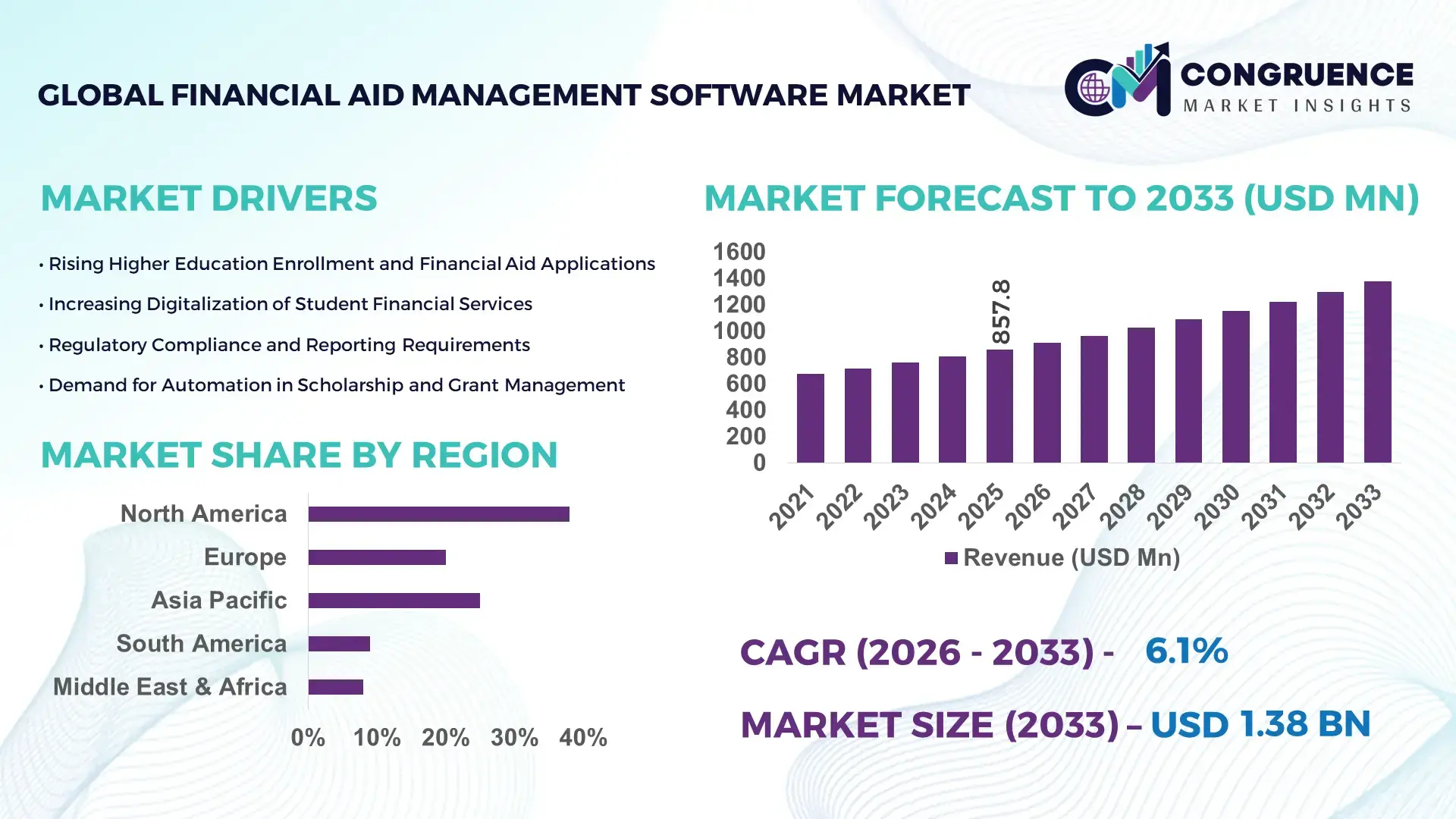
The Global Financial Aid Management Software Market was valued at USD 857.79 Million in 2025 and is anticipated to reach a value of USD 1377.55 Million by 2033 expanding at a CAGR of 6.1% between 2026 and 2033. Growth is driven by the increasing digitalization of higher education administration and compliance automation requirements.
The United States represents the most established national environment for Financial Aid Management Software deployment, supported by over 6,000 Title IV–participating postsecondary institutions and annual federal student aid disbursements exceeding USD 120 billion. Institutions widely integrate aid platforms with Student Information Systems (SIS), ERP, and compliance modules to manage FAFSA processing, verification workflows, and Pell Grant distribution. Cloud-based deployments now account for a significant portion of new system rollouts, while AI-enabled document indexing and automated eligibility checks are reducing manual processing time by more than 30% in large universities. Continuous institutional IT spending, averaging 4–6% of operating budgets, further sustains modernization of financial aid technology infrastructure.
Market Size & Growth: USD 857.79M (2025) to USD 1377.55M (2033), CAGR 6.1%, driven by compliance digitization.
Top Growth Drivers: Cloud adoption 48%, workflow automation 42%, regulatory reporting efficiency 37%.
Short-Term Forecast: By 2028, institutions may achieve 25% processing cost reduction and 30% faster aid disbursement cycles.
Emerging Technologies: AI-based eligibility verification, cloud-native SaaS platforms, API-led SIS and ERP integrations.
Regional Leaders: North America USD 520M, Europe USD 340M, Asia-Pacific USD 280M by 2033; rising cloud-first deployments.
Consumer/End-User Trends: Universities prioritize self-service student portals, mobile access, and automated document tracking.
Pilot or Case Example: 2024 university pilot showed 35% reduction in manual review time via AI-driven document classification.
Competitive Landscape: Ellucian ~18%, Oracle, Workday, SAP, Jenzabar among key enterprise solution providers.
Regulatory & ESG Impact: Data privacy mandates and education funding transparency rules accelerating secure cloud adoption.
Investment & Funding Patterns: Over USD 900M in recent edtech administration investments, emphasizing SaaS and automation tools.
Innovation & Future Outlook: Low-code workflow builders, predictive enrollment analytics, and cross-platform financial aid ecosystems advancing.
Financial Aid Management Software adoption spans public universities, private colleges, community colleges, and vocational institutions, with higher education accounting for the majority of solution deployments. Recent innovations include AI-powered verification engines, real-time eligibility analytics, and integrated communication modules. Regulatory frameworks related to student data protection and financial transparency are shaping procurement priorities. North America and Europe exhibit mature consumption, while Asia-Pacific shows accelerated growth due to expanding tertiary enrollment. Future demand will center on cloud migration, interoperability, and predictive financial aid planning tools.
Financial Aid Management Software has become strategically critical to higher education institutions seeking operational resilience, regulatory accuracy, and improved student service delivery. Institutions managing federal, state, and institutional aid programs process millions of applications annually, with automated platforms reducing manual documentation handling by up to 40% compared with legacy spreadsheet-based or paper-driven systems. Cloud-native financial aid platforms now support integrated workflows linking admissions, enrollment, and bursar systems, allowing real-time data exchange that improves award accuracy and reduces verification errors.
AI-enabled document recognition delivers 35% faster file completion compared to traditional manual indexing methods, while predictive analytics supports more precise aid packaging based on enrollment probability and financial need indicators. North America dominates in transaction volume due to extensive federal aid disbursement programs, while Asia-Pacific leads in digital adoption momentum with over 55% of new institutions deploying cloud-first student administration platforms. By 2028, AI-assisted eligibility verification is expected to improve processing turnaround time by 30%, enabling institutions to handle peak application cycles more efficiently.
Firms are committing to ESG-aligned digital modernization, targeting 25% reductions in paper consumption and physical storage needs by 2027 through fully digital documentation processes. In 2024, a large U.S. university system achieved a 32% reduction in incomplete aid files through AI-driven workflow automation. Looking ahead, the Financial Aid Management Software Market will serve as a pillar of institutional compliance, digital continuity, and sustainable administrative growth.
Public funding programs for higher education continue to expand in scope and reporting complexity, compelling institutions to adopt automated financial aid platforms. Large education systems administer billions in grants, loans, and scholarships annually, requiring strict documentation, verification, and audit trails. Manual processes struggle to meet compliance deadlines, whereas software solutions automate eligibility checks, flag discrepancies, and generate standardized reports. Institutions using digital verification workflows report over 30% reductions in document processing errors and significantly faster audit preparation. As governments introduce updated funding rules and digital reporting mandates, institutions must maintain real-time compliance visibility. This regulatory intensity directly supports demand for configurable, rules-based financial aid systems that adapt quickly to policy changes without large-scale system overhauls.
Many institutions operate aging Student Information Systems and on-premise databases built decades ago, creating integration barriers for modern financial aid platforms. Data migration risks, interoperability limitations, and concerns over operational disruption delay upgrades. IT teams often face resource constraints, with education institutions typically allocating limited staff for system transitions while maintaining daily operations. Additionally, procurement cycles in public institutions can extend beyond 12 months due to approval and budgeting procedures. These structural limitations slow cloud adoption and reduce the speed at which institutions can implement advanced automation, analytics, and AI-driven capabilities, even when operational benefits are well established.
AI-based document recognition, chatbots, and predictive analytics present substantial opportunities for institutions seeking to improve student experience and administrative efficiency. Automated verification tools can classify income documents, tax forms, and identity records with high accuracy, reducing processing time by up to 35%. Self-service portals with real-time status tracking improve transparency and reduce inquiry volumes handled by financial aid offices. Predictive modeling enables institutions to optimize aid packaging strategies to support student retention initiatives. As digital-native student populations grow, institutions investing in intuitive, mobile-accessible financial aid systems can strengthen engagement and streamline communications, positioning software vendors to capture demand for next-generation service capabilities.
Financial aid systems process sensitive personal and financial data, making them high-value targets for cyber threats. Institutions must comply with stringent privacy frameworks, requiring encryption, multi-factor authentication, audit logging, and secure data hosting practices. Compliance assessments and security certifications increase implementation timelines and operational costs. Any breach can lead to legal liabilities and reputational damage, prompting cautious adoption decisions. Moreover, cross-border student data transfers introduce additional regulatory considerations. Vendors must continuously update security architectures to address evolving threats, while institutions invest in monitoring and governance frameworks to maintain compliance across complex digital ecosystems.
• AI-Driven Document Processing Reducing Manual Workloads by Over 35% Financial aid offices are increasingly deploying AI-powered document recognition tools capable of classifying tax records, income statements, and identity documents with accuracy rates exceeding 90%. Institutions report up to 35% reductions in manual file review workloads and 28% faster completion of verification cycles. Automated indexing systems also decrease processing backlogs during peak enrollment periods by nearly 30%, enabling staff reallocation toward advisory services rather than administrative tasks.
• Cloud-Native Deployments Surpassing 60% of New Implementations More than 60% of newly procured Financial Aid Management Software platforms are now cloud-native, reflecting a shift away from on-premise infrastructure. Cloud environments enable system scalability of up to 2× during application surges while cutting infrastructure maintenance efforts by approximately 25%. Institutions adopting SaaS-based aid systems also report 20% faster update cycles for regulatory rule changes, improving compliance responsiveness and operational continuity.
• Student Self-Service Portals Increasing Digital Engagement by 40% Modern aid platforms integrate mobile-enabled student portals that allow real-time tracking of application status, missing documents, and award notifications. Institutions using these portals observe a 40% rise in digital engagement and a 32% drop in in-person inquiries. Automated alerts and chatbot assistance handle nearly 25% of routine student queries, improving response times while lowering administrative communication burdens.
• Predictive Analytics Improving Retention Outcomes by 18% Predictive modeling tools embedded within Financial Aid Management Software analyze financial need indicators, enrollment behavior, and academic performance data. Institutions applying these insights to optimize aid packaging strategies have achieved up to 18% improvement in student retention among at-risk groups. Early-warning dashboards also enable proactive interventions, reducing late disbursement cases by nearly 22% and strengthening institutional planning accuracy.
The Financial Aid Management Software market is structured around deployment types, institutional applications, and diverse end-user categories, reflecting the operational complexity of modern education funding systems. Segmentation by type primarily distinguishes between cloud-based, on-premise, and hybrid solutions, each aligned with institutional IT maturity levels. Application segmentation focuses on functions such as aid application processing, eligibility verification, compliance reporting, fund disbursement tracking, and analytics-driven retention planning. End-user segmentation spans public universities, private colleges, community colleges, vocational institutions, and education consortia. Over 65% of large institutions operate integrated aid modules connected with Student Information Systems, while smaller institutions increasingly adopt modular SaaS tools. Growing demand for automation, digital documentation, and real-time compliance monitoring is reshaping how institutions prioritize system capabilities across all segments.
Cloud-based Financial Aid Management Software represents the leading product type, accounting for approximately 58% of institutional deployments due to scalability, remote accessibility, and reduced infrastructure management burdens. Institutions using cloud platforms report 25% faster regulatory update cycles compared with traditional on-premise systems. On-premise solutions hold around 27% share, typically preferred by institutions with strict internal data governance frameworks or legacy IT investments. However, hybrid models are expanding fastest, supported by institutions transitioning gradually toward cloud ecosystems while retaining critical legacy databases; this segment is growing at an estimated 8.5% CAGR as integration tools improve interoperability.
Other niche deployment structures, including hosted private cloud environments and consortium-based shared platforms, together contribute roughly 15% of the market, mainly in multi-campus systems.
Aid application processing remains the leading application area, accounting for nearly 40% of system utilization as institutions manage millions of annual submissions requiring document validation and workflow tracking. Compliance reporting and audit management follow with about 26% share, reflecting the importance of maintaining eligibility records, disbursement logs, and verification documentation. However, analytics-driven retention and aid optimization tools are expanding fastest, with an estimated 9.2% CAGR, as institutions seek to align financial support with student success outcomes through predictive modeling and risk analysis.
Other applications, including fund disbursement tracking, communication management, and student self-service interfaces, collectively represent approximately 34% of system use.
Public universities constitute the leading end-user segment, representing about 46% of total deployments due to large enrollment volumes and complex funding program participation. Private colleges account for roughly 28%, focusing on integrated scholarship and institutional grant management tools. Community colleges and vocational institutions form the fastest-growing segment, expanding at an estimated 9.8% CAGR, driven by rising enrollment in career-oriented education and increased participation in government-supported aid programs.
Other users, including education consortia and distance learning institutions, collectively contribute about 26%, often leveraging shared-service platforms to manage costs.
North America accounted for the largest market share at 38% in 2025 however, Asia-Pacific is expected to register the fastest growth, expanding at a CAGR of 8.7% between 2026 and 2033.
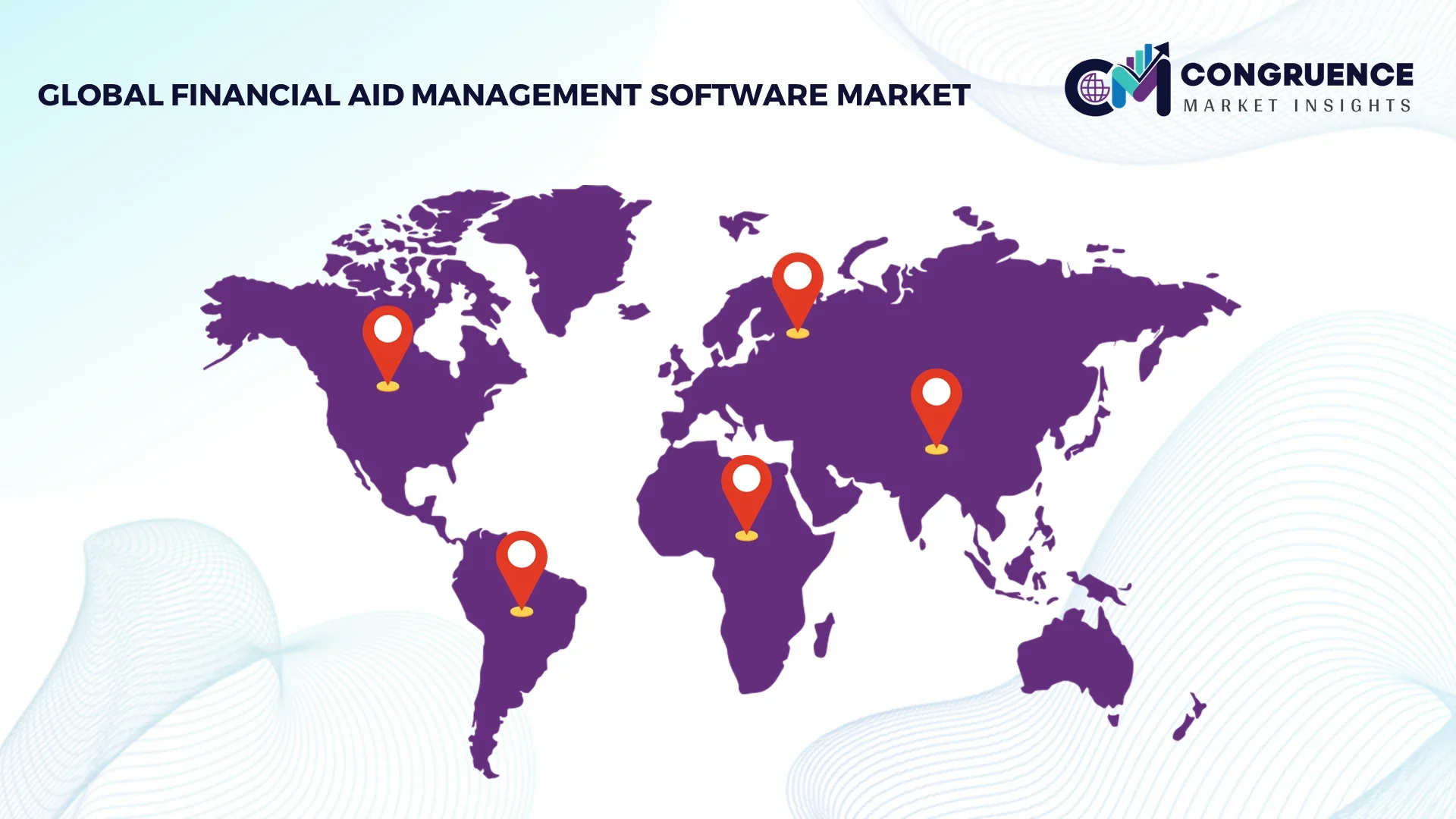
Europe follows with approximately 27% share, while Asia-Pacific currently represents about 22% and South America and Middle East & Africa collectively contribute nearly 13%. Over 65% of large higher education institutions in developed regions have already implemented centralized Financial Aid Management Software platforms. Digital student funding programs increased by 18% across public institutions between 2022 and 2025, intensifying demand for automated verification systems. Cloud-based deployments exceed 60% of new installations in mature education markets, while mobile-access student portals grew usage by 35% globally. Cross-border student enrollment rose 12% over the past three years, requiring multi-currency and multi-policy financial aid processing capabilities.
How are institutions modernizing student funding administration through digital transformation?
This region contributes nearly 38% of global demand, driven by large-scale higher education systems, federal student funding programs, and advanced digital infrastructure. Universities and community colleges process millions of aid applications annually, requiring automated eligibility engines and compliance monitoring tools. Regulatory oversight related to student data privacy and funding transparency has accelerated adoption of encrypted, cloud-hosted systems. AI-powered document processing and API-based integration with ERP and Student Information Systems are standard modernization initiatives. A major regional vendor, Ellucian, continues expanding SaaS-based aid modules with predictive analytics features to support retention planning. Institutions show strong preference for self-service portals, with over 45% of students using mobile devices to track financial aid status and documentation requirements.
What factors are shaping digital funding compliance and transparency initiatives?
Europe holds around 27% of the global Financial Aid Management Software landscape, supported by structured public funding systems and cross-border education mobility. Germany, the UK, and France represent key national markets, collectively accounting for more than half of regional deployments. Strict data protection frameworks and digital governance standards encourage institutions to prioritize secure and auditable aid platforms. AI-assisted compliance reporting and multilingual student communication interfaces are gaining traction. A regional higher education technology provider, Tribal Group, supports integrated student management and funding modules across multi-country education networks. Institutions exhibit cautious but steady adoption, with nearly 52% emphasizing explainable automation and audit traceability in procurement decisions.
Why is digital enrollment growth accelerating demand for automated funding systems?
Asia-Pacific represents about 22% of the global market and ranks first in growth momentum. China, India, and Japan are major contributors, with expanding tertiary enrollment and government-backed scholarship programs. Rapid digital infrastructure expansion and mobile-first education ecosystems encourage cloud-based financial aid platforms. Universities increasingly adopt AI-driven verification tools and digital document management to handle rising application volumes. A regional edtech firm, TCS iON, supports digital campus administration platforms integrated with scholarship and funding modules across multiple institutions. Students show strong preference for app-based communication, with mobile interactions accounting for nearly 50% of financial aid status checks.
How are public education reforms influencing system adoption?
South America contributes roughly 7% of global demand, with Brazil and Argentina as leading adopters. Education modernization initiatives and digital public service programs are driving system upgrades. Expanding vocational and technical education sectors require scalable aid processing platforms to manage government-backed student funding. Regulatory efforts to improve financial transparency and digital recordkeeping support cloud deployments. Regional institutions prioritize multilingual interfaces and centralized processing hubs. A local higher education technology integrator in Brazil has expanded hosted student administration platforms to support digital scholarship management across multi-campus systems. Students increasingly rely on digital communication channels, with online document submissions rising by 33% in recent years.
What modernization trends are shaping education funding systems?
This region accounts for nearly 6% of global adoption, with the UAE and South Africa representing major growth centers. National education digitization strategies and scholarship expansion programs are increasing demand for automated financial aid platforms. Institutions are investing in centralized digital student record systems linked to funding management modules. Cloud adoption is rising as governments promote digital transformation agendas. A regional technology services firm in the Gulf supports integrated campus and scholarship administration solutions for public universities. Students demonstrate growing preference for online services, with digital aid inquiries increasing by over 30% in metropolitan institutions.
United States Financial Aid Management Software Market – 34% share – Extensive federal funding programs and large institutional ecosystems requiring advanced compliance automation.
United Kingdom Financial Aid Management Software Market – 9% share – Strong public education funding frameworks and high digital governance standards supporting system adoption.
The Financial Aid Management Software market exhibits a moderately consolidated competitive environment with approximately 120 active vendors globally, including both enterprise-focused solutions and niche regional providers. The top five companies—Ellucian, Oracle, Workday, SAP, and Jenzabar—collectively account for around 62% of market adoption, demonstrating strong leadership in higher education and large-scale institutional deployments. Market competition is heavily influenced by product innovation, digital transformation initiatives, and strategic partnerships; in 2024 alone, Ellucian launched a predictive analytics module integrated with AI-driven verification, while Workday expanded cloud-based award management capabilities through collaborations with regional education consortia.
Innovation trends are reshaping differentiation, with over 50% of new software platforms incorporating AI-enabled document processing, mobile self-service portals, and API integrations with Student Information Systems and ERP suites. Strategic mergers and acquisitions are also active, with mid-sized SaaS providers seeking scale and multi-campus integration capabilities. Regional players in Europe, North America, and Asia-Pacific are emphasizing multilingual support, enhanced cybersecurity protocols, and cloud migration services to capture institutional demand. The competitive landscape is further shaped by regulatory compliance requirements, ESG-aligned digitization mandates, and growing adoption of predictive retention analytics, creating an environment where continuous product modernization is key to market leadership.
The Financial Aid Management Software market is undergoing a significant technological transformation driven by AI, cloud computing, and advanced analytics. AI-powered document recognition has become a critical feature, with institutions reporting up to 90% accuracy in processing tax forms, income statements, and identification documents. Automation of eligibility verification reduces manual intervention by over 35%, enabling staff to focus on advisory and compliance tasks. Machine learning algorithms are increasingly applied to predictive modeling, helping universities anticipate student financial needs and optimize award packaging, resulting in measurable retention improvements of 15–20% in targeted cohorts.
Cloud-based platforms dominate new deployments, accounting for more than 60% of recent installations, offering real-time scalability and multi-campus accessibility. Hybrid architectures are also gaining traction, particularly in multi-institution consortia, providing integration with legacy Student Information Systems while enabling centralized aid administration. Mobile-enabled self-service portals are now standard, with over 45% of students using apps to track award status and submit supporting documentation, enhancing engagement and reducing administrative inquiry volumes by 30%.
Emerging technologies such as blockchain for secure and auditable financial transactions, low-code/no-code workflow builders for custom process automation, and API-first ecosystems for interoperability are shaping the next generation of financial aid platforms. Institutions leveraging predictive analytics dashboards report up to 22% reduction in late disbursement incidents, while AI-assisted chatbots manage routine inquiries, handling 25% of student communications automatically. Overall, these technology innovations are enabling faster, more secure, and more efficient financial aid administration, improving compliance and operational resilience across higher education institutions.
• In June 2024, Ellucian announced new Student Financial Success innovations with enhanced AI and automation features that streamline financial aid data integration and workflows, now adopted by more than 720 institutions to improve personalized aid processing and compliance automation. (Ellucian)
• In early 2024, CampusLogic deployed its AI-based “Scholarship Match” engine across over 150 higher education institutions, reducing application processing time by 32% and increasing student satisfaction scores by 24% through smarter aid alignment tools.
• In October 2025, Workday reported that its AI-powered Student platform now supports over 650 higher education institutions globally, managing approximately 3 million student records and transforming financial aid and administrative efficiency with unified AI-driven services. (Newsroom | Workday)
• In 2025, Workday expanded its global footprint by enabling go-lives of its Student solution at institutions in Canada, Australia, and Europe, further enhancing its cloud-based campus administration capabilities around financial aid and student engagement. (Newsroom | Workday)
The Financial Aid Management Software Market Report offers a comprehensive examination of software solutions that institutions use to manage student funding workflows, from application intake and eligibility verification to award distribution and compliance reporting. The report covers product types including cloud-based, on-premise, and hybrid platforms, detailing deployment preferences across varied institutional sizes and IT strategies. It also breaks down key application areas such as automated processing, fund tracking, compliance automation, predictive analytics, and student self-service interfaces, showing how institutions prioritize technology investments to improve efficiency and student engagement. Segmentation by end-user includes public universities, private colleges, community colleges, and vocational institutions, with analysis on how educational strategies and adoption behaviors differ among these groups.
Geographic region analyses encompass North America, Europe, Asia-Pacific, South America, and Middle East & Africa, providing insights into regional deployment volumes, regulatory influences, and tech adoption patterns. The report also examines technological trends, such as the integration of AI-driven document recognition, real-time analytics dashboards, mobile-access features, and interoperability with Student Information Systems and enterprise platforms. Emerging niche segments like blockchain-enabled audit trails and AI-assisted predictive retention modeling are highlighted, as well as the role of multilingual portals in global deployments. Industry focus areas include compliance automation under evolving data privacy requirements, digital transformation roadmaps for large education consortia, and solutions tailored to scholarship and grant management. With clear segmentation frameworks and factual insights, the report serves decision-makers evaluating procurement priorities, technology investments, and competitive positioning across the Financial Aid Management Software landscape.
| Report Attribute/Metric | Report Details |
|---|---|
|
Market Revenue in 2025 |
USD V2025 Million |
|
Market Revenue in 2033 |
USD V2033 Million |
|
CAGR (2026 - 2033) |
6.1% |
|
Base Year |
2025 |
|
Forecast Period |
2026 - 2033 |
|
Historic Period |
2021 - 2025 |
|
Segments Covered |
By Types
By Application
By End-User
|
|
Key Report Deliverable |
Revenue Forecast, Growth Trends, Market Dynamics, Segmental Overview, Regional and Country-wise Analysis, Competition Landscape |
|
Region Covered |
North America, Europe, Asia-Pacific, South America, Middle East, Africa |
|
Key Players Analyzed |
Ellucian, Oracle, Workday, SAP, Jenzabar, Campus Management, Unit4, Blackbaud, CampusLogic, TCS iON |
|
Customization & Pricing |
Available on Request (10% Customization is Free) |




