
Reports
The Global Fill Finish Manufacturing Market was valued at USD 4174.28 Million in 2025 and is anticipated to reach a value of USD 6908.42 Million by 2033 expanding at a CAGR of 6.5% between 2026 and 2033. Growth is driven by rapid biologics and injectable drug pipelines, expansion of sterile CDMO capacity, and pharmaceutical supply-chain reshoring toward automated aseptic production.
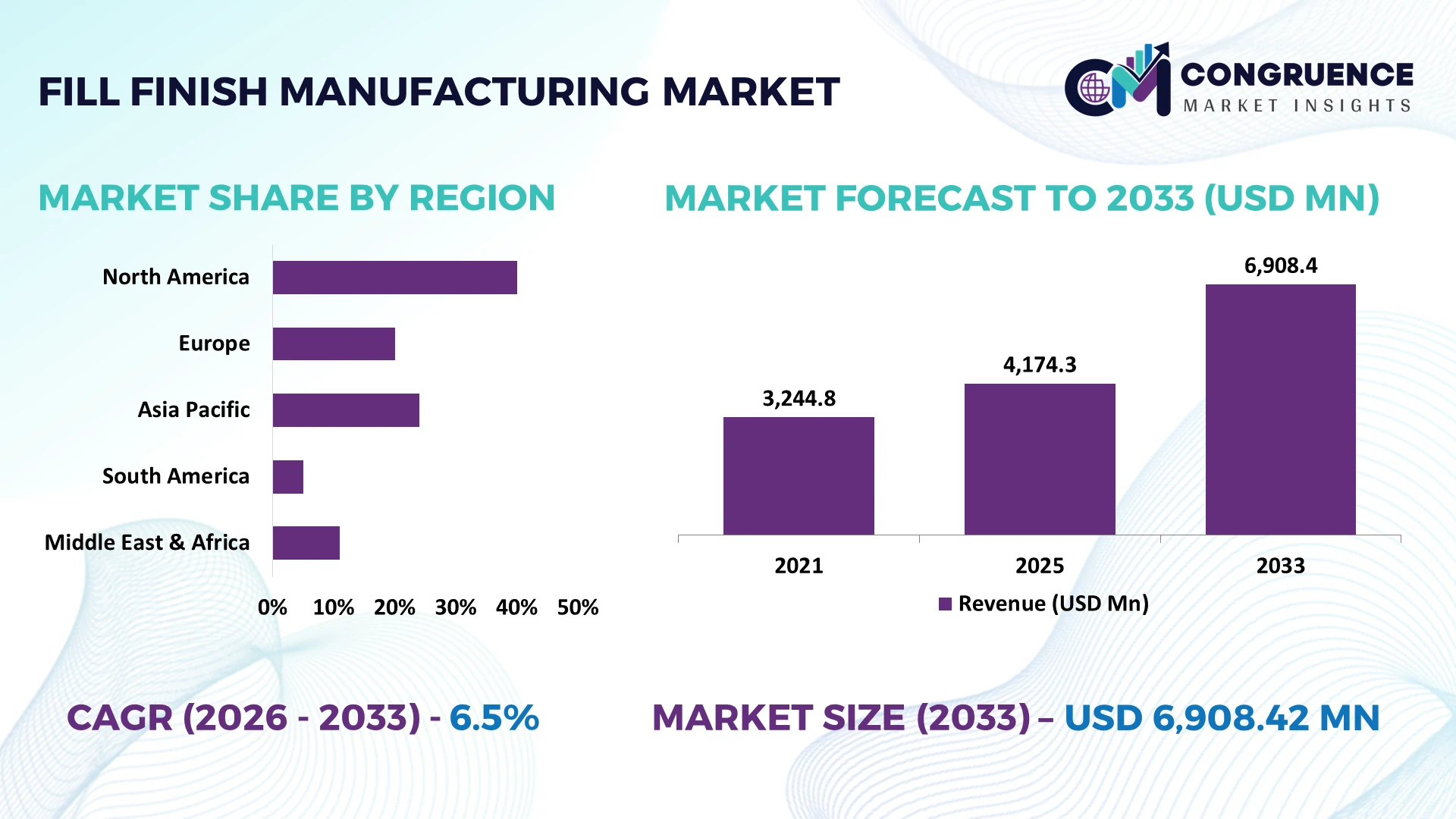
China holds a dominant position with approximately 35% of Asia-Pacific fill-finish activity, supported by expanding biologics and vaccine manufacturing, while India follows with strong cost-competitive capacity and more than USD 5 billion in pharmaceutical manufacturing investment. India’s PLI program recorded ₹41,943 crore investment by December 2025, while U.S. reshoring accelerated following tariff and supply-chain security pressures. China’s fill-finish market is growing faster than India’s, reinforcing Asia’s manufacturing advantage.
Strategically, manufacturers prioritizing high-containment sterile lines, flexible filling platforms, and regional capacity diversification will gain the strongest competitive positioning.
Market Size & Growth: USD 4174.28 Million in 2025 to USD 6908.42 Million by 2033 at 6.5% CAGR, driven by biologics, injectables, and automated sterile production.
Top Growth Drivers: Biologics 32%, outsourcing 24%, supply-chain reshoring 18%.
Short-Term Forecast: By 2028, advanced automation is expected to reduce filling costs 8% and improve line efficiency 12%.
Emerging Technologies: AI inspection, robotic aseptic handling, and advanced prefilled-syringe systems are raising high-speed production precision by 10%.
Regional Leaders: Asia-Pacific approaches USD 3.2 billion, North America USD 2.0 billion, and Europe USD 1.7 billion, led by outsourcing and regional capacity expansion.
Consumer/End-User Trends: More than 40% of new injectable pipelines increasingly favor ready-to-use formats, strengthening demand for prefilled syringes and cartridges.
Pilot/Case Example: In 2025, a U.S. sterile-fill expansion added 24,000 sq. ft. and new filling and lyophilization capacity, targeting 15% higher production efficiency.
Competitive Landscape: Leading suppliers control roughly 45% collectively, with major positions held by Catalent, Thermo Fisher Scientific, Lonza, Baxter, and Recipharm.
Regulatory & ESG Impact: Stricter aseptic controls and sustainability programs are pushing facilities toward 10% lower material and energy consumption.
Investment & Funding: Piramal Pharma committed USD 90 million to U.S. expansions, reflecting a broader shift toward domestic sterile-injectable capacity.
Innovation & Future Outlook: Next-generation facilities will integrate AI quality control, robotics, continuous monitoring, and flexible multi-product lines as global supply chains diversify.
Demand is concentrated in sterile injectables, biologics, vaccines, oncology therapies, and prefilled delivery systems, with automation increasingly embedded across filling and inspection operations. Advanced robotic handling and AI-enabled vision systems are supporting roughly 10% higher process precision, while U.S. reshoring and Asia-Pacific capacity expansion reshape supply-chain strategies. These shifts position flexible, digitally integrated facilities as the next strategic priority.
The Fill Finish Manufacturing Market is becoming strategically important as pharmaceutical companies compete for reliable sterile capacity, faster product launches, and tighter quality control. Biologics, vaccines, and injectable therapies are shifting manufacturing investment toward flexible aseptic facilities, while supply-chain restructuring is encouraging localized fill-finish capabilities. More than 40% of injectable development activity increasingly targets ready-to-use delivery formats, strengthening demand for advanced filling platforms.
Automation is materially changing economics. Robotic aseptic handling and automated inspection can improve line efficiency by approximately 10–15% and reduce manual intervention compared with legacy systems. The United States is emphasizing domestic capacity and high-containment infrastructure, while India combines lower manufacturing costs with rapidly expanding pharmaceutical production. Over the next 2–3 years, automated inspection adoption is expected to exceed 50% across newly modernized facilities, supported by digital batch monitoring and predictive maintenance.
Companies are responding through facility expansion, CDMO partnerships, modular production lines, and investment in prefilled syringes and lyophilization. A practical deployment model combines robotic filling with real-time environmental monitoring, reducing intervention points while improving batch consistency. Strategically, manufacturers that integrate automation, flexible capacity, and regional supply resilience will secure stronger operational advantages and long-term competitive positioning.
The strongest growth driver is the expanding injectable biologics pipeline, which is increasing demand for specialized aseptic filling and containment infrastructure. Biologics represent more than 30% of new injectable development activity, while automated filling can improve throughput by 12% and reduce manual interventions by nearly 20%. In the United States, pharmaceutical manufacturers are expanding domestic sterile capacity as supply-chain resilience becomes a procurement priority. Companies are responding through modular filling lines, CDMO partnerships, and investments in high-containment suites. The non-obvious advantage is flexibility: facilities capable of switching between vial, cartridge, and prefilled-syringe formats can absorb changing product pipelines faster and reduce asset underutilization.
High facility complexity remains a structural restraint because aseptic environments require validated HVAC, contamination controls, specialized equipment, and continuous monitoring. Advanced sterile facilities can carry operating and maintenance costs 15–20% above conventional pharmaceutical production environments, while equipment qualification can extend commissioning timelines by 10% or more. India benefits from lower manufacturing costs, but imported filling machinery and specialized components can expose operators to 8–12% procurement-cost volatility. Companies are reducing exposure through multi-year supplier contracts, localized component sourcing, and standardized equipment platforms. The key operational issue is not equipment availability alone; interoperability between legacy systems and new digital controls can determine whether capacity expansion delivers its intended productivity gains.
AI-enabled visual inspection, predictive maintenance, robotic material handling, and real-time environmental monitoring create a high-value modernization opportunity. Automated inspection can improve defect-detection consistency by approximately 10%, while predictive analytics can reduce unplanned equipment downtime by 8–12%. India, Singapore, and Ireland are positioned to capture outsourced sterile manufacturing demand through digitally integrated facilities and specialized CDMO ecosystems. The next opportunity is connecting filling equipment with manufacturing execution systems and electronic batch records, creating closed-loop production intelligence. Companies investing in AI validation, modular automation, and interoperable control architectures can differentiate through faster batch release, lower intervention rates, and more efficient multi-product utilization rather than competing solely on production capacity.
The market faces an execution challenge as modern fill-finish facilities combine robotics, machine vision, environmental sensors, serialization, and manufacturing execution systems. Integration failures can increase commissioning workloads by 10–15%, while skilled automation and validation personnel remain critical to maintaining consistent operations. In the United States, increasingly sophisticated sterile facilities require multidisciplinary expertise spanning engineering, microbiology, cybersecurity, and regulatory validation. Companies must therefore invest in workforce development, standardized digital architectures, and supplier-led training. A less visible challenge is cybersecurity exposure across connected production equipment; a disruption to digital controls can affect batch continuity even when physical filling assets remain operational. Competitive advantage will increasingly depend on resilient digital infrastructure alongside sterile manufacturing expertise.
Robotics Reshape Aseptic Lines: Fully automated aseptic platforms are moving toward speeds of up to 600 units per minute, while robotic handling reduces direct operator intervention and strengthens contamination control. Companies are scaling gloveless isolators, modular robotics, and automated transfer systems as labor availability and Annex 1 compliance pressures intensify.
Inspection Becomes AI-Driven: Deep-learning automated visual inspection is achieving detection accuracy above 99% with false-eject rates near 1%, replacing slower manual inspection workflows. Amgen and other manufacturers are advancing validated AI inspection to reduce rejection variability, improve throughput, and strengthen batch-quality decisions.
Real-Time Monitoring Gains Ground: Sterile facilities are integrating environmental monitoring directly with filling equipment, shifting from periodic manual checks toward continuous data capture. Recent implementations target faster intervention detection and stronger process visibility, while companies are expanding digital batch records and connected sensors to improve compliance and operational responsiveness.
Flexible Formats Drive Reconfiguration: Manufacturers are increasingly deploying filling platforms capable of handling vials, syringes, and cartridges on the same equipment, reducing format-specific constraints and improving asset utilization. Siegfried Hameln and Syntegon demonstrated fully automated robotic systems, while RTU packaging adoption reduces preparation complexity and supports faster campaign changes.
Automated Filling remains the leading type, accounting for approximately 38% of market activity, because high-speed dosing, repeatability, and integration with isolators provide stronger scalability than conventional manual systems. Automated Capping follows at nearly 24%, supported by synchronized container handling and reduced operator intervention. Labeling Systems represent about 17%, with serialization and track-and-trace requirements strengthening their role in regulated production. Inspection Systems hold roughly 21% and are the fastest-growing type as manufacturers replace manual quality checks with AI-enabled automated visual inspection. Companies are prioritizing integrated filling-inspection architectures rather than isolated equipment purchases, improving line synchronization and reducing transfer delays.
The shift is especially visible in the United States and Germany, where sterile facilities increasingly combine filling, capping, inspection, and digital batch controls. Mature filling and capping technologies continue to anchor high-volume production, while AI inspection is attracting disproportionate investment because detection accuracy above 99% is achievable in advanced implementations. The strategic implication is clear: suppliers offering interoperable end-to-end systems gain stronger positioning than vendors focused on single-machine functionality.
Liquid Filling dominates applications with approximately 54% share, reflecting extensive deployment across injectable medicines, vaccines, biologics, and sterile solutions. Its scale advantage comes from mature dosing technology and compatibility with high-throughput vial and syringe lines. Bottle Filling contributes around 19%, while Powder Filling represents nearly 15% and remains strategically important for specialized formulations. Pouch Filling accounts for about 12%, but its flexibility makes it the fastest-growing application, with adoption expanding approximately 8% as manufacturers seek lightweight formats and simplified material handling.
Liquid systems continue to receive automation upgrades, particularly in the United States and Germany, where robotic handling and closed processing are improving contamination control. Powder Filling is becoming more specialized as containment requirements increase, whereas Bottle Filling remains concentrated in established production workflows. Companies are responding by installing modular filling platforms capable of switching between container formats, improving utilization by approximately 10%. The key business shift is toward flexible equipment capable of serving multiple formulations without extensive line redesign.
Pharmaceuticals represent the dominant end-user group at approximately 61% share, driven by intensive requirements for sterile injectables, biologics, vaccines, and controlled filling environments. Food & Beverage follows at around 18%, while Cosmetics contributes nearly 13% through premium liquid and small-batch formulations. Chemicals account for approximately 8%. Pharmaceuticals also maintain the highest automation intensity, with more than 50% of newly modernized facilities increasingly incorporating automated inspection, robotics, or digital monitoring.
Cosmetics is the fastest-growing end-user segment, supported by premium formulations, smaller batch sizes, and rising demand for precise liquid filling. Food & Beverage remains focused on throughput and hygienic packaging, while Chemicals prioritize containment and material compatibility. Companies are responding through application-specific filling heads, modular automation, and partnerships with equipment integrators. The strategic opportunity is shifting from volume-only production toward configurable platforms that serve diverse batch sizes and stringent quality requirements, allowing suppliers to capture pharmaceutical-grade technology demand across adjacent industries.
North America accounted for the largest market share at 34% in 2025 however, Asia-Pacific is expected to register the fastest growth, expanding at a CAGR of 8.1% between 2026 and 2033.
Sterile Capacity Reshoring Accelerates Automation
North America maintains the leading position with approximately 34% market share, supported by concentrated pharmaceutical manufacturing, biologics production, and advanced sterile infrastructure in the United States. More than 50% of newly modernized facilities increasingly incorporate automated inspection, robotic handling, or digital monitoring. U.S. manufacturers are expanding domestic fill-finish capacity to reduce dependence on overseas sterile production and strengthen supply continuity. Large-scale CDMO networks are also increasing partnerships with pharmaceutical developers, particularly for injectable biologics and high-containment products. Isolator-based filling, real-time environmental monitoring, and prefilled delivery formats are gaining deployment priority. The region’s competitive advantage is shifting from production scale alone toward validated automation, rapid technology integration, and resilient domestic supply chains.
United States Market Outlook: The United States remains the region’s strategic manufacturing hub because of its extensive biologics pipeline, sophisticated regulatory infrastructure, and concentration of major pharmaceutical companies and CDMOs. More than 50% of modernized sterile facilities are integrating advanced automation, supporting faster batch handling and tighter contamination control. Domestic capacity expansion is strengthening supply resilience.
Regulatory Modernization Reshapes Sterile Production
Europe represents approximately 29% of global fill-finish activity, supported by established pharmaceutical manufacturing clusters in Germany, Switzerland, Ireland, and Italy. EU Annex 1 implementation has accelerated investment in contamination-control strategies, isolators, restricted-access barrier systems, and automated environmental monitoring. More than 40% of modernization programs increasingly prioritize closed processing and digital quality systems. Germany and Ireland remain important production centers for sterile medicines and contract manufacturing, while sustainability requirements are pushing manufacturers toward energy-efficient HVAC and reduced material consumption. Companies are combining equipment upgrades with facility redesign rather than relying on standalone automation, improving operational consistency and regulatory readiness. The competitive emphasis is shifting toward compliance-led modernization, flexible capacity, and lower lifecycle operating costs.
Germany Market Outlook: Germany remains a major European manufacturing center because of its engineering capabilities, pharmaceutical production base, and dense ecosystem of equipment suppliers. Advanced filling and inspection systems are increasingly integrated into modern sterile facilities, with automation adoption exceeding 40% across many modernization programs. Manufacturers are prioritizing energy-efficient production environments and validated digital controls to meet stricter quality expectations.
Scale Advantage Drives High-Capacity Deployment
Asia-Pacific accounts for approximately 27% of global fill-finish activity and is the fastest-expanding manufacturing base, supported by pharmaceutical exports, vaccine production, biologics capacity, and cost-efficient CDMO operations. China and India represent the region’s strongest deployment centers, while Singapore is strengthening its position in high-value sterile manufacturing. Automated equipment adoption is increasing by roughly 10–12% annually across new and upgraded facilities, particularly where manufacturers target export markets. India’s pharmaceutical manufacturing ecosystem benefits from lower production costs and expanding investment in injectable capacity, while China combines large-scale domestic demand with extensive manufacturing infrastructure. Companies are responding through new sterile lines, technology partnerships, and localized equipment sourcing. The strategic advantage increasingly lies in combining lower conversion costs with internationally compliant automation.
China Market Outlook: China holds the strongest manufacturing scale in Asia-Pacific, supported by extensive pharmaceutical infrastructure, vaccine production, and domestic demand. Approximately 35% of regional fill-finish activity is concentrated in Chinese facilities, strengthening its role in high-volume sterile production. Manufacturers are investing in automated filling, inspection, and containment technologies to improve export readiness and production consistency.
Local Production Strengthens Supply Resilience
South America contributes approximately 6% of global fill-finish activity, with Brazil accounting for the largest share because of its pharmaceutical manufacturing base, vaccine infrastructure, and concentrated healthcare production. Local manufacturers are increasing sterile filling capabilities to reduce reliance on imported finished medicines and improve supply continuity. Automation adoption is estimated at roughly 30% across modernized facilities, leaving substantial room for equipment upgrades and digital process integration. Brazil’s established pharmaceutical ecosystem supports larger-scale deployment, while Argentina and Colombia are developing more specialized production capabilities. Import dependency for advanced machinery and sterile components remains an operational constraint, increasing procurement exposure and extending equipment replacement cycles. Companies are responding through local partnerships, equipment standardization, and phased modernization. The strongest opportunity is integrating imported high-performance systems with locally optimized production workflows.
Brazil Market Outlook: Brazil is the region’s most strategically significant market because of its pharmaceutical manufacturing scale and established vaccine-production infrastructure. Domestic producers are increasingly upgrading sterile filling and inspection equipment, with automation penetration around 30% in modernized operations. Localized production strategies are improving supply resilience while supporting greater adoption of digitally monitored filling processes.
Pharmaceutical Localization Drives Infrastructure Investment
Middle East & Africa represents approximately 4% of global fill-finish activity, with Saudi Arabia, the United Arab Emirates, and South Africa emerging as important pharmaceutical manufacturing centers. Localization policies and healthcare-security priorities are encouraging investments in sterile production, packaging, and pharmaceutical infrastructure. Automated filling deployment remains below 30% across much of the region, creating a clear modernization gap compared with mature markets. Saudi Arabia is particularly focused on expanding domestic pharmaceutical manufacturing and reducing dependence on imported medicines, while the UAE is developing advanced logistics and healthcare manufacturing ecosystems. Companies are responding through technology partnerships, contract manufacturing agreements, and modular sterile facilities. The strategic opportunity is concentrated in facilities that combine localized production with internationally compliant automation and cold-chain infrastructure.
Saudi Arabia Market Outlook: Saudi Arabia has the strongest strategic position in the region because pharmaceutical localization is closely aligned with national industrial-development priorities. More than 20% of new pharmaceutical manufacturing initiatives increasingly emphasize domestic production capabilities. Investment in sterile facilities, automated filling, and integrated pharmaceutical infrastructure is strengthening the country’s position as a regional manufacturing hub.
Global fill-finish manufacturing competition is led by Catalent, Thermo Fisher Scientific, Lonza, Baxter, and Recipharm, while regional CDMOs and specialist equipment providers compete on flexibility and cost. The top five players together command approximately 45% of organized capacity. Competition centers on technology, supply resilience, speed, customization, and compliance. Automated inspection and robotic handling can improve throughput 10–15%, while modular lines can reduce changeover time 8–12%. Leaders are expanding sterile facilities, forming pharmaceutical partnerships, and integrating filling, inspection, and packaging capabilities. Regional specialists counter with lower-cost production, faster batch scheduling, and niche containment expertise. The competitive structure is shifting as pharmaceutical companies diversify suppliers after global supply disruptions and prioritize localized sterile capacity. High validation costs, qualified workforce requirements, and regulatory approval remain significant entry barriers, limiting rapid new capacity. Winning players will combine validated automation, reliable component sourcing, flexible multi-format lines, and geographically diversified capacity while maintaining competitive total cost.
Catalent, Inc.
Thermo Fisher Scientific Inc.
Lonza Group Ltd.
Baxter International Inc.
Recipharm AB
Siegfried Holding AG
Vetter Pharma International GmbH
Bora Pharmaceuticals Co., Ltd.
Ajinomoto Bio-Pharma Services
PCI Pharma Services
Curia Global, Inc.
Jubilant HollisterStier
Piramal Pharma Solutions
WuXi Biologics Co., Ltd.
Current fill-finish technology is centered on robotic aseptic handling, closed isolators, automated visual inspection, and real-time environmental monitoring. Robotic isolators can reduce Grade A human intervention by more than 90%, while automated inspection improves defect-detection consistency by around 10%. Adoption is strongest in newly modernized sterile facilities, where integrated filling, capping, inspection, and digital batch records improve throughput, contamination control, and compliance.
Emerging systems combine AI-enabled vision, predictive maintenance, digital twins, and connected manufacturing execution systems. Compared with legacy manual intervention and conventional RABS workflows, advanced robotic isolators can improve operational efficiency by 12–15% and reduce changeover requirements by about 8%. More than 60% of new aseptic facilities are incorporating high-level robotics or isolator-based automation, benefiting CDMOs and manufacturers handling complex biologics and small batches.
Disruptive development through 2026–2028 will center on autonomous process control, gloveless robotics, and closed-loop quality monitoring. AI-driven analytics can improve process performance by 5–8%, while integrated automation can reduce production stoppages by roughly 5%. Companies deploying flexible robotic platforms now gain faster format changes, lower intervention risk, and capacity utilization. Technology leaders with validated digital ecosystems will outperform cost-focused operators as sterile manufacturing becomes data-driven and automated.
February 2024 Alcami expanded Charleston sterile fill-finish capacity with a fully automated isolator line and two lyophilizers, supporting liquid and freeze-dried vials. The integrated expansion strengthened onshore manufacturing scalability, contamination control, and clinical-to-commercial production flexibility for pharmaceutical customers. Source: Alcami
October 2025 Aenova added another sterile fill-finish line at Latina, supporting vials, prefilled syringes, and cartridges through isolator technology. The flexible line expanded container-format capability and strengthened commercial biologics capacity, particularly for monoclonal antibodies, peptides, vaccines, and variable batch sizes. Source: Aenova
July 2025 Thermo Fisher agreed to acquire Sanofi’s Ridgefield, New Jersey manufacturing site, a sterile fill-finish and packaging facility employing over 200 people. The transaction strengthened U.S. manufacturing capacity and supported supply-chain localization, while expanding Thermo Fisher’s capabilities for essential medicines and pharmaceutical production. Source: Reuters
January 2026 Sharp Sterile Manufacturing committed $28 million to expand Lee, Massachusetts, installing a fully automated IMA Life isolated line. Filling capacity will more than double, with batches reaching 100,000 units, strengthening commercial-scale sterile production, automation, and pharmaceutical manufacturing employment in the region. Source: Sharp
The report covers the Fill Finish Manufacturing Market across Automated Filling, Automated Capping, Labeling Systems, and Inspection Systems, with application analysis spanning Liquid Filling, Powder Filling, Bottle Filling, and Pouch Filling. End-user coverage includes Food & Beverage, Pharmaceuticals, Cosmetics, and Chemicals, enabling comparison of deployment intensity, automation penetration, and operational requirements.
Geographic analysis encompasses North America, Europe, Asia-Pacific, South America, and Middle East & Africa, with country-level assessment of manufacturing capacity, infrastructure, technology adoption, and investment activity. The scope evaluates robotic aseptic handling, isolators, automated inspection, AI-enabled monitoring, digital batch systems, and flexible filling platforms. More than 50% of modernized sterile facilities increasingly integrate advanced automation, supporting investment planning, capacity expansion, partnership decisions, competitive positioning, and technology priorities through 2026–2033.
| Report Attribute/Metric | Report Details |
|---|---|
Market Revenue in 2025 | USD 11124.35 Million |
Market Revenue in 2033 | USD 38796.34 Million |
CAGR (2026 - 2033) | 16.9% |
Base Year | 2025 |
Forecast Period | 2026 - 2033 |
Historic Period | 2021 - 2025 |
Segments Covered | By Type
By Application
By End-User
|
Key Report Deliverable | Revenue Forecast, Growth Trends, Market Dynamics, Segmental Overview, Regional and Country-wise Analysis, Competition Landscape |
Region Covered | North America, Europe, Asia-Pacific, South America, Middle East, Africa |
Key Players Analyzed | IDEMIA, NEC Corporation, Thales, HID Global, Fujitsu Limited, ASSA ABLOY, Aware, Inc., M2SYS Technology, Touchless Biometric Systems AG, TECH5, Suprema Inc., Innovatrics, FacePhi, BioID |
Customization & Pricing | Available on Request (10% Customization is Free) |




