
Reports
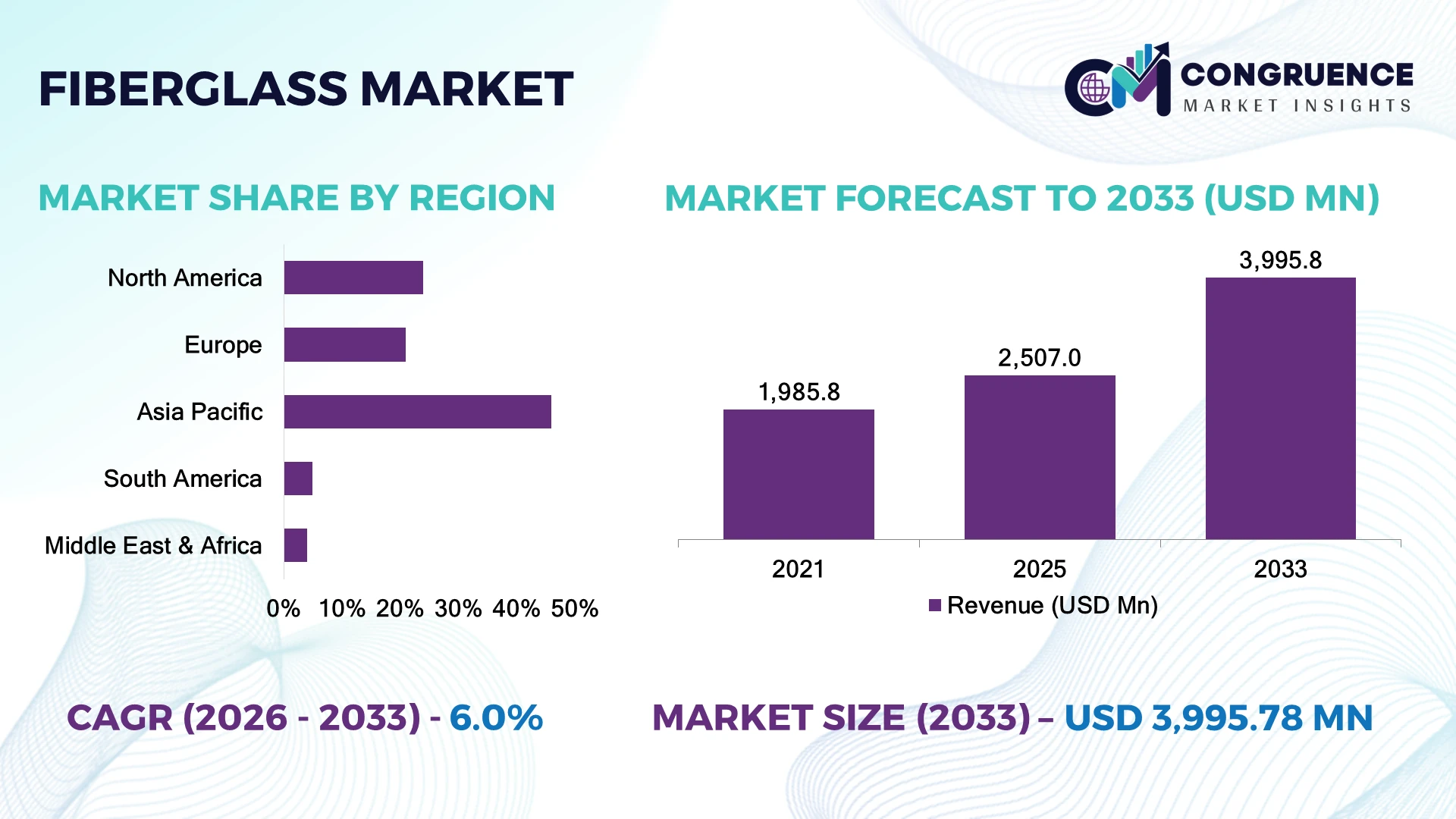
The Global Fiberglass Market was valued at USD 2,507.0 Million in 2025 and is anticipated to reach a value of USD 3,995.8 Million by 2033 expanding at a CAGR of 6.0% between 2026 and 2033. Growth is being driven by accelerating wind turbine blade production, lightweight automotive component adoption, and large-scale grid infrastructure upgrades requiring high-performance composite materials.
China remains the dominant country in the global fiberglass landscape, accounting for nearly 58% of worldwide fiberglass production capacity and over 50% of global exports, supported by investments exceeding USD 4 billion across advanced glass fiber manufacturing clusters. The country’s wind energy, construction, and electric vehicle industries consume substantial fiberglass volumes, while automated production penetration exceeds 70% in major facilities. In comparison, the United States contributes approximately 10% of global capacity but leads in high-performance composite applications for aerospace and infrastructure modernization. Ongoing trade realignments and strategic manufacturing localization continue influencing global supply patterns.
Strategic implication companies with diversified sourcing, advanced composite capabilities, and proximity to renewable energy value chains are positioned to secure long-term competitive advantages.
Market Size & Growth: USD 2,507.0 Million in 2025 is projected to reach USD 3,995.8 Million by 2033, supported by rapid renewable energy deployment and advanced composite material adoption across industrial sectors.
Top Growth Drivers: Wind energy installations (+18%), electric vehicle lightweighting demand (+22%), and infrastructure reinforcement applications (+14%) are the primary expansion catalysts.
Short-Term Forecast: By 2028, manufacturing automation is expected to reduce production waste by 12% while improving operational throughput by approximately 15%.
Emerging Technologies: AI-driven process optimization, automated filament winding, and high-strength glass fiber formulations are improving quality consistency and production efficiency.
Regional Leaders: Asia Pacific exceeds USD 1.9 billion supported by renewable energy expansion; North America surpasses USD 800 million through infrastructure upgrades; Europe exceeds USD 700 million driven by sustainable construction adoption.
Consumer/End-User Trends: More than 35% of new wind turbine blade manufacturing programs now prioritize advanced fiberglass composites for durability and weight optimization.
Pilot/Case Example: In 2024, multiple automated fiberglass manufacturing projects reported up to 20% lower material waste and 15% faster production cycles.
Competitive Landscape: Top five manufacturers collectively control approximately 45% of global supply, led by Jushi Group, Owens Corning, Taishan Fiberglass, Chongqing Polycomp, and Johns Manville.
Regulatory & ESG Impact: Industrial decarbonization initiatives and energy-efficiency mandates have accelerated adoption, with emissions-reduction targets exceeding 30% across several manufacturing sectors.
Investment & Funding: More than USD 5 billion has been directed toward capacity expansions, localization strategies, and advanced composite production facilities amid global supply-chain restructuring.
Innovation & Future Outlook: High-modulus fiberglass, recyclable composite systems, and digital manufacturing platforms are reshaping next-generation material strategies across high-growth end-use industries.
Fiberglass remains a critical material for wind energy systems, transportation components, electrical insulation, and modern infrastructure projects. Recent innovations focus on higher-strength glass fibers, automated manufacturing systems, and recyclable composite solutions that improve performance and sustainability. More than 35% of new renewable energy component programs now incorporate advanced fiberglass formulations, while supply-chain localization initiatives are reshaping procurement strategies. These developments are strengthening the market’s role in long-term industrial transformation and operational efficiency planning.
Fiberglass has become strategically important because it sits at the intersection of renewable energy deployment, transportation lightweighting, and infrastructure modernization. Governments and manufacturers are increasingly prioritizing durable, corrosion-resistant, and high-strength composite materials to improve operational efficiency and asset longevity. Supply-chain restructuring following recent geopolitical disruptions has further elevated fiberglass as a critical industrial input, prompting manufacturers to diversify production footprints and strengthen regional supply security.
Technology advancement is accelerating competitive differentiation. Modern automated fiberglass manufacturing lines can reduce material waste by nearly 20% compared with conventional production methods while improving throughput by approximately 15%. China continues to dominate large-scale manufacturing capacity, whereas the United States and Germany focus on high-performance applications for aerospace, electrical systems, and advanced infrastructure projects. This contrast highlights the shift from volume-driven production toward value-added composite innovation.
Over the next two to three years, demand from wind turbine manufacturing, electric mobility platforms, and utility infrastructure is expected to intensify. Leading producers are expanding specialized product portfolios, investing in automation, and establishing strategic partnerships with composite fabricators. Companies that secure advanced manufacturing capabilities, localized supply networks, and application-specific expertise will strengthen competitive positioning and capture long-term operational advantages.
The rapid expansion of renewable energy infrastructure and lightweight industrial design is the primary growth driver for fiberglass demand. Wind turbine installations increased by approximately 18% globally, while electric vehicle manufacturers expanded lightweight material usage by nearly 22% to improve energy efficiency and vehicle range. Fiberglass-reinforced composites can reduce component weight by up to 30% compared with traditional metal alternatives, creating strong adoption momentum across transportation and energy sectors. China has accelerated investments in large-scale wind blade manufacturing, while India continues expanding grid modernization programs requiring fiberglass insulation products. In response, major manufacturers are investing in automated production lines, expanding furnace capacity, and developing higher-strength formulations. A notable strategic insight is that fiberglass suppliers increasingly compete on application engineering support rather than material supply alone, strengthening long-term customer integration and value capture.
Fiberglass production remains highly sensitive to fluctuations in energy, silica, and industrial mineral costs. Energy expenses account for approximately 25–35% of total manufacturing costs, while transportation expenses have risen by nearly 12% in several export-dependent supply chains. European manufacturers continue facing elevated operating costs due to industrial energy market volatility, creating margin pressure and reducing pricing flexibility. These constraints directly affect production scalability, procurement planning, and project profitability for downstream composite manufacturers. To reduce exposure, companies are diversifying supplier networks, negotiating long-term procurement contracts, and expanding localized production capabilities. An important operational insight is that manufacturers with integrated raw material sourcing structures are better positioned to maintain pricing stability during commodity market disruptions, improving competitiveness in highly contested industrial applications.
Significant opportunities are emerging through recyclable composite technologies, smart manufacturing integration, and next-generation fiberglass formulations. Advanced glass fiber products can improve mechanical performance by approximately 15–20% while reducing material usage requirements in selected applications. Governments supporting clean-energy and infrastructure modernization initiatives are accelerating demand for durable composite systems. Japan and South Korea are actively investing in advanced material research programs focused on lightweight industrial applications and sustainable manufacturing methods. Companies are increasing R&D spending, forming technology partnerships, and developing closed-loop recycling ecosystems to capture emerging demand. A unique strategic opportunity lies in digitally optimized manufacturing platforms capable of reducing production defects by more than 10%, enabling higher-value product positioning and stronger differentiation in technically demanding end markets.
Long-term market expansion depends on overcoming manufacturing complexity, workforce limitations, and advanced production scaling challenges. Automated fiberglass facilities require specialized technical expertise, yet skilled composite manufacturing labor shortages exceed 15% in several industrial economies. Product qualification cycles for aerospace, energy, and infrastructure applications often extend beyond 12 months, slowing deployment and commercialization timelines. Additionally, manufacturers face increasing pressure to maintain consistent quality across multiple production locations while meeting evolving sustainability standards. To address these challenges, companies are investing in workforce development programs, digital quality-control systems, and collaborative research partnerships. A critical strategic insight is that future competitiveness will depend less on production volume and more on the ability to consistently deliver specialized, high-performance fiberglass solutions across complex industrial value chains.
Advanced Factory Automation Scaling Manufacturing facilities in China and the U.S. are increasing automation adoption, with automated winding, batching, and quality-control systems improving production throughput by 15% and reducing material waste by nearly 20%. Labor shortages in industrial manufacturing have accelerated deployment of machine-vision inspection systems. Producers are restructuring operations around digitally connected production lines to improve consistency, lower defect rates, and support higher-volume composite manufacturing programs.
Supply Chain Localization Strategies Fiberglass manufacturers are shifting procurement and production closer to end-use industries as supply-chain disruptions and trade uncertainties continue influencing sourcing decisions. More than 30% of major producers have expanded regional supply agreements, while localized raw-material sourcing has improved delivery reliability by approximately 18%. Companies are prioritizing domestic partnerships, warehouse expansion, and distributed manufacturing networks to reduce logistics exposure and improve customer responsiveness.
High-Performance Composite Transition Demand is shifting toward specialized fiberglass grades capable of delivering 15–25% higher mechanical performance in wind energy, transportation, and electrical applications. Manufacturers are increasing investment in engineered roving and reinforced composite solutions as lightweight design requirements intensify. A less obvious trend is the growing preference for application-specific formulations that reduce downstream processing costs, strengthening long-term supplier relationships and differentiation.
Circular Material Development Focus Sustainability requirements are driving adoption of recyclable fiberglass technologies and lower-emission production methods. Several manufacturers have reported energy-consumption reductions of 10–15% through furnace optimization and process redesign. Regulatory pressure related to industrial emissions is encouraging investment in cleaner manufacturing systems, while partnerships between material producers and recyclers are creating new recovery pathways for composite waste streams and improving lifecycle performance.
Roving remains the leading product type, accounting for approximately 33–35% of global fiberglass consumption due to its superior tensile strength, compatibility with multiple resin systems, and extensive use in wind turbine blades, automotive components, and industrial composites. Continuous fiber reinforcement enables scalable manufacturing while supporting lightweight structural performance. Manufacturers increasingly prioritize roving production because it delivers strong operational flexibility across pultrusion, filament winding, and molding applications. Glass wool follows closely, supported by insulation demand and energy-efficiency standards in commercial and residential construction.
Chopped strands represent the fastest-growing segment, supported by rising demand for reinforced thermoplastics in electric vehicles and electronics applications. Adoption of chopped-strand-reinforced compounds has increased by nearly 14% across selected transportation programs due to weight reduction benefits. Yarn products continue serving electrical insulation and specialty textile applications, while other niche fiberglass products support industrial reinforcement requirements. Producers are expanding specialty roving portfolios, increasing automated production capacity, and developing higher-performance formulations to align with changing composite manufacturing requirements. These investment priorities indicate a clear shift toward value-added reinforcement products rather than commodity-grade fiberglass.
Composites remain the dominant application segment, representing approximately 66% of fiberglass utilization because of widespread deployment across transportation, wind energy, marine, electrical, and industrial equipment manufacturing. Fiberglass composites provide high strength-to-weight ratios, corrosion resistance, and design flexibility, making them operationally critical for advanced engineering applications. Growing use of composite structures has reduced component weight by up to 30% in several transportation programs, supporting efficiency and durability objectives. Manufacturers continue expanding composite-focused production lines to address evolving industrial requirements.
Insulation is the fastest-growing application category, driven by stricter building-efficiency standards and modernization of commercial infrastructure. Demand for thermal insulation systems has increased by nearly 12% in several major construction markets as energy optimization becomes a priority. Fiberglass insulation also supports acoustic control and fire-performance requirements, strengthening its role in sustainable building design. Companies are scaling production capacity, improving installation characteristics, and introducing enhanced insulation products to capture growing demand from both retrofit and new-construction projects. The market increasingly reflects a balance between structural composite performance and energy-efficiency applications.
Construction remains the largest end-user segment, accounting for approximately 40% of total fiberglass demand due to extensive deployment in insulation systems, reinforced panels, roofing materials, pipes, and infrastructure projects. Large-scale commercial developments, energy-efficient buildings, and public infrastructure modernization programs continue driving material consumption. Fiberglass solutions improve durability, thermal performance, and corrosion resistance, making them essential across both residential and industrial construction environments. Manufacturers are strengthening distribution networks and developing application-specific products to maintain competitiveness in this high-volume segment.
Wind energy represents the fastest-growing end-user category as turbine manufacturers increasingly require advanced fiberglass reinforcements for longer, lighter, and more durable blades. Demand for fiberglass-intensive wind blade designs has expanded by more than 16% in several major renewable-energy markets. Automotive, aerospace, electronics, and industrial sectors continue adopting fiberglass to improve performance and reduce lifecycle costs. Companies are responding through strategic partnerships with turbine manufacturers, customized material solutions, and expanded technical support programs. Future demand is increasingly shifting toward sectors where lightweight engineering, energy efficiency, and operational reliability create measurable competitive advantages.
Asia-Pacific accounted for the largest market share at 46.0% in 2025 however, North America is expected to register the fastest growth, expanding at a CAGR of 6.8% between 2026 and 2033.

North America accounted for approximately 24% of global fiberglass demand in 2025, supported by strong adoption across renewable energy, transportation, electrical infrastructure, and advanced manufacturing sectors. The region continues shifting toward high-performance composite applications rather than volume-driven production, creating opportunities for specialized fiberglass products. Wind turbine blade manufacturing, utility grid modernization, and lightweight vehicle programs remain key consumption drivers. Several manufacturers have expanded automated production capabilities to improve throughput and quality consistency, while long-term supply agreements are strengthening domestic sourcing resilience. Industrial investments in advanced materials and energy infrastructure continue supporting fiberglass deployment across multiple sectors. The market also benefits from strong enterprise adoption of engineered composite solutions that improve durability, lifecycle performance, and operational efficiency.
United States Market Outlook: The United States remains the largest fiberglass market in North America due to its extensive renewable energy infrastructure, advanced composite manufacturing ecosystem, and strong industrial demand base. The country hosts significant production facilities serving transportation, aerospace, electrical, and construction sectors. More than 70% of utility-scale wind turbine blades deployed domestically incorporate fiberglass-based composite materials. Ongoing grid modernization programs, infrastructure investments, and reshoring initiatives are encouraging manufacturers to expand capacity and strengthen local supply chains. The combination of technological innovation, industrial scale, and advanced engineering capabilities positions the U.S. as the region’s primary fiberglass demand center.
Europe represented approximately 21% of global fiberglass consumption in 2025, supported by energy-efficiency regulations, renewable energy deployment, and advanced industrial manufacturing activities. Fiberglass demand remains closely tied to building insulation, transportation electrification, and wind energy projects. Manufacturers are increasingly investing in lower-emission production technologies and recyclable composite solutions to align with sustainability objectives. Industrial modernization programs across major economies are accelerating adoption of durable reinforcement materials in infrastructure and utility projects. Strategic collaborations between composite manufacturers and engineering firms are also improving product customization and deployment efficiency. The region maintains a strong position in high-value fiberglass applications where performance standards and regulatory compliance create competitive differentiation.
Germany Market Outlook: Germany serves as the leading fiberglass market in Europe due to its advanced industrial base, strong engineering sector, and leadership in renewable energy technologies. The country's manufacturing ecosystem supports extensive fiberglass utilization across automotive, industrial equipment, electrical systems, and wind energy applications. More than 30% of Europe’s installed wind energy manufacturing capacity is linked to German industrial supply chains. Investments in energy-efficient construction materials and sustainable industrial production continue driving demand. Germany’s emphasis on material innovation, automation, and industrial competitiveness strengthens its role as a strategic hub for fiberglass technology development and deployment.
Asia-Pacific dominated the global fiberglass market with approximately 46% share in 2025, supported by unmatched manufacturing capacity, infrastructure expansion, renewable energy deployment, and export-oriented production networks. The region hosts the majority of global fiberglass manufacturing facilities, enabling significant economies of scale and supply-chain integration. Construction activity, transportation manufacturing, and electrical infrastructure development continue driving material consumption. Fiberglass producers are expanding furnace capacity, upgrading automation systems, and increasing production of specialized reinforcement products. Export volumes remain strong due to competitive production costs and established industrial ecosystems. Rapid industrialization across emerging economies further strengthens regional demand while supporting long-term manufacturing leadership.
China Market Outlook: China is the single most influential fiberglass market globally, accounting for more than 55% of worldwide fiberglass production capacity. The country benefits from integrated raw-material supply chains, large-scale manufacturing infrastructure, and strong domestic demand from construction, wind energy, transportation, and industrial sectors. Automated production penetration exceeds 70% among leading fiberglass facilities, improving operational efficiency and product consistency. Continuous investments in renewable energy projects, advanced manufacturing programs, and export infrastructure reinforce China's leadership position. Its ability to combine production scale with growing technological sophistication gives domestic manufacturers a substantial competitive advantage across global fiberglass value chains.
South America accounted for approximately 5% of global fiberglass demand in 2025, with growth supported by infrastructure projects, utility modernization programs, and expanding renewable energy investments. Construction remains the primary consumption sector, while transportation and industrial applications are gradually increasing their share of demand. Fiberglass adoption is improving due to its durability and resistance to harsh environmental conditions common across several regional markets. Manufacturers continue strengthening distribution networks and local partnerships to improve market access and supply reliability. However, infrastructure bottlenecks and industrial investment variability still affect deployment consistency. Companies are increasingly targeting value-added applications that offer stronger margins and operational differentiation.
Brazil Market Outlook: Brazil leads the South American fiberglass market due to its large construction sector, expanding renewable energy investments, and diversified industrial base. Utility infrastructure upgrades, water management projects, and industrial modernization initiatives continue supporting fiberglass consumption. The country hosts significant wind energy deployment activity, creating steady demand for fiberglass-reinforced composite components. More than 80% of regional wind power installations are concentrated in Brazil, strengthening downstream material requirements. Industrial expansion programs and improving manufacturing capabilities are also supporting wider adoption across transportation, infrastructure, and utility applications, reinforcing Brazil’s strategic importance within the regional market.
The Middle East & Africa represented approximately 4% of global fiberglass demand in 2025, supported by infrastructure development, industrial diversification strategies, and large-scale construction activity. Demand is concentrated in utility infrastructure, commercial construction, water management systems, and energy-sector applications. Governments across several Gulf economies continue investing in industrial manufacturing capabilities and advanced building materials to support long-term economic diversification objectives. Fiberglass products are increasingly utilized in corrosion-resistant piping systems, industrial facilities, and large infrastructure projects. Strategic investments in logistics networks and industrial zones are improving supply-chain efficiency and supporting broader market adoption. The region continues transitioning from import dependence toward selective local manufacturing capabilities.
Saudi Arabia Market Outlook: Saudi Arabia represents the most strategically significant fiberglass market in the Middle East & Africa due to extensive infrastructure investments, industrial expansion initiatives, and large-scale economic transformation programs. Major construction, utility, and industrial projects continue driving demand for durable composite materials and fiberglass-reinforced products. Industrial development zones and manufacturing localization policies are encouraging investment across the advanced materials value chain. The country has committed hundreds of billions of dollars toward infrastructure and industrial diversification programs, creating substantial demand for fiberglass applications. Strong government support, expanding industrial capacity, and long-term modernization priorities position Saudi Arabia as the region’s leading fiberglass growth engine.
The fiberglass market is led by China Jushi, Owens Corning, Taishan Fiberglass, Johns Manville, and Saint-Gobain, with global leaders competing against regional manufacturers on scale, technology, and supply-chain control. The top five players collectively account for approximately 45–50% of global market share. China Jushi and Taishan compete through production scale and export strength, while Owens Corning, Johns Manville, and Saint-Gobain focus on engineered products, advanced composites, and high-value industrial applications. Competition increasingly centers on manufacturing efficiency, product performance, and customer integration. Automated production systems improve throughput by 15–20%, while specialized fiberglass formulations deliver 10–15% higher performance in demanding applications. Companies are expanding capacity, securing raw-material access, investing in digital manufacturing, and pursuing vertical integration strategies. Recent competitive shifts favor supply-chain localization and specialty fiberglass products over commodity-grade offerings. High capital requirements, energy-intensive manufacturing, and technical certification processes remain significant entry barriers. Success depends on combining cost-efficient production, application-specific innovation, reliable supply networks, and long-term customer partnerships.
Owens Corning
Taishan Fiberglass Inc.
Johns Manville
Saint-Gobain
Nippon Electric Glass Co., Ltd.
AGY Holding Corp.
Chongqing Polycomp International Corp. (CPIC)
Nitto Boseki Co., Ltd.
Binani 3B Fibreglass
Taiwan Glass Industry Corporation
PFG Fiber Glass Corporation
Lanxess-ISL (Interglas Technologies)
Sichuan Weibo New Material Group
Fiberglass manufacturing is undergoing a significant technology transition centered on automation, digital process control, and intelligent production systems. Advanced furnace monitoring platforms, AI-assisted quality inspection, and automated filament winding technologies are now deployed across major facilities. Automated quality-control systems reduce defect rates by approximately 15%, while process optimization software improves throughput by nearly 12%. More than 40% of newly commissioned fiberglass production lines incorporate digital manufacturing technologies, providing stronger operational consistency and lower production variability. Companies adopting these systems benefit from reduced waste generation, improved product uniformity, and faster production cycles.
Material innovation is equally important. High-modulus glass fibers, low-dielectric electronic-grade fiberglass, and corrosion-resistant composite formulations are replacing conventional reinforcement materials in specialized applications. Compared with legacy fiberglass products, next-generation formulations can improve mechanical performance by 15–20% while reducing component weight by approximately 10%. Wind energy, electric mobility, and electronics manufacturers gain the greatest advantage through improved durability and operational efficiency.
Between 2026 and 2028, intelligent manufacturing, digital twins, and low-emission melting technologies will reshape competitive positioning. Producers investing early in automation, advanced formulations, and data-driven production management will strengthen quality leadership, lower operating costs, and secure stronger positions in high-performance industrial applications.
February 2025 – China Jushi launched construction of a new electronic glass fiber production line at its Huai’an carbon-neutral intelligent manufacturing base. The project includes 100,000 tonnes of annual electronic fiberglass capacity and supporting renewable-energy infrastructure, strengthening advanced materials supply and digital manufacturing leadership. Source: jushi.com
November 2024 – Johns Manville inaugurated a new micro-fiberglass production line in Wertheim, Germany, expanding filtration-material manufacturing and creating 12 new jobs. The investment improves supply of high-performance filtration media while supporting energy-efficient HVAC applications and localized European production capabilities. Source: jm.com
February 2025 – Owens Corning signed an agreement to sell its glass reinforcements business to Praana Group for USD 755 million, representing a major portfolio restructuring initiative. The transaction sharpens strategic focus on building materials while enabling further specialization across advanced composite markets. Source: owenscorning.com
July 2025 – Saint-Gobain launched a circular manufacturing initiative that diverts over 1.5 million pounds of insulation fiber waste annually into ceiling panel production. The program strengthens material recovery, reduces landfill dependency, and advances industrial sustainability across fiberglass-based product lines. Source: saint-gobain-northamerica.com
This report provides a comprehensive assessment of the fiberglass industry across key product categories, applications, end-user sectors, and major geographic markets. Coverage includes roving, chopped strands, yarn, glass wool, and other specialty fiberglass products used across composite manufacturing, insulation systems, infrastructure projects, transportation, electrical equipment, and renewable energy applications. The analysis evaluates adoption patterns, production trends, supply-chain developments, and evolving deployment requirements across North America, Europe, Asia-Pacific, South America, and the Middle East & Africa.
The study examines competitive positioning of leading manufacturers, technological advancements, manufacturing modernization initiatives, and emerging opportunities in advanced composites and sustainable material systems. More than 45% of industry activity remains concentrated among leading global producers, while specialized applications continue gaining strategic importance. The report supports investment planning, market-entry assessment, expansion strategy development, supply-chain optimization, and competitive benchmarking by identifying operational trends, demand shifts, technology priorities, and strategic business developments expected to influence industry direction between 2026 and 2033.
| Report Attribute / Metric | Details |
|---|---|
| Market Revenue (2025) | USD 2,507.0 Million |
| Market Revenue (2033) | USD 3,995.8 Million |
| CAGR (2026–2033) | 6.0% |
| Base Year | 2025 |
| Forecast Period | 2026–2033 |
| Historic Period | 2021–2025 |
| Segments Covered |
By Type
By Application
By End-User
|
| Key Deliverables | Revenue Forecast; Market Trends; Growth Drivers & Restraints; Technology Insights; Segmentation Analysis; Regional Insights; Competitive Landscape; Regulatory & ESG Overview; Recent Developments |
| Regions Covered | North America; Europe; Asia-Pacific; South America; Middle East & Africa |
| Companies Profiled | China Jushi Co., Ltd.; Owens Corning; Taishan Fiberglass Inc.; Johns Manville; Saint-Gobain; Nippon Electric Glass Co., Ltd.; AGY Holding Corp.; Chongqing Polycomp International Corp. (CPIC); Nitto Boseki Co., Ltd.; Binani 3B Fibreglass; Taiwan Glass Industry Corporation; PFG Fiber Glass Corporation; Lanxess-ISL (Interglas Technologies); Sichuan Weibo New Material Group |
| Customization & Pricing | Available on Request (10% Customization Free) |




