
Reports
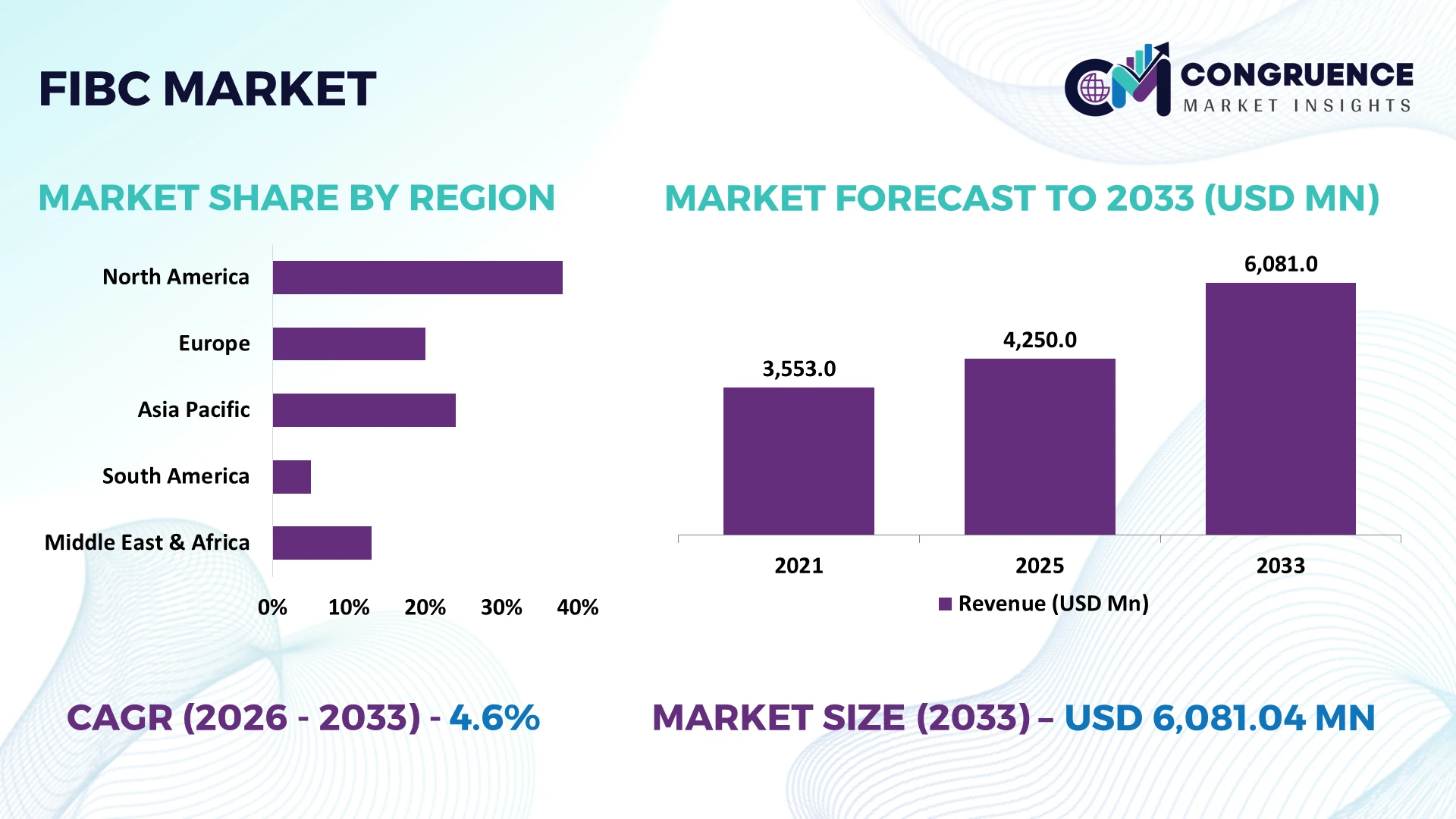
The Global FIBC Market was valued at USD 4250 Million in 2025 and is anticipated to reach a value of USD 6081.04 Million by 2033 expanding at a CAGR of 4.58% between 2026 and 2033. Growth is being driven by rising bulk material handling requirements across chemicals, food processing, agriculture, mining, and construction, supported by automation-ready packaging and higher adoption of recyclable woven polypropylene solutions.
India remains the dominant manufacturing hub, accounting for approximately 32% of global FIBC production capacity, supported by strong exports, expanding petrochemical feedstock availability, and advanced weaving infrastructure. Compared with China, India's export-oriented production benefits from competitive manufacturing costs, while European buyers increasingly diversify sourcing following Red Sea shipping disruptions. More than 45% of large-scale manufacturers now utilize automated cutting, stitching, and quality inspection systems, improving consistency and production efficiency.
Strategic sourcing diversification and investment in automated, compliant manufacturing facilities are becoming decisive competitive advantages for global FIBC suppliers.
Market Size & Growth: USD 4250 Million in 2025, reaching USD 6081.04 Million by 2033 at 4.58% CAGR, supported by automated packaging lines and resilient industrial supply chains.
Top Growth Drivers: Chemical packaging demand +8%, agricultural bulk exports +6%, mining material movement +5%, strengthening global consumption.
Short-Term Forecast: By 2027, automated bag manufacturing reduces production waste by nearly 12% while improving line efficiency by approximately 15%.
Emerging Technologies: AI-powered inspection, robotic stitching, and advanced recyclable polypropylene materials improve defect detection by over 20% and enhance product consistency.
Regional Leaders: Asia Pacific exceeds USD 2600 Million, Europe approaches USD 1500 Million, and North America surpasses USD 1100 Million, with stronger adoption of sustainable industrial packaging.
Consumer/End-User Trends: More than 55% of industrial buyers prioritize reusable and recyclable FIBC solutions to meet procurement and sustainability objectives.
Pilot/Case Example: In 2026, an automated packaging deployment improved production throughput by 18% while reducing quality defects by 14%.
Competitive Landscape: Leading manufacturers collectively control roughly 28% of the global market, with Berry Global, Conitex Sonoco, LC Packaging, Rishi FIBC Solutions, and Greif maintaining broad international presence.
Regulatory & ESG Impact: Recycled polymer integration increases by approximately 20% as manufacturers align with stricter packaging sustainability requirements across export markets.
Investment & Funding: More than USD 350 Million supports capacity expansion, automation upgrades, and strategic partnerships amid continuing regional supply chain realignment.
Innovation & Future Outlook: Smart traceability, lightweight high-strength fabrics, and digital quality monitoring accelerate the industry's transition toward advanced, high-performance bulk packaging.
Increasing demand for efficient bulk logistics across agriculture, chemicals, pharmaceuticals, and food processing continues to reshape the FIBC Market. Manufacturers are introducing lightweight, high-strength woven designs, AI-enabled quality inspection, and recyclable material innovations that improve operational performance. Around 20% more producers are integrating digital production monitoring, while evolving export compliance and supply-chain resilience strategies reinforce long-term competitiveness, setting the stage for broader strategic market evaluation.
The FIBC Market has become strategically important as manufacturers and industrial buyers prioritize resilient bulk packaging networks, automated material handling, and diversified sourcing strategies. Supply-chain restructuring following logistics disruptions has accelerated procurement shifts toward certified, high-capacity manufacturing hubs, while stricter packaging compliance is encouraging investment in traceable and recyclable bulk containers. Companies serving chemicals, fertilizers, food ingredients, and minerals increasingly view advanced FIBC solutions as a competitive asset that improves operational continuity and export reliability.
Modern automated weaving and AI-enabled quality inspection systems deliver approximately 18% higher production efficiency and reduce inspection defects by nearly 22% compared with conventional manual production methods. India continues to lead export-oriented manufacturing through integrated production clusters, while Germany focuses on premium technical specifications and sustainability-driven product innovation for industrial applications. Over the next two to three years, automated production is expected to exceed 50% adoption among large-scale manufacturers, supporting shorter lead times and more consistent product quality.
A leading deployment trend involves integrating digital production monitoring with automated testing to improve traceability and reduce material waste across export operations. Manufacturers are expanding certified production capacity, strengthening long-term customer partnerships, and investing in recyclable polypropylene technologies. Businesses that combine operational automation, diversified sourcing, and compliance-focused product development will strengthen competitive positioning and secure higher-value industrial contracts.
Growing industrial exports and automated material handling requirements continue to strengthen demand for high-performance FIBC solutions. Nearly 48% of bulk chemical and agricultural exporters now prioritize standardized industrial packaging that supports automated filling and unloading systems, while automated manufacturing improves production throughput by approximately 16%. India's expanding woven polypropylene manufacturing base and export infrastructure provide significant operational advantages for global buyers seeking supply diversification. In response, manufacturers are expanding production lines, investing in automated cutting and stitching equipment, and forming long-term partnerships with chemical, mining, and food processing companies. The combination of export-oriented manufacturing, automation, and certified quality systems enables suppliers to improve delivery reliability while strengthening their position in global industrial packaging networks.
Volatility in polypropylene resin pricing remains a structural constraint for FIBC manufacturers, with raw materials representing nearly 60% of total production costs. Export-oriented producers also face approximately 10–15% higher compliance and testing expenses as packaging regulations become more stringent across international markets. Shipping disruptions through critical maritime corridors continue to increase delivery uncertainty and inventory management complexity. To reduce exposure, manufacturers are diversifying resin sourcing, negotiating long-term procurement contracts, and increasing localized production near key industrial customers. Companies that successfully balance procurement flexibility with regulatory compliance achieve stronger operational resilience and protect profitability despite ongoing cost fluctuations.
Digital manufacturing and sustainable packaging innovation are creating differentiated opportunities across the FIBC Market. AI-driven production analytics can reduce quality defects by around 20%, while lightweight fabric engineering lowers material consumption by approximately 12% without compromising load performance. India is expanding investment in automated woven packaging facilities, while Japan continues advancing high-performance polymer processing technologies for specialized industrial applications. Companies are accelerating research into recyclable polypropylene structures, digital traceability systems, and closed-loop material recovery programs to strengthen long-term customer relationships. Early investment in intelligent manufacturing ecosystems enables suppliers to improve production efficiency while addressing increasingly sophisticated procurement and sustainability requirements.
Maintaining uniform product quality across expanding manufacturing networks remains a critical execution challenge. More than 35% of industrial buyers require rigorous certification and batch-level traceability before approving large-volume procurement, while automated inspection systems can reduce quality deviations by nearly 18% when fully integrated. Manufacturers in India and other major production hubs must continually upgrade workforce capabilities, digital quality management platforms, and testing infrastructure to satisfy evolving customer specifications. Companies are responding through advanced operator training, integrated manufacturing execution systems, and strategic technology partnerships. Organizations that successfully standardize quality, digital traceability, and operational governance will achieve stronger competitiveness in increasingly demanding global industrial supply chains.
Automated Quality Inspection Expands AI-enabled vision systems and automated inspection platforms are becoming standard across large FIBC production facilities, reducing product defects by nearly 22% and improving inspection speed by approximately 30%. Labor shortages in India and rising export quality expectations are accelerating deployment, prompting manufacturers to scale smart production lines and integrate digital process monitoring for consistent compliance and lower rejection rates.
Recyclable Material Integration Accelerates Recyclable polypropylene content has increased by around 18%, while lightweight fabric engineering lowers raw material consumption by nearly 12% without compromising load performance. Tightening packaging sustainability requirements are encouraging suppliers to redesign product portfolios, expand recycling partnerships, and invest in advanced extrusion technologies that improve material efficiency and strengthen export competitiveness.
Regional Supply Chains Diversify Global buyers continue reducing sourcing concentration, with multi-country procurement strategies increasing by approximately 25% since recent logistics disruptions. India, Vietnam, and Türkiye are expanding certified production capacity to support diversified procurement models. Manufacturers are strengthening regional warehousing, establishing strategic customer agreements, and restructuring supply networks to improve delivery resilience and reduce operational disruption.
Customization for Industrial Applications Demand for application-specific FIBC designs has grown by nearly 20%, while customized liners and discharge systems improve filling efficiency by approximately 15% for chemical and food processing operations. Manufacturers are responding through modular product development, collaborative engineering partnerships, and flexible manufacturing systems, enabling faster product adaptation for specialized industrial handling requirements and higher-value customer contracts.
Circular FIBC remains the leading product category, accounting for approximately 38% of overall demand due to its cost-efficient manufacturing process, strong load-bearing capability, and suitability for automated filling systems. High-volume chemical, agricultural, and construction material handling continues to favor this design because it supports scalable production and consistent operational performance. U-Panel FIBC maintains strong demand for medium-capacity industrial applications, while Four-Panel FIBC offers improved dimensional stability for customers requiring enhanced stacking efficiency and transport optimization.
Baffle FIBC represents the fastest-growing segment, supported by approximately 14% higher warehouse space utilization through improved cube stability and reduced bulging during storage. Conductive FIBC is gaining strategic importance within hazardous chemical processing, where electrostatic protection is increasingly required under stricter industrial safety standards. Manufacturers are expanding specialized product portfolios, investing in advanced woven fabric technologies, and strengthening partnerships with industrial distributors to address application-specific requirements while improving operational flexibility and premium product positioning.
Chemicals represent the largest application segment, accounting for approximately 34% of total FIBC demand because bulk powders, polymers, fertilizers, and specialty chemicals require durable, contamination-resistant packaging for domestic distribution and exports. Automated filling systems and stricter handling requirements continue driving procurement of certified FIBC solutions. Food & Beverages follows as manufacturers increase hygienic packaging adoption, while Agriculture maintains consistent demand through seasonal crop movement and fertilizer distribution.
Pharmaceuticals are the fastest-growing application segment as higher standards for contamination control, traceability, and product integrity encourage specialized FIBC adoption. Around 21% more pharmaceutical bulk shipments now utilize advanced packaging with enhanced barrier protection and controlled handling features. Construction Materials continue benefiting from infrastructure expansion, particularly for cement and mineral transportation. Suppliers are expanding automated production, introducing application-specific designs, and strengthening partnerships with industrial processors to meet increasingly differentiated customer requirements and improve supply reliability.
The Chemical Industry remains the dominant end-user, representing approximately 36% of total FIBC consumption because continuous production environments require high-volume, certified bulk packaging with reliable mechanical performance and safe material handling. Large processing facilities increasingly integrate automated filling and unloading operations, improving packaging productivity by nearly 18%. Mining follows with strong demand for mineral concentrates and industrial powders, while Agriculture maintains stable purchasing through grain, seed, and fertilizer logistics.
The Pharmaceutical Industry is the fastest-growing end-user segment as stricter quality assurance, traceability, and contamination control standards reshape procurement priorities. Food Processing companies continue expanding adoption of food-grade FIBC designs to improve logistics efficiency, while Mining operators increasingly specify reinforced products for demanding operating environments. Manufacturers are responding through customized product engineering, strategic supply agreements, and industry-focused certification programs that strengthen customer retention and improve competitiveness across specialized industrial sectors.
Asia-Pacific accounted for the largest market share at 46% in 2025 however, Middle East & Africa is expected to register the fastest growth, expanding at a 5.8% CAGR between 2026 and 2033.
Advanced Industrial Packaging and Supply Chain Modernization
North America represents approximately 23% of global FIBC demand, supported by highly automated chemical processing, food manufacturing, mining, and construction industries. Industrial users increasingly prioritize certified bulk packaging compatible with automated filling and discharge systems, improving warehouse productivity and reducing handling time. More than 60% of large manufacturing facilities now integrate automated bulk material handling equipment with standardized FIBC solutions. Investment in domestic logistics infrastructure and warehouse modernization continues strengthening procurement of premium industrial packaging. Companies are expanding regional distribution centers, introducing customized product configurations, and strengthening long-term supply agreements to improve inventory reliability while reducing operational disruptions across industrial supply chains.
United States Market Outlook: The United States leads regional demand through its extensive chemical, food processing, and mining industries supported by advanced logistics infrastructure. Around 65% of industrial bulk packaging procurement is concentrated among large manufacturing enterprises that increasingly require traceable and automation-compatible FIBC products. Manufacturers continue investing in localized inventory networks, digital quality assurance, and customized industrial packaging solutions to improve supply continuity and operational efficiency.
Sustainability Standards Reshape Industrial Packaging
Europe accounts for approximately 22% of global FIBC consumption, driven by stringent packaging compliance, advanced manufacturing standards, and expanding circular economy initiatives. Industrial buyers increasingly specify recyclable polypropylene packaging and certified production processes to meet evolving sustainability objectives. Nearly 48% of procurement contracts now include environmental performance criteria alongside product quality requirements. Modernization of manufacturing operations and investment in recyclable packaging technologies continue improving production efficiency while strengthening export competitiveness. Companies increasingly collaborate with recycling specialists and material innovators to expand sustainable product portfolios and enhance compliance across industrial applications.
Germany Market Outlook: Germany remains the region's strategic industrial hub due to its strong chemical manufacturing base, engineering expertise, and advanced packaging technology adoption. More than 55% of large industrial producers utilize digitally monitored packaging quality systems that improve traceability and production consistency. Domestic manufacturers continue investing in recyclable material innovation and automated converting technologies to strengthen premium product positioning across European industrial markets.
Manufacturing Scale Drives Global Leadership
Asia-Pacific contributes approximately 46% of global FIBC demand and remains the world's largest manufacturing and export center for industrial bulk packaging. Strong production ecosystems, integrated polypropylene supply chains, and competitive manufacturing costs enable large-scale exports across chemicals, agriculture, food processing, and construction materials. Automated weaving and cutting technologies have improved manufacturing productivity by nearly 20% within leading production clusters. Export-oriented manufacturers continue expanding certified production capacity while strengthening quality management systems and digital manufacturing capabilities to satisfy increasingly demanding international procurement standards.
India Market Outlook: India serves as the world's leading FIBC manufacturing base with approximately 32% of global production capacity supported by integrated woven polypropylene infrastructure and export-focused industrial clusters. Continuous investment in automated production equipment, testing laboratories, and international certifications strengthens product quality and delivery performance. Manufacturers increasingly expand strategic partnerships with multinational chemical and agricultural companies while diversifying export markets to reinforce long-term supply resilience.
Agricultural Logistics Strengthen Packaging Demand
South America represents approximately 6% of global FIBC demand, supported primarily by agricultural exports, mining operations, and fertilizer distribution. Expanding grain handling infrastructure and mineral transportation continue increasing demand for durable bulk packaging capable of supporting long-distance logistics. Bulk agricultural exports have increased packaging utilization by nearly 14% across major producing countries. Manufacturers are improving regional distribution capabilities, expanding warehouse networks, and introducing application-specific products for mining and agribusiness customers. Infrastructure limitations remain a challenge, yet targeted investment continues improving operational efficiency and logistics reliability.
Brazil Market Outlook: Brazil dominates regional consumption through its extensive soybean, sugar, fertilizer, and mining industries. Large agricultural cooperatives increasingly standardize bulk packaging procurement to improve logistics efficiency and reduce product losses during export operations. Investments in inland logistics corridors and export terminals continue supporting wider adoption of high-strength FIBC solutions designed for large-volume commodity transportation.
Industrial Diversification and Infrastructure Investment
The Middle East & Africa is strengthening its position through industrial diversification, petrochemical expansion, mining development, and logistics infrastructure modernization. Industrial packaging demand is increasing as governments invest in manufacturing zones and export-oriented industrial corridors. More than 15% additional industrial warehousing capacity has been introduced across key logistics hubs over recent years, supporting higher bulk material movement. Manufacturers are establishing regional partnerships, expanding distribution facilities, and introducing internationally certified packaging solutions to support industrial modernization while improving supply chain efficiency.
Saudi Arabia Market Outlook: Saudi Arabia leads regional industrial demand through large petrochemical, construction, and mining investments aligned with national industrial diversification initiatives. Advanced logistics infrastructure and expanding industrial cities continue supporting wider deployment of certified FIBC products for bulk material transportation. Industrial operators increasingly prioritize durable, recyclable packaging solutions that improve operational efficiency while supporting export-oriented manufacturing and large-scale infrastructure projects.
The competitive landscape is led by Berry Global, Greif, LC Packaging, Conitex Sonoco, and Rishi FIBC Solutions, competing against specialized regional manufacturers on manufacturing scale, product quality, and customization capabilities. The top five companies collectively account for approximately 30% of global market activity, while regional suppliers compete aggressively through cost-efficient production and localized customer service. Competition increasingly centers on automated manufacturing, recyclable materials, and supply reliability, with automated production improving operational efficiency by nearly 18% and advanced quality inspection reducing defects by around 20%. Companies are expanding certified production facilities, strengthening distributor partnerships, pursuing vertical integration in polypropylene sourcing, and developing application-specific product portfolios. Supply-chain resilience and sustainability compliance have become decisive competitive differentiators as industrial buyers diversify procurement strategies. High certification requirements, capital-intensive automation, and strict export quality standards create significant entry barriers. Winning requires scalable manufacturing, consistent quality, rapid customization, diversified sourcing, and long-term industrial customer relationships.
Berry Global
Greif
LC Packaging
Conitex Sonoco
Rishi FIBC Solutions
BAG Corp
Halsted Corporation
Intertape Polymer Group
Emmbi Industries
Jumbo Bag Ltd.
Plastene India Limited
Bulk Lift International LLC
Langston Companies Inc.
Taihua Group
Advanced manufacturing technologies are reshaping FIBC production through automated weaving, robotic cutting, and AI-based visual inspection. Automated weaving lines improve production efficiency by approximately 18%, while AI inspection reduces quality defects by nearly 22% compared with manual inspection processes. Around 48% of large-scale manufacturers have integrated digital production monitoring to improve batch traceability, reduce material waste, and maintain export-grade consistency. These technologies strengthen operational reliability for chemical, agricultural, and food-grade packaging while lowering rework costs and improving delivery performance across global supply chains.
Emerging technologies focus on recyclable polypropylene formulations, digital product traceability, and intelligent manufacturing execution systems. Lightweight fabric engineering reduces polymer consumption by nearly 12% while maintaining equivalent load capacity, improving both sustainability and production economics. Digital QR-enabled traceability is now deployed by approximately 35% of export-oriented manufacturers, enabling faster compliance verification and inventory visibility. Compared with conventional manual production environments, smart manufacturing facilities deliver roughly 20% higher throughput with better process control, directly benefiting manufacturers serving high-volume industrial customers requiring certified packaging solutions.
Between 2026 and 2028, AI-driven predictive maintenance, digital twins, and closed-loop recycled polymer processing will become key competitive differentiators. Companies investing early in integrated automation, real-time quality analytics, and advanced material engineering will achieve shorter production cycles, stronger compliance performance, and greater resilience against supply-chain disruptions. Technology leadership is shifting competitive advantage from low-cost production toward intelligent, high-performance manufacturing ecosystems capable of delivering customized, traceable, and sustainable FIBC solutions at industrial scale.
September 2024 Berry Global announced a USD 45 million investment to expand FIBC manufacturing capacity in India, adding advanced weaving technology and automated quality-control systems to strengthen supply for industrial bulk packaging across Asian markets. Business impact: higher production capability and quality consistency.
November 2024 Berry Global and Amcor agreed to combine in an all-stock transaction, creating a larger global packaging platform with broader industrial packaging capabilities. Business impact: expanded global manufacturing footprint and stronger customer reach through portfolio integration. Source: Berry Global
February 2025 United Bags completed the acquisition of BAG Corp, expanding its industrial bulk packaging portfolio and strengthening distribution of SUPER SACK® products. Business impact: broader product offering and enhanced North American customer coverage.
July 2025 LC Packaging expanded its recyclable FIBC product range to support circular packaging initiatives, accelerating sustainable industrial packaging adoption. Business impact: stronger positioning in environmentally compliant procurement while advancing recyclable bulk packaging solutions.
The report provides comprehensive analysis across five product types, five application segments, and five major end-user industries, delivering detailed evaluation of manufacturing trends, technology adoption, competitive positioning, and regional demand patterns. It examines North America, Europe, Asia-Pacific, South America, and the Middle East & Africa, while assessing automation deployment, recyclable material integration, digital traceability, and evolving industrial packaging requirements. More than 45% of leading manufacturers are adopting automated production technologies, reflecting a measurable shift toward high-efficiency manufacturing.
The study supports strategic decision-making by evaluating production capabilities, supply-chain diversification, procurement trends, regulatory developments, and investment priorities between 2026 and 2033. It identifies emerging opportunities in sustainable packaging, application-specific FIBC solutions, intelligent manufacturing, and export-oriented production hubs while benchmarking leading companies, operational strategies, and deployment trends to guide expansion planning, competitive positioning, product innovation, and long-term market development.
| Report Attribute/Metric | Report Details |
|---|---|
Market Revenue in 2025 | USD 4250 Million |
Market Revenue in 2033 | USD 6081.04 Million |
CAGR (2026 - 2033) | 4.58% |
Base Year | 2025 |
Forecast Period | 2026 - 2033 |
Historic Period | 2021 - 2025 |
Segments Covered | By Type
By Application
By End-User
|
Key Report Deliverable | Revenue Forecast, Growth Trends, Market Dynamics, Segmental Overview, Regional and Country-wise Analysis, Competition Landscape |
Region Covered | North America, Europe, Asia-Pacific, South America, Middle East, Africa |
Key Players Analyzed | Berry Global, Greif, LC Packaging, Conitex Sonoco, Rishi FIBC Solutions, BAG Corp, Halsted Corporation, Intertape Polymer Group, Emmbi Industries, Jumbo Bag Ltd., Plastene India Limited, Bulk Lift International LLC, Langston Companies Inc., Taihua Group |
Customization & Pricing | Available on Request (10% Customization is Free) |




