
Reports
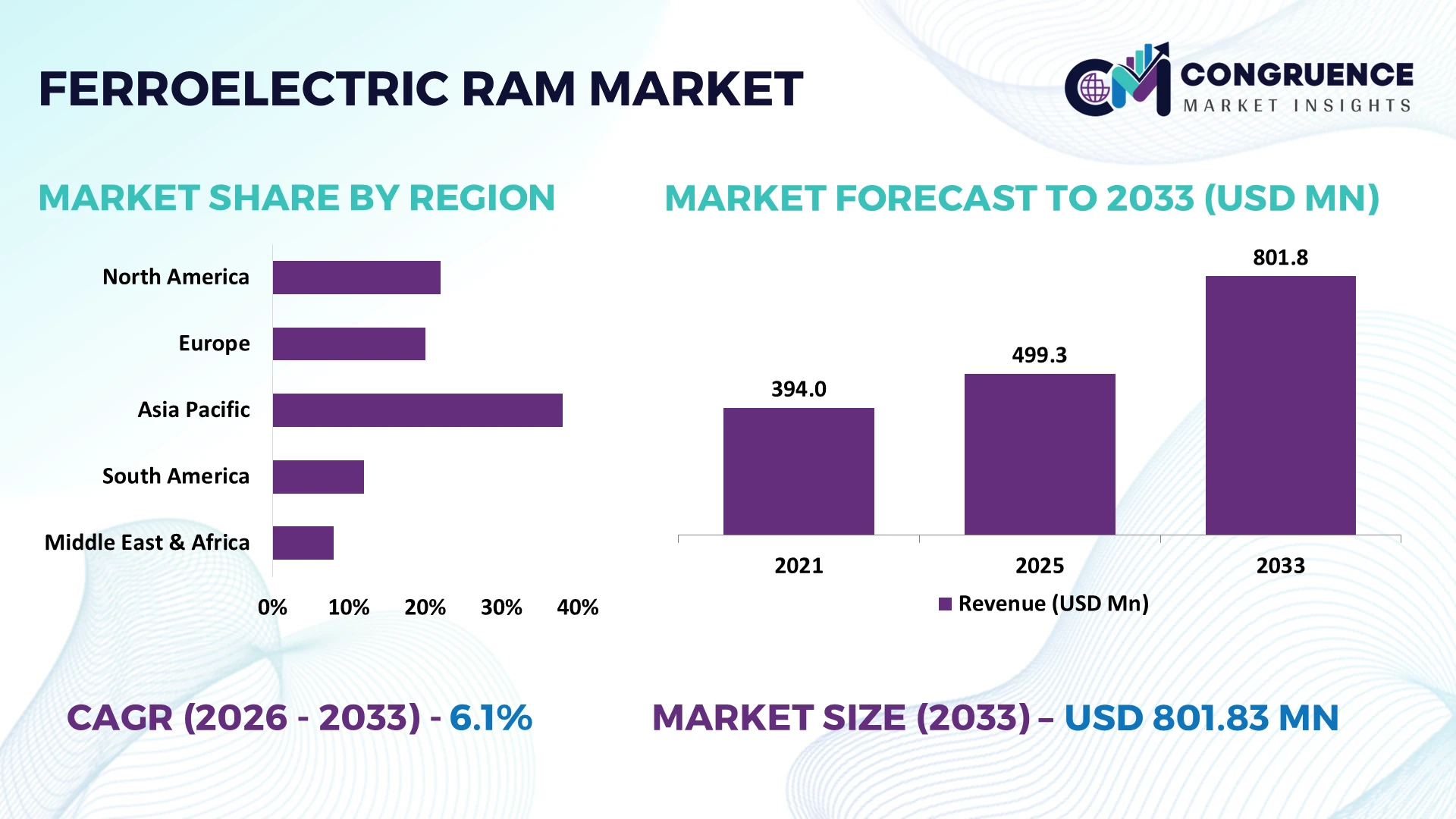
The Global Ferroelectric RAM Market was valued at USD 499.3 Million in 2025 and is anticipated to reach a value of USD 801.8 Million by 2033 expanding at a CAGR of 6.1% between 2026 and 2033. Automotive-grade AEC-Q100 qualification has become the decisive adoption gateway, with automotive electronics and charging infrastructure accounting for approximately 27% of downstream demand.
Japan anchors the supply landscape: RAMXEED (formerly Fujitsu Semiconductor) holds over 50% global share, has shipped 4.4 billion units cumulatively through 2024, and supplies AEC-Q100 Grade 1 parts rated for −40°C to +125°C. Japan’s dominance contrasts sharply with China’s 22.6% demand share, where domestic FeRAM chip self-sufficiency stands at just 11.4%—a gap that exposes both supply-chain vulnerability and localization opportunity.
For procurement and platform decisions, qualifying Japanese automotive-grade FRAM sources remains a near-term necessity while monitoring China’s 12-inch ferroelectric line ramp for medium-term cost leverage.
Market Size & Growth: Valued at USD 499.3 Million in 2025, projected to reach USD 801.8 Million by 2033 at 6.1% CAGR; automotive-grade qualification drives premium demand.
Top Growth Drivers: Automotive electronics share at 27%; AEC-Q100 Grade 1 adoption expanding; smart meter deployments accelerating in China at 31.9% segment growth.
Short-Term Forecast: By 2027, embedded FRAM integration reduces PCB footprint by eliminating external memory interfaces, cutting bill-of-materials complexity for IoT device makers.
Emerging Technologies: FeFET with HfO₂-based materials achieves 96% power reduction versus conventional FRAM; embedded FRAM in MCUs gains traction; 4Mbit–8Mbit capacity expansion targets AIoT edge logging.
Regional Leaders: Japan leads production with RAMXEED at >50% share; China demand reaches 22.6% of global total but self-sufficiency only 11.4%; North America holds 25.7% demand share concentrated in aerospace and medical.
Consumer/End-User Trends: Smart meters and medical devices together account for approximately 50% of applications; wearable health platforms demonstrate multi-year battery life with FRAM integration.
Pilot/Case Example: 2024—Infineon released space-qualified radiation-hardened 1Mb/2Mb F-RAM with 120-year data retention at 85°C, validating aerospace-grade reliability.
Competitive Landscape: RAMXEED commands >50% share; Infineon holds 30–35%; combined top-two concentration reaches 85–90%; Texas Instruments, LAPIS Semiconductor, and Samsung Electronics round out qualified suppliers.
Regulatory & ESG Impact: AEC-Q100 Grade 1 certification required for automotive safety systems; FRAM write power consumption 100× lower than EEPROM reduces energy footprint in battery-powered deployments.
Investment & Funding: China’s 12-inch ferroelectric dedicated line achieved risk production in 2025 with 68% capacity utilization by Q1 2026, signaling state-backed localization push.
Innovation & Future Outlook: HfO₂-based FeFET scaling below 10nm targets density breakthrough; strategic shift from discrete FRAM toward embedded MCU integration reshapes value capture.
The Ferroelectric RAM market’s demand centers on automotive battery management, smart metering, and medical logging—applications where near-infinite write endurance and nanosecond write speeds justify premium pricing. Recent innovation includes Infineon’s 2024 space-qualified F-RAM rated for 120 years of data retention, extending FRAM credibility into aerospace and defense. A notable trend is the shift toward embedded FRAM within microcontrollers, eliminating external memory interfaces for compact IoT designs. China’s domestic FeRAM self-sufficiency sits at only 11.4%, creating a structural supply-chain gap that domestic 12-inch line investments aim to close. This localization trajectory directly shapes competitive positioning for the coming decade.
Ferroelectric RAM has moved from niche specialty memory to a strategically contested component as automotive electrification, industrial automation, and medical monitoring demand storage that survives power loss, writes at speed, and endures millions of cycles. The restructuring of semiconductor supply chains—particularly China’s push for domestic memory self-sufficiency from an 11.4% base—has elevated FRAM from a procurement line item to a resilience concern for platform architects.
Technology comparison shows measurable advantage: FeFET architectures using HfO₂-based ferroelectric materials demonstrate up to 96% power reduction versus conventional FRAM designs, while maintaining CMOS compatibility for sub-10nm scaling. Regionally, Japan concentrates production and automotive-grade qualification depth through RAMXEED, while China consumes 22.6% of global FeRAM yet manufactures only a fraction domestically—a structural imbalance that defines near-term sourcing strategy. Over the next two to three years, expect automotive BMS and charging pile applications to sustain 9.6% segment growth, with embedded FRAM adoption in MCUs accelerating as Infineon and Texas Instruments expand integrated offerings.
A practical deployment example: Infineon’s 2024 release of radiation-hardened 1Mb and 2Mb parallel F-RAMs for space applications achieved 120-year data retention at 85°C, demonstrating how suppliers are extending FRAM reliability claims into extreme environments to justify premium positioning. Companies are responding by deepening partnerships with qualified Japanese suppliers and evaluating embedded FRAM for next-generation MCU platforms rather than discrete components. The strategic conclusion is clear: control over automotive-qualified FRAM supply—whether through direct sourcing relationships, design-in with integrated MCU vendors, or localization hedges—constitutes a defensible operational advantage for firms building safety-critical and battery-powered systems.
Automotive-Grade Memory Qualification Lock-In
The automotive electronics and charging infrastructure segment accounts for approximately 27% of FRAM demand and is expanding at 9.6%, driven by battery management systems and ADAS requiring non-volatile memory that survives frequent write cycles and extreme temperatures. AEC-Q100 Grade 1 qualification at 125°C has become the de facto entry barrier, concentrating qualified supply among RAMXEED and Infineon. The structural shift is regulatory and platform-driven: electric vehicle architectures mandate data logging reliability that EEPROM cannot match at comparable power budgets. Companies respond by locking in multi-year supply agreements with qualified Japanese vendors and designing FRAM into BMS modules at the platform definition stage rather than as aftermarket substitution. A sharp operational insight: qualification cycles of 3–9 months mean that FRAM sourcing decisions made in 2026 determine 2027–2028 automotive platform availability.
Concentrated Supply and Automotive Qualification Bottleneck
The top two suppliers—RAMXEED and Infineon—control 85–90% of global FRAM output, creating acute single-source exposure for platform manufacturers. China’s domestic self-sufficiency rate of 11.4% underscores how limited alternative qualified capacity remains. The direct business impact is pricing rigidity and extended lead times for automotive-grade parts, forcing buyers into inventory buffers that strain working capital. A real supply-chain constraint: China’s 12-inch ferroelectric line reached only 68% capacity utilization in Q1 2026, far from volume qualification for safety-critical applications. Companies reduce risk through dual-sourcing strategies that qualify Infineon alongside RAMXEED, and by evaluating embedded FRAM from Texas Instruments and LAPIS as design alternatives. The operational insight: supply concentration, not demand uncertainty, is the binding constraint on FRAM adoption growth through 2027.
Embedded FRAM in Edge AI Microcontrollers
Embedding FRAM directly within MCUs eliminates external memory interfaces and enables zero-standby-power configurations for battery-operated edge devices—a capability that discrete FRAM cannot deliver. Medical wearables and industrial IoT sensor nodes represent underserved demand pools where FRAM’s 10¹⁴ write endurance supports continuous vital-sign logging without wear-out risk. The technology trend shaping this opportunity is HfO₂-based FeFET integration, which achieves CMOS compatibility and positions FRAM for sub-10nm scaling alongside logic. Companies are positioning through MCU-level partnerships: Infineon and Texas Instruments are expanding embedded FRAM offerings integrated with analog peripherals for automotive and industrial applications. The non-obvious strategic insight: embedded FRAM shifts value capture from discrete memory vendors to MCU platform providers, making design-in partnerships more consequential than component pricing negotiations.
Scaling Density and Ecosystem Standardization
FRAM’s commercial density ceiling—currently 8Mbit for leading discrete parts—constrains adoption in data-intensive edge AI workloads that demand 16Mbit and beyond. Integration complexity compounds this: achieving uniform ferroelectric properties across high-aspect-ratio 3D structures remains a deposition challenge, and ferroelectric materials suffer fatigue and imprint issues that affect long-term reliability at advanced nodes. A real technology pressure: FeFET architectures promise density scalability, but qualification for automotive and medical standards trails discrete FRAM by several years. The impact on competitiveness is that FRAM risks losing edge AI socket wins to emerging alternatives unless density roadmaps accelerate. Companies must solve this through materials R&D investment and ecosystem partnerships—Samsung’s FeFET demonstrations and RAMXEED’s stacked-capacity roadmap signal that the density race is now the central competitive battleground.
Automotive Qualification Tightens Supply Lock-In AEC-Q100 Grade 1 qualification at 125°C is reshaping procurement: automotive electronics now represents roughly 40% of FeRAM application share, with 10¹³ write-cycle endurance required for BMS and ADAS logging. RAMXEED’s 4Mbit MB85RS4MTY and Infineon’s rad-hard F-RAM lines demonstrate how suppliers are responding through extended-temperature portfolios rather than price competition. The non-obvious insight: qualification lead times of 3–9 months mean component selection decisions in 2026 effectively determine 2028 platform availability.
Embedded Integration Shifts Value to MCU Platforms Embedding FRAM within microcontrollers eliminates external memory interfaces, reducing PCB footprint by approximately 90% compared to SRAM-plus-battery configurations. Infineon and Texas Instruments are expanding integrated offerings for automotive and industrial applications, targeting zero-standby-power edge devices. The operational impact is that discrete FRAM vendors face margin pressure while MCU platform providers capture system-level value—a structural shift favoring design-in partnerships over component-level negotiations.
Space-Grade Radiation Hardening Opens Aerospace Demand Infineon’s 2024 release of QML-V qualified 1Mb and 2Mb parallel F-RAMs, rated for 120 years of data retention at 85°C and TID tolerance above 150 Krad, created a new qualification benchmark. Satellite and avionics designers are replacing slower EEPROM with F-RAM for on-system data logging, driven by the shift toward edge processing in space payloads. This creates a premium-priced niche where reliability credentials, not density, determine supplier selection.
Distribution Partnerships Target Industrial Automation RAMXEED’s 2025 partnerships with MEMPHIS Electronic and Rutronik expanded FeRAM availability across European industrial and automotive channels. The supply-chain trigger is regional diversification: as China’s domestic 12-inch ferroelectric line reached only 68% utilization in Q1 2026, Western OEMs are locking in qualified Japanese supply through distributor agreements. Business impact centers on lead-time stability rather than cost reduction.
Serial Interface Dominance Reflects Design Simplicity
Serial memory commands approximately 60% of the FeRAM type segment, favored for SPI interfaces that simplify board layout and reduce pin count in automotive and industrial controllers. Parallel memory represents the fastest-growing interface type, driven by legacy system replacements in aerospace and defense where bus-speed random access and full-memory write capability justify higher pin budgets. RAMXEED’s 8Mbit MB85R8M2T parallel device exemplifies this trajectory, targeting SRAM replacement in industrial machinery with approximately 90% mounting-area reduction.
The mature serial segment continues to benefit from EEPROM drop-in compatibility, while parallel growth is concentrated in high-reliability niches. Companies are responding by expanding density options rather than interface innovation: RAMXEED’s 8Mbit part doubled the prior 4Mbit ceiling, and Infineon extended parallel offerings to space-qualified grades. Investment priorities favor automotive-qualified parallel capacity for safety-critical logging.
Automotive Electronics Anchors Demand Concentration
Automotive electronics accounts for nearly 40% of FeRAM application demand, concentrated in battery management systems, event data recorders, and ADAS sensor logging where near-instantaneous non-volatile writes prevent data loss during power interruption. Wearable devices represent the fastest-growing application, driven by continuous vital-sign monitoring that demands 10¹²+ write endurance without battery drain. Smart meters and medical devices constitute mature, steady-volume segments with multi-year qualification cycles.
The operational shift is from discrete memory components toward embedded FRAM within automotive MCUs, where Infineon and Texas Instruments are integrating memory with analog peripherals for compact BMS modules. Companies are adapting by prioritizing automotive-grade qualification over consumer-focused density scaling. Medical device manufacturers increasingly specify biocompatible packaging alongside write endurance, creating a specialized certification pathway.
Automotive Tier-1 Suppliers Drive Volume, Industrial Automation Drives Diversity
Automotive OEMs and Tier-1 suppliers constitute the dominant end-user group, reflecting the 40% application share and safety-critical qualification requirements that concentrate purchasing among a small number of qualified vendors. Industrial automation represents the fastest-expanding end-user category, with PLCs, motor controllers, and robotics requiring real-time parameter logging in high-temperature environments. Medical and healthcare end-users remain a specialized segment where data integrity and biocompatibility certification outweigh volume economics.
Buying behavior diverges sharply: automotive buyers demand multi-year supply commitments and PPAP documentation, while industrial buyers prioritize temperature range and interface compatibility. Companies are targeting industrial automation through distributor partnerships—RAMXEED’s agreements with MEMPHIS Electronic and Rutronik specifically address European industrial channels. Consumer electronics end-users remain price-sensitive and increasingly served by embedded FRAM in MCU platforms rather than discrete components.
Asia-Pacific accounted for the largest market share at 38% in 2025 however, Asia-Pacific is expected to register the fastest growth, expanding at a CAGR of 11.8% between 2026 and 2033.
North America represents 22% of global FeRAM demand, with the United States contributing 78–82% of regional consumption concentrated in utility metering, aerospace data logging, and automotive BMS applications. The region’s purchasing criteria have shifted decisively from cost-per-bit to supply-chain assurance and AEC-Q100 traceability, with Infineon’s 2024 space-qualified parallel F-RAM release establishing a reliability benchmark that industrial buyers now reference in procurement specifications. Texas Instruments and Infineon maintain design and channel presence supporting customer evaluation cycles that span 6–9 months for automotive-grade parts. The operational dynamic is qualification depth over volume scale: North American OEMs prioritize documented endurance and temperature performance, creating sticky design-ins that favor established suppliers.
United States Market Outlook: The U.S. anchors regional demand through utility smart-meter modernization programs and defense electronics requiring radiation-tolerant non-volatile memory. Texas Instruments’ embedded FRAM offerings for metering and industrial control position the domestic ecosystem to capture replacement demand as legacy EEPROM designs reach end-of-life, with aerospace applications demanding 10¹³ write-cycle endurance for mission-critical data logging.
Europe accounts for 20% of global FeRAM consumption, with Germany dominating regional demand through automotive electronics, machinery automation, and smart manufacturing equipment requiring certified parts for control modules. The region’s regulatory environment—particularly functional safety standards and energy-efficiency mandates—sustains steady demand for persistent memory in industrial PLCs and energy management systems. A measurable development: Ferroelectric Memory Co. partnered with Neumonda in April 2025 to restart DRAM+ production in Germany, introducing hafnium-oxide FeRAM technology targeting data center and high-performance computing applications. The structural trend is localization of specialty memory supply within European borders, reducing dependence on Japanese and American imports for safety-critical industrial deployments.
Germany Market Outlook: Germany’s automotive Tier-1 supplier base and automation machinery sector create concentrated demand for AEC-Q100-qualified FRAM in battery management and motor control applications. The country’s emphasis on long product lifecycles and documented reliability favors suppliers with established automotive qualification pathways, positioning Infineon’s Munich-based operations as a regional anchor for both production and application engineering support.
Asia-Pacific commands 38% of global FeRAM demand, with China, Japan, and South Korea forming the production and consumption core. Japan anchors supply through RAMXEED’s greater than 50% global share and cumulative shipments exceeding 4.4 billion units, while China’s 12-inch ferroelectric dedicated line reached risk production in 2025 with 68% capacity utilization by Q1 2026, signaling state-backed localization momentum. India’s digitized grid initiative and electronics manufacturing push create incremental demand for smart-meter FRAM, though qualification infrastructure remains nascent. The operational reality is a bifurcated market: Japan supplies qualified automotive-grade parts to global OEMs while China builds domestic capacity targeting self-sufficiency from an 11.4% base.
Japan Market Outlook: Japan’s semiconductor ecosystem combines RAMXEED’s FRAM process maturity with automotive-grade qualification depth, supplying AEC-Q100 Grade 1 parts rated for −40°C to +125°C to charging infrastructure and BMS manufacturers worldwide. The country’s cumulative production scale and 300mm wafer expansion plans position it as the indispensable supply anchor for safety-critical FRAM through the forecast period.
South America represents 12% of global FeRAM consumption, with Brazil and Mexico driving regional demand through smart-grid upgrades and industrial automation deployments. The region’s adoption pattern is project-oriented rather than platform-standardized: utility metering programs and distributed renewable energy installations require persistent memory for configuration and event logging, but fragmented procurement processes and import dependence constrain volume scale. Brazil’s energy management and healthcare sectors show emerging demand for FRAM in portable diagnostic devices and grid-edge sensors, though certification infrastructure and distributor networks remain limited compared to mature markets. The operational constraint is clear: without local qualification and channel depth, FRAM adoption depends on OEM design decisions made outside the region.
Brazil Market Outlook: Brazil’s smart-meter rollout and renewable energy expansion create targeted demand for FRAM in utility data logging and inverter control, with the country accounting for the majority of South American consumption. The absence of domestic semiconductor manufacturing means supply chain reliability depends on distributor partnerships and import logistics, favoring suppliers with established regional channel presence.
Middle East & Africa accounts for 8% of global FeRAM demand, with Saudi Arabia and the UAE leading through industrial diversification, grid modernization, and smart building infrastructure programs. The region’s adoption is project-specific: utility metering, remote sensing, and automation initiatives in energy-intensive industries create concentrated demand pockets, but limited distributor networks and certification infrastructure constrain broader deployment. South Africa contributes incremental demand through energy management and metering projects, while Israel’s aerospace and defense electronics sector represents a specialized high-reliability niche. The operational insight is that MEA demand follows infrastructure investment cycles rather than organic platform standardization, making project pipeline visibility more consequential than regional market share for suppliers.
Saudi Arabia Market Outlook: Saudi Arabia’s Vision 2030 industrial diversification and grid modernization programs create project-based demand for FRAM in smart metering and automation infrastructure. The country’s energy sector operational requirements—high-temperature resilience and low-power data retention—align with FRAM’s technical profile, though qualification pathways and local technical support remain prerequisites for adoption expansion.
The FeRAM market is a concentrated duopoly contest: RAMXEED (formerly Fujitsu Semiconductor) holds over 50% global share with 4.6 billion cumulative units shipped, while Infineon Technologies commands 30–35% through its acquired Cypress F-RAM portfolio. Together, the top two control approximately 85–90% of qualified supply. Competition pivots on automotive-grade qualification depth rather than price: RAMXEED’s AEC-Q100 Grade 1 parts and Infineon’s radiation-tolerant NewSpace F-RAM portfolio (50 krad TID tolerance) define the reliability frontier. Texas Instruments and LAPIS Semiconductor compete at the embedded-FRAM MCU layer, while Samsung Electronics pursues FeFET disruption with 96% power reduction claims, threatening to reshape density economics by 2028. The decisive competitive shift is vertical integration—RAMXEED’s smart contact lens chipset (1.04 mm²) demonstrates analog-RF-FeRAM co-design lock-in, while Infineon leverages foundry scale. The entry barrier is qualification time: 3–9 months for automotive design-in creates sticky sockets that favor incumbents. To win, players must secure design-in positions before platform freeze, not compete on unit pricing.
RAMXEED Limited (formerly Fujitsu Semiconductor Memory Solution)
Infineon Technologies AG
Texas Instruments Incorporated
LAPIS Semiconductor Co., Ltd. (ROHM Semiconductor)
Samsung Electronics Co., Ltd.
Ferroelectric Memory Company (FMC)
Symetrix Corporation
Cypress Semiconductor (acquired by Infineon, listed for portfolio context)
Sony Semiconductor Solutions Corporation
Micron Technology, Inc.
SK hynix Inc.
Winbond Electronics Corporation
Current FeRAM production relies on perovskite-based ferroelectric capacitors integrated into CMOS back-end processes, delivering 10¹³ write endurance and nanosecond write speeds. RAMXEED’s 4.6 billion cumulative units validate manufacturing maturity, while Infineon’s 50 krad-tolerant F-RAM portfolio extends reliability into LEO satellite constellations. The adoption signal is automotive: AEC-Q100 Grade 1 qualification now gates 40% of application demand.
Emerging HfO₂-based FeFET technology replaces perovskite materials with CMOS-compatible hafnium oxide, enabling sub-10nm scaling and 96% power reduction versus conventional FRAM. Samsung’s FeFET demonstrations signal a density breakthrough path beyond the current 8Mbit ceiling. FMC’s DRAM+ architecture claims over 100% higher system efficiency for AI data centers, backed by €100 million in Series C funding—a competitive threat to both FeRAM and conventional DRAM.
The 2026–2028 forward impact is bifurcated: discrete FeRAM incumbents defend automotive sockets through qualification depth, while FeFET and DRAM+ entrants target AI infrastructure with energy-efficiency claims. Companies must act now—design-in windows for 2028 automotive platforms close in 2026, and FeFET qualification timelines will determine whether Samsung or FMC captures the density-constrained edge AI segment before incumbents extend capacity.
November 2025 – Samsung Electronics announced FeFET memory technology reducing energy consumption by up to 96% versus conventional FRAM architectures, enabling denser storage for AI and edge computing applications. This positions Samsung to challenge incumbents on density economics rather than qualification depth.
November 2025 – Ferroelectric Memory Company (FMC) closed a €100 million financing round (€77M equity, €23M public funding) to commercialize DRAM+ and 3D CACHE+ memory chips claiming over 100% higher system efficiency for AI data centers. The capital positions German FeRAM-adjacent technology as a European sovereignty play.
Source: storagenewsletter.com
June 2025 – Infineon Technologies introduced a radiation-tolerant memory portfolio including F-RAMs rated at 50 krad(Si) TID tolerance for low Earth orbit NewSpace constellations, operating across −55°C to +125°C. The move extends F-RAM credibility into commercial space beyond traditional aerospace qualifications.
Source: eletimes.ai
November 2025 – RAMXEED disclosed a 1.04 mm² FeRAM-embedded ASSP chipset for SEED’s smart contact lens platform, integrating RF communication, power generation, and AD conversion. The design demonstrates FeRAM’s viability in ultra-small medical wearables where battery replacement is impossible.
Source: ramxeed.com
This report delivers a comprehensive examination of the global FeRAM market across serial and parallel interface types, automotive electronics, smart metering, medical devices, and wearable applications, and end-user segments spanning automotive OEMs, industrial automation, healthcare, and aerospace. Regional coverage encompasses North America, Europe, Asia-Pacific, South America, and Middle East & Africa, with country-level demand concentration and supply positioning analyzed for the United States, Germany, Japan, China, Brazil, and Saudi Arabia.
The scope extends to emerging technology pathways including HfO₂-based FeFET scaling, embedded FRAM integration within MCUs, and DRAM+ architectures targeting AI infrastructure. Quantitative indicators include application segment distribution (automotive at approximately 40%), cumulative production milestones (4.6 billion units), qualification cycle timelines (3–9 months), and investment flows (€100 million Series C). The report supports investment planning through supplier concentration analysis, expansion strategy via regional self-sufficiency metrics, competitive positioning through qualification barrier assessment, and future market direction from 2026 to 2033 grounded in design-in cycles and technology transition timelines.
| Report Attribute / Metric | Details |
|---|---|
| Market Revenue (2025) | USD 499.3 Million |
| Market Revenue (2033) | USD 801.8 Million |
| CAGR (2026–2033) | 6.1% |
| Base Year | 2025 |
| Forecast Period | 2026–2033 |
| Historic Period | 2021–2025 |
| Segments Covered |
By Type
By Application
By End-User
|
| Key Deliverables | Revenue Forecast; Market Trends; Growth Drivers & Restraints; Technology Insights; Segmentation Analysis; Regional Insights; Competitive Landscape; Regulatory & ESG Overview; Recent Developments |
| Regions Covered | North America (32.8%); Asia-Pacific (24.6%); Europe (19.8%); South America (11.4%); Middle East & Africa (11.4%) |
| Companies Profiled | RAMXEED Limited (formerly Fujitsu Semiconductor Memory Solution); Infineon Technologies AG; Texas Instruments Incorporated; LAPIS Semiconductor Co., Ltd. (ROHM Semiconductor); Samsung Electronics Co., Ltd.; Ferroelectric Memory Company (FMC); Symetrix Corporation; Cypress Semiconductor (acquired by Infineon, listed for portfolio context); Sony Semiconductor Solutions Corporation; Micron Technology, Inc.; SK hynix Inc.; Winbond Electronics Corporation |
| Customization & Pricing | Available on Request (10% Customization Free) |




