Global Feminine Hygiene Wash Market Report Overview
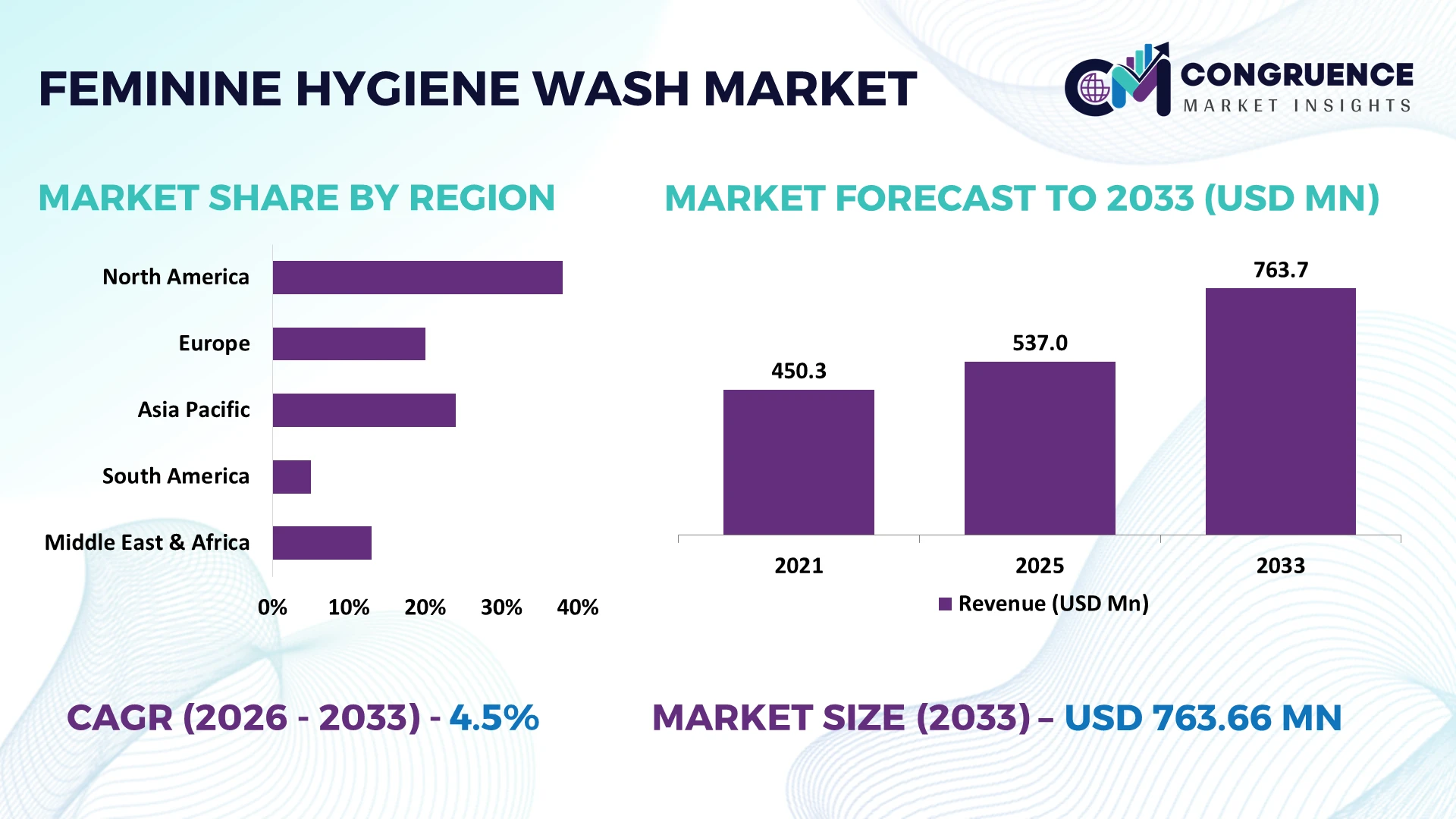
The Global Feminine Hygiene Wash Market was valued at USD 537 Million in 2025 and is anticipated to reach a value of USD 763.66 Million by 2033 expanding at a CAGR of 4.5% between 2026 and 2033. Growth is driven by expanding pharmacy distribution, adoption of pH-balanced intimate cleansing formulations, and rising availability of dermatologically tested, fragrance-free feminine hygiene products.
India represents a strategically important market for feminine hygiene wash manufacturers, supported by its expanding personal care manufacturing ecosystem, pharmaceutical distribution infrastructure, and digital retail penetration. The country's 18% GST rate on several personal cleansing preparations influences product pricing, while India's 2025 e-commerce landscape increasingly supports direct-to-consumer intimate care brands. Compared with the United States, where established pharmacy chains support mature intimate care categories, India offers substantial opportunities for first-time category adoption. Domestic contract manufacturers and ingredient suppliers provide additional advantages in localized product development.
Strategic implication: Manufacturers prioritizing affordable, clinically evaluated formulations and omnichannel distribution can strengthen penetration across India's expanding feminine intimate hygiene category.
Key Highlights of the Global Feminine Hygiene Wash Market
-
Market Size & Growth: USD 537 million in 2025, reaching USD 763.66 million by 2033 at 4.5% CAGR, supported by pH-balanced cleansing innovations and expanding pharmacy distribution.
-
Top Growth Drivers: Three priorities dominate product positioning: acidic pH compatibility around 3.8–4.5, fragrance-free formulations, and wider digital retail access.
-
Short-Term Forecast: By 2028, the market's implied value reaches approximately USD 613 million, making pharmacy penetration and repeat-purchase conversion critical commercial KPIs.
-
Emerging Technologies: Three formulation advances include microbiome-conscious cleansing systems, prebiotic ingredients, and automated pH monitoring during production.
-
Regional Leaders: North America, Europe, and Asia-Pacific represent three priority markets, differentiated by established retail networks, ingredient scrutiny, and expanding online adoption; regional revenue forecasts remain unestablished.
-
Consumer/End-User Trends: Daily-use products increasingly emphasize compatibility with the naturally acidic vaginal environment, typically pH 3.8–4.5, alongside sensitive-skin positioning.
-
Pilot/Case Example: A 2024 pharmaceutical formulation review documented nine marketed herbal intimate washes, demonstrating commercial application of botanical ingredients across multiple brands.
-
Competitive Landscape: Summer's Eve, Lactacyd, Sebamed, Oriflame, and VWash compete through differentiated formulations, clinical positioning, and distribution reach; verified individual market shares are unavailable.
-
Regulatory & ESG Impact: India's September 2025 GST reforms changed tax classifications across personal care categories, reinforcing the importance of product-specific compliance and pricing controls.
-
Investment & Funding: Category-specific disclosed investment totals remain unavailable; commercial expansion centers on formulation development, manufacturing partnerships, and direct-to-consumer distribution.
-
Innovation & Future Outlook: The projected USD 226.66 million market expansion through 2033 strengthens the commercial case for microbiome-conscious formulations and differentiated sensitive-skin products.
The feminine hygiene wash market increasingly concentrates on external intimate cleansing products designed for sensitive skin, including fragrance-free washes, lactic-acid formulations, and botanical cleansers. Product differentiation centers on maintaining appropriate acidity, with the vaginal environment typically exhibiting a pH of approximately 3.8–4.5, although external skin requirements differ. Emerging innovations include prebiotic ingredients, gentler surfactant combinations, and packaging designed for controlled dispensing. India's evolving GST framework and growing online personal care distribution reinforce the importance of localized pricing and formulation compliance. These developments establish the foundation for evaluating strategic market opportunities.
What Is the Strategic Relevance and Future Pathways of the Feminine Hygiene Wash Market?
The feminine hygiene wash market is becoming strategically important as intimate care manufacturers shift from conventional cleansing products toward dermatologically evaluated, microbiome-conscious formulations. Competitive differentiation increasingly depends on ingredient transparency, sensitive-skin compatibility, and pharmacy credibility rather than fragrance-led positioning. The European Union's Regulation (EU) 2023/1545 expands fragrance allergen disclosure requirements, with new-product compliance beginning in July 2026. This regulatory shift encourages manufacturers to reformulate products, strengthen ingredient traceability, and invest in standardized safety documentation across international distribution networks.
Technology modernization is reshaping formulation development and manufacturing economics. Automated filling lines operating at 60 bottles per minute can theoretically process 28,800 units during an eight-hour shift, compared with 14,400 units at 30 bottles per minute, representing a 100% throughput advantage. The United States emphasizes clinically positioned products and established pharmacy distribution, while India prioritizes affordable formulations, smaller packaging formats, and online accessibility. Manufacturers increasingly combine contract manufacturing with digital storefronts to reduce physical retail entry costs.
Between 2026 and 2028, strategic investment will concentrate on automated quality control, validated mild-surfactant systems, and improved packaging functionality. A practical deployment involves integrating inline pH monitoring with batch traceability to strengthen consistency across production sites. Companies combining formulation expertise, regulatory readiness, and localized distribution will establish stronger competitive positions.
Feminine Hygiene Wash Market Dynamics
DRIVER:
Increasing Preference for pH-Balanced Intimate Cleansing Products
Growing awareness of intimate skin sensitivity is encouraging manufacturers to develop mild, externally applied feminine hygiene washes using carefully selected surfactants and acidity regulators. The vaginal environment typically maintains a pH of 3.8–4.5 during reproductive years, although external vulvar skin has different physiological requirements. Formulators increasingly prioritize products designed around appropriate skin compatibility rather than aggressive cleansing. India's approximately 65% rural population in the 2011 Census illustrates the importance of affordability and accessible distribution beyond metropolitan retail networks. Manufacturers are expanding pharmacy partnerships, introducing smaller pack sizes, and developing fragrance-free alternatives. The strategic advantage lies in combining credible safety positioning with accessible pricing while avoiding unsupported claims about vaginal microbiome modification.
RESTRAINT:
Ingredient Compliance Costs and Formulation Sensitivity
Regulatory compliance and specialty ingredient procurement create immediate cost pressures for feminine hygiene wash manufacturers. European fragrance allergen rules require additional labeling when specified allergens exceed 0.001% in leave-on products or 0.01% in rinse-off cosmetics. These thresholds increase documentation requirements for botanical extracts, fragrance blends, and multifunctional ingredients. In India, the standard GST rate of 18% applies to many cosmetic cleansing preparations, affecting retail price architecture where applicable. Imported specialty surfactants and preservatives introduce additional foreign-exchange exposure, particularly for smaller contract manufacturers. Companies are responding through domestic ingredient qualification, simplified fragrance systems, and longer-term supplier agreements. Reducing formulation complexity without compromising product stability provides a measurable operational advantage.
OPPORTUNITY:
Microbiome-Conscious Innovation and Digital Product Distribution
Microbiome-conscious intimate cleansing presents an opportunity for manufacturers to differentiate products through validated mildness, appropriate acidity, and transparent ingredient selection. Formulation teams can target a 10–15% reduction in surfactant concentration during development, provided cleansing performance and safety remain acceptable; this is a design objective rather than an established industry improvement. India's digital commerce infrastructure supports direct customer education and subscription-based replenishment models. Manufacturers can also evaluate concentrated formulations designed to reduce packaging material by 15–20%, subject to stability and dispensing validation. Between 2026 and 2028, product development partnerships with dermatological laboratories and packaging specialists will strengthen premium positioning. The strongest opportunity lies in integrating clinically defensible product claims with lower-material packaging and recurring digital purchases.
CHALLENGE:
Clinical Validation and Consistent Product Performance at Scale
Maintaining reproducible product performance across manufacturing sites represents a long-term challenge for feminine hygiene wash producers. Formulations containing botanical extracts require careful management of microbial quality, preservative efficacy, and ingredient variability. Manufacturers targeting a 95% or higher first-pass batch acceptance rate must establish appropriate testing methods, process controls, and supplier specifications; this threshold represents an operational target, not a verified industry benchmark. Accelerated stability testing at 40°C and 75% relative humidity provides useful evidence about formulation robustness, although it does not replace real-time stability assessment. India's hot climatic conditions increase the importance of packaging compatibility and distribution-temperature validation. Companies must invest in analytical laboratories, standardized production procedures, and qualified manufacturing partners. Sustained competitiveness depends on demonstrating consistent product safety and quality beyond initial commercialization.
Feminine Hygiene Wash Market Latest Trends
-
Fragrance Disclosure Reshapes Product Portfolios: European Union fragrance allergen requirements are changing cosmetic labeling workflows, with disclosure thresholds of 0.01% for rinse-off products and 0.001% for leave-on formulations. New products face updated requirements from July 2026. Manufacturers are consolidating fragrance ingredients, revising packaging artwork, and coordinating regulatory reviews with contract formulators. Reducing ingredient complexity also simplifies procurement documentation and multilingual label management.
-
Precision Dispensing Gains Manufacturing Priority: Automated filling systems operating at 60 bottles per minute deliver twice the theoretical throughput of equipment processing 30 bottles per minute. Indian personal care manufacturers are integrating volumetric dosing, automated capping, and inline weight inspection into intimate wash production. These upgrades reduce manual handling and support consistent fill volumes across multiple packaging formats. Contract manufacturers benefit from faster product changeovers and improved capacity utilization.
-
Concentrated Packaging Changes Logistics Economics: Manufacturers are evaluating concentrated feminine hygiene formulations to reduce transportation weight and packaging consumption. A hypothetical 20% reduction in bottle material across 100,000 units saves the equivalent material used in 20,000 conventional bottles. Packaging suppliers are developing lightweight polyethylene containers and precision dispensing closures. The operational advantage extends beyond sustainability through improved warehouse density and lower material handling requirements.
-
Digital Traceability Strengthens Quality Oversight: Cosmetic producers are linking ingredient identification, batch records, and finished-product testing through electronic quality management systems. A facility manufacturing 50 batches monthly can establish 600 digitally traceable production records annually. Indian manufacturers supplying multiple retail brands increasingly prioritize standardized documentation and supplier verification. Digital workflows support faster investigation of quality deviations, more consistent audit preparation, and improved visibility across outsourced production networks.
Segmentation Analysis
By Type
pH-Balanced Washes Lead Formulation Preferences
pH-Balanced Washes represent the leading product category, although a defensible global market share percentage is not publicly established. Their competitive position reflects widespread positioning around mild cleansing and appropriate acidity for external intimate care. Manufacturers incorporate lactic acid, mild surfactant combinations, and controlled buffering systems to differentiate formulations. Soap-Free Washes compete through reduced reliance on traditional alkaline soap chemistry, while Fragrance-Free Washes address consumers seeking fewer potential irritants. The vaginal environment generally maintains a pH of approximately 3.8–4.5 during reproductive years, providing physiological context without establishing a universal target for vulvar cleansers.
Fragrance-Free Washes represent a strategically important emerging category as ingredient transparency becomes more prominent in purchasing decisions. Organic and Natural Washes appeal to botanical ingredient preferences, although natural origin does not establish superior safety. Medicated Washes occupy a more specialized position where particular active ingredients or therapeutic claims require appropriate regulatory treatment. Manufacturers are directing formulation resources toward preservative compatibility, validated mildness, and product differentiation rather than relying exclusively on fragrance-led marketing. This shift favors suppliers capable of supporting multiple product specifications through shared manufacturing infrastructure.
- In 2025, the European Commission's cosmetic regulatory framework remained relevant to intimate cleansing products, with expanded fragrance allergen labeling requirements approaching their July 2026 new-product deadline. These requirements reinforce the commercial importance of ingredient transparency and formulation documentation.
By Application
Daily Intimate Hygiene Leads Consumer Usage
Daily Intimate Hygiene represents the broadest commercial application for feminine hygiene wash products, supported by routine personal care purchasing and established retail availability. Its precise global market share remains unverified. Manufacturers compete through convenient packaging, mild cleansing formulations, and repeat-purchase positioning. Odor Control products address freshness preferences but require careful marketing to avoid implying that normal vaginal odor requires treatment. Menstrual Hygiene creates additional purchasing occasions, particularly among consumers seeking external cleansing products during menstruation. These applications differ in purchasing frequency, formulation expectations, and consumer education requirements.
Sensitive-Skin Care is emerging as an important differentiation area, supported by preference for fragrance-free products and avoidance of potentially irritating ingredients. Postpartum Intimate Care requires more specialized product evaluation because recovering tissue can be particularly sensitive. Manufacturers are adjusting product portfolios through simplified ingredient lists, gentle cleansing systems, and clearer external-use instructions. In India, pharmacy distribution and digital education provide opportunities to communicate appropriate product usage. Commercial success depends on aligning formulations with distinct consumer needs rather than promoting unnecessary cleansing frequency.
- The World Health Organization reported in June 2026 that approximately 2.1 billion women and adolescent girls menstruate globally, while around 500 million lack adequate menstrual health resources. These figures highlight hygiene access needs, not direct feminine wash adoption.
By End-User
Individual Consumers Dominate Purchasing Decisions
Individual Consumers constitute the principal purchasing group for feminine hygiene wash products because retail formulations are predominantly intended for personal use outside institutional settings. A reliable global percentage breakdown across the specified end-user categories is unavailable. Consumer purchasing behavior differs between established pharmacy markets and price-sensitive retail environments. In the United States, product selection increasingly emphasizes fragrance avoidance, ingredient disclosure, and dermatological compatibility. Indian manufacturers address accessibility through smaller packaging formats, pharmacy placement, and online product education. These distribution strategies help brands manage acquisition costs and build repeat-purchase relationships.
Pharmacies and Drugstores represent a strategically important commercial channel, although pharmacy retail purchases ultimately belong to individual consumers and should not be double-counted. Gynecology Clinics influence product evaluation through professional guidance, while Hospitals and Maternity Clinics prioritize appropriate hygiene protocols and patient safety rather than routine cosmetic product procurement. Manufacturers are strengthening pharmacist education, developing professionally reviewed product information, and expanding distribution agreements. The competitive distinction lies in building trusted retail access while maintaining appropriate boundaries between cosmetic cleansing and medical treatment.
- UNICEF's 2025 monitoring reported that basic hygiene service coverage reached 80% globally in 2024, compared with 66% in 2015. This infrastructure improvement supports broader hygiene accessibility but does not establish institutional purchasing shares for feminine hygiene washes.
Region-Wise Market Insights
North America accounted for the largest market share in 2025, however, Asia-Pacific is expected to register the fastest growth between 2026 and 2033.
North America Feminine Hygiene Wash Market
Established Pharmacy Networks Strengthen Premium Product Positioning
North America maintains a strong competitive position in the feminine hygiene wash market through established personal care brands, pharmacy distribution networks, and advanced cosmetic formulation capabilities. The United States anchors regional product development, supported by major retailers including CVS, Walgreens, Walmart, and Target. Manufacturers compete through dermatologist-tested formulations, sensitive-skin positioning, and convenient packaging formats. The US Modernization of Cosmetics Regulation Act strengthens requirements for facility registration, product listing, and safety substantiation, increasing the importance of documented manufacturing controls. Canada's bilingual labeling requirements add another operational consideration for cross-border distribution. Retailers increasingly evaluate ingredient transparency, packaging differentiation, and consumer education when selecting intimate care products. Established private-label manufacturing infrastructure allows brands to introduce specialized formulations without constructing dedicated production facilities, strengthening product development flexibility and shortening commercialization timelines.
United States Market Outlook: The United States benefits from extensive pharmacy infrastructure and established feminine care manufacturers, including Prestige Consumer Healthcare, which markets Summer's Eve. Its product portfolio spans multiple intimate cleansing formats, supporting differentiated retail positioning. Federal cosmetic facility registration and product listing requirements under MoCRA encourage manufacturers to strengthen documentation, supplier qualification, and regulatory oversight.
Europe Feminine Hygiene Wash Market
Regulatory Harmonization Accelerates Formulation and Packaging Modernization
Europe's feminine hygiene wash industry is shaped by stringent cosmetic safety requirements, established dermatological product development, and sophisticated pharmacy distribution. Germany, France, Italy, and the United Kingdom represent important commercial and formulation centers. European Union Regulation 2023/1545 expands fragrance allergen disclosure obligations, requiring manufacturers to review ingredient compositions and update packaging documentation. The regulation establishes a July 2026 deadline for placing newly compliant products on the market and a July 2028 deadline for making existing noncompliant products available. These requirements are accelerating fragrance portfolio rationalization and regulatory data integration. European manufacturers also face increasing packaging sustainability obligations, encouraging recyclable materials and improved dispensing systems. Companies with centralized regulatory teams and established testing infrastructure gain an operational advantage by managing product compliance across multiple national markets without duplicating formulation development.
Germany Market Outlook: Germany combines advanced cosmetic manufacturing expertise with extensive drugstore distribution through retailers such as dm and Rossmann. Beiersdorf's established dermatological research capabilities reinforce the country's technical expertise in sensitive-skin product development. Germany's participation in the European Union's 27-member regulatory framework supports standardized product safety documentation and cross-border commercialization.
Asia-Pacific Feminine Hygiene Wash Market
Localized Manufacturing and Digital Commerce Reshape Market Access
Asia-Pacific offers substantial expansion potential through domestic cosmetic manufacturing, expanding online retail networks, and differentiated consumer purchasing behavior. China, India, Japan, and South Korea provide distinct competitive advantages in production scale, formulation innovation, and digital commercialization. China's extensive personal care manufacturing ecosystem supports private-label production and rapid packaging customization. India's contract manufacturing networks enable emerging intimate care brands to develop accessible formulations without substantial manufacturing infrastructure investment. Japan and South Korea contribute advanced cosmetic ingredient technologies and sophisticated product testing capabilities. Regional manufacturers increasingly combine domestic ingredient sourcing with outsourced filling and packaging operations to improve production flexibility. Digital marketplaces also support product education and direct customer engagement, particularly for brands seeking alternatives to conventional pharmacy-led distribution. Competitive advantage increasingly depends on matching product specifications, affordability, and distribution methods to individual national markets.
India Market Outlook: India offers significant opportunities through domestic pharmaceutical manufacturing expertise, expanding beauty and personal care distribution, and digital retail infrastructure. The country's Unified Payments Interface processed more than 16 billion transactions in October 2024, demonstrating the scale of digital payment adoption. Manufacturers such as Piramal Pharma's consumer healthcare business compete through established intimate care brands and pharmacy relationships, while emerging brands emphasize specialized formulations.
South America Feminine Hygiene Wash Market
Domestic Cosmetic Manufacturing Supports Retail Market Diversification
South America's feminine hygiene wash market benefits from established beauty and personal care manufacturing capabilities, particularly in Brazil, Argentina, Colombia, and Chile. Brazil provides the strongest regional industrial foundation through domestic cosmetic production, extensive retail distribution, and established ingredient processing networks. Manufacturers increasingly use contract formulation and regional packaging suppliers to serve different consumer price categories. Brazil's National Health Surveillance Agency, ANVISA, regulates cosmetic product commercialization, making regulatory classification and labeling compliance essential for market entry. Argentina's currency volatility and import restrictions create additional procurement challenges for specialty cosmetic ingredients. Companies are responding through localized sourcing, flexible production arrangements, and differentiated retail packaging. E-commerce expansion also enables smaller intimate care brands to reach consumers without relying exclusively on supermarket shelf space. Efficient inventory management remains important where imported ingredients face longer replenishment cycles.
Brazil Market Outlook: Brazil benefits from a substantial domestic cosmetics industry supported by manufacturers such as Natura and established pharmaceutical retail networks. The Brazilian Association of the Personal Hygiene, Perfumery and Cosmetics Industry represents an industrial ecosystem covering thousands of companies. Local formulation expertise, tropical climate considerations, and extensive pharmacy distribution support differentiated intimate cleansing products.
Middle East & Africa Feminine Hygiene Wash Market
Retail Infrastructure Modernization Expands Specialized Hygiene Access
The Middle East & Africa feminine hygiene wash market is shaped by differences in retail infrastructure, consumer purchasing power, and cosmetic import requirements. Saudi Arabia and the United Arab Emirates support premium personal care distribution through modern pharmacies, organized supermarkets, and established international brand partnerships. South Africa offers a more diversified retail environment, combining pharmacy chains with domestic personal care manufacturing capabilities. The Saudi Food and Drug Authority oversees cosmetic product requirements, encouraging importers and distributors to maintain appropriate product documentation and ingredient compliance. In several African markets, fragmented distribution and limited access to specialized retail outlets constrain product availability outside major cities. Manufacturers are addressing these limitations through regional distribution agreements, affordable packaging configurations, and localized inventory management. Commercial success depends on balancing premium formulation positioning with reliable product availability and country-specific regulatory requirements.
Saudi Arabia Market Outlook: Saudi Arabia benefits from expanding organized retail infrastructure, established pharmaceutical distribution networks, and investment under Vision 2030. The Saudi Food and Drug Authority's eCosma notification system supports cosmetic product regulatory administration. Manufacturers entering the country prioritize compliant labeling, distributor partnerships, and formulations suited to local consumer preferences and climatic conditions.
Market Competition Landscape
The feminine hygiene wash market features competition between established intimate care specialists, dermatological skincare manufacturers, and emerging digital brands. Prestige Consumer Healthcare's Summer's Eve competes with Lactacyd, Sebamed, Vagisil, and VWash through formulation differentiation, pharmacy distribution, and consumer recognition. The combined global share of the five leading companies remains undisclosed, preventing a defensible concentration estimate. Competitive pricing reflects ingredient selection, packaging specifications, and retail margins. Fragrance allergen disclosure thresholds of 0.01% for rinse-off cosmetics and 0.001% for leave-on products influence formulation decisions. Automated filling systems offering 100% greater theoretical throughput than slower reference equipment provide manufacturing advantages. Companies are expanding fragrance-free portfolios, strengthening contract manufacturing partnerships, and investing in ingredient documentation. Regulatory scrutiny is shifting competition toward substantiated product claims and traceable manufacturing processes. Product safety validation, pharmacy access, and formulation consistency remain important entry barriers. Winning requires differentiated products, dependable supply, credible positioning, and disciplined retail execution across markets.
Companies Profiled in the Feminine Hygiene Wash Market Report
-
Prestige Consumer Healthcare Inc. (Summer's Eve)
-
Combe Incorporated (Vagisil)
-
Opella (Lactacyd)
-
Sebapharma GmbH & Co. KG (Sebamed)
-
Piramal Pharma Limited (i-feel)
-
Oriflame Cosmetics AG
-
Himalaya Wellness Company
-
Emami Limited (She Comfort)
-
Sirona Hygiene Private Limited
-
Unilever PLC (Lemisol)
-
Reckitt Benckiser Group PLC (Intima)
-
Beiersdorf AG
Technology Insights for the Feminine Hygiene Wash Market
Feminine hygiene wash manufacturing increasingly integrates mild surfactant chemistry, automated pH monitoring, and precision filling systems. Lactic acid buffering and amphoteric surfactants support formulation consistency, while inline sensors reduce dependence on periodic manual sampling. A production line operating at 60 bottles per minute delivers 100% higher theoretical throughput than a conventional 30 bottle system. Automated dosing also enables manufacturers to target filling deviations below 1%, subject to equipment calibration. Contract manufacturers benefit through consistent batch specifications, reduced handling, and faster packaging transitions across sensitive skin product portfolios.
Emerging technologies include microbiome conscious formulation screening, biodegradable surfactants, and digitally connected quality management systems. Laboratory testing evaluates cleansing performance, preservative efficacy, and irritation potential before commercialization. Manufacturers targeting 10–15% reductions in surfactant concentration must validate equivalent cleaning performance and product stability. Electronic batch records improve ingredient traceability and support regulatory inspections. Established pharmaceutical and dermatological brands gain competitive advantages through stronger analytical capabilities, while smaller companies increasingly access specialized testing through external laboratory partnerships.
Between 2026 and 2028, development priorities will shift toward predictive stability modeling, automated viscosity adjustment, and recyclable dispensing systems. Manufacturers integrating formulation analytics with production controls can reduce development iterations, improve process reproducibility, and accelerate compliant product launches across international markets.
Recent Developments in the Global Feminine Hygiene Wash Market
-
June 2025: O Positiv Health launched URO pH-Balanced Probiotic Wash, incorporating prebiotics, probiotics, and postbiotics into 1 dermatologist-tested cleanser. The innovation expanded microbiome-conscious intimate care positioning and differentiated the company's women's wellness portfolio through specialized cleansing technology. Source: prnewswire.com
-
April 2025: Maesa introduced Niches & Nooks through Target, launching 14 intimate wellness products priced at $13 each. The retail expansion established nationwide distribution for dermatologist-tested cleansing formulations, including fragrance-free options, strengthening accessibility and competitive positioning. Source: yahoo.com
-
May 2025: Pillbox Japan expanded Summer's Eve feminine wash packaging from 237 mL to 444 mL across 2 pump-bottle variants. The larger format improved dispensing convenience and supported longer replenishment intervals, strengthening product differentiation in Japanese pharmacies. Source: prtimes.jp
-
April 2025: INNERGARM introduced its medically approved INNERGAM MEDI cleansing gel through Olive Young's online platform in South Korea. The formulation combines 2 highlighted ingredients, lactic acid and sodium hyaluronate, supporting specialized product positioning and digital accessibility. Source: wettrust.com
Scope of the Feminine Hygiene Wash Market Report
The Feminine Hygiene Wash Market Report provides comprehensive analysis of industry developments between 2026 and 2033, covering five product types: pH-Balanced Washes, Soap-Free Washes, Fragrance-Free Washes, Organic and Natural Washes, and Medicated Washes. Application coverage includes Daily Intimate Hygiene, Odor Control, Sensitive-Skin Care, Menstrual Hygiene, and Postpartum Intimate Care. End-user analysis evaluates Individual Consumers, Hospitals and Maternity Clinics, Gynecology Clinics, and Pharmacies and Drugstores, identifying purchasing priorities and distribution dynamics.
Geographical coverage spans North America, Europe, Asia-Pacific, South America, and the Middle East & Africa, examining manufacturing capabilities, regulatory requirements, and commercial accessibility. Technology assessment addresses automated filling, microbiome-conscious formulations, ingredient traceability, and advanced packaging. Competitive analysis evaluates 12 influential manufacturers and brand operators, supporting investment planning, product portfolio optimization, market entry strategies, and long-term competitive positioning.
Feminine Hygiene Wash Market Report Summary
| Report Attribute/Metric | Report Details |
|---|
Market Revenue in 2025 | USD 537 Million |
Market Revenue in 2033 | USD 763.66 Million |
CAGR (2026 - 2033) | 4.5% |
Base Year | 2025 |
Forecast Period | 2026 - 2033 |
Historic Period | 2021 - 2025 |
Segments Covered | By TypeOrganic and Natural Washes
By ApplicationBy End-UserHospitals and Maternity Clinics Pharmacies and Drugstores
|
Key Report Deliverable | Revenue Forecast, Growth Trends, Market Dynamics, Segmental Overview, Regional and Country-wise Analysis, Competition Landscape |
Region Covered | North America, Europe, Asia-Pacific, South America, Middle East, Africa |
Key Players Analyzed | Prestige Consumer Healthcare Inc. (Summer's Eve), Combe Incorporated (Vagisil), Opella (Lactacyd), Sebapharma GmbH & Co. KG (Sebamed), Piramal Pharma Limited (i-feel), Oriflame Cosmetics AG, Himalaya Wellness Company, Emami Limited (She Comfort), Sirona Hygiene Private Limited, Unilever PLC (Lemisol), Reckitt Benckiser Group PLC (Intima), Beiersdorf AG |
Customization & Pricing | Available on Request (10% Customization is Free) |





