
Reports
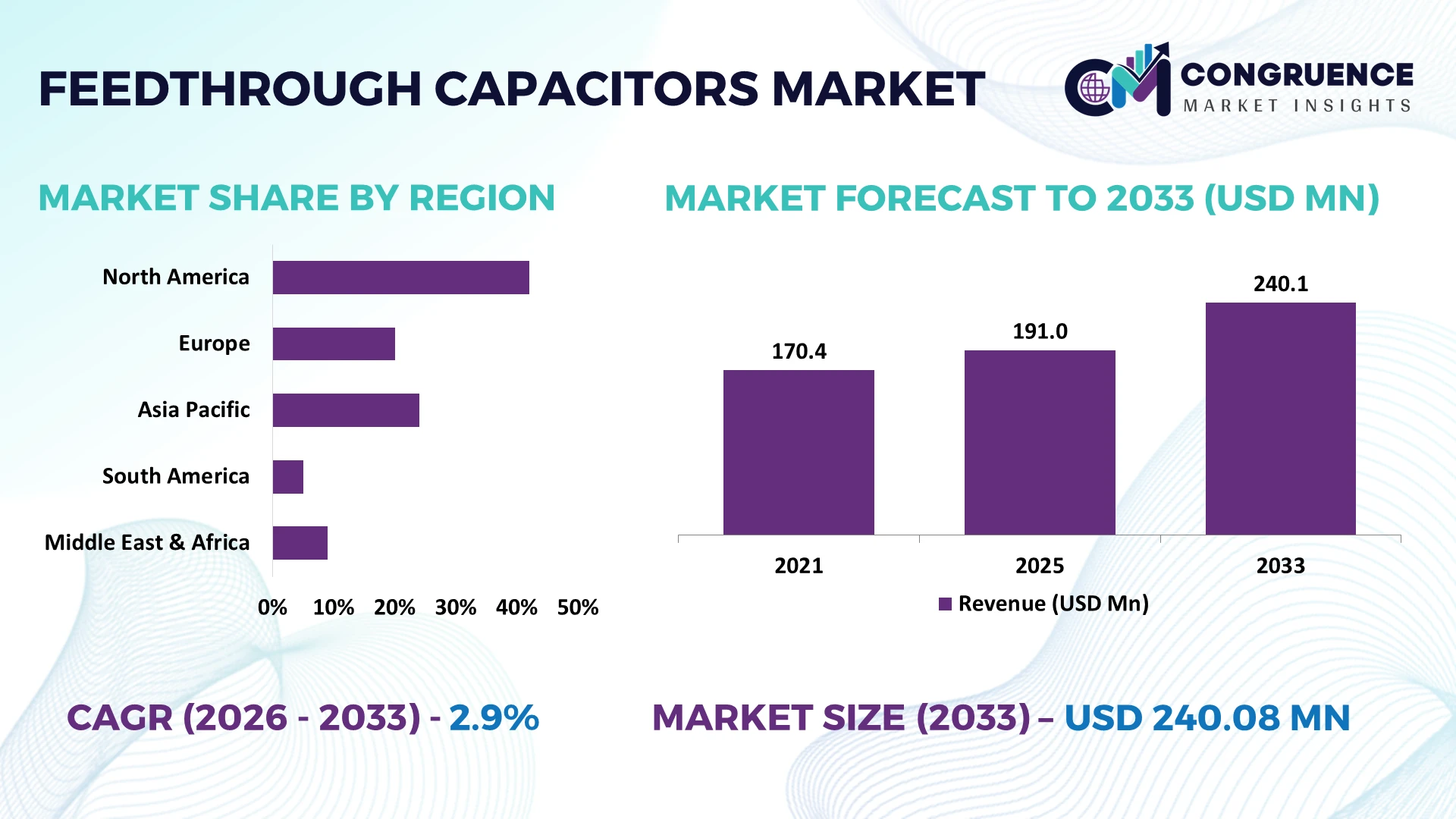
The Global Feedthrough Capacitors Market was valued at USD 191 Million in 2025 and is anticipated to reach a value of USD 240.08 Million by 2033 expanding at a CAGR of 2.9% between 2026 and 2033. Growth is driven by tighter EMI suppression requirements in 5G radios, defense electronics, EV power systems, industrial automation, and high-frequency medical equipment, where feedthrough designs provide substantially stronger filtering than conventional bypass capacitors.
China represents an estimated 30–35% of global feedthrough capacitor manufacturing capacity, supported by its extensive passive-component, telecom equipment, EV electronics, and industrial power supply ecosystem. More than 4.5 million 5G base stations deployed nationally by 2025 strengthen the installed equipment base requiring high-frequency EMI management. Japan remains stronger in premium ceramic and precision electronic components, while the United States benefits from defense and aerospace modernization. U.S.–China technology and semiconductor trade restrictions are simultaneously accelerating supplier qualification and regionalized sourcing across critical electronic components.
Strategically, manufacturers combining high-voltage capability, compact multilayer ceramics, automotive-grade reliability, and geographically diversified production will secure the strongest positions in specification-driven global applications.
Market Size & Growth: USD 191 million in 2025 advances to USD 240.08 million by 2033 at 2.9% CAGR, supported by higher EMI-filtering content in connected electronics.
Top Growth Drivers: 5G infrastructure contributes roughly 30% of incremental opportunity, automotive electrification 25%, and defense-industrial electronics approximately 20%.
Short-Term Forecast: By 2027, advanced automated ceramic processing and inspection can reduce production defects by approximately 10–15% across high-volume capacitor manufacturing lines.
Emerging Technologies: Multilayer ceramic structures, low-inductance architectures, and automated optical inspection are targeting 15–20% improvements in filtering consistency and manufacturing control.
Regional Leaders: Asia-Pacific approaches USD 125 million, North America USD 55 million, and Europe USD 45 million by 2033, led respectively by electronics manufacturing, defense systems, and automotive electrification.
Consumer/End-User Trends: Industrial, telecom, automotive, and defense applications collectively represent an estimated 75%+ of global feedthrough capacitor consumption.
Pilot/Case Example: 2025 high-density electronic filtering designs using integrated feedthrough architectures reduced component-level PCB filtering footprints by approximately 20% versus multi-component alternatives.
Competitive Landscape: Murata holds an estimated 15%+ position in relevant advanced ceramic capacitor categories, alongside TDK, Kyocera, Vishay, and AVX.
Regulatory & ESG Impact: RoHS restricts specified hazardous substances to 0.1% by weight in homogeneous materials, reinforcing compliant materials engineering across global electronic-component supply chains.
Investment & Funding: Global semiconductor investment exceeds USD 100 billion annually, indirectly strengthening advanced component localization, automated production, and regional electronics supply-chain expansion.
Innovation & Future Outlook: Next-generation feedthrough products target 20%+ footprint reductions through miniaturized multilayer designs optimized for higher-frequency, higher-density electronic architectures.
Feedthrough capacitors are becoming increasingly important in RF communication equipment, EV power electronics, aerospace systems, medical electronics, industrial drives, and precision instrumentation where electromagnetic interference directly affects system reliability. Product innovation is concentrating on multilayer ceramic construction, compact three-terminal configurations, higher-voltage insulation, and low-inductance filtering, with advanced designs delivering approximately 20% smaller component footprints in space-constrained assemblies. Supply-chain localization following semiconductor and electronics trade restrictions is also encouraging dual sourcing. These shifts move competition toward application-specific performance, qualification capability, and manufacturing consistency, establishing the foundation for the market’s strategic relevance.
Feedthrough capacitors are becoming strategically important as electromagnetic compatibility shifts from a component-level consideration to a system-level requirement across 5G infrastructure, EV power electronics, aerospace platforms, medical devices, and factory automation. Higher switching frequencies and denser electronics increase conducted interference, while U.S.–China technology restrictions are encouraging dual sourcing of critical passive components. Automotive platforms containing thousands of electronic components further raise the value of compact, qualification-ready EMI suppression.
Technologically, low-inductance multilayer feedthrough capacitors can provide 15–25% stronger high-frequency attenuation than comparable legacy discrete capacitor-filter arrangements while reducing PCB filtering footprint by roughly 20%. China leads manufacturing scale and telecom deployment, supported by more than 4.5 million 5G base stations, while Japan remains concentrated in precision ceramic processing and the United States emphasizes aerospace, defense, and high-reliability electronics. Through 2028, automotive-grade and high-voltage product qualification will become increasingly important procurement differentiators.
A practical example is inverter control circuitry, where feedthrough components suppress conducted noise between power and signal domains without requiring larger multi-component filtering networks. Manufacturers are consequently directing investment toward automated ceramic processing, multilayer miniaturization, local qualification capacity, and OEM design partnerships. Competitive advantage will increasingly depend on filtering performance, application engineering, qualification speed, and resilient manufacturing rather than component volume alone.
Vehicle electrification is expanding the number of high-frequency switching systems requiring robust conducted-noise suppression. Global electric-car sales exceeded 17 million units in 2024, representing more than 20% of new-car sales, while China accounted for nearly 50% of domestic new-car sales. Silicon-carbide traction inverters operating at substantially higher switching frequencies than conventional silicon systems intensify EMI across power and control circuits. This shift increases specification opportunities for low-inductance feedthrough capacitors in onboard chargers, battery-management systems, DC-DC converters, and inverter controls. Manufacturers are responding with automotive-grade multilayer ceramics, higher-voltage designs, automated inspection, and closer Tier-1 engineering partnerships. The strategic advantage lies in qualification: suppliers designed into vehicle platforms can secure multi-year component positions while reducing customers’ filtering footprint and system-level EMC engineering requirements.
Feedthrough capacitor production remains exposed to specialized ceramic powders, electrode metals, precision sintering, and tightly controlled termination processes. Palladium prices have historically moved by more than 20% within annual periods, while silver prices can register double-digit swings, creating procurement pressure for designs using precious-metal electrodes. China also accounts for more than 70% of global rare-earth mining, highlighting broader electronics-material concentration risks even where individual capacitor formulations differ. Export controls and U.S.–China technology restrictions reinforce customer pressure for traceable, diversified supply chains. Material volatility directly affects manufacturing margins and makes low-volume high-reliability products expensive to scale. Suppliers are responding through base-metal electrode development, longer-term material contracts, second-source qualification, and production localization. Operationally, material architecture is becoming as important as electrical performance when OEMs evaluate supply continuity.
Wide-bandgap power electronics create an attractive specification-driven opportunity beyond conventional EMI filtering. Silicon-carbide devices can operate at junction temperatures approaching 200°C, while higher switching frequencies enable power converters to reduce passive-component size by roughly 20–30% compared with traditional architectures. China’s rapid EV penetration and Japan’s strength in industrial robotics create concentrated demand for compact filters capable of maintaining attenuation under elevated voltage, temperature, and frequency conditions. Through 2028, integrated feedthrough arrays, multilayer three-terminal structures, and automated parameter screening will expand addressable applications in charging equipment, servo drives, medical imaging, and aerospace power conversion. Suppliers are increasing R&D around dielectric formulations and high-voltage terminations while collaborating earlier with inverter and converter designers. The non-obvious opportunity is engineering integration: customized filtering can eliminate separate suppression components, reducing assembly complexity and PCB area.
Scaling advanced feedthrough capacitors requires consistent dielectric thickness, electrode alignment, termination integrity, and thermal-cycle performance across millions of components. Automotive electronics commonly target defect levels below 10 parts per million, while qualified components can face operating temperatures reaching 125–150°C and extensive thermal cycling. In Japan and Germany, increasingly compact automotive and industrial control assemblies compound the challenge because smaller components must maintain insulation resistance and insertion-loss performance under vibration and temperature stress. Automated optical inspection detects visible defects, but internal ceramic cracking and latent dielectric weaknesses require X-ray, electrical screening, and statistical process control. Manufacturers must therefore invest in inline metrology, predictive process analytics, qualification laboratories, and joint validation with OEMs. Long-term competitiveness depends on reproducing laboratory-grade filtering performance at high manufacturing yield without allowing miniaturization to undermine reliability.
Miniaturization Reshapes Component Engineering: Feedthrough capacitor suppliers are shifting toward multilayer, three-terminal, and surface-mount architectures as electronics manufacturers compress PCB footprints. New configurations are targeting approximately 15–25% lower occupied board area and 10–20% better high-frequency filtering consistency than multi-component suppression layouts. Japanese component manufacturers are tightening dielectric-layer control and automated termination inspection to increase manufacturing yield. The operational impact is fewer discrete filtering components, shorter assembly cycles, and greater design flexibility in densely packaged controllers.
Automated Quality Control Accelerates: Ceramic-component production is increasingly integrating machine vision, inline electrical testing, and statistical process monitoring. Automated inspection can reduce manual inspection requirements by 20–30%, while tighter process control targets defect reductions above 10%. China’s manufacturing automation provides a strong operational trigger: 295,000 industrial robots were installed during 2024, up 7%. Capacitor producers are consequently expanding automated electrode printing, sintering control, dimensional inspection, and end-of-line testing to improve batch consistency.
Telecom Filtering Specifications Tighten: China ended 2025 with 4.838 million 5G base stations, including 2.064 million supporting 5G RedCap access, equivalent to 42.7% of its 5G infrastructure. Higher network density and increasingly integrated radios are shifting procurement toward compact components providing stable attenuation at elevated frequencies. Suppliers are responding with lower-inductance packages, application-specific frequency characterization, and closer qualification programs with telecom equipment manufacturers.
Localization Alters Supplier Qualification: Electronics manufacturers are expanding second-source qualification as trade controls and logistics disruptions expose concentrated component sourcing. Dual-sourcing programs increasingly require 2 qualified production locations, while localized manufacturing can shorten replenishment lead times by approximately 15–25%. Feedthrough capacitor suppliers are restructuring procurement, duplicating testing capabilities, and qualifying alternative ceramic and electrode materials. The less-visible advantage is faster engineering-change approval, making geographic manufacturing flexibility an increasingly important commercial differentiator.
Ceramic feedthrough capacitors account for an estimated 38–42% of market demand, making them the leading type because high dielectric stability, compact dimensions, low equivalent series inductance, and scalable multilayer manufacturing suit high-frequency EMI suppression. Single-line products remain important for individual conductor filtering, while multi-line configurations reduce assembly complexity where several circuits require simultaneous suppression. Feedthrough filters combine capacitive filtering with broader attenuation functionality and retain strong relevance in sensitive instrumentation and communications equipment.
High-voltage feedthrough capacitors represent the fastest-growing type as power conversion, charging infrastructure, aerospace electronics, and industrial equipment move toward higher operating voltages. Advanced designs can support voltage requirements several times above standard signal-level components while maintaining compact packaging. Film types retain relevance where pulse handling and dielectric characteristics outweigh miniaturization requirements. Manufacturers are prioritizing multilayer ceramic processing, approximately 15–20% footprint optimization, high-voltage insulation systems, and automated electrical screening. Investment is therefore shifting from commodity configurations toward application-qualified ceramic and high-voltage products carrying greater engineering differentiation.
EMI filtering represents an estimated 35–40% of feedthrough capacitor consumption, supported by its direct role in suppressing conducted interference where signals or power lines penetrate shielded enclosures. Signal filtering remains established across instrumentation and medical electronics, while power-supply applications increasingly require low-impedance suppression around switched-mode converters. RF systems demand particularly low-inductance architectures as higher operating frequencies make conventional discrete filtering less effective. Suppliers are responding with three-terminal configurations, broader frequency characterization, and application-specific packaging.
Power electronics is the fastest-growing application as EVs, charging equipment, industrial converters, and energy systems increase switching frequency and power density. Electric vehicles represented 25% of global car sales in 2025, reinforcing component requirements around traction inverters, onboard chargers, and DC-DC converters. Motor drives remain another substantial application as factories automate production; integrated filtering can reduce suppression-component count by approximately 10–20% in optimized assemblies. Manufacturers are therefore expanding high-voltage testing, automated parameter screening, and design-in collaboration with converter, RF, and motor-control engineers.
Industrial users represent an estimated 28–32% of feedthrough capacitor demand, reflecting the large installed base of motor drives, automation controllers, power supplies, instrumentation, robotics, and electrically noisy factory environments. Telecom remains a substantial buyer because radio equipment and network power systems require tightly controlled electromagnetic compatibility. Defense and aerospace customers purchase lower volumes but impose stricter qualification, temperature, vibration, and reliability requirements. Medical applications similarly favor high-reliability components for imaging, diagnostic, and monitoring platforms where interference control directly affects signal integrity.
Automotive is the fastest-growing end-user as vehicle architectures incorporate more power conversion, connectivity, advanced driver-assistance electronics, and electrified subsystems. EVs reached approximately 25% of worldwide new-car sales in 2025, increasing design opportunities for feedthrough components in inverters, chargers, battery-management electronics, and control modules. Suppliers are responding with automotive-grade ceramic systems, customized voltage ratings, approximately 15–20% smaller packages, and joint qualification with Tier-1 manufacturers. Competitive positioning is consequently shifting toward application engineering and long-duration qualification rather than standardized component availability.
Asia-Pacific accounted for the largest market share at 43% in 2025 however, Asia-Pacific is expected to register the fastest growth, expanding at a CAGR of 3.4% between 2026 and 2033.

Defense Electronics and Electrification Drive Specifications
North America accounted for approximately 27% of feedthrough capacitor demand in 2025, with consumption concentrated across aerospace, defense electronics, medical systems, EV power conversion, industrial controls, and telecommunications infrastructure. U.S. defense modernization increasingly favors high-reliability EMI suppression components capable of maintaining filtering performance under vibration, thermal cycling, and high-voltage conditions. Automotive electrification is simultaneously shifting specifications toward compact multilayer and three-terminal configurations for onboard chargers and inverter controls. The United States recorded approximately 1.6 million electric-vehicle sales in 2024, expanding the installed base of EMI-sensitive power electronics. Suppliers are strengthening domestic qualification laboratories, automated ceramic inspection, and OEM engineering support. Supply-chain localization following semiconductor and technology trade restrictions further favors vendors offering traceable materials, shorter qualification cycles, and North American production or distribution redundancy.
United States Market Outlook: The United States dominates regional demand through its combination of defense procurement, aerospace manufacturing, semiconductor infrastructure, medical-device production, and automotive electrification. Federal semiconductor manufacturing incentives exceeding USD 50 billion are expanding domestic electronics ecosystems. Feedthrough capacitor suppliers benefit from adjacent requirements for locally qualified passive components, particularly in high-reliability power, RF, and signal-filtering assemblies.
Electrification Raises High-Reliability Filtering Requirements
Europe represents approximately 21% of global feedthrough capacitor demand, supported by automotive electronics, industrial automation, aerospace, medical equipment, and precision power-conversion manufacturing. Germany anchors industrial consumption through vehicle electrification, machine tools, robotics, motor drives, and factory-control systems, while France contributes aerospace and defense demand. Electrically chargeable vehicles represented more than 20% of EU new-car registrations during 2024, increasing electromagnetic compatibility requirements around inverters, converters, charging modules, and battery-management electronics. European EMC and RoHS requirements simultaneously reinforce demand for qualification-ready, materials-compliant components. Manufacturers are responding with miniaturized ceramic structures, automated electrical screening, and closer engineering collaboration with automotive and industrial OEMs. The competitive shift favors suppliers capable of meeting stringent documentation requirements while maintaining reliable attenuation across temperature, voltage, and frequency variations.
Germany Market Outlook: Germany combines automotive engineering with a manufacturing sector where industry contributes roughly one-fifth of economic output. Its automotive OEMs and Tier-1 suppliers increasingly integrate high-frequency power electronics, automated production equipment, and digitally controlled drives. Component manufacturers targeting Germany therefore emphasize automotive qualification, low-inductance construction, thermal stability, and application-specific EMC engineering rather than standardized filtering components.
Electronics Scale Reinforces Manufacturing Leadership
Asia-Pacific held approximately 43% of global feedthrough capacitor demand in 2025, reflecting concentrated electronics manufacturing, telecommunications infrastructure, EV production, industrial automation, and passive-component supply chains. China provides unmatched deployment scale, while Japan maintains leadership in precision ceramics and high-reliability passive components and South Korea supports semiconductor, automotive, and communications applications. China operated more than 4.8 million 5G base stations by the end of 2025, creating extensive demand for RF, power-supply, and enclosure-level interference control. Japan and China also operate highly automated electronics factories, supporting tighter dimensional and electrical consistency in multilayer capacitor production. Manufacturers are scaling ceramic processing, automated inspection, and high-voltage product portfolios while strengthening domestic material sourcing. Dense supplier ecosystems shorten engineering iteration cycles, giving local manufacturers an operational advantage in customized component development.
China Market Outlook: China combines electronics assembly scale with the world’s largest EV and 5G infrastructure bases. Electric vehicles accounted for roughly half of domestic new-car sales during 2025, significantly expanding inverter, charging, and power-control electronics. Local feedthrough capacitor producers can leverage integrated ceramic, electrode, electronics, and automation supply chains to accelerate design changes and high-volume qualification.
Industrial Modernization Concentrates Demand in Brazil
South America accounts for approximately 4% of global feedthrough capacitor demand, with Brazil representing the primary consumption center through industrial automation, automotive production, telecommunications equipment, renewable-energy electronics, and power-conversion systems. Factory modernization is increasing the density of variable-frequency drives, programmable controllers, sensors, and switching power supplies requiring conducted-noise suppression. Brazil produced more than 2.5 million motor vehicles in 2024, maintaining a substantial electronics-intensive automotive manufacturing base. Telecom network upgrades and renewable-power integration create additional filtering requirements in radio equipment, converters, and industrial enclosures. However, imported component dependence exposes manufacturers to currency fluctuations, longer replenishment cycles, and customs-related inventory requirements. Suppliers are responding through local distributors, application-engineering partnerships, regional inventories, and broader second-source qualification rather than establishing capital-intensive ceramic manufacturing capacity.
Brazil Market Outlook: Brazil offers the strongest regional opportunity because automotive plants, industrial clusters, telecommunications networks, and renewable-energy installations create diversified component demand. Renewable sources provide more than 80% of the country’s electricity generation, supporting substantial power-conversion infrastructure. Suppliers with local inventory and technical support gain an advantage where imported-component lead times can disrupt maintenance and production schedules.
Infrastructure Investment Expands Electronics Intensity
Middle East & Africa represents approximately 5% of global feedthrough capacitor demand, concentrated in telecommunications, defense systems, industrial automation, energy infrastructure, medical equipment, and data-center electronics. Gulf countries are accelerating digital infrastructure and advanced manufacturing programs, increasing requirements for reliable EMI filtering in power supplies, communication systems, control cabinets, and high-density computing equipment. Saudi Arabia and the UAE are expanding localized defense and electronics capabilities while deploying large-scale cloud and data-center infrastructure. Saudi Arabia targets localization of more than 50% of military spending, strengthening incentives for domestic electronics assembly and qualified component supply chains. Feedthrough capacitor vendors are therefore building distribution partnerships, technical support channels, and qualification relationships with equipment integrators. Limited regional passive-component manufacturing keeps imported supply important, making inventory availability and engineering support major procurement differentiators.
Saudi Arabia Market Outlook: Saudi Arabia provides the strongest strategic platform through defense localization, industrial diversification, telecommunications investment, and data-center development. Vision 2030 programs are pushing local manufacturing and technology transfer into electronics-intensive industries. Suppliers establishing qualification partnerships with domestic system integrators can capture demand for high-voltage, RF, and ruggedized filtering components while reducing dependence on transactional imports.
The Feedthrough Capacitors Market is led by Murata Manufacturing, TDK, Kyocera, Vishay Intertechnology, and Yageo, competing against specialized filtering suppliers through ceramic processing, miniaturization, reliability, and application engineering. The top five collectively account for an estimated 55–60% of relevant demand, reflecting advantages in multilayer manufacturing and OEM qualification. Premium suppliers compete on attenuation performance and reliability, while regional producers apply pricing pressure of approximately 10–20%. Advanced multilayer architectures deliver roughly 15–25% footprint reductions, making miniaturization a stronger differentiator than unit price in dense electronics. Players are expanding automated inspection, high-voltage portfolios, localized production, and automotive and defense design partnerships. Competition is shifting toward supply-chain resilience and application-specific qualification as OEMs introduce second-source requirements. High ceramic-processing precision, long qualification cycles, and demanding EMC performance create substantial entry barriers. Winning requires scalable manufacturing, consistent high-frequency performance, rapid customization, resilient sourcing, and early integration into customer designs.
Murata Manufacturing
TDK Corporation
Kyocera Corporation
Vishay Intertechnology
Yageo Corporation
Johanson Dielectrics
Spectrum Control
Exxelia
SCHURTER
CTS Corporation
Knowles Corporation
Presidio Components
Syfer Technology
Tusonix
Current feedthrough technology centers on low-ESL three-terminal multilayer ceramic structures that route noise directly to ground while preserving signal or power continuity. Compared with conventional two-terminal MLCC filtering, optimized feedthrough layouts can improve high-frequency attenuation by 20–30% and reduce filtering component count by 15–25%. Surface-mount adoption is strongest in automotive ECUs, telecom radios, industrial controls, and medical electronics, where automated placement and compact 0603–1206 packages improve assembly throughput and board utilization.
Emerging development is shifting toward X2Y architectures, higher-voltage ceramics, flexible terminations, and automated electrical screening. X2Y integrated filters combine differential and common-mode suppression within one device, enabling approximately 20% PCB-area savings in dense power and signal paths. Automotive-qualified products operating to 125°C and filtering into gigahertz frequencies are expanding deployment as Ethernet, ADAS, and electrified powertrains raise EMC requirements. Suppliers with ceramic formulation expertise and application-level simulation gain faster design-in access.
Disruptive progress through 2026–2028 will center on thinner dielectric layers, AI-assisted process control, digital-twin filter simulation, and integration with SiC/GaN power electronics. Automated inspection can cut screening labor by 20–30%, while predictive process analytics can improve first-pass yield by roughly 10%. Manufacturers acting now can secure qualification positions before higher-frequency power architectures make legacy discrete filtering operationally inefficient.
October 2024 TDK published YFF Series deployment guidance for three-terminal feed-through filters, demonstrating low-ESL noise suppression and reduced MLCC counts in automotive electronics. The shift strengthens design-in demand for compact feedthrough architectures as vehicle systems move toward faster, high-frequency interfaces. Source: tdk.com
March 2025 Knowles Precision Devices announced relocation of EMI panel-mount filters, EMI assemblies, SBSG/M surface-mount filters, and capacitor assemblies from Suzhou to Penang. Malaysia line qualification targeted March 2026, with first customer shipments scheduled for April 2026, strengthening supply-chain diversification. Source: tti.com
June 2025 Murata disclosed an industry-first closed-loop recycling system for silver used in EMI filter products, operational since January 2025. Manufacturing silver waste is recovered and returned as raw material, reducing virgin-material dependence while strengthening resource security for noise-suppression production. Source: technology4environment.com
March 2026 Vishay introduced the SGCM05339 space-grade surface-mount EMI choke for GaN and SiC systems, supporting 14.43 A, -55°C to +130°C operation, and 1000 VRMS dielectric withstand. The launch broadens high-reliability filtering options for modern aerospace and defense power architectures. Source: signalintegrityjournal.com
The Feedthrough Capacitors Market Report evaluates single-line, multi-line, ceramic, film, feedthrough filter, and high-voltage configurations across EMI filtering, power supply, signal filtering, RF systems, motor drives, and power electronics. Ceramic products represent approximately 38–42% of demand, while EMI filtering accounts for an estimated 35–40% of application deployment. End-user coverage includes automotive, aerospace, telecom, medical, defense, and industrial buyers, capturing both volume-driven and high-reliability procurement requirements.
Geographic analysis covers North America, Europe, Asia-Pacific, South America, and Middle East & Africa, with Asia-Pacific representing approximately 43% of 2025 demand. Technology assessment addresses low-ESL architectures, X2Y filtering, multilayer ceramics, high-voltage designs, automated inspection, and SiC/GaN integration. The 2026–2033 framework evaluates supplier positioning, qualification barriers, localization, miniaturization, application shifts, and emerging high-frequency requirements to support investment planning, capacity expansion, product development, partnership decisions, and competitive strategy.
| Report Attribute/Metric | Report Details |
|---|---|
Market Revenue in 2025 | USD 191 Million |
Market Revenue in 2033 | USD 240.08 Million |
CAGR (2026 - 2033) | 2.9% |
Base Year | 2025 |
Forecast Period | 2026 - 2033 |
Historic Period | 2021 - 2025 |
Segments Covered | By Type
By Application
By End-User
|
Key Report Deliverable | Revenue Forecast, Growth Trends, Market Dynamics, Segmental Overview, Regional and Country-wise Analysis, Competition Landscape |
Region Covered | North America, Europe, Asia-Pacific, South America, Middle East, Africa |
Key Players Analyzed | Murata Manufacturing, TDK Corporation, Kyocera Corporation, Vishay Intertechnology, Yageo Corporation, Johanson Dielectrics, Spectrum Control, Exxelia, SCHURTER, CTS Corporation, Knowles Corporation, Presidio Components, Syfer Technology, Tusonix |
Customization & Pricing | Available on Request (10% Customization is Free) |




