
Reports
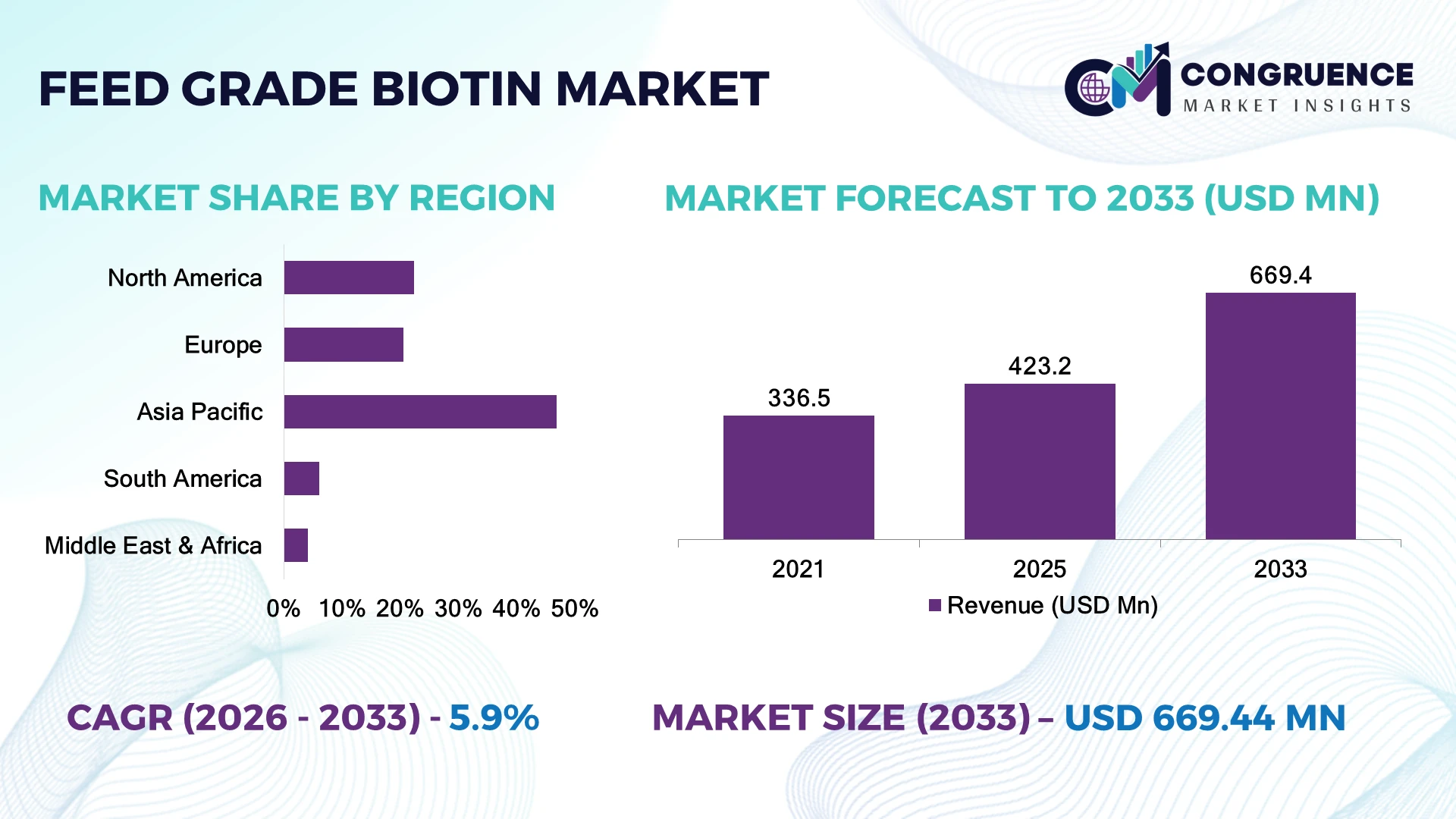
The Global Feed Grade Biotin Market was valued at USD 423.2 Million in 2025 and is anticipated to reach a value of USD 669.4 Million by 2033 expanding at a CAGR of 5.9% between 2026 and 2033. Growth is driven by rising precision livestock nutrition programs, stricter feed efficiency standards, and increasing commercial poultry and swine production requiring optimized vitamin supplementation.
China dominates the global Feed Grade Biotin Market with approximately 34% of global production capacity, supported by large-scale feed manufacturing, integrated livestock operations, and continued investments in vitamin production technologies. More than 72% of industrial feed mills in China incorporate fortified vitamin premixes, compared with nearly 58% across India, reflecting stronger adoption of advanced feed formulations. Ongoing agricultural modernization under national food security initiatives further strengthens China's competitive position while expanding export capabilities across Asia.
Strategically, companies should prioritize manufacturing expansion, regional supply security, and high-performance feed formulations to strengthen long-term market competitiveness.
Market Size & Growth: USD 423.2 Million in 2025 reaching USD 669.4 Million by 2033 at 5.9% CAGR, supported by precision livestock nutrition and commercial feed optimization.
Top Growth Drivers: Poultry feed production +8%, vitamin premix adoption +12%, commercial livestock productivity improvement +10%.
Short-Term Forecast: By 2028, feed conversion efficiency improves by nearly 7% through advanced micronutrient formulation and automated feed blending.
Emerging Technologies: AI-based feed formulation, automated premix dosing, and precision nutrition platforms improve formulation accuracy by over 15%.
Regional Leaders: Asia Pacific USD 275 Million, Europe USD 156 Million, North America USD 142 Million, driven by commercial feed modernization and supply-chain expansion.
Consumer/End-User Trends: More than 68% of industrial feed manufacturers increasingly use fortified vitamin premixes to enhance animal productivity.
Pilot/Case Example: In 2024, integrated poultry nutrition programs achieved approximately 9% better feed conversion through optimized biotin supplementation.
Competitive Landscape: Leading manufacturers collectively account for nearly 48% market share, with DSM-Firmenich, BASF, Adisseo, Zhejiang Medicine, and NHU leading competition.
Regulatory & ESG Impact: Sustainable feed initiatives reduced nutrient waste by approximately 11% while supporting stricter livestock nutrition compliance.
Investment & Funding: More than USD 240 Million has been directed toward production expansion, strategic partnerships, and advanced vitamin manufacturing capacity.
Innovation & Future Outlook: High-purity biotin production, digital nutrition platforms, and resilient regional supply networks are reshaping competitive strategies worldwide.
Feed Grade Biotin Market demand continues expanding across commercial poultry, swine, aquaculture, and dairy nutrition as producers focus on higher feed efficiency and animal health performance. Advanced precision nutrition software and automated premix technologies are improving formulation consistency, while nearly 70% of industrial feed producers emphasize customized micronutrient blends. Ongoing supply-chain diversification and stricter feed quality regulations are accelerating innovation, creating a stronger foundation for long-term strategic market development.
The Feed Grade Biotin Market has become strategically important as livestock producers focus on maximizing feed efficiency, reducing production costs, and improving animal health outcomes. Competitive advantage increasingly depends on consistent vitamin quality, resilient sourcing strategies, and advanced nutritional formulations. Supply-chain diversification following recent global logistics disruptions has encouraged manufacturers to establish regional production capabilities and strengthen procurement resilience.
Modern automated premix systems deliver formulation accuracy improvements of approximately 15% compared with conventional batch-mixing methods while reducing ingredient variation and production losses. Asia Pacific continues expanding manufacturing capacity and commercial livestock operations, whereas Europe emphasizes premium-quality formulations supported by stringent feed regulations and advanced nutritional research. Over the next two to three years, greater digital integration across feed mills is expected to increase automated formulation adoption beyond 60%, improving operational consistency and quality control.
Manufacturers are deploying precision nutrition platforms, expanding localized production facilities, and strengthening partnerships with feed producers to enhance supply reliability. Large commercial feed companies are investing in integrated vitamin blending technologies to improve production efficiency while minimizing formulation variability. These strategic initiatives position industry participants to secure stronger competitive differentiation, improve operational performance, and reinforce long-term leadership across the evolving global Feed Grade Biotin Market.
Commercial livestock producers are integrating precision nutrition strategies to maximize feed conversion and improve animal productivity, making feed grade biotin a critical component of balanced vitamin premixes. More than 72% of industrial poultry feed mills in China now utilize fortified micronutrient formulations, while automated feed formulation systems improve dosing accuracy by nearly 15% and reduce nutrient variation by approximately 10%. Stricter feed quality regulations and food security initiatives are encouraging higher-quality vitamin supplementation across commercial production systems. This operational shift is improving livestock performance and reducing nutritional losses. Leading manufacturers are expanding vitamin production capacity, investing in advanced fermentation technologies, and forming long-term partnerships with integrated feed companies to secure stable supply and strengthen competitive positioning.
Feed grade biotin production remains highly dependent on specialized chemical intermediates and energy-intensive manufacturing processes, creating cost volatility across global supply chains. Raw material procurement costs fluctuate by nearly 12%, while energy expenses account for approximately 18% of total production costs in several manufacturing facilities. China's concentration in vitamin production continues to expose international buyers to supply disruptions during logistics constraints and environmental compliance inspections. These factors compress producer margins and complicate procurement planning for feed manufacturers. Companies are responding by diversifying supplier networks, localizing inventory management, securing multi-year procurement contracts, and optimizing manufacturing efficiency to improve operational resilience and stabilize product availability.
Digital feed manufacturing platforms are creating new opportunities for differentiated feed grade biotin applications through precision formulation and data-driven nutrition management. Smart feed mills equipped with automated dosing technologies improve formulation consistency by approximately 16%, while predictive nutrition software reduces ingredient waste by nearly 11%. India is accelerating investment in commercial feed infrastructure and digital livestock management under agricultural modernization initiatives, creating demand for premium micronutrient solutions. Manufacturers are strengthening research collaborations, expanding customized vitamin premix portfolios, and integrating digital quality monitoring into production workflows. A particularly valuable opportunity lies in combining precision nutrition with livestock performance analytics, enabling measurable productivity improvements beyond conventional feed supplementation.
Maintaining consistent feed grade biotin quality across expanding international supply networks remains a significant execution challenge as regulatory standards and manufacturing capabilities vary between countries. Product quality deviations during transportation and storage can affect nearly 8% of vitamin premix batches, while cross-border compliance requirements increase certification timelines by approximately 20%. Manufacturers supplying multiple export markets must continuously adapt to evolving feed safety standards and documentation requirements without disrupting production schedules. Companies are investing in advanced quality assurance laboratories, digital traceability systems, standardized production protocols, and regional distribution infrastructure. Establishing globally consistent quality verification while supporting large-scale commercial feed production will remain a defining competitive advantage over the coming years.
Precision Premix Automation Expands Commercial feed manufacturers are accelerating automated micronutrient dosing systems, with automated premix lines increasing by nearly 18% and formulation deviations declining by approximately 14%. Digital quality monitoring enables faster production cycles and improved batch consistency. Rising feed safety compliance requirements are encouraging manufacturers to modernize blending operations, while vitamin producers are scaling automation investments and integrating intelligent process controls to strengthen manufacturing reliability.
Localized Production Strategies Strengthen Feed additive companies are restructuring manufacturing footprints as over 30% of global procurement contracts increasingly prioritize regional sourcing. Local inventory programs have shortened delivery timelines by nearly 20% while reducing logistics disruptions. China continues expanding production efficiency, whereas India is increasing domestic feed manufacturing capacity. Companies are responding through localized warehousing, strategic partnerships, and diversified procurement models that improve operational continuity and inventory flexibility.
High-Purity Formulations Gain Momentum Premium feed formulations containing high-purity biotin have increased adoption by approximately 16% among integrated livestock enterprises seeking improved nutritional consistency. Standardized vitamin premixes reduce formulation variability by nearly 12%, supporting better production planning and feed performance. Manufacturers are expanding fermentation technologies, improving purification processes, and introducing customized vitamin solutions that align with commercial livestock productivity objectives.
Integrated Nutrition Platforms Advance Feed producers are increasingly combining nutritional formulation software with production management systems, improving formulation accuracy by approximately 15% and reducing ingredient waste by nearly 10%. Digital integration enables faster quality verification and operational traceability throughout feed manufacturing workflows. Companies are strengthening software partnerships, expanding digital service portfolios, and embedding predictive nutrition analytics into commercial feed operations to improve long-term manufacturing efficiency.
Synthetic Biotin dominates the Feed Grade Biotin Market with an estimated market share of approximately 82%, supported by consistent product purity, scalable industrial manufacturing, and competitive production economics. Large commercial feed producers prefer synthetic formulations because they ensure uniform vitamin concentration across high-volume feed operations while simplifying quality control and regulatory compliance. Natural Biotin represents a smaller but steadily expanding segment as specialty livestock nutrition programs increasingly emphasize premium and sustainable feed ingredients.Natural Biotin is emerging as the fastest-growing segment due to increasing demand for differentiated animal nutrition products and expanding investment in biotechnology-based production. Feed manufacturers are broadening premium product portfolios while strengthening fermentation capabilities to improve production efficiency. Companies continue investing in advanced manufacturing technologies and strategic partnerships to balance cost competitiveness with evolving customer preferences, supporting diversified product offerings across industrial and specialty feed applications.
Poultry Feed accounts for approximately 46% of Feed Grade Biotin consumption, supported by intensive commercial production, high feed utilization rates, and continuous productivity optimization. Biotin supplementation plays a critical role in improving feather development, metabolism, and feed efficiency, making poultry operations the largest application segment. Swine Feed remains another mature segment where nutritional optimization continues supporting commercial production performance, while Aquaculture Feed steadily expands through improving feed quality requirements. Pet Food represents the fastest-growing application as manufacturers increasingly incorporate premium micronutrient formulations into functional nutrition products. Cattle Feed continues generating stable demand across dairy and beef production systems, while specialty livestock applications are expanding through customized vitamin blends. Feed companies are strengthening formulation capabilities, increasing automated production, and developing species-specific nutritional solutions to address evolving commercial requirements across diversified animal production sectors.
Commercial Feed Manufacturers represent the dominant end-user group with approximately 63% market share due to large-scale industrial production, integrated procurement systems, and continuous demand for standardized vitamin premixes. Their extensive manufacturing infrastructure enables consistent biotin incorporation across high-volume feed production while supporting rigorous quality assurance requirements. Large enterprises continue investing in automated blending technologies and digital quality monitoring to improve operational efficiency and product consistency. Integrated Livestock Producers are the fastest-growing end-user segment as companies increasingly internalize feed production to strengthen nutritional control and improve production economics. Feed Premix Manufacturers continue serving specialized formulation requirements, while Animal Nutrition Companies expand customized micronutrient portfolios targeting performance-oriented livestock operations. Companies are responding through collaborative product development, flexible supply agreements, and customized formulation services that strengthen long-term customer relationships and improve competitive differentiation.
Asia-Pacific accounted for the largest market share at 46.8% in 2025 however, South America is expected to register the fastest growth, expanding at a CAGR of 6.7% between 2026 and 2033.

North America accounted for approximately 22.4% of the global Feed Grade Biotin Market in 2025, supported by highly integrated livestock production systems and technologically advanced commercial feed manufacturing. Feed producers continue investing in automated premix facilities, precision nutrient dosing, and digital quality monitoring to improve formulation consistency and production efficiency. Poultry and swine nutrition remain the primary demand centers, while premium dairy nutrition is gaining greater commercial importance. More than 65% of industrial feed mills across the region now utilize automated micronutrient blending systems, improving batch consistency and reducing formulation errors. Companies continue expanding regional warehousing, strengthening supply agreements, and upgrading manufacturing infrastructure to improve operational resilience and shorten delivery cycles.
United States Market Outlook: The United States remains the largest contributor within North America due to its extensive commercial livestock industry, advanced feed manufacturing infrastructure, and strong adoption of precision nutrition technologies. Nearly 70% of industrial feed production is concentrated within integrated commercial operations that increasingly utilize automated vitamin premix systems. Domestic manufacturers continue expanding production efficiency through digital quality assurance, strategic procurement partnerships, and advanced formulation technologies that strengthen competitiveness across poultry, dairy, and swine nutrition.
Europe represented approximately 20.6% of the global market in 2025, supported by stringent feed quality standards, advanced animal nutrition practices, and widespread adoption of scientifically formulated vitamin premixes. Commercial feed manufacturers continue prioritizing traceability, nutritional consistency, and environmentally responsible production systems. More than 60% of industrial feed facilities have incorporated automated quality monitoring into vitamin premix operations, improving production control and compliance performance. Companies are investing in sustainable manufacturing technologies, expanding specialized nutrition portfolios, and strengthening partnerships across livestock value chains to improve operational efficiency while meeting evolving regulatory expectations.
Germany Market Outlook: Germany serves as Europe's leading market through its highly developed feed manufacturing sector, strong livestock production base, and advanced nutritional research capabilities. Integrated feed companies continue modernizing production facilities while adopting intelligent formulation technologies to improve product consistency. Approximately 68% of large commercial feed manufacturers operate automated production environments, supporting premium livestock nutrition and strengthening Germany's leadership in high-quality feed additive manufacturing.
Asia-Pacific dominated the global Feed Grade Biotin Market with approximately 46.8% market share in 2025, driven by large-scale vitamin manufacturing, expanding livestock production, and integrated commercial feed industries. The region benefits from extensive production capacity, established export infrastructure, and rapidly modernizing feed manufacturing operations. More than 72% of industrial feed mills in key manufacturing countries utilize standardized vitamin premixes, while production automation continues improving manufacturing efficiency. Feed additive producers are expanding fermentation capacity, strengthening regional logistics networks, and investing in advanced quality management systems to support domestic consumption and international exports.
China Market Outlook: China remains the largest national market owing to its dominant vitamin manufacturing capacity, integrated livestock production, and extensive commercial feed industry. Approximately one-third of global feed-grade biotin production originates from Chinese manufacturing facilities supported by continuous investment in fermentation technology and industrial automation. Domestic producers continue expanding export capabilities, upgrading environmental compliance systems, and improving manufacturing productivity to reinforce global supply leadership.
South America accounted for approximately 6.1% of the global market in 2025, supported by expanding poultry, beef, and swine production alongside increasing adoption of commercial compound feed. Large livestock enterprises continue upgrading nutritional programs to improve feed efficiency and export competitiveness. Industrial feed production has expanded by approximately 11% over recent years, encouraging greater incorporation of standardized vitamin premixes. Feed manufacturers are investing in localized production, strengthening logistics infrastructure, and expanding technical support services to improve operational performance despite transportation and distribution challenges across several production corridors.
Brazil Market Outlook: Brazil leads the South American market through its globally competitive poultry and beef industries, extensive feed manufacturing capacity, and strong agricultural export infrastructure. Large commercial producers increasingly integrate precision nutrition into feed operations to enhance livestock productivity and export quality standards. More than 60% of industrial feed production supports poultry and swine operations, encouraging continuous investment in advanced feed additives and modern formulation technologies.
The Middle East & Africa accounted for approximately 4.1% of the global market in 2025 as governments and commercial livestock enterprises increased investment in food security, modern feed production, and intensive farming systems. Demand continues strengthening through expanding poultry operations and improving commercial dairy production. Nearly 35% of newly established industrial feed facilities now incorporate automated micronutrient blending systems, improving production consistency and operational efficiency. Companies are expanding regional distribution partnerships, modernizing feed manufacturing infrastructure, and strengthening localized technical services to support evolving commercial livestock requirements.
Saudi Arabia Market Outlook: Saudi Arabia remains the leading national market within the region due to continued investment in commercial poultry production, modern feed manufacturing facilities, and national food security initiatives. Integrated livestock companies are expanding technologically advanced feed operations while increasing adoption of precision vitamin premixes to improve production performance. Ongoing infrastructure modernization and strategic investment in domestic feed manufacturing continue strengthening long-term market competitiveness and reducing dependence on imported finished feed products.
The Feed Grade Biotin Market is characterized by competition between global vitamin manufacturers including dsm-firmenich, BASF, Adisseo, Zhejiang NHU, and Zhejiang Medicine, and regional Chinese producers competing primarily on manufacturing scale and pricing. The top five companies collectively control approximately 68% of global market share through integrated production, established distribution, and long-term feed industry relationships. Global leaders differentiate through product purity, regulatory compliance, and supply reliability, while regional manufacturers compete with pricing advantages typically 8–12% below premium brands. Automated production improves manufacturing efficiency by nearly 15%, enabling faster deliveries and consistent product quality. Companies continue expanding fermentation capacity, strengthening feed manufacturer partnerships, pursuing vertical integration, and regionalizing inventories to reduce supply-chain disruptions. Competitive intensity is shifting toward production resilience and technology-enabled quality assurance rather than price alone. High capital investment, stringent regulatory approvals, and advanced process know-how remain major entry barriers. Winning requires manufacturing scale, consistent quality, resilient supply networks, technical support, and continuous process innovation.
BASF SE
Adisseo
Zhejiang NHU Co., Ltd.
Zhejiang Medicine Co., Ltd.
Jiangxi Tianxin Pharmaceutical Co., Ltd.
Hegno International
Kexing Biochem Co., Ltd.
Shanghai Acebright Pharmaceuticals Group Co., Ltd.
Huazhong Pharmaceutical Co., Ltd.
Xinfa Pharmaceutical Co., Ltd.
Zagro
Advanced fermentation technology and automated purification systems are transforming feed grade biotin manufacturing by improving production consistency and reducing process variability. Modern fermentation platforms increase production efficiency by approximately 18% compared with conventional synthesis workflows while lowering quality deviations by nearly 12%. Around 60% of newly expanded manufacturing lines now integrate automated process monitoring, enabling higher batch reliability and reduced production downtime. Manufacturers benefit through improved product consistency, lower operating costs, and stronger regulatory compliance.
Digital feed formulation platforms, automated micronutrient dosing, and intelligent quality assurance systems are becoming standard across commercial feed manufacturing. Facilities using automated premix technologies achieve approximately 15% greater formulation accuracy than traditional manual blending while reducing ingredient waste by nearly 10%. Premium feed manufacturers and integrated livestock enterprises gain the greatest competitive advantage through faster production scheduling, improved traceability, and optimized inventory management, strengthening operational performance across industrial feed production.
Between 2026 and 2028, predictive nutrition analytics, AI-assisted formulation software, and digital manufacturing execution systems are expected to accelerate adoption across large commercial feed operations. Companies investing early in integrated digital production, precision fermentation, and advanced traceability platforms will strengthen supply resilience, improve manufacturing flexibility, and respond more rapidly to evolving customer specifications and regulatory requirements.
January 2025 – dsm-firmenich supported the renewal process for its feed-grade biotin authorization for all animal species in the European Union, maintaining product specifications with purity above 99%. The decision reinforced long-term regulatory continuity for commercial feed manufacturers. Source: www.dsm-firmenich.com
February 2025 – Adisseo's feed-grade biotin authorization was reaffirmed through the European renewal assessment covering all animal species, confirming compliance with existing safety and quality requirements. The outcome strengthened customer confidence across regulated feed markets. Source: www.adisseo.com
February 2025 – Zhejiang NHU remained one of the manufacturers included in the successful European feed biotin authorization renewal, with production batches demonstrating purity levels exceeding 99%. The development supported uninterrupted participation in regulated international feed additive markets.
February 2026 – dsm-firmenich introduced additional technical guidance covering its feed-grade biotin product portfolio for premix manufacturers, highlighting optimized formulations for improved homogeneity and consistent distribution across commercial feed applications. The initiative strengthened technical support and product differentiation. Source: www.dsm-firmenich.com
This report provides a comprehensive assessment of the Feed Grade Biotin Market across product types, applications, end-user industries, and major regional markets between 2026 and 2033. It evaluates competitive positioning, manufacturing capabilities, technology adoption, regulatory developments, production trends, and evolving procurement strategies. The study covers commercial livestock nutrition, poultry, swine, ruminants, aquaculture, pet nutrition, and specialized feed applications while examining deployment patterns across industrial feed manufacturers and integrated livestock enterprises.
The report analyzes regional manufacturing concentration, supply-chain evolution, digital feed production technologies, automated premix systems, and precision nutrition innovations shaping industry competitiveness. More than 65% of industrial demand originates from commercial feed manufacturing operations, while advanced automated formulation technologies continue expanding across large production facilities. The analysis supports investment prioritization, capacity expansion planning, partnership evaluation, competitive benchmarking, risk assessment, and long-term strategic decision-making for manufacturers, investors, distributors, and animal nutrition stakeholders operating within the global Feed Grade Biotin Market.
| Report Attribute / Metric | Details |
|---|---|
| Market Revenue (2025) | USD 423.2 Million |
| Market Revenue (2033) | USD 669.4 Million |
| CAGR (2026–2033) | 5.9% |
| Base Year | 2025 |
| Forecast Period | 2026–2033 |
| Historic Period | 2021–2025 |
| Segments Covered |
By Type
By Application
By End-User
|
| Key Deliverables | Revenue Forecast; Market Trends; Growth Drivers & Restraints; Technology Insights; Segmentation Analysis; Regional Insights; Competitive Landscape; Regulatory & ESG Overview; Recent Developments |
| Regions Covered | North America; Europe; Asia-Pacific; South America; Middle East & Africa |
| Companies Profiled | dsm-firmenich; BASF SE; Adisseo; Zhejiang NHU Co., Ltd.; Zhejiang Medicine Co., Ltd.; Jiangxi Tianxin Pharmaceutical Co., Ltd.; Hegno International; Kexing Biochem Co., Ltd.; Shanghai Acebright Pharmaceuticals Group Co., Ltd.; Huazhong Pharmaceutical Co., Ltd.; Xinfa Pharmaceutical Co., Ltd.; Zagro |
| Customization & Pricing | Available on Request (10% Customization Free) |




