
Reports
The Global Fault Current Limiters Market was valued at USD 649.0 Million in 2025 and is anticipated to reach a value of USD 1,255.7 Million by 2033 expanding at a CAGR of 8.6% between 2026 and 2033. Growth is anchored in grid modernization mandates requiring fault-level management as renewable penetration exceeds 30% of global electricity generation.
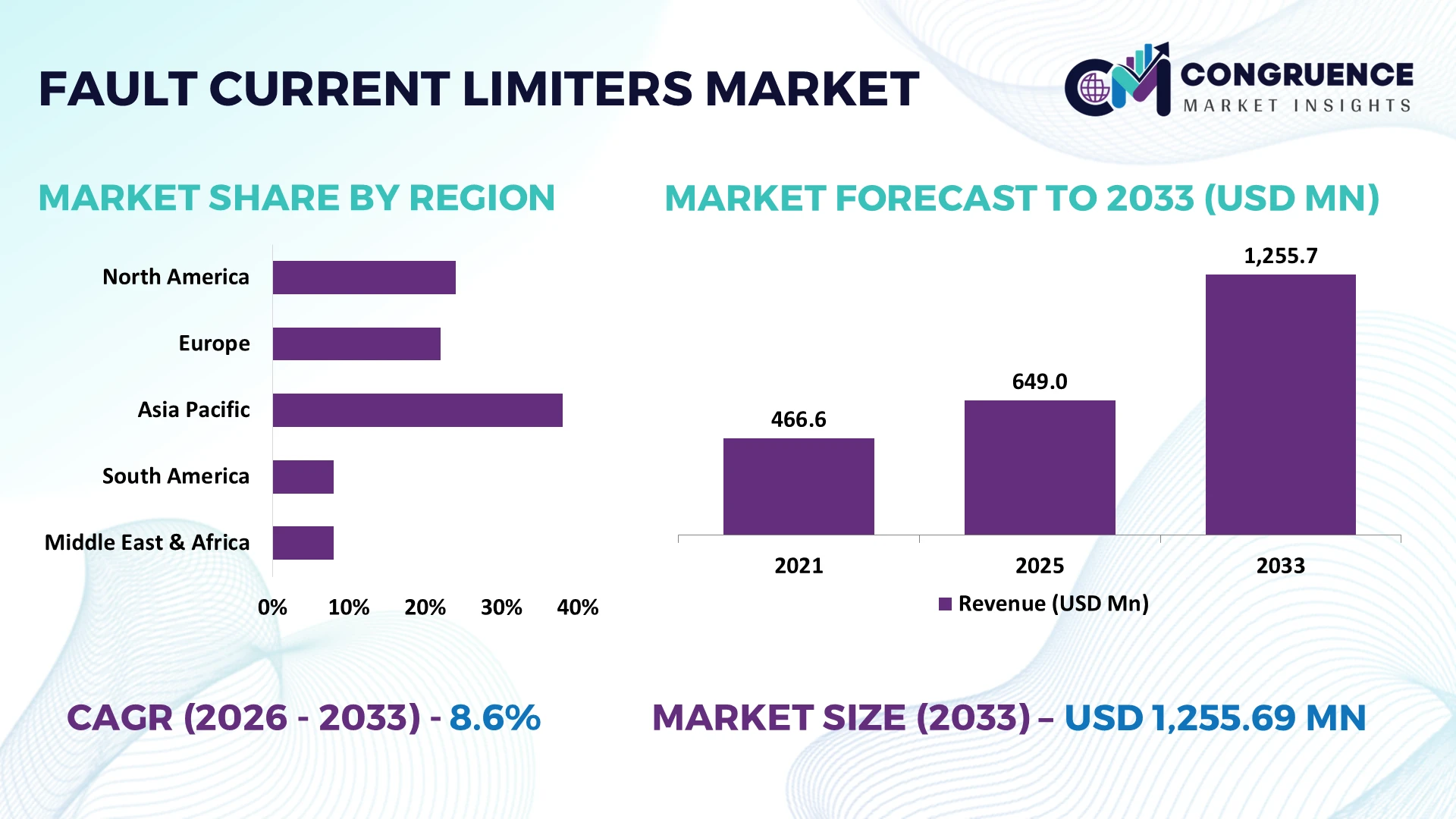
Asia-Pacific commands 44.3% of global share, led by China’s requirement for limiters in all 220 kV renewable-zone substations and Korea Electric Power’s 22.9 kV pilot deployment targeting high-density urban grids. Japan’s superconducting rail projects and Europe’s offshore HVDC converter specifications illustrate a widening deployment gap: Asia-Pacific prioritizes volume-driven utility adoption, while Europe emphasizes high-voltage transmission integration.
This divergence signals that vendors capable of scaling standardized medium-voltage platforms across Asian distribution networks while meeting European HVDC specifications will capture disproportionate share as procurement cycles shorten.
Market Size & Growth: Valued at USD 649.0 Million in 2025, forecast to USD 1,255.7 Million by 2033, with superconducting units holding 66.6% share driven by 50–70% current reduction within 2–5 milliseconds.
Top Growth Drivers: Renewable integration at 30% of global generation, over USD 14 trillion in energy infrastructure investment needed by 2040, and medium-voltage demand rising 9.1% annually from EV chargers and rooftop solar.
Short-Term Forecast: By 2028, solid-state limiter costs decline an estimated 25–50% through advanced magnetic alloys, while medium-voltage segment nearly doubles in size by 2031.
Emerging Technologies: Hybrid superconducting-solid-state stacks targeting duties above 100 kA, silicon-carbide switches interrupting in under 200 microseconds, and REBCO wire commercialization unlocking utility-scale projects.
Regional Leaders: Asia-Pacific at 44.3% share with China’s 220 kV renewable-zone mandate; North America driven by California and New York out-of-rate-case recovery approvals; Europe led by Scotland’s 525 kV HVDC links incorporating limiters at converter stations.
Consumer/End-User Trends: Data-center operators in Korea deploy LS Electric’s HypergridNX for hyperscale AI facilities exceeding 100,000 servers, reducing fault currents within 1–2 milliseconds.
Pilot/Case Example: SuperGrid Institute’s January 2025 test achieved 87% fault current reduction at 50 kV DC, limiting 43 kA prospective current to 5.5 kA before circuit-breaker interruption.
Competitive Landscape: ABB, Siemens Energy, Nexans, Toshiba ESS, and AMSC lead; superconducting incumbents face pressure as solid-state entrants leverage traction-inverter supply chains.
Regulatory & ESG Impact: Absence of IEC testing protocols above 63 kA constrains high-voltage growth; cryogenic OPEX of USD 20,000–30,000 annually per device limits emerging-market adoption.
Investment & Funding: NKT’s EUR 2.0 billion Scottish HVDC contracts embed limiters in converter specifications, signaling procurement integration as a funding catalyst.
Innovation & Future Outlook: Vendors converge on modular, digitally monitored hybrid platforms scalable from 12 kV to 220 kV, shifting competition from hardware performance to lifecycle service ecosystems.
The Fault Current Limiters market is increasingly shaped by medium-voltage demand from EV charging hubs and data centers, where modular superconducting designs reduce footprint by up to 70% compared to air-core reactors. LS Electric’s HypergridNX integration for hyperscale AI facilities demonstrates operational urgency, limiting fault currents within 1–2 milliseconds. A critical supply-chain constraint persists: high-temperature superconducting tape supply concentration creates procurement risk, with key AMSC patents expiring after 2027 potentially lowering entry barriers for Asian wire manufacturers. These dynamics position the market for a structural shift from utility-only procurement toward distributed, application-specific deployment models.
Fault current limiters have shifted from ancillary protection equipment to strategic grid enablers as renewable penetration and data-center density push fault levels beyond conventional breaker ratings. China’s mandate for limiters in every 220 kV renewable-zone substation and Scotland’s 525 kV HVDC specifications embedding limiters at converter stations illustrate how procurement requirements now shape vendor roadmaps years before commissioning. The technology comparison is stark: resistive superconducting limiters reduce prospective fault current by 87% while cutting DC protection equipment footprint by 40–50% compared to conventional breaker-only architectures. Regionally, Asia-Pacific’s 44.3% volume share contrasts with Europe’s emphasis on high-voltage integration, creating distinct competitive arenas—standardized medium-voltage platforms versus engineered HVDC solutions. Over the next 2–3 years, California and New York’s out-of-rate-case recovery approvals should accelerate North American project pipelines, while Oman’s June 2025 deployment signals early Middle Eastern adoption aimed at avoiding breaker replacement costs. LS Electric’s modular SFCL deployment with Korea Electric Power, targeting Southeast Asian microgrids, exemplifies how vendors are pairing utility partnerships with export-oriented product localization. Competitive positioning will hinge on platform scalability across voltage classes and the ability to convert one-time hardware sales into recurring digital monitoring and service contracts.
China’s requirement for fault current limiters in all 220 kV renewable-zone substations creates a structural demand floor unmatched by any other national policy, directly addressing fault-level escalation from inverter-based generation. Medium-voltage fault levels are simultaneously rising 9.1% annually as rooftop solar, battery storage, and 400 kW-plus EV chargers push distribution networks beyond breaker limits. The operational consequence is clear: utilities in high-density grids cannot defer limiter adoption without risking equipment damage or service interruptions. Korea Electric Power’s 22.9 kV pilot demonstrates the response pathway—modular superconducting units reducing footprint by 70% versus air-core reactors, enabling retrofit into existing pad-mount enclosures. Companies are responding by localizing medium-voltage product lines for Asian distribution networks while reserving high-voltage engineering resources for European HVDC tenders, a bifurcation that will define competitive boundaries through 2030.
Utility-scale superconducting limiters carry annual cryogenic OPEX of USD 20,000–30,000 per device, with supply costs in regions lacking liquid-nitrogen logistics running 2–3 times higher and extending payback beyond 15 years. Korea Electric Power’s 22.9 kV pilot recorded 8 kW average cryocooler consumption, translating to roughly USD 7,000 annual cost at local tariffs—a sensitivity that escalates where electricity prices are volatile. The business impact is most acute in emerging markets where grid operators face rate-base pressure and defer capital expenditures. Companies are mitigating exposure through closed-cycle cryocooler pilots and materials operating above 90 K, though commercialization is not expected before 2028. A less obvious constraint is the absence of IEC type-testing protocols above 63 kA, which delays high-voltage procurement cycles and pushes vendors toward modular medium-voltage designs with faster certification pathways.
Hyperscale AI data centers housing over 100,000 servers require fault current limitation within 1–2 milliseconds, a performance envelope conventional reactors cannot meet without excessive footprint. LS Electric’s HypergridNX, combining superconducting cables with limiters, targets this niche by eliminating new substation requirements in dense urban zones. Rail electrification presents a parallel opportunity: Nexans and SNCF Réseau’s June 2024 collaboration deployed the first superconducting fault current limiter for railway networks, automatically limiting short-circuit currents to protect traction infrastructure. The non-obvious strategic insight is that these application-specific deployments generate operational data—fault signatures, recovery times, maintenance intervals—that utilities cannot replicate in laboratory settings. Vendors accumulating this field data will hold a defensible advantage in standard-setting discussions and service-contract negotiations, particularly as Korean and Japanese firms target Southeast Asian microgrid exports.
High-temperature superconducting tape supply remains concentrated among a small number of producers, creating procurement vulnerability for utilities scaling deployments beyond pilot volumes. The impending expiration of key AMSC patents after 2027 introduces a dual-edged dynamic: lower entry barriers for Asian wire manufacturers scaling MOCVD production lines, but also potential quality dispersion and pricing pressure that could destabilize incumbent supply relationships. A less-discussed execution barrier is workforce readiness—cryogenic system maintenance requires specialized technicians that utilities in emerging markets have not yet trained at scale. Companies must address this through service-contract bundling and remote monitoring platforms that reduce on-site expertise requirements. The operational insight is that supply-chain diversification and workforce development are not parallel workstreams but sequential dependencies: without trained local technicians, alternative wire suppliers cannot translate into deployed capacity.
Medium-Voltage Demand Accelerates: Distribution-level fault levels are rising as rooftop solar and 400 kW-plus EV chargers push networks beyond breaker limits, driving 9.1% annual growth in medium-voltage limiter demand. LS Electric’s 22.9 kV modular SFCL cuts footprint by 70% versus air-core reactors, enabling retrofit into existing pad-mount enclosures across Korean and Southeast Asian grids. Vendors are rebalancing portfolios toward standardized medium-voltage platforms with faster certification cycles.
Solid-State Adoption Gains Traction: Silicon-carbide switches interrupt faults in under 200 microseconds without cryogenic maintenance, attracting data-center and rail operators seeking maintenance-free electronics. Solid-state designs leverage traction-inverter supply chains, allowing ABB, Eaton, and Schneider Electric to bundle limiters with integrated protection packages. This shifts competitive pressure onto superconducting incumbents to justify cryogenic OPEX through superior current-reduction performance.
Cryogenic Cost Pressure Reshapes Siting: Maintaining 77 K costs USD 20,000–30,000 annually per utility-scale device, with regions lacking liquid-nitrogen logistics facing 2–3 times higher supply costs and payback exceeding 15 years. Korea Electric Power’s pilot recorded 8 kW average cryocooler consumption, translating to roughly USD 7,000 annual cost at local tariffs. Operators are prioritizing deployments where breaker replacement costs exceed limiter lifecycle expenses, concentrating adoption in high-density urban grids.
Patent Transition Looms: Key AMSC patents expire after 2027, lowering entry barriers for Asian wire manufacturers scaling MOCVD production lines. Simultaneously, Germany’s October 2025 VDE FNN guideline mandates impedance-limiting devices in large photovoltaic and battery plants, creating a regulatory demand trigger in Europe’s most renewable-saturated grid. Vendors are locking in long-term service contracts and digital monitoring to secure recurring revenue as hardware competition intensifies.
Superconducting fault current limiters commanded 66.6% of market share in 2025, driven by their ability to reduce fault currents by 50–70% within 2–5 milliseconds while occupying 40% less space than conventional reactors. Their dominance is anchored in utility-scale transmission and distribution applications where high current-reduction ratios justify cryogenic infrastructure. However, solid-state designs represent the fastest-growing type, supported by silicon-carbide switches that interrupt in under 200 microseconds and eliminate cryogenic maintenance entirely. Data-center, rail, and MVDC buyers increasingly favor maintenance-free electronics, pushing solid-state adoption despite lower current-limiting ratios.
Inductive-resistive hybrids serve a retrofit niche where utilities prioritize simplicity over response speed, while saturable-core designs retain relevance in cost-sensitive industrial settings. Vendors are responding through technology convergence—hybrid superconducting-solid-state stacks targeting duties exceeding 100 kA—and modular platforms scalable from 12 kV to 220 kV. Investment priorities are shifting toward solid-state R&D and manufacturing scale-up, with superconducting incumbents emphasizing lifecycle service contracts to defend installed-base revenue.
Power transmission and distribution remains the leading application, accounting for an estimated 55–60% of deployments as utilities manage fault-level escalation from inverter-based generation and meshed network configurations. Renewable energy integration is the fastest-growing application, accelerated by Germany’s VDE FNN guideline mandating impedance-limiting devices in large solar and battery installations, and China’s requirement for limiters in 220 kV renewable-zone substations. Industrial systems retain steady demand from steel, chemicals, and oil and gas facilities requiring protection against voltage sags and equipment damage.
The operational shift is toward fault-limiting over fault-clearing as the primary protection philosophy in renewable-saturated grids, where voltage sag prevention matters more than rapid disconnection. Rail electrification represents an emerging application niche, demonstrated by Nexans and SNCF Réseau’s 2024 deployment of the first superconducting limiter for railway traction infrastructure. Companies are adapting by packaging limiters with digital monitoring for predictive maintenance and integrating them into broader substation automation ecosystems.
Utilities represented 37.4% of fault current limiter spending in 2025, maintaining dominance through deployment scale, infrastructure dependency, and regulatory mandates for grid reliability. Their buying behavior is shaped by rate-base recovery mechanisms—California and New York’s approval of out-of-rate-case recovery for limiter installations is expected to strengthen North American project pipelines through 2028. The fastest-growing end-user group is commercial and data-center operators, driven by hyperscale AI facilities requiring fault limitation within 1–2 milliseconds to protect sensitive loads and avoid new substation construction.
Transportation end-users, particularly rail operators, represent an emerging buying group with distinct requirements for compact, low-maintenance solutions suited to space-constrained traction substations. Industrial end-users maintain steady adoption in process-critical facilities where voltage sags cause production losses. Companies are targeting utilities through bundled substation packages and long-term service agreements, while pursuing data-center opportunities with modular, containerized limiter systems that integrate directly into existing electrical rooms.
Asia-Pacific accounted for the largest market share at 38% in 2025 however, North America is expected to register the fastest growth, expanding at a CAGR of 7.5% between 2026 and 2033.
North America holds 24% of global fault current limiter deployment, concentrated in urban distribution networks where hyperscale data centers and renewable interconnections push fault duties beyond existing breaker ratings. California and New York’s out-of-rate-case recovery approvals have unlocked utility procurement pathways, while Texas’s ERCOT interconnection queue—exceeding 200 GW of renewable and storage capacity—creates structural demand for fault-level management at medium-voltage substations. Vendors are responding by bundling limiters with switchgear packages for campus microgrids and industrial corridors, where avoided substation reconstruction costs justify premium pricing. The region’s competitive landscape favors ABB and Siemens Energy, which leverage installed utility relationships and integrated protection portfolios to capture framework agreements.
United States Market Outlook: The U.S. accounts for approximately 82% of North American limiter spending, driven by data-center clusters in Virginia and Texas requiring fault limitation within 1–2 milliseconds to protect sensitive AI workloads. LS Electric’s HypergridNX targeting U.S. hyperscale facilities signals Korean vendor ambitions in this high-growth niche.
Europe commands 22% of global market share, with deployment increasingly embedded in offshore wind and HVDC interconnection specifications. NKT’s EUR 2.0 billion Scottish contracts for 525 kV links explicitly require fault current limiters at converter stations to protect semiconductor valves, establishing a procurement template for North Sea offshore projects. Germany’s VDE FNN guideline mandating impedance-limiting devices in large photovoltaic and battery installations creates a regulatory demand floor across Europe’s most renewable-saturated grid. The region’s competitive dynamic favors Nexans and Siemens Energy, which pair superconducting expertise with transmission-scale integration capabilities, while solid-state entrants target rail and industrial niches where maintenance-free operation justifies premium pricing.
Germany Market Outlook: Germany represents approximately 28% of European limiter demand, anchored by Energiewende-driven grid reinforcements and the VDE FNN mandate requiring limiters in installations exceeding 135 kW. The country’s synchronous condenser retrofit programs and offshore wind connections position it as Europe’s most standardized limiter procurement market.
Asia-Pacific dominates with 38% of global fault current limiter spending, anchored by China’s requirement for limiters in all 220 kV renewable-zone substations and Korea Electric Power’s 22.9 kV pilot targeting high-density urban grids. Japan’s superconducting rail projects and India’s renewable-zone interconnection backlog add complementary demand streams. The region’s manufacturing scale—LS Electric’s modular SFCL production and Chinese domestic suppliers scaling MOCVD tape lines—positions Asia-Pacific as both the largest consumption market and the emerging export base for medium-voltage limiter platforms. Vendors are localizing production to reduce lead times and align with state procurement preferences, while Korean firms target Southeast Asian microgrids as export opportunities.
China Market Outlook: China accounts for an estimated 27% of Asia-Pacific limiter opportunity, driven by state-mandated deployment in renewable-zone substations and domestic superconductor tape production scaling. The country’s procurement model favors standardized, locally manufactured medium-voltage platforms, creating scale advantages for domestic suppliers while pressuring international vendors to localize production.
South America represents 8% of global fault current limiter deployment, with Brazil and Chile leading adoption in mining and utility applications where fault-level escalation from distributed generation outpaces breaker upgrade cycles. The region’s growth potential is tempered by limited liquid-nitrogen logistics, which elevate cryogenic operating costs 2–3 times above Asian benchmarks and extend payback periods beyond 15 years. Brazil’s grid modernization auctions and Chile’s solar-plus-storage tenders create selective opportunities for solid-state limiters, which avoid cryogenic infrastructure entirely. Vendors are pursuing partnerships with local engineering firms and EPC contractors to reduce qualification friction and convert pilot demonstrations into framework agreements.
Brazil Market Outlook: Brazil represents approximately 45% of South American limiter spending, concentrated in mining and utility substations where fault-level constraints limit renewable interconnection capacity. The country’s reliance on imported limiter technology and limited cryogenic service infrastructure favors solid-state designs with remote monitoring capabilities, positioning vendors that offer maintenance-free operation for competitive advantage.
The Middle East & Africa region holds 8% of global fault current limiter deployment, with Gulf Cooperation Council states investing in grid modernization to support data-center expansion and industrial diversification. Oman’s June 2025 limiter deployment aimed at avoiding circuit-breaker replacement costs signals emerging utility procurement interest, while Saudi Arabia’s NEOM and Red Sea projects incorporate fault-level management into greenfield infrastructure specifications. South Africa’s mining sector represents a steady industrial demand pocket where voltage sag prevention protects continuous-process operations. The region’s adoption trajectory depends on utility rate-base mechanisms and the availability of service infrastructure, with vendors prioritizing GCC projects where capital availability and procurement speed favor pilot-to-deployment conversion.
Saudi Arabia Market Outlook: Saudi Arabia accounts for approximately 52% of Middle Eastern limiter demand, driven by NEOM’s greenfield infrastructure requirements and utility substation upgrades supporting data-center and industrial loads. The country’s Vision 2030 investment program prioritizes grid reliability and renewable integration, creating procurement pathways for limiters bundled with substation automation and digital monitoring packages.
The fault current limiter market is structured around two competing camps: superconducting incumbents (Siemens Energy, ABB, AMSC, Nexans) defending transmission-scale performance advantages, and solid-state challengers (LS Electric, NR Electric, Eaton) attacking medium-voltage niches with maintenance-free operation. The top five players hold an estimated 52–58% combined share, concentrated in high-voltage utility deployments. Competition hinges on three axes: response speed (superconducting units limit within 2–5 milliseconds versus solid-state sub-200-microsecond interruption), lifecycle cost (cryogenic OPEX of USD 20,000–30,000 annually penalizes superconducting adoption), and certification speed (absence of IEC protocols above 63 kA delays high-voltage qualification). LS Electric’s HypergridNX bundling superconducting limiters with cables for hyperscale AI data centers illustrates vertical integration as a differentiation strategy. The decisive competitive shift is the post-2027 AMSC patent expiry, which will lower wire-supply barriers and invite Asian manufacturers into markets previously controlled by Western incumbents. Winning requires either transmission-scale engineering credibility or distribution-level standardization speed—mid-spectrum positioning invites margin compression.
Siemens Energy
ABB
American Superconductor Corporation (AMSC)
Nexans
LS Electric
NR Electric
Toshiba Energy Systems
Mitsubishi Electric
Eaton
Schneider Electric
Beijing Innopower Superconductor Cable
Tianjin Benefo Tejing Electric
Zenergy Power
Gridon
Resistive superconducting limiters remain the performance benchmark, achieving 87% fault-current reduction in high-voltage DC trials and reducing protection equipment footprint by 40–50% compared to breaker-only architectures. These systems dominate utility transmission applications where current-limiting ratios justify cryogenic infrastructure, but adoption remains constrained by annual OPEX exceeding USD 20,000 per device.
Solid-state limiters using silicon-carbide switches represent the disruptive trajectory, interrupting faults in under 200 microseconds without cryogenic maintenance and leveraging traction-inverter supply chains for cost reduction. Adoption signals are strengthening in data-center and rail applications where maintenance-free operation outweighs lower current-limiting ratios.
Hybrid superconducting-solid-state stacks targeting duties above 100 kA represent the 2026–2028 convergence pathway, combining superconducting response speed with solid-state recovery advantages. Vendors that master hybrid architectures will capture procurement specifications now being written for renewable-zone and HVDC projects. The competitive beneficiary is clear: firms with both superconducting and power-electronics portfolios—Siemens Energy, ABB, LS Electric—can offer technology-agnostic solutions, while single-technology specialists face specification exclusion as utilities demand integrated protection packages.
January 2025 SuperGrid Institute validated the world’s first 50 kV DC breaking using a resistive superconducting fault current limiter combined with a mechanical circuit breaker, limiting prospective current of 43 kAp to 5.5 kA—an 87% reduction—and cutting DC protection equipment footprint by 40–50%. Source: supergrid institute
February 2025 LS Electric unveiled HypergridNX, integrating superconducting fault current limiters with superconducting cables for hyperscale AI data centers exceeding 100,000 servers, reducing fault currents within 1–2 milliseconds and targeting U.S. big-tech facility deployments. Source: LS electric
January 2026 NKT secured EUR 2.0 billion contracts with SSEN Transmission for two 525 kV HVDC links in Scotland, specifying fault current limiters at converter stations to protect semiconductor valves from DC-side faults across 170 km and 210 km transmission corridors. Source: staging mordorintelligence
July 2026 NR Electric commissioned its 252 kV metal-enclosed fast-switching fault current limiter at Bangladesh’s Anwara 590 MW combined-cycle plant, resolving grid-connection short-circuit constraints and enabling the plant to pass Bangladesh Power Development Board technical review. Source: NR electri
The report delivers comprehensive coverage of the global fault current limiter landscape, segmented by type (superconducting and non-superconducting), voltage level (medium and high voltage), application (power transmission and distribution, renewable integration, industrial systems, rail electrification), and end-user (utilities, industrial, commercial, transportation). Regional analysis spans North America, Europe, Asia-Pacific, South America, and Middle East & Africa, with country-level insights for the United States, Germany, China, Brazil, and Saudi Arabia.
Quantitative indicators include segment distribution patterns—superconducting units holding 66.6% revenue share while solid-state designs accelerate—and adoption trends across data-center, renewable-zone, and rail deployment contexts. Company participation levels cover 14 profiled players with competitive positioning across technology, supply chain, and certification dimensions. The report supports investment planning through technology transition timelines, expansion strategy via regional procurement pathway mapping, and competitive positioning through patent expiry and supply-chain localization analysis, framing the market direction from 2026 to 2033.
| Report Attribute / Metric | Details |
|---|---|
| Market Revenue (2025) | USD 649.0 Million |
| Market Revenue (2033) | USD 1,255.7 Million |
| CAGR (2026–2033) | 8.6% |
| Base Year | 2025 |
| Forecast Period | 2026–2033 |
| Historic Period | 2021–2025 |
| Segments Covered |
By Type
By Application
By End-User
|
| Key Deliverables | Revenue Forecast; Market Trends; Growth Drivers & Restraints; Technology Insights; Segmentation Analysis; Regional Insights; Competitive Landscape; Regulatory & ESG Overview; Recent Developments |
| Regions Covered | North America; Europe; Asia-Pacific; South America; Middle East & Africa |
| Companies Profiled | Siemens Energy; ABB; American Superconductor Corporation (AMSC); Nexans; LS Electric; NR Electric; Toshiba Energy Systems; Mitsubishi Electric; Eaton; Schneider Electric; Beijing Innopower Superconductor Cable; Tianjin Benefo Tejing Electric; Zenergy Power; Gridon |
| Customization & Pricing | Available on Request (10% Customization Free) |




