
Reports
The Global Fast Attack Craft (FAC) Market was valued at USD 582.0 Million in 2025 and is anticipated to reach a value of USD 941.7 Million by 2033 expanding at a CAGR of 6.2% between 2026 and 2033. Growth is driven by naval modernization programs, asymmetric warfare requirements, advanced missile integration, and rising investments in coastal surveillance and rapid-response maritime platforms.
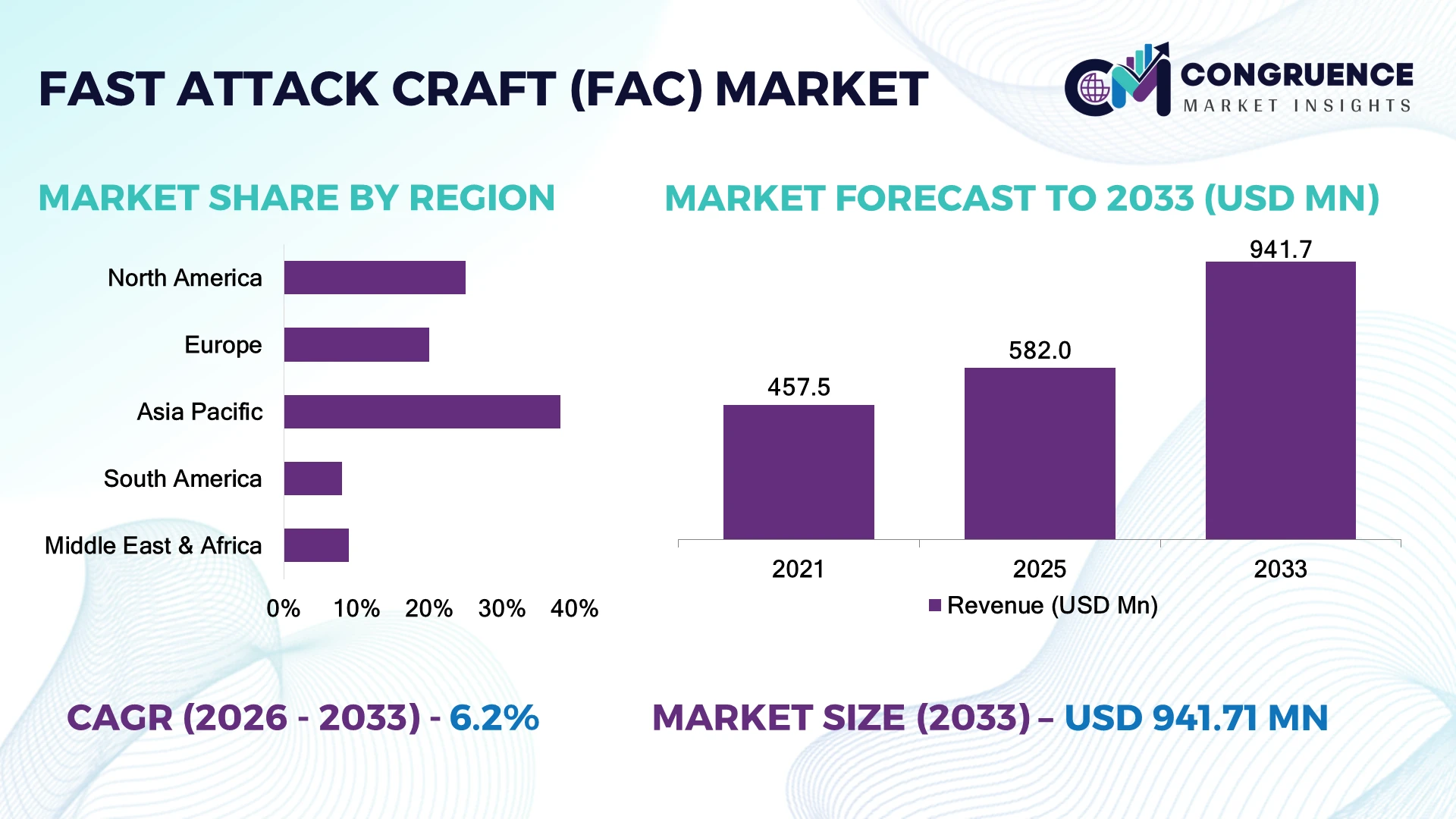
China dominates the market with approximately 28% share of global fast attack craft deployments, supported by large-scale naval expansion programs and indigenous shipbuilding capacity exceeding 20 major naval vessels annually. The United States follows with advanced littoral defense investments, while India is accelerating FAC procurement under the “Make in India” initiative, with domestic naval manufacturing participation above 60%. Compared with China’s fleet-scale approach, European operators prioritize technologically advanced, smaller-volume platforms with enhanced automation.
Strategic decisions are shifting toward digitally integrated, multi-mission craft platforms that improve maritime readiness and reduce lifecycle costs.
Market Size & Growth: USD 582.0 Million (2025) to USD 941.7 Million (2033) at 6.2% CAGR, driven by naval fleet modernization and missile-equipped coastal defense requirements.
Top Growth Drivers: Coastal security investments (35%), autonomous maritime technology adoption (28%), and regional naval modernization programs (22%) are accelerating procurement.
Short-Term Forecast: By 2028, automation integration is projected to improve operational efficiency by 20% and reduce crew requirements by 15%.
Emerging Technologies: AI-enabled navigation, autonomous control systems, electronic warfare modules, and advanced composite materials are reshaping FAC capabilities.
Regional Leaders: Asia-Pacific expected to exceed USD 400 Million by 2033 with fleet expansion; North America near USD 250 Million with digital defense upgrades; Europe approaching USD 200 Million through modernization programs.
Consumer/End-User Trends: Naval forces adopting network-centric FAC systems increased by nearly 30% as maritime surveillance priorities expand.
Pilot/Case Example: In 2023, advanced missile FAC deployments improved coastal response effectiveness by approximately 25% through integrated targeting systems.
Competitive Landscape: Leading manufacturers include approximately 15–20% combined influence from major players such as Damen Shipyards, Fincantieri, Lürssen, Israel Shipyards, and BAE Systems.
Regulatory & ESG Impact: Green propulsion initiatives are targeting 20% lower maritime emissions through hybrid-electric naval vessel technologies.
Investment & Funding: Global defense shipbuilding investments exceeded USD 100 Billion annually, supporting partnerships, indigenous production, and supply-chain localization.
Innovation & Future Outlook: Next-generation FAC platforms are shifting toward autonomous swarming, AI-based combat systems, and modular mission configurations.
Fast Attack Craft (FAC) platforms are becoming essential assets for coastal defense, maritime interception, and rapid-response missions, particularly across Asia-Pacific and Middle Eastern naval operations. Demand is increasing for missile-equipped vessels, hybrid propulsion systems, and digitally connected combat networks, with autonomous maritime technologies receiving more than 30% higher research attention across defense programs. Rising geopolitical tensions in the South China Sea and strategic maritime corridors are encouraging governments to strengthen local shipbuilding capabilities and secure critical naval supply chains. The market is transitioning toward smarter, faster, and more adaptable maritime platforms.
Fast Attack Craft (FAC) platforms are becoming strategically important as naval forces prioritize distributed maritime defense, rapid interception capability, and cost-efficient fleet expansion. Rising geopolitical competition in regions such as the South China Sea, Persian Gulf, and Indo-Pacific is accelerating investments in agile combat vessels capable of protecting coastal assets and supporting asymmetric warfare operations.
The market is undergoing a technology-driven transformation as traditional patrol craft are replaced by digitally connected platforms integrating AI navigation, precision weapons, and advanced communication systems. Modern composite-based FAC designs reduce structural weight by nearly 20% compared with conventional steel configurations, improving speed, fuel efficiency, and operational flexibility. Countries such as China and India emphasize fleet expansion and domestic manufacturing, while European operators focus on automation, modularity, and export-oriented solutions.
Over the next 2–3 years, naval procurement programs will increasingly prioritize unmanned support systems, electronic warfare capabilities, and integrated maritime surveillance. Companies are strengthening partnerships with defense agencies and expanding local production facilities to address supply-chain risks. Strategic advantage will depend on delivering adaptable FAC platforms that combine speed, intelligence, and mission flexibility.
Growing maritime security requirements are accelerating FAC adoption as governments expand coastal defense capabilities. Countries in Asia-Pacific are increasing naval modernization budgets, with regional defense spending rising by more than 5% annually and unmanned maritime technology investments increasing over 25%. Missile integration, advanced radar systems, and AI-based navigation are improving mission effectiveness. India’s indigenous naval programs and China’s shipbuilding expansion demonstrate the shift toward localized production and faster deployment cycles. Companies are responding through strategic partnerships, domestic manufacturing facilities, and investments in modular FAC designs. The key advantage is the ability to deliver high-speed maritime response without the cost burden of larger combat vessels.
FAC development faces constraints from advanced component costs, defense-grade electronics shortages, and specialized manufacturing requirements. Imported propulsion systems and combat electronics account for nearly 30–40% of platform complexity, creating dependency risks for emerging naval markets. Global semiconductor supply disruptions have affected defense electronics availability, increasing project timelines by approximately 10–15% in some programs. Countries including India and Turkey are reducing exposure through localization strategies and domestic defense manufacturing initiatives. Companies are diversifying suppliers, establishing regional production networks, and developing indigenous subsystems to control costs and improve delivery reliability.
The integration of autonomous technologies creates significant opportunities for next-generation FAC platforms. AI-assisted navigation, unmanned teaming, and predictive maintenance solutions are expected to improve operational efficiency by more than 20%. Defense organizations are increasing investments in autonomous maritime systems as naval forces seek lower-risk surveillance and combat operations. Middle Eastern and Asian countries are exploring digitally integrated fleets to enhance coastal monitoring capabilities. Companies are positioning through R&D partnerships, AI defense collaborations, and modular vessel architectures. The emerging opportunity lies in combining crewed FAC platforms with autonomous support vessels to create scalable maritime defense ecosystems.
Increasing digitalization introduces cybersecurity and interoperability challenges across advanced FAC platforms. Modern vessels integrate multiple electronic systems, creating vulnerabilities that require continuous upgrades and specialized expertise. Cybersecurity-related defense spending is expanding by more than 10% annually as naval forces strengthen protection against electronic threats. Countries operating mixed fleets face integration issues between legacy vessels and next-generation systems, affecting operational consistency. Companies must invest in secure communication networks, advanced training programs, and collaborative defense ecosystems. Long-term competitiveness will depend on building resilient platforms capable of operating effectively within increasingly connected maritime environments.
Autonomous Maritime Integration Fast Attack Craft platforms are adopting AI navigation, autonomous control, and unmanned support technologies, with automation adoption increasing by nearly 30% across modern naval programs. These systems reduce crew dependency by 15–20% and improve mission coordination. Companies are expanding partnerships with defense technology firms to integrate autonomous modules into next-generation FAC fleets.
Advanced Propulsion Transition Hybrid propulsion and lightweight composite structures are gaining adoption as naval operators target 20% lower fuel consumption and improved vessel endurance. Countries including India and Turkey are investing in indigenous propulsion development to reduce supply-chain dependence. Shipbuilders are scaling advanced material usage to improve speed, efficiency, and lifecycle performance.
Digital Combat Network Expansion Network-centric warfare capabilities are transforming FAC operations through integrated radar, electronic warfare, and satellite communication systems. Adoption of digitally connected platforms has increased by approximately 25%, improving real-time targeting and surveillance efficiency. Defense companies are restructuring product portfolios around modular combat systems and secure communication technologies.
Localized Naval Manufacturing Growth Supply-chain restructuring is accelerating domestic FAC production as countries seek greater defense independence. India’s local defense manufacturing programs have increased domestic participation beyond 60%, while European suppliers are strengthening regional partnerships. Companies are expanding shipyard capacity and supplier ecosystems to improve delivery timelines and reduce external dependency.
Missile-equipped Fast Attack Craft represents the leading segment, accounting for approximately 45% of market adoption due to superior strike capability, rapid deployment, and coastal defense effectiveness. These platforms are preferred by naval forces requiring high-speed response with lower operating costs than larger combat vessels. Gun-based FAC platforms maintain relevance with nearly 30% adoption, particularly for patrol and surveillance missions, while torpedo and patrol variants support specialized maritime operations. The fastest-growing segment is advanced missile FAC, driven by increasing precision-strike requirements and electronic warfare integration. Adoption of smart weapons and automated targeting systems has increased by around 25%, encouraging manufacturers to prioritize modular combat systems. Companies are investing in lightweight structures, extended-range weapons, and integrated sensors to strengthen competitive positioning.
Coastal defense is the leading application segment, representing approximately 50% of FAC deployments due to increasing maritime security requirements, border protection priorities, and rapid interception needs. Naval forces rely on FAC platforms for protecting strategic ports, offshore assets, and critical maritime routes. Patrol and surveillance applications account for nearly 30% adoption, supported by rising demand for persistent maritime monitoring. The fastest-growing application is asymmetric warfare and rapid-response missions, supported by advancements in AI-enabled targeting and network communication systems. Adoption of integrated surveillance technologies has increased by approximately 35%, enabling faster threat detection and coordinated responses. Companies are expanding FAC offerings with improved sensors, automation features, and multi-role capabilities to address evolving naval requirements.
Naval forces represent the dominant end-user segment with approximately 65% market share due to continuous fleet modernization, maritime security expansion, and strategic defense requirements. Governments are prioritizing FAC procurement as a cost-efficient alternative to larger warships, particularly for coastal operations and rapid-response missions. Defense agencies account for significant demand, while coast guards and maritime security organizations represent growing adoption areas. The fastest-growing end-user group is maritime security agencies, expanding at nearly 20% adoption growth as countries strengthen port protection and illegal activity monitoring. Coast guard modernization programs in countries such as India and Indonesia are increasing demand for advanced surveillance-equipped FAC platforms. Companies are responding through customized solutions, government partnerships, and localized manufacturing strategies.
Asia-Pacific accounted for the largest market share at 38% in 2025 however, North America is expected to register the fastest growth, expanding at a CAGR of 6.8% between 2026 and 2033.
North America holds a significant position in the Fast Attack Craft (FAC) market, supported by naval modernization programs, coastal security investments, and advanced maritime technology integration. The region contributes approximately 25% of global FAC demand, with the United States representing the largest deployment base through naval and homeland security operations. Investments in autonomous systems, electronic warfare, and high-speed patrol capabilities are increasing, with defense agencies allocating billions toward maritime technology upgrades. Partnerships between shipbuilders and defense technology providers are strengthening domestic production capabilities. The U.S. focus on distributed maritime operations is encouraging adoption of smaller, network-enabled vessels that complement larger naval platforms and improve operational flexibility.
United States Market Outlook: The United States remains the leading North American market due to extensive naval infrastructure, advanced shipbuilding capabilities, and coastal defense requirements. The country operates hundreds of fast-response maritime assets across naval and security fleets, while investments in unmanned surface vessels and digital combat networks are improving mission efficiency. Domestic manufacturers are expanding partnerships to support next-generation maritime platforms.
Europe is advancing FAC adoption through fleet replacement programs, maritime security initiatives, and demand for flexible combat platforms. The region accounts for approximately 20% of global market participation, supported by established shipbuilding industries in Germany, Italy, France, and Sweden. European operators are prioritizing modular designs, automation, and lower-emission propulsion technologies to improve operational sustainability. Defense cooperation programs are increasing cross-border production efficiency, with several naval modernization projects emphasizing advanced sensors and integrated combat systems. Shipbuilders are investing in digital engineering and customized vessel solutions to address changing maritime requirements and export opportunities.
Italy Market Outlook: Italy represents a strategically important European market due to its strong naval manufacturing ecosystem and advanced shipbuilding expertise. The country’s defense industry supports multiple maritime programs and contributes significantly to specialized vessel production. Italian shipbuilders are focusing on automation, lightweight structures, and integrated naval systems to strengthen competitiveness in domestic and international markets.
Asia-Pacific dominates the Fast Attack Craft (FAC) market with approximately 38% market share due to extensive coastal defense requirements, geopolitical tensions, and large-scale naval modernization. China, India, South Korea, and Japan are increasing investments in high-speed maritime platforms, advanced weapons systems, and domestic shipbuilding capacity. China maintains one of the world’s largest fast attack craft fleets, while India is accelerating indigenous naval production through domestic defense initiatives. Regional shipyards are improving manufacturing capabilities, with local production programs reducing foreign component dependency by more than 30%. Companies are expanding partnerships with naval agencies to deliver digitally connected and mission-specific FAC platforms.
China Market Outlook: China leads the Asia-Pacific market through large naval production capacity, extensive shipyard infrastructure, and continuous maritime expansion. The country has developed a significant fleet of missile-equipped fast attack craft and continues investing in advanced radar, communication, and weapons integration. Domestic manufacturers benefit from strong government support and large-scale naval procurement programs.
South America is experiencing gradual FAC adoption driven by maritime surveillance requirements, territorial protection, and modernization of aging naval fleets. The region represents approximately 8% of global demand, with Brazil, Chile, and Colombia accounting for major procurement activity. Limited defense budgets and infrastructure constraints influence purchasing decisions, increasing demand for cost-efficient and multi-role vessels. Regional operators are focusing on patrol, interception, and offshore security applications rather than large-scale fleet expansion. Partnerships with international shipbuilders are supporting technology transfer and maintenance capabilities. Companies are targeting customized FAC solutions that balance affordability, operational capability, and lifecycle efficiency.
Brazil Market Outlook: Brazil represents the largest South American FAC market due to its extensive coastline, offshore resource protection needs, and naval infrastructure. The country operates significant maritime security assets and continues strengthening domestic shipbuilding capabilities. Investments in coastal monitoring systems and naval modernization programs are creating opportunities for advanced patrol and rapid-response vessels.
The Middle East & Africa market is expanding through maritime defense modernization, strategic port protection, and increasing investments in naval capabilities. The region contributes around 9% of global FAC demand, with countries such as Saudi Arabia, the United Arab Emirates, Egypt, and South Africa driving procurement activity. Growing protection requirements for energy infrastructure and critical shipping routes are encouraging adoption of missile-equipped and surveillance-focused vessels. Defense partnerships with international shipbuilders are improving technology access and local maintenance capabilities. Regional operators are prioritizing advanced sensors, electronic warfare systems, and faster deployment platforms to strengthen maritime readiness.
Saudi Arabia Market Outlook: Saudi Arabia is a key Middle East market due to its strategic coastline, energy infrastructure protection requirements, and defense modernization programs. The country is expanding naval capabilities through international partnerships and local industrial development initiatives. Investments in maritime security systems and advanced patrol vessels are supporting demand for technologically enhanced FAC platforms.
The Fast Attack Craft (FAC) market features competition between global naval shipbuilders, regional defense manufacturers, and specialized maritime technology suppliers. Leading players such as Damen Shipyards, BAE Systems, Fincantieri, and Israel Shipyards compete with regional builders including Garden Reach Shipbuilders and Turkish naval contractors. The top five companies collectively account for approximately 35% of market influence, reflecting a moderately consolidated structure. Competition is based on advanced weapons integration, vessel speed, customization, and supply-chain reliability, with technology differentiation influencing nearly 40% of procurement decisions. Players are expanding through government partnerships, localized production, and modular platform development. The competitive landscape is shifting toward autonomous systems, digital combat networks, and domestic manufacturing control. High capital requirements, defense certifications, and specialized engineering capabilities create significant entry barriers. Winning requires combining advanced maritime technology, cost efficiency, rapid delivery, and long-term defense partnerships.
BAE Systems
Fincantieri S.p.A.
Israel Shipyards Ltd.
Lürssen Group
Naval Group
Austal Limited
Garden Reach Shipbuilders & Engineers Ltd.
Goa Shipyard Limited
ST Engineering Marine
Dearsan Shipyard
Hyundai Heavy Industries
CMN Naval
Huntington Ingalls Industries
Fast Attack Craft technology is shifting toward AI-enabled navigation, autonomous assistance, and integrated combat management systems. Modern FAC platforms using AI-based decision support improve mission coordination by approximately 20% compared with conventional manual systems. Adoption of autonomous maritime technologies is increasing as naval operators seek lower crew requirements and faster response capabilities. Companies investing in AI integration, sensor fusion, and predictive maintenance are gaining operational advantages.
Advanced propulsion systems and composite materials are transforming vessel efficiency and performance. Hybrid propulsion solutions reduce fuel consumption by nearly 15–25% compared with traditional propulsion systems while improving endurance. Lightweight composite structures provide approximately 20% weight reduction over conventional materials, enabling higher speeds and improved maneuverability. Shipbuilders are adopting these technologies to meet sustainability targets and enhance platform competitiveness.
Electronic warfare systems, network-centric communication, and unmanned teaming will shape FAC development between 2026 and 2028. Digitally connected vessels improve battlefield awareness by nearly 30% through real-time data sharing. Global leaders benefit from technology integration capabilities, while regional manufacturers compete through customization and cost-effective solutions. The next competitive advantage will depend on secure, intelligent, and modular maritime platforms.
February 2025 Israel Shipyards Ltd. began production activities for the Reshef-class multi-mission naval vessels in partnership with Israel’s Ministry of Defense and Navy. The program includes 5 advanced vessels valued at approximately USD 780 million, strengthening domestic naval manufacturing and replacing aging combat platforms. Source: www.mod.gov.il
March 2025 Damen Shipyards Group delivered the Combat Support Ship Den Helder to the Royal Netherlands Navy, marking a major naval modernization milestone. The vessel completed sea acceptance testing, including replenishment operations, improving fleet support capability and strengthening Damen’s position in European defense shipbuilding. Source: www.damen.com
February 2026 Damen Shipyards Group announced a licensing agreement with Blue Water Autonomy for the Liberty Class autonomous vessel program supporting U.S. Navy requirements. The 60-meter autonomous platform offers over 10,000 nautical miles range and more than 150 tonnes payload capacity, accelerating unmanned maritime capability development. Source: www.damen.com
March 2026 Fincantieri S.p.A. reported continued defense-sector expansion with record order intake and increased shipbuilding activity. The company achieved a EUR 20.3 billion order intake in 2025, supporting naval production capacity expansion and strengthening its position in advanced maritime defense solutions.
The Fast Attack Craft (FAC) Market Report covers comprehensive analysis across vessel types, including missile-equipped craft, patrol craft, torpedo platforms, and specialized fast-response vessels. The report evaluates applications such as coastal defense, surveillance, maritime security, and rapid-response operations, along with end-users including naval forces, coast guards, and defense agencies. Regional assessment includes North America, Europe, Asia-Pacific, South America, and Middle East & Africa.
The report analyzes emerging technologies including autonomous navigation, advanced propulsion, composite materials, electronic warfare, and integrated combat systems. It provides strategic insights into deployment patterns, modernization programs, supply-chain developments, and competitive positioning across major industry participants. Coverage supports investment planning, market expansion decisions, partnership strategies, and technology prioritization from 2026 to 2033, with emphasis on evolving maritime defense requirements and future operational capabilities.
| Report Attribute / Metric | Details |
|---|---|
| Market Revenue (2025) | USD 582.0 Million |
| Market Revenue (2033) | USD 941.7 Million |
| CAGR (2026–2033) | 6.2% |
| Base Year | 2025 |
| Forecast Period | 2026–2033 |
| Historic Period | 2021–2025 |
| Segments Covered |
By Type
By Application
By End-User
|
| Key Deliverables | Revenue Forecast; Market Trends; Growth Drivers & Restraints; Technology Insights; Segmentation Analysis; Regional Insights; Competitive Landscape; Regulatory & ESG Overview; Recent Developments |
| Regions Covered | North America; Europe; Asia-Pacific; South America; Middle East & Africa |
| Companies Profiled | Damen Shipyards Group; BAE Systems; Fincantieri S.p.A.; Israel Shipyards Ltd.; Lürssen Group; Naval Group; Austal Limited; Garden Reach Shipbuilders & Engineers Ltd.; Goa Shipyard Limited; ST Engineering Marine; Dearsan Shipyard; Hyundai Heavy Industries; CMN Naval; Huntington Ingalls Industries |
| Customization & Pricing | Available on Request (10% Customization Free) |




