
Reports
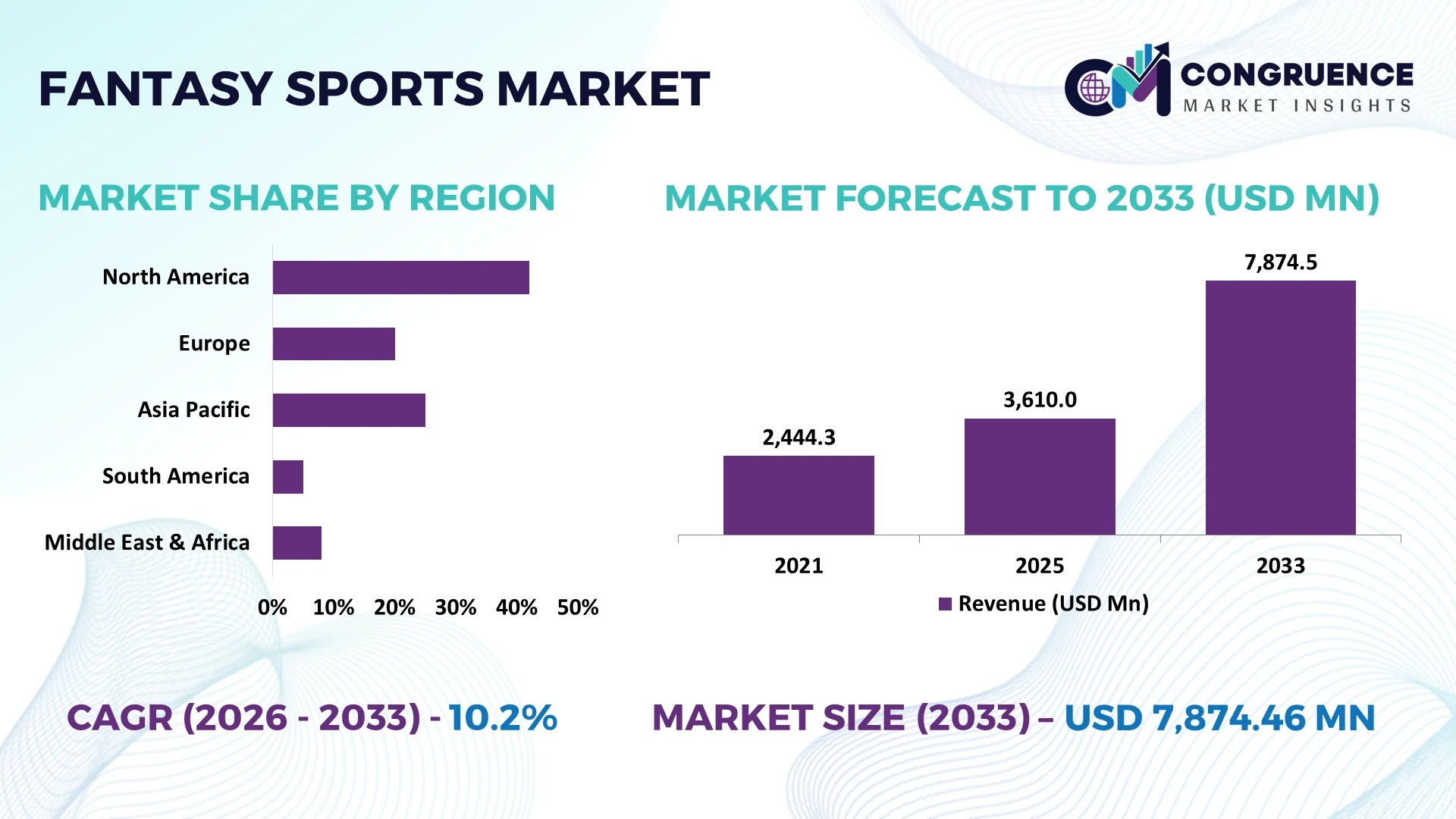
The Global Fantasy Sports Market was valued at USD 3610 Million in 2025 and is anticipated to reach a value of USD 7874.46 Million by 2033 expanding at a CAGR of 10.24% between 2026 and 2033. Growth is driven by mobile-first fantasy platforms, live sports-data integration, AI-assisted lineup analytics, expanding sports-media engagement, and deeper crossover between fantasy participation and regulated sports betting.
The United States remains the dominant country market, supported by mature NFL, NBA, MLB, and NHL fantasy ecosystems and approximately 50 million adult fantasy participants in established industry benchmarks. Fantasy sports participation reaches about 19% of U.S. adults, with football played by 79% of fantasy users, creating exceptional engagement concentration around the NFL calendar. Canada provides a smaller but established comparison, while India’s 2025 prohibition on online money games has sharply altered Asia’s real-money fantasy landscape and redirected operators toward free-to-play, social, and international models.
Strategically, platforms should prioritize U.S. engagement monetization, AI-enabled personalization, diversified sports portfolios, and regulatory-resilient product structures rather than relying on cash-contest expansion.
Market Size & Growth: USD 3,610 million in 2025 advances to USD 7,874.46 million by 2033 at 10.24% CAGR, supported by mobile engagement and real-time sports data.
Top Growth Drivers: U.S. adult fantasy participation reaches 19%, football attracts 79% of fantasy players, and 75% of fantasy users also engage with sports betting.
Short-Term Forecast: By 2028, AI-assisted personalization and automated lineup intelligence are positioned to reduce manual content-processing workloads by approximately 20–30% across advanced platforms.
Emerging Technologies: Generative AI, predictive analytics, and real-time data automation are reshaping fantasy decisions; 25% of fantasy players and sports bettors used AI tools by 2026.
Regional Leaders: North America remains the largest market, Europe strengthens football-led adoption, while Asia-Pacific restructures after India’s 2025 regulatory intervention in real-money online gaming.
Consumer/End-User Trends: North American fantasy and sports-gaming participation reached 90.3 million people in 2026, while 51% of U.S. participants engaged in both fantasy sports and sports betting.
Pilot/Case Example: FSGA’s 2026 research found 25% AI-tool adoption among fantasy and betting participants, demonstrating measurable migration toward algorithm-supported player research and decision workflows.
Competitive Landscape: DraftKings remains a major U.S. platform with approximately 4 million average monthly unique payers in 2025, competing with FanDuel, Yahoo Fantasy, ESPN Fantasy, and Sleeper.
Regulatory & ESG Impact: India’s 2025 Gaming Act prohibits 100% of online money games covered by its definition, forcing fantasy operators to separate social engagement from real-money mechanics.
Investment & Funding: DraftKings acquired Jackpocket for approximately USD 750 million in 2024, illustrating continued investment in adjacent digital engagement and customer-acquisition ecosystems.
Innovation & Future Outlook: AI usage reached 25% among fantasy and betting participants in 2026, shifting platform differentiation toward personalized analysis, conversational interfaces, automated recommendations, and transparent AI-assisted experiences.
The Fantasy Sports Market is evolving around mobile participation, live statistical feeds, personalized content, AI-assisted lineup tools, and deeper integration with sports-media ecosystems. Football remains the strongest engagement engine, played by 79% of fantasy participants in established North American research, while basketball, baseball, soccer, and emerging formats diversify seasonal activity. AI-supported decision tools are becoming a distinct product layer, although India’s prohibition of online money games is forcing major strategic restructuring. These shifts place engagement depth, regulatory adaptability, data quality, and product diversification at the center of the market’s strategic discussion.
Fantasy sports is becoming strategically important because platforms now compete for year-round sports attention rather than seasonal contest participation. North America recorded 90.3 million fantasy and sports-gaming participants in 2026, while 51% engaged with both fantasy sports and sports betting. India’s 2025 prohibition of online money games fundamentally altered a major operating model, pushing platforms toward free-to-play engagement, subscriptions, advertising, and international diversification.
Technology is simultaneously changing platform economics. AI-driven player analysis can automate data-intensive research workflows by roughly 20–30% compared with manual statistical evaluation, while 25% of fantasy and betting participants already used AI tools in 2026. The United States leads monetized multi-sport engagement; Europe remains football-centric, while India is restructuring around non-wagering formats. Through 2026–2028, personalization, conversational AI, and real-time micro-content will become increasingly embedded within fantasy interfaces.
A practical deployment combines live player feeds with AI-generated projections, injury alerts, and personalized lineup recommendations during games. Platforms are expanding data partnerships and integrating media, streaming, and social functionality to extend session duration. Competitive advantage will depend on proprietary engagement data, regulatory-resilient monetization, and the ability to convert live sports consumption into persistent digital participation.
Mobile-first sports consumption is strengthening fantasy participation by connecting live viewing, player statistics, social interaction, and lineup management within a single workflow. Approximately 19% of U.S. adults participate in fantasy sports, while football attracts about 79% of fantasy users and 51% of fantasy and betting participants engage in both activities. The migration of sports broadcasting toward streaming and second-screen viewing makes real-time fantasy interaction easier during matches. U.S. platforms are responding with instant notifications, live scoring, personalized projections, and integrated social features rather than relying on pre-game roster management. Operators are also extending coverage across basketball, baseball, golf, and soccer. Strategically, mobile engagement converts individual sporting events into recurring digital sessions, increasing retention opportunities without requiring additional sports inventory.
Regulatory divergence remains the principal structural restraint because fantasy contest classification varies sharply across jurisdictions. India’s 2025 online-gaming legislation prohibited money-based online games covered by the national framework, disrupting a country where fantasy platforms had accumulated more than 100 million users. In the United States, fantasy sports legality and permitted contest formats remain state-dependent, while operators must manage age verification, consumer protection, and responsible-play requirements. This fragmentation raises compliance expenditure and prevents standardized global monetization. Real-money operators face particularly high exposure because regulatory changes can immediately restrict deposits, contests, or advertising. Companies are reducing concentration risk through free-to-play formats, subscription products, geographic diversification, and jurisdiction-specific compliance systems. The strategic constraint is not user interest but the portability of monetization models across national and state boundaries.
AI creates an opportunity to transform fantasy platforms from contest interfaces into continuous sports-intelligence services. Around 25% of fantasy and sports-betting participants used AI tools in 2026, while football accounts for approximately 79% of fantasy participation, leaving substantial scope to transfer AI-assisted engagement into basketball, baseball, soccer, and golf. Generative interfaces can automate player comparisons, injury interpretation, lineup optimization, and personalized content, potentially reducing manual research workloads by 20–30%. U.S. operators are integrating proprietary statistics with conversational tools, while European platforms can adapt similar technology to football-focused audiences. Companies are investing in machine learning, sports-data partnerships, recommendation engines, and subscription analytics. The less obvious opportunity is monetizing intelligence itself: premium analytical tools can generate recurring value independently of paid-entry contests.
Real-time data complexity creates a long-term execution challenge as fantasy outcomes increasingly depend on instantaneous player statistics, injuries, substitutions, and official scoring adjustments. Major sports can generate millions of data events across a season, while users expect scoring updates within seconds and service availability approaching 99.9% during peak fixtures. AI adds another risk layer: 25% user adoption of AI tools increases pressure to distinguish verified statistics from inaccurate generated recommendations. High-profile NFL, NBA, and cricket events can concentrate enormous traffic into narrow time windows, magnifying latency and infrastructure failures. Platforms must invest in redundant data feeds, scalable cloud infrastructure, model validation, cybersecurity, and transparent scoring governance. Long-term competitiveness depends on delivering speed without sacrificing statistical accuracy, because one incorrect high-impact scoring event can damage trust across an entire user community.
Free-to-Play Models Gain Priority: India’s 2025 prohibition on online money games has forced platforms serving more than 100 million historical fantasy users to restructure contest mechanics. Operators are shifting toward free leagues, advertising, subscriptions, and sponsored competitions, while preserving engagement infrastructure. With fantasy participation reaching roughly 19% of U.S. adults, geographically diversified companies are allocating product resources toward formats that remain viable across different regulatory regimes.
Second-Screen Engagement Intensifies Rapidly: Fantasy platforms increasingly synchronize live scoring, injury notifications, player tracking, and interactive statistics with televised and streamed matches. Football attracts approximately 79% of fantasy participants, while 51% of fantasy and betting users participate in both activities. Operators are integrating real-time feeds and push notifications, turning match windows into high-frequency interaction periods and increasing the commercial importance of low-latency sports-data partnerships.
Private Communities Strengthen Retention: Platforms are emphasizing commissioner tools, private leagues, messaging, and shareable competitions as acquisition costs push operators toward retention-led economics. North American fantasy and sports-gaming participation reached 90.3 million people in 2026, creating substantial network effects. Companies are improving invitations, league history, customizable scoring, and social functionality because established peer groups create switching friction that transactional contests cannot replicate easily.
Multi-Sport Calendars Reduce Seasonality: Operators are expanding beyond football into basketball, baseball, hockey, cricket, and esports to sustain year-round activity. Football still captures 79% of fantasy users, highlighting substantial concentration risk. Platforms are automating sport-specific scoring and content workflows while partnering with data providers, enabling faster launches across additional competitions and reducing dependence on a single league calendar.
Daily Contests represent the leading type with an estimated 35–40% market share, supported by rapid contest turnover, flexible participation, scalable digital operations, and strong alignment with individual match schedules. Unlike Season-Long Leagues, daily formats remove extended commitment requirements and create repeated engagement opportunities throughout a sporting calendar. Season-Long Leagues remain strategically important among established football and baseball audiences because persistent team ownership strengthens retention. Head-to-Head Contests attract users seeking direct competition with simpler winner structures.
Tournament Contests represent the fastest-growing type as platforms use larger participant pools, tiered formats, and event-linked competitions to concentrate engagement around major fixtures. Tournament participation can generate several engagement opportunities within a single sports week, while Private Leagues provide differentiated value through invitation-based communities and customized scoring. Platforms are improving contest discovery, automated lineup tools, social functionality, and personalized notifications. Investment is therefore shifting toward flexible contest engines capable of supporting daily, tournament, private, and season-long structures without separate technology stacks.
Football leads the application segment with approximately 40–45% of global fantasy activity, driven primarily by the NFL’s concentrated U.S. audience and extensive European football participation. Approximately 79% of North American fantasy players participate in fantasy football, creating exceptionally high user concentration around weekly fixtures. Basketball provides stronger year-round frequency through larger game schedules, while Baseball retains an established statistical culture that aligns naturally with fantasy analytics. Hockey remains concentrated in Canada and northern U.S. markets.
Esports represents the fastest-growing application as digitally native audiences respond to data-rich competitive gaming, frequent tournaments, and global streaming distribution. Cricket remains strategically significant, particularly among Indian, British, Australian, and South Asian audiences, although India’s regulatory restructuring has altered real-money contest economics. Platforms are diversifying sports coverage, automating scoring feeds, and adapting interfaces to sport-specific statistics. The business priority is reducing football dependence while transferring established fantasy mechanics into sports offering more frequent competitive events.
Individual Players represent the largest end-user segment with approximately 45–50% of participation, reflecting direct mobile access, simplified onboarding, and widespread availability of public contests. Their activity concentrates around lineup creation, player statistics, rankings, and match-day interaction. Sports Enthusiasts represent a broader engagement cohort using fantasy products as extensions of live sports consumption, while Professional Sports Fans typically demonstrate stronger team knowledge, statistical engagement, and willingness to maintain participation across complete seasons.
Fantasy Sports Communities represent the fastest-growing end-user segment as private groups, social competition, commissioner functionality, and persistent league histories strengthen network-based retention. Approximately 51% of U.S. fantasy and sports-gaming participants engage in both fantasy and sports betting, while total North American participation reached 90.3 million in 2026. Platforms are responding with community messaging, personalized scoring, private contests, loyalty mechanisms, and cross-sport profiles. Competitive investment is shifting from acquiring isolated users toward preserving connected groups whose social relationships create stronger retention and lower switching propensity.
North America accounted for the largest market share at approximately 46% in 2025 however, Europe is expected to register the fastest growth, expanding at a CAGR of approximately 11.8% between 2026 and 2033.

Integrated Sports Engagement Strengthens Platform Economics
North America accounts for approximately 46% of global fantasy sports activity, supported by mature NFL, MLB, NBA, and NHL ecosystems, high smartphone penetration, and established fantasy communities. The United States and Canada together reached 90.3 million fantasy and sports-gaming participants in 2026, demonstrating substantial digital engagement capacity. Football remains the primary acquisition channel, with approximately 79% of fantasy participants playing the sport. Operators increasingly connect fantasy contests with live statistics, streaming content, social communities, and personalized analytics rather than maintaining standalone game interfaces. The overlap between fantasy and regulated sports betting is also reshaping platform economics, with 51% of participants engaging in both activities. DraftKings, FanDuel, ESPN, Yahoo, and Sleeper are consequently competing through product integration, data depth, mobile experience, and broader year-round sports engagement.
United States Market Outlook: The United States provides the market’s deepest professional-sports infrastructure and strongest monetization ecosystem. Approximately 19% of U.S. adults participate in fantasy sports, creating a substantial addressable audience across multiple leagues. Extensive NFL media consumption, legalized sports wagering in numerous states, and mature sports-data infrastructure support sophisticated personalization, live scoring, and cross-platform customer engagement.
Football Ecosystems Drive Digital Participation
Europe represents approximately 20% of global fantasy sports activity, with football providing the central engagement engine across the United Kingdom, Germany, Spain, Italy, and France. Fantasy participation is closely linked with domestic leagues, UEFA competitions, sports-media platforms, and official club ecosystems. The English Premier League’s official fantasy game has attracted more than 11 million teams during recent seasons, demonstrating the scalability of free-to-play league-linked formats. European operators increasingly emphasize official data feeds, private leagues, multilingual applications, and mobile-first engagement rather than U.S.-style multi-sport portfolios. Regulatory differences surrounding gambling and paid contests encourage platforms to separate fantasy mechanics from wagering products in selected jurisdictions. Partnerships with leagues, broadcasters, clubs, and sports-data companies strengthen user acquisition while reducing dependence on expensive performance marketing.
United Kingdom Market Outlook: The United Kingdom combines exceptional Premier League engagement with advanced digital media and sports-data infrastructure. Fantasy Premier League provides a large recurring user funnel extending across the entire football season. Operators benefit from high smartphone adoption, sophisticated sports audiences, and established football analytics, supporting premium statistics, community competitions, and personalized fantasy content.
Regulatory Reset Reshapes Platform Strategy
Asia-Pacific represents approximately 25% of fantasy sports activity, but its operating structure changed materially after India’s 2025 prohibition of online money games. India previously supported an enormous fantasy user base exceeding 100 million registered participants, primarily concentrated around cricket. Operators are consequently restructuring toward free-to-play formats, advertising, sponsorship, content, and overseas markets while reducing dependence on paid-entry contests. Australia provides a mature sports environment spanning Australian football, cricket, rugby, and basketball, while Japan and South Korea offer digitally sophisticated audiences for baseball and esports-oriented fantasy products. High smartphone penetration and extensive live-sports consumption remain important infrastructure advantages. Companies are redesigning monetization, strengthening compliance functions, and broadening sports portfolios. The region’s strategic opportunity has therefore shifted from cash-contest scale toward sustainable engagement economics.
India Market Outlook: India remains strategically important because cricket delivers exceptional digital sports engagement despite the regulatory reset affecting money-based online gaming. The IPL attracts hundreds of millions of digital viewers during each season, creating substantial demand for statistics, predictions, social competitions, and free fantasy experiences. Platforms are redirecting technology and brand assets toward compliant engagement models and international operations.
Football Engagement Creates Mobile Opportunity
South America represents approximately 5% of global fantasy sports activity, with demand concentrated around football competitions in Brazil, Argentina, Colombia, and Chile. Brazil provides the largest addressable audience because of its population scale, extensive smartphone usage, national football ecosystem, and strong engagement with domestic and international competitions. Internet penetration exceeds 80% across several major markets, giving fantasy operators a substantial mobile distribution foundation. However, monetization remains less mature than in North America, while regulatory frameworks and payment behavior differ considerably between countries. Operators increasingly combine fantasy contests with sports-media content, social features, statistics, and localized payment infrastructure. Partnerships with football organizations and media platforms improve acquisition efficiency, while free-entry competitions provide a practical route for building audiences before introducing additional monetization layers.
Brazil Market Outlook: Brazil provides the strongest country opportunity through its football culture and large digitally connected population. More than 180 million people use the internet, creating significant distribution scale for mobile fantasy products. Brasileirão, Copa Libertadores, and European football generate recurring engagement windows that support localized scoring, player analytics, private leagues, and sponsor-backed competitions.
Mobile Sports Consumption Broadens Participation
Middle East & Africa represents approximately 4% of fantasy sports activity, with adoption concentrated in football, cricket, and digitally engaged urban populations. Gulf markets benefit from high smartphone penetration, advanced telecommunications infrastructure, and expanding investment in professional sports. Saudi Arabia’s sports transformation, including major football investments and international events, is increasing digital fan engagement, while the UAE provides a strong expatriate audience for cricket and European football. Across Africa, South Africa, Nigeria, and Kenya offer expanding mobile sports communities, although payment infrastructure and regulatory differences limit uniform monetization. Operators are emphasizing lightweight mobile platforms, free contests, localized content, and telecommunications partnerships. The strongest operational opportunity lies in converting growing sports audiences into persistent digital communities rather than immediately replicating mature-market paid contest structures.
Saudi Arabia Market Outlook: Saudi Arabia combines near-universal internet access with accelerating investment in football, esports, and digital entertainment under Vision 2030. The Saudi Pro League’s international player acquisitions have increased global visibility, creating stronger demand for statistics and interactive fan experiences. Mobile-first fantasy formats can complement league, club, broadcaster, and sponsor engagement strategies.
DraftKings, FanDuel, Yahoo Fantasy, ESPN Fantasy, and Sleeper compete for North American multi-sport engagement, while football-focused and regional platforms target localized audiences. The top five platforms collectively control an estimated 55–60% of commercially monetized fantasy activity in established markets. Competition centers on user retention, data quality, contest depth, and acquisition efficiency; football reaches 79% of fantasy participants, while 51% of fantasy and betting users participate in both categories. DraftKings and FanDuel leverage broader gaming ecosystems, ESPN and Yahoo exploit media distribution, and Sleeper differentiates through social-first communities. Players are expanding through league partnerships, AI analytics, cross-sport products, and integrated content. Regulation is shifting competition toward free-to-play and subscription models in restricted jurisdictions. Licensing, official sports data, customer acquisition costs, and established network effects create substantial entry pressure. Winning requires proprietary engagement data, trusted scoring, deep sports coverage, efficient retention, and monetization models adaptable to jurisdiction-specific regulation without weakening user experience or community scale.
DraftKings
FanDuel
Yahoo Fantasy Sports
ESPN Fantasy Sports
Sleeper
Underdog Fantasy
PrizePicks
Sorare
Dream11
My11Circle
RealFevr
Fantrax
SuperDraft
OwnersBox
Current fantasy sports technology combines real-time data APIs, cloud scoring engines, mobile applications, recommendation systems, and automated contest management. Low-latency feeds update player events within seconds, while cloud autoscaling supports traffic surges around major fixtures. Mobile dominates participation, with about 85% of Yahoo Fantasy users accessing through mobile devices. Operators gain faster scoring, lower administration costs, and stronger match-day retention.
Emerging stacks integrate generative AI, machine learning, computer vision data, and conversational assistants into drafting and roster workflows. AI-supported research can compress manual player-comparison workflows by roughly 20–30%, while 25% of fantasy and sports-betting participants used AI tools in 2026. Compared with legacy spreadsheet research, automated projection engines process datasets instantly. Platforms with proprietary historical data benefit most because differentiated models strengthen personalization without relying entirely on third-party analysis.
Disruptive development centers on agentic assistants, personalized simulations, and unified media-game interfaces that continuously interpret injuries, lineups, probabilities, and live events. Integration with streaming and official league data reduces application switching and creates richer second-screen experiences. Through 2026–2028, AI-generated draft guidance, automated roster alerts, and predictive personalization will move deeper into mainstream products. Operators investing now gain faster content production, stronger retention, and scalable differentiation as basic scoring functionality becomes commoditized.
August 2024 Yahoo Sports redesigned Yahoo Fantasy after roughly seven years without a major UX overhaul, adding three navigation tabs and more than 100 team logos. With 85% of users on mobile, the redesign strengthened mobile-first roster management. Source: yahooinc.com
September 2025 Allwyn agreed to acquire a 62% majority stake in PrizePicks, positioning the fantasy operator as its primary U.S. platform. The transaction strengthened PrizePicks’ expansion capacity while connecting daily fantasy operations with a broader international gaming portfolio. Source: reuters.com
September 2025 DraftKings signed a multi-year NBCUniversal collaboration spanning major properties including NFL, NBA, NCAA, PGA Tour, and Premier League coverage. Exclusive digital sponsorship rights expanded fantasy-sports distribution across a broad premium sports-media portfolio and strengthened audience acquisition. Source: draftkings.com
April 2026 PrizePicks became an Official Daily Fantasy Sports Partner of the NBA under a multi-year agreement, gaining league, team, and event intellectual-property rights. The partnership expanded basketball-focused fantasy engagement through approved digital products, promotions, and co-marketing campaigns. Source: prizepicks.com
The Fantasy Sports Market report evaluates Daily Contests, Season-Long Leagues, Head-to-Head Contests, Tournament Contests, and Private Leagues across Cricket, Football, Basketball, Baseball, Hockey, and Esports. Daily Contests represent approximately 35–40% of type-level activity, while football captures roughly 40–45% of application demand, reflecting strong concentration around recurring professional fixtures and established fantasy communities.
Coverage includes Individual Players, Sports Enthusiasts, Professional Sports Fans, and Fantasy Sports Communities across North America, Europe, Asia-Pacific, South America, and Middle East & Africa. Technology analysis addresses real-time data feeds, cloud scoring, AI projections, automated personalization, conversational assistants, and mobile engagement infrastructure. The 2026–2033 assessment supports investment planning, regulatory diversification, geographic expansion, partnership selection, competitive positioning, and product strategy as platforms increasingly prioritize AI-enabled intelligence, community retention, multi-sport engagement, and regulatory-resilient monetization.
| Report Attribute/Metric | Report Details |
|---|---|
Market Revenue in 2025 | USD 3610 Million |
Market Revenue in 2033 | USD 7874.46 Million |
CAGR (2026 - 2033) | 10.24% |
Base Year | 2025 |
Forecast Period | 2026 - 2033 |
Historic Period | 2021 - 2025 |
Segments Covered | By Type
By Application
By End-User
|
Key Report Deliverable | Revenue Forecast, Growth Trends, Market Dynamics, Segmental Overview, Regional and Country-wise Analysis, Competition Landscape |
Region Covered | North America, Europe, Asia-Pacific, South America, Middle East, Africa |
Key Players Analyzed | DraftKings, FanDuel, Yahoo Fantasy Sports, ESPN Fantasy Sports, Sleeper, Underdog Fantasy, PrizePicks, Sorare, Dream11, My11Circle, RealFevr, Fantrax, SuperDraft, OwnersBox |
Customization & Pricing | Available on Request (10% Customization is Free) |




