
Reports
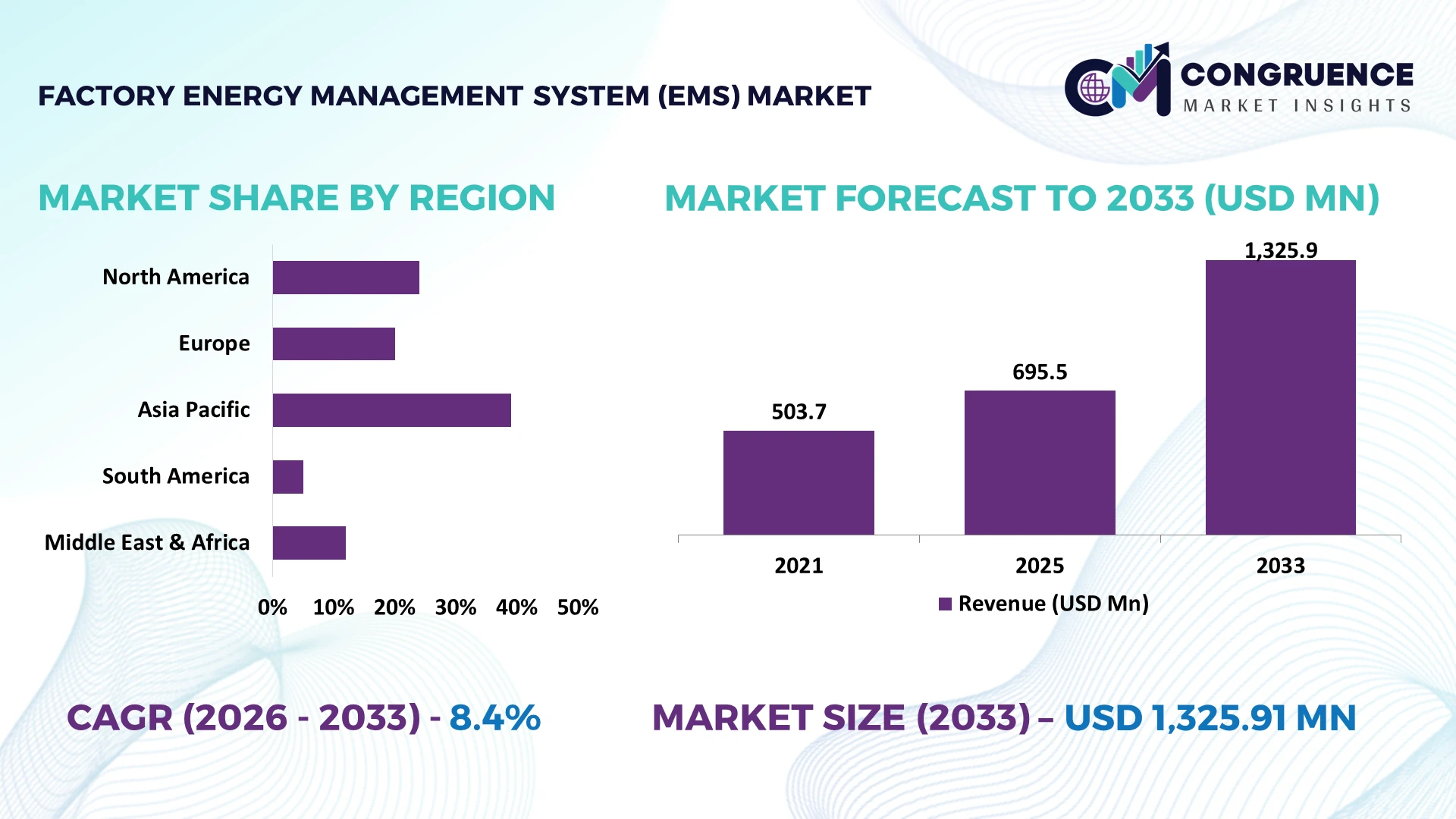
The Global Factory Energy Management System (EMS) Market was valued at USD 695.47 Million in 2025 and is anticipated to reach a value of USD 1325.91 Million by 2033 expanding at a CAGR of 8.4% between 2026 and 2033. Growth is driven by AI-enabled energy monitoring, ISO 50001 implementation, industrial electrification, and factory-level integration of renewable generation, storage, and automated demand-response systems.
China remains the dominant country market, supported by 14,459 ISO 50001-certified organizations, representing about 38% of global certifications, alongside more than USD 625 billion in clean-energy investment in 2024. Germany follows with 6,524 certifications, giving China more than twice Germany’s certification base. Chinese manufacturing, electronics, chemicals, metals, and automotive plants are accelerating digital EMS deployment as energy-security priorities intensify.
Strategically, suppliers should prioritize AI-integrated EMS platforms and scalable factory architectures in China and Germany, where certification, industrial efficiency, and energy-security investments are converging.
Market Size & Growth: USD 695.47 million in 2025 to USD 1,325.91 million by 2033, with 8.4% CAGR driven by AI-based optimization and industrial electrification.
Top Growth Drivers: AI analytics 28%, automation 24%, renewable integration 19% are reshaping factory energy controls.
Short-Term Forecast: By 2028, advanced EMS deployments target 8–12% lower energy costs and 10% higher operational efficiency.
Emerging Technologies: AI forecasting, digital twins, IoT sensors, and automated demand response are becoming core EMS capabilities.
Regional Leaders: Asia-Pacific leads with an estimated USD 560 million by 2033, Europe approaches USD 365 million, while North America exceeds USD 285 million, supported by digital factory upgrades.
Consumer/End-User Trends: Around 38% of global ISO 50001 certifications are concentrated in China, reflecting accelerating industrial energy-management adoption.
Pilot/Case Example: In 2025, BASF’s Rudong site achieved Zero-Carbon Factory verification alongside ISO 50001 certification, demonstrating integrated energy and carbon management.
Competitive Landscape: Siemens, Schneider Electric, ABB, Honeywell, and Rockwell Automation lead advanced factory EMS deployment, with leading vendors capturing roughly 10–15% individually across targeted industrial niches.
Regulatory & ESG Impact: China recorded an 11.6% reduction in energy consumption per GDP unit during the first four years of its 14th Five-Year Plan, strengthening industrial efficiency priorities.
Investment & Funding: China exceeded USD 625 billion in clean-energy investment in 2024, while USD 88 billion was directed toward transmission and distribution investment in 2025, reinforcing smart-energy infrastructure demand.
Innovation & Future Outlook: Next-generation EMS platforms are shifting toward autonomous optimization, predictive maintenance, digital twins, storage coordination, and real-time carbon intelligence as global supply chains prioritize resilient, lower-energy manufacturing.
Factory Energy Management System (EMS) demand is strongest across automotive, electronics, chemicals, metals, pharmaceuticals, food processing, and other energy-intensive production environments where real-time visibility directly influences operating costs. AI-enabled forecasting and IoT-connected meters are increasing automated energy optimization, while ISO 50001 adoption is reinforcing structured energy-performance management. Empirical evidence from Chinese manufacturing indicates ISO 50001 adoption reduced energy intensity by approximately 26%, strengthening the business case for digitally managed factories. As manufacturers respond to energy-security pressures and increasingly stringent carbon requirements, EMS is becoming a strategic layer connecting production efficiency with broader industrial decarbonization.
Factory Energy Management System (EMS) is becoming a competitive infrastructure layer as manufacturers face volatile electricity costs, tighter carbon requirements, and increasingly digital production environments. Unlike legacy meter-based monitoring, AI-enabled EMS platforms can combine real-time IoT data, production schedules, and predictive analytics to deliver 8–15% better energy efficiency while reducing manual monitoring requirements. This shift is particularly important as supply chains move toward localized, energy-efficient manufacturing.
Germany and Japan emphasize highly automated, precision-oriented EMS deployment, while China is scaling adoption across large electronics, automotive, chemicals, and metals factories. China’s extensive industrial base creates greater deployment volume, whereas Germany places stronger emphasis on integrated automation, energy optimization, and industrial decarbonization. Over the next 2–3 years, industrial users are expected to prioritize systems capable of delivering 5–10% measurable energy savings, automated demand response, and carbon-performance reporting.
Operationally, manufacturers are integrating EMS with SCADA, MES, smart meters, onsite solar, and battery systems rather than deploying standalone platforms. Vendors are responding through cloud partnerships, AI development, and bundled automation offerings. Strategically, EMS is shifting from an energy-monitoring expense into a production-optimization asset that strengthens cost control, compliance readiness, and competitive positioning.
AI-driven energy analytics is accelerating EMS adoption as factories seek measurable control over electricity-intensive operations. Advanced systems can improve energy efficiency by 8–15%, while automated demand-response functions can reduce peak consumption by approximately 5–10%. In China, electronics and automotive manufacturing hubs are increasingly integrating EMS with IoT meters, MES, and production-control platforms. This creates a structural shift from retrospective energy reporting toward predictive optimization. Companies are responding by expanding software partnerships, embedding machine-learning capabilities, and integrating EMS into broader industrial automation portfolios. The non-obvious advantage is production synchronization: EMS platforms can align energy-intensive processes with operating schedules, reducing avoidable consumption without compromising throughput.
High integration costs remain a structural restraint, particularly for factories operating legacy PLC, SCADA, and metering architectures. Hardware, sensors, communication gateways, and software integration can account for 20–35% of initial deployment expenditure, while fragmented systems frequently require 15–25% additional engineering effort. Older facilities in Japan and parts of Europe often face interoperability constraints because equipment generations use different communication protocols. These limitations slow multi-site standardization and extend deployment cycles. Companies are reducing exposure through modular EMS architectures, standardized APIs, phased retrofits, and multi-year technology contracts. A key operational issue is that low-cost monitoring hardware alone does not create savings; measurable value depends on reliable data integration and automated control.
Autonomous EMS represents a significant opportunity as manufacturers combine AI forecasting, digital twins, distributed energy resources, and automated controls. Next-generation platforms can target 10–20% efficiency improvements in selected energy-intensive processes, while predictive algorithms can reduce avoidable peak-load events by roughly 5–12%. South Korea’s semiconductor and electronics clusters offer particularly attractive deployment opportunities because continuous production requires highly precise energy management. Companies are increasing R&D investment in self-optimizing controls and forming partnerships across automation, cloud, storage, and renewable-energy ecosystems. A less obvious opportunity lies in behind-the-meter optimization, where EMS coordinates solar generation, batteries, and flexible production loads. This transforms EMS from monitoring software into an active energy-cost management platform.
Connecting factory EMS platforms with operational technology introduces cybersecurity and workforce challenges that become more significant as deployments scale across multiple facilities. Approximately 30–40% of industrial organizations still operate mixed-generation control environments, increasing the complexity of secure data exchange and system maintenance. Skilled industrial data and energy-management personnel also remain limited, with specialist shortages capable of delaying deployment and optimization by 10–20%. Germany’s highly connected manufacturing environment illustrates the need to secure EMS links across OT, cloud, and enterprise systems. Companies must therefore invest in zero-trust architectures, network segmentation, employee training, and managed-service partnerships. The strategic priority is maintaining energy visibility without creating a new cyber vulnerability within critical production infrastructure.
AI-Based Energy Optimization: AI forecasting and machine-learning controls are moving factory EMS from visibility toward automated energy decisions, with deployments targeting 8–15% efficiency gains and 5–10% lower peak consumption. Chinese electronics and automotive plants are integrating EMS with IoT meters and MES platforms, while vendors expand AI partnerships and predictive-control capabilities.
Multi-Site Cloud Integration: Cloud-connected EMS adoption is increasing among manufacturers operating multiple facilities, cutting manual reporting workloads by approximately 20–30% and accelerating cross-site benchmarking. Automotive and electronics enterprises are linking centralized EMS platforms with production and utility data, while suppliers expand subscription models, APIs, and remote-management tools.
Carbon-Aware Load Coordination: Manufacturers are increasingly aligning production schedules with renewable generation, storage, and grid signals, targeting 5–12% reductions in peak electricity exposure. Germany’s industrial decarbonization requirements are strengthening this transition, prompting companies to integrate EMS with energy procurement and plant scheduling. A notable shift is the use of production timing itself as an energy-cost optimization mechanism.
Automated Energy Verification: Smart meters, edge sensors, and anomaly-detection software are replacing periodic energy audits with continuous performance tracking. ISO 50001-certified organizations use structured energy-management processes to improve measurement discipline, while the U.S. Department of Energy continues expanding industrial energy-efficiency initiatives. Companies are responding by prioritizing EMS platforms that verify savings continuously rather than simply displaying consumption data.
Hardware is the leading type, accounting for approximately 35% of Factory Energy Management System (EMS) deployments, supported by demand for smart meters, sensors, controllers, gateways, and power-quality equipment. Its dominance reflects the infrastructure required for granular factory-level measurement and control. Connected hardware can improve energy-data coverage by approximately 15–25% compared with fragmented legacy metering. Software follows at about 27%, gaining traction through AI analytics, automated optimization, visualization, and integration with industrial automation. Vendors are increasingly bundling software with hardware to improve interoperability and strengthen recurring service opportunities.
Cloud-Based EMS is the fastest-growing type, representing approximately 18% of new deployments as manufacturers prioritize centralized monitoring, multi-site benchmarking, and rapid software updates. On-Premises platforms remain important for pharmaceutical and chemical plants requiring localized control and strict data governance, while Hybrid solutions balance cloud analytics with local operational control. Companies are therefore increasing investment in modular, interoperable architectures. ISO reported continued global expansion of ISO 50001 energy-management certification, reinforcing the importance of standardized energy-management practices and supporting demand for structured digital EMS infrastructure.
Energy Monitoring is the leading application, representing approximately 31% of market demand, because factories require continuous visibility into equipment consumption, abnormal loads, and energy-intensive processes. Smart metering can improve granular consumption visibility by approximately 20–30% compared with periodic manual readings. Demand Management accounts for about 22%, supported by variable electricity pricing and grid constraints. Load Management remains important for motors, compressors, HVAC systems, and production equipment, while Predictive Maintenance is increasingly linked with energy signatures to detect equipment deterioration. Companies are integrating these applications with SCADA, MES, and industrial IoT systems.
Energy Optimization is the fastest-growing application, accounting for approximately 19% of new deployments as AI-enabled controls convert energy data into automated operational actions. Advanced optimization systems target 8–15% energy savings in suitable processes, strengthening adoption among continuous-production facilities. Manufacturers are expanding automation partnerships and deploying integrated platforms that coordinate energy, production, and carbon metrics. The U.S. Department of Energy’s Better Plants program has engaged more than 300 industrial partners, demonstrating sustained enterprise focus on systematic energy-performance improvement and reinforcing demand for measurable optimization capabilities.
Manufacturing is the dominant end-user, representing approximately 41% of Factory Energy Management System (EMS) demand because large plants operate numerous energy-intensive assets and require centralized performance monitoring. Integrated EMS can support 5–12% energy-use improvements through coordinated monitoring, scheduling, and automated controls. Automotive accounts for approximately 23%, driven by increasingly automated assembly, stamping, painting, and battery-production operations. Chemicals, Food & Beverage, and Pharmaceuticals maintain specialized demand based on process heat, refrigeration, controlled environments, and production continuity. Vendors are responding with sector-specific configurations, application modules, and integration partnerships.
Automotive is the fastest-growing end-user segment as battery plants and highly automated vehicle facilities require tighter synchronization between production and energy consumption. Advanced facilities increasingly combine EMS with predictive analytics, renewable generation, and real-time load balancing. Chemicals remain attractive because thermal processes offer significant optimization opportunities, while Food & Beverage emphasizes refrigeration and process heating. Pharmaceuticals prioritize data integrity and controlled environments. UNIDO continues to identify industrial energy efficiency and digitalization as important pathways for manufacturing modernization, encouraging enterprises to combine energy-management systems with broader automation and production-efficiency investments.
North America accounted for the largest market share at 31.2% in 2025 however, Asia-Pacific is expected to register the fastest growth, expanding at a CAGR of 9.6% between 2026 and 2033.
Industrial digitalization and grid-responsive energy control
North America represents approximately 31.2% of the global Factory Energy Management System (EMS) market, supported by energy-intensive manufacturing, advanced industrial automation, and growing integration of distributed energy resources. The United States accounts for the majority of regional deployments, particularly across automotive, chemicals, pharmaceuticals, food processing, and semiconductor facilities. Factory operators are increasingly connecting EMS platforms with SCADA, MES, smart meters, battery storage, and onsite generation to improve load visibility and reduce peak exposure. U.S. industrial facilities participating in structured energy-efficiency programs increasingly use digital monitoring to identify equipment-level consumption and operational inefficiencies. Partnerships between automation providers, utilities, and industrial software vendors are strengthening deployment capabilities, while reshoring investments are creating new demand for integrated energy infrastructure.
United States Market Outlook: The United States remains the regional technology and deployment center because of its large manufacturing base, mature industrial automation infrastructure, and strong emphasis on energy productivity. Automotive and semiconductor investments are particularly important, with new highly automated facilities requiring continuous energy monitoring, load balancing, and predictive analytics. Federal industrial-efficiency initiatives are also encouraging manufacturers to standardize energy-performance measurement across multi-site operations.
Decarbonization mandates accelerate factory modernization
Europe holds approximately 27.4% of global Factory Energy Management System (EMS) demand, with Germany, France, Italy, and the United Kingdom forming important deployment centers. Industrial decarbonization requirements, electricity-price volatility, and stringent energy-performance expectations are pushing manufacturers toward real-time monitoring and automated optimization. Germany remains particularly influential because automotive, machinery, chemicals, and industrial-equipment manufacturers operate highly automated facilities where energy management is increasingly integrated with production systems. European manufacturers are also linking EMS with renewable power, storage, and carbon-accounting platforms. The EU’s revised Energy Efficiency Directive targets a 32.5% reduction in final energy consumption by 2030 compared with the 2007 reference scenario, reinforcing investment in measurable industrial efficiency. Vendors are responding with interoperable platforms that combine energy, automation, and sustainability analytics.
Germany Market Outlook: Germany represents Europe’s strongest industrial EMS opportunity because its manufacturing structure combines high automation intensity with energy-intensive production. Automotive, chemicals, machinery, and electronics facilities increasingly require granular energy data across production lines. Germany’s industrial energy-management ecosystem is also supported by extensive ISO 50001 adoption, strengthening demand for systems capable of continuous measurement, verification, and optimization.
Manufacturing scale drives high-volume EMS deployment
Asia-Pacific represents approximately 29.8% of global Factory Energy Management System (EMS) demand and is becoming the most important expansion zone because of its manufacturing concentration and rapid industrial digitalization. China accounts for the largest deployment base, followed by Japan, South Korea, and India. Electronics, automotive, batteries, chemicals, metals, and semiconductor manufacturing are driving demand for integrated energy monitoring and automated load management. China’s manufacturing sector contributes more than 30% of global manufacturing value added, creating an unusually large installed base for factory-level EMS modernization. Companies are increasingly integrating EMS with industrial IoT, AI analytics, renewable generation, and storage. Vendors are expanding local partnerships and production capabilities to address multi-site industrial deployments and increasingly sophisticated energy-management requirements.
China Market Outlook: China is the region’s most strategically significant market because of its enormous industrial installed base and concentration of electronics, automotive, battery, chemicals, and semiconductor production. Large factories increasingly combine EMS with smart manufacturing platforms, automated controls, and renewable-energy assets. Continued industrial digitalization is shifting procurement toward scalable systems capable of managing energy performance across extensive production networks.
Industrial efficiency meets infrastructure modernization
South America accounts for approximately 6.7% of global Factory Energy Management System (EMS) demand, with Brazil representing the principal deployment market because of its diversified manufacturing base and large industrial electricity consumption. Food processing, automotive, chemicals, mining-related processing, metals, and pulp and paper facilities represent important application areas. Brazil’s expanding renewable-power base creates additional opportunities for EMS platforms capable of coordinating factory demand with distributed generation and storage. However, uneven digital infrastructure and differing levels of industrial automation constrain deployment consistency across smaller facilities. Companies are addressing these limitations through modular systems, localized implementation partnerships, and phased modernization programs. Large industrial groups increasingly prioritize energy monitoring before advanced optimization, creating a practical upgrade pathway from basic metering toward AI-enabled control.
Brazil Market Outlook: Brazil dominates the South American opportunity through its scale in food processing, automotive manufacturing, chemicals, pulp and paper, and energy-intensive industrial operations. Its substantial renewable-electricity penetration creates a distinctive EMS requirement: factories increasingly need to coordinate production loads with variable generation and grid conditions while maintaining operational continuity.
Industrial diversification strengthens smart-energy investment
Middle East & Africa represents approximately 4.9% of global Factory Energy Management System (EMS) demand, with the United Arab Emirates, Saudi Arabia, South Africa, and Qatar emerging as important deployment centers. Industrial diversification programs, new manufacturing zones, data-intensive infrastructure, and energy-efficiency initiatives are increasing demand for real-time factory energy management. Saudi Arabia’s Vision 2030 industrial expansion and the UAE’s smart-infrastructure investments are encouraging manufacturers to adopt connected monitoring, automated controls, and renewable-energy integration. Energy-intensive chemicals, metals, food processing, and advanced manufacturing facilities represent key demand pockets. Companies are increasingly partnering with automation providers and energy-service firms to overcome limited local engineering capacity. The region’s combination of abundant energy resources and ambitious industrial diversification makes optimization, rather than simple consumption reduction, a central EMS value proposition.
Saudi Arabia Market Outlook: Saudi Arabia is the region’s strongest strategic market because industrial diversification is expanding manufacturing capacity across chemicals, metals, food processing, and advanced industrial projects. New industrial facilities increasingly incorporate digital infrastructure from the design stage, creating stronger opportunities for integrated EMS deployment than retrofit-heavy markets.
Siemens, Schneider Electric, ABB, Honeywell, and Rockwell Automation compete primarily as global automation and energy-management leaders, while regional integrators and industrial software specialists compete through customization and implementation speed. The top five players collectively account for approximately 38% of the market, indicating a moderately concentrated structure with meaningful room for specialized providers. Technology remains the strongest differentiator, with AI-enabled optimization improving targeted energy performance by 8–15%, while cloud integration can reduce multi-site monitoring workloads by 20–30%. Competition is shifting toward bundled EMS, industrial IoT, automation, and renewable-energy management rather than standalone monitoring. Leading vendors are expanding through technology partnerships, software integration, local engineering networks, and vertical-specific solutions. Regional providers compete aggressively on customization and implementation costs, creating pricing pressure of roughly 5–10% in standardized deployments. High interoperability requirements, cybersecurity capabilities, installed automation ecosystems, and engineering expertise remain major entry barriers. Winning requires scalable technology, deep industrial integration, and measurable energy-performance outcomes.
Siemens AG
Schneider Electric SE
ABB Ltd.
Honeywell International Inc.
Rockwell Automation, Inc.
Emerson Electric Co.
General Electric Company
Eaton Corporation plc
Johnson Controls International plc
Mitsubishi Electric Corporation
Yokogawa Electric Corporation
Hitachi, Ltd.
Fuji Electric Co., Ltd.
Delta Electronics, Inc.
Current factory EMS technology is centered on IoT meters, edge gateways, cloud analytics, SCADA integration, and AI forecasting. Smart connected metering can improve energy visibility by 15–25%, while AI-based optimization can deliver 8–12% efficiency gains. Compared with periodic manual monitoring, real-time EMS enables roughly 10–15% faster detection of abnormal consumption, giving large manufacturers stronger cost and production control.
Emerging platforms are integrating digital twins, demand-response algorithms, predictive maintenance, and renewable-energy coordination. Digital twins can improve energy-system planning accuracy by 10–20%, while automated demand response can reduce peak-load exposure by 5–10%. Cloud-based EMS adoption is strongest in multi-site enterprises, where centralized analytics reduce reporting workloads by approximately 20–30%. Siemens, Schneider Electric, and Rockwell Automation benefit from combining EMS with automation, industrial software, and connected equipment.
Through 2026–2028, disruptive value will shift toward agentic AI, closed-loop controls, battery coordination, and energy-aware production scheduling. AI-driven systems can target another 5–10% improvement in selected processes by continuously adjusting operating parameters. Adoption will accelerate first in automotive, electronics, chemicals, and semiconductor plants with high energy intensity. Companies acting now can standardize data architectures before legacy fragmentation increases, securing measurable efficiency, faster decision-making, and stronger competitive positioning stronger resilience against volatile electricity prices and grid constraints.
April 2025 Siemens introduced AI-based drive optimization through Drivetrain Analyzer Cloud, targeting up to 20% energy savings across industrial drive systems. The cloud platform supports continuous monitoring across multiple sites, strengthening Siemens’ position in AI-enabled industrial energy management. Source: siemens.com
April 2025 Rockwell Automation deployed AI-driven FactoryTalk Energy Manager at its Singapore manufacturing facility, with projected annual energy savings of 15–30% and Scope 1 and 2 emissions reductions of 20–40%. The scalable model supports wider smart-factory replication. Source: rockwellautomation.com
June 2025 Emerson launched specialized Ovation Green battery-energy-storage solutions combining energy-management software, SCADA, and automated charge-discharge controls. The platform supports scalable storage systems, including 5 MWh factory-tested units, strengthening industrial flexibility and grid-responsive energy management. Source: emerson.com
April 2026 ABB integrated generative AI into ABB Ability Energy Management System, enabling natural-language access to energy and sustainability data. The upgrade extends EMS analytics across mining, pulp and paper, metals, and cement, accelerating operational insight and decision-making. Source: abb.com
The Factory Energy Management System (EMS) Market Report covers Hardware, Software, Cloud-Based, On-Premises, and Hybrid types, alongside Energy Monitoring, Demand Management, Energy Optimization, Load Management, and Predictive Maintenance applications. End-user coverage includes Manufacturing, Automotive, Chemicals, Food & Beverage, and Pharmaceuticals, with analysis spanning North America, Europe, Asia-Pacific, South America, and Middle East & Africa.
The report evaluates AI analytics, IoT connectivity, edge computing, digital twins, automated demand response, renewable-energy integration, battery coordination, and predictive energy controls. Deployment patterns increasingly favor integrated platforms connecting EMS with SCADA, MES, industrial automation, and smart-metering infrastructure. Competitive assessment covers 10–14 major companies and evaluates technology positioning, partnerships, geographic expansion, customization, and vertical integration. The analysis supports investment planning, market-entry decisions, capacity expansion, technology prioritization, supplier selection, and competitive positioning through 2026–2033, with emphasis on high-energy manufacturing hubs and emerging digital factory deployments.
| Report Attribute/Metric | Report Details |
|---|---|
Market Revenue in 2025 | USD 695.47 Million |
Market Revenue in 2033 | USD 1325.91 Million |
CAGR (2026 - 2033) | 8.4% |
Base Year | 2025 |
Forecast Period | 2026 - 2033 |
Historic Period | 2021 - 2025 |
Segments Covered | By Type
By Application
By End-User
|
Key Report Deliverable | Revenue Forecast, Growth Trends, Market Dynamics, Segmental Overview, Regional and Country-wise Analysis, Competition Landscape |
Region Covered | North America, Europe, Asia-Pacific, South America, Middle East, Africa |
Key Players Analyzed | Siemens AG, Schneider Electric SE, ABB Ltd., Honeywell International Inc., Rockwell Automation, Inc., Emerson Electric Co., General Electric Company, Eaton Corporation plc, Johnson Controls International plc, Mitsubishi Electric Corporation, Yokogawa Electric Corporation, Hitachi, Ltd., Fuji Electric Co., Ltd., Delta Electronics, Inc. |
Customization & Pricing | Available on Request (10% Customization is Free) |




