
Reports
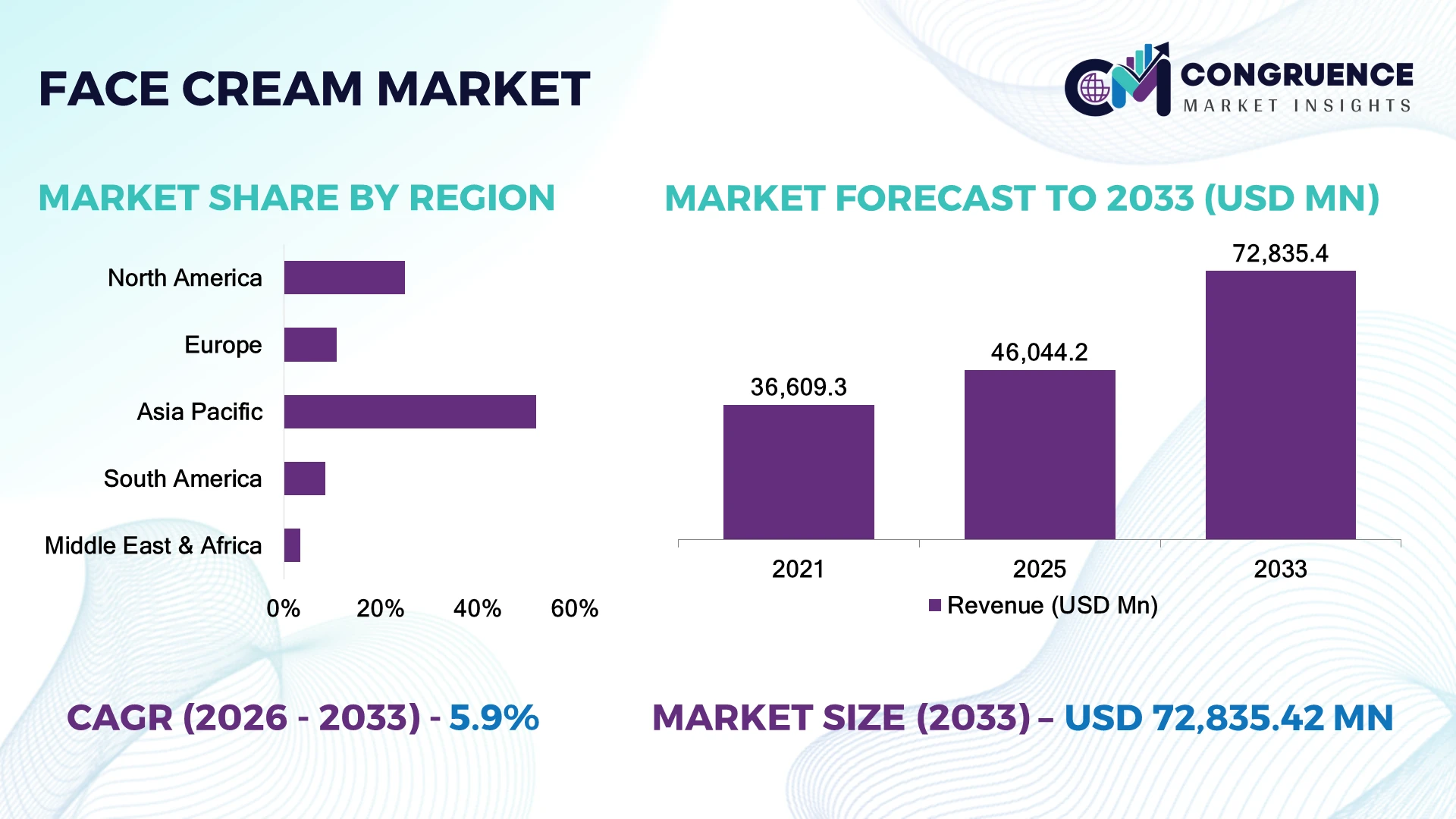
The Global Face Cream Market was valued at USD 46,044.2 Million in 2025 and is anticipated to reach a value of USD 72,835.4 Million by 2033 expanding at a CAGR of 5.9% between 2026 and 2033. Growth is being driven by rapid premiumization of barrier-repair, SPF-integrated, microbiome-focused, and multifunctional formulations, supported by dermocosmetic adoption and digitally enabled personalized skincare.
China is the dominant country market, estimated at about 24% of global face-cream consumption, supported by extensive domestic manufacturing, e-commerce penetration, and investment in functional skincare. South Korea follows with roughly 8%, but its advanced formulation ecosystem and rapid product-cycle innovation give it greater influence in premium skincare technology. In 2026, Asian manufacturers are increasing investments in fermentation-derived actives, AI-assisted skin analysis, and high-performance delivery systems, with personalized formulations gaining approximately 12% higher consumer engagement than conventional mass-market products. Regulatory tightening around cosmetic claims is simultaneously pushing brands toward clinically substantiated ingredients.
Strategically, companies should prioritize localized formulation, proven active ingredients, and digital personalization rather than competing primarily on volume.
Market Size & Growth: USD 46.0 billion in 2025 to USD 72.8 billion by 2033 at 5.9% CAGR, driven by premium anti-aging, barrier-repair, and multifunctional formulations.
Top Growth Drivers: Premium skincare 28%, digital beauty commerce 22%, dermocosmetic adoption 19%.
Short-Term Forecast: By 2028, automated filling and digital demand planning can reduce production waste 8–12% and improve inventory efficiency 10%.
Emerging Technologies: AI skin diagnostics, microbiome-friendly formulations, peptide delivery, and encapsulated actives are reshaping product development.
Regional Leaders: Asia-Pacific is projected at approximately USD 30 billion, North America at USD 20 billion, and Europe at USD 17 billion, supported by premium and dermatological skincare adoption.
Consumer Trends: Approximately 42% of urban skincare consumers increasingly prioritize multifunctional products combining moisturization, anti-aging, and sun protection.
Pilot/Case Example: In 2025, AI-assisted skin-analysis programs demonstrated approximately 15% higher product-matching engagement than conventional recommendation workflows.
Competitive Landscape: L'Oréal leads premium global positioning at an estimated 12% share, competing with Estée Lauder, Shiseido, Beiersdorf, and Procter & Gamble.
Regulatory & ESG Impact: Cleaner-label and packaging initiatives are reducing virgin-plastic intensity by approximately 10–15% across selected product lines.
Investment & Funding: More than USD 2 billion is being directed toward beauty-tech, biotechnology-derived actives, formulation laboratories, and regional manufacturing expansion.
Innovation & Future Outlook: Through 2030, personalized skincare, biomimetic ingredients, refillable packaging, and AI-enabled diagnostics will shift competition toward measurable efficacy and formulation intelligence.
The Face Cream Market is increasingly concentrated around high-efficacy moisturizers, anti-aging products, SPF-integrated creams, and barrier-support formulations. Approximately 35% of new product launches increasingly incorporate multifunctional positioning, while biotechnology-derived ingredients and personalized skincare are moving from niche concepts toward commercial product lines. In 2026, brands are also restructuring ingredient sourcing and regional production to reduce exposure to logistics volatility and improve regulatory compliance, creating a stronger transition toward science-led product differentiation.
The Face Cream Market is becoming strategically important because formulation science, consumer personalization, and premiumization are reshaping how brands compete for recurring skincare spending. The competitive center is moving from basic moisturization toward clinically positioned products addressing skin barrier damage, pigmentation, sensitivity, photoaging, and environmental stress. Brands with strong ingredient credentials and rapid product-development cycles are gaining greater shelf and digital visibility.
Technology is accelerating this shift. AI-supported skin assessment can reduce product-selection friction by roughly 15% compared with conventional questionnaire-led recommendations, while encapsulated active-delivery systems can improve ingredient stability by approximately 10–20%. South Korea and Japan remain formulation-innovation leaders, whereas the United States emphasizes dermatological positioning and premium clinical skincare. China combines manufacturing scale with exceptionally rapid digital product commercialization.
Between 2026 and 2028, companies are expected to increase investment in peptide complexes, microbiome-compatible formulations, fermented actives, and personalized product recommendations. A practical deployment model is the integration of AI skin diagnostics with online consultation and targeted product bundles, allowing brands to convert diagnostic data into repeat purchasing. Competitive advantage will increasingly depend on validated efficacy, formulation agility, ingredient security, and personalized customer engagement rather than brand visibility alone.
The shift toward multifunctional and dermocosmetic face creams is strengthening premium product mix, with approximately 35% of launches combining moisturization with barrier repair, anti-aging, or SPF functionality. In South Korea, digitally enabled skin-analysis and personalized formulation programs are increasing premium-product conversion, while India is seeing stronger demand for ingredient-led formulations. Companies are responding by expanding peptide, ceramide, niacinamide, and hybrid SPF portfolios, with approximately 20% of product development increasingly focused on multifunctionality. The strategic implication is clear: formulation differentiation is becoming more important than basic moisturization, allowing manufacturers to defend margins through clinically positioned ingredients and targeted skin concerns.
Raw-material volatility remains a structural constraint, particularly for specialty actives, botanical extracts, fragrances, and emulsifiers, where procurement costs can fluctuate by 8–15% across sourcing cycles. Regulatory requirements can also increase reformulation workloads by 10–20% when ingredient restrictions or labeling standards change across markets. European manufacturers face tighter scrutiny over claims and formulation compliance, while Indian producers remain exposed to imported specialty ingredients. These pressures directly affect gross margins, launch timelines, and batch consistency. Companies are reducing exposure through dual sourcing, regional supplier qualification, longer procurement contracts, and greater use of locally available actives. The non-obvious pressure point is formulation agility: brands with standardized ingredient platforms can adapt faster without redesigning entire product ranges.
AI-assisted skin diagnostics, personalized recommendations, and microbiome-oriented formulations are creating higher-value opportunities beyond conventional moisturizers. Digital skin assessment can improve product-selection accuracy by approximately 15–25%, while personalized regimens can increase repeat-purchase engagement by 10–18% in digitally active consumer segments. China, South Korea, and India provide strong commercialization environments because e-commerce, social commerce, and beauty-tech ecosystems are closely integrated. Companies are investing in diagnostic platforms, customized formulation engines, and retail partnerships that connect consumer data with product selection. A distinctive opportunity lies in combining face creams with sunscreen, barrier repair, and anti-pollution functionality, enabling fewer products per routine while increasing formulation value and improving portfolio productivity.
Personalized face creams introduce manufacturing and inventory complexity that conventional mass formulations avoid. Producing smaller batches can increase unit-processing costs by 12–20%, while maintaining dozens of ingredient combinations can raise SKU complexity by more than 25%. Digital recommendation systems also require reliable consumer data integration, cybersecurity controls, and standardized formulation databases. In markets such as India, fragmented retail and uneven digital infrastructure further complicate consistent deployment across channels. Companies must therefore invest in modular formulation platforms, automated filling systems, interoperable consumer-data architecture, and regional manufacturing hubs. The critical competitive issue is scalability: brands that convert personalization into standardized production modules will achieve faster customization without allowing operational complexity to erode margins.
Barrier Repair Takes Priority: Ceramide, peptide, panthenol, and niacinamide-based formulations are gaining prominence, with multifunctional barrier-focused products representing an estimated 25–35% of new premium launches. Consumer sensitivity concerns and stronger ingredient scrutiny are shifting formulation priorities, prompting manufacturers to simplify ingredient lists, increase clinical testing, and strengthen dermatologist-oriented positioning.
SPF Integration Expands Rapidly: Hybrid face creams combining moisturization and UV protection are gaining adoption, particularly in South Korea, India, and Southeast Asian markets, where multifunctional routines are increasingly preferred. Approximately 20–30% of premium facial-care launches now emphasize SPF or environmental protection, encouraging companies to redesign emulsions for lighter textures, faster absorption, and improved daily wear.
Digital Skin Analysis Scales: AI-assisted skin assessment is moving from experimental retail formats toward mainstream beauty-commerce workflows, with digital diagnostic usage estimated to rise 15–25% among technology-oriented consumers. Retailers and brands are integrating image analysis with personalized recommendations, improving product matching while reducing reliance on broad demographic segmentation and enabling more targeted inventory planning.
Refillable Packaging Gains Traction: Packaging redesign is accelerating as brands respond to plastic-reduction targets and retailer sustainability requirements. Refillable or reduced-material formats can cut packaging material consumption by roughly 20–40% per product cycle. Manufacturers are shifting toward mono-material containers, lightweight pumps, and refill cartridges, while contract packagers are adapting filling lines to accommodate higher packaging-format variability.
Mass-Market Formulations Lead, Functional Creams Accelerate
Mass-market face creams account for approximately 48% of demand, supported by broad distribution, lower unit costs, and high repeat-purchase frequency. Their scale advantage remains strongest in India, China, and Southeast Asian markets, while premium formulations command roughly 28% as consumers increasingly prioritize clinically positioned ingredients, texture, and efficacy. Companies are protecting mass-market volume through larger pack formats, localized pricing, and efficient emulsification processes, while premium brands are increasing investment in peptides, ceramides, niacinamide, and dermatological positioning.
Functional and treatment-oriented creams represent the fastest-growing type, with adoption expanding around 12–15% annually within premium and dermocosmetic portfolios as consumers consolidate multiple skincare steps. Approximately 30% of new product positioning emphasizes combinations such as hydration plus barrier repair or anti-aging plus SPF. Traditional moisturizing creams remain commercially important, while natural and organic formulations strengthen niche differentiation. The strategic shift is moving investment from basic moisturization toward multifunctional formulations capable of commanding higher margins.
The American Academy of Dermatology reported in 2025 that 73% of surveyed U.S. adults use products or procedures to prevent premature aging, while 56% regularly use sunscreen, reinforcing demand for efficacy-led facial-care formulations.
Daily Moisturization Dominates, Treatment Use Expands
Daily moisturization represents the leading application at approximately 42% share, reflecting its high-frequency use, broad skin-type compatibility, and established presence across mass, pharmacy, and specialty channels. Hydration remains particularly important in India, where consumer research identifies moisturizing as the primary face-moisturizer purpose for 69% of respondents. Anti-aging applications follow at roughly 22%, supported by premium ingredient adoption and greater interest in clinically substantiated claims. Companies are broadening everyday creams with barrier-support, antioxidant, and SPF functionality to increase routine relevance without materially increasing application complexity.
Anti-aging and corrective applications are the fastest-growing use cases, expanding adoption by approximately 13–16% as peptide, retinoid, and niacinamide formulations move into mainstream portfolios. Acne-control and brightening applications retain strong relevance in younger consumer cohorts, while sensitive-skin and barrier-repair uses are gaining specialist traction. Companies are responding through dermatologist partnerships, targeted product architecture, and smaller trial formats. The commercial implication is significant: application-specific claims increasingly determine premium pricing and shelf visibility.
A 2025 Indian dermatology survey found that 98% of participating dermatologists considered early moisturization essential for sensitive-skin management, while 86% identified ceramides as an important barrier-repair ingredient, strengthening the clinical positioning of specialized face creams.
Mass Consumers Anchor Volume, Premium Buyers Shift Value
Mass-market consumers represent approximately 55% of face-cream demand, supported by frequent replenishment, supermarket penetration, pharmacy availability, and affordable multi-pack formats. Their purchasing behavior remains more price-sensitive than premium buyers, with value, ingredient familiarity, and convenience strongly influencing repeat purchases. Premium and dermocosmetic consumers account for roughly 25% and are generating disproportionate value through higher willingness to pay for clinically positioned formulations. Companies are segmenting portfolios by skin concern, pack size, and price tier rather than relying on one formulation architecture across all consumers.
Premium and digitally engaged consumers are the fastest-growing end-user group, with adoption of specialist formulations increasing approximately 14–18%. India illustrates the transition: 73.3% of surveyed consumers reported relying on product reviews when purchasing cosmetics, while 71.6% read ingredient labels. Established mass buyers therefore remain essential for scale, but younger digitally influenced consumers increasingly shape formulation innovation, claims strategy, and launch sequencing. Companies are responding with direct-to-consumer programs, dermatologist-led education, personalized recommendations, and targeted premium ranges.
NielsenIQ reported in 2025 that 41% of U.S. beauty and personal-care sales were generated through e-commerce, while social commerce influenced 68% of global beauty purchases, highlighting the growing importance of digital channels for reaching ingredient-conscious and premium skincare buyers.
Asia-Pacific accounted for the largest market share at 52.0% in 2025 however, South America is expected to register the fastest growth, expanding at a CAGR of 6.8% between 2026 and 2033.
Premium Dermocosmetics and Digital Discovery Reshape Demand
North America remains a high-value face cream market, supported by mature specialty retail, pharmacy distribution, dermatology-led product positioning, and strong premium skincare penetration. The region represented approximately 25% of global skincare demand in 2025, while the United States accounted for the majority of regional consumption. U.S. facial moisturizers generated approximately USD 2.0 billion in multi-outlet sales during 2025, demonstrating the commercial scale of daily-use formulations. Premium brands are increasingly integrating peptides, ceramides, SPF, and barrier-repair claims to differentiate products. Digital discovery is also reshaping merchandising, with brands expanding direct-to-consumer testing and targeted social-commerce campaigns. The operational priority is shifting toward clinically substantiated formulations and faster product iteration rather than simply expanding SKU breadth.
United States Market Outlook: The United States combines the region's largest consumer base with advanced dermatology infrastructure, sophisticated beauty retail, and strong e-commerce penetration. Approximately 73% of U.S. adults reported using products or procedures to prevent premature aging in a 2025 dermatology survey, supporting demand for efficacy-oriented face creams. Brands are therefore prioritizing anti-aging, SPF, and barrier-support formulations across mass-premium channels.
Regulation-Driven Formulation Modernization Strengthens Premium Skincare
Europe's face cream market is shaped by sophisticated skincare consumption, stringent formulation oversight, and established pharmacy and specialty-retail infrastructure. Skin care represented the largest European cosmetics category at €32.3 billion in 2025, creating a substantial ecosystem for facial moisturizers, anti-aging creams, and dermocosmetics. Germany, France, and the United Kingdom remain major demand centers, while France and Spain together accounted for nearly 50% of Europe's cosmetics exports. Manufacturers are increasingly reformulating around microbiome-friendly ingredients, traceability, recyclable packaging, and clinically supported claims. The commercial consequence is greater R&D intensity: regulatory compliance and sustainability requirements increasingly function as product-development filters rather than downstream labeling considerations.
Germany Market Outlook: Germany is Europe's largest national cosmetics market, supported by sophisticated drugstore distribution, strong private-label capabilities, and high consumer acceptance of natural and dermatologist-positioned skincare. Germany accounted for approximately 21.6% of the European cosmetics market in 2025, while sustainability-oriented retail formats continue to influence formulation and packaging decisions. Manufacturers are emphasizing certified ingredients, recyclable formats, and affordable premium positioning to protect volume while meeting increasingly stringent consumer expectations.
K-Beauty and C-Beauty Scale Convert Innovation Into Global Demand
Asia-Pacific held the dominant position in facial skincare, supported by large consumer populations, high skincare-routine penetration, advanced formulation ecosystems, and rapid digital commerce adoption. China, Japan, South Korea, and India form the principal commercial engines, with China alone recording 5.13 billion beauty and skincare units sold online in 2025. South Korea is strengthening its manufacturing and export position, with skincare exports reaching USD 8.54 billion in 2025, up 11.6%. Companies are combining proprietary actives, lightweight textures, skin-barrier science, and social-commerce launches to shorten innovation cycles. The region's strategic advantage increasingly lies in converting fast-moving consumer feedback into commercially scalable formulations.
China Market Outlook: China combines extensive beauty-manufacturing capacity, sophisticated e-commerce infrastructure, and rapidly evolving domestic formulation capabilities. Its online beauty and skincare market reached CN¥454.2 billion in 2025, increasing 9.7% year over year, while anti-aging products expanded 26.3%. Domestic brands are therefore moving beyond price competition toward proprietary actives, premium packaging, and international expansion. This combination of manufacturing depth and digital distribution gives Chinese face cream producers a strong platform for both domestic scale and overseas brand building.
Brazilian Beauty Scale Drives Localized Face-Care Innovation
South America represents a smaller but increasingly differentiated face cream market, with Brazil accounting for the majority of regional commercial activity. Tropical climates, high UV exposure, diverse skin types, and established beauty retail networks favor lightweight moisturizers, brightening products, SPF-integrated creams, and multifunctional formulations. Approximately 8.6% of global skincare demand was attributed to South America in 2025, creating a meaningful platform for local brands and multinational portfolios. Manufacturers are increasingly adapting textures, fragrances, packaging sizes, and price points to local conditions. The principal operational constraint remains distribution fragmentation outside major urban centers, encouraging companies to combine pharmacy, specialty retail, marketplaces, and direct-to-consumer channels rather than rely on a single route to market.
Brazil Market Outlook: Brazil is the region's most strategically important market because of its large consumer base, established cosmetics manufacturing ecosystem, strong local-brand presence, and sophisticated beauty retail infrastructure. The country supports high product turnover across moisturizers, anti-aging creams, and multifunctional skincare. Manufacturers increasingly localize formulations for humid climates and diverse skin profiles while using smaller pack sizes to improve affordability. Digital channels are becoming particularly important for reaching consumers beyond major metropolitan markets, strengthening the case for localized product portfolios and omnichannel distribution.
Premium Skincare Infrastructure Expands Around Gulf Hubs
The Middle East & Africa market is being reshaped by premium beauty investment, modern retail infrastructure, tourism-linked consumption, and expanding e-commerce. Saudi Arabia and the UAE are the principal commercial hubs, with demand concentrated around premium moisturizers, anti-aging formulations, brightening products, and high-SPF skincare suited to intense solar exposure. The region represented approximately 3.5% of global skincare demand in 2025, leaving substantial whitespace for organized brands and specialist retailers. Companies are strengthening distributor networks, localized digital campaigns, and climate-adapted formulations. In Gulf markets, premiumization is increasingly linked to retail experience and product efficacy, while African markets remain more price-sensitive, making differentiated pack sizes and tiered formulations strategically important.
Saudi Arabia Market Outlook: Saudi Arabia offers the strongest combination of purchasing power, modern retail development, beauty-sector investment, and premium consumer demand in the region. High solar exposure supports demand for SPF-enabled and protective face creams, while expanding organized retail improves product accessibility. Manufacturers are positioning through premium dermocosmetics, localized marketing, and partnerships with pharmacy and beauty-retail networks. The country's rapidly modernizing consumer economy also provides a strong testing ground for digitally promoted skincare products before wider Middle Eastern expansion.
L’Oréal, Estée Lauder, Beiersdorf, Shiseido, and Unilever compete as global brand leaders, while regional dermocosmetic and mass-market specialists challenge them on price and localization. The top five players collectively hold an estimated 23% share, leaving a fragmented field. Premium brands derive roughly 35% of competitive advantage from formulation efficacy, while localized pricing influences about 25% of purchase decisions and distribution reach contributes nearly 20%. Companies are expanding through targeted launches, dermatology partnerships, localized R&D, and vertically integrated ingredient sourcing. Beiersdorf is strengthening India, China, Japan, and the United States with localized portfolios, while Japanese players emphasize advanced skin-barrier science and prestige formulations. Competition is shifting toward clinically supported actives, personalized skincare, sustainable packaging, and faster product localization rather than advertising scale alone. Entry barriers remain high around regulatory compliance, clinical substantiation, brand trust, and retail access. Winning requires differentiated efficacy, agile localization, reliable supply, and disciplined premium-to-mass portfolio execution.
L’Oréal S.A.
Estée Lauder Companies Inc.
Beiersdorf AG
Shiseido Company, Limited
Unilever PLC
Procter & Gamble Company
Kao Corporation
Amorepacific Corporation
Johnson & Johnson
Natura &Co
Coty Inc.
Revlon, Inc.
AI-assisted formulation is accelerating ingredient screening, texture optimization, and consumer personalization. Machine-learning models reduce formulation iteration cycles by an estimated 15–20%, while digital skin-analysis platforms improve product-matching accuracy by approximately 10–15%. Adoption is strongest among premium brands, dermatology-led portfolios, and digitally native skincare businesses. Between 2026 and 2028, AI-enabled formulation and personalization will strengthen speed-to-market and reduce development waste.
Biotechnology is reshaping face cream efficacy through fermented actives, peptides, microbiome-supporting ingredients, and biomimetic barrier technologies. Fermentation-based production can reduce selected ingredient-processing costs by 8–12%, while advanced delivery systems improve active stability by roughly 10%. Compared with conventional emulsions, encapsulated actives can provide approximately 15% better controlled delivery. Premium dermocosmetic brands benefit most because clinically differentiated formulations support higher-value positioning.
Automation is moving beyond manufacturing into quality control, filling, packaging, and demand forecasting. Automated inspection can reduce selected production defects by 12–18%, while digitally connected production lines improve throughput by around 5–10%. Refillable packaging systems and lightweight materials are also gaining traction as sustainability requirements tighten. From 2026–2028, companies combining biotechnology, AI formulation, automation, and traceable supply chains will gain the strongest competitive advantage through faster launches, lower waste, and more consistent product performance.
January 2025 Beiersdorf launched NIVEA LUMINOUS EVEN GLOW in India, adapting Thiamidol facial care with lighter textures, cost-efficient packs, and trial sizes. The localized portfolio strengthened pigmentation-care positioning and improved accessibility across India’s fragmented facial-care market more broadly. Source: Beiersdorf. (Beiersdorf Reports)
June 2025 Beiersdorf committed €139 million to a Hamburg Innovation Center, with opening planned for 2028 and collaboration with universities and start-ups. The investment expands formulation, testing, and research capacity, strengthening innovation throughput and global competitiveness in skincare. Source: Beiersdorf. (Beiersdorf)
July 2025 Kao introduced SENSAI TOTAL FORM EXPERT CREAM, scheduled for rollout across more than 40 countries from September. The flagship combines Total Form CPX and Koishimaru Silk EX, supporting premium anti-ageing positioning and accelerating SENSAI international expansion. Source: Kao. (Kao)
December 2025 Beiersdorf launched Eucerin in Japan, its third-largest cosmetics market, with the premium HARI FILLER series developed specifically for Japanese consumers. The entry expands dermocosmetic reach and creates a localized premium platform within a sophisticated skincare market.
The Face Cream Market Report covers formulation type, product positioning, skin concern, distribution channel, price tier, and end-user segments, including mass-market, premium, dermocosmetic, anti-ageing, moisturizing, brightening, sensitive-skin, and multifunctional formulations. Regional analysis spans North America, Europe, Asia-Pacific, South America, and the Middle East & Africa, with country-level assessment of China, Japan, India, the United States, Germany, Brazil, and the UAE. Emerging niches such as microbiome-supporting creams, peptide formulations, biomimetic barriers, refillable packaging, and personalized skincare are evaluated alongside established categories.
The report assesses formulation technologies, active-ingredient innovation, digital skin analysis, automated manufacturing, packaging modernization, and localized product development. Competitive analysis covers major global brands and regional specialists, while adoption patterns, channel shifts, portfolio strategies, and supply-chain positioning provide decision-useful context. The analysis supports investment planning, market-entry decisions, capacity expansion, product prioritization, competitive positioning, and strategic direction through 2026–2033.
| Report Attribute/Metric | Report Details |
|---|---|
|
Market Revenue in 2025 |
USD 46,044.2 Million |
|
Market Revenue in 2033 |
USD 72,835.4 Million |
|
CAGR (2026 - 2033) |
5.9% |
|
Base Year |
2025 |
|
Forecast Period |
2026 - 2033 |
|
Historic Period |
2021 - 2025 |
|
Segments Covered |
By Type
By Application
By End-User
|
|
Key Report Deliverable |
Revenue Forecast, Growth Trends, Market Dynamics, Segmental Overview, Regional and Country-wise Analysis, Competition Landscape |
|
Region Covered |
North America, Europe, Asia-Pacific, South America, Middle East, Africa |
|
Key Players Analyzed |
L’Oréal S.A., Estée Lauder Companies Inc., Beiersdorf AG, Shiseido Company, Limited, Unilever PLC, Procter & Gamble Company, Kao Corporation, Amorepacific Corporation, Johnson & Johnson, Natura &Co, Coty Inc., Revlon, Inc. |
|
Customization & Pricing |
Available on Request (10% Customization is Free) |




