
Reports
The Global Eyelash Glue Market was valued at USD 1170 Million in 2025 and is anticipated to reach a value of USD 2025.35 Million by 2033 expanding at a CAGR of 7.1% between 2026 and 2033. Growth is driven by expanding professional lash-extension services, at-home false-lash adoption, faster-curing cyanoacrylate formulations, sensitive-eye products, and rising demand for latex-free, low-fume adhesives.
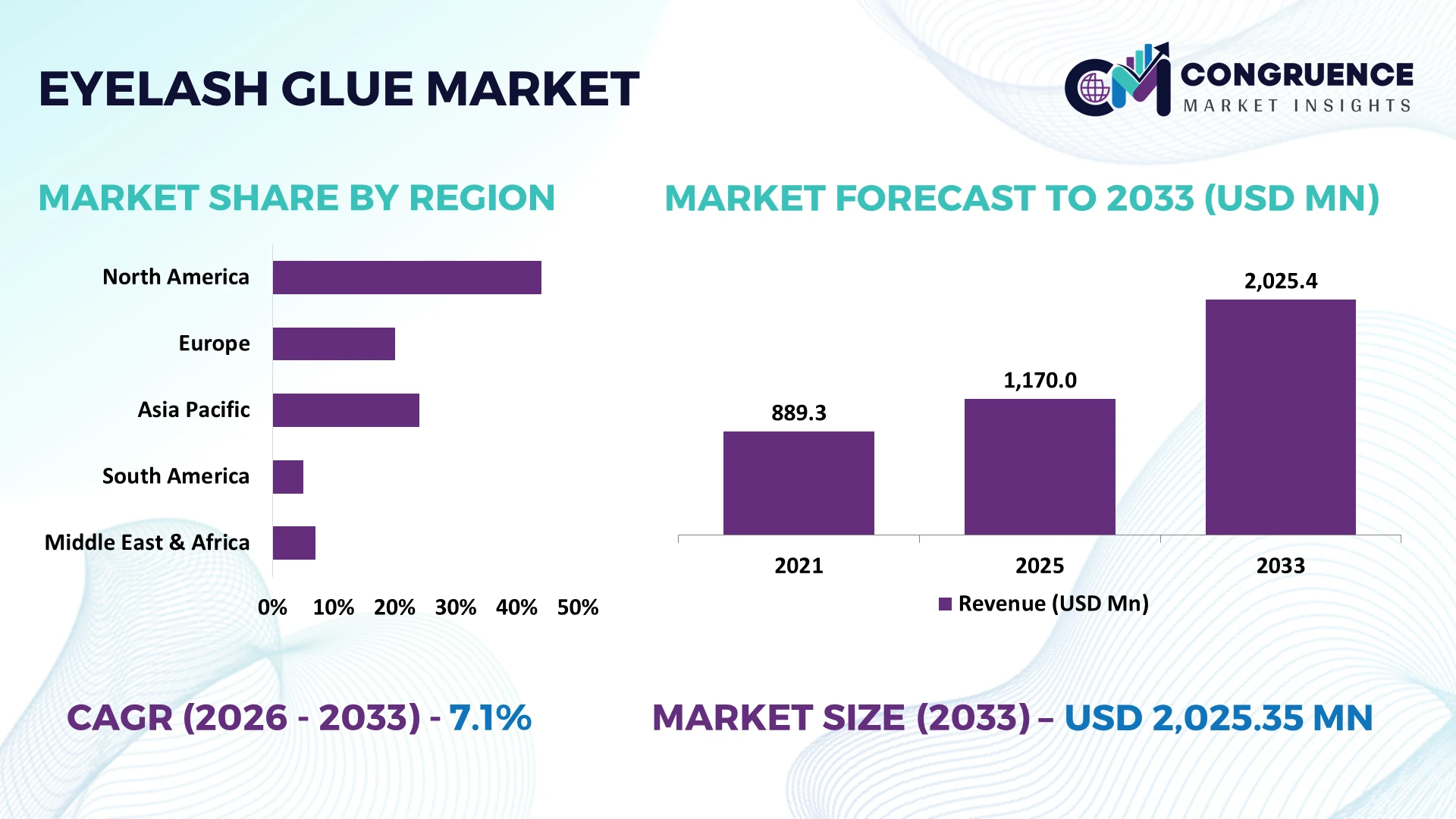
The United States leads global eyelash glue demand with an estimated 24–27% share, supported by professional lash studios, premium cosmetics spending, and strong DIY adoption. China contributes roughly 16–19%, backed by large-scale adhesive, false-eyelash, and private-label manufacturing. South Korea holds approximately 8–10%, driven by K-beauty innovation and advanced low-irritation formulations, while Japan represents about 6–8% through premium salon-grade products. The United Kingdom and Germany together contribute around 8–10%, supported by established beauty-service networks and growing demand for compliant, sensitive-eye adhesives. U.S.–China trade pressures are also encouraging sourcing diversification toward South Korea and other Asian manufacturing hubs.
The strategic priority is securing compliant, low-irritation formulations and diversified production while building products for both professional recurring-use and fast-expanding at-home application channels.
Market Size & Growth: USD 1.17 billion in 2025 is projected to reach USD 2.03 billion by 2033 at 7.1% CAGR, driven by professional lash services and advanced low-fume formulations.
Top Growth Drivers: Professional lash extensions contribute about 35% of growth momentum, DIY lash adoption 30%, and sensitive-eye or latex-free formulations roughly 20%.
Short-Term Forecast: By 2027, automated filling and dispensing systems are expected to improve production efficiency by 10–15% while reducing adhesive wastage by around 8%.
Emerging Technologies: UV/LED curing, fast-bond cyanoacrylates, and precision micro-dispensing are advancing, with newer systems cutting bonding time by approximately 20–30%.
Regional Leaders: By 2033, Asia-Pacific approaches USD 750 million, North America USD 590 million, and Europe USD 440 million, supported by manufacturing scale, DIY adoption, and premium salon demand.
Consumer/End-User Trends: Nearly 55–60% of frequent users increasingly prioritize quick drying, low odor, longer retention, and sensitive-eye compatibility when selecting eyelash adhesives.
Pilot/Case Example: In 2025, UV-assisted lash systems reduced curing dependence on ambient humidity and shortened bond stabilization time by roughly 25–30% in controlled salon workflows.
Competitive Landscape: Duo holds an estimated 8–10% share, while Ardell, Kiss, Lilly Lashes, House of Lashes, and professional salon brands compete through formulation, retention, and application convenience.
Regulatory & ESG Impact: Ingredient transparency and eye-area safety requirements are pushing reformulation, while recyclable packaging initiatives are targeting 10–15% reductions in secondary plastic use.
Investment & Funding: More than USD 50 million in cumulative brand expansion, contract manufacturing, salon partnerships, and DTC scaling is strengthening formulation capacity and regional distribution networks.
Innovation & Future Outlook: By 2028, next-generation low-fume, humidity-tolerant, and LED-curable adhesives are expected to improve application consistency by 15–20% and shift competition toward performance-led product ecosystems.
The Eyelash Glue Market is shifting toward professional lash extensions, DIY clusters, sensitive-eye adhesives, and faster-curing formulations. Low-fume cyanoacrylates, precision applicators, and UV/LED curing are improving application consistency, with advanced systems reducing bonding time by approximately 20–30%. Regulatory scrutiny of eye-area formulations and diversified Asian sourcing are reinforcing ingredient transparency, product safety, and manufacturing resilience, setting up the market’s strategic transformation.
Low-Fume Formulations Gain Ground Professional users are shifting toward low-odor, latex-free, and reduced-fume adhesives as eye-area sensitivity becomes a stronger purchase criterion. Sensitive formulations now represent an estimated 18–22% of premium professional demand, while 1–2 second curing products are replacing slower 3–5 second systems. Brands are expanding allergen-conscious ranges, refining cyanoacrylate blends, and tightening batch testing, improving salon retention while reducing complaint-related replacement costs.
UV Curing Enters Salon Workflows UV/LED-assisted lash systems are moving from niche deployment into specialist studios, reducing dependence on ambient humidity and shortening stabilization time by roughly 25–30%. Systems operating with targeted light exposure improve curing consistency across changing salon conditions, particularly where humidity varies beyond 15–20 percentage points. Suppliers are pairing dedicated adhesives with lamps and technician training, creating integrated ecosystems rather than standalone glue sales.
Packaging Shifts Toward Freshness Control Smaller bottle formats, precision nozzles, and moisture-resistant packaging are becoming operational priorities because opened professional adhesives commonly remain optimal for only 4–8 weeks. Brands are reducing fill sizes by approximately 20–30% in selected professional ranges to lower wastage and preserve viscosity. Manufacturers are also adopting automated filling and sealed dispensing systems, improving consistency while protecting margins against discarded inventory.
Private-Label Sourcing Diversifies Beauty brands are restructuring sourcing beyond concentrated Chinese supply networks toward South Korea and other Asian contract manufacturers. Dual-sourcing strategies can cut disruption exposure by approximately 10–15%, while automated filling improves throughput by around 12%. The non-obvious shift is that formulation ownership is becoming more valuable than packaging differentiation. Companies are securing exclusive chemistries, smaller production runs, and regional manufacturing partnerships to accelerate launches and protect product continuity.
Cyanoacrylate-Based adhesives lead the market with an estimated 48–52% share because professional lash technicians depend on rapid polymerization, strong retention, and reliable compatibility with individual extension workflows. Premium formulations typically cure within 1–2 seconds and support retention periods approaching 4–6 weeks under controlled conditions. Black Adhesive holds strong professional relevance because pigmentation visually integrates with lash lines, while Clear Adhesive serves colored lashes, sensitive applications, and users seeking less visible bonding. Latex-Based products retain a meaningful position in temporary and strip-lash usage because of flexibility and easier removal.
Sensitive-Skin Adhesive is the fastest-growing type, supported by increasing demand for lower-fume, latex-free, and more controlled formulations. This category is estimated to represent roughly 15–18% of premium launches, with adoption expanding fastest in specialist studios. Manufacturers are shifting investment toward purified cyanoacrylates, reduced-odor chemistry, and smaller freshness-preserving bottles. The business implication is clear: formulation differentiation increasingly determines repeat professional purchasing, while commodity latex products face stronger price pressure.
Classic Extensions account for approximately 34–38% of application demand because they remain the standard entry point for professional lash services, offering predictable adhesive consumption and simpler technician workflows. A typical classic set can involve more than 80–120 individual lash attachments, creating sustained demand for fast-curing cyanoacrylate adhesives. Volume Extensions hold a smaller but higher-value position because multiple lightweight lashes are bonded into fans, increasing precision requirements and favoring 1–2 second curing products. Hybrid Extensions combine both methods and are gaining popularity in premium salons.
Cluster Lashes are the fastest-growing application as at-home users seek salon-like appearance with shorter application time. Adoption has expanded by an estimated 20–25% among frequent DIY users, supported by precision applicators and longer-wear bond-and-seal systems. Strip Lashes remain mature because they prioritize temporary wear and flexible latex or clear adhesives. Companies are separating professional and DIY adhesive architectures, expanding cluster-specific bonding systems, and refining nozzle designs. Investment is shifting toward applications that increase frequency of use rather than one-time event purchases.
Lash Studios represent the leading end-user group with an estimated 32–36% share because specialist technicians consume adhesives continuously across classic, volume, and hybrid services. High-volume studios can replace opened bottles every 4–8 weeks, creating predictable recurring demand and stronger loyalty to formulations that perform consistently within defined temperature and humidity ranges. Beauty Salons contribute substantial volume through broader service portfolios, while Professional Makeup Artists favor portable, fast-setting products suited to short-duration assignments and event work.
Individual Consumers are the fastest-growing end-user group as cluster lashes, bond-and-seal kits, and simplified applicators reduce dependence on professional application. DIY-oriented demand is estimated to be expanding 20–25% faster than conventional strip-lash purchasing in premium online channels. Cosmetic Retailers are responding with wider assortments and private-label products, while brands are building technician education programs, subscription replenishment, and direct-to-consumer bundles. The strategic shift is toward dual-channel portfolios: professional products maximize recurring technical demand, while consumer systems expand volume through accessibility and convenience.
Asia-Pacific accounted for the largest market share at 35% in 2025 however, Asia-Pacific is expected to register the fastest growth, expanding at a CAGR of 8.2% between 2026 and 2033.
Professional Services Shift Toward Safer Formulations
North America accounts for approximately 29% of global eyelash glue demand, led by the United States through dense salon networks, established false-lash brands, and high direct-to-consumer beauty spending. Professional studios increasingly require 1–2-second curing adhesives, while cluster-lash systems are expanding the addressable DIY customer base. Low-fume, latex-free, and sensitive-eye formulations are gaining shelf space as ingredient transparency becomes more important around eye-area cosmetics. Automated micro-filling and controlled packaging are also improving batch consistency and reducing adhesive exposure to moisture during production. Canada contributes a smaller but premium-oriented market, particularly through specialist beauty distributors and professional education channels. Suppliers are strengthening salon partnerships, e-commerce replenishment, technician training, and smaller freshness-preserving bottle formats, shifting competition from basic bonding strength toward retention consistency and formulation reliability.
United States Market Outlook: The United States combines large professional beauty-service infrastructure with advanced omnichannel cosmetics distribution. Thousands of specialist lash businesses create recurring adhesive consumption because opened professional bottles typically require replacement within 4–8 weeks. Brands are increasingly differentiating through professional education, low-odor chemistry, cluster-lash kits, subscription replenishment, and transparent ingredient positioning.
Compliance Reshapes Professional Adhesive Portfolios
Europe represents approximately 23% of global demand, with the United Kingdom, Germany, France, Italy, and Spain forming the principal professional and consumer markets. Ingredient documentation, cosmetic safety requirements, and stronger scrutiny of sensitizing substances are pushing suppliers toward tighter formulation control and traceability. Professional users increasingly favor low-fume adhesives operating across broader humidity ranges, while consumer channels are expanding latex-free strip and cluster products. European distributors also prioritize packaging reduction and more controlled dispensing, encouraging smaller bottles and precision applicators that limit unnecessary product disposal. The United Kingdom maintains a particularly developed independent lash-technician ecosystem, while Germany emphasizes compliant professional beauty products. Manufacturers are responding through localized labeling, technical training, formulation testing, and EU-focused distribution partnerships. Compliance capability is consequently becoming a commercial differentiator rather than simply an administrative requirement.
United Kingdom Market Outlook: The United Kingdom remains strategically significant because specialist lash technicians, beauty academies, online retailers, and professional distributors create a mature purchasing ecosystem. Fast-curing adhesives operating around 1–2 seconds increasingly support experienced technicians, while sensitive formulations broaden salon accessibility. Supplier differentiation centers on education, retention performance, humidity guidance, and dependable domestic fulfillment.
Manufacturing Scale Meets K-Beauty Innovation
Asia-Pacific leads with approximately 35% of global demand, combining Chinese manufacturing scale, South Korean formulation innovation, Japanese premium beauty standards, and rapidly expanding Indian salon consumption. China remains a major production base for false eyelashes, adhesive packaging, applicators, and private-label beauty products, enabling vertically connected supply chains. South Korea differentiates through low-irritation formulations and K-beauty product development, while Japan maintains demand for precision professional products. India is strengthening through expanding beauty academies, salons, and digitally distributed cosmetics. Contract manufacturers are adopting automated filling and precision dispensing that can improve throughput by roughly 10–15%. Brands are also diversifying procurement across multiple Asian production hubs as geopolitical and logistics pressures expose single-country sourcing risks. Scale increasingly favors manufacturers capable of combining formulation ownership, flexible minimum orders, rapid packaging customization, and export-ready compliance.
China Market Outlook: China provides a powerful manufacturing advantage through concentrated false-eyelash, packaging, applicator, and cosmetics supply networks. Integrated sourcing can shorten product-development cycles by approximately 15–20% compared with fragmented procurement models. Domestic suppliers are moving beyond low-cost private labeling toward improved cyanoacrylate chemistry, automated filling, customized packaging, and faster small-batch production for international beauty brands.
Social Commerce Accelerates DIY Adoption
South America represents approximately 7% of global demand, with Brazil dominating through its extensive beauty-service economy, cosmetics manufacturing base, and highly engaged consumer market. Professional salons remain important, but cluster lashes, strip lashes, and home-application adhesives are gaining visibility through social commerce and beauty marketplaces. Brazil’s established cosmetics supply chain provides local packaging and distribution capabilities, while imported specialist adhesives serve higher-end studios. Currency fluctuations and import costs remain operational constraints for premium formulations, increasing incentives for local sourcing and private-label production. Argentina, Colombia, and Chile provide additional urban beauty-service demand, although distribution depth varies considerably. Suppliers are adapting with smaller pack sizes, localized pricing, digital technician education, and distributor partnerships. The commercial advantage increasingly comes from balancing professional-grade performance with price points suited to frequent consumer replenishment.
Brazil Market Outlook: Brazil combines a large beauty workforce with domestic cosmetics manufacturing and extensive specialist retail infrastructure. Professional lash studios support recurring purchases, while social-media-driven beauty routines are accelerating cluster and strip-lash adoption. Companies are emphasizing locally distributed adhesives, Portuguese-language technician support, humidity-compatible formulations, and accessible pack sizes to reduce dependence on expensive imported products.
Premium Salons Drive Distribution Modernization
Middle East & Africa contributes approximately 6% of global eyelash glue demand, with the UAE and Saudi Arabia concentrating premium professional services while South Africa anchors more developed beauty retail in Africa. Dubai and Riyadh support high-end salons, beauty academies, and international cosmetics distribution, encouraging demand for professional fast-curing and low-fume adhesives. Hot climatic conditions make storage stability and controlled salon environments particularly important because cyanoacrylate polymerization responds strongly to temperature and humidity. African markets remain more fragmented, with affordability and distributor coverage shaping product accessibility. Suppliers are strengthening authorized distribution, salon education, climate-specific storage guidance, and e-commerce availability. Premium Gulf markets reward formulation performance and international branding, whereas African expansion depends more heavily on affordable pack architecture and reliable last-mile distribution.
United Arab Emirates Market Outlook: The UAE functions as a premium beauty-services hub and regional distribution gateway, particularly through Dubai. International salons and beauty academies support demand for professional adhesives with 1–2-second curing performance and extended retention. Suppliers benefit from sophisticated retail infrastructure but must prioritize temperature-controlled storage, technician education, authenticity protection, and dependable replenishment.
The Eyelash Glue Market pits established consumer brands Ardell, KISS, DUO, and House of Lashes against professional specialists such as Borboleta Beauty and London Lash. The top five players collectively control an estimated 25–30% share, leaving substantial space for salon-focused and private-label brands. Consumer leaders compete through retail reach, pricing, and application simplicity, while professional suppliers emphasize 1–2-second curing, retention consistency, humidity tolerance, and technician education. Advanced formulations can shorten bonding time by 20–30%, while precision dispensing can reduce product wastage by approximately 8–12%. Players are expanding direct-to-consumer channels, salon partnerships, formulation laboratories, and Asian contract-manufacturing relationships. Competition is shifting toward low-fume chemistry, sensitive-eye positioning, cluster-lash bonding systems, and UV-assisted curing. Regulatory documentation, formulation stability, brand trust, and access to reliable cyanoacrylate manufacturing create meaningful entry pressure. Winning requires consistent adhesive performance, credible safety positioning, rapid innovation, resilient sourcing, technician loyalty, and omnichannel distribution across professional and consumer applications globally.
Ardell
KISS Products
DUO
House of Lashes
Lilly Lashes
Borboleta Beauty
London Lash
NovaLash
Xtreme Lashes
LashBox LA
Tatti Lashes
Velour Beauty
Sugarlash PRO
M·A·C Cosmetics
Current eyelash glue technology centers on fast-curing cyanoacrylate chemistry, humidity-tolerant formulations, and precision dispensing. Professional adhesives curing within 1–2 seconds can shorten attachment cycles by approximately 20–30% versus legacy 3–5-second systems. Low-fume and latex-free formulations are gaining adoption across premium studios, while automated micro-filling can improve packaging throughput by 10–15%. These technologies reduce technician downtime, strengthen application consistency, and support repeat professional purchasing.
Emerging technologies include UV/LED-assisted curing, flexible polymer systems, moisture-resistant packaging, and controlled micro-dosing. UV-assisted adhesives reduce dependence on ambient humidity and can improve curing consistency by roughly 20–25% in variable salon environments. Sensitive-eye formulations represent an estimated 15–20% of premium professional product introductions. Brands integrating proprietary chemistry, precision applicators, and technician education gain stronger differentiation than suppliers competing primarily through packaging and price.
Disruptive development is moving toward climate-adaptive chemistry, automated dispensing, bio-based packaging, and digitally monitored salon environments. Between 2026 and 2028, advanced curing systems are positioned to reach 20–25% of specialist premium portfolios, while automated filling can reduce material wastage by 8–12%. Early investment matters because formulation ownership, safety validation, manufacturing repeatability, and technician loyalty increasingly determine competitive advantage across global professional and consumer channels.
April 2025 KISS Products expanded its Falscara ecosystem with Bond & Seal adhesive technology designed for under-lash application and extended wear of up to 10 days, strengthening the company’s position in reusable DIY lash systems and salon-alternative beauty routines. Source: kissusa.com
February 2025 Ardell strengthened its Seamless Underlash portfolio with long-wear Bond & Seal technology supporting wear for up to 10 days. The system simplifies cluster application and expands Ardell’s participation in the fast-growing crossover between traditional strip lashes and extensions. Source: ardellshop.com
May 2024 London Lash expanded its UV lash-extension system around UV-compatible adhesive and controlled light curing, enabling bonding within approximately 1–2 seconds. The technology reduces dependence on salon humidity, improving curing predictability and technician workflow consistency across professional extension applications. Source: londonlash.com
March 2024 NovaLash expanded its professional adhesive positioning around Platinum Bond formulations delivering extension retention approaching 4–6 weeks under recommended application conditions. Longer retention supports fewer corrective appointments, stronger technician productivity, and differentiated professional-service economics for certified lash artists. Source: novalash.com
The Eyelash Glue Market report covers Latex-Based, Cyanoacrylate-Based, Clear Adhesive, Black Adhesive, and Sensitive-Skin Adhesive products across Classic Extensions, Volume Extensions, Hybrid Extensions, Cluster Lashes, and Strip Lashes. End-user analysis includes Beauty Salons, Lash Studios, Professional Makeup Artists, Cosmetic Retailers, and Individual Consumers. Cyanoacrylate-based adhesives represent approximately 48–52% of demand, while professional studios maintain strong recurring consumption through frequent adhesive replacement and extension services.
Regional coverage spans North America, Europe, Asia-Pacific, South America, and Middle East & Africa, incorporating manufacturing, distribution, professional-service, regulatory, and consumer-adoption dynamics. Technology assessment includes 1–2-second curing chemistry, UV/LED systems, low-fume formulations, humidity tolerance, precision dispensing, and automated filling. The report evaluates sourcing diversification, private-label manufacturing, professional-versus-DIY adoption, sensitive-eye products, and competitive positioning, supporting investment planning, geographic expansion, partnership decisions, product development, and portfolio strategy between 2026 and 2033.
| Report Attribute/Metric | Report Details |
|---|---|
Market Revenue in 2025 | USD 1170 Million |
Market Revenue in 2033 | USD 2025.35 Million |
CAGR (2026 - 2033) | 7.1% |
Base Year | 2025 |
Forecast Period | 2026 - 2033 |
Historic Period | 2021 - 2025 |
Segments Covered | By Type
By Application
By End-User
ers |
Key Report Deliverable | Revenue Forecast, Growth Trends, Market Dynamics, Segmental Overview, Regional and Country-wise Analysis, Competition Landscape |
Region Covered | North America, Europe, Asia-Pacific, South America, Middle East, Africa |
Key Players Analyzed | Ardell, KISS Products, DUO, House of Lashes, Lilly Lashes, Borboleta Beauty, London Lash, NovaLash, Xtreme Lashes, LashBox LA, Tatti Lashes, Velour Beauty, Sugarlash PRO, M·A·C Cosmetics |
Customization & Pricing | Available on Request (10% Customization is Free) |




