
Reports
The Global External Concrete Vibrator Market was valued at USD 409.33 Million in 2025 and is anticipated to reach a value of USD 713.9 Million by 2033 expanding at a CAGR of 7.2% between 2026 and 2033. Precast automation, accelerated infrastructure construction, higher concrete-quality specifications, and replacement of pneumatic vibrators with controllable electric and high-frequency systems are strengthening equipment deployment.
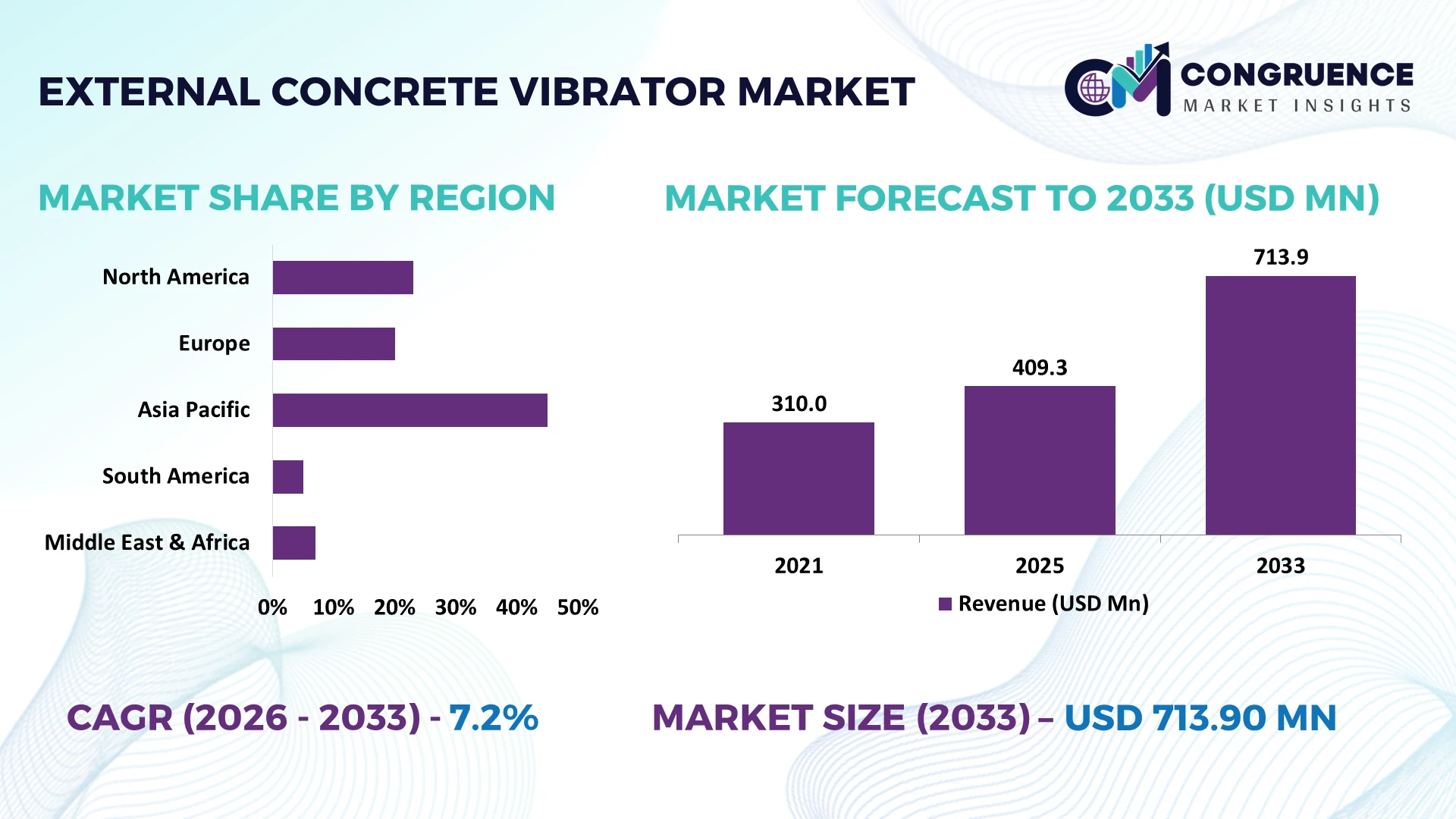
China represents approximately 32% of global external concrete vibrator demand, supported by the world’s largest construction ecosystem and extensive precast, railway, bridge, tunnel, and industrial-project activity. Infrastructure fixed-asset investment continues to channel equipment demand toward mechanized concrete placement, while high-frequency electric vibrators can reduce consolidation time by approximately 20–30% versus conventional pneumatic workflows. India remains smaller but infrastructure-led adoption is accelerating through highways, metros, and precast facilities. China’s Belt and Road-linked equipment supply chains additionally reinforce domestic manufacturing scale and export competitiveness.
Strategically, suppliers should prioritize high-frequency electric platforms, precast automation compatibility, localized service, and Asian manufacturing partnerships where infrastructure intensity and equipment replacement create the strongest utilization economics.
Market Size & Growth: USD 409.33 million in 2025 reaches USD 713.9 million by 2033 at 7.2% CAGR, driven by precast automation and infrastructure mechanization.
Top Growth Drivers: Infrastructure construction contributes 39%, precast expansion 34%, and equipment modernization 27% to incremental demand.
Short-Term Forecast: By 2027, high-frequency electric systems can improve concrete-consolidation productivity by 20–30% versus conventional pneumatic workflows.
Emerging Technologies: Variable-frequency drives, wireless controls, and sensor-assisted vibration management are targeting 15–25% improvements in operating precision and energy utilization.
Regional Leaders: Asia-Pacific approaches USD 360 million, Europe USD 145 million, and North America USD 130 million by 2033 as electric equipment adoption deepens.
Consumer/End-User Trends: Precast manufacturers account for approximately 40% of equipment utilization, favoring repeatable vibration frequency and automated mold integration.
Pilot/Case Example: 2025 automated precast deployments demonstrated approximately 20% shorter consolidation cycles through synchronized high-frequency vibration and controlled operating sequences.
Competitive Landscape: Wacker Neuson holds an estimated 12% share, competing with Husqvarna, OLI, Enar, and NetterVibration across electric and industrial vibration platforms.
Regulatory & ESG Impact: Electric vibrators can lower onsite energy losses by approximately 15–20% while eliminating compressed-air infrastructure required by pneumatic alternatives.
Investment & Funding: More than USD 500 million in broader construction-equipment manufacturing expansion supports localization, automation, electrification, and Asian production capacity.
Innovation & Future Outlook: Sensor-controlled vibration and connected equipment target 20%+ process-efficiency gains, shifting competition from standalone motors toward digitally managed concrete consolidation.
External concrete vibrators are increasingly specified across precast plants, bridge components, tunnel linings, columns, concrete pipes, architectural molds, and heavily reinforced structures where internal vibration access is restricted. High-frequency electric units and variable-frequency control are replacing pneumatic systems in automated production environments, delivering approximately 20–30% faster consolidation cycles under optimized conditions. Precast manufacturers are integrating multiple synchronized vibrators directly onto molds to improve repeatability and surface finish. Infrastructure programs across China and India are reinforcing equipment utilization, while sensor-assisted vibration monitoring is emerging as the next operational layer, creating a clear pathway into strategic technology and deployment analysis.
External concrete vibrators are becoming strategically important as precast factories and infrastructure contractors shift from labor-dependent consolidation toward repeatable, mechanized concrete production. China’s transport infrastructure buildout and India’s highway, metro, and industrial-corridor programs are increasing utilization of mold-mounted vibration equipment. The decisive market shift is integration of high-frequency electric vibrators with automated precast lines, where vibration becomes a controlled production parameter rather than a standalone construction activity.
High-frequency electric systems can shorten optimized consolidation cycles by approximately 20–30% versus conventional pneumatic workflows while eliminating compressed-air distribution losses. China leads deployment scale through extensive precast and infrastructure manufacturing, whereas Germany and Italy retain advantages in precision vibration engineering and industrial automation. Through 2028, variable-frequency drives, synchronized multi-vibrator control, and condition monitoring will penetrate more automated concrete plants as producers prioritize repeatability and equipment uptime.
A precast beam line can synchronize several external vibrators across one mold, improving consolidation consistency without repositioning handheld equipment. Manufacturers are expanding electric portfolios, automation interfaces, local service networks, and OEM partnerships with batching and precast-equipment suppliers. Competitive positioning will increasingly depend on controllable vibration performance, automation compatibility, lifecycle reliability, and application engineering rather than motor capacity alone.
Industrialized precast production is the strongest structural driver because repetitive molds require consistent vibration frequency, shorter cycle times, and reduced dependence on manual consolidation. High-frequency external systems can improve optimized consolidation productivity by 20–30%, while synchronized mold vibration can reduce manual intervention by approximately 15–25%. China remains the principal deployment base, supported by large-scale concrete component production for railways, bridges, tunnels, and urban infrastructure. India’s expanding metro and highway construction is accelerating factory-produced concrete adoption alongside onsite mechanization. Equipment manufacturers are responding with variable-frequency converters, multi-unit control panels, and vibrator configurations designed specifically for steel molds. The strategic advantage lies in production-line integration: suppliers specified during mold design capture recurring equipment, replacement, control-system, and service demand.
The transition from basic pneumatic or fixed-frequency equipment to high-frequency electric vibration requires converters, reinforced mounting systems, electrical infrastructure, and application-specific engineering. Complete electric installations can carry approximately 20–30% higher initial equipment costs than basic pneumatic configurations, while frequency converters and control equipment can add another 10–15% to project expenditure. This creates procurement resistance among smaller contractors and fragmented precast operators in India, Indonesia, and other price-sensitive markets. Imported motors, bearings, and electronic controls also expose distributors to currency and lead-time volatility. Manufacturers are reducing these constraints through localized assembly, modular control systems, standardized mounting interfaces, rental programs, and distributor inventory. The operational insight is decisive: lifecycle economics favor electric systems primarily where equipment utilization is sufficiently high to offset upfront integration costs.
Sensor-assisted vibration control is opening a higher-value opportunity beyond conventional equipment replacement. Accelerometers, variable-frequency drives, PLC integration, and connected monitoring can adjust vibration intensity to mold geometry and concrete consistency, targeting 10–20% shorter processing cycles and approximately 15% lower avoidable energy use in automated installations. Germany’s advanced precast sector provides a strong environment for integrating vibration equipment with batching, mold handling, and production-control systems, while India offers substantial whitespace for automation upgrades. Through 2028, condition monitoring and digitally recorded vibration parameters will increasingly support preventive maintenance and quality documentation. Manufacturers are investing in intelligent controllers, remote diagnostics, OEM interfaces, and partnerships with precast-line integrators. The non-obvious opportunity is data: vibration records can become quality-control evidence, extending supplier value beyond mechanical equipment.
External vibration performance depends heavily on mounting position, mold stiffness, concrete rheology, frequency selection, and synchronization, creating an execution challenge that equipment specifications alone cannot solve. Poorly positioned vibrators can reduce effective energy transfer by 20–30%, while incorrect frequency settings can extend consolidation cycles by more than 15% and increase component wear. India’s rapidly expanding precast capacity intensifies demand for technicians capable of matching vibration systems to increasingly complex molds. Automated installations add PLC configuration, sensor calibration, electrical protection, and preventive-maintenance requirements. Suppliers must therefore expand application-engineering teams, contractor training, digital commissioning tools, and predictive maintenance capabilities. The strategic pressure point is commissioning consistency: manufacturers that cannot reproduce designed vibration performance across customer sites risk losing automation projects regardless of nominal equipment power or price competitiveness.
Electric Platforms Replace Pneumatic Fleets: Contractors and precast plants are reducing dependence on compressed-air vibration as high-frequency electric units deliver approximately 15–20% lower energy requirements and 20–30% shorter optimized consolidation cycles. German and Chinese manufacturers are expanding converter-compatible portfolios and standardized mounting systems. Rising electricity-efficiency requirements and compressed-air maintenance costs are accelerating replacement, giving suppliers with broad electric ranges stronger aftermarket and retrofit opportunities.
Wireless Controls Simplify Site Operations: Remote activation is replacing manually operated control boxes across bridge, foundation, and large-formwork applications. Wireless configurations can reduce operator movement around molds by 20–30% and shorten equipment-adjustment time by approximately 15%. Contractors are deploying centralized controllers capable of coordinating multiple vibrator positions. Equipment suppliers are responding with rugged remote interfaces and modular control architectures, reducing labor exposure while enabling safer vibration management around congested reinforcement.
Rental Fleets Shift Toward Premium Equipment: Infrastructure contractors increasingly rent specialized vibrators instead of purchasing equipment for intermittent projects, improving utilization while transferring maintenance responsibility. Rental models can reduce project-specific capital commitments by 20–40%, while standardized equipment fleets can shorten replacement availability to 24–48 hours in established markets. U.S. and European rental operators are adding electric and high-frequency models, encouraging manufacturers to strengthen dealer partnerships, serviceability, and interchangeable components.
Durability Engineering Gains Procurement Weight: Continuous precast operation is shifting purchasing criteria from motor power toward bearing life, thermal protection, and enclosure durability. Improved sealing and overload protection can reduce vibration-equipment downtime by 15–25%, while preventive component replacement can extend service intervals by roughly 20%. Manufacturers are strengthening housings, bearings, and thermal monitoring as labor shortages increase the operational cost of unplanned maintenance; lifecycle reliability is becoming a decisive procurement metric.
Electric Vibrators lead the type segment with an estimated 42% share, supported by broad applicability across formwork, precast molds, foundations, and infrastructure construction. Their scalability, simpler energy infrastructure, and compatibility with electronic controls strengthen their position over Pneumatic Vibrators, which remain relevant where compressed-air systems already exist. Hydraulic Vibrators serve specialized heavy-duty applications requiring high force and resistance to demanding operating conditions. Electric configurations can lower operating-energy requirements by approximately 15–20% compared with compressed-air-dependent alternatives in suitable installations.
High-Frequency Vibrators represent the fastest-growing type as precast manufacturers pursue shorter consolidation cycles and improved concrete surface consistency. Optimized high-frequency systems can deliver 20–30% faster consolidation than conventional fixed-frequency equipment. Variable-Speed Vibrators are also gaining strategic relevance because adjustable output enables operators to match vibration to mold geometry and concrete rheology. Manufacturers are expanding converter-driven portfolios, ruggedized electric motors, and integrated controllers. Investment priorities are consequently moving toward electronically controllable platforms that combine vibration force with repeatability, energy management, and automation compatibility.
Concrete Compaction represents the leading application with an estimated 38% share because external vibration is required wherever reinforcement density, mold geometry, or limited access restricts conventional internal consolidation. Foundation Construction maintains substantial demand across industrial facilities, buildings, and heavy civil projects, while Road Construction uses external systems selectively for barriers, drainage components, paving molds, and prefabricated elements. Proper vibration can reduce entrapped air substantially and improve concrete density, surface quality, and structural consistency, making equipment reliability operationally critical.
Precast Concrete is the fastest-growing application as factory production shifts toward automated molds and repeatable cycle management. High-frequency systems can shorten optimized consolidation cycles by approximately 20–30%, while synchronized vibration can reduce manual handling by 15–25%. Bridge Construction increasingly requires controlled vibration for girders, piers, segments, and heavily reinforced components. Suppliers are adapting through mold-specific mounting solutions, multi-vibrator controllers, high-frequency platforms, and precast-equipment partnerships. Demand is therefore moving toward applications where vibration performance directly influences throughput, reject rates, and finished-component quality.
Construction Contractors represent the leading end-user group with an estimated 35% share because external vibrators are deployed across foundations, walls, infrastructure formwork, bridge components, and specialized concrete pours. Their purchasing behavior prioritizes portability, durability, rapid servicing, and compatibility across multiple formwork configurations. Infrastructure Developers represent another important buyer group as rail, highway, tunnel, and bridge programs require repeatable concrete quality. Civil Engineering Firms influence technical specifications, while Concrete Producers increasingly support customers with consolidation requirements tied to specialized concrete mixes.
Precast Manufacturers are the fastest-growing end-user group as automated plants increase equipment intensity per production line. High-frequency vibration can improve optimized consolidation productivity by 20–30%, while synchronized systems can reduce manual intervention by approximately 15–25%. Manufacturers are targeting these buyers with fixed mold-mounted systems, variable-frequency controllers, application engineering, maintenance contracts, and automation interfaces. Competitive demand is shifting toward suppliers capable of supporting both equipment selection and process optimization, particularly in Chinese, Indian, and European precast operations.
Asia-Pacific accounted for the largest market share at 42% in 2025 however, Middle East & Africa is expected to register the fastest growth, expanding at a CAGR of 8.6% between 2026 and 2033.
Infrastructure Renewal Favors High-Productivity Equipment
North America accounted for approximately 21% of global external concrete vibrator demand in 2025, with the United States concentrating deployment across highway rehabilitation, bridge construction, precast plants, foundations, utility structures, and commercial projects. Contractors increasingly favor electric and high-frequency equipment where controlled consolidation improves productivity and reduces dependence on compressed-air systems. Optimized high-frequency vibration can shorten consolidation cycles by approximately 20–30%, strengthening utilization economics on repetitive precast operations. Federal infrastructure programs are sustaining large concrete-intensive transport projects, while labor constraints encourage contractors to standardize equipment and reduce manual handling. Rental channels remain strategically important for project-based deployment. Manufacturers are strengthening dealer inventories, ruggedized electric portfolios, remote-control capability, and service coverage, making equipment availability and field support critical differentiators alongside vibration performance.
United States Market Outlook: The United States combines extensive precast manufacturing with sustained bridge, highway, transit, water, and industrial construction requirements. Federal infrastructure programs include approximately 60,000 projects moving forward across multiple asset classes, sustaining concrete-equipment utilization. Contractors increasingly prioritize readily serviceable electric platforms, interchangeable components, and rental access because minimizing equipment downtime carries greater operational value than simply securing the lowest acquisition price.
Precast Automation Elevates Control Precision
Europe represented approximately 24% of global demand in 2025, supported by established precast manufacturing, tunnel construction, transportation renewal, and industrialized building systems in Germany, Italy, France, Spain, and Nordic markets. Germany and Italy retain strong vibration-equipment engineering capabilities, particularly in electric motors, frequency control, and industrial automation. Precast plants increasingly integrate external vibrators directly with steel molds and centralized controllers, allowing synchronized operation across repetitive production cycles. Electrically controlled systems can lower energy requirements by approximately 15–20% relative to compressed-air-dependent configurations under suitable operating conditions. European workplace safety and equipment-efficiency requirements further reinforce automated controls and reduced operator exposure. Manufacturers are responding with variable-frequency converters, lower-maintenance motors, modular mounting systems, and OEM partnerships with precast machinery providers. Competitive advantage increasingly rests on engineering integration rather than standalone vibrator output.
Germany Market Outlook: Germany is strategically significant because its precast, machinery, construction, and industrial-automation ecosystems support specification-driven equipment purchasing. Factory operators increasingly combine high-frequency vibrators with programmable controls for repeatable component production. Germany’s emphasis on industrial energy efficiency strengthens the case for electrically controlled systems that eliminate compressed-air distribution losses while supporting precise adjustment to mold geometry and concrete consistency.
Infrastructure Scale Sustains Equipment Leadership
Asia-Pacific held approximately 42% of global external concrete vibrator demand in 2025, reflecting China’s construction-equipment manufacturing scale and intensive concrete consumption alongside expanding infrastructure programs in India, Japan, South Korea, and Southeast Asia. China concentrates demand across precast components, high-speed rail, bridges, tunnels, industrial construction, and urban infrastructure, while its manufacturing clusters strengthen price competitiveness and component availability. India is increasing equipment deployment through highway corridors, metros, rail infrastructure, and precast capacity. High-frequency systems can improve optimized consolidation productivity by 20–30%, creating measurable advantages where molds operate repeatedly each shift. Suppliers are localizing motors and control equipment, widening dealer networks, and offering application-specific configurations. The region’s strategic shift is from basic vibration hardware toward higher-frequency, electrically controlled equipment capable of supporting industrialized concrete production.
China Market Outlook: China remains the region’s principal manufacturing and deployment center, supported by extensive domestic supply chains for motors, cast housings, bearings, electrical controls, and construction machinery. The country operates more than 45,000 kilometers of high-speed railway, creating substantial ongoing requirements for precast beams, structural components, stations, and maintenance infrastructure where controlled concrete consolidation remains operationally important.
Infrastructure Contractors Drive Selective Modernization
South America represented approximately 5% of global demand in 2025, with Brazil accounting for the largest equipment concentration through road construction, industrial foundations, housing, precast concrete, sanitation infrastructure, and transportation projects. Electric external vibrators dominate modernization opportunities because contractors can deploy them without maintaining dedicated compressed-air networks. High-frequency configurations can reduce optimized consolidation time by approximately 20–30%, but imported electronic controls and specialized components increase acquisition and servicing complexity. Currency volatility and fragmented equipment distribution also encourage contractors to retain basic machines longer. Suppliers are countering these constraints through Brazilian distributor partnerships, local spare-parts inventories, repair networks, and rental availability. Demand is strongest around São Paulo and other industrial corridors where precast producers operate repetitive molds and can capture measurable productivity benefits from higher equipment utilization.
Brazil Market Outlook: Brazil combines a large domestic construction sector with established cement, concrete, precast, and heavy-engineering industries. Road concessions, sanitation investment, logistics infrastructure, and industrial construction sustain vibrator utilization beyond residential building cycles. Local distributors increasingly differentiate through maintenance capability and parts availability, important because imported high-frequency controllers can create costly production interruptions when replacement components are not immediately accessible.
Mega-Projects Accelerate Equipment Modernization
Middle East & Africa accounted for approximately 8% of global demand in 2025, with Saudi Arabia, the UAE, South Africa, and major North African construction markets concentrating equipment deployment. Saudi giga-projects and UAE transport, hospitality, residential, and industrial developments create intensive requirements for foundations, precast elements, tunnels, bridges, and complex reinforced structures. External vibrators gain operational relevance where dense reinforcement restricts internal vibrator movement. High-frequency equipment can shorten optimized consolidation cycles by 20–30%, improving formwork turnaround on repetitive concrete packages. Harsh operating environments increase demand for sealed housings, thermal protection, and dependable field servicing. Global suppliers are strengthening regional distributors, contractor training, rental partnerships, and spare-parts availability. Africa remains more infrastructure-constrained, making durable entry-level electric equipment and service coverage more commercially important than advanced automation outside major industrial centers.
Saudi Arabia Market Outlook: Saudi Arabia provides the strongest regional deployment case through simultaneous development of transport networks, tourism destinations, industrial facilities, housing, and large-scale urban projects under Vision 2030. Concrete-intensive construction creates demand for durable mold-mounted and formwork vibration systems. Contractors increasingly require high-temperature reliability, rapid replacement support, and equipment capable of maintaining consistent consolidation across accelerated project schedules.
Wacker Neuson, OLI, NetterVibration, Enar, and Husqvarna compete with specialized Asian manufacturers across electric, pneumatic, high-frequency, and variable-speed external vibration systems. The top five suppliers collectively account for approximately 42% of organized global demand, leaving regional manufacturers influential in price-sensitive construction markets. Premium suppliers compete through durability, application engineering, automation compatibility, and service networks, while Asian producers can undercut comparable imported equipment by 15–25%. High-frequency systems deliver roughly 20–30% shorter optimized consolidation cycles, and electric platforms can reduce operating-energy requirements by 15–20% against compressed-air-dependent alternatives. Companies are expanding distributor coverage, integrating frequency converters, developing remote controls, and partnering with precast-equipment providers. Competition is shifting from standalone motors toward controllable vibration systems and lifecycle support. Certification, motor reliability, application engineering, channel density, and spare-parts availability remain entry barriers. Winning requires competitive pricing, repeatable vibration performance, automation-ready controls, rapid servicing, and application-specific engineering that demonstrably improves concrete-production productivity.
Wacker Neuson SE
OLI S.p.A.
NetterVibration
ENARCO S.A.
Husqvarna Group
BRECON Vibrationstechnik GmbH
Knauer Engineering GmbH
VIBCO Vibrators
Cleveland Vibrator Company
Martin Engineering
EXEN Corporation
Houston Vibrator Ltd.
Airmatic Inc.
Badger Meter, Inc.
Current external concrete vibrator technology centers on asynchronous electric motors, high-frequency drives, adjustable eccentric weights, and frequency converters for concrete consolidation. High-frequency units reaching 6,000 rpm improve energy transmission, while integrated converters eliminate separate power equipment. Electric platforms can reduce energy consumption 15–20% versus compressed-air systems, giving precast operators lower utility and maintenance exposure across continuous production.
Emerging systems combine variable-frequency control, quick-clamping mounts, thermal protection, wireless switching, and condition monitoring. Variable-frequency operation across roughly 80–210 Hz lets operators tune centrifugal force to concrete rheology and mold fill, improving consolidation efficiency by 10–20%. Compared with legacy fixed-frequency equipment, electronically controlled vibration can shorten optimized processing cycles about 20%, benefiting automated precast plants where repeatability raises mold throughput and reduces rework.
Disruptive development is moving toward sensor-guided vibration, battery-compatible equipment, digital commissioning, and closed-loop control linked with batching and precast automation. Adoption remains concentrated in advanced factories, while conventional electric units still dominate field deployment. Predictive monitoring can cut unplanned maintenance 15–25% by identifying bearing, temperature, or imbalance deterioration earlier. During 2026–2028, suppliers integrating vibration data with plant controls will gain specification advantage; contractors and precasters should invest now because automation-ready equipment converts consolidation from operator judgment into measurable process control.
October 2024 – Wacker Neuson expanded concrete-compaction positioning in South and sub-Saharan Africa, combining external vibrators, converters, and battery equipment producing 0 direct emissions. The localized portfolio targets infrastructure and precast contractors requiring reliable consolidation and lower-emission operations. Source: EngineeringNews.
July 2025 – ENAR formalized external-vibrator application guidance specifying optimal vibration periods of 2–3 minutes and effective radii of 0.9–1.5 meters. The engineering framework improves vibrator sizing, installation discipline, surface quality, and equipment utilization on reinforced concrete projects. Source: ENAR.
September 2025 – EXEN Vibrator Machinery filed a Chinese hydraulic vibration-table patent incorporating airbag cushioning, sealed-chamber damping, and vibration-energy recovery. The design targets improved stability and energy efficiency while protecting molds and equipment during precast industrial production operations. Source: Patsnap.
May 2026 – EXEN expanded technical promotion of its EKCA handheld external vibrator for hard-surface and wall concreting, adding application video support. The formwork-mounted system targets labor reduction and difficult concrete placement, strengthening contractor adoption of external consolidation. Source: EXEN.
The External Concrete Vibrator Market Report evaluates Electric Vibrators, Pneumatic Vibrators, Hydraulic Vibrators, High-Frequency Vibrators, and Variable-Speed Vibrators across Concrete Compaction, Precast Concrete, Foundation Construction, Bridge Construction, and Road Construction. End-user analysis covers Construction Contractors, Precast Manufacturers, Infrastructure Developers, Concrete Producers, and Civil Engineering Firms. Electric vibrators represent approximately 42% of type-level demand, while Asia-Pacific accounts for roughly 42% of deployment.
Regional coverage spans North America, Europe, Asia-Pacific, South America, and Middle East & Africa, with country-level assessment of infrastructure pipelines, precast automation, equipment localization, and service ecosystems. Technology analysis includes 6,000-rpm high-frequency motors, variable-frequency control, integrated converters, wireless operation, condition monitoring, and sensor-guided consolidation. The 2026–2033 framework supports manufacturing investment, distribution expansion, technology selection, partnership strategy, competitive positioning, and identification of automation-intensive infrastructure and precast opportunities.
| Report Attribute/Metric | Report Details |
|---|---|
Market Revenue in 2025 | USD 409.33 Million |
Market Revenue in 2033 | USD 713.9 Million |
CAGR (2026 - 2033) | 7.2% |
Base Year | 2025 |
Forecast Period | 2026 - 2033 |
Historic Period | 2021 - 2025 |
Segments Covered | By Type
By Application
By End-User
|
Key Report Deliverable | Revenue Forecast, Growth Trends, Market Dynamics, Segmental Overview, Regional and Country-wise Analysis, Competition Landscape |
Region Covered | North America, Europe, Asia-Pacific, South America, Middle East, Africa |
Key Players Analyzed | Wacker Neuson SE, OLI S.p.A., NetterVibration, ENARCO S.A., Husqvarna Group, BRECON Vibrationstechnik GmbH, Knauer Engineering GmbH, VIBCO Vibrators, Cleveland Vibrator Company, Martin Engineering, EXEN Corporation, Houston Vibrator Ltd., Airmatic Inc., Badger Meter, Inc. |
Customization & Pricing | Available on Request (10% Customization is Free) |




