
Reports
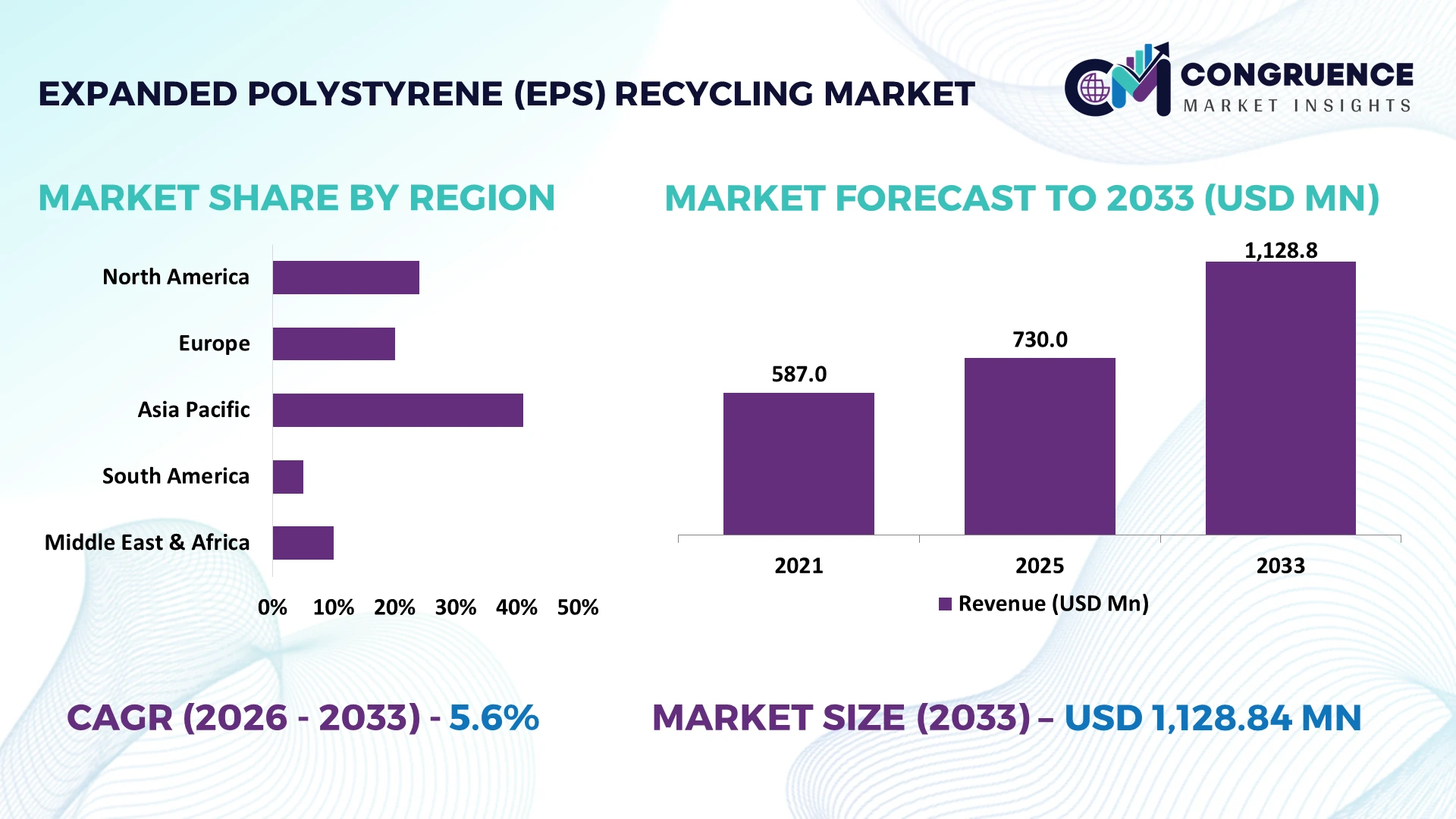
The Global Expanded Polystyrene (EPS) Recycling Market was valued at USD 730 Million in 2025 and is anticipated to reach a value of USD 1128.84 Million by 2033 expanding at a CAGR of 5.6% between 2026 and 2033. Extended producer responsibility, recycled-content procurement, densification technology, and closed-loop recovery of protective packaging, insulation, and food-service EPS are expanding economically recoverable feedstock volumes.
Japan maintains one of the strongest national EPS recovery systems, recycling approximately 90% of collected EPS through material and energy-recovery pathways, supported by established collection networks serving electronics packaging, fisheries, appliances, construction, and logistics. Volume-reduction equipment can compress EPS by roughly 50:1, materially improving transport economics for a material containing about 98% air. Compared with the United States, Japan benefits from denser collection infrastructure and mature segregation practices. Europe’s tightening packaging rules are simultaneously pushing recycled-content and recyclability requirements deeper into producer procurement strategies.
Strategically, recyclers should prioritize high-density collection corridors, on-site densification, traceable recycled resin, and long-term packaging partnerships because logistics efficiency determines whether low-density EPS becomes profitable secondary feedstock.
Market Size & Growth: USD 730 million in 2025 reaches USD 1,128.84 million by 2033 at 5.6% CAGR, supported by EPR expansion and recycled-content procurement.
Top Growth Drivers: Packaging recovery contributes 42%, construction waste diversion 33%, and recycled-polystyrene demand 25% to incremental market momentum.
Short-Term Forecast: By 2027, optimized densification networks can reduce EPS transportation volume by more than 95%, improving collection economics across fragmented waste streams.
Emerging Technologies: Thermal densification, solvent purification, and advanced dissolution recycling can achieve 90%+ volume reduction while recovering higher-quality polystyrene feedstock.
Regional Leaders: Asia-Pacific approaches USD 480 million by 2033, Europe USD 315 million, and North America USD 250 million as collection and circular-packaging systems expand.
Consumer/End-User Trends: EPS contains approximately 98% air, making source segregation and compaction increasingly critical for retailers, appliance distributors, fisheries, and construction operators.
Pilot/Case Example: In 2025, closed-loop EPS programs demonstrated compression ratios near 50:1, converting bulky packaging waste into transport-efficient material suitable for reprocessing.
Competitive Landscape: Specialized recyclers and resin producers compete across collection density, recycled-resin purity, and processing yield, with leading operators targeting recovery efficiencies above 90%.
Regulatory & ESG Impact: EU packaging rules target 100% recyclable packaging by 2030, strengthening commercial incentives for recyclable EPS designs and verified secondary-material pathways.
Investment & Funding: Recycling infrastructure programs exceeding USD 100 million collectively are supporting sorting, densification, advanced recycling, and regional collection expansion across major markets.
Innovation & Future Outlook: Dissolution and purification technologies target 95%+ polymer recovery, shifting EPS recycling from low-value compaction toward higher-purity circular polystyrene production.
Expanded Polystyrene recycling demand is concentrated across protective appliance and electronics packaging, seafood boxes, building insulation, distribution centers, and food-service waste streams where material volumes justify dedicated collection. Modern cold-compaction, thermal densification, and dissolution technologies address EPS’s central logistical disadvantage: approximately 98% of its structure is air. Densification can reduce transport volume by more than 95%, materially improving collection economics and downstream resin recovery. Europe’s packaging circularity requirements are also encouraging producers to establish traceable recycling pathways, while closed-loop recycled-polystyrene applications are moving beyond traditional low-value outlets, establishing the strategic context for market positioning.
EPS recycling is becoming strategically important as packaging producers, construction suppliers, fisheries, and retailers face tighter circularity requirements while seeking lower-cost secondary polystyrene feedstock. Europe’s packaging regulatory transition is shifting procurement toward recyclable formats, traceable recovery, and recycled-content integration. Because EPS contains approximately 98% air, competitive economics increasingly depend on collection density and preprocessing infrastructure rather than recycling capacity alone.
Modern cold compactors and thermal densifiers can reduce EPS volume by more than 95%, delivering roughly 50:1 compression versus legacy loose-bale transportation. Japan operates mature collection systems with recovery exceeding 80%, while the United States remains more geographically fragmented; Europe is advancing producer-funded collection under extended producer responsibility. Through 2028, densification at waste-generation sites and higher-purity dissolution processes should expand materially across commercial packaging corridors.
An appliance distribution center can compact protective EPS onsite before sending dense blocks directly to recyclers, eliminating repeated low-density truck movements. Recyclers are therefore investing in distributed densifiers, retailer partnerships, purification technology, and contracted feedstock networks. Long-term competitive advantage will belong to operators integrating collection, volume reduction, polymer purification, and verified recycled-resin offtake into one economically controlled circular system.
Extended producer responsibility and packaging circularity requirements are converting EPS recovery from discretionary waste management into structured material procurement. EPS contains approximately 98% air, yet modern densification can reduce its volume by more than 95%, while mature Japanese collection systems recover over 80% through established recycling pathways. Europe’s Packaging and Packaging Waste Regulation requires packaging to become recyclable under increasingly stringent conditions, intensifying pressure on manufacturers and distributors to document end-of-life pathways. This shifts investment toward source-separated collection, densification, and recycled-polystyrene offtake agreements. Recyclers are partnering with appliance retailers, fisheries, logistics operators, and construction businesses to secure cleaner feedstock. The strategic insight is that regulation increases value most for operators controlling collection points, because contamination-free EPS commands better processing economics than mixed municipal material.
EPS’s physical structure remains the market’s primary structural restraint: approximately 98% air creates exceptionally poor transport economics when material is collected without preprocessing. Densification can remove more than 95% of transport volume, but installing compactors across fragmented waste-generation points requires capital, maintenance, electricity, and trained operators. Food-service and seafood EPS can also carry moisture and organic contamination, reducing recoverable polymer quality; heavily contaminated loads can experience rejection rates exceeding 10–20% in poorly segregated systems. Rural U.S. collection networks illustrate the geographic problem, where long haul distances weaken economics relative to dense Japanese cities. Recyclers are mitigating exposure through hub-and-spoke collection, equipment leasing, retailer take-back contracts, and onsite compactors. Profitability therefore depends more heavily on inbound logistics optimization than nominal processing throughput.
Advanced dissolution and purification create an opportunity to move recycled EPS beyond low-value molding applications into higher-quality circular polystyrene feedstock. Conventional mechanical recycling performs best with clean material, whereas solvent-based processes can separate additives and contaminants while achieving polymer recovery above 90% in optimized systems. Combined with densification exceeding 95% volume reduction, this improves both transportation and downstream purification economics. Europe’s transition toward packaging designed for recycling strengthens potential demand for traceable secondary resin, while Japan provides a mature feedstock-collection model. Through 2028, digital material tracking and certified recycled-content systems will further improve offtake transparency. Recyclers and resin producers are investing in purification R&D, brand-owner partnerships, and closed-loop trials. The higher-value opportunity is selling verified polymer performance rather than commodity recycled material by weight.
Maintaining consistent recycled-polystyrene quality across heterogeneous EPS streams remains a long-term execution challenge. Protective packaging can deliver relatively clean polymer, while seafood boxes, demolition insulation, and food-service EPS introduce moisture, adhesives, coatings, dirt, and other contaminants. Even 10–20% contamination or rejection at collection points can materially lower plant utilization and increase washing, sorting, and disposal requirements. Europe’s increasingly demanding recyclability criteria also require recyclers to demonstrate reliable material quality as packaging specifications evolve. Unlike virgin resin production, recycled EPS operations must manage variable inbound material before achieving standardized output. Companies must invest in optical sorting, washing, feedstock grading, digital traceability, and supplier training while establishing application-specific quality specifications with converters. Sustainable scale depends on standardizing incoming material, not simply expanding recycling capacity.
Onsite Densification Reshapes Collection Logistics: Retailers, seafood distributors, and appliance warehouses are moving EPS preprocessing directly to waste-generation points. Cold compactors can achieve compression ratios near 50:1 and reduce transport volume by more than 95%. Japanese collection networks increasingly route densified material directly to processors, eliminating low-density truck movements. Recyclers are deploying leased compactors and scheduled pickup programs, lowering freight intensity while expanding economically viable collection radiuses.
Retail Take-Back Networks Expand: Appliance and electronics packaging is increasingly captured through distributor-led collection rather than mixed municipal streams. Clean protective EPS can deliver recovery yields above 90% after effective segregation, compared with materially lower usable yields from contaminated waste. U.S. recyclers are partnering with retailers and logistics facilities to aggregate consistent feedstock. The operational shift improves bale quality, reduces sorting requirements, and gives recyclers predictable material flows without building consumer-facing collection infrastructure.
Construction EPS Separation Improves: Contractors are increasingly segregating insulation offcuts at construction sites as landfill restrictions and waste-diversion requirements tighten. Clean installation scrap can achieve recycling yields exceeding 90%, while densification reduces bulky storage requirements by more than 95%. European processors are adding dedicated construction-material collection arrangements and contamination controls. Manufacturers are simultaneously designing insulation products around recoverability, turning previously dispersed construction waste into a more standardized industrial recycling stream.
Traceability Moves Into Resin Procurement: Recycled-polystyrene buyers increasingly require documented feedstock origin, recycled-content verification, and batch-level material quality. European packaging regulation is reinforcing this shift as packaging moves toward full recyclability requirements by 2030. Digital tracking can reduce manual documentation workloads by 20–30% in structured collection systems. Recyclers and converters are integrating material passports, certification workflows, and supplier data; non-obviously, traceability is becoming a commercial differentiator alongside resin purity.
Mechanical Recycling leads the type segmentation with an estimated 43% share, supported by established grinding, washing, extrusion, and pelletizing infrastructure for relatively clean EPS feedstock. Its lower processing complexity makes it particularly effective for protective packaging and manufacturing scrap. Densified EPS and Compacted EPS complement mechanical recycling by solving transportation inefficiency; compression can reduce material volume by more than 95%, with optimized equipment achieving approximately 50:1 ratios. Thermal Recycling remains relevant for contaminated material where polymer recovery is impractical, although it does not retain material within a circular polymer loop.
Chemical Recycling is the fastest-growing type as dissolution and purification technologies target contaminated or specification-sensitive EPS streams that conventional mechanical processes cannot efficiently upgrade. Optimized purification systems can recover more than 90% of usable polymer while separating selected additives and contaminants. Companies are therefore balancing investment between distributed densification for immediate logistics savings and centralized chemical-processing capacity for higher-quality output. Competitive priorities are shifting from maximum throughput toward feedstock flexibility, recovered-polymer purity, and verified circularity.
Packaging Products represent the leading application with an estimated 41% share because protective EPS from electronics, appliances, seafood distribution, and temperature-sensitive logistics is available in concentrated commercial streams. Clean packaging material can deliver recycling yields exceeding 90% when segregated correctly, while densification removes more than 95% of its original volume. Plastic Products remain an established outlet for recycled polystyrene pellets used in molded components and extruded applications. Consumer Goods absorb secondary material where appearance and mechanical-property requirements permit recycled content.
Insulation Materials represent the fastest-growing application as circular construction policies strengthen demand for recovered EPS in building products. Construction Materials provide another expanding outlet through lightweight components and composite applications, although contamination control remains essential for demolition-derived feedstock. Processors are installing dedicated packaging collection systems, improving resin filtration, and developing application-specific recycled grades. Investment is consequently moving toward closed-loop applications capable of preserving polymer value rather than directing recovered material toward progressively lower-value products.
Packaging Manufacturers lead end-user demand with an estimated 36% share because protective packaging provides both substantial EPS consumption and relatively clean post-industrial or commercial recovery streams. Source-separated material can achieve recovery yields above 90%, giving packaging producers stronger closed-loop economics than users dependent on mixed waste. Plastic Processors remain important purchasers of densified EPS and recycled polystyrene pellets, converting recovered material into molded and extruded products. Consumer Goods Manufacturers increasingly evaluate recycled feedstock where appearance, impact resistance, and regulatory specifications can be maintained.
Waste Management Companies represent the fastest-growing end-user group as collection economics improve through distributed compactors capable of reducing EPS volume by more than 95%. Construction Companies are also becoming more active participants through segregation of clean insulation offcuts. Recyclers and equipment suppliers are responding with compactor leasing, scheduled collection, feedstock contracts, and quality-linked pricing. Future competitive advantage is shifting toward companies connecting waste generators directly with processors, reducing handling stages while improving feedstock traceability and utilization.
Asia-Pacific accounted for the largest market share at 36% in 2025 however, Europe is expected to register the fastest growth, expanding at a CAGR of 6.4% between 2026 and 2033.
Distributed Densification Improves Collection Economics
North America represented approximately 27% of global EPS recycling activity in 2025, led by U.S. packaging, appliance distribution, seafood logistics, construction insulation, and retail waste streams. The operational constraint remains material density: EPS contains approximately 98% air, making untreated transportation uneconomic across long collection distances. Commercial recyclers increasingly position compactors at distribution centers and high-volume generators, achieving compression ratios approaching 50:1 and reducing transport volume by more than 95%. U.S. state-level extended producer responsibility programs are also transferring packaging-management obligations toward producers, strengthening interest in documented collection networks. Recyclers are responding through retailer partnerships, equipment-leasing models, scheduled collection, and regional consolidation hubs. The strongest economics emerge where clean commercial EPS bypasses mixed municipal sorting and moves directly from generators into densification and reprocessing channels.
United States Market Outlook: The United States combines substantial protective-packaging consumption with an expanding network of commercial EPS drop-off and densification operations. California’s packaging EPR framework is particularly significant because producers face progressively structured recovery responsibilities. Appliance retailers, seafood distributors, manufacturers, and logistics operators provide concentrated feedstock, allowing recyclers to improve utilization by establishing direct collection contracts rather than relying exclusively on household recycling infrastructure.
Circularity Regulation Restructures Material Flows
Europe accounted for approximately 25% of global EPS recycling activity in 2025, with Germany, the Netherlands, Italy, France, and the United Kingdom supporting established packaging and construction recovery systems. Packaging regulation and construction-waste requirements increasingly favor documented recyclability, secondary-material utilization, and producer-funded recovery. EPS insulation is particularly important because clean construction offcuts can achieve recycling yields exceeding 90% when segregated before contamination. Mechanical recycling remains established, while dissolution technologies are being developed for difficult construction streams containing legacy additives. Collection systems are becoming more specialized as recyclers separate packaging EPS from building insulation to maintain predictable polymer specifications. Companies are investing in purification, digital traceability, construction-site collection, and converter partnerships. Regulation is therefore shifting competitive advantage toward processors capable of documenting both feedstock origin and recycled-material destination.
Germany Market Outlook: Germany provides a strategically mature environment through established waste segregation, extensive insulation use, and a large construction-material industry. National recycling infrastructure supports separate handling of commercial packaging and building waste, while demolition activity creates longer-term insulation recovery requirements. German processors increasingly emphasize closed-loop material quality, contaminant removal, and traceable secondary polystyrene suitable for demanding construction and manufacturing applications.
Dense Collection Networks Support Processing Scale
Asia-Pacific held approximately 36% of global EPS recycling activity in 2025, supported by major electronics manufacturing, seafood logistics, appliance production, construction activity, and polystyrene-processing capacity in China, Japan, South Korea, and other industrial centers. Japan maintains one of the world’s most organized EPS recovery systems, with overall recovery exceeding 80% across established material and energy-recovery pathways. China provides considerably greater waste-generation and processing scale, supported by dense manufacturing clusters capable of aggregating protective packaging efficiently. Densification exceeding 95% volume reduction is particularly valuable for export-oriented electronics and appliance supply chains. Recyclers are integrating collection with manufacturing facilities, seafood markets, logistics hubs, and resin processors. The region’s operational advantage comes from locating preprocessing near concentrated waste generation, reducing the transport penalty associated with extremely lightweight EPS.
Japan Market Outlook: Japan combines disciplined waste segregation with established EPS collection from fish markets, retailers, appliance distribution, and industrial packaging. Recovery rates above 80% demonstrate the effectiveness of coordinated collection and preprocessing. Dense urban logistics shorten collection distances, while domestic recyclers use mechanical processing and volume-reduction technologies to convert bulky EPS into secondary feedstock for plastic products and other applications.
Brazil Concentrates Commercial Recovery Activity
South America represented approximately 6% of global EPS recycling activity in 2025, with Brazil providing the largest concentration of packaging consumption, plastics processing, retail distribution, construction, and recycling infrastructure. EPS collection remains uneven because municipal recovery systems often prioritize higher-density materials with stronger transportation economics. Commercial generators offer better economics: onsite compaction can reduce EPS volume by more than 95%, making appliance packaging, supermarket boxes, seafood containers, and construction offcuts practical recycling streams. Brazil’s National Solid Waste Policy and reverse-logistics framework provide an institutional basis for greater producer participation, although execution differs between municipalities. Recyclers are developing direct generator agreements, cooperative partnerships, and compacted-material aggregation systems. The commercial opportunity is strongest in São Paulo and other dense industrial corridors where transportation distances and feedstock aggregation can be controlled.
Brazil Market Outlook: Brazil benefits from a substantial plastics-converting industry and concentrated consumer-goods distribution around São Paulo, creating recoverable streams of protective EPS. Waste-picker cooperatives also provide an established collection layer, although bulky EPS requires dedicated logistics. Installing compactors at retailers and distribution facilities can convert previously uneconomic material into dense feedstock suitable for centralized mechanical recycling and downstream plastic processing.
Waste Infrastructure Modernization Opens Recovery Channels
Middle East & Africa accounted for approximately 6% of global EPS recycling activity in 2025, with the UAE, Saudi Arabia, South Africa, and selected urban markets concentrating formal recycling infrastructure. EPS waste arises primarily from construction insulation, appliance packaging, food distribution, seafood handling, and expanding e-commerce logistics. Saudi Arabia and the UAE are investing in waste diversion and circular-economy infrastructure as large construction programs increase packaging and insulation flows. Densification can reduce EPS transport volume by more than 95%, an important advantage where collection points are geographically dispersed. South Africa maintains a more established plastics-recycling ecosystem but faces collection and municipal infrastructure disparities. Operators are introducing source-separation contracts, compactors, centralized material-recovery facilities, and partnerships with property developers. Capturing clean commercial EPS before municipal mixing remains the most operationally effective route.
Saudi Arabia Market Outlook: Saudi Arabia offers a distinctive EPS recycling opportunity because large-scale construction, appliance distribution, hospitality development, and food logistics generate concentrated material streams. Vision 2030 waste-diversion objectives are encouraging stronger recovery infrastructure and private-sector participation. Developers and waste operators can improve recycling economics by positioning densification equipment directly at construction compounds, distribution centers, and other high-volume generation locations.
BEWI, GreenMax, Styro Recycle, INTCO Recycling, and specialized regional processors compete across EPS collection, densification, mechanical reprocessing, and recycled-polystyrene supply, while technology developers challenge conventional recyclers through purification and dissolution. The top five participants represent approximately 28% of organized processing capacity, reflecting fragmented feedstock ownership. Competition centers on collection economics, polymer purity, processing yield, and offtake security. Densification reduces transport volume by over 95%, clean commercial streams can deliver recovery yields above 90%, and optimized purification processes target polymer recovery exceeding 90%. Players are installing compactors at customer sites, securing retailer and construction partnerships, integrating collection with resin conversion, and developing higher-purity recycled grades. The competitive shift favors closed-loop operators controlling feedstock through final resin applications rather than standalone processors. Low-density logistics, contamination, equipment investment, and contracted feedstock availability create entry pressure. Winning requires dense collection networks, high utilization, traceable output, reliable offtake, and technology capable of upgrading heterogeneous EPS into specification-consistent recycled polystyrene.
BEWI ASA
INTCO Recycling
GREENMAX
Styro Recycle LLC
ACH Foam Technologies
RAPAC
Epsilyte LLC
Styro-Go
Foam Cycle
Polystyvert Inc.
Agilyx ASA
Pyrowave Inc.
TotalEnergies Corbion
Recycling Technologies Ltd.
Current EPS recycling relies on cold compaction, thermal densification, shredding, extrusion, and mechanical reprocessing. Modern compactors compress bulky EPS by approximately 50:1, reducing transport volume by 98% versus loose collection and materially improving logistics economics. Mechanical systems dominate commercial deployment because clean packaging and insulation streams can be converted directly into recycled polystyrene, benefiting integrated recyclers controlling collection, processing, and downstream conversion.
Emerging technologies combine automated sorting, contaminant removal, advanced extrusion, digital traceability, and solvent-based purification. Near-infrared sorting improves polymer identification above 90%, while optimized purification can recover over 90% of usable polystyrene from difficult feedstock. Compared with legacy loose-bale logistics, onsite densification delivers roughly 95–98% greater volume efficiency. Construction recyclers benefit particularly because purification enables recovery of aged insulation containing additives unsuitable for conventional mechanical processing.
Disruptive development centers on closed-loop dissolution, chemical purification, additive separation, and digitally verified recycled content. Commercial adoption remains early, but demonstration systems have successfully recovered construction EPS containing legacy flame retardants. During 2026–2028, tighter packaging rules will accelerate integration of purification with mechanical recycling and traceability platforms. Operators combining distributed densification with centralized high-purity processing gain stronger margins, broader feedstock access, and specification-grade output, making technology investment critical before recycled-content requirements reshape procurement globally.
May 2024 – BEWI opened Sweden’s first circular EPS hub in Norrköping, increasing company recycling capacity 40%. Latest extrusion technology converts packaging and insulation waste into recycled feedstock, strengthening closed-loop supply and improving Nordic collection economics. Source: bewi.com.
March 2025 – Versalis opened Porto Marghera’s recycled-polymers plant with 20,000-tonne annual capacity, producing r-EPS and r-GPPS containing 35–100% post-consumer recycled plastics. The investment converts construction EPS waste into specification-grade circular polymers for new applications. Source: versalis.com.
July 2025 – Polystyrene Recycling Alliance partnered with Circular Colorado to integrate EPS into an existing statewide collection network. The scalable model connects post-use foam with established end markets, reducing infrastructure duplication while extending recycling access geographically. Source: psrecycling.org.
February 2026 – BEWI inaugurated Norway’s first dedicated EPS recycling plant in Fredrikstad with 3,500-tonne annual capacity. Integrated onsite processing converts regional packaging and insulation waste directly into new insulation feedstock, shortening logistics and strengthening circular manufacturing. Source: recycling-magazine.com.
The Expanded Polystyrene (EPS) Recycling Market Report evaluates Mechanical Recycling, Thermal Recycling, Chemical Recycling, Densified EPS, and Compacted EPS across Packaging Products, Insulation Materials, Plastic Products, Construction Materials, and Consumer Goods. End-user coverage includes Packaging Manufacturers, Construction Companies, Plastic Processors, Consumer Goods Manufacturers, and Waste Management Companies. Mechanical recycling represents approximately 43% of activity, while Asia-Pacific accounts for about 36% of market deployment.
Regional analysis covers North America, Europe, Asia-Pacific, South America, and Middle East & Africa, alongside country-level collection and processing ecosystems. Technology assessment includes 50:1 compaction, thermal densification, automated sorting, extrusion, dissolution purification, contaminant separation, and digital traceability. The 2026–2033 framework supports investment planning, processing-capacity expansion, collection-network development, feedstock partnerships, technology selection, competitive positioning, and identification of higher-value closed-loop recycled-polystyrene applications.
| Report Attribute/Metric | Report Details |
|---|---|
Market Revenue in 2025 | USD 730 Million |
Market Revenue in 2033 | USD 1128.84 Million |
CAGR (2026 - 2033) | 5.6% |
Base Year | 2025 |
Forecast Period | 2026 - 2033 |
Historic Period | 2021 - 2025 |
Segments Covered | By Type
By Application
By End-User
|
Key Report Deliverable | Revenue Forecast, Growth Trends, Market Dynamics, Segmental Overview, Regional and Country-wise Analysis, Competition Landscape |
Region Covered | North America, Europe, Asia-Pacific, South America, Middle East, Africa |
Key Players Analyzed | BEWI ASA, INTCO Recycling, GREENMAX, Styro Recycle LLC, ACH Foam Technologies, RAPAC, Epsilyte LLC, Styro-Go, Foam Cycle, Polystyvert Inc., Agilyx ASA, Pyrowave Inc., TotalEnergies Corbion, Recycling Technologies Ltd. |
Customization & Pricing | Available on Request (10% Customization is Free) |




