
Reports
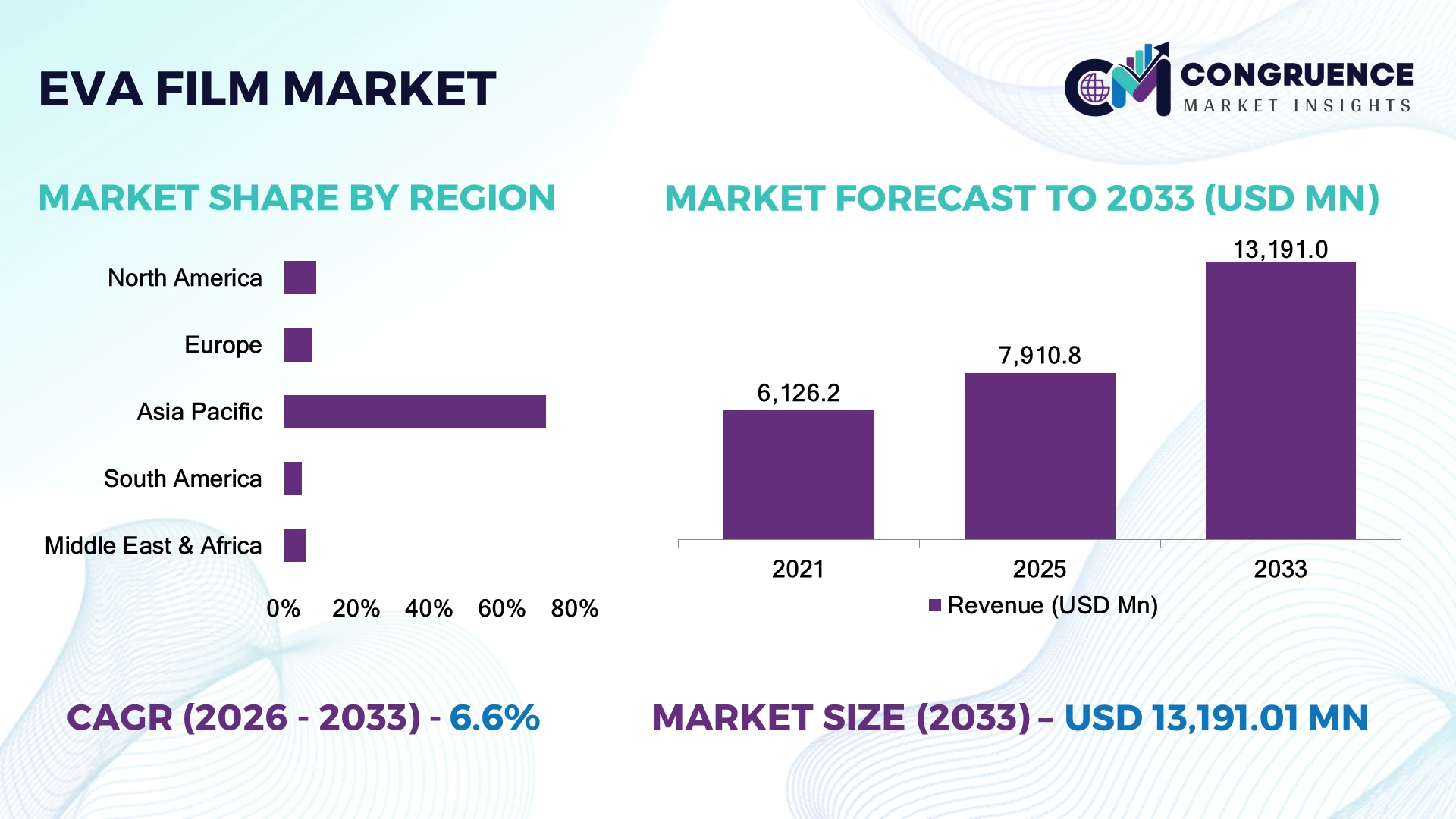
The Global EVA Film Market was valued at USD 7,910.8 Million in 2025 and is anticipated to reach a value of USD 13,191.0 Million by 2033 expanding at a CAGR of 6.6% between 2026 and 2033. Growth is being driven by photovoltaic module encapsulation, higher deployment of n-type cells, and the shift toward thinner, higher-transparency encapsulants requiring tighter optical and moisture-control specifications.
China dominates the EVA film supply chain, with more than 80% of global solar-module manufacturing concentrated across its PV ecosystem and China holding over 70% of EVA resin supply. In 2025, China added roughly 260 GW of solar capacity, substantially exceeding India's cumulative PV base of about 180 GW. High-efficiency formulations with optical transmittance above 91% are increasingly specified for advanced modules.
Strategically, manufacturers must prioritize solar-grade formulation consistency, localized supply security, and next-generation encapsulation compatibility as PV technology moves beyond conventional PERC architectures.
The EVA Film Market is concentrated in photovoltaic encapsulation, laminated glass, automotive glazing, and specialty protective films, with solar applications representing more than 80% of market value. High-transparency and UV-stable formulations are gaining importance as module architectures become more moisture-sensitive. China’s concentrated PV manufacturing base remains a critical supply-chain factor, while India and Southeast Asia are building localized encapsulant capacity. The market is transitioning toward thinner, higher-performance films and EPE structures, creating a clear bridge into the strategic investment discussion.
EVA film has become strategically important because encapsulation now directly influences module reliability, optical transmission, manufacturing throughput, and long-term energy yield. The transition from PERC toward TOPCon, heterojunction, back-contact, and tandem architectures is increasing scrutiny of moisture resistance and electrical insulation. EPE structures combine EVA's processability with a polyolefin core and have already gained meaningful industry adoption.
Technology selection is becoming a measurable competitive lever. Conventional EVA offers established lamination economics, while EPE substantially lowers water-vapor transmission; high-UV-transparency formulations can deliver more than 1% relative module power improvement compared with conventional UV-cut encapsulation. China retains overwhelming manufacturing scale, whereas India and Southeast Asia are prioritizing localized film production to diversify supply chains.
During 2026–2028, manufacturers are expected to prioritize co-extrusion, automated optical inspection, tighter formulation control, and compatibility with n-type cells. Companies are also shifting investment toward regional production and qualification partnerships. The strategic winners will be suppliers that combine cost-efficient EVA processing with moisture-barrier performance, rapid qualification, and dependable supply for next-generation PV module platforms.
Photovoltaic modules account for more than 80% of EVA film consumption, while n-type architectures are increasing demand for tighter moisture and adhesion control. TOPCon and heterojunction modules increasingly require encapsulants with stronger hydrolysis resistance, pushing premium formulation adoption by approximately 12–15%. China’s concentrated solar-module manufacturing base is accelerating qualification of high-transparency and low-gel-content grades. Manufacturers are responding by expanding co-extrusion capacity, improving crosslinking control, and developing application-specific formulations for bifacial modules. The non-obvious advantage is yield consistency: tighter film thickness and gel-content tolerances can reduce lamination-related defects by roughly 5–8%, improving factory throughput and lowering module rework.
EVA resin remains a significant cost component, and feedstock price movements can alter film manufacturing economics by approximately 8–15% across procurement cycles. China’s concentrated resin and photovoltaic supply chain also exposes manufacturers to inventory corrections, export disruptions, and abrupt changes in module production schedules. Film producers operating with imported resin can face 5–10% longer replenishment cycles than vertically integrated competitors. This directly pressures working capital and contract margins, particularly for smaller converters. Companies are responding through multi-source resin qualification, longer-term procurement contracts, localized warehousing, and increased use of EPE structures where technically appropriate. The strategic pressure is shifting from simple film capacity toward feedstock security and formulation flexibility.
EPE co-extrusion creates an opportunity to combine EVA process familiarity with polyolefin-based moisture-barrier performance, particularly for TOPCon and heterojunction modules. Advanced encapsulation structures can reduce water-vapor transmission by more than 50% versus conventional EVA configurations, while thinner film designs can reduce polymer consumption approximately 5–10% per module. India, Vietnam, and Malaysia are strategically attractive for localized production as module manufacturers diversify sourcing beyond China. Film suppliers are investing in co-extrusion lines, application laboratories, and joint qualification programs with module producers. A less obvious opportunity lies in dual-product manufacturing: plants capable of switching between EVA and EPE can respond faster to technology migration without duplicating the entire production infrastructure.
Rapid movement toward TOPCon, heterojunction, back-contact, and tandem architectures is increasing encapsulant qualification requirements. Changes in cell metallization and module structures can extend validation cycles by 10–20%, while tighter optical, adhesion, and moisture specifications increase laboratory workload. Manufacturing plants also face thickness uniformity requirements approaching ±3% for premium applications, making extrusion control increasingly critical. China-based suppliers benefit from dense module-maker ecosystems, whereas newer manufacturing hubs must build comparable qualification networks. Companies are addressing the challenge through accelerated aging laboratories, inline optical inspection, digital process control, and joint testing with module OEMs. The critical long-term issue is not film availability but maintaining formulation compatibility as cell architectures evolve faster than conventional qualification cycles.
EPE Adoption Accelerates: EPE encapsulation is moving beyond pilot qualification as module makers prioritize moisture resistance and n-type compatibility. Polyolefin-based structures can cut water-vapor transmission by more than 50%, while co-extrusion enables 5–10% lower material usage. Chinese suppliers are scaling dual-material production to hedge against rapid cell-technology transitions.
Thinner Films Improve Throughput: Film producers are optimizing thickness uniformity toward ±3% while reducing unnecessary polymer loading by approximately 5–8%. Automated extrusion control and inline inspection are replacing manual sampling, reducing dimensional defects by roughly 3–5%. This shift is particularly relevant for high-volume photovoltaic plants seeking faster lamination cycles and lower material intensity.
Supply Chains Diversify Production: India and Southeast Asia are attracting encapsulant investments as module manufacturers reduce dependence on concentrated Chinese sourcing. Regional qualification programs are increasing, while localized inventory can shorten replenishment windows by approximately 10–15%. Producers are establishing multi-country resin procurement and converting partnerships rather than relying on single-source supply chains.
Qualification Becomes Technology-Specific: Encapsulant specifications are increasingly differentiated by TOPCon, heterojunction, bifacial, and emerging tandem architectures rather than one universal EVA grade. Advanced formulations can improve adhesion and reliability margins by approximately 5–10%. Manufacturers are expanding accelerated-aging laboratories and OEM testing partnerships, making qualification capability an increasingly important competitive differentiator.
High-transparency EVA film represents the leading type, accounting for approximately 58% of global demand, supported by its established compatibility with crystalline-silicon modules, reliable lamination behavior, and favorable cost-performance balance. Standard EVA remains important in conventional module production, while UV-stabilized and anti-PID formulations capture higher-value applications where optical retention and electrical reliability are critical. EPE-based encapsulation is the fastest-growing category as TOPCon and heterojunction architectures place greater emphasis on moisture-barrier performance. Its adoption is expanding from qualification into volume production, with premium encapsulation structures reducing moisture transmission by more than 50% in relevant configurations.
Companies are responding by expanding co-extrusion capability, developing application-specific formulations, and qualifying EVA/EPE platforms with module manufacturers. Advanced grades command approximately 8–15% higher value than conventional formulations, while tighter thickness control can reduce lamination-related defects by 3–5%. Investment is therefore shifting from commodity EVA capacity toward flexible lines capable of producing multiple encapsulant architectures.
Photovoltaic module encapsulation accounts for approximately 84% of global EVA film consumption, making it overwhelmingly the leading application. The concentration reflects EVA's established lamination performance, adhesion to glass and cell surfaces, electrical insulation, and cost advantages across high-volume crystalline-silicon production. Laminated glass and automotive applications remain established secondary markets, while building-integrated photovoltaics and specialty laminated structures are developing more selectively. Within solar, bifacial and n-type modules are driving the fastest specification changes because moisture resistance and optical transmission increasingly influence module reliability.
Companies are adapting by scaling high-transparency grades, introducing UV-stable formulations, and integrating inline thickness and optical inspection. Premium solar formulations now typically command approximately 10–15% higher value than basic grades, while automated inspection can reduce film-related production defects by roughly 3–5%. The strategic implication is clear: suppliers with module-specific qualification capability are gaining greater pricing resilience than producers competing primarily on commodity film volume.
Solar module manufacturers account for approximately 86% of EVA film demand, reflecting the material's direct role in cell encapsulation, module durability, optical performance, and electrical insulation. Procurement is increasingly specification-driven rather than purely price-led, particularly among producers manufacturing TOPCon, heterojunction, and bifacial modules. Laminated-glass manufacturers and automotive component producers represent smaller but strategically relevant end-user groups, with tighter requirements for adhesion, optical clarity, weatherability, and dimensional consistency. Emerging module manufacturers in India and Southeast Asia represent the fastest-growing buyer group as production capacity diversifies beyond China.
Film suppliers are responding through joint qualification programs, regional warehouses, technical service teams, and customized formulation agreements. Large module producers can secure approximately 5–10% procurement advantages through volume contracts, while localized inventory can reduce replenishment lead times by roughly 10–15%. The competitive shift favors suppliers that can provide both formulation flexibility and consistent high-volume delivery rather than those offering the lowest nominal film price.
Asia-Pacific accounted for the largest market share at 72% in 2025 however, Middle East & Africa is expected to register the fastest growth, expanding at a CAGR of 8.1% between 2026 and 2033.

Domestic PV manufacturing strengthens encapsulant localization
North America accounts for approximately 9% of global EVA film demand, supported primarily by U.S. solar-module manufacturing, utility-scale deployment, and domestic-content strategies. The United States installed approximately 43 GW of PV capacity in 2025, creating a substantial downstream requirement for encapsulation materials. Local module production is increasingly encouraging regional sourcing of EVA film, particularly for n-type modules requiring tighter moisture and adhesion specifications. Manufacturers are responding through domestic inventory hubs, qualification partnerships with module producers, and investment in automated extrusion and inspection. U.S. production remains considerably smaller than China's, but the strategic value is higher because localized encapsulation reduces exposure to shipping disruption and qualification delays. The region's operational priority is therefore supply assurance rather than commodity-scale volume.
United States Market Outlook: The United States is the region's principal EVA film market because of its large solar deployment base and expanding domestic module manufacturing ecosystem. The country produced approximately 23 GW of PV modules in 2024, creating a growing qualification base for locally supplied encapsulants. Domestic-content requirements are encouraging suppliers to establish shorter, more traceable material chains and support OEM-specific formulations.
Localized manufacturing meets resilient PV supply-chain goals
Europe represents approximately 8% of global EVA film demand, supported by large distributed and utility-scale solar deployment and increasing emphasis on resilient clean-technology supply chains. The European Union installed approximately 68 GW of PV capacity in 2025, sustaining demand for encapsulants used in crystalline-silicon modules. European manufacturers increasingly prioritize low-carbon production, traceable feedstocks, recyclability, and compatibility with advanced n-type modules. The Net-Zero Industry Act is also encouraging domestic clean-technology manufacturing, although Chinese cost advantages remain significant. Suppliers are therefore concentrating on premium formulations, technical qualification, and partnerships rather than competing purely on volume. Advanced encapsulants with tighter optical and moisture specifications are gaining importance as European module producers target longer operating lifetimes.
Germany Market Outlook: Germany remains Europe's most important EVA film demand center, supported by large distributed-PV deployment and a sophisticated module installation ecosystem. The country added approximately 18 GW of PV capacity in 2025, strengthening recurring demand for encapsulation materials. German buyers place particular emphasis on module durability, traceability, and long-term performance, favoring suppliers with validated formulations and reliable technical support.
China's manufacturing scale anchors the global supply chain
Asia-Pacific accounts for approximately 72% of global EVA film demand, reflecting China's dominant position across PV manufacturing, encapsulant production, and module assembly. China installed approximately 415 GW of PV capacity in 2025 and produced about 627 GW of modules in 2024, representing roughly 86% of global module output. This manufacturing concentration supports dense supplier networks, rapid formulation qualification, and competitive film pricing. India, Vietnam, Malaysia, and Thailand are expanding manufacturing footprints as buyers diversify sourcing. Film producers are consequently adding flexible production lines and regional technical centers to serve multiple module architectures. The region's decisive advantage remains integrated supply-chain depth from polymers through finished modules.
China Market Outlook: China remains the world's dominant EVA film market because its PV ecosystem combines resin availability, film conversion, cell manufacturing, and module assembly within highly integrated industrial clusters. The country installed 415 GW of PV in 2025, while n-type technologies represented about 82% of crystalline-silicon wafer usage. This combination accelerates qualification of advanced EVA and EPE encapsulation structures.
Brazilian solar deployment creates a localized demand base
South America accounts for approximately 5% of global EVA film demand, with Brazil representing the region's principal market through large distributed generation, utility-scale projects, and domestic module assembly. Brazil installed approximately 14.3 GW of PV capacity in 2024, supporting recurring demand for encapsulation materials. Local module producers increasingly value shorter material lead times and technical support, while imported EVA film remains important because upstream polymer and specialty-film production is limited. Suppliers are responding through distributor partnerships, regional inventories, and application-specific grades. Currency volatility and logistics costs remain important purchasing considerations, making inventory positioning a competitive tool. The strongest opportunity is therefore tied to reliable supply for Brazil's expanding solar manufacturing and installation ecosystem.
Brazil Market Outlook: Brazil is the region's strategic anchor because of its large solar fleet, strong distributed-generation market, and established module-import and assembly channels. Distributed PV remains particularly important, creating demand for standardized encapsulation films across repeated module configurations. Suppliers with Brazilian inventory and technical qualification capabilities can reduce procurement friction and respond faster than fully import-dependent competitors.
Utility-scale solar expansion opens a new encapsulant frontier
Middle East & Africa accounts for approximately 6% of global EVA film demand, but its strategic importance is increasing as Saudi Arabia, the United Arab Emirates, Egypt, and South Africa accelerate utility-scale solar deployment. Saudi Arabia nearly quadrupled annual solar additions in 2025 to almost 7 GW, while sub-Saharan Africa and the Middle East and North Africa each roughly doubled renewable capacity additions to around 12 GW. Large desert projects require encapsulants engineered for high UV exposure, elevated temperatures, and long operating cycles. Suppliers are therefore emphasizing UV stability, adhesion retention, and regional logistics. Project-scale procurement increasingly favors manufacturers capable of supplying large volumes with validated environmental performance.
Saudi Arabia Market Outlook: Saudi Arabia is the region's most strategically significant EVA film market because its utility-scale solar pipeline combines very high irradiation with rapidly expanding project deployment. Solar additions reached nearly 7 GW in 2025, quadrupling from the previous year. This environment favors encapsulants with strong UV stability and thermal-aging performance, while regional warehousing can materially improve project delivery reliability.
Hangzhou First Applied Material, SVECK, HIUV, Betterial, and RenewSys compete directly, with Chinese scale leaders facing Indian localization-focused producers and technology-led suppliers. The top five players hold roughly 55% of global solar encapsulant film sales. Competition centers on price, formulation performance, qualification speed, and supply security: integrated producers can achieve 8–12% cost advantages, while premium grades command 10–15% value premiums. First and SVECK emphasize scale and automated production; HIUV differentiates through co-extrusion and overseas partnerships; RenewSys competes through vertical integration and domestic capacity. Companies are expanding encapsulant lines, qualifying EPE and POE structures, and forming OEM partnerships to secure demand. The competitive shift is moving from commodity EVA toward application-specific encapsulation as TOPCon and heterojunction architectures tighten moisture, optical, and adhesion requirements. Entry barriers include formulation IP, qualification history, capital-intensive extrusion equipment, and customer validation. Winning requires scale, reliable feedstock, rapid qualification, flexible multi-material production, and localized technical support capability.
Current EVA film production is moving toward automated extrusion, inline thickness monitoring, optical inspection, and closed-loop crosslinking control. These systems typically improve thickness consistency by 3–5% and reduce film-related defects by 2–4% versus manual sampling. Adoption is strongest among high-volume Chinese producers, where automated inspection is increasingly integrated with production lines. Digital process records shorten troubleshooting cycles and improve batch traceability for module OEM qualification.
Emerging technology is centered on co-extruded EPE, high-transparency EVA, anti-PID formulations, and UV-stable encapsulants for TOPCon and heterojunction modules. EPE can reduce moisture transmission by more than 50% in structures, while advanced EVA formulations can improve optical retention by approximately 1–2%. Compared with EVA-only production, automated co-extrusion can reduce material-changeover losses by roughly 5–8%. Suppliers with flexible multi-material lines therefore gain an advantage as module architectures diversify.
From 2026–2028, AI-assisted inspection, predictive maintenance, digital recipe management, and application-specific encapsulation will become important. AI-supported defect classification can reduce inspection response time by approximately 20%, while predictive maintenance can improve equipment availability by 2–3%. Chinese scale leaders benefit from deployment, whereas Indian and Southeast Asian producers gain differentiation through localized qualification and supply security. Acting now matters because encapsulant specifications are changing faster than qualification cycles.
December 2025 Saatvik Green Energy commissioned a 2 GW EPE film facility in Haryana, integrating encapsulant production with module manufacturing. The project deepens vertical integration, reduces external sourcing exposure, and strengthens control over encapsulation specifications for n-type modules. Source: saatvikgroup.com
May 2025 RenewSys added eight encapsulant lines, targeting 30 GW capacity across 19 lines. The expansion strengthens India's domestic supply base, supports EVA, POE, and EPE production, and aligns encapsulant output with rapidly scaling module manufacturing operations. Source: renewsysworld.com
August 2025 HIUV expanded encapsulant partnerships across India, the Middle East, Africa, and the Americas. The company reported more than 100 R&D professionals and RMB 100 million annual R&D investment, supporting production, qualification, and technology transfer. Source: pv-magazine.com
April 2024 Chinese Academy of Sciences researchers demonstrated limonene-assisted EVA delamination, achieving complete glass and backsheet separation while preserving silicon cells. The laboratory process reached separation in 20 minutes, strengthening the technical pathway toward higher-value photovoltaic module recycling. Source: sciencedirect.com ScienceDirect
The EVA Film Market Report covers transparent EVA, white EVA, UV-stable EVA, anti-PID grades, and emerging EVA-based EPE structures across photovoltaic encapsulation, laminated glass, automotive glazing, construction, and specialty applications. End-user analysis emphasizes solar module manufacturers, glass laminators, automotive suppliers, construction-material producers, and film converters. Coverage spans North America, Europe, Asia-Pacific, South America, and Middle East & Africa, with assessment of China, the United States, India, Germany, Brazil, and Saudi Arabia.
The report evaluates extrusion, co-extrusion, automated inspection, crosslinking control, optical enhancement, moisture-barrier technologies, and recycling-oriented decapsulation. It benchmarks suppliers on capacity positioning, product qualification, vertical integration, partnerships, localization, and application-specific innovation. With photovoltaic encapsulation representing more than 80% of demand, the analysis identifies investment areas, supply-chain vulnerabilities, technology transitions, and emerging EPE adoption. The 2026–2033 outlook supports capacity planning, market entry, sourcing decisions, partnership strategy, product development, and positioning.
| Report Attribute/Metric | Report Details |
|---|---|
|
Market Revenue in 2025 |
USD 7,910.8 Million |
|
Market Revenue in 2033 |
USD 13,191.0 Million |
|
CAGR (2026 - 2033) |
6.6% |
|
Base Year |
2025 |
|
Forecast Period |
2026 - 2033 |
|
Historic Period |
2021 - 2025 |
|
Segments Covered |
By Type
By Application
By End-User
|
|
Key Report Deliverable |
Revenue Forecast, Growth Trends, Market Dynamics, Segmental Overview, Regional and Country-wise Analysis, Competition Landscape |
|
Region Covered |
North America, Europe, Asia-Pacific, South America, Middle East, Africa |
|
Key Players Analyzed |
Hangzhou First Applied Material Co., Ltd., Jiangsu SVECK Photovoltaic Technology Co., Ltd., Shanghai HIUV New Materials Co., Ltd., Betterial Film Technology Co., Ltd., RenewSys India Pvt. Ltd., H.B. Fuller Company, Mitsui Chemicals, Inc., Bridgestone Corporation, Dow Inc., Toppan Holdings Inc., Vishakha Renewables Pvt. Ltd., STR Holdings, Inc., Folienwerk Wolfen GmbH, SWM International |
|
Customization & Pricing |
Available on Request (10% Customization is Free) |




