
Reports
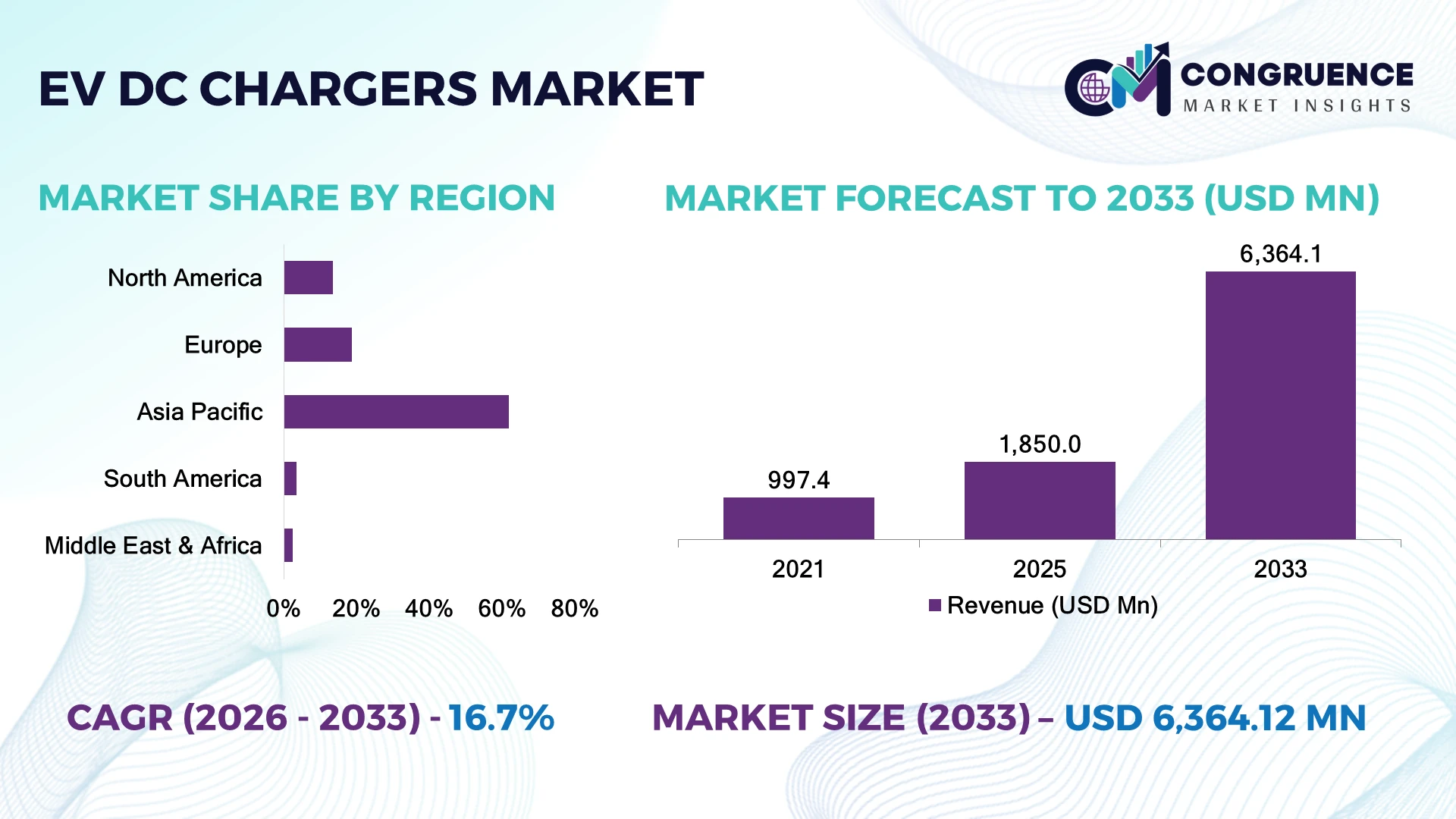
The Global EV DC Chargers Market was valued at USD 1,850.0 Million in 2025 and is anticipated to reach a value of USD 6,364.1 Million by 2033 expanding at a CAGR of 16.7% between 2026 and 2033. Growth is being accelerated by ultra-fast charging deployment, rising electric vehicle parc expansion, and grid-integrated charging infrastructure investments across major transportation corridors.
China dominates the global EV DC chargers landscape, accounting for approximately 62% of installed public DC fast-charging capacity, supported by investments exceeding USD 25 billion in charging infrastructure and strong integration with the automotive manufacturing ecosystem. The country operates more than 1.8 million public charging points, significantly ahead of the United States, which holds nearly 11% of global public charging infrastructure. Accelerated deployment along the Belt and Road-connected logistics network and increasing adoption of 800V vehicle platforms continue strengthening China's leadership in high-power charging technology.
The strategic implication is clear companies securing charger-network scale, grid connectivity, and high-power charging capabilities will command stronger competitive positioning across the evolving electric mobility value chain.
Market Size & Growth: USD 1,850.0 million in 2025 reaching USD 6,364.1 million by 2033 at 16.7% CAGR, supported by high-power charging network expansion.
Top Growth Drivers: Public fast-charging installations up 38%, EV fleet penetration up 29%, and charging utilization rates improving by 21%.
Short-Term Forecast: By 2028, average charging session efficiency is expected to improve by 25% through advanced power management.
Emerging Technologies: AI-driven load balancing, 800V charging architecture, and silicon-carbide power electronics are reducing charging times by up to 35%.
Regional Leaders: Asia Pacific exceeds USD 3.1 billion, Europe approaches USD 1.5 billion, and North America surpasses USD 1.2 billion with highway charging expansion.
Consumer/End-User Trends: More than 70% of EV users prioritize charging speeds below 30 minutes for long-distance travel.
Pilot/Case Example: In 2024, several 350 kW corridor charging projects reduced average charging durations by nearly 40%.
Competitive Landscape: Tesla holds approximately 18% market influence, alongside ABB, Siemens, Delta Electronics, and Schneider Electric.
Regulatory & ESG Impact: Zero-emission transport policies contributed to over 30% growth in public fast-charging deployment.
Investment & Funding: Global investments exceeded USD 30 billion, driven by infrastructure partnerships and utility-backed expansion.
Innovation & Future Outlook: Vehicle-to-grid integration and intelligent energy orchestration are becoming core competitive differentiators.
High-power charging deployment across passenger vehicles, commercial fleets, logistics hubs, and highway corridors remains the primary demand center for EV DC chargers. Recent innovations include 350 kW ultra-fast chargers, AI-enabled energy optimization, and 800V charging systems that significantly reduce dwell times. An emerging trend is the integration of renewable energy and battery storage, with charging utilization rates improving by nearly 20% as operators optimize network performance amid evolving grid modernization initiatives and supply-chain localization efforts.
The EV DC chargers market has become a critical enabler of electric mobility expansion, transportation electrification, and infrastructure modernization. Competitive advantage is increasingly tied to charger availability, charging speed, and network reliability. Governments and private operators are accelerating corridor electrification programs while manufacturers are restructuring supply chains to secure power electronics, semiconductor components, and grid integration technologies.
Modern DC fast chargers deliver charging efficiencies above 95% and can reduce charging durations by up to 50% compared with conventional AC charging systems. China continues to lead deployment scale through dense public charging networks, while Europe emphasizes interoperability standards and the United States focuses on nationwide corridor coverage. This divergence is shaping distinct investment priorities across the industry. Over the next two to three years, charger utilization rates are expected to improve by more than 20% as network density and vehicle adoption increase simultaneously.
Fleet charging hubs serving logistics operators provide a practical example of market evolution, enabling higher vehicle uptime and improved route optimization. Companies are responding through infrastructure partnerships, software integration, and high-power charger deployment. Organizations that combine network scale, intelligent energy management, and strategic infrastructure placement will secure lasting operational and competitive advantages.
The rapid deployment of high-power charging networks is strengthening the foundation of electric mobility ecosystems. Public DC fast-charging installations increased by approximately 38% globally, while EV adoption expanded by nearly 29% and charger utilization improved by 21%. China, Germany, and the United States are prioritizing highway charging corridors and urban charging hubs to support growing vehicle fleets. This infrastructure expansion directly reduces range anxiety, improves vehicle utilization, and increases consumer confidence. In response, leading companies are investing in 350 kW charging technology, expanding strategic utility partnerships, and integrating smart energy management platforms. A notable operational insight is that charger availability is becoming as important as charging speed in determining network competitiveness and long-term asset utilization.
Grid limitations and fragmented charging standards remain significant barriers to efficient deployment. In several developed markets, grid connection approvals can account for over 30% of project timelines, while installation costs have increased by approximately 18% due to power infrastructure upgrades. In the United States and parts of Europe, interoperability inconsistencies continue affecting charging reliability and user experience. These constraints directly impact deployment speed, project economics, and network profitability. To mitigate risks, operators are localizing supply chains, securing long-term equipment contracts, and incorporating battery energy storage systems to reduce grid dependency. A key strategic insight is that grid readiness increasingly determines deployment success more than charger hardware availability alone.
The integration of intelligent charging software, energy storage, and commercial fleet electrification presents substantial growth opportunities. Fleet operators can improve charging efficiency by more than 25%, while AI-enabled load management can reduce peak energy costs by nearly 20%. India and Southeast Asian markets are rapidly expanding electric bus and commercial vehicle programs, creating new demand clusters beyond passenger mobility. Emerging vehicle-to-grid functionality is also enabling chargers to participate in energy management ecosystems. Companies are expanding R&D programs, forming utility partnerships, and developing software-centric charging platforms. A distinctive strategic opportunity lies in transforming charging networks from infrastructure assets into revenue-generating energy management ecosystems with multiple service layers.
Long-term scalability requires overcoming complex operational and technological challenges. High-power charging stations can experience utilization fluctuations exceeding 35%, creating difficulties in infrastructure planning and return optimization. Cybersecurity concerns have intensified as connected charging networks process increasing volumes of vehicle and payment data. In addition, maintaining uptime above 97% remains challenging across geographically dispersed networks. These factors directly influence customer satisfaction, operational consistency, and network competitiveness. Companies are responding through predictive maintenance systems, cybersecurity investments, and advanced monitoring platforms. A critical operational insight is that future market leaders will be defined not by charger deployment volume alone, but by their ability to maintain reliable, secure, and consistently available charging ecosystems at scale.
Ultra-Fast Charging Network Expansion High-power chargers above 250 kW increased by nearly 32% during the last year, while average charging times declined by approximately 28%. Highway corridor deployment and commercial fleet electrification are accelerating installation activity. Automotive OEMs and charging operators are forming long-term infrastructure partnerships to improve charger density, reduce vehicle downtime, and strengthen network utilization across key transportation routes.
Smart Energy Management Integration AI-enabled load balancing adoption expanded by roughly 27%, while peak electricity consumption at charging sites declined by nearly 18%. Utilities are integrating chargers with battery storage and demand-response systems to manage grid pressure more effectively. Companies are deploying software-driven charging platforms that optimize energy distribution, improve operational efficiency, and lower electricity procurement costs without expanding physical infrastructure footprints.
Localized Supply Chain Development Domestic sourcing of power electronics and charging components increased by approximately 24% as manufacturers responded to geopolitical trade uncertainty and semiconductor availability concerns. Lead times for critical charging equipment improved by nearly 20% in several manufacturing hubs. Industry participants are restructuring supplier networks, expanding regional production capacity, and securing component agreements to improve deployment reliability and project execution timelines.
Fleet-Centric Charging Ecosystems Dedicated commercial fleet charging installations grew by nearly 35%, while charging utilization rates improved by approximately 22%. Logistics operators increasingly require centralized charging hubs integrated with route-planning software and telematics platforms. Charging providers are investing in automated fleet management solutions, enabling higher vehicle uptime and more predictable energy consumption. A notable shift is the transition from standalone charging assets toward fully integrated mobility and energy service ecosystems.
DC fast chargers represent the leading segment, accounting for approximately 68% of total market deployment due to their ability to deliver rapid charging, support long-distance travel, and maximize charger utilization rates. Their scalability and compatibility with expanding EV fleets make them the preferred choice for public charging operators and commercial charging networks. Adoption remains strongest across China, the United States, and Germany, where charging corridor development remains a strategic priority. Companies continue expanding high-power charger portfolios, with installations above 150 kW increasing by nearly 30% year-over-year.
Ultra-fast DC chargers are the fastest-growing segment as automotive manufacturers accelerate the rollout of 800V vehicle architectures capable of accepting significantly higher charging power. Charging sessions completed within 20 minutes increased by approximately 25%, driving investment toward advanced charging systems. Conventional DC chargers maintain relevance for urban charging hubs and commercial parking facilities due to lower infrastructure requirements and deployment flexibility. Industry participants are prioritizing power electronics innovation, software integration, and network optimization strategies to strengthen competitive differentiation.
Public charging stations remain the leading application segment with an estimated 57% market share, supported by large-scale infrastructure deployment and increasing demand for reliable charging access. National corridor electrification programs and urban charging expansion continue concentrating demand within this segment. Utilization rates at public charging locations improved by nearly 20%, while charger availability remains a key operational performance indicator. Network operators are expanding charging footprints and integrating digital monitoring platforms to enhance user experience and asset productivity.
Commercial fleet charging is emerging as the fastest-growing application segment due to rising electrification of logistics vehicles, buses, and delivery fleets. Fleet charging demand increased by approximately 33%, supported by operational requirements for predictable charging schedules and centralized energy management. Residential and workplace charging applications continue expanding steadily, particularly in countries with strong EV adoption incentives. Companies are responding through dedicated fleet charging solutions, software-enabled energy management, and strategic partnerships with transportation operators to strengthen long-term service contracts and recurring usage patterns.
Charging network operators represent the dominant end-user group with approximately 49% of total market demand, driven by large-scale infrastructure ownership and continuous expansion requirements. Their investment focus centers on charger density, uptime performance, and network interoperability. Public charging utilization increased by roughly 21%, encouraging operators to expand corridor coverage and deploy higher-capacity charging systems. Market participants are strengthening partnerships with utilities, technology providers, and automotive manufacturers to improve operational efficiency and customer retention.
Fleet operators are the fastest-growing end-user segment as transportation companies accelerate electrification strategies. Fleet charging investments increased by approximately 31%, supported by the need to reduce operational costs and improve vehicle availability. Automotive manufacturers and commercial property owners also remain important buyers as they integrate charging infrastructure into broader mobility and real-estate strategies. Companies are introducing customized charging solutions, flexible pricing models, and software-enabled management platforms to address evolving customer requirements and secure long-term infrastructure contracts.
Asia-Pacific accounted for the largest market share at 61.8% in 2025 however, North America is expected to register the fastest growth, expanding at a CAGR of 18.4% between 2026 and 2033.
North America accounted for approximately 13.5% of the global EV DC chargers market in 2025, supported by large-scale charging corridor deployment, utility-backed infrastructure programs, and growing commercial fleet electrification. The region is prioritizing interoperability, charger reliability, and high-power charging capacity to support long-distance transportation networks. More than 35% of newly installed public fast chargers are now rated above 150 kW, reflecting a shift toward shorter charging sessions and improved asset utilization. Charging providers are increasingly partnering with utilities, fleet operators, and retail enterprises to strengthen network density and improve customer accessibility. Infrastructure investments remain concentrated along interstate transportation corridors and urban mobility hubs, creating stronger operational integration between transportation and energy systems.
United States Market Outlook: The United States remains the dominant market within North America due to its extensive highway infrastructure, large EV fleet base, and growing charging network investments. Public charging deployment continues accelerating across major transportation corridors, while commercial fleet electrification is expanding demand for dedicated charging hubs. More than 70% of regional DC fast-charging installations are concentrated in the country, supported by utility partnerships, private-sector investment, and increasing adoption of high-power charging technology. Companies are also prioritizing software-enabled charging management systems to improve network uptime and energy optimization.
Europe represented approximately 18.7% of the global EV DC chargers market in 2025, supported by extensive charging infrastructure expansion, cross-border mobility initiatives, and strong EV adoption rates. The market benefits from harmonized charging standards and increasing deployment of high-capacity charging stations along major transport corridors. Public charging availability improved by nearly 24% over recent years as operators expanded infrastructure to support growing electric vehicle volumes. Utilities, automotive manufacturers, and charging providers are collaborating to improve interoperability and charging accessibility. The transition toward ultra-fast charging systems is strengthening operational efficiency while supporting long-distance electric mobility across multiple national markets.
Germany Market Outlook: Germany serves as the strategic center of the European EV DC chargers market due to its automotive manufacturing strength, advanced charging infrastructure, and technology leadership. The country continues expanding fast-charging coverage across highways and logistics corridors while supporting industrial electrification initiatives. More than 25% of Europe's high-power charging stations are estimated to be located in Germany. Strong collaboration between automotive manufacturers, charging operators, and energy providers is accelerating deployment of intelligent charging systems and improving network utilization across both passenger and commercial vehicle segments.
Asia-Pacific dominates the global EV DC chargers market with approximately 61.8% market share, supported by unmatched manufacturing capacity, extensive charging deployment, and strong electric vehicle adoption. The region hosts the largest concentration of charging equipment manufacturers and accounts for the majority of global public fast-charging installations. Public charging infrastructure expanded by more than 30% across key markets, supported by transportation electrification programs and large-scale urban mobility initiatives. Enterprise investments continue targeting high-density charging hubs, smart charging systems, and integrated energy management platforms. Strong supply-chain localization and production scale enable rapid deployment while maintaining competitive equipment costs.
China Market Outlook: China remains the most influential market globally due to its extensive charging infrastructure, large EV fleet, and dominant manufacturing ecosystem. The country operates the world's largest public charging network and leads deployment of ultra-fast charging technologies. More than 60% of global public DC fast chargers are estimated to be installed within China. Domestic manufacturers continue expanding production capacity while investing in next-generation charging technologies, battery integration solutions, and intelligent energy management systems that strengthen the country's long-term competitive position.
South America accounted for approximately 3.5% of the global EV DC chargers market in 2025, with adoption primarily concentrated in urban transportation networks and commercial mobility applications. Public charging deployment is accelerating in major metropolitan areas as governments and private operators seek to support electric vehicle adoption. Charging infrastructure expansion remains strongest around commercial centers, logistics corridors, and public transit systems. Infrastructure availability and grid readiness continue to present execution challenges; however, strategic partnerships between utilities and charging providers are improving deployment efficiency. Recent charging network projects have increased public fast-charging availability by more than 20% in several major cities.
Brazil Market Outlook: Brazil leads the South American market through its large automotive sector, growing EV adoption, and expanding charging infrastructure network. The country is increasingly focused on supporting electric mobility across major urban regions and freight transportation routes. Nearly half of the region's public fast-charging installations are estimated to be located in Brazil. Charging providers are partnering with retailers, utilities, and commercial property operators to expand network coverage while improving charging accessibility for both passenger and commercial vehicle users.
The Middle East & Africa region represented approximately 2.5% of the global EV DC chargers market in 2025, driven by transportation modernization initiatives, smart city developments, and increasing sustainability investments. Charging deployment is concentrated in major metropolitan centers, transportation corridors, and commercial districts where electric mobility adoption is emerging. Several infrastructure programs are supporting expansion of public charging networks, while utilities are integrating charging infrastructure into broader energy transition strategies. Deployment activity increased by nearly 18% across key markets as governments and private investors accelerated mobility infrastructure projects. Enterprise partnerships continue improving charging accessibility and operational readiness.
United Arab Emirates Market Outlook: The United Arab Emirates is the leading market within the region due to its advanced infrastructure, smart mobility initiatives, and strong investment environment. The country continues integrating charging infrastructure into urban development projects, commercial real estate assets, and transportation modernization programs. More than one-third of the region's public fast-charging infrastructure is estimated to be concentrated in the UAE. Strategic collaboration between government agencies, utilities, and private charging operators is supporting rapid deployment of high-power charging systems and strengthening long-term electric mobility adoption.
The EV DC chargers market is characterized by competition between global infrastructure leaders such as ABB, Siemens, Delta Electronics, Schneider Electric, and ChargePoint, regional charging specialists, and emerging high-power charging innovators. The top five players collectively account for approximately 42% of global market activity, creating a moderately concentrated structure where technology scale and deployment capability determine leadership. Global manufacturers compete on charging speed, power conversion efficiency, and service networks, while regional players focus on localization and cost optimization. High-power charger adoption has increased by nearly 30%, software-enabled energy management deployment exceeds 35%, and charger uptime targets above 97% have become key competitive benchmarks. Companies are expanding manufacturing capacity, forming utility partnerships, integrating software platforms, and strengthening supply-chain control to secure long-term contracts. Competition is increasingly shifting toward intelligent charging ecosystems, fleet charging solutions, and vertically integrated energy management platforms. Grid connectivity requirements and certification complexity remain major entry barriers. Winning requires scalable infrastructure, reliable technology, strong partnerships, and operational excellence.
Siemens AG
Delta Electronics, Inc.
Schneider Electric SE
ChargePoint Holdings, Inc.
EVBox
Tritium DCFC Limited
Exicom Tele-Systems Limited
Kempower Oyj
Alpitronic GmbH
Blink Charging Co.
Wallbox N.V.
Heliox Energy B.V.
Star Charge Technology Co., Ltd.
Current technology development is centered on ultra-fast charging platforms, silicon carbide power electronics, and intelligent power distribution systems. Modern high-power DC chargers achieve conversion efficiencies above 95%, reducing energy losses by nearly 10% compared with previous-generation systems. More than 40% of newly deployed public fast chargers now incorporate remote diagnostics, predictive maintenance, and dynamic load balancing capabilities. These technologies improve charger uptime, lower operational costs, and enhance network reliability, creating measurable advantages for charging operators and fleet owners.
Emerging technologies are shifting toward 800V charging architectures, vehicle-to-grid integration, and AI-enabled energy orchestration. Compared with conventional 400V charging platforms, 800V systems can reduce charging duration by approximately 30% while improving power delivery efficiency. Adoption is accelerating among premium passenger vehicles and commercial fleets seeking shorter dwell times. Companies with advanced semiconductor expertise, charging software platforms, and grid-integration capabilities are gaining stronger competitive positioning as charging infrastructure becomes increasingly intelligent and interconnected.
Between 2026 and 2028, disruptive innovation will focus on megawatt charging systems, integrated battery storage, and autonomous energy management. Megawatt-scale charging can improve heavy-duty fleet charging throughput by more than 40%, supporting logistics electrification and large-scale commercial deployments. Organizations investing early in intelligent charging ecosystems, software integration, and advanced power electronics will secure stronger operational flexibility, superior asset utilization, and long-term infrastructure leadership.
May 2026 ABB E-mobility launched the OM X-Series megawatt-scale charging platform capable of scaling from 800 kW to over 10 MW across more than 100 charging points. The architecture strengthens heavy-duty fleet charging efficiency and large-site infrastructure deployment. Source: ABB E-mobility
April 2026 ABB E-mobility and Walmart announced rollout of an extensive EV fast-charging network, expanding public charging accessibility across retail locations. The initiative supports broader charging availability and enhances utilization through strategic site placement and customer traffic integration. Source: ABB E-mobility Newsroom
April 2025 Delta Electronics introduced a scalable megawatt charging solution supporting up to 3 MW and 16 charging outputs for large electric fleets. The deployment improves charging throughput, addresses grid constraints, and accelerates commercial fleet electrification. Source: Delta Americas
March 2025 Delta Electronics unveiled its next-generation 50 kW DC Wallbox charger featuring integrated payment functionality and enhanced public charging capabilities. The platform improves user accessibility, streamlines transactions, and supports broader deployment across commercial charging environments. Source: Delta EMEA
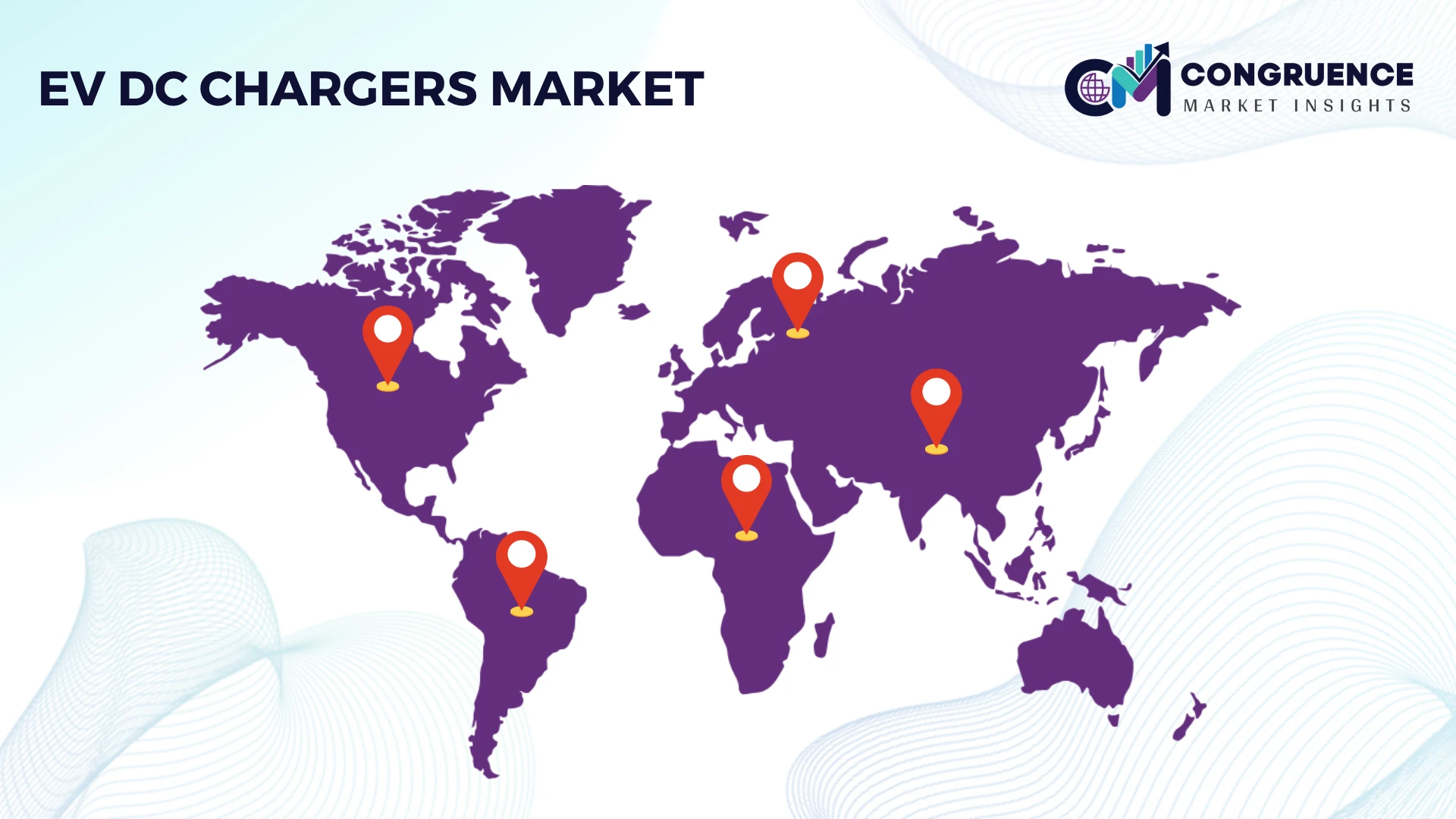
This report provides comprehensive analysis of the EV DC chargers market across major charger types, applications, end-user categories, and geographic regions. The study evaluates deployment patterns, charging infrastructure density, technology adoption trends, and competitive positioning across North America, Europe, Asia-Pacific, South America, and the Middle East & Africa. Market coverage includes public charging networks, fleet charging operations, workplace charging environments, and emerging high-power charging ecosystems supporting commercial transportation and logistics electrification.
The report examines operational trends including ultra-fast charging adoption, intelligent energy management integration, software-enabled charging optimization, and megawatt-scale charging development. Analysis covers leading industry participants, technology innovation strategies, infrastructure investments, and evolving enterprise requirements. More than 60% of market activity remains concentrated within Asia-Pacific, while high-power charger deployment continues expanding across developed and emerging mobility markets. The insights support investment planning, infrastructure expansion, partnership evaluation, competitive benchmarking, and long-term strategic decision-making through 2033.
| Report Attribute / Metric | Details |
|---|---|
| Market Revenue (2025) | USD 1,850.0 Million |
| Market Revenue (2033) | USD 6,364.1 Million |
| CAGR (2026–2033) | 16.7% |
| Base Year | 2025 |
| Forecast Period | 2026–2033 |
| Historic Period | 2021–2025 |
| Segments Covered |
By Type
By Application
By End-User
|
| Key Deliverables | Revenue Forecast; Market Trends; Growth Drivers & Restraints; Technology Insights; Segmentation Analysis; Regional Insights; Competitive Landscape; Regulatory & ESG Overview; Recent Developments |
| Regions Covered | North America; Europe; Asia-Pacific; South America; Middle East & Africa |
| Companies Profiled | ABB E-mobility; Siemens AG; Delta Electronics, Inc.; Schneider Electric SE; ChargePoint Holdings, Inc.; EVBox; Tritium DCFC Limited; Exicom Tele-Systems Limited; Kempower Oyj; Alpitronic GmbH; Blink Charging Co.; Wallbox N.V.; Heliox Energy B.V.; Star Charge Technology Co., Ltd. |
| Customization & Pricing | Available on Request (10% Customization Free) |




