
Reports
The Global EV Connector Market was valued at USD 204 Million in 2025 and is anticipated to reach a value of USD 894.86 Million by 2033 expanding at a CAGR of 20.3% between 2026 and 2033. Growth is driven by 800V+ vehicle architectures, liquid-cooled high-current charging connectors, and the rapid transition toward standardized NACS interfaces and zonal electrical systems.
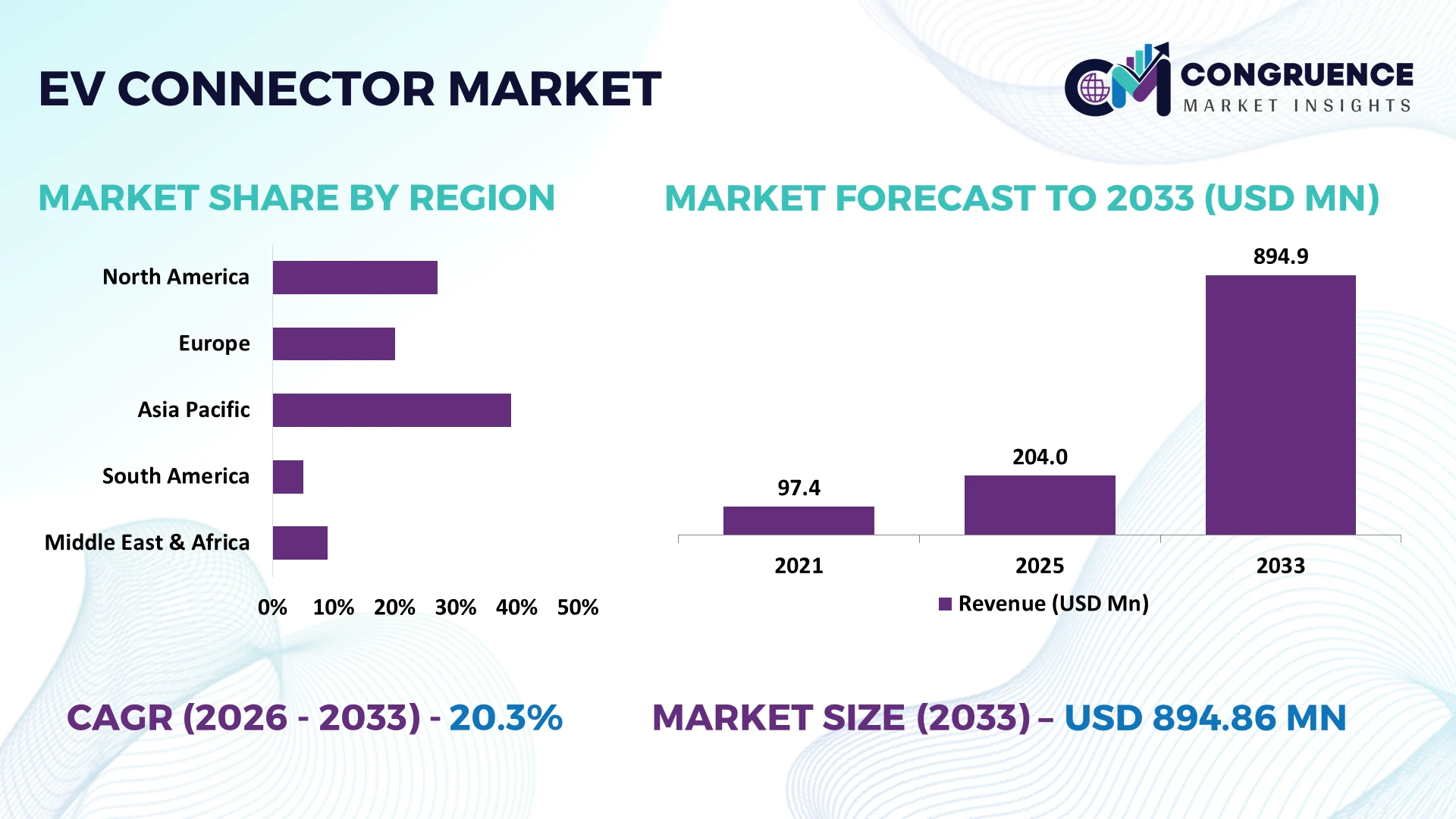
China dominates the EV connector ecosystem, accounting for more than 65% of global public charging points and nearly 55% of new-car sales being electric in 2025. China produced nearly 75% of global electric cars, while Europe reached 28% EV sales penetration versus below 10% in the United States. Its manufacturing scale and charging-network investments reinforce connector adoption across automotive, commercial-vehicle, and battery industries.
Strategic implication: suppliers should prioritize China-led volume opportunities while scaling high-voltage, thermally managed, and interoperable connector platforms for Europe and North America.
Market Size & Growth: USD 204 Million in 2025 to USD 894.86 Million by 2033 at 20.3% CAGR, driven by 800V architectures and high-power charging.
Top Growth Drivers: 55% China EV sales share; 33% global public-charger expansion; 65%+ China share of global public charging points.
Short-Term Forecast: By 2028, advanced cooling designs target up to 24.4% lower connector cable-core temperatures under high-power operation.
Emerging Technologies: 800V connectors, liquid cooling, AI-enabled charging management, advanced materials, and zonal E/E architectures are reshaping designs.
Regional Leaders: Asia-Pacific reaches modeled USD 492.17 Million; Europe USD 223.72 Million; North America USD 134.23 Million, supported by accelerating fast-charging deployment.
Consumer/End-User Trends: Electric vehicles represented 25% of global new-car sales in 2025, increasing demand for reliable charging and vehicle-side connectors.
Pilot/Case Example: A 2025 high-power connector thermal-management design reduced average cable-core temperature by up to 24.4%, improving thermal stability.
Competitive Landscape: TE Connectivity leads with approximately 21% share, followed by Amphenol, Aptiv, Molex, and Yazaki in the high-growth connector ecosystem.
Regulatory & ESG Impact: EU CO2 standards accelerated EV adoption to 28% of European car sales in 2025, strengthening demand for efficient, recyclable connector systems.
Investment & Funding: Identified U.S. and Indian charging commitments exceed USD 7.7 Billion, accelerating corridor expansion, localization, and connector manufacturing opportunities.
Innovation & Future Outlook: NACS standardization, bidirectional V2G, liquid-cooled connectors, and integrated high-voltage systems are shifting competition toward efficiency, interoperability, and thermal performance.
The EV Connector Market is increasingly shaped by high-voltage passenger vehicles, electric commercial fleets, ultra-fast charging stations, and battery-management systems. Advanced liquid-cooled and compact connector designs address higher current loads while reducing thermal stress, with China holding over 65% of global public charging points. Standardization and supply-chain localization are accelerating product redesign across major automotive manufacturing hubs, supporting the transition toward integrated, high-performance connector platforms.
EV connectors are becoming a strategic hardware layer for automakers because charging speed, voltage capability, thermal performance, and interoperability increasingly influence vehicle differentiation and infrastructure economics. The shift from 400V to 800V architectures is restructuring connector specifications, while NACS standardization in North America is accelerating platform convergence and supplier redesign.
Advanced liquid-cooled connectors can support substantially higher continuous-current loads while achieving around 20–25% better thermal control than conventional air-cooled designs. China leads deployment scale, with electric vehicles accounting for more than half of new-car sales, while the United States is moving toward broader NACS adoption and Europe emphasizes standardized charging interoperability. Over the next 2–3 years, 800V vehicle penetration, ultra-fast charging deployment, and fleet electrification will remain key operational indicators.
Companies are responding by localizing high-voltage connector production, expanding automated assembly, and forming charging-network and OEM partnerships. A practical deployment example is high-power DC charging, where liquid-cooled cable assemblies enable sustained current delivery without excessive cable size or thermal degradation. Strategically, suppliers that combine connector miniaturization, thermal management, digital diagnostics, and multi-standard compatibility will secure stronger positions across rapidly modernizing automotive supply chains.
The transition toward 800V vehicle platforms is a major structural driver, with high-voltage systems reducing charging-related electrical losses by roughly 2–4% and enabling substantially higher charging power. China already represents more than 50% of new-car EV sales, creating a large production base for high-voltage connector integration. The operational shift toward ultra-fast charging is forcing suppliers to improve terminal conductivity, insulation, shielding, and thermal dissipation. Companies are expanding automated connector manufacturing and investing in liquid-cooled architectures to handle higher current density. A non-obvious advantage is vehicle weight reduction: higher-voltage architectures can use smaller conductors, improving packaging efficiency while lowering material intensity.
Copper, engineering plastics, seals, and specialty plating remain significant cost variables, while connector designs must accommodate different voltage, communication, and locking requirements. Copper-price fluctuations can affect material costs by more than 10% during volatile periods, directly pressuring supplier margins. Europe, North America, and China also differ in charging-interface adoption, increasing engineering and inventory complexity. NACS expansion in the United States is reducing fragmentation, but transition periods require manufacturers to support multiple connector configurations. Companies are mitigating exposure through localized sourcing, long-term material contracts, modular connector platforms, and dual-supplier strategies. The strategic issue is not component availability alone; it is maintaining commonality across platforms without sacrificing regional compliance.
High-power charging creates an attractive opportunity for liquid-cooled connectors, which can improve thermal performance by approximately 20–25% compared with conventional configurations under demanding loads. Bidirectional charging and vehicle-to-grid applications add another layer of value by requiring connectors capable of repeated high-power cycling and reliable communication. China, Germany, and the United States are emerging as important innovation hubs for advanced charging ecosystems. Companies are increasing R&D spending on compact terminals, temperature sensing, automated diagnostics, and recyclable materials. The non-obvious opportunity lies in connector intelligence: embedded thermal and condition-monitoring capabilities can transform a passive component into a diagnostic asset, reducing maintenance intervention and improving charging-station utilization.
High-power EV charging increases integration pressure across connectors, batteries, inverters, cooling systems, and charging software. Thermal loads can rise sharply as charging power moves beyond 300 kW, while repeated high-current cycles accelerate contact resistance and material degradation. Automotive manufacturers also face software-hardware synchronization requirements as intelligent connectors increasingly communicate with charging controllers and battery-management systems. China’s large deployment scale highlights the challenge: infrastructure must maintain high availability while supporting diverse vehicle architectures. Companies must invest in automated validation, cybersecurity controls, predictive diagnostics, and standardized interfaces to sustain deployment consistency. The key long-term risk is system-level incompatibility, making cross-industry testing and strategic partnerships essential for reliable high-power charging ecosystems.
Ultra-Fast Charging Expansion: Ultra-fast chargers of 150 kW+ increased 40% in China during 2025, reaching 2.2 million fast and ultra-fast units. Higher-power deployment is shifting connector specifications toward liquid cooling, improved contact resistance, and automated thermal monitoring as manufacturers scale high-current assemblies.
Standardization Reshapes Platforms: NACS adoption is restructuring North American connector programs, while China continues GB/T-based deployment. Europe added charging points by about 20% in 2025, pushing suppliers toward modular architectures that support interoperability without duplicating tooling, inventory, and validation workflows.
Automated Production Gains: Connector manufacturers are increasing automated crimping, terminal inspection, laser welding, and end-of-line testing, targeting 10–15% faster assembly cycles and lower defect exposure. Rising labor and quality-control pressures in China, Germany, and the United States are accelerating factory digitization and supplier consolidation.
Grid-Integrated Charging Shift: Vehicle-to-grid integration is moving from pilot activity toward infrastructure planning, with China targeting 10 GW of EV-based flexible capacity by 2030. Companies are integrating communication interfaces and bidirectional connectors, creating a non-obvious shift: connector suppliers increasingly compete on data reliability and grid compatibility, not only electrical performance.
DC Fast-Charging Connectors lead the EV Connector Market with an estimated 34% share, supported by high-power public charging, commercial fleets, and highway infrastructure. Their higher current-handling capability and shorter charging cycles make them more strategically important than conventional AC Charging Connectors, which retain broad residential and workplace deployment. DC demand is strengthening as ultra-fast chargers gain scale, while AC remains the cost-efficient choice for lower-duty applications. CCS Connectors account for an estimated 24% share, benefiting from established interoperability across European and North American vehicle platforms.
GB/T Connectors hold roughly 19%, reinforced by China's enormous charging ecosystem, while CHAdeMO Connectors represent about 8% and face platform-transition pressure as newer standards gain acceptance. Companies are prioritizing modular DC designs, improved thermal management, and region-specific compatibility. The key investment shift is toward high-current connector platforms rather than standalone interface variants, improving manufacturing commonality and reducing lifecycle engineering costs.
DC Fast Charging represents the leading application at an estimated 46% market share, reflecting its concentration in highway corridors, commercial depots, retail charging hubs, and high-utilization public networks. AC Charging remains structurally important at approximately 38%, particularly for residential and workplace installations where longer dwell times favor lower equipment costs. Battery Swapping accounts for about 7%, concentrated in specialized two-wheeler and commercial mobility ecosystems, while V2G remains smaller but strategically significant.
V2G is the fastest-growing application segment as smart charging, bidirectional power electronics, and grid-balancing programs advance. China is standardizing V2G technologies, while utilities and fleet operators increasingly evaluate managed charging as an operational asset. Companies are adapting through integrated communication systems, bidirectional connector development, and charging-platform partnerships. The business implication is clear: connector design is shifting from simple power delivery toward intelligent, grid-connected infrastructure capable of supporting higher utilization and new energy-management services.
Passenger Vehicle OEMs represent the dominant end-user group at an estimated 43% share, reflecting the scale of global vehicle production and direct integration of connectors into new EV platforms. Charging Infrastructure Providers follow at approximately 27%, driven by expanding public and ultra-fast charging networks. Commercial Vehicle OEMs account for around 12%, while Fleet Operators and Automotive Component Manufacturers represent approximately 10% and 8%, respectively. Passenger OEM purchasing remains specification-driven, whereas infrastructure providers increasingly prioritize uptime, thermal performance, and interoperability.
Fleet Operators are the fastest-growing end-user group as depot charging, delivery electrification, and high-utilization vehicle cycles increase connector requirements. Companies are responding with customized high-current assemblies, longer-cycle components, predictive diagnostics, and direct partnerships with charging providers. The competitive shift is toward ecosystem contracts rather than component-only sales, allowing suppliers to lock in OEM, infrastructure, and fleet relationships simultaneously. China emphasizes deployment scale, while Germany and the United States increasingly prioritize reliability, standardization, and lifecycle performance.
Asia-Pacific accounted for the largest market share at 54% in 2025 however, South America is expected to register the fastest growth, expanding at a CAGR of 24.1% between 2026 and 2033.
NACS standardization is accelerating high-power charging integration
North America represented approximately 22% of the global EV Connector Market in 2025, with the United States accounting for the majority of regional demand. NACS adoption is restructuring connector specifications across passenger vehicles, charging networks, and fleet infrastructure, while 150 kW+ DC charging deployment is increasing demand for liquid-cooled, high-current systems. U.S. federal infrastructure programs are supporting charging corridors and heavy-duty applications, encouraging suppliers to localize production and strengthen supply resilience. Automakers and connector manufacturers are increasingly aligning product development around NACS compatibility, thermal management, automated assembly, and shorter qualification cycles. The competitive advantage is shifting toward suppliers capable of integrating connector hardware with charging communication and vehicle electrical architectures.
United States Market Outlook: The United States remains North America's principal EV connector manufacturing and deployment center, supported by major automotive production, charging-network expansion, and NACS standardization. More than 200,000 public charging ports were added nationally during 2025, strengthening demand for high-reliability AC and DC connector systems. Suppliers are prioritizing domestic assembly, automated quality inspection, and partnerships with charging operators.
Charging regulation is accelerating infrastructure standardization
Europe accounted for approximately 25% of global EV Connector demand in 2025, supported by strong electric-vehicle adoption in Germany, France, the United Kingdom, and the Netherlands. EU charging regulations are accelerating deployment along major transport corridors, with alternative-fuel infrastructure requirements increasingly favoring standardized high-power systems. Electric vehicles represented approximately 28% of European new-car sales in 2025, creating sustained demand for CCS-compatible connectors. Charging operators are expanding ultra-fast installations, while manufacturers are improving thermal dissipation, contact durability, and recyclable material use. Companies are responding through localized manufacturing, OEM partnerships, modular connector platforms, and automated production. Sustainability requirements are also increasing pressure on suppliers to reduce material intensity and improve component recyclability.
Germany Market Outlook: Germany remains Europe's most strategically important automotive production hub, combining major passenger-vehicle OEMs with advanced component manufacturing. Approximately 850,000 electric cars were sold in 2025, supporting connector demand across new vehicle platforms and charging infrastructure. German suppliers are emphasizing CCS compatibility, high-voltage architectures, precision manufacturing, and thermal-management technologies to meet demanding OEM qualification standards.
Manufacturing scale reinforces regional supply-chain dominance
Asia-Pacific held approximately 54% of the global EV Connector Market in 2025, led by China's exceptional EV production and charging infrastructure scale. China produced nearly 75% of global electric cars and accounted for more than 65% of global public charging points, creating concentrated demand for GB/T, DC fast-charging, and high-current connector systems. Japan and South Korea contribute advanced automotive electronics and precision-component capabilities, while India is expanding domestic EV manufacturing and charging infrastructure. Chinese manufacturers increasingly integrate connector production with terminals, housings, cable assemblies, and charging equipment, reducing procurement complexity. Companies are investing in automated assembly, localized material sourcing, and high-voltage platforms to capture both domestic and export demand.
China Market Outlook: China is the dominant country for EV connector manufacturing, vehicle integration, and charging deployment. More than 13 million electric cars were sold domestically during 2025, creating substantial recurring demand for vehicle-side and charging-side connectors. Its vertically integrated supply chain enables rapid product redesign, high-volume production, competitive pricing, and accelerated adoption of high-current charging technologies.
Import-led electrification is opening localized supply opportunities
South America accounted for approximately 6% of global EV Connector demand in 2025, with Brazil emerging as the principal market due to its automotive manufacturing base and accelerating electrification. Electric-car sales across Latin America increased by approximately 75% in 2025, strengthening demand for AC charging and DC fast-charging infrastructure. Chinese EV manufacturers are expanding their presence, increasing requirements for compatible connector architectures and charging equipment. However, dependence on imported components creates longer lead times and inventory exposure for charging operators. Suppliers are responding through distributor partnerships, regional assembly strategies, and multi-standard connector portfolios. The key opportunity is establishing localized service and component networks before infrastructure utilization reaches higher operating intensity.
Brazil Market Outlook: Brazil offers the strongest industrial platform in South America because of its established automotive manufacturing ecosystem and expanding EV adoption. Electric-car sales increased approximately 40% in 2025, encouraging charging-network investment and fleet electrification. Connector suppliers are targeting automakers, charging infrastructure providers, and commercial fleets with adaptable AC/DC systems and localized distribution partnerships.
Smart-mobility investment is creating premium charging demand
The Middle East & Africa EV Connector Market represented approximately 4% of global demand in 2025, with the United Arab Emirates and Saudi Arabia leading infrastructure modernization. Dubai and Abu Dhabi are expanding smart-charging infrastructure alongside electric taxis, premium passenger vehicles, and commercial mobility programs. Saudi Arabia is integrating EV infrastructure into broader transport modernization and industrial diversification initiatives. High temperatures create additional requirements for heat-resistant housings, reliable terminals, thermal monitoring, and durable cable assemblies. Companies are forming infrastructure partnerships and emphasizing ruggedized connector platforms designed for high ambient temperatures. The region's non-obvious advantage is its ability to deploy advanced charging infrastructure without extensive legacy systems, allowing new installations to adopt high-power and digitally managed connector technologies directly.
United Arab Emirates Market Outlook: The UAE is the region's strongest premium EV connector opportunity, supported by advanced charging infrastructure, smart-city programs, and high EV adoption in major urban centers. Dubai's public charging ecosystem continues expanding alongside electric taxi and fleet initiatives. Suppliers are targeting high-power DC systems, interoperable connectors, and heat-resistant technologies engineered for demanding operating conditions.
The EV Connector Market features direct competition among TE Connectivity, Amphenol, Aptiv, Yazaki, and Molex, alongside regional specialists competing through cost, customization, and localized supply. The top five players collectively hold approximately 45% share, creating a moderately concentrated structure. Competition increasingly centers on high-voltage performance, thermal management, manufacturing speed, and supply-chain reliability. Liquid-cooled designs can improve thermal performance by approximately 20–25%, while automated assembly can reduce production-cycle time by 10–15%. Global leaders are expanding localized production and forming OEM and charging-network partnerships, while regional suppliers compete through faster customization and lower-cost manufacturing. NACS standardization is also shifting competition toward platform compatibility and engineering flexibility. Automotive qualification, tooling requirements, safety validation, and global delivery consistency remain significant entry barriers. The competitive shift favors suppliers that combine advanced connector engineering with scalable production, localized sourcing, rapid qualification, and long-term ecosystem partnerships. Winning players will prioritize integrated platforms over commodity component pricing.
TE Connectivity
Amphenol Corporation
Aptiv PLC
Yazaki Corporation
Molex
Hirose Electric
Sumitomo Electric Industries
Phoenix Contact
LEAR Corporation
Rosenberger
HUBER+SUHNER
Japan Aviation Electronics Industry
ITT Inc.
TE Connectivity Automotive Solutions
High-voltage connectivity is moving from conventional 400V architectures toward 800V systems, liquid-cooled charging inlets, and compact high-current terminals. Liquid cooling can support roughly 20–25% better thermal control under high-power operation, while advanced contact materials reduce resistance and heat generation by about 1–2%. Adoption is strongest in premium EVs and ultra-fast charging platforms, where higher power density improves charging speed and packaging.
Emerging connector platforms integrate temperature sensing, digital diagnostics, modular interfaces, and bidirectional charging communication. Phoenix Contact’s HPC technology reaches 500A continuously and up to 700A in boost operation, while its next-generation MCS roadmap targets 2.25MW by Q4 2026. Compared with conventional high-power systems, intelligent thermal monitoring can improve operational efficiency by around 2%, reduce overheating-related interruptions, and strengthen charger utilization. TE Connectivity’s charging-inlet expansion and Amphenol’s compact high-voltage designs favor suppliers with broad OEM qualification capabilities.
Through 2026–2028, megawatt charging, NACS standardization, V2G interfaces, and automated connector assembly will reshape competitive priorities. Automated manufacturing can reduce connector production-cycle time by 10–15%, while modular architectures lower tooling duplication. China benefits from scale and GB/T deployment; North America benefits from NACS convergence. Suppliers that combine thermal management, miniaturization, sensing, and multi-standard compatibility will gain the strongest platform access as charging infrastructure modernizes.
February 2026 TE Connectivity acquired major Phoenix Contact E-Mobility charging-inlet assets, strengthening its automotive charging portfolio and supply continuity. The transaction expands TE’s OEM reach while Phoenix exits automotive activity, accelerating consolidation around qualified global connector platforms. Source: te.com
April 2025 Phoenix Contact introduced an HPC charging cable supporting 800A continuously and 1,000A in Boost Mode, reaching one-megawatt charging capability. The innovation raises power density for commercial and passenger EVs, strengthening Phoenix’s high-power charging technology position. Source: phoenixcontact.com
October 2024 Aptiv highlighted HVDuty connectors for commercial vehicles, offering RCS800 and RCS1400 variants for AC and DC power-conversion applications. The portfolio expands high-voltage connectivity options for electrified trucks and buses, supporting OEM integration across demanding duty cycles. Source: aptiv.com
June 2025 CharIN conducted an MCS Testival using four heavy-duty vehicles, successfully testing vehicle and charging systems with mutual TLS 1.3 authentication. The validation advanced interoperable megawatt charging and strengthened cybersecurity readiness for commercial fleets adopting high-power charging. Source: charin.global
The EV Connector Market Report covers AC Charging Connectors, DC Fast-Charging Connectors, CCS, CHAdeMO, and GB/T connectors across AC Charging, DC Fast Charging, Battery Swapping, and Vehicle-to-Grid applications. End-user analysis includes Passenger Vehicle OEMs, Commercial Vehicle OEMs, Charging Infrastructure Providers, Fleet Operators, and Automotive Component Manufacturers. The study evaluates North America, Europe, Asia-Pacific, South America, and Middle East & Africa.
The scope assesses high-voltage connectivity, liquid-cooled charging, thermal management, NACS standardization, intelligent sensing, modular interfaces, and megawatt charging technologies. Asia-Pacific represents approximately 54% of demand, while DC Fast Charging accounts for an estimated 46% of application demand. Competitive coverage evaluates major suppliers, manufacturing strategies, partnerships, localization, and product innovation. The analysis supports investment planning, capacity expansion, technology prioritization, supplier selection, competitive positioning, and strategic decisions through 2026–2033.
| Report Attribute/Metric | Report Details |
|---|---|
Market Revenue in 2025 | USD 461.35 Million |
Market Revenue in 2033 | USD 890.01 Million |
CAGR (2026 - 2033) | 8.56% |
Base Year | 2025 |
Forecast Period | 2026 - 2033 |
Historic Period | 2021 - 2025 |
Segments Covered | By Type
By Application
By End-User
|
Key Report Deliverable | Revenue Forecast, Growth Trends, Market Dynamics, Segmental Overview, Regional and Country-wise Analysis, Competition Landscape |
Region Covered | North America, Europe, Asia-Pacific, South America, Middle East, Africa |
Key Players Analyzed | Toray Industries, Inc., Hexcel Corporation, Teijin Limited, Solvay S.A., SGL Carbon SE, Mitsubishi Chemical Group Corporation, Celanese Corporation, Victrex plc, Avient Corporation, Gurit Holding AG, Covestro AG, Park Aerospace Corp. |
Customization & Pricing | Available on Request (10% Customization is Free) |




