
Reports
The Global EV Battery Recycling Market was valued at USD 757.08 Million in 2025 and is anticipated to reach a value of USD 11301.23 Million by 2033 expanding at a CAGR of 40.2% between 2026 and 2033. Growth is driven by accelerating gigafactory production scrap, rising retired EV battery volumes, mandatory material-recovery targets, and automaker efforts to secure domestic lithium, nickel, cobalt, copper, and graphite through closed-loop recycling.
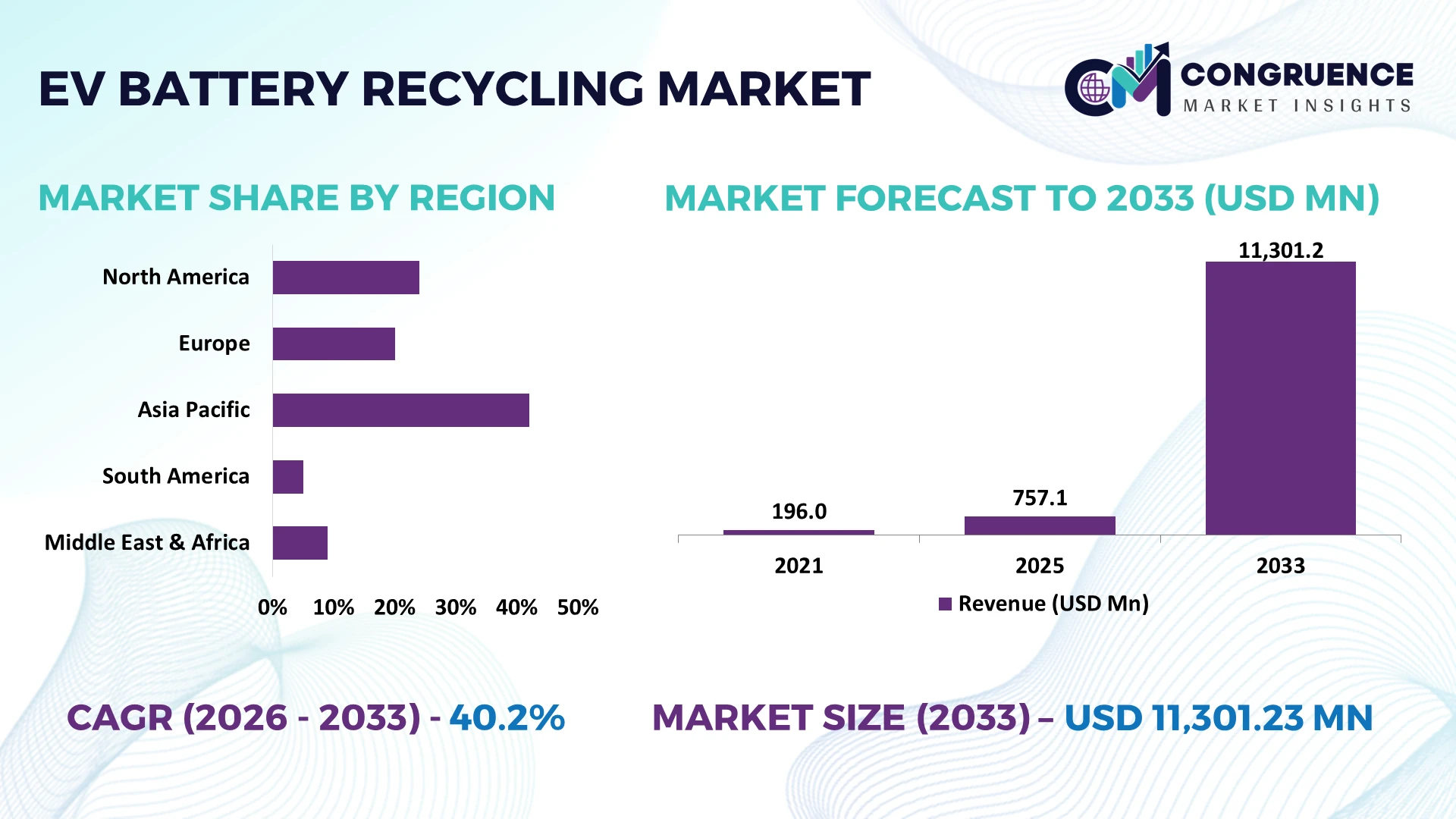
China dominates the global EV battery recycling ecosystem, hosting over 85% of worldwide recycling capacity, supported by its position as the largest battery producer and EV market. Chinese manufacturers supplied almost 75% of global electric-car battery deployment in 2025, creating substantial captive recycling feedstock. By comparison, Europe and the United States maintain considerably smaller recycling footprints despite rapidly expanding battery manufacturing. China’s August 2025 decision to permit high-grade black-mass imports further strengthened its processing position.
The strategic priority is therefore feedstock security: recyclers integrating with battery manufacturers, automakers, collection networks, and regional refining operations will achieve higher utilization and stronger control over recovered critical-material supply.
Market Size & Growth: USD 757.08 million in 2025 is projected to reach USD 11.30 billion by 2033 at 40.2% CAGR, driven by gigafactory scrap and accelerating EV battery retirements.
Top Growth Drivers: Manufacturing scrap represents approximately 67% of available recycling feedstock toward 2030, China controls over 85% of current recycling capacity, and LFP represented nearly 50% of global EV batteries in 2024.
Short-Term Forecast: By 2027, EU requirements target 90% recovery for cobalt, copper and nickel and 50% for lithium, accelerating investment in advanced hydrometallurgical separation, purification, and recovery lines.
Emerging Technologies: Hydrometallurgy, direct recycling, automated dismantling, AI-based battery identification, and electrochemical extraction are increasing recovery precision; advanced processes increasingly target above 90% recovery for high-value battery materials.
Regional Leaders: Asia-Pacific remains the capacity center, led by China’s 85%+ recycling share; Europe is building regulation-led capacity, while North America benefits from more than 200 GWh of U.S. battery manufacturing capacity generating future recyclable material.
Consumer/End-User Trends: EVs and stationary storage represent approximately 90% of lithium-ion battery deployment, progressively enlarging the recoverable battery pool as early-generation vehicle packs move toward retirement.
Pilot/Case Example: In 2025, commercial closed-loop projects increasingly connected recycling with cathode-material production, demonstrating recovery rates above 95% for selected critical materials and reducing dependence on newly mined inputs.
Competitive Landscape: China holds above 85% of global recycling capacity; CATL/Brunp, GEM, Redwood Materials, Li-Cycle, and Ascend Elements compete through feedstock agreements, recovery technology, refining integration, and OEM partnerships.
Regulatory & ESG Impact: EU rules establish recovery targets reaching 90% for cobalt, copper and nickel, creating measurable compliance requirements and shifting battery waste from disposal toward traceable secondary-material supply chains.
Investment & Funding: Announced global recycling capacity exceeds 1,500 GWh toward 2030, versus roughly 300 GWh in 2023, highlighting aggressive capacity investment but also intensifying competition for production scrap and retired batteries.
Innovation & Future Outlook: End-of-life batteries become the dominant recycling feedstock after 2035 and exceed 90% of available feedstock by 2050, shifting competitive advantage toward automated dismantling, direct recycling, graphite recovery, and closed-loop refining.
The global EV battery recycling market is increasingly concentrated around automotive manufacturing clusters, gigafactories, battery collection systems, and critical-mineral refining hubs. Manufacturing scrap remains the primary near-term feedstock, representing about 67% of available material toward 2030. Advanced hydrometallurgy, direct recycling, graphite recovery, and automated sorting are improving material circularity, while EU recovery mandates and global critical-mineral supply-chain localization are making feedstock access strategically decisive for the next phase of market development.
EV battery recycling is becoming strategically important because control of recovered lithium, nickel, cobalt, copper, and graphite increasingly determines battery supply-chain resilience. China processes more than 80% of global battery recycling feedstock, while the EU Battery Regulation is introducing progressively tighter recovery and recycled-content requirements. This is shifting competition from stand-alone waste processing toward vertically integrated collection, black-mass processing, refining, and cathode-material production.
Technology economics are reinforcing that transition. Advanced hydrometallurgical systems can recover above 90% of lithium, nickel, cobalt, and copper, while conventional pyrometallurgy typically loses much of the lithium and graphite into slag. Direct recycling provides another pathway by preserving cathode structures and potentially reducing processing energy by more than 50%. China leads industrial deployment, whereas Europe emphasizes traceability and regulatory compliance and the United States prioritizes domestic critical-mineral security.
Through 2026–2028, automated disassembly, battery passports, LFP recycling, and localized refining will reshape investment priorities. Closed-loop deployments linking automakers, cell manufacturers, and recyclers can return recovered metals directly into new batteries. Companies are consequently securing long-duration feedstock agreements and colocating recycling near gigafactories. Competitive advantage will increasingly depend on recovery yield, utilization, chemistry flexibility, and guaranteed material offtake.
Rapid EV fleet expansion and gigafactory output are creating concentrated recycling feedstock, making closed-loop material recovery the market’s strongest structural driver. Manufacturing scrap can represent 20–30% of cell-material throughput during production ramp-up, while advanced recycling processes recover more than 90% of lithium, nickel, cobalt, and copper. China already controls over 80% of global battery recycling capacity, demonstrating the scale advantage created by integrating cell production and material recovery. Meanwhile, EU rules progressively mandate minimum recovery and recycled-material thresholds. This combination converts battery waste into strategic manufacturing input rather than disposal material. Automakers and recyclers are responding through long-term feedstock agreements, colocated processing facilities, refining investments, and cathode-material partnerships. The operational advantage lies in securing predictable material flows before end-of-life EV batteries become the dominant feedstock.
Installed recycling capacity is expanding faster than near-term end-of-life battery availability, creating a significant utilization constraint. EV batteries commonly retain useful vehicle performance for 8–15 years, delaying large-scale retirement volumes, while manufacturing scrap currently supplies a substantial share of recyclable material. At the same time, LFP batteries have approached 50% of global EV battery deployment, but their lower nickel and cobalt content reduces recoverable material value versus NMC chemistries. China’s mature collection ecosystem intensifies competition for black mass and production scrap, while U.S. and European facilities face fragmented collection networks. Underutilized plants carry high fixed processing and refining costs, weakening unit economics. Companies are mitigating exposure through multi-year OEM contracts, battery take-back partnerships, chemistry-flexible processing lines, and geographic diversification. Securing feedstock density, rather than simply adding nameplate capacity, has become the decisive profitability constraint.
The next opportunity lies in extracting greater value from battery components that conventional recycling economics underutilize. LFP accounted for nearly 50% of global electric-car battery demand in 2024, making efficient lithium, graphite, electrolyte, and cathode recovery increasingly important. Advanced hydrometallurgical routes can achieve above 90% recovery for several critical materials, while direct recycling can preserve cathode structures and potentially cut processing energy by more than 50% compared with material-intensive reprocessing pathways. Battery passports introduced under European regulation will also improve chemistry identification and material traceability. Companies are investing in automated sorting, direct cathode regeneration, graphite purification, and digital battery tracking. A particularly attractive opportunity is colocating recycling with cell plants: production scrap avoids complex collection logistics and provides predictable chemistry, enabling higher utilization, lower transportation costs, and faster reintegration of recovered materials into manufacturing.
Long-term competitiveness depends on processing increasingly diverse battery formats and chemistries without sacrificing recovery yield or plant utilization. LFP now represents close to half of global EV battery demand, while NMC, NCA, sodium-ion, and emerging solid-state architectures require different dismantling, separation, and refining conditions. Battery packs can contain thousands of interconnected cells, adhesives, cooling components, electronics, and structural materials, making automated disassembly substantially more complex than standardized scrap processing. Recovery targets exceeding 90% for selected metals further raise process-control requirements as regulators tighten material-accounting standards. Companies must therefore develop chemistry-flexible lines, AI-assisted identification, robotic disassembly, safer discharge systems, and adaptable hydrometallurgical circuits. Partnerships with automakers are becoming operationally essential because access to pack designs and battery-management data improves dismantling efficiency. The strategic challenge is achieving industrial scale without locking expensive facilities into battery architectures that rapidly become obsolete.
Black-Mass Processing Moves Upstream: Recyclers are increasingly colocating shredding and black-mass preparation near battery plants to reduce hazardous transport and improve feedstock control. Manufacturing scrap can represent 20–30% of cell-material throughput during factory ramp-up, while advanced plants recover above 90% of nickel and cobalt. Companies are expanding preprocessing capacity and signing localized collection agreements, reducing logistics complexity and shortening material-return cycles.
Battery Traceability Becomes Operational: Digital battery passports, chemistry identification, and automated material tracking are moving from compliance functions into recycling workflows. EU rules require 65% recycling efficiency for lithium-based batteries from 2025, while 90% recovery targets for cobalt, copper, and nickel apply from 2027. Recyclers are integrating digital records with sorting systems, improving routing accuracy and reducing chemistry-mixing losses.
LFP Economics Reshape Process Design: LFP batteries approached 50% of global electric-car battery demand in 2024, weakening recycling models historically dependent on nickel and cobalt value. Operators are therefore redesigning hydrometallurgical circuits around lithium, graphite, copper, and aluminum recovery. Automation and lower-reagent processing are becoming critical because recovering more than 90% of selected materials no longer guarantees attractive economics when feedstock contains fewer high-value metals.
Closed-Loop Qualification Accelerates: Automotive OEMs increasingly require recycled materials to meet battery-grade purity rather than commodity-grade specifications. Integrated processes can recover more than 95% of lithium, nickel, cobalt, and copper, while future EU batteries require minimum recycled-content thresholds including 16% cobalt and 6% lithium from 2031. Recyclers are adding purification, cathode-material conversion, and qualification capabilities to capture higher-value supply contracts.
Hydrometallurgical recycling leads the EV battery recycling market with an estimated 45–50% share because it combines high metal recovery, chemistry flexibility, and compatibility with black-mass processing. Modern systems routinely target above 90% recovery for lithium, nickel, cobalt, and copper, making them attractive for NMC and increasingly LFP feedstock. Pyrometallurgical recycling remains commercially established because of its tolerance for mixed battery inputs, but high-temperature processing sacrifices more lithium and graphite and carries greater energy intensity. Mechanical recycling supports both routes by concentrating electrode materials before refining.
Direct recycling is the fastest-growing type because it preserves cathode structures instead of decomposing them completely, potentially reducing energy use by more than 50% compared with conventional material rebuilding. Hybrid recycling combines mechanical separation with hydrometallurgical or thermal stages, enabling operators to optimize recovery according to chemistry. Companies are consequently investing in modular hydrometallurgical lines, direct-cathode regeneration pilots, and hybrid process integration rather than committing facilities to one battery architecture.
Battery Material Recovery leads application demand with approximately 35–40% share because recyclers ultimately monetize lithium, nickel, cobalt, copper, graphite, and manganese returned to battery or industrial supply chains. Black Mass Processing follows closely as shredding capacity expands near gigafactories, converting cells and manufacturing scrap into concentrated intermediate material. Metal Recovery remains mature, particularly for nickel, cobalt, and copper, where advanced plants can exceed 90% recovery. These applications benefit from established hydrometallurgical purification and refining infrastructure.
Cathode Recovery is the fastest-growing application as operators shift from selling intermediate black mass toward producing battery-grade precursors and regenerated cathode materials. Direct cathode regeneration can eliminate several refining and resynthesis stages, materially reducing energy and processing complexity. Anode Recovery is also gaining strategic importance as graphite becomes a localization priority, although commercial deployment remains earlier-stage than cathode processing. Companies are adding purification, precursor manufacturing, graphite recovery, and automation capabilities, indicating that competitive value is shifting downstream from simple shredding toward qualified battery-material production.
Battery Manufacturers represent the leading end-user group with an estimated 35–40% share because gigafactories generate concentrated production scrap and require increasingly secure secondary-material supply. During manufacturing ramp-up, scrap can equal 20–30% of electrode and cell-material throughput, creating predictable feedstock streams that are substantially easier to collect than dispersed end-of-life packs. Automotive OEMs represent another major demand group as closed-loop agreements connect retired vehicle batteries with new-cell production. Recycling Companies remain core processing buyers of sorting, shredding, separation, and refining technologies.
Cathode Producers are the fastest-growing end-user group because recycled nickel, cobalt, lithium, and manganese increasingly move directly into precursor and active-material manufacturing. Material Refiners are also expanding involvement as recyclers pursue battery-grade lithium salts and purified metals rather than low-value intermediates. Companies are responding through OEM-recycler joint ventures, gigafactory-adjacent plants, long-term scrap agreements, and cathode-material partnerships. Future demand is therefore shifting toward integrated ecosystems capable of linking collection, recovery, refining, qualification, and battery-material reinsertion.
Asia-Pacific accounted for the largest market share at 50.5% in 2025 however, North America is expected to register the fastest growth, expanding at a CAGR of 43.5% between 2026 and 2033.
Domestic Battery Circularity Accelerates
North America accounted for approximately 16.8% of global EV battery recycling activity in 2025, with the United States concentrating regional processing capacity, automotive battery manufacturing, and closed-loop investments. Recycling infrastructure is increasingly clustering around battery plants in Nevada, Georgia, Kentucky, Tennessee, and the Midwest, reducing hazardous-material transportation and improving access to manufacturing scrap. Commercial facilities increasingly target above 90% recovery of lithium, nickel, cobalt, and copper through mechanical preprocessing and hydrometallurgy. Production scrap remains strategically important because large end-of-life EV volumes have not yet matured. Redwood Materials processes more than 20 GWh of batteries annually, while other operators are scaling black-mass refining and cathode-material production. U.S. industrial policy is accelerating localization, shifting competition from waste collection toward integrated recovery, refining, and battery-grade material reinsertion.
United States Market Outlook: The United States leads North American deployment through expanding gigafactory clusters, domestic critical-mineral policy, and integrated recycling investments. Nevada has emerged as a major recycling and battery-material hub, while Georgia and Kentucky are strengthening cathode and cell-manufacturing ecosystems. Commercial recyclers increasingly pursue recovery rates exceeding 90% for selected critical materials, reducing dependence on imported refined inputs and strengthening domestic battery supply-chain resilience.
Regulation Restructures Material Recovery
Europe represented approximately 21.3% of global EV battery recycling activity in 2025, supported by expanding cell manufacturing, established automotive collection networks, and increasingly stringent battery regulation. European pretreatment capacity reached approximately 270,000 tonnes annually, while hydrometallurgical and downstream processing infrastructure continued expanding across Germany, France, Finland, Belgium, and Sweden. The structural shift is moving recyclers beyond shredding and black-mass exports toward domestic purification and battery-grade material recovery. EU requirements covering recycling efficiency, lithium recovery, recycled content, and battery traceability are strengthening demand for integrated processing. However, announced capacity is developing faster than available end-of-life feedstock, placing utilization discipline at the center of investment decisions. Operators are consequently securing production scrap, forming OEM partnerships, and locating facilities close to cell plants. Competitive advantage increasingly depends on traceability, high-purity output, chemistry flexibility, and reliable material reintegration.
Germany Market Outlook: Germany is Europe’s strategically important recycling center because its automotive manufacturing base connects directly with cell production, chemical processing, and material recovery infrastructure. Schwarzheide alone has black-mass processing capacity of approximately 15,000 tonnes annually, equivalent to around 40,000 EV batteries. German operators are integrating recycling with cathode-material production, allowing recovered metals to re-enter automotive battery supply chains with fewer cross-border processing stages.
China Converts Scale Into Integration
Asia-Pacific accounted for approximately 50.5% of global EV battery recycling activity in 2025, supported by unmatched battery manufacturing density, EV deployment, refining infrastructure, and collection volumes. China dominates regional throughput because its battery manufacturers supply the majority of globally deployed EV cells, generating substantial manufacturing scrap before large retirement volumes emerge. Hydrometallurgical processing represents approximately 60% of regional recycling activity, reflecting demand for high-purity lithium, nickel, cobalt, and manganese recovery. South Korea contributes advanced cell-manufacturing integration, while India is formalizing producer-responsibility and battery-waste collection systems. China’s decision to permit qualified black-mass imports in 2025 further strengthened feedstock access for domestic processors. Companies are increasingly combining collection, shredding, refining, precursor production, and cathode-material manufacturing. This vertically integrated structure lowers material-handling friction and gives Asian operators a decisive utilization advantage over standalone recycling facilities.
China Market Outlook: China remains the global operational benchmark through its tightly connected EV, battery manufacturing, refining, and recycling ecosystem. CATL processed approximately 210,000 tonnes of spent batteries in 2025 and regenerated around 24,000 tonnes of lithium salts. Large-scale operators increasingly recover lithium, nickel, cobalt, manganese, copper, and graphite within integrated systems, positioning recycled materials as strategic manufacturing inputs rather than conventional waste outputs.
EV Adoption Tests Collection Infrastructure
South America represented approximately 5.4% of global EV battery recycling activity in 2025, with Brazil concentrating the strongest near-term combination of vehicle demand, industrial infrastructure, and formal waste-management capability. Regional battery recycling remains weighted toward lead-acid systems, while lithium-ion collection, diagnostics, dismantling, and black-mass processing are developing from a smaller base. Brazil registered more than 170,000 electrified light-vehicle sales during 2024, progressively enlarging the future pool of traction batteries requiring second-life assessment or recycling. Chile and Argentina add strategic relevance through lithium-resource ecosystems, creating opportunities to connect primary materials with future circular supply chains. Limited specialized processing infrastructure means collected batteries can require long-distance transport or external refining. Companies are therefore prioritizing collection partnerships, safe storage, battery diagnostics, and modular preprocessing rather than immediately constructing large hydrometallurgical plants without secured feedstock.
Brazil Market Outlook: Brazil offers South America’s strongest operating foundation through its large automotive market, established recycling industry, and accelerating electrified-vehicle adoption. The country surpassed 170,000 electrified light-vehicle registrations in 2024, expanding the installed battery base requiring eventual recovery. Domestic recyclers can leverage existing collection networks while developing lithium-ion discharge, dismantling, sorting, and preprocessing capabilities before retirement volumes justify larger refining investments.
Industrial Diversification Shapes Recycling Investment
Middle East & Africa accounted for approximately 6.0% of global EV battery recycling activity in 2025, with development concentrated around the Gulf’s industrial diversification programs and South Africa’s established automotive ecosystem. The UAE and Saudi Arabia are investing in electric mobility, battery storage, logistics electrification, and circular-economy infrastructure, creating an emerging stream of lithium-ion batteries requiring traceable end-of-life management. Saudi Arabia targets 30% electric vehicle penetration in Riyadh by 2030, strengthening the future requirement for battery diagnostics, collection, second-life assessment, and recycling infrastructure. Africa presents a different operating profile, where limited specialized lithium-ion processing and fragmented collection increase logistics complexity. Companies are responding through recycling partnerships, industrial-zone projects, battery-storage initiatives, and phased preprocessing investments. Near-term advantage belongs to operators establishing collection and safe-handling networks before regional battery retirement volumes become materially larger.
Saudi Arabia Market Outlook: Saudi Arabia is developing the region’s strongest strategic platform through EV manufacturing ambitions, renewable-energy storage deployment, and industrial localization programs. The 30% Riyadh EV penetration objective creates a measurable future battery-management requirement. Industrial clusters can support centralized diagnostics, discharge, dismantling, and preprocessing, while partnerships with international recycling technology providers can accelerate domestic capability without requiring immediate dependence on fully integrated refining infrastructure.
CATL-linked recycling operations, GEM, Redwood Materials, Umicore, and Glencore compete across feedstock acquisition, black-mass processing, refining, and closed-loop battery materials, with technology-focused recyclers challenging vertically integrated battery and materials groups. The top five participants account for approximately 35% of organized processing capacity, leaving substantial regional fragmentation. Recovery performance is a primary differentiator: advanced hydrometallurgical platforms exceed 90% recovery for lithium, nickel, cobalt, and copper, while integrated processes can surpass 95% for selected materials. Direct recycling targets energy reductions above 50% by retaining cathode structures rather than fully refining metals. Competition increasingly centers on long-term OEM feedstock contracts, gigafactory-adjacent expansion, automation, and integration into cathode production. Control of production scrap is shifting bargaining power toward recyclers with embedded manufacturer relationships. High capital intensity, battery-grade purification requirements, hazardous-material compliance, and uncertain plant utilization create substantial entry barriers. Winning requires secured feedstock, chemistry-flexible processing, high recovery yields, localized refining, and guaranteed battery-material offtake agreements.
Contemporary Amperex Technology Co., Limited (CATL)
GEM Co., Ltd.
Redwood Materials
Umicore
Glencore
Li-Cycle Holdings Corp.
Ascend Elements
Cirba Solutions
Ecobat
Fortum
Neometals Ltd.
RecycLiCo Battery Materials Inc.
SungEel HiTech
SK tes
Hydrometallurgical processing is the current commercial technology backbone, combining mechanical shredding, black-mass separation, leaching, solvent extraction, and precipitation. Advanced plants recover above 90% of lithium, nickel, cobalt, and copper, while automated sorting can improve processing throughput by 15–25%. Deployment is strongest across integrated Chinese, European, and U.S. facilities, where battery-grade purification converts recovered materials directly into manufacturing inputs, improving feedstock value and reducing dependence on primary refining.
Direct recycling is emerging by preserving cathode structures instead of breaking materials into elemental compounds. Compared with conventional pyrometallurgical routes, which frequently lose lithium and graphite into slag, direct processing can reduce energy requirements by more than 50% while retaining higher material functionality. AI-enabled chemistry identification, robotic disassembly, digital battery passports, and sensor-based sorting are also improving workflow accuracy by approximately 10–20%, benefiting operators processing mixed LFP and nickel-rich batteries.
Between 2026 and 2028, technology integration will shift investment toward chemistry-flexible plants combining automated preprocessing, hydrometallurgy, direct cathode regeneration, and graphite purification. Commercial systems exceeding 95% critical-material recovery already establish the performance benchmark. Recyclers colocated with gigafactories gain the strongest advantage through lower logistics requirements, predictable production scrap, faster qualification, and closed-loop material reinsertion. Companies delaying automation and battery-grade refining risk becoming low-margin black-mass suppliers as integrated competitors capture higher-value cathode and refined-material contracts.
April 2024 Ascend Elements and Elemental Strategic Metals established AE Elemental, opening a Polish recycling facility processing 12,000 metric tons annually, equivalent to approximately 28,000 EV batteries. The venture strengthened European black-mass supply while sharing expansion capital and processing infrastructure. Source: Reuters
June 2025 BASF started commercial operation of its Schwarzheide black-mass facility in Germany, providing annual processing capacity of 15,000 tonnes, equivalent to roughly 40,000 EV batteries. The expansion integrates mechanical recycling with BASF’s European battery-material operations and localized circular supply. Source: BASF
December 2025 Redwood Materials reported bringing South Carolina recycling operations online with more than 20,000 metric tons of annual processing capacity. Its Nevada operations produced 60,000 metric tons of critical minerals, strengthening domestic recovery, refining, and closed-loop battery-material availability. Source: Redwood
May 2026 The European Union and India launched a coordinated EV-battery recycling initiative with €15.2 million in funding for high-efficiency material recovery, digitalized collection, and pilot demonstrations. The program strengthens cross-border technology development while accelerating scalable recycling infrastructure and critical-material circularity. Source: EEAS
The EV Battery Recycling Market Report evaluates the industry across Hydrometallurgical Recycling, Pyrometallurgical Recycling, Direct Recycling, Mechanical Recycling, and Hybrid Recycling. Application coverage includes Battery Material Recovery, Black Mass Processing, Cathode Recovery, Anode Recovery, and Metal Recovery, while end-user analysis assesses Battery Manufacturers, Automotive OEMs, Recycling Companies, Cathode Producers, and Material Refiners. Advanced processes exceeding 90% recovery for selected critical materials receive particular attention.
Geographic coverage spans North America, Europe, Asia-Pacific, South America, and Middle East & Africa, including country-level manufacturing, recycling infrastructure, regulation, feedstock availability, and technology deployment. The report also evaluates automated dismantling, AI-enabled sorting, battery passports, graphite recovery, direct cathode regeneration, LFP processing, and closed-loop refining. Competitive benchmarking, capacity positioning, partnerships, feedstock strategies, and emerging recycling ecosystems support investment planning, geographic expansion, technology selection, and competitive positioning through 2026–2033.
| Report Attribute/Metric | Report Details |
|---|---|
Market Revenue in 2025 | USD 757.08 Million |
Market Revenue in 2033 | USD 11301.23 Million |
CAGR (2026 - 2033) | 40.2% |
Base Year | 2025 |
Forecast Period | 2026 - 2033 |
Historic Period | 2021 - 2025 |
Segments Covered | By Type
By Application
By End-User
|
Key Report Deliverable | Revenue Forecast, Growth Trends, Market Dynamics, Segmental Overview, Regional and Country-wise Analysis, Competition Landscape |
Region Covered | North America, Europe, Asia-Pacific, South America, Middle East, Africa |
Key Players Analyzed | Contemporary Amperex Technology Co., Limited (CATL), GEM Co., Ltd., Redwood Materials, Umicore, Glencore, Li-Cycle Holdings Corp., Ascend Elements, Cirba Solutions, Ecobat, Fortum, Neometals Ltd., RecycLiCo Battery Materials Inc., SungEel HiTech, SK tes |
Customization & Pricing | Available on Request (10% Customization is Free) |




