
Reports
The Global EV Battery Cell and Pack Materials Market was valued at USD 23619.58 Million in 2025 and is anticipated to reach a value of USD 77970.44 Million by 2033 expanding at a CAGR of 16.1% between 2026 and 2033. Growth is driven by expanding LFP adoption, cell-to-pack architectures, silicon-enhanced anodes, advanced thermal-management materials, and accelerated localization of battery supply chains.
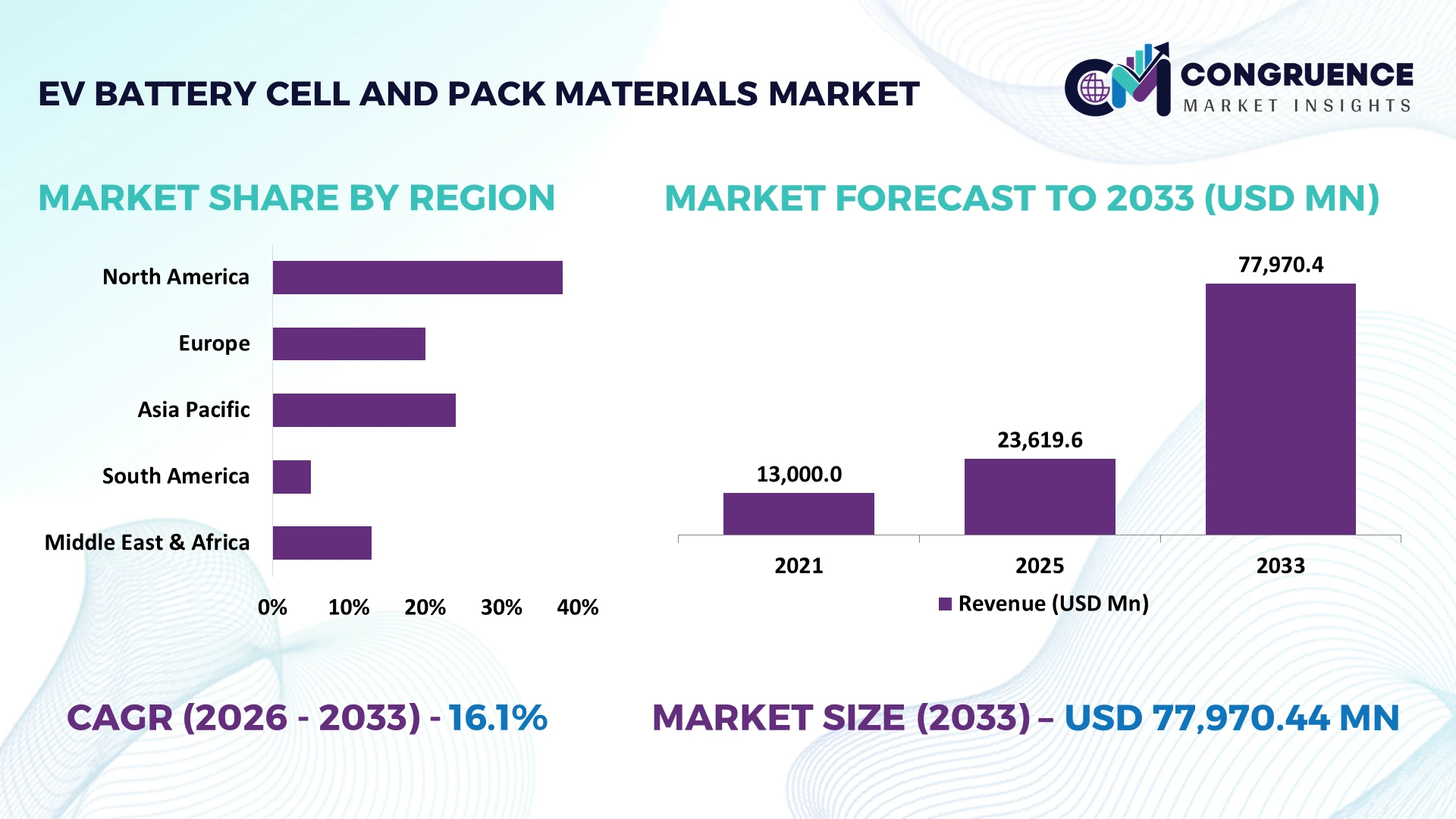
China remains the dominant production base, accounting for more than 80% of global battery-cell manufacturing capacity and over 85% of cathode active-material production. LFP batteries represented more than 55% of global EV battery deployment in 2025, while China supplied roughly three-quarters of global EV battery demand. By comparison, the United States and Europe represented substantially smaller production shares despite expanding domestic gigafactory investments. China’s 2025 export-control measures on advanced battery materials further highlighted geopolitical supply-chain concentration.
Strategic implication: suppliers should prioritize localized cathode, anode, separator, thermal-management, enclosure, and recycling capacity to reduce exposure to concentrated Asian material supply chains.
Market Size & Growth: USD 23.62 billion in 2025 is projected to reach USD 77.97 billion by 2033 at a 16.1% CAGR, supported by LFP adoption, cell-to-pack integration, and battery supply-chain localization.
Top Growth Drivers: LFP batteries exceeded 55% of global EV battery deployment, global battery-cell manufacturing capacity surpassed 4 TWh, and annual EV battery deployment exceeded 1,100 GWh.
Short-Term Forecast: By 2028, increasing chemistry optimization and pack integration are expected to intensify cost competition, building on an 8% decline in average battery-pack prices recorded during 2025.
Emerging Technologies: Silicon-carbon anodes, sodium-ion cells, AI-enabled manufacturing, dry-electrode processing, and cell-to-pack architectures are advancing material utilization, manufacturing consistency, and pack-level energy density.
Regional Leaders: Asia-Pacific is projected to exceed USD 33 billion by 2030, Europe above USD 21 billion, and North America above USD 7 billion, with localized gigafactory deployment strengthening regional material demand.
Consumer/End-User Trends: LFP captured more than 55% of global EV battery deployment in 2025, reflecting stronger adoption of lower-cost battery chemistries across mass-market passenger EVs and commercial vehicles.
Pilot/Case Example: In 2025, advanced cell-to-pack architectures achieved approximately 72% volumetric utilization compared with about 55% for earlier pack designs, increasing usable battery capacity within comparable vehicle packaging.
Competitive Landscape: CATL held approximately 39% of global EV battery installations in 2025, followed by BYD at about 16%, with LG Energy Solution, CALB, and Gotion High-Tech forming the next major competitive group.
Regulatory & ESG Impact: EU battery regulations establish recycled-content requirements from 2030, including 16% cobalt, 6% lithium, and 6% nickel, increasing demand for traceable materials and closed-loop recycling.
Investment & Funding: Global battery investment reached approximately USD 150 billion in 2023, with around USD 115 billion directed toward EV batteries, accelerating gigafactory expansion and regionalized material-processing capacity.
Innovation & Future Outlook: Solid-state batteries, silicon-rich anodes, sodium-ion chemistry, structural packs, advanced thermal materials, and battery recycling are shifting competition toward higher material performance, safety, and supply-chain resilience.
The EV Battery Cell and Pack Materials Market is increasingly shaped by demand for LFP cathodes, silicon-enhanced anodes, advanced separators, lightweight enclosures, thermal-interface materials, and fire-resistant pack components. LFP accounted for more than 55% of global EV battery deployment in 2025, changing material requirements across high-volume passenger EV platforms. Meanwhile, battery-cell manufacturing remains heavily concentrated in China, while Europe and North America are expanding localized production to reduce supply-chain exposure. The resulting shift toward regional sourcing, higher pack integration, and material-efficient designs is creating new procurement priorities and accelerating investment in advanced battery-material technologies.
The EV Battery Cell and Pack Materials Market is becoming strategically important because material selection directly influences vehicle cost, range, safety, sourcing resilience, and manufacturing localization. China produced more than 80% of global battery cells in 2025, while its share exceeded 85% for cathode active materials and 90% for anode materials. This concentration is accelerating supply-chain restructuring as automakers and battery producers diversify sourcing and establish localized material-processing ecosystems.
Technology selection is also reshaping procurement economics. LFP batteries exceeded 55% of global EV battery deployment in 2025, offering lower-cost chemistry than nickel-rich alternatives while reducing dependence on cobalt and nickel. China has scaled LFP rapidly, whereas Europe and the United States are building domestic capacity under different regulatory and sourcing conditions. Over the next 2–3 years, suppliers will prioritize localized LFP, graphite, separator, thermal-management, and recycling capacity as production footprints expand.
A practical pathway is integrating cell-to-pack designs with automated material handling and thermal-management systems, reducing inactive pack components while improving space utilization. Companies are shifting investment toward integrated pack materials, regional partnerships, and closed-loop recycling. EU battery requirements will increase demand for traceable secondary inputs, making material provenance commercially important. Competitive advantage will increasingly depend on combining material performance with localized, compliant, and resilient supply chains.
LFP adoption is the primary structural driver, exceeding 55% of global EV battery deployment in 2025, compared with nearly 50% in 2024. China remains the largest LFP manufacturing base, while India and Southeast Asia recorded more than 50% LFP penetration in EV batteries during 2024. This chemistry shift increases demand for phosphate-based cathode materials, graphite anodes, separators, and thermal-management components while reducing cobalt intensity. More than 50 GWh of US capacity was reallocated toward LFP production in 2025, demonstrating direct localization of chemistry supply. Companies are responding through domestic cathode projects, technology partnerships, and integrated cell-to-pack manufacturing.
Supply concentration remains a significant constraint because China accounted for over 90% of global anode active-material production and approximately 85% of cathode active-material production in 2025. Battery manufacturing capacity also exceeded 3 TWh in 2024, creating substantial overcapacity relative to immediate demand and intensifying pricing pressure across suppliers. This combination creates two-sided exposure: buyers face geopolitical dependency, while producers face margin compression from excess capacity. European and US manufacturers therefore face higher localization costs than Chinese competitors, particularly for graphite, cathode precursors, and processing equipment. Companies are reducing exposure through multi-country sourcing, long-term offtake agreements, domestic processing investments, and chemistry diversification.
Recycling and material recovery create a high-value opportunity as regulation converts battery waste into strategic feedstock. EU rules target 50% lithium recovery by 2027 and 80% by 2031, while recovery targets for cobalt, copper, lead, and nickel rise from 90% to 95%. At the same time, silicon-rich anodes, dry-electrode processing, structural packs, and advanced thermal materials can reduce inactive material and improve pack-level performance. Companies combining recycling with direct battery-manufacturing partnerships can shorten material loops and reduce exposure to virgin-material procurement. The non-obvious advantage is traceability: recycled-content documentation is becoming a commercial qualification factor rather than only an ESG requirement.
The next challenge is coordinating increasingly complex material systems across cell chemistry, pack architecture, thermal management, safety components, and recycling processes. Global battery-cell manufacturing capacity expanded almost 30% in 2024 to more than 3 TWh, while US capacity grew nearly 50%, increasing the need for consistent qualification across rapidly expanding production networks. Europe also faces integration pressure as imported Chinese LFP batteries represented nearly two-thirds of LFP batteries used in its EV market in 2024. Companies must strengthen supplier qualification, process automation, material traceability, and cross-border technical partnerships. Long-term competitiveness will depend on consistent material performance across multiple plants without sacrificing localization economics or regulatory compliance.
LFP Chemistry Reshapes Sourcing: LFP exceeded 55% of global EV battery deployment in 2025, while total deployment reached about 1.2 TWh, nearly 30% above 2024. Battery producers are increasing phosphate cathode sourcing and redesigning pack configurations to lower material costs and improve supply continuity.
Electric Trucks Increase Intensity: Electric-truck battery demand more than doubled in 2025, lifting trucks to approximately 8% of global EV battery deployment from below 5% in 2024. Manufacturers are scaling high-capacity platforms, increasing requirements for durable thermal materials, structural components, and high-cycle battery systems.
Battery Supply Chains Localize: China retained more than 80% of global battery-cell production capacity in 2025, while cathode and anode material production remained above 85% and 90%. US and European manufacturers are expanding domestic processing and qualifying alternative suppliers to reduce concentrated sourcing exposure.
Integrated Packs Improve Utilization: Cell-to-pack and structural-pack architectures are reducing inactive components and improving usable battery space, while automated assembly strengthens consistency and throughput. Battery producers are combining lightweight enclosures, thermal-interface materials, and digital quality controls, shifting procurement toward integrated pack-performance specifications.
Cathode Materials represent the leading type, accounting for approximately 38% of demand because cathode chemistry directly influences energy density, cost, and battery performance. Anode Materials hold nearly 24%, while Pack Materials contribute about 13% as integrated architectures expand. Electrolytes, Separators, Current Collectors, and Thermal Materials remain smaller but essential categories. Companies continue prioritizing high-volume cathode procurement because chemistry selection determines downstream cell architecture, qualification requirements, and material intensity across the pack.
Thermal Materials are emerging as the fastest-growing type as higher charging rates and larger battery capacities increase heat-management requirements. Advanced thermal-interface compounds and phase-change materials are gaining attention alongside silicon-compatible anodes and high-performance separators. Companies are shifting investment toward differentiated formulations and integrated thermal solutions, creating opportunities for suppliers that demonstrate validated safety, cycle-life, and fast-charging performance rather than competing solely on material volume. This shift increasingly links material selection with complete pack-level engineering outcomes.
Passenger EVs lead the application segment with approximately 78% of demand because their production volumes substantially exceed other electric-vehicle categories. Commercial EVs and Electric Buses represent established demand pools, while Electric Trucks are the fastest-growing application, with battery demand more than doubling in 2025. Two-Wheelers remain focused on compact, cost-efficient battery configurations, whereas Energy Storage increasingly draws on overlapping cell and pack supply chains. This concentration keeps passenger vehicles central to cathode, anode, separator, electrolyte, and pack-material procurement.
Electric-truck adoption is simultaneously changing material specifications, increasing requirements for thermal stability, cycle durability, and high-capacity pack structures. Companies are responding with dedicated heavy-duty platforms, automated pack assembly, and extended material qualification programs. Passenger EVs continue providing procurement scale, but commercial electrification is creating higher-value opportunities for suppliers offering advanced thermal and structural solutions. The operational implication is a widening distinction between volume-driven passenger applications and performance-intensive commercial platforms requiring specialized material engineering.
Battery Manufacturers represent the leading end-user group, accounting for approximately 43% of demand because cell producers require continuous, high-volume procurement of cathodes, anodes, electrolytes, separators, and current collectors. EV Manufacturers and Automotive OEMs form major downstream buyers, while Battery Pack Assemblers are gaining importance as integrated architectures expand. Energy Storage Companies are developing faster purchasing momentum as stationary applications increasingly utilize lithium-ion supply chains. Established battery manufacturers emphasize cost, consistency, yield, and chemistry compatibility, creating stringent qualification requirements for material suppliers.
EV Manufacturers and Automotive OEMs increasingly seek customized thermal, structural, and safety materials that align with specific vehicle platforms. Companies are responding through multi-year supply agreements, joint-development programs, localized processing, and application-specific material engineering. Battery Pack Assemblers are also increasing integration capabilities to capture value between cell suppliers and OEMs. The competitive shift is toward ecosystem-based procurement, where suppliers supporting formulation optimization, qualification, and pack-level engineering can secure deeper customer relationships. This creates stronger demand for technically differentiated materials and integrated development partnerships.
Asia-Pacific accounted for the largest market share at 68% in 2025 however, Middle East & Africa is expected to register the fastest growth, expanding at a CAGR of 18.4% between 2026 and 2033.
Localized production strengthens supply-chain resilience
North America accounts for approximately 14% of global EV battery cell and pack materials demand, led by the United States. More than 50 GWh of US battery capacity shifted toward LFP production during 2025, increasing requirements for phosphate cathodes, graphite anodes, separators, and thermal-management materials. Battery manufacturers are also expanding domestic supplier qualification to reduce dependence on Asian inputs. Canada strengthens the regional ecosystem through mineral processing and battery-material projects, while US automotive hubs are increasing localized pack assembly. The principal operational shift is vertical integration, with manufacturers linking material procurement, cell production, pack assembly, and recycling to improve supply visibility and shorten qualification cycles. This structure is increasing demand for suppliers capable of meeting chemistry-specific specifications at high production volumes.
United States Market Outlook: The United States is the dominant North American manufacturing hub, supported by gigafactory expansion, localized material processing, and OEM sourcing programs. More than 50 GWh of capacity has shifted toward LFP production, strengthening demand for phosphate cathodes and compatible pack components. Manufacturers are increasingly using domestic contracts and integrated recycling partnerships.
Regulation accelerates battery-material localization
Europe represents approximately 11% of global EV battery cell and pack materials demand, with Germany serving as its principal automotive manufacturing hub. Poland, Hungary, and Sweden are also expanding battery-cell and component production. European manufacturers are increasingly prioritizing local processing, recycling, and traceability as battery regulations tighten requirements for recycled content and carbon-footprint disclosure. Recycling targets reaching 50% for lithium recovery by 2027 are increasing investment in recovery infrastructure and secondary material processing. Companies are expanding partnerships across cathode, anode, separator, and recycling value chains while emphasizing lower-carbon production. The region's competitive shift is moving material procurement from price-based sourcing toward compliance, traceability, and lifecycle-performance criteria, creating additional qualification requirements for international suppliers entering European battery programs.
Germany Market Outlook: Germany remains strategically important because of its concentrated automotive manufacturing base and growing battery-production ecosystem. Major vehicle and component manufacturers are increasing local battery sourcing, while suppliers are developing automated assembly, thermal-management, and recycling capabilities. The country's established industrial infrastructure supports faster qualification of advanced battery materials and strengthens demand for localized cell and pack components.
Manufacturing scale reinforces supply-chain dominance
Asia-Pacific accounts for approximately 68% of global EV battery cell and pack materials demand, supported by concentrated battery manufacturing and extensive upstream processing. China produces more than 80% of global battery cells, while its cathode and anode material production shares exceed 85% and 90%, respectively. Japan and South Korea contribute advanced separators, high-performance cathode materials, battery controls, and premium cell technologies. India is expanding LFP-focused battery manufacturing and EV assembly, increasing demand for cost-efficient pack materials. Companies across the region are strengthening vertical integration, long-term mineral contracts, automated production, and recycling systems. The major operational advantage is the proximity of chemical processing, cell manufacturing, pack assembly, and vehicle production, allowing suppliers to reduce logistics complexity and accelerate material qualification across high-volume platforms.
China Market Outlook: China remains the leading country-level manufacturing center, supported by integrated cathode, anode, electrolyte, separator, and cell-production networks. Battery manufacturing capacity exceeds 3 TWh annually, providing substantial scale advantages. Companies benefit from rapid chemistry commercialization, dense supplier ecosystems, and high-volume LFP production, enabling faster material qualification and pack-platform optimization.
Mineral resources strengthen upstream positioning
South America remains a developing market for EV battery cell and pack materials but holds strategic importance through lithium, copper, graphite, and other battery-related minerals. Brazil provides the strongest industrial platform through its automotive manufacturing base, while Argentina and Chile strengthen upstream lithium supply. EV penetration remains below 10% across major regional markets, limiting immediate demand for large-scale cell manufacturing. Companies are instead emphasizing mineral partnerships, refined-material processing, fleet electrification, and localized battery-pack assembly. Brazil's automotive ecosystem provides a potential downstream customer base for regional material suppliers. The strategic shift is from raw-material exports toward higher-value processing, which can increase domestic value capture while reducing dependence on imported intermediate materials. Suppliers are prioritizing partnerships that connect mineral resources with chemical processing and future battery assembly.
Brazil Market Outlook: Brazil has the region's strongest automotive manufacturing infrastructure and provides a substantial platform for electric-vehicle and battery-pack deployment. EV adoption remains relatively low compared with mature markets, creating expansion space for localized suppliers. Companies are focusing on fleet applications, pack assembly, mineral partnerships, and recycling infrastructure to establish early positions across the emerging battery ecosystem.
Industrial diversification supports emerging battery demand
Middle East & Africa remains an emerging market for EV battery cell and pack materials, with investment concentrated in electric mobility, charging infrastructure, renewable energy, and industrial diversification. The United Arab Emirates and Saudi Arabia are developing EV manufacturing ecosystems, while South Africa provides the region's strongest established automotive production base. EV penetration remains below 5% across most major markets, making charging infrastructure and localized assembly critical prerequisites for broader deployment. Companies are responding through vehicle-manufacturing partnerships, charging-network expansion, battery-storage projects, and localized pack integration. High ambient temperatures create additional demand for advanced thermal-management materials, protective enclosures, and battery monitoring systems. This creates a distinct opportunity for suppliers offering climate-adapted technologies rather than competing solely through material pricing.
Saudi Arabia Market Outlook: Saudi Arabia is developing an integrated EV ecosystem through vehicle manufacturing, battery investments, charging infrastructure, and mineral-sector development. Domestic EV production initiatives are increasing demand for localized battery-pack components and supporting materials. Companies are prioritizing industrial partnerships, local manufacturing, and energy-storage integration to establish battery-material capabilities within the country's broader industrial diversification strategy.
CATL, BYD, LG Energy Solution, Panasonic Energy, and SK On compete across global battery supply chains, while specialized material producers compete upstream on chemistry, performance, and qualification. The top five battery manufacturers collectively hold approximately 70% of global EV battery installations, creating substantial purchasing leverage. LFP platforms can reduce chemistry costs by roughly 15–25% versus nickel-rich alternatives, intensifying price competition, while advanced pack integration improves space utilization by more than 15%. CATL and BYD emphasize vertical integration, cell-to-pack architectures, and manufacturing scale. Korean and Japanese players focus more heavily on high-nickel performance, process technology, and premium applications. North American and European manufacturers are countering Chinese supply concentration through localization and strategic partnerships. High capital requirements, lengthy qualification cycles, material access, and chemistry expertise create significant entry barriers. Winning requires reliable supply, competitive economics, rapid qualification, differentiated materials, and integrated pack engineering.
CATL
BYD
LG Energy Solution
Panasonic Energy
SK On
Samsung SDI
EVE Energy
CALB
Gotion High-Tech
Umicore
POSCO Future M
Albemarle
BASF
SGL Carbon
Current battery platforms are shifting toward LFP, cell-to-pack integration, silicon-enhanced anodes, advanced separators, and high-conductivity electrolytes. LFP exceeded 55% of global EV battery deployment in 2025, while cell-to-pack architecture can improve packing efficiency by about 7% versus earlier designs. AI-enabled battery-management systems are improving charge control and thermal balancing, giving manufacturers faster qualification, lower material waste, and stronger pack-level reliability.
Emerging technologies are increasing performance without proportional material expansion. CATL’s Shenxing PLUS reached 205 Wh/kg and improved packing efficiency 7%, while delivering 600 km of range from 10 minutes of charging. Compared with conventional module-based architectures, cell-to-pack designs remove intermediate structures and improve usable space. Silicon-carbon anodes, sodium-ion integration, dry-electrode processing, and phase-change thermal materials are moving toward commercial deployment, with LFP already representing more than half of global EV battery installations.
From 2026–2028, disruptive competition will center on material-platform integration rather than isolated chemistry improvements. Solid-state cells, AI-controlled BMS, structural packs, and closed-loop recycling will increasingly influence supplier qualification. Battery manufacturers with automated production and integrated material ecosystems benefit through faster scaling and tighter cost control, while OEMs gain shorter charging times, higher usable capacity, and greater supply-chain flexibility. Acting now on qualification and localized sourcing is becoming strategically important.
April 2024 CATL and Volvo Cars signed a recycling partnership covering retired batteries and recovery of nickel, cobalt, and lithium for new EV batteries, establishing a closed-loop material pathway and strengthening circular procurement. Source: catl.com
April 2024 CATL launched Shenxing PLUS, achieving 205 Wh/kg system energy density and 7% higher packing efficiency through CTP 3.0, enabling more than 1,000 km range and strengthening high-performance LFP commercialization. Source: catl.com
June 2024 CATL, BAIC, Beijing Energy Holding, and Xiaomi began construction of a joint battery plant in Beijing using highly automated production lines, targeting large-scale supply for multiple automotive customers and strengthening regional battery manufacturing integration. Source: catl.com
December 2024 CATL batteries powered 75% of China’s top-ranked new luxury EV models, while CATL held 63% of the high-end EV battery market from January through October, reinforcing its premium-segment technology position. Source: catl.com
The report covers the EV Battery Cell and Pack Materials Market across Cathode Materials, Anode Materials, Electrolytes, Separators, Current Collectors, Pack Materials, and Thermal Materials. Application analysis includes Passenger EVs, Commercial EVs, Electric Buses, Electric Trucks, Two-Wheelers, and Energy Storage, while end-user coverage spans Battery Manufacturers, EV Manufacturers, Battery Pack Assemblers, Automotive OEMs, and Energy Storage Companies.
Regional assessment covers North America, Europe, Asia-Pacific, South America, and Middle East & Africa, with country-level analysis of manufacturing concentration, deployment, localization, and technology adoption. The report evaluates LFP, silicon-enhanced anodes, cell-to-pack architecture, advanced thermal systems, automation, recycling, and emerging battery technologies. It supports investment planning, supplier qualification, capacity expansion, partnership strategy, competitive positioning, and technology prioritization through 2026–2033, with particular attention to supply-chain localization, material efficiency, regulatory compliance, and evolving battery-platform requirements.
| Report Attribute/Metric | Report Details |
|---|---|
Market Revenue in 2025 | USD 23619.58 Million |
Market Revenue in 2033 | USD 77970.44 Million |
CAGR (2026 - 2033) | 16.1% |
Base Year | 2025 |
Forecast Period | 2026 - 2033 |
Historic Period | 2021 - 2025 |
Segments Covered | By Type
By Application
By End-User
|
Key Report Deliverable | Revenue Forecast, Growth Trends, Market Dynamics, Segmental Overview, Regional and Country-wise Analysis, Competition Landscape |
Region Covered | North America, Europe, Asia-Pacific, South America, Middle East, Africa |
Key Players Analyzed | CATL, BYD, LG Energy Solution, Panasonic Energy, SK On, Samsung SDI, EVE Energy, CALB, Gotion High-Tech, Umicore, POSCO Future M, Albemarle, BASF, SGL Carbon |
Customization & Pricing | Available on Request (10% Customization is Free) |




