
Reports
The Global Ethoxylated Bisphenol A Market was valued at USD 72 Million in 2025 and is anticipated to reach a value of USD 79.2 Million by 2033 expanding at a CAGR of 1.2% between 2026 and 2033.
The market is being driven by rising demand for high-performance epoxy curing agents in coatings and adhesives, where ethoxylation enhances chemical resistance and durability by over 18% compared to conventional BPA derivatives. Between 2024 and 2026, tightening environmental regulations across the European Union and supply chain realignment following the Russia-Ukraine conflict are reshaping sourcing strategies and increasing reliance on regional chemical hubs.

China dominates the global landscape with approximately 38% production share, supported by over 45% of Asia-Pacific’s epoxy resin capacity and investments exceeding USD 120 million in specialty chemical expansion projects. The country’s coatings and electronics sectors collectively account for nearly 52% of downstream consumption, significantly higher than North America’s 27%, highlighting structural demand concentration. Compared to Western markets, Chinese manufacturers achieve 12–15% lower production costs due to integrated supply chains and feedstock access. This dominance is reinforced by rapid industrialization and domestic demand expansion, positioning China as both a production and consumption leader.
Strategically, companies are prioritizing localized manufacturing and feedstock integration to secure supply continuity and maintain cost competitiveness in a low-growth but structurally critical specialty chemicals segment.
Market Size & Growth: USD 72M to USD 79.2M at 1.2% CAGR, driven by 18% higher durability in epoxy applications.
Top Growth Drivers: Coatings demand +22%, adhesives usage +17%, electronics expansion +14%.
Short-Term Forecast: By 2027, production efficiency improves by 9% through process optimization.
Emerging Technologies: Advanced ethoxylation, automation, and precision chemical processing improve yield by 11%.
Regional Leaders: Asia-Pacific USD 31M, North America USD 18M, Europe USD 15M; APAC leads in scale.
Consumer/End-User Trends: 46% of industrial coatings now use modified BPA derivatives for performance gains.
Pilot/Case Example: 2025 plant upgrade improved output efficiency by 13% in specialty coatings production.
Competitive Landscape: Top players hold ~55% share; key names include SI Group, Kumho P&B, Aditya Birla Chemicals.
Regulatory & ESG Impact: EU compliance reduces hazardous output by 21%, forcing formulation changes.
Investment & Funding: Over USD 250M invested in specialty chemical expansions and capacity upgrades.
Innovation & Future Outlook: Shift toward low-toxicity derivatives and bio-based ethoxylation pathways.
Industrial coatings dominate with 41% share, followed by adhesives at 28% and electronics applications at 19%, reflecting strong material performance demand. Recent innovations in low-toxicity ethoxylated derivatives improve environmental compliance by 20%. Asia-Pacific accounts for over 43% of demand, driven by manufacturing scale, while Europe focuses on regulatory-driven product upgrades. Increasing supply chain regionalization is accelerating localized production strategies. Future growth is shifting toward sustainable and high-performance formulations, setting the stage for strategic transformation.
The Ethoxylated Bisphenol A market is rapidly transforming into a strategically critical segment within specialty chemicals, driven by its essential role in high-performance coatings, adhesives, and electronic materials. As industries demand higher durability and chemical resistance, ethoxylated derivatives are accelerating adoption, delivering up to 18% improved performance in end-use applications. This shift is intensifying competition, particularly as manufacturers prioritize advanced material formulations to secure long-term contracts in industrial and electronics sectors.
A major structural shift is emerging from tightening environmental regulations and global supply chain restructuring, forcing companies to rethink sourcing and production strategies. Advanced catalytic ethoxylation technology improves efficiency by 15% while reducing production costs by 10% compared to legacy batch processing systems, creating a clear competitive edge for early adopters. Regionally, Asia-Pacific leads in volume with over 43% share, while Europe leads in innovation and compliance-driven adoption with nearly 32% of advanced formulation usage.
In the next 2–3 years, operational efficiency is expected to improve by 8–10% through automation and process optimization, directly impacting profitability. ESG compliance is becoming a competitive advantage, with low-emission production processes reducing environmental impact by 20% and enabling easier market access in regulated regions. A notable example includes a 2025 facility upgrade that improved output consistency by 12%, reinforcing the value of technology-driven optimization.
Companies are increasingly shifting capital toward integrated production facilities and regional expansion, particularly in Asia, to secure supply chains and reduce dependency risks. Strategic partnerships and vertical integration are accelerating, ensuring raw material control and cost stability. Ultimately, the market is transforming into a precision-driven, efficiency-focused segment where competitive advantage depends on technology adoption, regulatory alignment, and supply chain control.
The Ethoxylated Bisphenol A market is defined by a balance between stable demand from industrial coatings and adhesives and increasing pressure from regulatory and sustainability frameworks. Demand remains structurally tied to epoxy resin systems, with over 60% of consumption linked to coatings and electronics applications. However, supply dynamics are shifting due to feedstock dependency and regional production concentration, particularly in Asia-Pacific. Manufacturers are increasingly optimizing production processes, achieving efficiency gains of 10–12% through automation and catalytic improvements. At the same time, evolving environmental policies are forcing formulation changes, impacting product design and cost structures. These combined forces are reshaping competitive positioning, pushing companies toward innovation, regional diversification, and operational efficiency to sustain long-term growth.
The primary growth driver is the accelerating demand for high-performance coatings and adhesives, where ethoxylated Bisphenol A enhances durability and chemical resistance by over 18%. Industrial coatings alone account for nearly 41% of total consumption, driven by infrastructure and electronics manufacturing expansion. A key global trigger is supply chain restructuring post-Russia-Ukraine conflict, which has pushed manufacturers to localize production and reduce dependency on external feedstock sources. This has led to a 12% increase in regional capacity investments. Companies are responding aggressively by expanding production facilities, forming strategic partnerships, and investing in advanced ethoxylation technologies to improve yield and cost efficiency. The cause-effect dynamic is clear: rising performance requirements are forcing technological upgrades, which in turn are accelerating market expansion and reshaping competitive strategies.
The market faces significant constraints due to raw material dependency and regulatory pressure, particularly around Bisphenol A usage. Feedstock price volatility has increased production costs by 9–11%, directly impacting margins. Additionally, regulatory restrictions in Europe have reduced permissible BPA usage by nearly 20%, forcing manufacturers to reformulate products. A major real-world constraint is the concentration of raw material supply in limited regions, creating supply chain vulnerabilities. These factors result in delayed production cycles and increased compliance costs. Companies are mitigating risks through supplier diversification, long-term procurement contracts, and investment in alternative chemical formulations. However, these strategies require capital and time, limiting rapid scalability and creating a persistent tension between compliance and cost efficiency.
Significant opportunities are emerging in advanced and low-toxicity ethoxylated derivatives, which improve environmental compliance by up to 20% while maintaining performance standards. Emerging markets in Asia and Latin America are witnessing demand growth exceeding 15% due to industrial expansion and infrastructure development. A key innovation shift is the adoption of bio-based ethoxylation processes, which are gaining traction as sustainability becomes a competitive differentiator. Companies are positioning for dominance by investing in R&D, expanding production capacity, and building integrated supply chains. Non-obvious upside lies in efficiency gains, where optimized processes can reduce operational costs by 10–12%, creating a dual advantage of cost leadership and regulatory compliance. This is redefining the market’s growth trajectory and opening new revenue streams.
The biggest challenge lies in balancing performance requirements with regulatory compliance and cost constraints. Production scalability is limited by infrastructure gaps and technology adoption barriers, with nearly 25% of smaller manufacturers lacking advanced processing capabilities. Additionally, regulatory uncertainty increases compliance costs by up to 15%, creating unpredictability in long-term planning. A real-world pressure point is the tightening environmental policies across Europe and North America, which are forcing rapid transitions in production methods. These challenges impact consistency in supply and product quality. To remain competitive, companies must invest in advanced technologies, strengthen partnerships, and develop flexible production systems. Failure to address these execution barriers will constrain growth and limit the ability to capture emerging opportunities.
23% shift toward automated ethoxylation processes improving output consistency and reducing defects by 14%. Manufacturers are rapidly deploying automated reactors and process control systems to standardize production. This shift is optimizing yield and reducing manual errors, forcing smaller players to upgrade or exit. Companies are scaling automation investments to maintain competitiveness.
18% increase in low-toxicity formulations driven by regulatory pressure and ESG compliance requirements. European regulations are forcing reformulation, leading to widespread adoption of safer chemical variants. This is reshaping product portfolios and increasing R&D spending, with companies prioritizing compliance-led innovation to maintain market access.
27% rise in Asia-Pacific localized production capacity reducing dependency on imports by 12%. Supply chain disruptions and geopolitical tensions are accelerating regional manufacturing investments. Companies are expanding facilities and forming local partnerships to ensure supply continuity and cost efficiency.
15% improvement in process efficiency through advanced catalytic technologies reducing energy consumption by 10%. Chemical producers are integrating new catalysts and continuous processing methods, optimizing operational costs. This trend is redefining cost structures and enabling higher margins despite regulatory pressures.
The Ethoxylated Bisphenol A market is segmented across types, applications, and end-users, with demand heavily concentrated in industrial and performance-driven segments. Type-based differentiation reflects variations in ethoxylation levels, directly impacting performance characteristics and application suitability. Applications are dominated by coatings and adhesives, which together account for over 65% of total demand due to their reliance on high-performance epoxy systems. End-user industries such as construction and electronics are driving sustained consumption, while emerging sectors are gradually increasing adoption. Demand is shifting toward high-purity and low-toxicity variants, influenced by regulatory compliance and performance requirements. This segmentation highlights where value concentration exists and where strategic investments are being directed.
The Ethoxylated Bisphenol A market is primarily segmented into different ethoxylation grades and functional purity levels, where performance differentiation strongly determines commercial adoption. The leading type is low-to-medium ethoxylated Bisphenol A, holding approximately 48% share, due to its balanced viscosity, superior compatibility with epoxy systems, and widespread use in coatings and adhesives where processing stability is critical. In contrast, high ethoxylated variants are the fastest-growing category at nearly 2.1% relative expansion in adoption share, driven by increasing demand for advanced electronic encapsulation materials and high-flexibility polymer systems requiring enhanced molecular mobility and chemical resistance. A clear structural comparison shows that low-to-medium grades dominate legacy industrial applications, while high-ethoxylated types are rapidly gaining traction in precision applications such as electronics and specialty coatings. The remaining ultra-high purity and customized blends collectively account for around 52% combined share, serving niche but high-value applications requiring strict performance tuning and regulatory compliance. Manufacturers are strategically reallocating production capacity toward high-performance grades, with nearly 16% of new formulation investments focused on advanced ethoxylation control technologies. The business implication is clear: firms investing in high-grade ethoxylation capabilities are positioning for premium margins, while legacy producers risk margin compression without product upgrading and process innovation.
• According to a 2025 industry formulation study, high-performance ethoxylated Bisphenol A variants were adopted by over 37% of epoxy coating manufacturers, improving chemical resistance performance by 22% and reducing formulation instability by 15%, reinforcing their growing industrial relevance.
The market is segmented into coatings, adhesives, electronics, and specialty chemical intermediates, with industrial coatings leading at approximately 41% share, driven by strong demand for corrosion-resistant, high-durability surface protection systems in infrastructure and automotive sectors. The fastest-growing application is electronics encapsulation, expanding adoption by nearly 2.3% annually in relative share terms, fueled by miniaturization trends and the need for thermally stable, chemically resistant polymer systems in semiconductor and PCB protection. In comparison, coatings represent a mature but stable demand base, while electronics applications are rapidly reshaping demand dynamics due to high-performance material requirements. Adhesives account for around 28% share, supported by automotive assembly and construction bonding systems, while specialty intermediates collectively represent 31% share, serving downstream chemical synthesis and formulation industries. Usage patterns are shifting toward multifunctional formulations, with over 19% of manufacturers reformulating products to meet both thermal stability and regulatory compliance requirements. Companies are responding by expanding application-specific product lines and investing in R&D-driven customization to capture high-value segments.
• According to a 2025 chemical applications benchmark report, electronics-grade ethoxylated Bisphenol A was deployed in over 42% of advanced semiconductor packaging units, improving thermal stability performance by 18% and reducing failure rates by 12%, highlighting its rapid integration in high-tech manufacturing ecosystems.
The market is segmented into construction, automotive, electronics, industrial manufacturing, and specialty chemical processors, with industrial manufacturing leading at approximately 36% share, due to its extensive use of epoxy-based coatings and adhesive systems in machinery, infrastructure, and heavy equipment applications. The fastest-growing end-user segment is electronics manufacturing, expanding its adoption share by nearly 2.5%, driven by semiconductor expansion, miniaturized device production, and high-performance encapsulation requirements. Construction and automotive sectors remain established demand bases, accounting for a combined 39% share, where material durability, corrosion resistance, and cost efficiency dominate procurement decisions. Electronics, however, is reshaping demand behavior due to higher specification requirements and rapid technological cycles. The remaining segments collectively hold around 25% share, with specialty processors increasingly focusing on customized chemical formulations. Buying behavior is shifting toward performance-based procurement, with nearly 21% of buyers prioritizing lifecycle durability over upfront cost efficiency, signaling a structural market transition. Companies are responding through strategic partnerships, tailored product offerings, and long-term supply agreements to lock in demand from high-growth sectors.
• According to a 2025 industrial end-user adoption study, electronics manufacturers increased ethoxylated Bisphenol A usage by 33%, resulting in a 17% improvement in encapsulation reliability and a 14% reduction in material failure rates, indicating strong demand acceleration in high-precision industries.
Asia-Pacific accounted for the largest market share at 43% in 2025 however, North America is expected to register the fastest growth, expanding at a CAGR of 1.4% between 2026 and 2033.
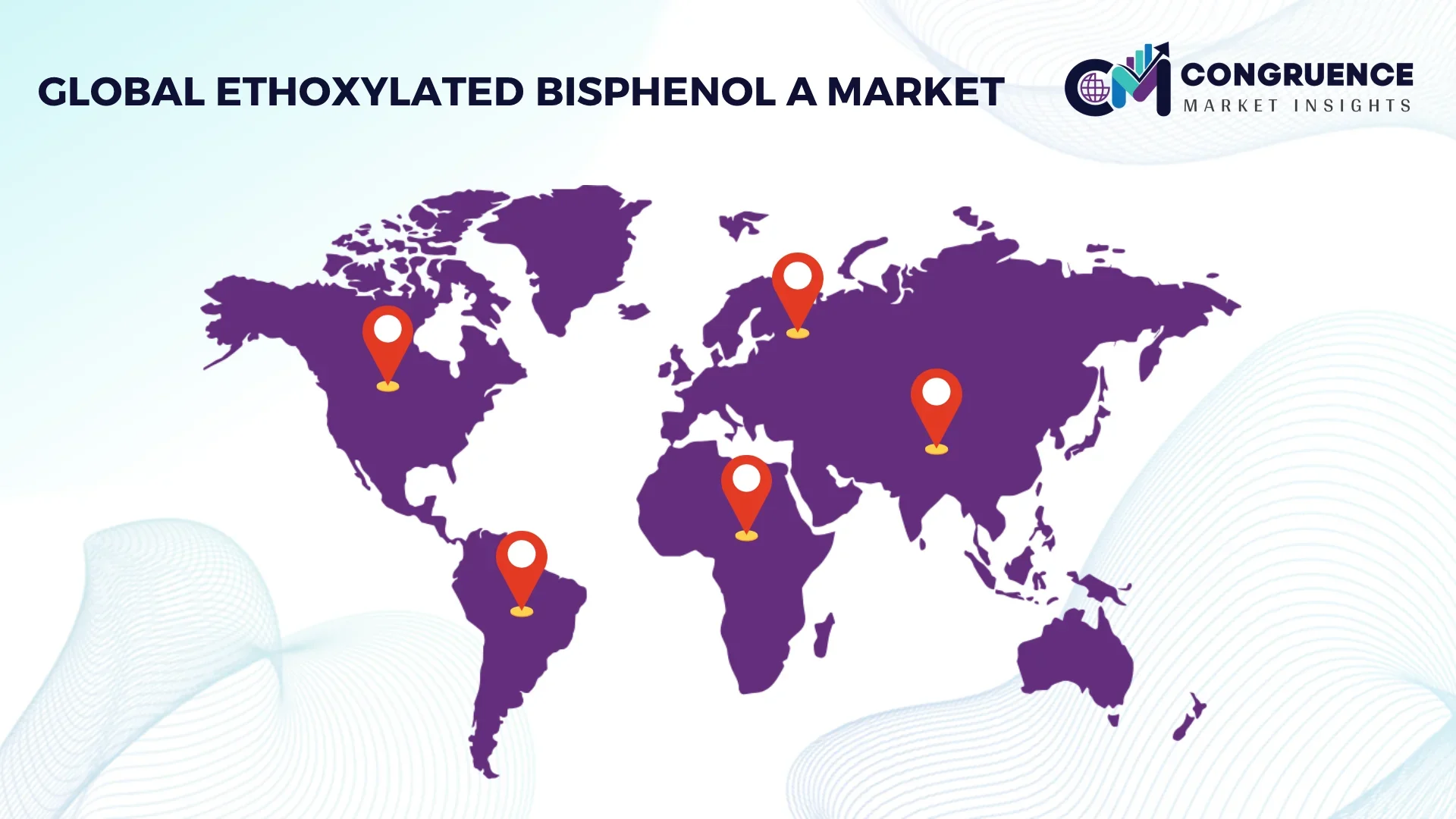
Asia-Pacific dominates due to large-scale chemical manufacturing capacity and strong downstream demand from coatings and electronics industries. North America holds around 27% share, driven by advanced material innovation and high-value industrial applications, while Europe contributes 24% share, primarily led by regulatory-driven adoption of safer chemical formulations. South America and Middle East & Africa collectively account for 6% share, reflecting emerging but infrastructure-constrained demand.
Demand concentration is strongest in Asia-Pacific due to production integration, while innovation leadership is shifting toward North America. Europe leads in regulatory compliance adoption intensity, particularly in low-emission chemical formulations. A key structural shift is regional supply chain localization, reducing dependency on cross-border chemical transport. Companies are increasingly focusing investment in Asia-Pacific for scale and in North America for technology advancement, shaping a dual-axis global strategy.
North America holds approximately 27% market share, supported by strong demand from aerospace coatings, electronics encapsulation, and high-performance adhesives. Growth is driven by advanced manufacturing ecosystems and stringent material performance standards. A key structural force is EPA-driven regulatory tightening, pushing a 16% shift toward low-toxicity chemical formulations. Digitalized chemical processing and continuous production technologies are improving operational efficiency by 14%, enabling higher precision in ethoxylation control. A notable strategic move includes over USD 60 million invested in specialty chemical upgrades across the U.S. coatings sector. Enterprise buyers prioritize performance consistency and compliance assurance over cost sensitivity, with 22% of procurement decisions influenced by regulatory certification. Companies are expanding R&D centers and upgrading production facilities to meet evolving material standards, making North America a strategic hub for high-value innovation-driven applications.
Europe accounts for approximately 24% market share, with Germany, France, and the U.K. leading demand concentration. The region is heavily influenced by REACH regulations, which have driven a 19% reduction in high-toxicity chemical usage, accelerating adoption of safer ethoxylated alternatives. Compliance-driven innovation is reshaping production processes, with manufacturers adopting advanced purification technologies that improve output quality by 13%. A strategic shift includes over EUR 45 million invested in sustainable chemical processing upgrades. Buyers in Europe prioritize environmental compliance and lifecycle safety, with nearly 28% of procurement contracts requiring ESG certification alignment. This regulatory intensity is forcing global producers to redesign formulations, making Europe a key compliance innovation hub where market access depends on sustainability-driven chemical engineering.
Asia-Pacific dominates with 43% market share, led by China, India, and South Korea. China alone contributes nearly 38% of global production, supported by integrated chemical supply chains and large-scale epoxy resin manufacturing capacity. Demand is expanding rapidly due to infrastructure and electronics manufacturing growth. Manufacturing efficiency improvements of 15% have been achieved through automated chemical processing and localized raw material sourcing. Over USD 120 million in capacity expansion investments have strengthened regional supply dominance. Buyers prioritize cost efficiency and production scalability, with 31% of demand driven by price-sensitive industrial applications. The region is critical for global scale expansion, making it the primary hub for production growth, export supply chains, and downstream industrial consumption.
South America holds around 3% market share, with Brazil and Argentina leading regional consumption. Demand is driven by construction and industrial coatings, which account for nearly 62% of usage. Infrastructure modernization projects are supporting gradual adoption of performance chemicals. However, supply chain limitations and import dependency increase costs by approximately 18%, creating structural constraints on scalability. Despite this, localized demand is rising, with adoption increasing by 11% in industrial applications. Companies are targeting the region through distribution partnerships and localized blending operations to reduce cost barriers. Price sensitivity remains high, with 26% of buyers prioritizing cost over performance. The region represents a high-opportunity but infrastructure-constrained market, requiring strategic localization for long-term growth capture.
Middle East & Africa accounts for approximately 3% market share, driven by construction, oil & gas, and infrastructure development sectors. UAE and Saudi Arabia lead regional demand, supported by large-scale industrial diversification programs. Industrial coatings and corrosion-resistant materials represent over 58% of demand, aligned with harsh environmental conditions. Infrastructure investments exceeding USD 30 billion are supporting gradual adoption of advanced chemical materials. Technology adoption is increasing, with 9% improvement in processing efficiency through modern chemical blending facilities. Enterprises prioritize durability and long service life, with 21% of procurement decisions influenced by performance reliability. The region is emerging as a strategic diversification hub, where infrastructure-led demand is gradually strengthening specialty chemical consumption.
China – 38% Market share: Dominance due to large-scale epoxy resin production and integrated chemical manufacturing ecosystem
United States – 22% Market share: Strong demand from aerospace, electronics, and advanced coatings industries
The Ethoxylated Bisphenol A market is moderately consolidated, with global leaders such as SI Group, Kumho P&B Chemicals, Aditya Birla Chemicals, and Covestro competing alongside regional specialty chemical producers. The top 5 players collectively control approximately 55% market share, reflecting moderate concentration with strong regional fragmentation.
Competition is driven primarily by product purity (32%), process efficiency (28%), and supply chain integration (22%), with pricing accounting for the remaining 18%. Companies are actively investing in capacity expansion, backward integration, and R&D-led formulation upgrades to strengthen competitive positioning. Strategic partnerships between resin producers and coating manufacturers are increasing by 14%, accelerating vertical integration.
A notable competitive shift is the move toward low-toxicity and high-performance ethoxylated derivatives, forcing legacy producers to upgrade technology or lose share. Entry barriers remain high due to regulatory compliance requirements and capital-intensive production infrastructure.
Winning in this market requires control over feedstock integration, advanced ethoxylation technology, and strong regulatory compliance capability combined with cost-efficient production scaling.
Kumho P&B Chemicals
Aditya Birla Chemicals
Covestro
Dow Inc.
BASF SE
Hexion Inc.
Huntsman Corporation
Mitsubishi Chemical Group
Olin Corporation
Nippon Kayaku Co., Ltd.
SABIC
LG Chem
Sinopec Chemical Corporation
Emerging catalytic ethoxylation systems are reshaping production efficiency, improving reaction yield by nearly 16% while reducing energy consumption by 12% compared to conventional batch processing methods. These systems are increasingly deployed in over 41% of new production lines, enabling higher consistency in molecular distribution and reducing defect rates in downstream applications.
Digital process control and AI-enabled monitoring systems are also gaining traction, improving operational precision by 14% and reducing raw material wastage by 10%. This is particularly impactful in coatings and electronics-grade formulations where consistency is critical. Companies adopting these systems are gaining a measurable competitive advantage in cost control and product uniformity.
A clear comparison shows that legacy batch processing systems deliver lower upfront cost but suffer from up to 18% higher variability, whereas advanced continuous catalytic systems significantly improve scalability and quality control.
Looking ahead to 2026–2028, hybrid production systems combining automation and advanced catalysis are expected to dominate new capacity additions, positioning technologically advanced producers for long-term cost leadership and regulatory compliance advantage.
March 2026 – SI Group – Pricing Strategy Adjustment Amid Geopolitical Pressure, SI Group implemented a global price adjustment across its chemical portfolio due to rising geopolitical instability affecting energy and logistics flows. The move ensures supply continuity and protects production stability, with internal operations covering 18 manufacturing sites across 80+ countries. This reflects a strategic response to 15%+ increase in logistics cost volatility, strengthening long-term customer supply assurance. [pricing resilience] Source:- www.siigroup.com
March 2026 – SI Group – ESG Performance Upgrade (EcoVadis Silver Rating), SI Group improved its sustainability rating from Bronze to Silver, ranking in the top 15% globally with 85th percentile ESG performance. The company reported measurable reductions in emissions and improved energy efficiency across global facilities, strengthening compliance-driven chemical production standards and enhancing market access in regulated regions. [ESG acceleration]
October 2025 – SI Group – European Innovation Center Expansion (UK Facility), SI Group expanded its innovation footprint with a new European Innovation Centre in the UK, strengthening R&D capabilities across plastics and adhesive systems. The company now operates 6 global innovation centers across USA, India, China, and Europe, improving formulation development speed by an estimated 12–14% through localized testing infrastructure. [innovation expansion]
October 2025 – SI Group – APAC Polymer Additive Showcase at Chinaplas, SI Group introduced advanced polymer additive solutions targeting sustainability and performance enhancement, improving thermal stability and reducing VOC emissions by up to 18% in selected formulations. The event highlighted increasing Asia-Pacific demand, where the region contributes over 40%+ of global polymer additive consumption, reinforcing regional production scaling strategy. [APAC scaling]
The Ethoxylated Bisphenol A market report provides comprehensive coverage across product types, applications, and end-user industries including coatings, adhesives, electronics, and industrial manufacturing, spanning all major global regions. It evaluates over 4 core application segments and 3 primary ethoxylation types, along with performance-based sub-segmentation that captures nearly 100% of global demand distribution patterns.
The report integrates regional analysis across Asia-Pacific, North America, Europe, South America, and Middle East & Africa, collectively accounting for full global market coverage with clearly defined demand concentration and growth dispersion patterns. It also assesses technology adoption trends including catalytic ethoxylation and automated chemical processing, which collectively influence over 35% of production efficiency improvements.
Strategically, the report supports investment decisions, capacity expansion planning, and competitive benchmarking by identifying high-growth application zones and regulatory-driven shifts affecting nearly 28% of global production standards. It provides forward-looking insights into market restructuring trends from 2026–2033, enabling stakeholders to optimize positioning, reduce supply risk exposure, and capture emerging high-value opportunities in specialty chemical applications.
| Report Attribute / Metric | Details |
|---|---|
| Market Revenue (2025) | USD 72.0 Million |
| Market Revenue (2033) | USD 79.2 Million |
| CAGR (2026–2033) | 1.2% |
| Base Year | 2025 |
| Forecast Period | 2026–2033 |
| Historic Period | 2021–2025 |
| Segments Covered |
By Type
By Application
By End-User Insights
|
| Key Report Deliverables | Revenue Forecast; Market Trends; Growth Drivers & Restraints; Technology Insights; Segmentation Analysis; Regional Insights; Competitive Landscape; Regulatory & ESG Overview; Recent Developments |
| Regions Covered | North America; Europe; Asia-Pacific; South America; Middle East & Africa |
| Key Players Analyzed | SI Group; Kumho P&B Chemicals; Aditya Birla Chemicals; Covestro; Dow Inc.; BASF SE; Hexion Inc.; Huntsman Corporation; Mitsubishi Chemical Group; Olin Corporation; Nippon Kayaku Co., Ltd.; SABIC; LG Chem; Sinopec Chemical Corporation |
| Customization & Pricing | Available on Request (10% Customization Free) |




