
Reports
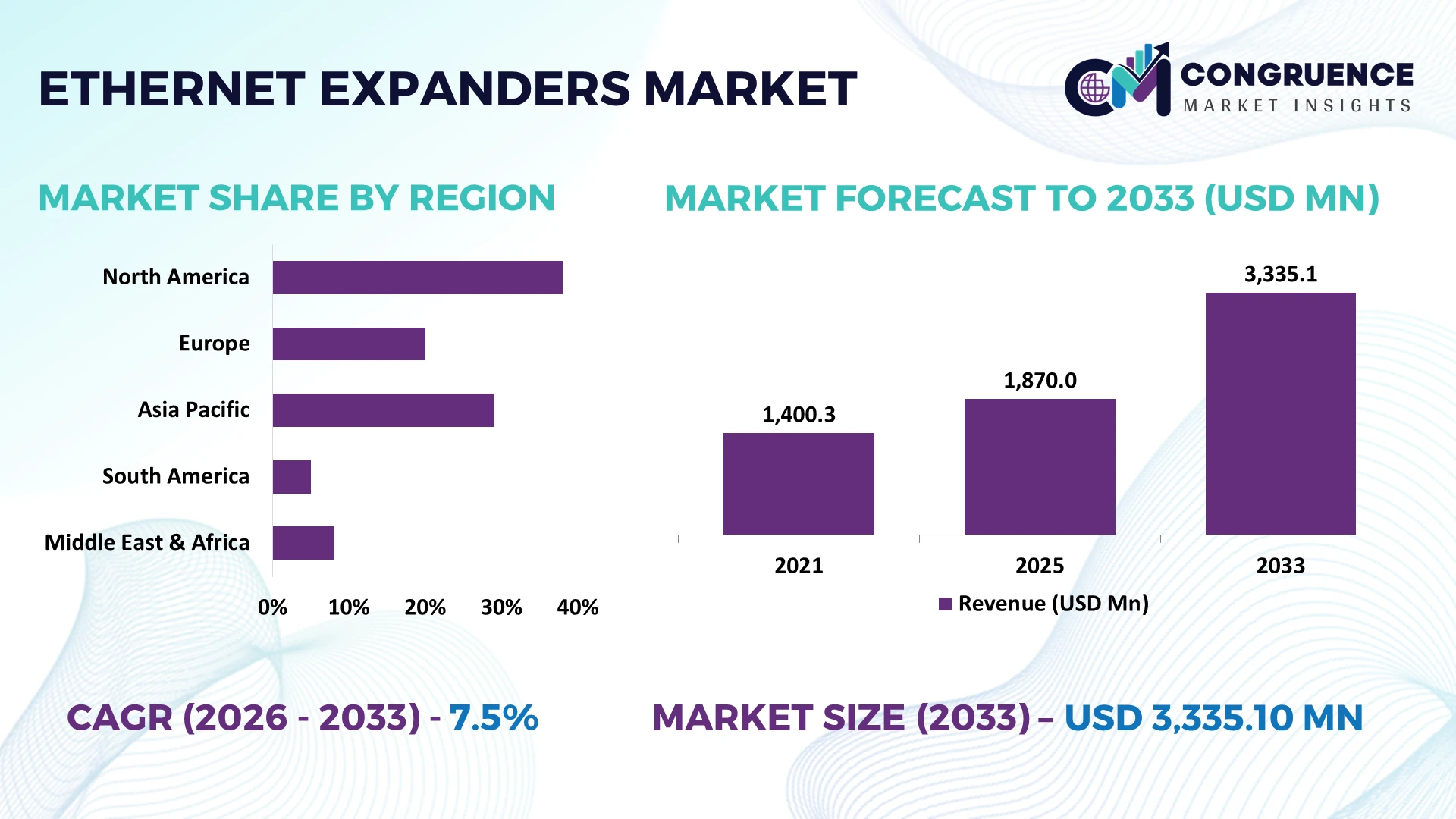
The Global Ethernet Expanders Market was valued at USD 1870 Million in 2025 and is anticipated to reach a value of USD 3335.1 Million by 2033 expanding at a CAGR of 7.5% between 2026 and 2033. Growth is being accelerated by expanding industrial Ethernet deployments, long-distance IP surveillance upgrades, and cost-efficient network extension requirements across smart infrastructure and manufacturing facilities.
China remains the dominant country, accounting for approximately 34% of global production capacity, supported by sustained investments in industrial automation, smart manufacturing, and digital infrastructure. More than 68% of newly deployed industrial communication networks integrate Ethernet-based connectivity, compared with about 27% in India, where infrastructure expansion is accelerating. Ongoing supply-chain diversification following post-Red Sea shipping disruptions has also strengthened regional manufacturing resilience and component localization across Asia.
Organizations prioritizing scalable Ethernet extension technologies gain stronger network coverage, lower infrastructure replacement costs, and greater operational flexibility across distributed industrial and commercial environments.
Market Size & Growth: USD 1870 Million in 2025, reaching USD 3335.1 Million by 2033 at 7.5% CAGR, driven by expanding industrial Ethernet and IP surveillance modernization.
Top Growth Drivers: Industrial automation contributes 31%, smart building deployments 28%, and transportation infrastructure upgrades 24% of incremental market demand.
Short-Term Forecast: By 2028, advanced Ethernet extender deployments reduce network installation costs by 18% while improving transmission efficiency by 22%.
Emerging Technologies: AI-enabled network diagnostics, Power over Ethernet optimization, and intelligent remote management improve operational uptime by approximately 20%.
Regional Leaders: Asia-Pacific exceeds USD 1380 Million, North America reaches about USD 840 Million, and Europe approaches USD 690 Million, supported by industrial digitalization and regional network expansion.
Consumer/End-User Trends: More than 63% of industrial facilities prioritize long-distance Ethernet connectivity to modernize legacy infrastructure without extensive cable replacement.
Pilot/Case Example: A 2026 smart manufacturing deployment improved network availability by 25% through advanced Ethernet expander integration across distributed production lines.
Competitive Landscape: Leading suppliers collectively hold approximately 46% market share, with competition focused on industrial-grade reliability, cybersecurity, and simplified deployment.
Regulatory & ESG Impact: Energy-efficient networking solutions reduce equipment power consumption by nearly 14%, aligning with stricter industrial sustainability requirements.
Investment & Funding: More than USD 920 Million supports manufacturing expansion, strategic partnerships, and regional supply-chain diversification across advanced networking technologies.
Innovation & Future Outlook: Next-generation gigabit expanders, cloud-based monitoring, and edge-ready network architectures accelerate digital infrastructure transformation and strengthen long-term competitive positioning.
Ethernet Expanders Market demand is strengthening across industrial automation, transportation systems, commercial security, and utility networks where long-distance connectivity is essential without replacing existing cabling. New gigabit-capable designs with intelligent remote diagnostics improve network availability, while approximately 40% of new industrial networking projects prioritize scalable Ethernet extension. Ongoing component localization and resilient supply-chain strategies are reinforcing deployment momentum, setting the stage for broader strategic market evaluation.
Ethernet Expanders are becoming strategically important as enterprises modernize distributed network infrastructure without replacing existing copper cabling, reducing deployment costs while accelerating digital transformation. Industrial automation, intelligent transportation, utility monitoring, and smart facility management increasingly depend on extended Ethernet connectivity for reliable data transmission. Supply-chain restructuring since 2024 has encouraged equipment manufacturers to diversify component sourcing and establish localized assembly operations, improving delivery reliability and reducing lead-time exposure for infrastructure projects.
Compared with legacy fiber replacement projects, advanced Ethernet expanders lower installation costs by approximately 30% and shorten deployment time by nearly 40% by utilizing existing network infrastructure. China continues to lead large-scale industrial deployment through manufacturing digitization, while Germany emphasizes highly secure industrial networking for advanced production facilities and critical infrastructure. Over the next two to three years, more than 55% of industrial network upgrades are expected to prioritize scalable Ethernet extension solutions integrated with remote monitoring and predictive maintenance capabilities.
A practical example is the deployment of Ethernet expanders across large manufacturing campuses, where production equipment, surveillance systems, and warehouse automation operate over extended distances without major infrastructure replacement. Companies are expanding partnerships with industrial automation providers, strengthening localized production, and investing in managed networking platforms to improve interoperability. Businesses that integrate intelligent Ethernet extension technologies into broader digital infrastructure strategies will secure stronger operational resilience, faster deployment cycles, and a more competitive position in industrial connectivity.
Industrial enterprises are replacing fragmented communication networks with scalable Ethernet infrastructure to support automation, machine connectivity, and real-time monitoring. Approximately 64% of newly commissioned manufacturing facilities prioritize Ethernet-based industrial communication, while network modernization reduces maintenance requirements by nearly 22% and improves operational uptime by around 18%. China's continued investment in smart manufacturing and factory digitalization is accelerating deployment across automotive and electronics production hubs. This structural transition increases demand for long-distance Ethernet connectivity without extensive civil infrastructure work. In response, manufacturers are expanding industrial-grade product portfolios, forming partnerships with automation integrators, and introducing ruggedized Ethernet expanders designed for high-temperature and high-vibration operating environments, strengthening competitive differentiation through application-specific innovation.
Interoperability challenges between legacy industrial protocols and modern Ethernet architectures continue to slow deployment across mixed infrastructure environments. Around 29% of industrial facilities still operate aging communication systems requiring customized integration, while specialized networking components have experienced procurement lead-time fluctuations exceeding 15% during supply-chain disruptions. Japan and several European industrial manufacturers continue prioritizing strict compatibility standards, increasing engineering complexity and validation costs. These structural limitations raise deployment expenses, extend project timelines, and reduce implementation flexibility for system integrators. Companies are mitigating risk by diversifying component suppliers, expanding localized inventory strategies, establishing long-term procurement agreements, and developing protocol-compatible networking platforms that simplify migration from legacy industrial communication environments.
The convergence of edge computing, AI-enabled diagnostics, and industrial IoT creates new opportunities for Ethernet expanders beyond traditional network extension. Nearly 58% of new smart factory deployments are integrating edge-enabled communication infrastructure, while intelligent remote management reduces maintenance interventions by approximately 20%. India is expanding digital manufacturing initiatives that encourage deployment of scalable industrial networking across logistics, utilities, and electronics production facilities. Equipment manufacturers are increasing investment in software-driven network management, cybersecurity integration, and cloud-enabled monitoring ecosystems. A significant strategic opportunity lies in delivering subscription-based network management services alongside hardware, enabling recurring value creation while improving lifecycle performance and reducing operational complexity for enterprise customers.
As industrial networks become increasingly interconnected, maintaining secure, standardized, and scalable Ethernet infrastructure presents a major execution challenge. Approximately 47% of industrial operators identify cybersecurity integration as a primary deployment concern, while multi-site facilities report network configuration complexity increasing by nearly 26% after digital expansion. Germany's advanced manufacturing sector illustrates the growing need for standardized security architectures across distributed production environments. These challenges directly affect deployment consistency, operational resilience, and long-term infrastructure sustainability. Companies must strengthen cybersecurity capabilities, invest in automated network management, collaborate with industrial software providers, and expand workforce expertise in industrial networking to ensure secure, reliable, and scalable Ethernet connectivity across increasingly complex operational ecosystems.
Industrial Ethernet Standardization Industrial facilities are standardizing Ethernet architectures to simplify multi-vendor connectivity, with nearly 61% of new automation projects adopting unified Ethernet communication platforms and reducing network commissioning time by approximately 24%. Germany and Japan are accelerating standardized industrial networking to improve interoperability across production assets. Vendors are responding by expanding protocol-compatible product portfolios and collaborating with automation ecosystem partners, enabling faster deployment while lowering lifecycle integration costs for large industrial operators.
Smart Surveillance Network Expansion IP surveillance modernization is increasing demand for long-distance Ethernet connectivity, with more than 57% of newly installed enterprise security systems supporting high-bandwidth video transmission over extended distances. Large logistics hubs and transportation terminals are replacing fragmented networking with centralized management platforms, improving monitoring efficiency by nearly 21%. Equipment manufacturers are integrating intelligent diagnostics and remote configuration features while expanding partnerships with security solution providers to streamline deployment and reduce maintenance workloads.
Localized Manufacturing Strategies Supply-chain diversification continues to reshape production priorities as approximately 36% of networking equipment manufacturers increase localized assembly and regional component sourcing. Ongoing logistics disruptions and stricter procurement resilience requirements have encouraged enterprises in India and Southeast Asia to shorten supplier networks. Companies are restructuring procurement operations, expanding regional manufacturing capacity, and qualifying multiple component vendors, improving production continuity while reducing exposure to cross-border supply interruptions.
Edge-Ready Network Intelligence Ethernet expanders increasingly incorporate intelligent monitoring capabilities, with around 48% of newly introduced industrial models supporting edge-based diagnostics and remote health monitoring. Automated fault detection lowers service response times by roughly 27%, improving operational continuity across distributed industrial sites. Instead of competing solely on hardware specifications, manufacturers are differentiating through software-enabled network visibility, predictive maintenance capabilities, and integrated lifecycle management services, strengthening long-term customer retention and operational value.
PoE Ethernet expanders account for approximately 43% of the market due to their ability to transmit both power and data through a single cable, reducing installation complexity and infrastructure costs across surveillance, industrial automation, and commercial networking. Organizations report installation cost reductions of nearly 25% by minimizing separate power infrastructure. Managed Ethernet expanders represent the fastest-growing segment as enterprises increasingly require centralized monitoring, remote diagnostics, and cybersecurity management for distributed industrial networks. Manufacturers are expanding managed product portfolios with intelligent configuration software and enhanced network visibility to support digital infrastructure strategies.
Non-PoE Ethernet expanders remain strategically relevant in existing industrial environments where independent power architectures are already established, providing a cost-efficient migration pathway. Unmanaged Ethernet expanders continue serving smaller commercial facilities and entry-level deployments due to straightforward installation and competitive pricing, although their relative adoption is gradually declining as network complexity increases. Companies are prioritizing managed and PoE innovation while maintaining broader product portfolios to address varied deployment environments and customer investment strategies.
Industrial Networking represents the largest application, accounting for approximately 39% of deployments because manufacturing facilities, warehouses, and processing plants require reliable long-distance communication between controllers, sensors, and production equipment. Digital factory upgrades have increased industrial Ethernet implementation by nearly 28%, while expanding automation initiatives continue strengthening demand. Transportation Networks are the fastest-growing application as rail systems, intelligent traffic management, and connected infrastructure require resilient communication over extended operational environments. Suppliers are developing ruggedized Ethernet expanders specifically for harsh industrial and outdoor conditions.
IP Surveillance remains a mature application with widespread deployment across commercial campuses, logistics facilities, and critical infrastructure where centralized monitoring is operationally essential. Building Automation continues expanding through integrated HVAC, lighting, and security management, with enterprises increasingly consolidating building management onto unified Ethernet platforms. Companies are strengthening application-specific partnerships with automation integrators, security providers, and transportation technology firms to improve deployment efficiency and accelerate market penetration.
Manufacturing remains the dominant end-user, representing approximately 37% of demand because production facilities require continuous, high-reliability communication between automation equipment, robotics, quality systems, and centralized control platforms. Around 59% of factory modernization programs now prioritize Ethernet-based industrial networking to improve operational visibility and equipment connectivity. Telecommunications is the fastest-growing end-user segment as network operators expand edge infrastructure, distributed communication sites, and enterprise connectivity services requiring extended Ethernet transmission. Vendors are introducing carrier-grade networking solutions optimized for continuous network availability and simplified remote management.
Energy & Utilities continue increasing deployments across substations, renewable energy facilities, and remote monitoring assets where reliable long-distance communication is operationally critical. Transportation operators are expanding Ethernet infrastructure across rail corridors, airports, and traffic management systems, while Commercial Buildings increasingly integrate Ethernet expanders into intelligent facility management ecosystems. Companies are strengthening customer engagement through vertical-specific product customization, strategic partnerships, and solution-based pricing models that improve deployment flexibility across diverse operational environments.
Asia-Pacific accounted for the largest market share at 42% in 2025 however, Middle East & Africa is expected to register the fastest growth, expanding at a 9.2% CAGR between 2026 and 2033.

Industrial Digitalization Strengthens Enterprise Network Expansion
North America represents approximately 27% of the global Ethernet Expanders Market, supported by advanced manufacturing, hyperscale data infrastructure, industrial automation, and modernization of enterprise communication networks. The United States and Canada continue upgrading industrial facilities with Ethernet-based connectivity to improve operational visibility and network reliability. More than 60% of newly modernized industrial sites incorporate managed Ethernet infrastructure capable of remote monitoring. Investment in smart manufacturing and logistics automation is accelerating deployment across automotive, warehouse, and energy sectors. Equipment suppliers are expanding partnerships with industrial automation providers while integrating cybersecurity features and intelligent diagnostics into Ethernet expansion solutions to support resilient industrial networking and reduce maintenance complexity.
United States Market Outlook: The United States remains the regional leader through extensive deployment of industrial automation, warehouse modernization, and enterprise networking infrastructure. Nearly 66% of large manufacturing facilities continue integrating Ethernet-based communication platforms for machine connectivity and operational monitoring. Strong investment in semiconductor manufacturing, digital infrastructure, and critical industrial facilities is encouraging suppliers to expand localized engineering support, customized networking solutions, and long-term technology partnerships for industrial customers.
Industrial Connectivity Modernization Drives Network Standardization
Europe accounts for nearly 24% of global demand, supported by advanced manufacturing, industrial digitalization, and strict operational reliability requirements across automotive, pharmaceutical, and process industries. Factory modernization initiatives increasingly emphasize interoperable Ethernet communication capable of supporting distributed automation systems. Approximately 54% of industrial networking upgrades prioritize secure Ethernet architectures with centralized management. Sustainability initiatives also encourage longer equipment life through infrastructure modernization instead of complete cable replacement. Manufacturers are strengthening collaboration with industrial automation vendors while introducing ruggedized networking equipment designed for demanding operating environments.
Germany Market Outlook: Germany leads the European market through its highly automated manufacturing base and strong Industry 4.0 implementation. Around 63% of advanced production facilities continue investing in industrial Ethernet communication to improve machine interoperability and production efficiency. Engineering expertise, industrial software integration, and continued factory modernization create favorable conditions for Ethernet expander suppliers developing high-performance, industrial-grade networking solutions with advanced security and diagnostic capabilities.
Manufacturing Scale and Infrastructure Expansion Accelerate Deployment
Asia-Pacific contributes approximately 42% of global market demand, supported by large-scale electronics manufacturing, industrial automation, transportation infrastructure, and smart city development. China, Japan, South Korea, and India continue expanding digital industrial ecosystems requiring reliable long-distance Ethernet communication. More than 68% of newly established smart manufacturing projects deploy Ethernet-based industrial networking. Export-oriented manufacturing clusters are also increasing investment in advanced factory communication infrastructure to improve productivity and operational visibility. Equipment suppliers continue expanding production capacity while strengthening regional distribution networks and localized technical support to meet growing enterprise demand.
China Market Outlook: China remains the largest individual market because of its extensive industrial production capacity and continued investment in manufacturing automation. Approximately 34% of global Ethernet expander production capacity is concentrated in China, supported by electronics manufacturing, industrial equipment production, and smart factory deployment. Domestic manufacturers continue expanding product innovation, localized component sourcing, and industrial networking ecosystems to strengthen competitiveness across domestic and international markets.
Infrastructure Modernization Supports Industrial Connectivity
South America accounts for approximately 5% of global market activity, with demand primarily driven by industrial modernization, mining operations, logistics facilities, and commercial infrastructure upgrades. Ethernet expanders are increasingly deployed where long-distance communication is required without replacing existing network infrastructure. Around 31% of industrial modernization projects now incorporate Ethernet-based communication platforms to improve operational continuity. Investment remains selective due to infrastructure constraints, yet enterprises continue prioritizing scalable networking technologies that lower installation costs. Vendors are expanding channel partnerships and strengthening regional technical support to improve deployment efficiency and after-sales service.
Brazil Market Outlook: Brazil dominates regional demand through its large industrial sector, mining industry, logistics operations, and commercial infrastructure expansion. More than 44% of South American industrial Ethernet deployments are concentrated within Brazil. Companies continue investing in factory automation, distribution centers, and intelligent security infrastructure, creating favorable opportunities for suppliers offering ruggedized Ethernet expansion solutions with simplified installation and lower operating costs.
Digital Infrastructure Investment Reshapes Enterprise Networking
The Middle East & Africa represents an emerging high-growth market supported by smart city development, utility modernization, transportation expansion, and industrial diversification initiatives. Approximately 29% of new infrastructure projects now integrate Ethernet-based communication systems for surveillance, automation, and operational management. Large investments in industrial zones, airports, and energy infrastructure continue increasing demand for scalable networking technologies. Suppliers are expanding partnerships with infrastructure contractors while establishing regional distribution capabilities to improve delivery responsiveness and technical support for enterprise customers.
Saudi Arabia Market Outlook: Saudi Arabia leads regional deployment through extensive investment in smart infrastructure, industrial diversification, and digital transformation initiatives. Nearly 38% of large industrial and infrastructure modernization projects incorporate advanced Ethernet communication technologies to improve operational efficiency. Continued expansion of industrial cities, logistics hubs, and intelligent transportation networks encourages suppliers to establish strategic partnerships and localized technical services supporting long-term infrastructure development.
Global competitors including Moxa, Advantech, Antaira Technologies, Westermo, Perle Systems, and EtherWAN compete against regional industrial networking specialists through technology performance, industrial reliability, and deployment flexibility. The top five players collectively control approximately 48% of the market, while regional suppliers compete aggressively on pricing and application-specific customization. Technology leaders differentiate through managed networking, cybersecurity integration, and ruggedized hardware that improves network uptime by about 20%, whereas cost-focused manufacturers reduce deployment expenses by nearly 15% through simplified architectures. Competition increasingly centers on localized manufacturing, strategic automation partnerships, software-enabled network management, and vertical integration of industrial communication portfolios. Supply-chain resilience and component availability have become decisive competitive factors following global logistics disruptions. High certification requirements, protocol interoperability, and industrial reliability standards create meaningful entry barriers for new participants. Success depends on delivering secure, scalable, application-specific Ethernet expansion solutions backed by strong technical support, rapid deployment capability, and long-term ecosystem partnerships.
Moxa Inc.
Advantech Co., Ltd.
Perle Systems
Antaira Technologies
Westermo Network Technologies
EtherWAN Systems, Inc.
PLANET Technology Corporation
Korenix Technology Co., Ltd.
Omnitron Systems Technology, Inc.
Red Lion Controls
Lantronix, Inc.
Black Box Corporation
ComNet (Communication Networks)
Hirschmann (Belden Inc.)
Industrial-grade VDSL2 Ethernet expanders, Power over Ethernet integration, and managed networking platforms remain the core technologies transforming long-distance connectivity across manufacturing, utilities, and commercial infrastructure. Around 62% of new industrial Ethernet extension deployments now include remote management capabilities, improving network uptime by approximately 18% while reducing maintenance visits by nearly 15%. Compared with legacy unmanaged extenders, intelligent managed solutions shorten fault isolation time by about 35%, enabling faster operational recovery and lower lifecycle support costs.
Emerging technologies between 2026 and 2028 include AI-assisted network diagnostics, edge-enabled monitoring, Time-Sensitive Networking (TSN), and enhanced industrial cybersecurity integration. Nearly 46% of enterprise infrastructure upgrades are expected to incorporate predictive network analytics, improving asset utilization by roughly 20%. Integration with Industrial IoT platforms allows centralized monitoring of geographically distributed facilities, while IEC 62443-aligned security capabilities strengthen protection for critical industrial communication networks. Companies investing in software-defined management platforms gain measurable operational visibility and improved network resilience compared with hardware-only deployments.
Disruptive innovation is shifting competition from standalone hardware toward intelligent connectivity ecosystems. Cloud-enabled lifecycle management, automated firmware orchestration, and edge intelligence improve deployment efficiency by approximately 22% while lowering configuration effort by around 17%. Technology leaders offering integrated networking software, cybersecurity, and industrial interoperability gain stronger enterprise adoption, whereas low-cost hardware suppliers face increasing differentiation pressure. Organizations acting before 2028 will secure faster infrastructure modernization, stronger operational continuity, and higher-value industrial networking capabilities.
July 2024 Moxa launched its MRX Series industrial Ethernet switch portfolio with configurations supporting up to 64 ports and 16×10GbE interfaces, strengthening high-bandwidth industrial networking and accelerating IT/OT convergence for large-scale deployments. Business impact: improved scalability for data-intensive applications. Source: https://www.moxa.com
July 2024 Perle Systems received the IoT Evolution Product of the Year Award for its 10G Media Converters, supporting 10Gbps connectivity while extending Ethernet beyond conventional copper distance limits. Business impact: stronger positioning in industrial IoT and infrastructure modernization.
December 2024 Perle Systems earned the CyberSecured Award for its IOLAN SCR Secure Console Servers, reinforcing secure remote infrastructure management for critical networking environments. Business impact: enhanced enterprise confidence in secure industrial connectivity and critical infrastructure deployments. Source: https://www.perle.com
June 2026 Moxa achieved dual IEC 62443-4-1 Maturity Level 3 certifications, strengthening secure product development for industrial networking solutions. Business impact: improved cybersecurity readiness for critical infrastructure operators and higher compliance value across industrial Ethernet deployments. Source: https://www.moxa.com
This report provides a comprehensive assessment of the Ethernet Expanders Market across product categories, deployment models, application environments, and end-user industries. It evaluates PoE, Non-PoE, Managed, and Unmanaged solutions while examining demand across industrial networking, IP surveillance, building automation, and transportation networks. Manufacturing, telecommunications, energy and utilities, transportation, and commercial buildings are analyzed to identify deployment priorities, technology adoption patterns, and competitive positioning. More than 60% of enterprise deployments are assessed through industrial modernization and digital infrastructure indicators to reflect current operational trends.
The study covers North America, Europe, Asia-Pacific, South America, and the Middle East & Africa, highlighting regional deployment dynamics, technology integration, and strategic investment priorities between 2026 and 2033. It evaluates intelligent network management, edge connectivity, industrial cybersecurity, and Ethernet infrastructure modernization while benchmarking major market participants, emerging application areas, partnership strategies, and product innovation. The report supports expansion planning, competitive analysis, investment decisions, and long-term infrastructure strategy through detailed operational and segment-specific intelligence.
| Report Attribute/Metric | Report Details |
|---|---|
Market Revenue in 2025 | USD 1870 Million |
Market Revenue in 2033 | USD 3335.1 Million |
CAGR (2026 - 2033) | 7.5% |
Base Year | 2025 |
Forecast Period | 2026 - 2033 |
Historic Period | 2021 - 2025 |
Segments Covered | By Type
By Application
By End-User
|
Key Report Deliverable | Revenue Forecast, Growth Trends, Market Dynamics, Segmental Overview, Regional and Country-wise Analysis, Competition Landscape |
Region Covered | North America, Europe, Asia-Pacific, South America, Middle East, Africa |
Key Players Analyzed | Moxa Inc., Advantech Co., Ltd., Perle Systems, Antaira Technologies, Westermo Network Technologies, EtherWAN Systems, Inc., PLANET Technology Corporation, Korenix Technology Co., Ltd., Omnitron Systems Technology, Inc., Red Lion Controls, Lantronix, Inc., Black Box Corporation, ComNet (Communication Networks), Hirschmann (Belden Inc.) |
Customization & Pricing | Available on Request (10% Customization is Free) |




