
Reports
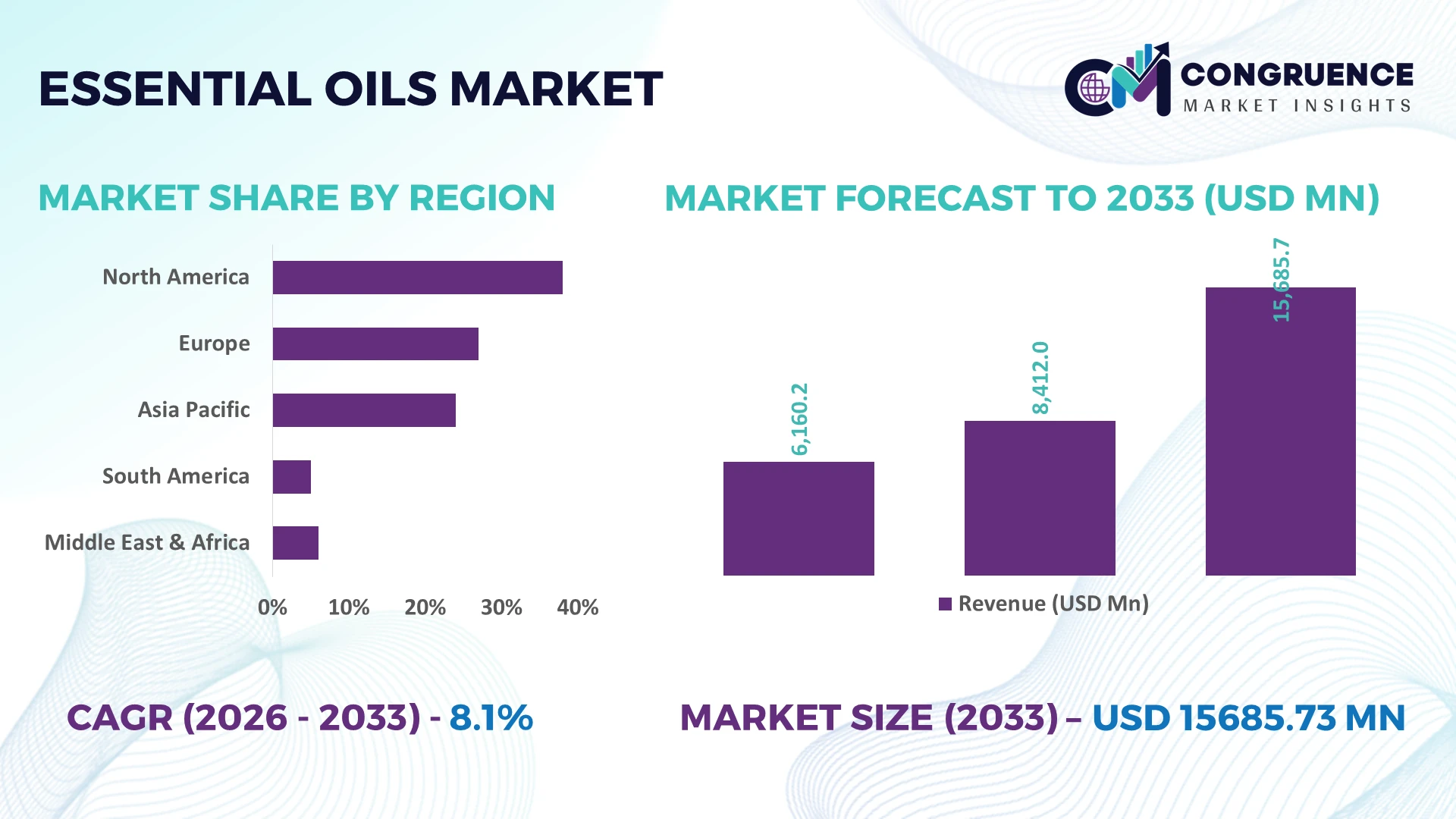
The Global Essential Oils Market was valued at USD 8412 Million in 2025 and is anticipated to reach a value of USD 15685.73 Million by 2033 expanding at a CAGR of 8.1% between 2026 and 2033. Growth is driven by expanding botanical ingredient processing, precision extraction technologies, rising pharmaceutical-grade formulations, and wider adoption of traceable natural ingredients across food, cosmetics, and wellness manufacturing.
The United States leads the global essential oils market with approximately 27% share, supported by advanced aromatherapy, personal care, nutraceutical, and food processing industries alongside over 2,500 commercial formulation facilities. Compared with India, which continues expanding cultivation and steam-distillation capacity through export-focused investments, the U.S. records nearly 35% higher adoption of AI-enabled quality control systems. Continued Red Sea shipping disruptions in 2026 have accelerated regional sourcing strategies and inventory diversification across manufacturers.
Strategic investment in resilient botanical supply chains, automated extraction capacity, and certified sustainable sourcing remains essential for maintaining long-term competitive advantage.
Market Size & Growth: USD 8412 Million (2025) to USD 15685.73 Million (2033) at 8.1% CAGR, supported by advanced extraction technology and premium natural ingredient demand.
Top Growth Drivers: Pharmaceutical applications (+18%), clean-label cosmetics (+16%), and functional food ingredients (+14%) accelerate global expansion.
Short-Term Forecast: By 2027, automated extraction improves production efficiency by 20% while reducing processing waste by 15%.
Emerging Technologies: AI quality inspection, supercritical CO₂ extraction, and IoT-enabled distillation improve consistency and traceability.
Regional Leaders: North America, Europe, and Asia-Pacific lead with strong manufacturing expansion, export growth, and sustainable cultivation investments.
Consumer/End-User Trends: Nearly 62% of premium wellness product launches incorporate plant-derived aromatic ingredients.
Pilot/Case Example: In 2025, automated botanical processing improved extraction yield by approximately 12% while lowering energy consumption by 10%.
Competitive Landscape: Top suppliers collectively account for roughly 38% share, led by global fragrance, flavor, and specialty ingredient manufacturers.
Regulatory & ESG Impact: Sustainable cultivation programs reduce water consumption by around 18% while strengthening certification compliance.
Investment & Funding: More than USD 900 Million supports capacity expansion, sustainable farming partnerships, and advanced processing facilities amid supply-chain diversification.
Innovation & Future Outlook: Bio-based formulations, precision botanical blending, and digital traceability strengthen premium product differentiation and long-term market competitiveness.
Demand continues expanding across personal care, pharmaceutical formulations, food flavoring, household products, and aromatherapy applications. Advanced supercritical CO₂ extraction, AI-assisted quality verification, and digital batch traceability are improving product consistency. More than 40% of premium product launches emphasize certified natural ingredients, while regional sourcing strategies strengthen supply resilience amid evolving global trade and sustainability requirements, setting the stage for deeper strategic market evaluation.
The Essential Oils Market has become strategically important as manufacturers reposition botanical ingredients within premium consumer products, pharmaceutical formulations, functional foods, and industrial fragrances. Competition increasingly depends on traceable sourcing, standardized quality, and resilient procurement networks rather than production volume alone. Since 2026, continued supply-chain restructuring and stricter ingredient transparency requirements have accelerated investment in vertically integrated cultivation, automated distillation, and digital traceability platforms, enabling producers to secure consistent raw material availability while strengthening export competitiveness.
Modern supercritical CO₂ extraction delivers approximately 18% higher recovery efficiency and reduces solvent-related processing costs by nearly 15% compared with conventional steam extraction for selected botanical applications. The United States emphasizes AI-enabled quality assurance and pharmaceutical-grade processing, whereas India continues expanding cultivation acreage and export-oriented distillation infrastructure with lower feedstock costs. Over the next two to three years, digital quality monitoring is expected to exceed 45% adoption among large-scale processors, improving batch consistency and reducing production variability across international supply chains.
Leading producers are deploying contract farming networks, expanding sustainable cultivation partnerships, and investing in automated extraction facilities to improve operational resilience. Companies are also strengthening collaborations with cosmetics and nutraceutical manufacturers to secure long-term supply agreements. Organizations that combine certified sourcing, advanced processing technologies, and diversified production footprints will strengthen competitive positioning while building lasting operational advantages in a rapidly evolving global marketplace.
Growing investment in certified botanical cultivation and advanced extraction technologies is transforming industrial production across the essential oils value chain. More than 58% of premium personal care formulations now specify naturally derived aromatic ingredients, while automated distillation improves extraction consistency by nearly 20% and reduces processing waste by approximately 15%. India continues expanding contract farming and export-oriented processing facilities, supported by stronger traceability requirements across international buyers. This structural shift increases procurement reliability and product standardization. In response, leading companies are expanding cultivation partnerships, investing in AI-assisted quality inspection, and integrating digital batch monitoring to improve compliance, optimize yields, and strengthen long-term supply security across high-value application sectors.
Seasonal crop variability, climate fluctuations, and dependence on limited cultivation zones continue to constrain production stability. Raw botanical prices fluctuate by 18–25% during unfavorable harvest cycles, while transportation expenses remain around 12% above pre-disruption averages in several export corridors. Mediterranean lavender and Australian tea tree producers face increasing weather-related yield uncertainty, affecting manufacturing schedules and contract fulfillment. These structural pressures compress operating margins and reduce pricing flexibility for processors. Companies are mitigating exposure through multi-country sourcing strategies, localized extraction facilities, long-term procurement agreements, and expanded cultivation programs that reduce dependence on single-origin feedstock while improving operational continuity.
Digital quality management and next-generation extraction technologies are creating new competitive opportunities beyond conventional production expansion. AI-supported botanical grading improves inspection accuracy by nearly 30%, while precision extraction enhances active compound retention by approximately 18%. Japan and South Korea are accelerating adoption of smart manufacturing systems for premium cosmetic and wellness ingredients, supported by stricter quality verification standards. Companies are increasing investment in digital traceability, blockchain-enabled ingredient authentication, and advanced formulation research to differentiate premium products. This transition enables stronger brand positioning, higher-value exports, and improved customer confidence while supporting efficient regulatory compliance across international markets.
Maintaining consistent quality across geographically dispersed cultivation and processing networks remains a significant execution challenge. Natural variation in plant chemistry creates batch composition differences exceeding 15% for selected botanical species, while laboratory testing requirements increase quality assurance costs by roughly 10%. France and India must balance expanding production capacity with increasingly stringent international purity and sustainability expectations. Companies also face growing pressure to harmonize certification protocols across multiple export destinations. Sustained investment in analytical laboratories, workforce training, automated process controls, and standardized cultivation practices is essential to ensure product consistency, strengthen international competitiveness, and support long-term industrial scalability.
Digital Quality Traceability Expansion: Manufacturers are integrating AI-based quality inspection and blockchain-enabled batch traceability to improve ingredient verification across global supply chains. Digital inspection now reduces manual quality assessment time by nearly 35% while improving specification compliance by approximately 22%. Stricter ingredient transparency requirements and export documentation standards are accelerating deployment. Companies are standardizing digital workflows, expanding laboratory automation, and integrating traceability platforms with procurement systems to strengthen customer confidence and reduce shipment delays.
Advanced Extraction Process Modernization: Supercritical CO₂ extraction and hybrid low-temperature distillation are replacing conventional processing for premium botanical products. Modern extraction improves active compound retention by nearly 18% while lowering energy consumption by around 14% and shortening processing cycles by approximately 12%. Japanese and European processors are modernizing production lines to address rising premium product demand. Companies continue expanding automated extraction capacity and upgrading processing infrastructure to improve operational consistency and reduce production variability.
Localized Botanical Sourcing Networks: Supply-chain disruption and climate-related cultivation uncertainty are encouraging companies to diversify procurement beyond traditional sourcing regions. Multi-country sourcing programs have increased by roughly 28%, while contract farming participation has expanded by nearly 20% among large processors. India, Brazil, and Australia are strengthening regional cultivation partnerships to improve raw material availability. Producers are restructuring supplier networks and expanding localized processing facilities to reduce logistics risks and stabilize manufacturing schedules.
High-Purity Industrial Formulations: Demand is shifting toward standardized pharmaceutical and clinical-grade essential oils with tighter composition specifications. Automated analytical testing improves batch consistency by approximately 25%, while standardized formulations reduce product variability by nearly 17%. Regulatory expectations for purity verification continue influencing manufacturing practices. Companies are expanding R&D partnerships, investing in advanced analytical laboratories, and developing customized botanical formulations for pharmaceutical, nutraceutical, and premium personal care applications.
Citrus Oils remain the dominant segment because of abundant raw material availability, lower extraction costs, and broad application across food, beverages, household products, and personal care. The segment represents approximately 38% of commercial essential oil consumption due to scalable citrus processing infrastructure and consistent global availability. Herbal Oils continue supporting pharmaceutical and wellness applications, while Spice Oils maintain stable demand in food processing and functional formulations. Wood Oils retain strategic importance for premium fragrances and specialty industrial products where long-lasting aromatic performance is required. Leading producers continue expanding citrus processing capacity and optimizing extraction technologies to improve yield consistency.
Floral Oils are the fastest-growing type as premium cosmetics and therapeutic formulations increasingly prioritize high-value botanical ingredients. Adoption of floral oils in luxury skincare has increased by nearly 19%, while advanced extraction technologies improve fragrance retention by approximately 16%. Companies are expanding cultivation partnerships, investing in controlled-environment farming, and developing premium formulations targeting wellness and high-end personal care markets. This investment shift reflects growing emphasis on product differentiation, higher-margin applications, and resilient botanical sourcing.
Personal Care remains the leading application because essential oils are extensively incorporated into skincare, haircare, fragrances, and premium cosmetic formulations. Nearly 45% of new botanical-based cosmetic product launches include essential oil ingredients, supported by increasing demand for naturally derived formulations and standardized ingredient quality. Food & Beverages continue utilizing citrus and spice oils for flavor enhancement, while Aromatherapy maintains stable adoption through wellness centers and consumer retail channels. Household Products increasingly integrate botanical ingredients into cleaning and air-care products as manufacturers expand naturally positioned product portfolios.
Pharmaceuticals represent the fastest-growing application due to expanding research into botanical active ingredients and greater emphasis on standardized formulations. Pharmaceutical-grade essential oil utilization has increased by approximately 17%, while automated quality verification reduces formulation variability by nearly 15%. Companies are strengthening research collaborations, expanding GMP-compliant processing facilities, and integrating advanced analytical testing into production workflows. These developments are shifting investment toward clinically validated, high-purity applications with stronger regulatory alignment.
Cosmetics Companies remain the largest end-user group because of extensive integration of essential oils into skincare, fragrance, haircare, and premium beauty products. This segment accounts for nearly 42% of industrial demand, supported by continuous product launches emphasizing botanical ingredients and clean-label positioning. Household Product Manufacturers continue expanding plant-based cleaning and air-freshening formulations, while Food Manufacturers rely on citrus, spice, and herbal oils for flavor innovation. Suppliers are developing customized blends, improving formulation consistency, and expanding manufacturing partnerships to support large-scale production requirements.
Pharmaceutical Companies represent the fastest-growing end-user segment as demand increases for standardized botanical ingredients with verified purity and composition. Procurement volumes have expanded by approximately 16%, while automated laboratory validation shortens product qualification cycles by nearly 14%. Spa & Wellness Centers continue adopting premium aromatherapy formulations to differentiate customer experiences. Producers are responding through application-specific product customization, long-term supply agreements, and collaborative research programs that strengthen customer retention while supporting higher-value specialty product portfolios.
North America accounted for the largest market share at 34.2% in 2025 however, Asia-Pacific is expected to register the fastest growth, expanding at a 9.4% CAGR between 2026 and 2033.
Advanced Processing and Premium Ingredient Leadership
North America maintains the largest position through advanced botanical processing, mature personal care manufacturing, and strong pharmaceutical-grade ingredient demand. The region contributes nearly 34% of global consumption, supported by integrated extraction facilities, digital quality assurance, and high-value formulation capabilities. More than 55% of large processors have implemented automated quality monitoring to improve production consistency and regulatory compliance. Strategic partnerships between botanical suppliers and consumer product manufacturers continue strengthening long-term procurement stability while expanding premium product portfolios across cosmetics, food, and wellness industries.
United States Market Outlook: The United States remains the regional leader because of its extensive cosmetics, nutraceutical, and specialty ingredient manufacturing ecosystem. More than 2,500 commercial formulation facilities utilize botanical ingredients across multiple industrial applications, while AI-enabled quality inspection has improved production efficiency by approximately 20%. Domestic companies continue expanding sustainable sourcing partnerships and investing in automated extraction technologies to strengthen operational resilience and premium product differentiation.
Sustainability Standards Reshape Production Networks
Europe remains a leading production and innovation hub supported by stringent quality standards, advanced fragrance manufacturing, and sustainable cultivation practices. The region accounts for approximately 28% of global demand, with manufacturers emphasizing certified botanical sourcing and low-impact extraction technologies. Around 48% of premium fragrance producers have expanded traceability programs to comply with evolving ingredient transparency requirements. Investments in energy-efficient processing facilities and standardized analytical testing continue improving export competitiveness while reinforcing premium positioning across industrial and consumer applications.
France Market Outlook: France leads the European market through its globally recognized fragrance and cosmetics industry supported by advanced essential oil formulation expertise. Premium lavender and floral oil production remains a strategic advantage, while automated laboratory testing has increased batch consistency by nearly 18%. Manufacturers continue investing in sustainable cultivation programs, advanced extraction technologies, and long-term grower partnerships that strengthen international competitiveness and high-value product development.
Manufacturing Scale and Export Expansion
Asia-Pacific represents the fastest-expanding regional market due to large-scale botanical cultivation, expanding extraction infrastructure, and increasing demand from pharmaceutical, food, and personal care industries. The region contributes approximately 31% of global production capacity, while export-oriented processing facilities have expanded by nearly 22% over recent years. Modern distillation investments and contract farming networks continue improving raw material availability. Companies are strengthening integrated supply chains and increasing production automation to support higher-value exports and consistent international quality standards.
India Market Outlook: India serves as the region's strategic production hub with extensive cultivation of mint, lemongrass, basil, and other aromatic crops supported by expanding processing infrastructure. Contract farming participation has increased by approximately 24%, improving raw material consistency and supply reliability. Domestic enterprises continue modernizing steam-distillation facilities, strengthening export quality certification, and expanding partnerships with global cosmetics and pharmaceutical manufacturers to reinforce international market leadership.
Botanical Resource Commercialization Accelerates
South America continues strengthening its position through abundant botanical resources, expanding cultivation programs, and increasing investment in value-added processing. The region contributes approximately 9% of global production, supported by growing exports of citrus and forest-derived essential oils. Processing capacity has expanded by nearly 16% through modernization initiatives and public-private agricultural partnerships. While logistics infrastructure remains uneven across producing countries, manufacturers are investing in regional extraction facilities and localized supply chains to improve operational efficiency and export reliability.
Brazil Market Outlook: Brazil leads regional production with extensive citrus cultivation, diversified agricultural infrastructure, and growing investment in essential oil processing. Citrus-derived oils account for a significant share of industrial output, while automated extraction technologies have improved production efficiency by approximately 15%. Companies continue expanding export-oriented manufacturing, strengthening sustainable agricultural practices, and developing higher-value specialty botanical ingredients for international food and personal care industries.
Agricultural Modernization Supports Premium Production
The Middle East & Africa market is advancing through agricultural modernization, expanding cultivation projects, and greater investment in botanical processing infrastructure. The region represents approximately 7% of global production, with increasing emphasis on export-quality essential oils and sustainable farming systems. Modern irrigation and cultivation technologies have improved aromatic crop productivity by nearly 14% across selected production areas. Companies are establishing processing partnerships and upgrading extraction facilities to strengthen product quality while supporting expanding international trade opportunities.
South Africa Market Outlook: South Africa remains the leading regional market due to its diversified agricultural base, established export networks, and expanding cultivation of lavender, rosemary, and tea tree crops. Certified cultivation programs now cover approximately 30% of commercial botanical production, improving access to premium international markets. Local producers continue investing in processing modernization, quality certification, and value-added formulation capabilities to strengthen long-term competitiveness across pharmaceutical, cosmetic, and wellness industries.
The Essential Oils Market is led by doTERRA, Young Living, Givaudan, Symrise, and International Flavors & Fragrances, competing against specialized botanical processors and regional distillation companies on quality, supply security, and formulation capability rather than price alone. The top five players collectively control approximately 34% of the market, while regional producers compete through localized cultivation and lower processing costs. Global leaders differentiate through proprietary extraction technologies that improve yield by nearly 18%, digital quality systems reducing batch variation by 20%, and vertically integrated sourcing covering over 60% of premium botanical requirements. Regional suppliers respond by expanding contract farming, accelerating export certifications, and forming formulation partnerships with cosmetics and pharmaceutical manufacturers. Competition is shifting toward supply-chain control, traceable ingredients, and automated production as premium applications demand standardized composition. New entrants face significant barriers from certification requirements, validated quality systems, and long-term cultivation networks. Sustainable sourcing, technology-enabled consistency, and resilient procurement strategies define competitive success.
doTERRA International
Young Living Essential Oils
Givaudan
Symrise AG
International Flavors & Fragrances Inc.
Robertet Group
Firmenich SA
MANE
Ultra International B.V.
Berjé Inc.
Moksha Lifestyle Products
Plant Therapy Essential Oils
Eden Botanicals
AOS Products Pvt. Ltd.
Modern essential oil manufacturing is transitioning from conventional steam distillation toward intelligent extraction, digital quality management, and automated production systems. Supercritical CO₂ extraction improves active compound recovery by approximately 18% while reducing energy consumption by nearly 14% compared with traditional processing. Around 46% of large commercial processors now deploy automated analytical testing and digital batch monitoring to improve product consistency, shorten release cycles, and strengthen compliance with increasingly demanding customer specifications.
Emerging technologies include AI-enabled botanical grading, IoT-connected distillation equipment, blockchain-based ingredient traceability, and hyperspectral quality inspection. AI-assisted quality control improves inspection accuracy by nearly 30%, while predictive maintenance lowers equipment downtime by approximately 16%. Premium cosmetics, pharmaceutical, and nutraceutical manufacturers benefit most because standardized raw materials improve formulation reliability and reduce quality-related production losses. Companies integrating cultivation data with manufacturing platforms also strengthen procurement planning and inventory optimization.
Between 2026 and 2028, digital twin process optimization, precision extraction controls, and automated formulation systems will become major competitive differentiators. Adoption of connected production platforms is expected to exceed 55% among large processors. Businesses investing now in intelligent manufacturing, integrated traceability, and advanced laboratory automation will achieve stronger operational resilience, faster product qualification, superior export readiness, and sustainable competitive advantage over manufacturers relying on legacy extraction workflows.
September 2025: doTERRA introduced four new wellness products, including new essential oil formulations, during its Global Convention attended by more than 10,000 participants worldwide. The launch strengthened portfolio diversification and reinforced premium brand positioning across global wellness distribution channels. Source: news.doterra.com
January 2026: Givaudan reported expansion of its advanced responsible sourcing program, reaching 38 Advanced-level natural ingredient projects spanning 54 ingredients. The initiative strengthened traceable botanical supply chains and improved long-term procurement resilience for fragrance and essential oil customers. Source: givaudan.com
January 2026: doTERRA appointed Steve Powell as Executive Vice President of Innovation and Advanced Development to accelerate product innovation and scientific development across its essential oils portfolio. The leadership expansion strengthened commercialization capabilities and long-term innovation strategy.
2026: Young Living expanded distribution into additional Asia-Pacific and Latin American markets, strengthening its direct-to-consumer wellness network and international market access. The expansion increased geographic reach across two high-growth regions, supporting broader customer acquisition and supply-chain diversification. Source: factmr.com
The report delivers comprehensive analysis of the global Essential Oils Market across Citrus Oils, Floral Oils, Herbal Oils, Spice Oils, and Wood Oils while evaluating demand across aromatherapy, personal care, food & beverages, pharmaceuticals, and household products. It further examines purchasing patterns among cosmetics companies, food manufacturers, pharmaceutical companies, spa & wellness centers, and household product manufacturers. Regional assessment covers North America, Europe, Asia-Pacific, South America, and the Middle East & Africa, supported by operational, technology, and competitive benchmarking.
The study evaluates advanced extraction technologies, AI-enabled quality inspection, digital traceability, sustainable cultivation practices, and supply-chain transformation influencing industry performance between 2026 and 2033. It analyzes deployment trends, production capabilities, competitive positioning, and adoption patterns across major manufacturing hubs, while covering more than 10 leading industry participants. Strategic insights support investment prioritization, product portfolio expansion, partnership planning, sourcing optimization, capacity development, and long-term competitive decision-making across established and emerging application segments.
| Report Attribute/Metric | Report Details |
|---|---|
Market Revenue in 2025 | USD 8412 Million |
Market Revenue in 2033 | USD 15685.73 Million |
CAGR (2026 - 2033) | 8.1% |
Base Year | 2025 |
Forecast Period | 2026 - 2033 |
Historic Period | 2021 - 2025 |
Segments Covered | By Type
By Application
By End-User
|
Key Report Deliverable | Revenue Forecast, Growth Trends, Market Dynamics, Segmental Overview, Regional and Country-wise Analysis, Competition Landscape |
Region Covered | North America, Europe, Asia-Pacific, South America, Middle East, Africa |
Key Players Analyzed | doTERRA International, Young Living Essential Oils, Givaudan, Symrise AG, International Flavors & Fragrances Inc., Robertet Group, Firmenich SA, MANE, Ultra International B.V., Berjé Inc., Moksha Lifestyle Products, Plant Therapy Essential Oils, Eden Botanicals, AOS Products Pvt. Ltd. |
Customization & Pricing | Available on Request (10% Customization is Free) |




