
Reports
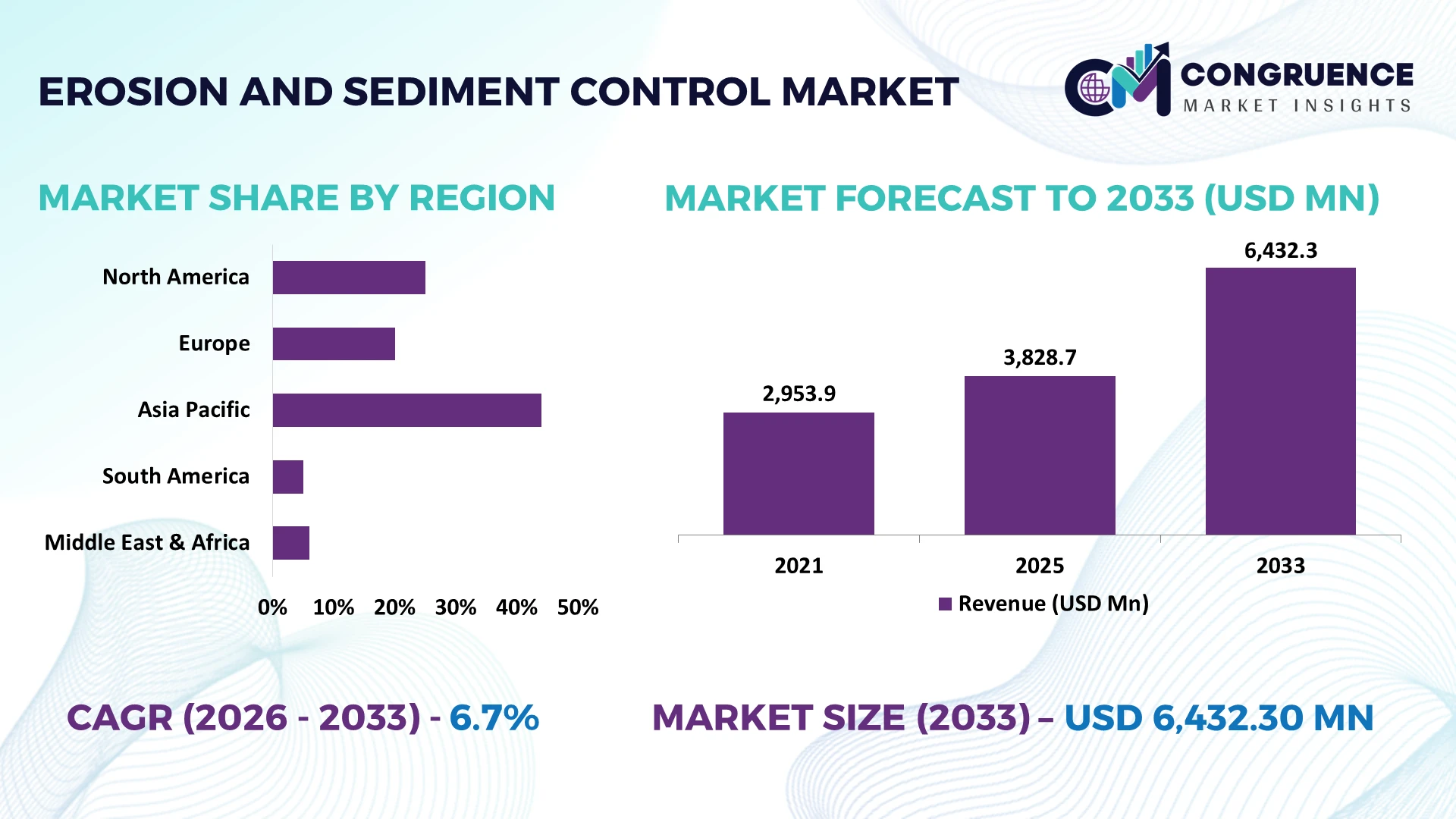
The Global Erosion and Sediment Control Market was valued at USD 3828.73 Million in 2025 and is anticipated to reach a value of USD 6432.3 Million by 2033 expanding at a CAGR of 6.7% between 2026 and 2033. Growth is driven by mandatory construction stormwater controls, highway embankment stabilization, expanding renewable energy infrastructure, and adoption of biodegradable geotextiles.
The United States represents a major erosion and sediment control market, supported by extensive highway construction, land development, and stormwater compliance requirements. Construction activities disturbing 1 acre or more generally require stormwater permit coverage under federal regulations. The Infrastructure Investment and Jobs Act authorized approximately USD 1.2 trillion for infrastructure investment, strengthening demand for slope protection and sediment management. Compared with India, where highway expansion supports geosynthetic adoption, US projects emphasize regulated stormwater management, engineered sediment barriers, and documented erosion prevention performance.
Manufacturers prioritizing certified erosion control products, infrastructure procurement partnerships, and environmentally compatible stabilization materials are positioned to strengthen long-term competitive advantage.
Market Size & Growth: Valued at USD 3828.73 Million in 2025, projected to USD 6432.3 Million by 2033 at 6.7% CAGR, driven by infrastructure investment and stormwater regulation enforcement.
Top Growth Drivers: Highway and road construction expansion, regulatory compliance mandates for land-disturbing activities, and energy and mining sector erosion control requirements.
Short-Term Forecast: By 2027, smart sensor integration into silt fences and geotextiles enables real-time monitoring of moisture and flow parameters, reducing site inspection labor by 20–30% .
Emerging Technologies: IoT-enabled erosion monitoring systems, AI-based sediment management solutions, and biodegradable erosion control materials gaining traction .
Regional Leaders: North America at 45% of regional value with US regulatory-driven demand, Asia-Pacific expanding through China infrastructure programs, and Europe maintaining compliance-driven stability.
Consumer/End-User Trends: Highway and road construction commands dominant application share; energy and mining represents fastest-growing end-user segment.
Pilot/Case Example: Jute geotextile mulching reduced runoff coefficients by 22.75% and sediment yield by 50.01% versus bare control in simulated rainfall studies on granite-derived red soils .
Competitive Landscape: Tensar International, Contech Engineered Solutions, ACF Environmental, and Profile Products lead; market remains fragmented with regional specialists competing on application expertise .
Regulatory & ESG Impact: EPA Construction General Permit and state VESMP programs mandate erosion control plans; Clean Water Act enforcement drives compliance-driven procurement .
Investment & Funding: Infrastructure modernization programs and green building standards including LEED drive adoption of sustainable erosion control materials .
Innovation & Future Outlook: Smart monitoring systems, predictive analytics, and biodegradable materials reshape product portfolios toward compliance efficiency and environmental performance .
The erosion and sediment control market serves highway construction, commercial development, mining operations, renewable energy installations, and watershed restoration projects requiring soil stabilization and runoff management. Recent product innovations include biodegradable coir blankets, reinforced turf protection mats, high-strength geocells, and modular sediment filtration systems. Construction stormwater regulations in the United States generally apply to projects disturbing at least 1 acre, reinforcing demand for documented environmental compliance. An emerging industry trend involves combining nature-based stabilization with engineered geosynthetics to improve slope resilience and reduce long-term maintenance requirements. These developments establish the strategic importance of material performance, regulatory alignment, and infrastructure-focused procurement.
Erosion and sediment control is becoming strategically important as infrastructure developers prioritize soil conservation, construction compliance, and long-term asset protection. Regulatory enforcement is shifting procurement toward engineered stabilization systems with documented hydraulic performance. In the United States, construction stormwater permitting generally applies to disturbances covering at least 1 acre, making sediment containment essential for qualifying developments. Transportation authorities increasingly incorporate permanent erosion protection into highway embankments, drainage corridors, and bridge approaches, creating opportunities for specialized geosynthetic manufacturers.
Technology modernization is strengthening installation productivity and lifecycle performance. Mechanically installed erosion control blankets can reduce installation labor requirements by approximately 20–30% compared with labor-intensive conventional stabilization methods under suitable site conditions. North America emphasizes regulatory compliance and engineered sediment barriers, while Europe advances biodegradable materials and vegetation-based reinforcement. India prioritizes slope stabilization across expanding transportation corridors. These differences influence product specifications, manufacturing localization, and contractor procurement strategies.
Between 2026 and 2028, demand will increasingly favor reinforced turf mats, modular sediment filtration, and digitally monitored runoff management. Highway contractors are combining geocells with vegetation to stabilize steep embankments and reduce surface soil displacement. Manufacturers are expanding technical partnerships with civil engineering firms and infrastructure developers to improve installation consistency. Competitive advantage will depend on verified field performance, material durability, and the ability to deliver integrated erosion protection across complex construction environments.
Expanding transportation infrastructure and construction stormwater regulations are strengthening demand for engineered erosion protection. In the United States, federal construction stormwater requirements generally cover land disturbances of at least 1 acre, creating mandatory sediment management obligations. The Infrastructure Investment and Jobs Act allocated approximately USD 110 billion in additional funding for roads, bridges, and major transportation projects. Federal Highway Administration data indicate that approximately 39% of US public roads are unpaved, highlighting extensive opportunities for drainage protection and roadside stabilization. Contractors increasingly specify sediment barriers, erosion control blankets, and reinforced turf systems during initial project engineering. Manufacturers are expanding distribution networks and technical support capabilities to secure infrastructure contracts. Early specification creates recurring advantages through standardized materials and approved installation practices.
Erosion control manufacturers face structural cost pressures from polypropylene feedstock exposure, transportation expenses, and inconsistent availability of specialized geotextile materials. Polypropylene-based products depend on petroleum-linked supply chains, creating purchasing uncertainty for contractors operating under fixed-price infrastructure agreements. The United States imports substantial quantities of industrial textile materials, while domestic manufacturing capacity varies across specialized geosynthetic categories. Construction projects frequently require product certification, hydraulic testing, and approved supplier documentation before installation. These requirements increase qualification expenses and limit substitution flexibility. Manufacturers are responding through regional warehousing, long-term polymer supply agreements, and alternative natural-fiber product development. Procurement competitiveness increasingly depends on predictable material availability and documented performance rather than unit pricing alone.
Biodegradable erosion control materials are creating opportunities within ecological restoration, riverbank stabilization, and environmentally sensitive infrastructure development. India's extensive coconut processing industry supports the availability of coir fibers for erosion blankets, geotextile meshes, and vegetation reinforcement. Natural-fiber products offer temporary soil protection while supporting vegetation establishment, reducing the requirement for permanent synthetic materials in suitable applications. The European Union's Nature Restoration Regulation establishes restoration measures covering at least 20% of EU land and sea areas by 2030, strengthening policy attention toward ecosystem rehabilitation. Manufacturers are developing blended fiber composites, reinforced biodegradable mats, and project-specific installation systems. Partnerships with landscape engineering contractors and watershed authorities provide opportunities to integrate erosion control products into restoration procurement frameworks.
Increasing rainfall variability creates significant execution challenges for erosion control systems installed across exposed slopes, drainage channels, and disturbed construction sites. Intense precipitation can exceed sediment basin design capacity, undermine poorly anchored blankets, and displace temporary barriers before vegetation becomes established. In the United States, construction operators must maintain stormwater controls throughout active land disturbance, requiring inspection, corrective maintenance, and site-specific runoff management. India's monsoon conditions create additional challenges for embankment stabilization and roadside drainage infrastructure. Manufacturers must improve hydraulic performance testing, anchoring systems, and installation guidance to maintain protection under variable flow conditions. Contractors are investing in site monitoring, reinforced channel protection, and preventive maintenance programs. Long-term competitiveness depends on reliable field performance across changing rainfall intensity and soil conditions.
• Advanced Turf Reinforcement Gains Preference: Infrastructure contractors increasingly specify high-performance turf reinforcement mats for drainage channels and exposed embankments. Engineered products with tested permissible shear resistance exceeding 10 pounds per square foot provide greater hydraulic protection than conventional vegetation alone. Manufacturers are expanding reinforced geosynthetic portfolios and collaborating with engineering contractors to improve channel durability, reduce maintenance interventions, and optimize installation requirements.
• Digital Inspections Transform Stormwater Compliance: Construction operators are adopting drone mapping, geotagged inspections, and digital corrective-action tracking. US construction stormwater inspection options commonly include checks every 7 calendar days or every 14 days with rainfall-triggered inspections. Environmental consultants are integrating mobile reporting with site management platforms, improving documentation consistency and enabling faster identification of damaged sediment barriers across distributed projects.
• Engineered Geotextiles Improve Filtration Performance: Contractors are shifting procurement toward filtration fabrics specified by hydraulic conductivity, apparent opening size, and sediment retention. Nonwoven geotextiles are increasingly selected for drainage filtration, while woven materials support applications requiring greater tensile reinforcement. Manufacturers are expanding laboratory testing and customized fabric production, helping infrastructure developers improve drainage reliability and reduce premature replacement during prolonged construction schedules.
• Modular Sediment Systems Enable Flexible Deployment: Construction projects increasingly use reusable filtration units and prefabricated sediment barriers during phased earthworks. US stormwater permit coverage generally begins at 1 acre of qualifying land disturbance, encouraging standardized containment planning. Equipment suppliers are developing replaceable filter components and modular installation systems, allowing contractors to reposition protection measures efficiently while maintaining sediment containment throughout changing construction activities.
Erosion Control Blankets represent a leading product category, with a reported 2025 share of approximately 32.4% in a broader erosion and sediment control solutions classification. Their application across exposed slopes, highway embankments, and construction sites supports consistent procurement. Geotextiles account for approximately 28.6% under the same classification, benefiting from filtration, separation, and soil reinforcement requirements. Silt Fences remain important for temporary perimeter containment, while Sediment Traps and Sediment Basins provide runoff detention and suspended sediment capture. Check Dams reduce flow velocity in drainage channels, particularly during active earthworks.
Geotextiles are positioned for faster adoption as infrastructure contractors increasingly specify multifunctional geosynthetic materials instead of single-purpose surface protection. Erosion Control Mats support permanent vegetation reinforcement, while Slope Stabilization Systems address complex terrain requiring engineered soil retention. Certain reinforced products provide hydraulic shear resistance exceeding 10 pounds per square foot under specified testing conditions. Manufacturers are expanding composite material portfolios, improving filtration performance, and strengthening partnerships with civil engineering contractors. Investment priorities increasingly favor products combining installation efficiency, hydraulic reliability, and long-term soil stabilization.
Construction Site Protection represents the largest application category, with a reported 2025 share of approximately 42% in a broader erosion and sediment control market classification. Excavation, grading, and land preparation create immediate requirements for sediment containment and exposed soil protection. Road and Highway Projects represent another important application, supported by transportation infrastructure modernization and embankment reinforcement requirements. Slope Stabilization addresses terrain instability, while Stormwater Management incorporates sediment detention, filtration, and controlled discharge infrastructure. Contractors increasingly coordinate these applications during initial project planning to reduce installation conflicts and environmental compliance expenditure.
Coastal Protection represents an advancing application as shoreline infrastructure faces erosion, flooding, and storm exposure. Riverbank Protection requires hydraulic reinforcement and vegetation-compatible stabilization, while Mining Site Rehabilitation focuses on restoring disturbed land and controlling sediment migration. Approximately 40% of the US population resides in coastal shoreline counties, illustrating the scale of infrastructure exposure. Manufacturers are developing reinforced geotextile structures, engineered erosion mats, and application-specific stabilization systems. Competitive positioning increasingly depends on verified hydraulic performance, installation efficiency, and reliable protection under changing environmental conditions.
Construction Companies represent a leading end-user category because their activities directly generate demand for temporary sediment containment, slope protection, and runoff management. Their procurement decisions prioritize installation productivity, regulatory compliance, and consistent material availability. Government Agencies and Transportation Authorities constitute important institutional buyers, particularly for infrastructure modernization and watershed protection. Real Estate Developers require erosion barriers during land preparation, while Agriculture and Forestry Operators prioritize soil conservation and vegetation establishment. Mining Companies deploy engineered stabilization systems during extraction, rehabilitation, and land restoration.
Environmental Consulting Firms are gaining influence over product specifications as developers strengthen environmental monitoring and site-specific stormwater planning. Their technical recommendations increasingly determine filtration performance requirements, installation standards, and maintenance practices. US construction stormwater requirements generally apply to qualifying disturbances covering 1 acre or more, creating recurring demand for qualified oversight. Manufacturers are strengthening technical advisory services, contractor training, and engineering partnerships to improve product specification acceptance. Competitive advantage increasingly depends on documented hydraulic performance, reliable distribution, and compatibility with project-specific environmental requirements.
North America accounted for the largest market share at an estimated 36% in 2025 however, Asia-Pacific is expected to register the fastest growth, expanding at a CAGR of an estimated 8.5% between 2026 and 2033.
Infrastructure Rehabilitation and Regulatory-Driven Sediment Management
North America holds a leading position in the erosion and sediment control market, supported by extensive highway networks, construction stormwater regulations, and established geosynthetic manufacturing capabilities. The United States dominates regional demand, while Canada contributes through mining rehabilitation, transportation infrastructure, and watershed restoration. Federal construction stormwater requirements generally apply to projects disturbing at least 1 acre, strengthening demand for sediment barriers, erosion control blankets, and engineered drainage systems. The US Infrastructure Investment and Jobs Act provides approximately USD 110 billion in additional funding for roads, bridges, and major transportation projects, supporting associated slope protection requirements. Manufacturers including Solmax, Tensar, and Propex supply geosynthetic reinforcement and erosion protection solutions. Regional procurement increasingly emphasizes hydraulically tested products, standardized installation procedures, and long-term embankment durability, creating competitive advantages for technically qualified suppliers.
United States Market Outlook: The United States benefits from extensive transportation infrastructure, established environmental regulations, and advanced geosynthetic engineering capabilities. The Federal Highway Administration maintains technical guidance for roadside drainage and slope stabilization, influencing product specifications across public infrastructure projects. The country's approximately 4.2 million miles of public roads create substantial maintenance and rehabilitation requirements, supporting continued demand for sediment containment and engineered soil protection.
Nature-Based Engineering and Advanced Geosynthetic Integration
Europe represents an established erosion and sediment control market, supported by environmental restoration policies, transportation modernization, and advanced geosynthetic manufacturing. Germany, France, the Netherlands, and the United Kingdom maintain significant capabilities in engineered soil reinforcement, hydraulic protection, and ecological stabilization. The European Union's Nature Restoration Regulation establishes restoration measures covering at least 20% of EU land and sea areas by 2030, strengthening policy attention toward degraded ecosystems. Infrastructure contractors increasingly integrate biodegradable erosion blankets, reinforced vegetation systems, and engineered geotextiles into riverbank restoration and transportation projects. Manufacturers including HUESKER and Maccaferri are developing specialized reinforcement solutions and collaborating with engineering contractors. Procurement priorities increasingly emphasize material durability, environmental compatibility, and verified hydraulic performance, encouraging investment in products that combine structural protection with ecological rehabilitation.
Germany Market Outlook: Germany benefits from advanced technical textile manufacturing, established civil engineering capabilities, and extensive transportation infrastructure. HUESKER's domestic engineering and manufacturing expertise supports geosynthetic applications across embankments, waterways, and infrastructure rehabilitation. Germany's approximately 13,000-kilometer Autobahn network requires ongoing drainage maintenance and slope protection, creating opportunities for reinforced erosion mats, filtration geotextiles, and engineered stabilization systems.
Transportation Expansion and Geosynthetic Manufacturing Scale
Asia-Pacific is positioned for accelerated erosion and sediment control adoption, supported by infrastructure construction, industrial land development, and expanding geosynthetic manufacturing capacity. China maintains substantial production capabilities for synthetic technical textiles, while India generates demand through highway construction, railway expansion, and slope stabilization projects. Japan contributes advanced erosion engineering and landslide prevention technologies, particularly across mountainous terrain. India's national highway network exceeds 146,000 kilometers, creating extensive requirements for embankment reinforcement, drainage protection, and sediment management. China continues integrating geosynthetics into transportation infrastructure and water management projects, supported by domestic polymer processing capabilities. Manufacturers are strengthening regional distribution networks and developing cost-efficient stabilization products for large infrastructure contracts. Competitive differentiation increasingly depends on locally available materials, engineering customization, and installation performance under monsoon rainfall conditions.
China Market Outlook: China benefits from extensive geotextile manufacturing clusters, advanced polymer processing infrastructure, and large-scale transportation development. Its expressway network exceeds 180,000 kilometers, generating substantial opportunities for embankment protection and drainage stabilization. Domestic manufacturers supply woven geotextiles, geogrids, and reinforced erosion protection systems, supporting competitive procurement for highway construction, river engineering, and industrial land development.
Mining Rehabilitation and Transportation Corridor Stabilization
South America's erosion and sediment control market is shaped by mining operations, transportation infrastructure development, and watershed protection requirements. Brazil represents a major demand center, supported by extensive highway networks, agricultural land development, and hydropower infrastructure. Chile and Peru contribute through mining rehabilitation and engineered slope protection, particularly in mountainous mineral extraction regions. Brazil's federal highway network exceeds 75,000 kilometers, creating considerable requirements for roadside drainage, embankment stabilization, and sediment containment. Mining operators increasingly specify geotextiles, erosion control mats, and reinforced drainage systems to manage disturbed land and runoff. However, transportation costs, imported specialty materials, and challenging terrain influence project execution. Suppliers are responding through local distribution partnerships, regional material sourcing, and technical collaboration with civil engineering contractors.
Brazil Market Outlook: Brazil benefits from extensive agricultural infrastructure, mining operations, and transportation development. The country's road network extends approximately 1.7 million kilometers, creating substantial soil stabilization and drainage management requirements. Brazilian construction and engineering companies increasingly integrate geosynthetic reinforcement into highway embankments and industrial developments, while environmental rehabilitation projects support demand for erosion blankets and vegetation-compatible protection systems.
Desert Infrastructure Protection and Water Management Investment
The Middle East & Africa erosion and sediment control market is influenced by transportation development, industrial construction, mining operations, and water infrastructure modernization. Saudi Arabia and the United Arab Emirates represent important deployment centers for engineered slope protection, drainage stabilization, and geosynthetic reinforcement. Saudi Arabia's Vision 2030 infrastructure programs are expanding construction activity across transportation corridors and large-scale development projects. In Africa, South Africa maintains established mining and civil engineering capabilities, while Morocco and Kenya contribute through transportation modernization and watershed protection. Arid environments require stabilization systems capable of managing loose soils and concentrated runoff during episodic rainfall. Manufacturers are developing UV-resistant geosynthetics, reinforced drainage materials, and project-specific installation systems. Regional partnerships with engineering contractors support technical adaptation and improve equipment availability across geographically dispersed infrastructure projects.
Saudi Arabia Market Outlook: Saudi Arabia benefits from extensive infrastructure investment, industrial development, and major construction programs associated with Vision 2030. The NEOM development covers a planned area of approximately 26,500 square kilometers, creating complex requirements for earthworks stabilization, drainage management, and environmental protection. Infrastructure contractors increasingly prioritize geosynthetic reinforcement, erosion-resistant surface materials, and engineered sediment control systems suited to arid terrain and episodic rainfall.
Tensar International, Contech Engineered Solutions, ACF Environmental, Profile Products, and GeoSolutions anchor the erosion and sediment control market, with the top five players commanding approximately 25–30% of global revenue through product breadth and distribution reach. Competition bifurcates between national suppliers competing on specification approval and contractor relationships, and regional manufacturers competing on price and local availability for commodity products including silt fence and straw wattles. The basis of competition is shifting from commodity pricing toward regulatory compliance documentation and technical support: suppliers providing stamped engineering calculations and site-specific erosion control plans win specification on highway and infrastructure projects. Players compete through product line expansion into biodegradable materials, distributor network development, and partnerships with engineering firms for early-stage specification influence. The competitive shift is toward smart monitoring integration—IoT-enabled silt fence sensors and real-time sediment tracking create differentiation opportunities. Entry barriers center on regulatory approval pathways and contractor specification relationships.
Tensar International
Contech Engineered Solutions
ACF Environmental
Profile Products
GeoSolutions
Silt-Saver
Nilex
Hanes Geo Components
Ferguson Waterworks
US Fabrics
Layfield Group
Western Excelsior
North American Green
Maccaferri
Current erosion control technologies combine geotextile filtration, erosion control blankets, geocells, and reinforced turf protection to stabilize disturbed soils. High-performance turf reinforcement mats can withstand permissible shear stresses exceeding 10 pounds per square foot under specified hydraulic conditions. Compared with conventional unreinforced vegetation, engineered reinforcement provides greater resistance to concentrated runoff and surface displacement. Construction contractors increasingly integrate these materials into highway embankments, drainage channels, and mining rehabilitation projects, improving installation consistency and reducing recurring maintenance requirements.
Emerging technologies include biodegradable fiber composites, sensor-enabled sediment monitoring, and digitally optimized slope stabilization. Drone-based terrain mapping supports centimeter-level surveying accuracy under suitable operating conditions, improving drainage assessment and erosion-risk identification. Geosynthetic manufacturers are developing hybrid natural-synthetic reinforcement systems that combine temporary soil protection with vegetation establishment. Environmental contractors benefit from integrated monitoring platforms that identify damaged barriers, prioritize inspections, and strengthen regulatory documentation across geographically dispersed infrastructure projects.
Between 2026 and 2028, advanced hydraulic modeling, geospatial analytics, and automated inspection systems will increasingly influence erosion protection design. Digital terrain models will support targeted placement of sediment controls, reducing unnecessary material deployment. Manufacturers investing in tested filtration performance, modular installation systems, and engineering partnerships will strengthen competitive positioning. Technology adoption will increasingly depend on demonstrated hydraulic reliability, installation productivity, and measurable lifecycle performance.
March 2024: Core & Main entered a definitive agreement to acquire ACF West Inc., a geosynthetics distributor with six locations across Oregon, Washington, Idaho, and Utah serving municipality, contractor, and DOT customers. This consolidation expands Core & Main’s erosion control and soil stabilization distribution footprint across the western United States. Source: coreandmain.com
October 2024: Maccaferri launched ECoMac Design software for erosion control, enabling engineers to estimate soil loss and select appropriate erosion protection solutions through a simplified design interface. The tool streamlines specification workflows and positions Maccaferri as a technical authority in erosion control design. Source: maccaferri.com
February 2025: Profile Products promoted Adam Dibble to Vice President of Global Environmental Solutions, tasking him with leading global sales, distribution, and marketing for erosion control and vegetation solutions including hydraulically applied technology and biotic soil media. This leadership restructuring signals Profile’s intent to expand international market presence. Source: stormwater.com
April 2025: Contech Engineered Solutions received nine Project of the Year awards from the National Corrugated Steel Pipe Association, including recognition in the “Going Green” category for the LBJ Hospital Expansion stormwater detention project in Houston. These awards reinforce Contech’s erosion control and drainage solution positioning across DOT and infrastructure applications. Source: conteches.com
The Erosion and Sediment Control Market Report evaluates industry developments from 2026 to 2033 across eight product types, including Silt Fences, Erosion Control Blankets, Geotextiles, Sediment Traps, Sediment Basins, Erosion Control Mats, Check Dams, and Slope Stabilization Systems. Application coverage includes Construction Site Protection, Road and Highway Projects, Slope Stabilization, Riverbank Protection, Stormwater Management, Mining Site Rehabilitation, and Coastal Protection. End-user analysis examines Construction Companies, Government Agencies, Transportation Authorities, Mining Companies, Real Estate Developers, Agriculture and Forestry Operators, and Environmental Consulting Firms.
Regional analysis covers five major geographic markets, evaluating infrastructure deployment, regulatory requirements, manufacturing capabilities, and procurement trends. Technology assessment addresses biodegradable materials, reinforced geosynthetics, hydraulic filtration, and digital monitoring. The report supports investment planning, geographic expansion, competitive positioning, and infrastructure-focused product development.
| Report Attribute/Metric | Report Details |
|---|---|
Market Revenue in 2025 | USD 3828.73 Million |
Market Revenue in 2033 | USD 6432.3 Million |
CAGR (2026 - 2033) | 6.7% |
Base Year | 2025 |
Forecast Period | 2026 - 2033 |
Historic Period | 2021 - 2025 |
Segments Covered | By Type
By Application
By End-User
|
Key Report Deliverable | Revenue Forecast, Growth Trends, Market Dynamics, Segmental Overview, Regional and Country-wise Analysis, Competition Landscape |
Region Covered | North America, Europe, Asia-Pacific, South America, Middle East, Africa |
Key Players Analyzed | Tensar International, Contech Engineered Solutions, ACF Environmental, Profile Products, GeoSolutions, Silt-Saver, Nilex, Hanes Geo Components, Ferguson Waterworks, US Fabrics, Layfield Group, Western Excelsior, North American Green, Maccaferri |
Customization & Pricing | Available on Request (10% Customization is Free) |




