
Reports
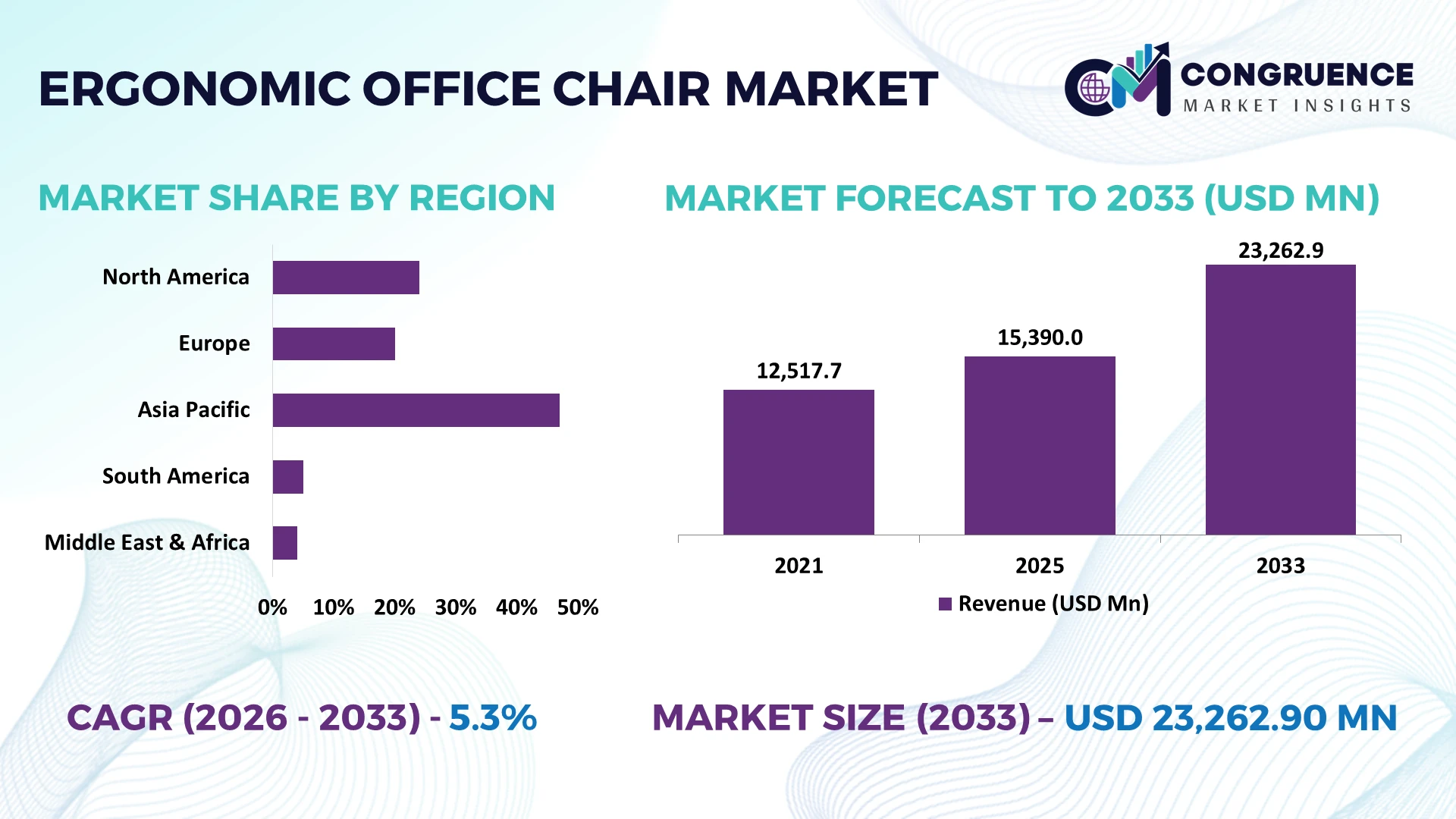
The Global Ergonomic Office Chair Market was valued at USD 15390 Million in 2025 and is anticipated to reach a value of USD 23262.9 Million by 2033 expanding at a CAGR of 5.3% between 2026 and 2033. Growth is driven by permanent hybrid-work structures, corporate workstation standardization, rising musculoskeletal-risk mitigation, and procurement shifts toward adjustable, recyclable, BIFMA-tested seating.
The United States represents approximately 38% of global ergonomic-chair demand, with more than 70% of organizations providing ergonomic seating and 52% of remote-capable employees operating hybrid schedules. MillerKnoll invested USD 107.6 million in fiscal-2025 capital expenditure, supporting manufacturing and retail capabilities. China remains the key production comparison, while U.S.–China tariff and sourcing pressures are accelerating Mexico and domestic supply-chain diversification.
Strategically, manufacturers combining ergonomic performance, local supply resilience, and circular-material engineering will secure the strongest enterprise procurement positions.
Market Size & Growth: USD 15.39 billion in 2025 reaches USD 23.26 billion by 2033 at 5.3% CAGR, supported by hybrid-workstation standardization and ergonomic redesign.
Top Growth Drivers: Hybrid employment reaches 52%, office-worker musculoskeletal disorders 80.8%, and corporate ergonomic-seating provision exceeds 70% in the United States.
Short-Term Forecast: By 2028, modular redesign is positioned to reduce chair component counts by approximately 15%, improving assembly, maintenance, and end-of-life processing efficiency.
Emerging Technologies: Weight-responsive lumbar systems, 3D-knitted upholstery, and sensor-enabled posture analytics are moving ergonomic seating toward automatic adjustment and measurable workplace-health performance.
Regional Leaders: North America represents about USD 5.42 billion, Asia-Pacific USD 4.40 billion, and Europe USD 4.22 billion in 2025, with hybrid, manufacturing, and compliance-led adoption respectively.
Consumer/End-User Trends: 52% of remote-capable U.S. employees work hybrid, sustaining dual-location demand for adjustable seating across corporate offices and home workstations.
Pilot/Case Example: Steelcase’s 2025 Think redesign increased recycled content 24% and reduced product carbon footprint 36%, demonstrating measurable circular-design gains without sacrificing ergonomic functionality.
Competitive Landscape: MillerKnoll leads the premium tier, while HNI/Steelcase, Haworth, Humanscale, and Okamura compete through ergonomic IP, dealer coverage, customization, and enterprise contracts.
Regulatory & ESG Impact: Advanced task chairs now exceed 50% recycled material in selected portfolios, while redesign programs have lowered embodied carbon approximately 35–43%.
Investment & Funding: HNI’s USD 2.2 billion Steelcase acquisition highlights consolidation toward broader dealer networks, procurement scale, digital transformation, and integrated workplace-furniture portfolios.
Innovation & Future Outlook: Chairs using 15% fewer parts and 6% lower weight signal the shift toward lighter, repairable, automatically responsive seating optimized for circular procurement.
The Ergonomic Office Chair Market is increasingly concentrated around hybrid offices, technology workplaces, healthcare administration, financial services, and home workstations. With 52% of remote-capable U.S. employees working hybrid, demand is shifting toward adjustable lumbar systems, synchronized tilt mechanisms, 3D-knit materials, and recyclable modular components. U.S.–China sourcing pressure is simultaneously encouraging localized production, creating a stronger strategic focus on ergonomics, supply resilience, and lifecycle efficiency.
Ergonomic office chairs are becoming strategically important as workplace furniture shifts from discretionary furnishing toward productivity, occupational-health, and hybrid-work infrastructure. Around 52% of remote-capable U.S. employees now work hybrid schedules, forcing employers to standardize adjustable seating across flexible workstations. Simultaneously, U.S.–China trade friction and tariff exposure are encouraging manufacturers to diversify component sourcing toward Mexico, Vietnam, and domestic production.
Technology is changing product economics. Modular chairs using simplified assemblies can contain approximately 15% fewer components and weigh 6% less than legacy designs, lowering assembly effort, replacement complexity, and logistics exposure. North America leads enterprise procurement and premium ergonomics, while China retains manufacturing scale; Japan and Germany differentiate through engineering, durability, and workplace standards. Sensor-enabled posture monitoring and weight-responsive adjustment are extending competition beyond mechanical adjustability.
A practical example is Steelcase’s redesigned Think chair, which incorporates 24% more recycled content while reducing its carbon footprint by 36%. Through 2026–2028, corporate buyers will increasingly specify repairability, recycled materials, and adaptive ergonomics alongside price. Manufacturers are therefore investing in modular platforms, circular design, localized sourcing, and workplace-technology partnerships. Competitive advantage will belong to suppliers combining measurable ergonomic performance with lower lifecycle complexity and resilient fulfillment.
Hybrid workplace normalization is converting ergonomic seating into standardized employee infrastructure rather than periodic office refurbishment. Approximately 52% of remote-capable U.S. employees operate hybrid schedules, while about 27% remain fully remote, creating simultaneous demand across headquarters, satellite offices, and home workstations. Musculoskeletal symptoms affect more than 80% of office workers in several occupational studies, strengthening employer attention to adjustable lumbar support, seat depth, armrests, and synchronized recline. U.S. corporations are consequently redesigning offices around shared desks and activity-based working, where one chair must accommodate multiple users daily. Manufacturers are responding with automatic tension adjustment, broader anthropometric ranges, enterprise purchasing programs, and dealer expansion. The operational insight is clear: shared workstations increase adjustment frequency, making intuitive self-adjusting mechanisms more valuable than simply adding additional manual controls.
Steel, aluminum, polymers, molded foam, mesh, and precision mechanisms create persistent cost exposure, particularly for manufacturers dependent on internationally sourced components. Steel represents approximately 15–25% of material content in many task-chair structures, while freight and packaging can contribute 8–12% of delivered furniture costs because assembled chairs have low shipping density. U.S. tariff measures affecting Chinese-origin furniture and components have further complicated procurement economics, while China remains a major global office-chair manufacturing base. Premium ergonomic mechanisms also increase bill-of-material complexity relative to basic task seating. Manufacturers are reducing exposure through knock-down designs, dual sourcing, localized final assembly, and longer supplier agreements. Strategically, component standardization matters more than aggressive SKU expansion because common mechanisms and frames provide stronger purchasing leverage and reduce spare-parts inventory.
Sensor-enabled ergonomics creates an opportunity to reposition office chairs from static furniture into measurable workplace-performance assets. Embedded pressure sensors, occupancy detection, and posture analytics can identify prolonged sitting and poor seating positions, while automated adjustment can reduce manual configuration steps by approximately 20–30%. Modular architecture can simultaneously cut component counts by around 15%, improving repair economics and extending useful product life. The United States provides an attractive enterprise deployment environment because hybrid workplaces increasingly use occupancy analytics and connected facility-management platforms. Manufacturers are developing sensor modules, app-connected adjustment, replaceable components, and furniture-as-a-service models while partnering with workplace-technology providers. A non-obvious opportunity lies in utilization data: enterprises can connect chair occupancy with space-planning systems, allowing ergonomic seating investments to support both employee wellbeing and real-estate optimization.
Achieving consistent ergonomic performance across diverse employee populations remains a substantial execution challenge. Human body dimensions can vary by more than 20% across workforce populations, while shared desks require chairs to accommodate repeated daily user changes without lengthy adjustment. Advanced models commonly provide 5–8 adjustable functions, but additional controls can reduce correct configuration when users receive limited ergonomic training. This becomes particularly important in multinational deployments spanning U.S., Japanese, Indian, and European workforces with different anthropometric profiles and workplace standards. Sensor-equipped chairs introduce another layer of complexity because connected components require maintenance, software support, and responsible handling of occupancy data. Manufacturers must invest in intuitive automatic adjustment, broader fit ranges, standardized replacement modules, dealer training, and enterprise implementation support. Long-term competitiveness depends on making sophisticated ergonomics effectively self-configuring rather than transferring adjustment complexity to employees.
Circular Seating Moves Into Procurement: Enterprise buyers are shifting from disposal-based replacement toward remanufacturable seating. Steelcase’s updated Think platform uses 24% more recycled content and cuts product carbon footprint 36%, while selected remade chairs can halve lifecycle emissions. Manufacturers are redesigning frames, arm caps, and mechanisms for rapid disassembly, helping customers reduce landfill exposure and improve furniture-asset utilization.
Specialized Seating Expands Beyond Offices: Ergonomic engineering is moving into laboratories, healthcare environments, and electrostatic-discharge workplaces. Herman Miller’s 2025 Aeron ESD uses more than 65% recycled materials and offers 2 chair sizes plus 2 cylinder heights. Suppliers are creating application-specific variants rather than universal task chairs, improving fit while opening higher-value institutional procurement channels.
Hybrid Floors Favor Shared Adjustability: U.S. hybrid work remains structurally stable, with 52% of remote-capable employees hybrid and only 22% fully on-site in 2026. Shared workstations therefore require faster seat-height, lumbar, tilt, and arm adjustments. Manufacturers are scaling weight-responsive mechanisms and simplified controls so multiple employees can configure the same chair without formal ergonomic setup.
Localization Reshapes Furniture Supply Chains: Import exposure and geopolitical tariff pressure are pushing chair producers toward regional assembly and component diversification. India’s office-chair imports draw heavily from at least 5 major supplying countries, while local manufacturing capacity is expanding. Companies are standardizing mechanisms, increasing knock-down shipping, and sourcing frames, mesh, and molded components closer to end markets to shorten replenishment cycles.
Mesh chairs hold the leading position with approximately 35% of ergonomic office chair demand, supported by breathability, lower heat retention, lightweight construction, and suitability for high-density workstations. Their standardized frames and suspension backs also simplify bulk procurement compared with premium leather configurations. Leather chairs retain relevance in executive and client-facing environments, where appearance and perceived durability outweigh thermal-performance disadvantages. Executive chairs remain a mature premium category, concentrated in management offices and boardroom-adjacent workspaces.
Task chairs are the fastest-growing type as employers replace assigned seating with shared and hybrid workstations. Their scalable adjustment architecture, narrower footprint, and standardized components strengthen fleet economics, particularly across technology, financial-services, and business-process offices. Task-oriented models increasingly incorporate synchronized tilt, adjustable lumbar support, 3D or 4D armrests, and weight-responsive mechanisms. Kneeling chairs remain a niche alternative for posture variation rather than full-shift deployment. Manufacturers are consequently prioritizing modular mesh-task platforms while using leather and executive variants to preserve premium margins.
Workstations account for approximately 44% of ergonomic office chair deployment because they concentrate the highest number of repetitive, long-duration seated positions across corporate floors, technology operations, administrative centers, and shared offices. Adjustable task seating is operationally critical here because one standardized platform can support different body dimensions and desk configurations. Meeting rooms represent around 14% of demand, where shorter occupancy periods favor simpler adjustment mechanisms, while executive offices remain focused on premium materials and higher-specification lumbar and recline systems.
Home offices are the fastest-growing application, supported by the persistence of hybrid work and employee-funded workstation upgrades. In 2026, 52% of remote-capable U.S. employees work hybrid and 26% work exclusively remotely, sustaining demand outside traditional corporate procurement. Call centers remain intensive users because prolonged seated shifts require durable mechanisms and rapid multi-user adjustment. Manufacturers are responding with compact task chairs, direct-to-consumer distribution, assembly-friendly packaging, and enterprise home-office programs that bridge corporate and residential purchasing.
Corporate offices represent approximately 48% of ergonomic office chair demand because large enterprises procure seating in standardized fleets across headquarters, shared workspaces, contact centers, and satellite offices. Their buying criteria increasingly combine anthropometric fit, durability, warranty support, repairability, and environmental documentation. Government offices remain specification-driven purchasers, while educational institutions prioritize cost, durability, and multi-user adjustability. Healthcare facilities require specialized cleanability, mobility, and, in selected technical environments, electrostatic-control performance.
Home-based workers are the fastest-growing end-user group as hybrid employment keeps ergonomic spending distributed beyond centralized offices. Roughly 78% of remote-capable U.S. employees now work either hybrid or fully remote, sustaining replacement demand for residential workstations. Manufacturers are responding with direct shipment, simplified assembly, mid-priced ergonomic lines, and employer reimbursement partnerships. Healthcare suppliers are simultaneously developing specialized seating, while institutional vendors are using longer warranties and standardized replacement components to win government and education contracts. Future competitive advantage increasingly depends on serving both bulk enterprise procurement and fragmented individual buying efficiently.
North America accounted for the largest market share at 35.2% in 2025 however, Asia-Pacific is expected to register the fastest growth, expanding at a CAGR of 6.4% between 2026 and 2033.
Hybrid Workplace Redesign Reshapes Procurement
North America accounts for approximately 35.2% of global ergonomic office chair demand, anchored by enterprise workplace modernization, hybrid seating strategies, and established contract-furniture distribution. U.S. corporations are replacing assigned desks with shared workpoints requiring intuitive lumbar, armrest, seat-depth, and tilt adjustment. With 52% of remote-capable U.S. employees operating hybrid schedules, procurement increasingly spans corporate facilities and distributed home offices. MillerKnoll, Steelcase, Haworth, and Humanscale reinforce the region’s premium manufacturing and ergonomic-engineering base. Circularity is becoming measurable: Steelcase’s redesigned Think chair increased recycled content by 24% and lowered its product carbon footprint by 36%. Buyers are consequently evaluating lifecycle durability, replaceable components, environmental declarations, and fleet standardization alongside purchase price, strengthening established suppliers with service and dealer infrastructure.
United States Market Outlook: The United States combines large enterprise procurement, workplace-design expertise, domestic manufacturing, and extensive dealer networks. Approximately 78% of remote-capable employees work either hybrid or fully remotely, sustaining dual-location seating requirements. Corporate buyers increasingly favor standardized chair platforms with long warranties, replaceable components, rapid adjustment, and environmental documentation, rewarding manufacturers capable of supporting nationwide installations and aftermarket servicing.
Circular Procurement Reshapes Product Engineering
Europe represents approximately 27.4% of global ergonomic office chair demand, supported by mature workplace-safety standards, corporate refurbishment, circular procurement, and strong German, British, Scandinavian, and Italian furniture ecosystems. Employers increasingly specify EN 1335-compatible task seating, repairable assemblies, recycled inputs, and environmental product documentation for office modernization projects. EU sustainability policy is accelerating the transition from linear furniture replacement toward durable, disassemblable products, encouraging manufacturers to redesign frames, upholstery, mechanisms, and packaging. Germany provides significant engineering and contract-furniture capacity, while Scandinavia maintains strong ergonomic and circular-design influence. Leading suppliers increasingly operate refurbishment, component-replacement, and furniture take-back programs rather than relying solely on new-unit sales. This lifecycle model reduces material exposure and strengthens long-term enterprise relationships, making serviceability and documented environmental performance increasingly important tender criteria.
Germany Market Outlook: Germany provides a strategic combination of advanced office-furniture manufacturing, engineering expertise, occupational-health awareness, and standardized procurement. Manufacturing groups increasingly integrate automated cutting, molded-component production, and modular assembly into chair plants. Germany’s workforce exceeds 46 million people, providing a substantial installed workplace base where ergonomic compliance, durability, repairability, and certified product performance directly influence institutional and enterprise purchasing.
Manufacturing Scale Meets Premiumization
Asia-Pacific represents approximately 28.6% of global ergonomic office chair demand and combines China’s manufacturing scale with rapidly expanding workplace infrastructure in India, Japan, South Korea, and Southeast Asia. China remains the principal production hub for mesh, mechanisms, molded components, bases, and finished seating, giving manufacturers significant cost and supplier-cluster advantages. India is increasingly important as technology, business-process, and flexible-workspace operators expand office footprints across Bengaluru, Hyderabad, Pune, Chennai, and Delhi-NCR. Japanese manufacturers differentiate through compact engineering, durability, and high-adjustability task chairs. U.S.–China tariff pressure is encouraging exporters to diversify final assembly and component sourcing toward Vietnam and other Asian manufacturing bases. Producers are simultaneously deploying automated cutting, injection molding, standardized mechanisms, and knock-down packaging to improve production throughput and container utilization while supporting increasingly sophisticated domestic demand.
China Market Outlook: China retains the strongest manufacturing position through integrated metalworking, plastics, mesh, foam, hardware, and chair-mechanism supply clusters concentrated around Zhejiang, Guangdong, and Jiangsu. Export-oriented factories increasingly use robotic welding and automated component processing. The strategic advantage is supplier proximity: standardized components, high-volume tooling, and dense subcontracting networks allow faster product iteration and lower procurement complexity than fragmented production locations.
Brazil Drives Workplace Modernization
South America accounts for approximately 4.8% of global ergonomic office chair demand, with Brazil providing the principal corporate, manufacturing, and commercial base. Demand is concentrated in São Paulo, Rio de Janeiro, Curitiba, and other service-sector centers where financial services, technology companies, contact centers, and flexible offices require adjustable task seating. Brazil’s NR-17 ergonomics framework creates an important workplace reference for seating, posture, and workstation design, strengthening specification-led institutional procurement. Local furniture manufacturers provide wood, metalworking, molded-plastic, upholstery, and final-assembly capabilities, reducing dependence on completely built imports. However, imported mechanisms, premium mesh, and specialist components expose suppliers to currency and logistics volatility. Manufacturers are therefore localizing frames and upholstery, standardizing imported mechanisms, and expanding dealer networks, balancing ergonomic performance with price-sensitive enterprise purchasing.
Brazil Market Outlook: Brazil offers the region’s strongest combination of office employment, furniture production, regulatory ergonomics, and domestic distribution. São Paulo alone hosts a dense concentration of corporate headquarters and service operations. NR-17 requirements reinforce professional workstation assessment, encouraging employers to specify adjustable seating rather than basic fixed chairs and giving compliant domestic manufacturers a defensible institutional-sales advantage.
Commercial Infrastructure Raises Specification Levels
Middle East & Africa represents approximately 4.0% of global ergonomic office chair demand, with the UAE, Saudi Arabia, and South Africa concentrating higher-specification commercial deployment. Dubai and Abu Dhabi are expanding Grade-A offices, financial centers, technology campuses, and flexible-workspace infrastructure, supporting premium task and executive seating. Saudi Arabia’s Vision 2030 transformation is increasing office fit-outs across government, professional services, technology, tourism, and new urban developments. Large projects increasingly use international workplace consultants and specification-based procurement, favoring established global manufacturers with project delivery capabilities. South Africa provides the strongest established office-furniture production and distribution platform in Sub-Saharan Africa. Import dependence remains significant for premium mechanisms and branded seating, encouraging distributors to hold regional inventory, develop local assembly partnerships, and standardize product ranges to shorten project lead times.
United Arab Emirates Market Outlook: The UAE provides the strongest premium deployment platform through Dubai’s multinational corporate base, free-zone infrastructure, coworking networks, and large commercial fit-out industry. Dubai International Financial Centre hosts more than 7,000 active registered companies, creating concentrated demand for workplace furniture. Suppliers increasingly maintain local showrooms, inventory, installation teams, and specification partnerships to secure complex enterprise projects.
MillerKnoll, Steelcase, Haworth, Humanscale, and HNI compete across premium enterprise seating, while Asian OEMs pressure established brands through lower-cost manufacturing and faster customization. The top five suppliers collectively control approximately 28% of global demand, leaving procurement fragmented across regional specialists. Premium brands defend pricing through ergonomic engineering, warranties, dealer networks, and sustainability credentials; modular platforms can reduce component counts 15%, while redesigned chairs achieve carbon reductions above 30%. Cost-focused manufacturers compete with prices approximately 20–35% below branded equivalents and increasingly improve mesh, synchronized-tilt, and lumbar technologies. Players are expanding dealer coverage, acquiring complementary portfolios, automating factories, and regionalizing component sourcing. Consolidation is intensifying as enterprise customers prefer integrated workplace portfolios and dependable servicing. Certification, tooling investment, ergonomic intellectual property, distribution access, and long warranty obligations remain significant entry barriers. Winning requires scalable customization, demonstrable ergonomic performance, resilient component sourcing, circular product architecture, and lifecycle service capabilities that outperform price-only competitors.
MillerKnoll
Steelcase
Haworth
HNI Corporation
Humanscale
Okamura Corporation
KOKUYO
Inter IKEA Systems
Kinnarps
Sedus Stoll
Wilkhahn
Vitra
Nowy Styl
Flokk
Current ergonomic-chair technology centers on weight-activated recline, synchronized tilt, flexible lumbar systems, 4D armrests, and engineered mesh. Haworth’s Breck was developed from 5.5 billion ergonomic data points. These advanced deployed automated tension mechanisms reduce manual adjustment steps by roughly 20–30% versus multi-lever legacy chairs, improving shared-workstation usability. Modular construction cuts component counts around 15%, lowering assembly complexity and accelerating maintenance.
Emerging platforms combine pressure sensing, occupancy detection, posture analytics, and anthropometric modeling with recyclable polymers and 3D-knit suspension. Sensor-assisted seating can reduce configuration time by approximately 20%, while redesigned material architectures have demonstrated carbon-footprint reductions around 36%. Adoption is strongest in enterprise, technology, healthcare, and hybrid offices, where connected systems integrate seating utilization with space-planning data. Premium manufacturers benefit because ergonomic IP, software integration, and environmental documentation strengthen specification-based procurement.
Disruptive development is moving toward self-configuring chairs, bio-based polymers, digital product passports, and AI-assisted personalization. Compared with conventional manually adjusted seating, weight-responsive systems deliver support with fewer user inputs, improving deployment consistency across shared desks. Through 2026–2028, sensor modules and circular component platforms should expand across premium fleets, reducing maintenance effort by 10–15%. Manufacturers acting now secure data, patents, supplier capability, and enterprise integration advantages before adaptive ergonomics becomes standard.
June 2026 Herman Miller advanced Aeron with two new colors and material innovation; the chair contains over 50% recycled material. The update strengthens sustainable premium seating while extending Aeron’s specification flexibility across evolving workplaces. Source: MillerKnoll.com
August 2025 HNI agreed to acquire Steelcase for approximately $2.2 billion, with HNI shareholders owning about 64% of the combined company. The consolidation combines complementary dealer networks and workplace portfolios, strengthening procurement scale and enterprise reach. Source: Reuters.com
January 2025 Humanscale expanded its World chair family with World Upholstered and World LM Upholstered, offering 13 Corde 4 and 14 Kvadrat Autumn colors. The launch broadens ergonomic task-chair customization for design-sensitive commercial workplaces. Source: Humanscale.com
August 2024 Haworth launched Breck, engineered using 5.5 billion ergonomic data points and featuring a weight-activated mechanism with 3-position backstop. Geostretch technology simplifies ergonomic adjustment, supporting scalable seating deployment across personal and commercial offices. Source: Haworth.com
The Ergonomic Office Chair Market report evaluates mesh chairs, leather chairs, executive chairs, task chairs, and kneeling chairs across workstations, home offices, meeting rooms, executive offices, and call centers. End-user coverage includes corporate offices, government offices, educational institutions, healthcare facilities, and home-based workers. North America represents approximately 35% of demand, while Asia-Pacific combines manufacturing scale with accelerating workplace modernization.
Technology coverage includes weight-responsive mechanisms, synchronized tilt, adaptive lumbar systems, engineered mesh, posture sensing, recyclable materials, and AI-enabled personalization. The analysis also examines North America, Europe, Asia-Pacific, South America, and Middle East & Africa alongside circular procurement and specialized ESD seating. With 52% of remote-capable U.S. employees operating hybrid schedules, the report evaluates distributed seating requirements through 2026–2033, supporting investment planning, manufacturing localization, portfolio development, geographic expansion, partnership selection, and competitive positioning.
| Report Attribute/Metric | Report Details |
|---|---|
Market Revenue in 2025 | USD 15390 Million |
Market Revenue in 2033 | USD 23262.9 Million |
CAGR (2026 - 2033) | 5.3% |
Base Year | 2025 |
Forecast Period | 2026 - 2033 |
Historic Period | 2021 - 2025 |
Segments Covered | By Type
By Application
By End-User
|
Key Report Deliverable | Revenue Forecast, Growth Trends, Market Dynamics, Segmental Overview, Regional and Country-wise Analysis, Competition Landscape |
Region Covered | North America, Europe, Asia-Pacific, South America, Middle East, Africa |
Key Players Analyzed | MillerKnoll, Steelcase, Haworth, HNI Corporation, Humanscale, Okamura Corporation, KOKUYO, Inter IKEA Systems, Kinnarps, Sedus Stoll, Wilkhahn, Vitra, Nowy Styl, Flokk |
Customization & Pricing | Available on Request (10% Customization is Free) |




