
Reports
The Global Epoxy Flooring Market was valued at USD 9,408.1 Million in 2025 and is anticipated to reach a value of USD 16,408.2 Million by 2033 expanding at a CAGR of 7.2% between 2026 and 2033. Growth is fueled by rising industrial facility construction, warehouse automation, food-grade manufacturing expansion, and increasing adoption of durable, chemical-resistant flooring systems across logistics, healthcare, and electronics production.
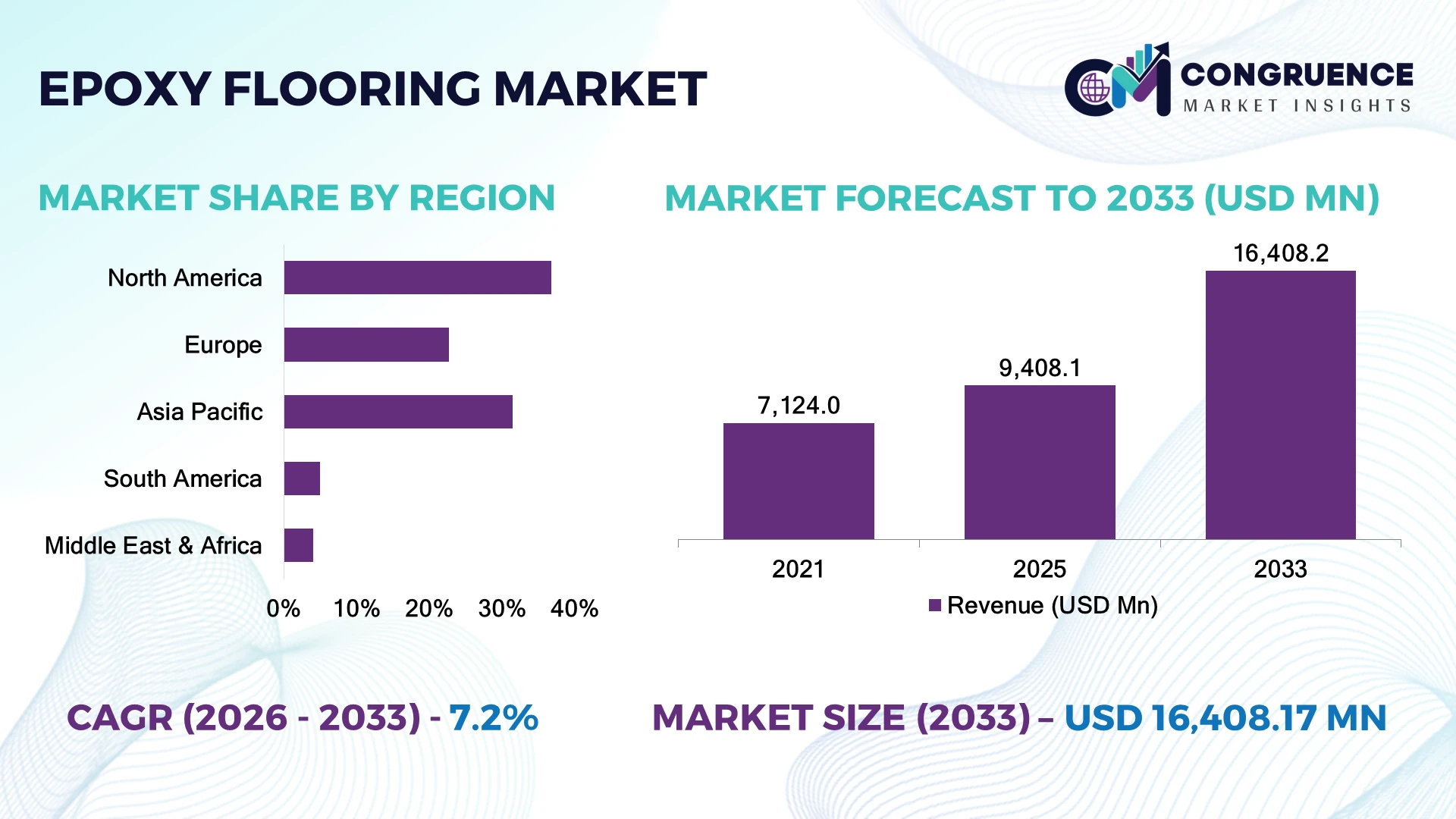
China dominates the global epoxy flooring market with an estimated 34% production share, supported by large-scale manufacturing, industrial parks, and logistics infrastructure investments. Compared with Germany, China installs nearly 2.3 times more industrial floor coating area annually, while over 62% of newly commissioned advanced manufacturing facilities specify high-performance resin flooring. Supply-chain diversification following global manufacturing realignment continues to strengthen domestic production capacity and export competitiveness across industrial coating materials.
Manufacturers prioritizing low-VOC formulations, rapid-curing technologies, and automated installation capabilities are strengthening competitive positioning across high-growth industrial flooring applications.
Market Size & Growth: USD 9,408.1 million in 2025 to USD 16,408.2 million by 2033 at 7.2% CAGR, driven by industrial infrastructure modernization and warehouse expansion.
Top Growth Drivers: Manufacturing expansion (31%), logistics infrastructure (28%), food processing investments (24%).
Short-Term Forecast: By 2028, installation time declines 18% while maintenance costs reduce 22% through advanced formulations.
Emerging Technologies: Low-VOC resins, self-leveling systems, antimicrobial coatings, and smart curing technologies accelerate adoption.
Regional Leaders: Asia-Pacific, North America, and Europe account for the majority of demand, led by industrial construction and automation.
Consumer/End-User Trends: Nearly 61% of industrial buyers prioritize chemical-resistant, low-maintenance flooring solutions.
Pilot/Case Example: A 2026 automated warehouse project improved floor durability by 27% using advanced epoxy systems.
Competitive Landscape: Top five suppliers collectively control approximately 42% market share through product innovation and distribution strength.
Regulatory & ESG Impact: Low-emission coating adoption improves indoor environmental compliance by approximately 26%.
Investment & Funding: More than USD 2.8 billion supports industrial construction and advanced flooring capacity expansion.
Innovation & Future Outlook: Fast-curing bio-based epoxy systems and digital installation monitoring reshape project execution.
Epoxy flooring continues gaining traction across manufacturing plants, semiconductor facilities, pharmaceutical production, commercial warehouses, and healthcare infrastructure where durability and contamination control remain operational priorities. Advanced hybrid resin formulations improve abrasion resistance by approximately 20% while supporting lower-emission installation practices. Increasing automation in industrial construction and stricter environmental compliance requirements continue accelerating product innovation, setting the stage for broader strategic market development.
Epoxy flooring has become strategically important as industrial operators prioritize long-life infrastructure, operational safety, and lower lifecycle maintenance costs. Modern manufacturing facilities, distribution centers, pharmaceutical plants, and semiconductor fabrication units increasingly specify advanced resin flooring to withstand heavy mechanical loads, chemical exposure, and continuous equipment movement. Expansion of automated warehouses and industrial modernization programs is reshaping purchasing priorities toward high-performance flooring systems.
Modern self-leveling epoxy formulations reduce installation time by approximately 21% and improve abrasion resistance by nearly 30% compared with conventional cement-based industrial flooring. China leads large-scale manufacturing deployment through extensive industrial construction, while the United States emphasizes premium flooring systems for logistics, aerospace, and healthcare applications. During the next two to three years, rapid-curing and low-VOC technologies are expected to account for a growing share of new industrial flooring specifications as project timelines become increasingly compressed.
Manufacturers are expanding regional production, investing in bio-based resin research, and partnering with industrial contractors to improve installation efficiency and product availability. Automated mixing systems, digital moisture monitoring, and advanced surface preparation technologies are improving project consistency across complex facilities. Companies capable of combining sustainability, rapid installation, and long-term durability will strengthen competitive positioning as industrial infrastructure investment continues accelerating.
Rapid expansion of advanced manufacturing facilities, logistics warehouses, and pharmaceutical production plants is accelerating epoxy flooring demand. Approximately 64% of newly developed industrial facilities specify seamless resin flooring, while self-leveling epoxy systems reduce maintenance frequency by nearly 30% and improve floor service life by approximately 25%. India's industrial corridor projects and factory modernization initiatives are increasing deployment of chemical-resistant flooring across automotive and electronics manufacturing. This structural shift improves operational uptime, workplace safety, and contamination control, prompting manufacturers to invest in fast-curing formulations, expand regional production capacity, and collaborate with engineering contractors. A key competitive advantage increasingly lies in delivering customized flooring systems tailored to industry-specific operational environments rather than standardized coating products.
Volatility in epoxy resin, bisphenol-A, and specialty hardener supply continues constraining project profitability and procurement planning. Raw material costs account for nearly 48% of finished flooring system expenses, while fluctuations in petrochemical feedstocks can increase production costs by approximately 18%. Germany's chemical manufacturing sector continues facing elevated energy costs that influence resin pricing and downstream coating production. These conditions compress supplier margins and delay fixed-price industrial contracts. Companies are mitigating risk through regional sourcing diversification, long-term supply agreements, bio-based resin development, and localized manufacturing investments. Operational resilience increasingly depends on supply chain flexibility rather than production scale alone.
Growing demand for environmentally compliant industrial buildings is creating opportunities for advanced low-VOC and bio-based epoxy flooring systems. Nearly 42% of new commercial construction specifications now include sustainability-focused flooring requirements, while rapid-curing technologies reduce installation downtime by approximately 28%. Japan is advancing smart manufacturing facilities that require durable flooring compatible with automated equipment and clean production environments. Manufacturers are expanding research into hybrid resin chemistry, antimicrobial coatings, and recyclable material integration while partnering with green building developers. A non-obvious opportunity lies in combining sustainability certification with reduced facility shutdown time, delivering measurable operational value beyond environmental compliance.
Consistent installation quality remains a long-term challenge because flooring performance depends heavily on substrate preparation, environmental control, and application precision. Approximately 35% of premature flooring failures are linked to installation deficiencies, while inadequate surface preparation can reduce coating lifespan by nearly 32%. Large industrial projects in Southeast Asia increasingly encounter shortages of certified flooring applicators as construction activity accelerates. Manufacturers must strengthen installer training, digital quality monitoring, automated mixing technologies, and contractor certification programs to maintain deployment consistency. Competitive differentiation will increasingly depend on execution excellence throughout the installation lifecycle rather than product formulation alone.
Fast-Curing Systems Expand: Rapid-curing epoxy formulations reduce installation time by approximately 35% and enable facilities to resume operations nearly 24 hours earlier than conventional systems. Tight industrial construction schedules are accelerating adoption. Manufacturers are increasing production capacity and introducing automated application technologies to improve project turnaround.
Low-VOC Products Accelerate: Low-emission epoxy flooring now represents nearly 44% of new commercial specifications, supported by stricter environmental standards and indoor air quality requirements. Advanced formulations lower solvent emissions by approximately 40%. Companies are reformulating product portfolios and investing in sustainable resin technologies to strengthen regulatory compliance.
Automation-Ready Flooring Grows: Warehouses and smart factories increasingly specify high-abrasion-resistant epoxy surfaces capable of supporting autonomous mobile robots, improving floor durability by approximately 27% and reducing maintenance interruptions by nearly 20%. Suppliers are collaborating with industrial automation integrators to optimize flooring performance for continuous robotic operations.
Digital Installation Management: Contractors are adopting digital moisture testing, laser surface profiling, and automated resin proportioning, reducing installation defects by approximately 22% while improving application consistency by nearly 18%. A notable operational shift is integrating digital quality assurance into flooring projects. Manufacturers are expanding certified installer networks and deploying digital project management tools to improve long-term coating performance.
Self-leveling epoxy flooring accounted for approximately 41% of the market in 2025, supported by superior surface uniformity, high load-bearing capability, and compatibility with automated manufacturing facilities. Its seamless finish minimizes dust accumulation while improving equipment mobility, making it the preferred solution for electronics, pharmaceutical, logistics, and precision manufacturing environments. Water-based epoxy flooring represents the fastest-growing segment as tightening environmental regulations and green building standards accelerate adoption of low-VOC formulations. Solvent-based systems continue serving heavy-duty industrial facilities requiring exceptional chemical resistance, while mortar epoxy flooring retains strategic importance in food processing plants and high-impact manufacturing sites demanding maximum mechanical durability.
Manufacturers are expanding portfolios with rapid-curing and antimicrobial formulations while strengthening partnerships with industrial contractors to address application-specific requirements. Water-based formulations are increasing adoption by nearly 16% across commercial renovation projects, while self-leveling systems account for more than 60% of new clean manufacturing floor installations. Investment priorities continue shifting toward sustainable resin technologies and customized flooring systems that lower maintenance frequency and improve lifecycle performance.
According to findings published by the American Concrete Institute (ACI) in 2025, seamless resin flooring systems continue gaining preference in industrial facilities because they improve hygiene management, chemical resistance, and long-term floor durability across demanding production environments.
Industrial facilities represented approximately 46% of total epoxy flooring demand in 2025, reflecting widespread deployment across manufacturing plants, warehouses, automotive production units, and pharmaceutical facilities. Continuous equipment movement, chemical exposure, and workplace safety requirements sustain demand for highly durable flooring systems with minimal maintenance requirements. Commercial buildings are emerging as the fastest-growing application as retail complexes, hospitals, laboratories, and educational institutions increasingly prioritize aesthetically durable, easy-to-maintain flooring solutions. Residential projects continue expanding through premium garages and basements, while institutional infrastructure remains strategically important where hygiene and long service life directly influence operational performance.
Demand is steadily shifting toward high-performance flooring capable of supporting automated material handling and continuous industrial operations. Nearly 58% of newly developed logistics warehouses specify seamless epoxy flooring, while rapid-curing installation technologies reduce operational downtime by approximately 30%. Manufacturers are responding through integrated flooring solutions, digital project management capabilities, and application-specific coating systems that improve productivity while extending service life in demanding environments.
Recent findings published by the International Facility Management Association (IFMA) during 2026 indicate that durable seamless flooring solutions remain among the highest-priority infrastructure upgrades for industrial and commercial facilities seeking lower maintenance requirements and improved operational efficiency.
Manufacturing companies accounted for approximately 48% of epoxy flooring installations in 2025, driven by continuous production environments requiring abrasion resistance, chemical protection, and safe operating conditions. Automotive, electronics, pharmaceutical, and food manufacturing plants continue investing in advanced flooring systems to improve productivity and regulatory compliance. Healthcare providers represent the fastest-growing end-user segment as hospitals, laboratories, and medical facilities increasingly deploy antimicrobial and seamless flooring to strengthen infection control. Warehousing and logistics operators maintain strong procurement momentum, while retail and commercial property owners increasingly adopt decorative yet durable epoxy flooring solutions to reduce lifecycle maintenance expenses.
Suppliers are strengthening customer-specific product portfolios through customized formulations, contractor partnerships, and value-added installation services. Healthcare facility adoption has expanded by approximately 18% through modernization initiatives, while warehouse investments contribute nearly 24% of new industrial flooring contracts linked to logistics infrastructure expansion. Companies increasingly compete through application expertise, project execution capability, and long-term maintenance support rather than product pricing alone.
A 2025 industry assessment published by the Association for Materials Protection and Performance (AMPP) highlighted that industrial manufacturers increasingly prioritize high-performance protective flooring systems to extend asset life, reduce maintenance shutdowns, and improve workplace safety across production facilities.
North America accounted for the largest market share at 36.8% in 2025 however, Asia-Pacific is expected to register the fastest growth, expanding at a CAGR of 8.4% between 2026 and 2033.
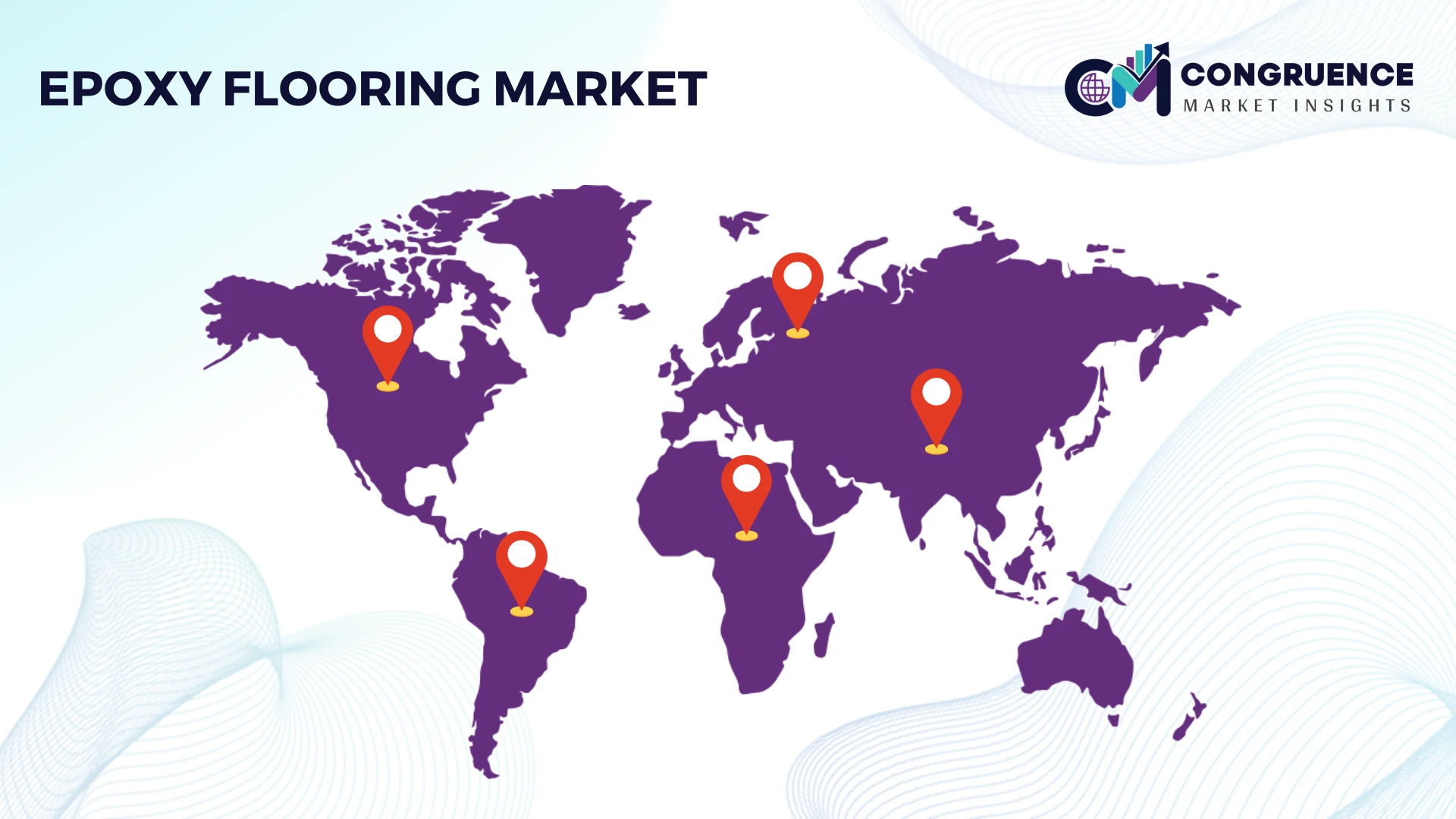
Industrial Modernization and Logistics Expansion Sustain Market Leadership
North America maintains its leading position through continuous investments in advanced manufacturing, warehouse automation, pharmaceutical production, and data center construction. Large-scale industrial refurbishment projects and strict workplace safety standards continue driving demand for seamless, chemical-resistant flooring systems. More than 55% of large industrial renovation projects specify high-performance resin flooring, while rapid-curing epoxy technologies reduce facility downtime by nearly 30%. Manufacturers are expanding local production capacity and collaborating with industrial contractors to accelerate deployment across automotive, aerospace, and life sciences facilities. The growing adoption of automated warehouses further strengthens demand for abrasion-resistant flooring capable of supporting continuous material handling operations.
United States Market Outlook: The United States dominates regional demand due to its extensive manufacturing base, logistics infrastructure, and pharmaceutical production capacity. Large-scale investments in semiconductor fabrication, battery manufacturing, and fulfillment centers continue expanding the addressable market. Approximately 60% of newly developed high-value industrial facilities specify seamless resin flooring systems during construction, while refurbishment of aging manufacturing assets continues creating replacement demand. Domestic suppliers are strengthening contractor networks and introducing rapid-installation systems that minimize production interruptions.
Sustainable Industrial Upgrades Accelerate Resin Flooring Adoption
Europe continues strengthening epoxy flooring demand through industrial modernization, sustainable construction practices, and manufacturing automation. Food processing, automotive production, pharmaceuticals, and commercial infrastructure remain primary deployment sectors where durability and hygiene standards are operational priorities. Nearly 48% of newly upgraded industrial facilities incorporate low-VOC flooring systems, while modernization initiatives across manufacturing plants continue supporting premium flooring installations. Producers are introducing environmentally compliant formulations and expanding localized technical support to meet evolving regulatory requirements and improve installation efficiency.
Germany Market Outlook: Germany remains the region's largest market owing to its advanced automotive, machinery, chemical, and industrial manufacturing sectors. Factory modernization and automation initiatives continue supporting high-performance flooring installations capable of withstanding intensive mechanical loads and chemical exposure. More than 50% of industrial refurbishment projects within advanced manufacturing facilities incorporate durable resin flooring systems, encouraging suppliers to expand customized industrial flooring solutions.
Manufacturing Scale and Infrastructure Expansion Drive Rapid Deployment
Asia-Pacific is experiencing the strongest market momentum through expanding manufacturing capacity, industrial infrastructure investment, electronics production, and logistics development. China, India, South Korea, and Southeast Asia continue investing in factories, warehouses, and transportation infrastructure requiring durable flooring solutions. Industrial construction activity contributes to widespread deployment, while nearly 65% of new electronics manufacturing facilities install seamless flooring for contamination control and operational efficiency. Companies continue expanding regional manufacturing capacity and contractor partnerships to improve project execution and shorten delivery timelines.
China Market Outlook: China represents the largest regional market due to its dominant manufacturing ecosystem, industrial parks, and export-oriented production facilities. Rapid investment in electric vehicles, semiconductors, chemicals, and logistics infrastructure continues supporting epoxy flooring demand. Industrial flooring deployment across newly constructed manufacturing facilities has increased by approximately 22% over recent project cycles, encouraging domestic producers to invest in higher-capacity resin production and advanced flooring technologies.
Industrial Diversification Supports Steady Market Expansion
South America is witnessing stable demand driven by food processing, mining, warehousing, healthcare infrastructure, and commercial construction. Industrial modernization initiatives are gradually increasing the installation of high-performance flooring systems despite uneven infrastructure development across several economies. Nearly 35% of newly developed logistics facilities specify seamless industrial flooring, while manufacturers continue strengthening regional distribution networks and technical service capabilities. Investment remains concentrated in high-value industrial corridors where operational durability and maintenance efficiency deliver measurable lifecycle savings.
Brazil Market Outlook: Brazil leads regional demand through its diversified industrial economy, expanding food manufacturing sector, and growing logistics infrastructure. Pharmaceutical facilities, automotive manufacturing, and commercial developments continue supporting epoxy flooring installations. More than 45% of large industrial flooring projects are concentrated within major manufacturing states, prompting suppliers to expand local application expertise and contractor partnerships for faster project completion.
Industrial Investment and Infrastructure Modernization Strengthen Adoption
The Middle East & Africa market is expanding through industrial diversification, logistics infrastructure development, healthcare construction, and large-scale commercial projects. High-performance flooring is increasingly specified for manufacturing facilities, airports, warehouses, and pharmaceutical operations requiring chemical resistance and operational durability. More than 40% of newly commissioned industrial facilities within major economic zones include seamless flooring systems, while regional suppliers continue investing in localized application capabilities and technical support to improve execution quality.
Saudi Arabia Market Outlook: Saudi Arabia remains the region's most influential market, supported by industrial diversification programs, logistics expansion, and advanced manufacturing investments. New industrial cities, healthcare infrastructure, and food production facilities continue generating demand for durable resin flooring solutions. Industrial project investments have increased epoxy flooring deployment by approximately 20% across newly commissioned manufacturing facilities, encouraging suppliers to establish local partnerships and strengthen installation capabilities for long-term infrastructure development.
Global coating leaders including Sika, Sherwin-Williams, PPG Industries, BASF, and Stonhard compete directly with regional resin formulators and specialized flooring contractors. The top five participants collectively control approximately 46% of market activity through integrated product portfolios, technical service, and contractor ecosystems. Competition centers on low-VOC formulations, curing speed, durability, and installation efficiency, where rapid-curing systems shorten project completion by nearly 30% and advanced formulations reduce lifecycle maintenance costs by over 20%. Premium manufacturers compete through innovation and specification-driven sales, while regional suppliers challenge them with lower pricing and localized customization. Strategic partnerships with industrial contractors, manufacturing expansion, backward integration into resin chemistry, and digital specification tools are strengthening customer retention. The competitive landscape is shifting toward sustainable technologies and complete flooring system solutions rather than standalone coatings. Strict regulatory compliance, certification requirements, and extensive application expertise remain significant entry barriers. Winning requires differentiated chemistry, reliable supply chains, certified installer networks, and consistently superior lifecycle performance instead of competing solely on price.
Sika AG
Sherwin-Williams Company
PPG Industries, Inc.
BASF SE
Stonhard
RPM International Inc.
Nippon Paint Holdings Co., Ltd.
Kansai Paint Co., Ltd.
Jotun A/S
Akzo Nobel N.V.
Asian Paints Limited
Ardex Group
MAPEI S.p.A.
Fosroc International Limited
Epoxy flooring technology is rapidly shifting toward low-VOC, high-solids, and rapid-curing formulations that improve installation productivity without sacrificing durability. Approximately 58% of newly specified industrial flooring projects now prioritize environmentally compliant systems, while advanced self-leveling formulations improve surface uniformity by nearly 18%. Digital color matching, moisture-tolerant primers, and hybrid epoxy-polyurethane systems are becoming standard across manufacturing, logistics, and pharmaceutical facilities, reducing installation risks while extending coating service life.
Next-generation curing chemistry delivers measurable operational improvements over conventional systems. Modern rapid-curing epoxy technology reduces return-to-service time by nearly 40% compared with legacy formulations while lowering labor requirements by approximately 15%. AI-assisted project planning, robotic surface preparation, and sensor-based moisture inspection continue improving installation consistency. Large multinational coating manufacturers benefit most because integrated manufacturing, R&D, and contractor certification programs accelerate technology deployment across multiple industrial sectors while strengthening premium product positioning.
Between 2026 and 2028, smart flooring systems incorporating embedded condition-monitoring sensors, antimicrobial coatings, and predictive maintenance capabilities are expected to move into mainstream industrial deployment. Adoption across advanced manufacturing facilities is projected to exceed 30%, supporting improved maintenance scheduling, longer flooring life, and lower operational disruption. Companies investing early in intelligent flooring technologies, sustainable resin chemistry, and automated installation workflows will secure stronger specification rates and long-term competitive differentiation.
March 2025: BASF and Sika jointly commercialized the Baxxodur® EC 151 epoxy hardener, reducing VOC emissions by up to 90% while enabling faster curing for industrial flooring applications. The innovation strengthens sustainable flooring portfolios and lowers installation costs. Source: basf.com
March 2024: Flowcrete expanded its Low Emission (LE) epoxy flooring portfolio with Indoor Air Comfort® Gold-certified systems, broadening low-emission solutions across industrial, decorative, and parking applications. The enhanced range supports healthier indoor environments and stricter building compliance. Source: bpcc.org.pl
March 2025: Sika introduced new Sikafloor technology incorporating an innovative curing platform that cuts volatile organic compound emissions by up to 90% while simplifying product selection. The development improves regulatory compliance and strengthens competitive positioning in sustainable industrial flooring. Source: sika.com
October 2024: Sherwin-Williams completed expansion of its Tournus manufacturing facility to increase production capacity for next-generation epoxy coating technologies serving European industrial customers. The investment improves regional supply resilience and supports growing demand for advanced coating systems. Source: industrial.sherwin-williams.com
The report provides comprehensive analysis of epoxy flooring technologies across product types, applications, end-users, and major geographic markets between 2026 and 2033. Coverage includes solvent-based, water-based, and solid epoxy systems serving industrial facilities, commercial buildings, residential construction, healthcare, food processing, logistics, and infrastructure projects. Regional assessment evaluates more than 20 key countries representing over 90% of global industrial flooring demand while examining technology adoption, regulatory evolution, and competitive positioning.
The study evaluates deployment patterns, material innovation, contractor ecosystems, sustainability trends, and digital project management influencing purchasing decisions. It profiles major manufacturers, analyzes product differentiation, distribution strategies, and technology investments while identifying emerging opportunities in low-VOC formulations, rapid-curing systems, antimicrobial flooring, and smart industrial surfaces. Strategic insights support capacity planning, investment prioritization, geographic expansion, supplier benchmarking, partnership evaluation, and long-term competitive positioning across mature and emerging epoxy flooring markets.
| Report Attribute/Metric | Report Details |
|---|---|
|
Market Revenue in 2025 |
USD 9,408.1 Million |
|
Market Revenue in 2033 |
USD 16,408.2 Million |
|
CAGR (2026 - 2033) |
7.2% |
|
Base Year |
2025 |
|
Forecast Period |
2026 - 2033 |
|
Historic Period |
2021 - 2025 |
|
Segments Covered |
By Type
By Application
By End-User
|
|
Key Report Deliverable |
Revenue Forecast, Growth Trends, Market Dynamics, Segmental Overview, Regional and Country-wise Analysis, Competition Landscape |
|
Region Covered |
North America, Europe, Asia-Pacific, South America, Middle East, Africa |
|
Key Players Analyzed |
Sika AG, Sherwin-Williams Company, PPG Industries, Inc., BASF SE, Stonhard, RPM International Inc., Nippon Paint Holdings Co., Ltd., Kansai Paint Co., Ltd., Jotun A/S, Akzo Nobel N.V., Asian Paints Limited, Ardex Group, MAPEI S.p.A., Fosroc International Limited |
|
Customization & Pricing |
Available on Request (10% Customization is Free) |




