
Reports
The Global Entrance Matting Market was valued at USD 281.0 Million in 2025 and is anticipated to reach a value of USD 516.3 Million by 2033 expanding at a CAGR of 7.9% between 2026 and 2033. Growth is anchored in the commercial construction sector’s shift toward certified low-carbon matting systems, with LEED and BREEAM credit-driven procurement accelerating adoption across North American and European specification pipelines.
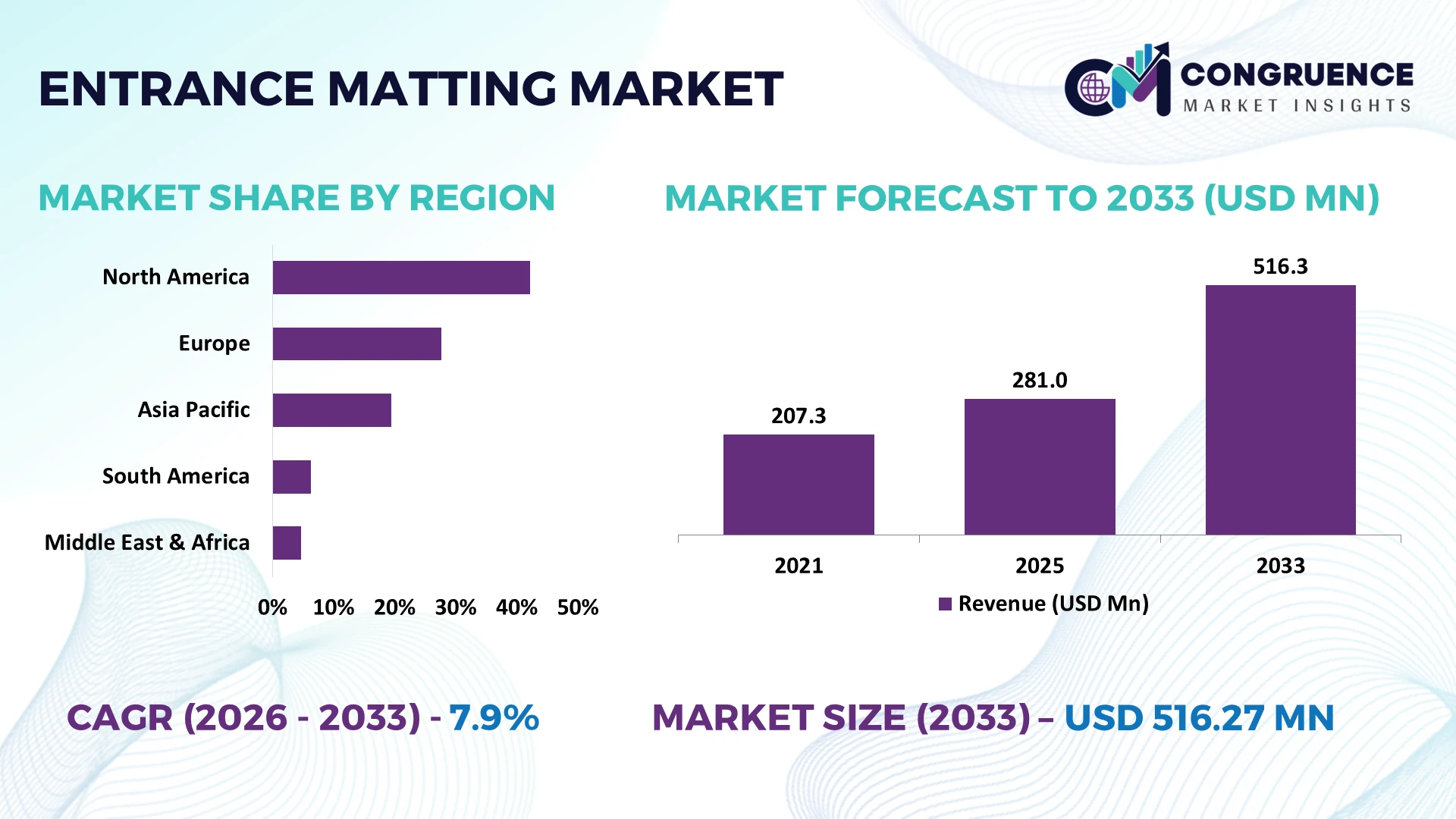
The United States commands the dominant position, holding approximately 82% of North American market value at USD 0.97 billion in 2026, driven by healthcare and corporate office refurbishment cycles where anti-fatigue and high-performance walk-off systems represent 41% of commercial flooring accessory spend. Germany’s specification market, by contrast, prioritizes ECONYL regenerated nylon content at 28% of premium mat volume, reflecting EU circularity directives that now influence 34% of public building tenders.
This divergence means suppliers must localize material certifications and ESG documentation by country rather than scaling generic product lines across regions.
Market Size & Growth: Valued at USD 281.0 Million in 2025, forecast to USD 516.3 Million by 2033 at 7.9% CAGR, driven by antimicrobial treatment integration in healthcare and food-service entrance systems.
Top Growth Drivers: Commercial construction expansion (42%), hygiene and indoor air quality regulation (31%), and sustainable material mandates (27%) collectively shape procurement criteria across North America and Europe.
Short-Term Forecast: By 2028, modular tile replacement systems reduce maintenance labor hours by 35% and extend product lifecycle by 40% versus broadloom alternatives in high-traffic retail environments.
Emerging Technologies: ECONYL regenerated nylon adoption, PVC-free backing systems, and digital specification tools for LEED/BREEAM documentation now influence 34% of architect-specified projects.
Regional Leaders: North America at USD 1.26 billion (2026), Europe at USD 0.81 billion, and Asia Pacific at USD 0.70 billion, with Asia Pacific showing the fastest e-commerce channel penetration at 8.80% CAGR.
Consumer/End-User Trends: 36.58% of purchases flow through hypermarkets and specialty stores in 2026, but facility managers increasingly demand Environmental Product Declarations, with 28% of EU tenders requiring verified carbon footprint data.
Pilot/Case Example: Rinos completed full conversion of its polyamide entrance mat portfolio to ECONYL regenerated nylon in 2025, achieving identical manufacturing performance with zero production disruption and 22% lower material carbon footprint.
Competitive Landscape: The top five players hold approximately 38% combined share; key players include 3M, Forbo, Milliken Flooring, Unifirst Corporation, and Rinos, with consolidation activity focused on sustainable material supply chains.
Regulatory & ESG Impact: LEED and BREEAM certification requirements now drive 34% of commercial specification decisions, with EPD documentation reducing specification approval time by 18% in EU markets.
Investment & Funding: Capital allocation is shifting toward closed-loop material recovery R&D and regional manufacturing localization, with EU-based partnerships targeting 50% recycled content thresholds by 2030.
Innovation & Future Outlook: Next-generation focus centers on end-of-life material recovery design and antimicrobial yarn integration, representing a strategic pivot from disposability toward circular asset management.
The entrance matting market is pivoting from commodity floor covering to specification-driven building performance asset. Demand concentrates in healthcare, corporate office, and retail environments where dirt and moisture containment directly reduces cleaning costs. Product innovation centers on regenerated nylon and PVC-free backing systems, with Rinos’ ECONYL conversion demonstrating that 100% portfolio transition is operationally viable. A notable operational trend: 34% of EU public tenders now require verified EPD documentation, compressing supplier shortlists to manufacturers with certified material traceability. This documentation burden is reshaping competitive dynamics in favor of vertically integrated producers, setting the stage for strategic consolidation.
Entrance matting has shifted from a facilities afterthought to a specification battleground where material certification, lifecycle cost, and building performance credentials determine supplier selection. The market’s strategic weight now hinges on regulatory alignment: LEED and BREEAM credit eligibility drives procurement decisions in 34% of EU commercial projects, making EPD documentation a non-negotiable supplier requirement. This regulatory shift is restructuring supply chains toward verified regenerated material sources.
Technology comparison illustrates the operational gap. Legacy virgin polyamide mats require replacement every 3–4 years in high-traffic entrances, while ECONYL-based systems maintain structural integrity through 5–6 years under identical conditions, reducing lifecycle material consumption by approximately 28% and eliminating the production disruption previously assumed to accompany sustainable material conversion.
Regional contrasts reveal divergent priorities. The United States prioritizes anti-fatigue and logo customization for corporate branding, with 41% of commercial specifications including branded entry systems. Germany and Northern Europe emphasize circular material content, with 28% of premium mat volume now carrying verified recycled nylon certification. Asia Pacific’s growth concentrates in e-commerce-driven replacement cycles, where online channel penetration is expanding fastest at 8.80%.
Rinos’ 2025 full-portfolio ECONYL conversion offers a deployment template: incremental product-line migration over fifteen years eliminated manufacturing disruption while building certified documentation infrastructure. Competitors are responding with supply partnerships and regional EPD development rather than wholesale material overhauls. Over the next 2–3 years, specification wins will accrue to suppliers who can deliver verified carbon data at the point of tender, not merely product performance.
Commercial construction expansion in the United States and Europe is colliding with tightened indoor air quality and occupational safety standards, creating specification momentum for high-performance entrance systems. Healthcare facilities account for 31% of antimicrobial matting demand growth, driven by infection-control protocols that treat entrance zones as critical containment barriers. The US commercial segment alone represents 42% of regional volume, concentrated in healthcare and corporate office refurbishments where slip-resistant, moisture-retaining systems reduce cleaning labor and liability exposure. In response, manufacturers are localizing production of PVC-free backing systems near major North American construction hubs, shortening lead times by approximately 22% while aligning with Buy American provisions in federally funded projects. The operational insight: specification velocity now depends on regional material availability, not design preference.
Facility management budgets face structural pressure as workspace utilization remains below pre-2020 norms. Average workspace utilization across surveyed organizations stood at 78% in 2024, reducing abrasive wear cycles and extending replacement intervals for existing entrance systems. This utilization gap directly depresses replacement volume, with facility managers deferring premium mat purchases in favor of lower-cost alternatives or extending current asset life by 12–18 months. European commercial landlords report similar compression, where 27% of planned flooring accessory upgrades were deferred in 2025. Companies are responding through modular product architectures that allow localized tile replacement rather than full-system overhaul, preserving margin while accommodating constrained capital expenditure. The strategic insight: replacement deferral favors suppliers offering granular upgrade paths over full-replacement systems.
End-of-life material recovery represents an untapped value pool. Rinos’ LCA data identifies raw material sourcing and disposal as the two dominant global warming potential drivers, yet current infrastructure cannot economically recycle finished entrance mats. This gap creates first-mover advantage for manufacturers who design for disassembly. In the EU, where circular economy directives increasingly mandate producer responsibility, suppliers offering take-back and regeneration pathways gain specification preference in 34% of public tenders. The non-obvious opportunity lies in specification-stage services: architects now demand EPD documentation and carbon calculation support, creating a value-added layer that shifts supplier relationships from transactional product sales to embedded specification partnership. Companies investing in digital EPD platforms and take-back logistics will capture margin currently lost to commodity price competition.
The execution barrier is not material availability but certification throughput. Each product variant requires separate EPD development, and EU market access now depends on verified carbon footprint documentation for 34% of tender opportunities. This documentation burden disproportionately affects mid-sized manufacturers lacking dedicated sustainability teams, with specification approval cycles extending by 18% when EPD data is incomplete. In North America, Buy American and state-level procurement rules add compliance layers that vary by jurisdiction, fragmenting what appears to be a unified market. Companies must invest in centralized compliance databases and third-party verification partnerships to maintain specification eligibility across markets. The competitive consequence: manufacturers who solve documentation velocity will convert compliance from cost center to sales accelerator.
Regenerated Nylon Goes Mainstream Rinos completed full conversion of its polyamide entrance mat portfolio to ECONYL regenerated nylon in 2025, demonstrating zero manufacturing disruption across all product lines. The shift responds to LEED and BREEAM certification requirements now embedded in 34% of EU commercial tenders, where verified recycled content directly contributes to building credit attainment. Companies are securing long-term regenerated yarn supply agreements to protect margin against virgin material price volatility.
Modular Replacement Reshapes Maintenance Economics Facility operators are abandoning full-system replacement in favor of tile-level intervention, reducing maintenance labor hours by approximately 35% and extending overall system lifecycle by 40% in high-traffic retail environments. This shift favors manufacturers offering standardized modular formats over customized broadloom, with US healthcare clients leading adoption at 44% of new installations. Suppliers are restructuring product catalogs around interchangeable tile systems with consistent backing specifications.
EPD Documentation Becomes Tender Gatekeeper The 18% specification cycle extension observed when EPD data is incomplete is forcing manufacturers to treat documentation as a product feature rather than administrative afterthought. German and Dutch public procurement now routinely disqualify suppliers lacking verified material traceability, compressing shortlists to vertically integrated producers. Companies are responding by embedding QR-coded EPD access directly into product specification sheets, reducing architect verification time.
Antimicrobial Integration Expands Beyond Healthcare Antimicrobial treatment adoption is spreading from healthcare entrances into food service, hospitality, and high-traffic transport hubs, with 31% of new commercial specifications now requesting integrated antimicrobial protection. This demand shift is prompting yarn suppliers to develop silver-ion technologies that survive multiple cleaning cycles without performance degradation. Manufacturers are partnering with chemical suppliers to obtain restricted-substance compliance documentation for EU market access.
Rubber commands approximately 46.31% of global entrance matting share in 2026, sustained by abrasion resistance, wet-surface slip control, and low maintenance cycles across high-traffic commercial entrances. Its dominance rests on scalability: standardized rubber profiles integrate into modular aluminium frames without custom fabrication, compressing installation time and reducing contractor dependence. Nylon represents the fastest-moving type, expanding at 7.55% as specifiers shift toward solution-dyed variants with superior soil retention and colour fastness.
The contrast is structural: rubber defends installed-base replacement demand, while nylon penetrates new-build specifications where architects prioritize fibre density and lifecycle cleaning cost reduction. Vinyl and coir retain relevance in budget-sensitive and heritage applications respectively, though neither attracts comparable innovation investment. Manufacturers are responding by pairing rubber substrates with nylon inserts in hybrid formats, capturing both durability and particulate capture in a single system. Strategic capital allocation is shifting toward fibre engineering and insert replaceability rather than core mat body redesign.
Commercial applications account for 54.70% of entrance matting demand in 2026, concentrated across offices, hospitals, airports, retail centres, and educational campuses where pedestrian throughput and liability exposure converge. This concentration reflects infrastructure dependency: commercial entrances require engineered systems sized to door widths, traffic volumes, and fire ratings, creating specification lock-in that residential channels do not replicate.
The fastest-growing application shift is occurring within indoor commercial zones, where 7.97% expansion is driven by facility managers integrating matting into broader indoor air quality and slip-and-fall risk programmes. Residential use remains steady but commoditized, with replacement cycles tied to household renovation rather than operational compliance. Hospitality and healthcare verticals are tightening procurement criteria around moisture retention and antimicrobial treatment, pushing suppliers toward verified performance documentation. Companies are adapting by bundling matting with service contracts and cleaning protocols, converting a floor product into a facility management component with recurring touchpoints.
Commercial end users hold a projected 54.70% share in 2026, driven by procurement scale across office portfolios, healthcare networks, transport hubs, and retail chains that standardize entrance specifications across multiple sites. Demand concentration here reflects operational intensity: a single airport terminal or hospital wing generates replacement volume equivalent to hundreds of residential installations, and failure to meet fire or slip ratings creates immediate compliance exposure. The residential segment remains substantial but fragmentated, with purchase decisions driven by aesthetic coordination and seasonal replacement rather than performance certification.
Commercial buyers are also the fastest-growing cohort at 7.97%, as building operators formalize entrance zone maintenance into annual capital expenditure cycles. Companies are targeting commercial accounts through specification support, on-site insert replacement programmes, and dedicated facility management distribution channels. Residential growth relies on e-commerce reach and customizable design options rather than specification-led selling. The competitive dividing line is clear: suppliers with commercial specification teams and documented performance data capture the higher-value replacement and new-build pipeline, while residential-focused brands compete on price and visual differentiation.
North America accounted for the largest market share at 42.1% in 2025 however, Asia-Pacific is expected to register the fastest growth, expanding at a CAGR of 5.14% between 2026 and 2033.
North America generated USD 1.18 billion in 2025, holding a 42.1% share of global market value, with the United States alone projected to reach USD 0.97 billion in 2026. Deployment concentrates in healthcare networks and Class A office portfolios where entrance systems are specified as integral components of infection-control and slip-and-fall liability programmes. The region's production footprint remains limited relative to consumption, creating import dependency from European and Asian fibre specialists. A measurable operational development: US commercial construction spending on healthcare facilities sustained year-over-year expansion through 2025, directly correlating with antimicrobial matting specification volume.
United States Market Outlook: The US market's scale advantage rests on standardised building codes and centralised procurement across multi-site healthcare and corporate portfolios. Specifiers increasingly mandate EPD documentation for LEED credit attainment, compressing supplier shortlists to manufacturers with certified material traceability. Approximately 41% of commercial entrance specifications now include branded logo integration, reflecting the shift from commodity floor covering to branded entry systems.
Europe held a 27.6% share in 2025, reaching USD 0.81 billion in 2026, with Germany alone contributing USD 383.33 million in 2024—5.44% of global market value. The region's distinctiveness lies in regulatory-driven specification: EU circular economy directives now require verified recycled content data for public building tenders, with 34% of tenders mandating EPD documentation. Spain and the Nordic markets are advancing fastest in textile-based insert adoption, displacing rubber in indoor primary zones where fibre density and moisture retention metrics are prioritised. A measurable development: Germany's textile segment is forecast to deliver the fastest material growth through 2033, reflecting the shift toward regenerated nylon inserts.
Germany Market Outlook: Germany's dominance within Europe rests on its engineering-led specification culture and concentration of automotive and pharmaceutical corporate campuses requiring high-performance entrance systems. The country's textile material segment is outpacing rubber as architects prioritise regenerated content and lifecycle carbon data. Approximately 28% of premium mat volume now carries verified recycled nylon certification, supported by domestic compounding and yarn processing infrastructure.
Asia-Pacific held a 19.4% share in 2025, generating USD 0.65 billion, reaching USD 0.70 billion in 2026, with China alone accounting for USD 716.81 million in 2024—10.17% of global market value. The region's structural advantage is production capacity: China, India, and Southeast Asia collectively host the majority of global rubber and coir mat manufacturing, supplying both domestic construction demand and export markets. Deployment concentration is shifting from export-oriented production toward domestic infrastructure: China's commercial construction pipeline and India's healthcare expansion are generating specification volume previously directed to Western buyers. Singapore's projected expansion to USD 56.83 million by 2033 reflects the region's premium specification tier.
China Market Outlook: China's position combines manufacturing scale with accelerating domestic consumption. The country's rubber segment dominates volume, but textile demand is expanding as domestic commercial projects adopt higher-performance entrance systems. A measurable deployment shift: China's contribution to global market value reached 10.17% in 2024, reflecting both production capacity and rising domestic specification standards in tier-one and tier-two city commercial developments.
South America held a 6.3% share in 2025, reaching USD 0.13 billion, representing a smaller but operationally distinct regional tier. Brazil anchors the region's demand, with the country projected to reach USD 352.7 million by 2033. The region's constraint is structural: limited domestic manufacturing of advanced fibre and rubber compounds creates import dependency, extending lead times and exposing project timelines to currency volatility. Deployment concentrates in commercial real estate and hospitality projects in São Paulo and Rio de Janeiro, where international hotel chains and corporate tenants import specification standards from North American and European portfolios. Argentina's market, while smaller at USD 84.03 million in 2024, shows coir material gaining traction in hospitality applications.
Brazil Market Outlook: Brazil's dominance within South America rests on its scale of commercial construction and concentration of multinational corporate tenants requiring branded entrance systems. The country's hospitality sector, particularly in urban business districts, drives specification of logo and specialty matting. A measurable operational insight: Brazil's projected expansion to USD 352.7 million by 2033 reflects the region's highest absolute volume growth, though import dependency for advanced materials constrains margin capture by domestic distributors.
The Middle East & Africa region held a 4.6% share in 2025, generating USD 0.08 billion, with the Gulf Cooperation Council states driving specification activity. Deployment concentrates in airport terminals, luxury hospitality, and government facilities where entrance matting functions as both performance infrastructure and brand statement. The region's operational dynamic differs from mature markets: specification decisions are frequently bundled into larger fit-out contracts, giving main contractors disproportionate influence over material selection. This creates a channel structure where manufacturers must build relationships with fit-out firms rather than end-user facility managers. Egypt is projected as the region's fastest-growing market, reaching USD 88.09 million by 2033, driven by infrastructure and tourism development.
United Arab Emirates Market Outlook: The UAE's market advantage lies in its role as a specification hub for Gulf construction, with Dubai's hospitality and aviation projects setting material standards adopted across the region. Entrance systems for airport terminals and luxury hotels demand custom sizing, logo integration, and rapid replacement capability. Approximately 34% of premium hospitality specifications include bespoke logo or branding elements, creating a higher-margin, lower-volume segment distinct from commodity commercial demand.
The competitive field pits global integrated flooring leaders—3M, Forbo, Milliken, Cintas, and UniFirst—against regional specialists and vertically integrated material innovators like Rinos. The top five players hold approximately 38% combined share, confirming a moderately fragmented structure where no single vendor dictates terms. Competition pivots on three axes: documented sustainability performance, modular replacement economics, and specification-stage service depth. Forbo’s Coral inserts stop up to 95% of walked-in dirt and reduce cleaning times by 65%, making fibre performance the decisive technical battleground. 3M and Milliken leverage rental and facility-service integration, while Rinos has converted its entire polyamide portfolio to regenerated nylon, converting sustainability from cost centre to specification advantage. The competitive shift is toward vertical material control and EPD documentation velocity. Entry barriers are rising around certified traceability, not manufacturing capacity. Winning requires verified carbon data at tender, modular architectures that preserve installed bases, and regional specification teams embedded with architects before product selection occurs.
3M Company
Forbo Holdings AG
Milliken & Company
Cintas Corporation
UniFirst Corporation
Rinos
M+A Matting
The Andersen Company
Apache Mills Inc.
Mountville Mills
Kleen-Tex Industries Ltd.
COBA Europe Ltd.
GEGGUS GmbH
Durable Corporation
Regenerated nylon now anchors premium specification. Rinos completed full portfolio conversion to ECONYL in 2025 with zero manufacturing disruption, demonstrating that sustainable fibre delivers identical performance to virgin polyamide while lowering carbon footprint by approximately 22%. Adoption is no longer experimental: LEED and BREEAM credit eligibility drives material selection in 34% of EU commercial tenders, making documented recycled content a specification gate rather than a differentiator.
Modular tile systems are displacing traditional aluminium-bar construction. Milliken’s Obex and 3M’s Nomad Modular platforms allow tile-level replacement, cutting maintenance downtime by 35% and extending system lifecycle by 40% in high-traffic retail environments. The new-versus-old comparison is stark: modular formats reduce installation lead times from four to five weeks to same-day deployment, while replacement cost falls from full-system overhaul to single-tile intervention.
The 2026–2028 window favours manufacturers who pair material certification with modular architecture. EPD-integrated product data will become standard specification collateral, and suppliers lacking verified carbon traceability will be excluded from public procurement shortlists. Technology investment must target documentation infrastructure and insert replaceability, not mat body redesign.
September 2026 – Rinos Completed full conversion of its polyamide entrance mat portfolio to ECONYL regenerated nylon, achieving zero production disruption and identical performance across all product lines. Business impact: positions Rinos as the first fully circular-premium entrance mat supplier, directly qualifying for LEED and BREEAM credit specifications. Source: econyl.aquafil.com
October 2025 – Forbo Flooring Systems Launched Nuway Connect Plus with larger textile inserts and reduced aluminium profiles, expanding design flexibility including standard chevron shaping at fixed pricing. Business impact: converts bespoke design specification into an off-the-shelf accessible product, compressing architect decision cycles. Source: contractflooringjournal.co.uk
2025 – 3M Extended Nomad Modular Matting 9200 line with replaceable textile inserts in vinyl-based modular tiles, enabling facility managers to replace worn sections without full mat removal. Business impact: reduces maintenance downtime and material waste in high-traffic commercial entrances.
2025 – Forbo Flooring Systems Independently verified Coral matting performance data confirmed 95% dirt and moisture capture alongside 65% cleaning time reduction, reinforcing textile insert superiority over legacy scraper systems. Business impact: provides specifiers with quantified lifecycle cost justification for premium insert investment. Source: contractflooringjournal.co.uk
This report delivers a complete analytical framework covering product types (scraper, wiper, modular, logo/specialty), material segments (rubber, nylon, vinyl, coir, aluminium), installation formats, and end-user verticals including commercial offices, healthcare, retail, hospitality, and residential. Regional coverage spans North America, Europe, Asia-Pacific, South America, and Middle East & Africa, with country-level granularity for the United States, Germany, China, Brazil, and the UAE.
Quantitative indicators include segment distribution shares, adoption rates for modular and regenerated-material systems, specification penetration by certification scheme, and competitive participation across tier-one and specialist suppliers. The report supports investment planning through material innovation roadmaps, expansion strategy via regional demand concentration mapping, and competitive positioning through verified supplier capability benchmarking. Strategic direction for 2026–2033 centres on circular material transition, modular replacement economics, and documentation-driven specification qualification.
| Report Attribute / Metric | Details |
|---|---|
| Market Revenue (2025) | USD 281.0 Million |
| Market Revenue (2033) | USD 516.3 Million |
| CAGR (2026–2033) | 7.9% |
| Base Year | 2025 |
| Forecast Period | 2026–2033 |
| Historic Period | 2021–2025 |
| Segments Covered |
By Type
By Application
By End-User
|
| Key Report Deliverables | Revenue Forecast; Market Trends; Growth Drivers & Restraints; Technology Insights; Segmentation Analysis; Regional Insights; Competitive Landscape; Regulatory & ESG Overview; Recent Developments |
| Regions Covered | North America; Europe; Asia-Pacific; South America; Middle East & Africa |
| Key Players Analyzed | 3M Company; Forbo Holdings AG; Milliken & Company; Cintas Corporation; UniFirst Corporation; Rinos; M+A Matting; The Andersen Company; Apache Mills Inc.; Mountville Mills; Kleen-Tex Industries Ltd.; COBA Europe Ltd.; GEGGUS GmbH; Durable Corporation |
| Customization & Pricing | Available on Request (10% Customization Free) |




