
Reports
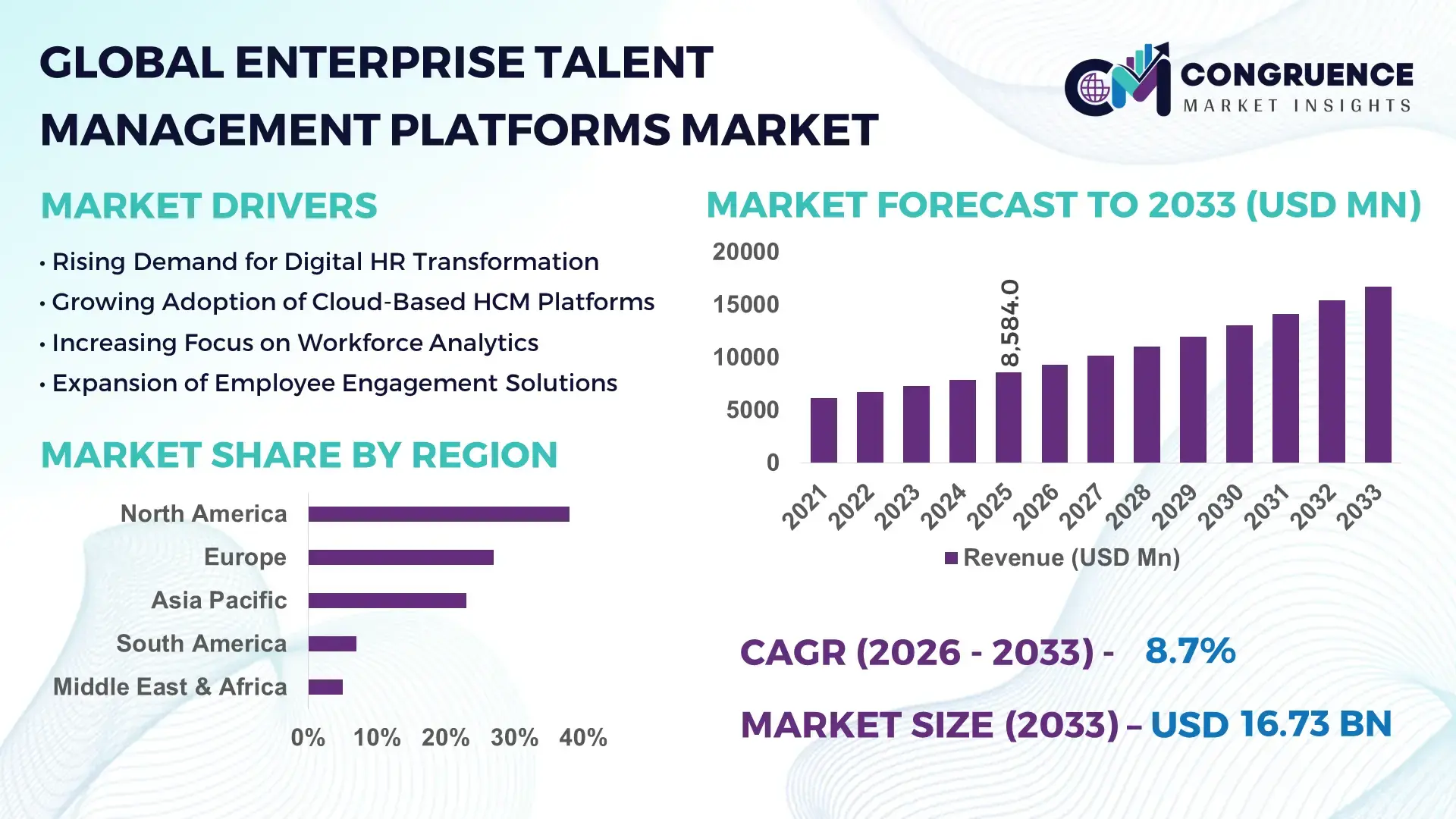
The Global Enterprise Talent Management Platforms Market was valued at USD 8,584 Million in 2025 and is anticipated to reach a value of USD 16,731.2 Million by 2033 expanding at a CAGR of 8.7% between 2026 and 2033, according to an analysis by Congruence Market Insights. The growth is primarily driven by enterprise-wide digital HR transformation initiatives and the increasing integration of AI-based workforce analytics across large organizations.
The United States remains the dominant country in the Enterprise Talent Management Platforms Market, supported by strong enterprise software production capacity and high corporate IT expenditure exceeding USD 1.7 trillion annually. Over 72% of large enterprises in the U.S. deploy integrated HR technology suites, with performance management and recruitment modules representing more than 48% of total platform utilization. The country hosts leading cloud infrastructure providers and HR technology innovators, enabling advanced AI-driven workforce analytics, predictive retention modeling, and automated compliance tracking. More than 65% of Fortune 500 companies operate unified talent platforms integrated with ERP and CRM systems, reflecting high enterprise-grade adoption and continuous investment in workforce digitization.
Market Size & Growth: Valued at USD 8,584 Million in 2025 and projected to reach USD 16,731.2 Million by 2033 at 8.7% CAGR, driven by enterprise-wide HR digitization and AI-based workforce analytics adoption.
Top Growth Drivers: 72% cloud HR adoption rate, 38% improvement in hiring efficiency through AI screening, 41% reduction in employee turnover via predictive analytics.
Short-Term Forecast: By 2028, automated talent workflows are expected to reduce HR administrative costs by 30% and improve onboarding cycle time by 25%.
Emerging Technologies: Generative AI for workforce planning, machine learning-based attrition prediction, blockchain-enabled credential verification.
Regional Leaders: North America projected above USD 6,900 Million by 2033 with strong SaaS penetration; Europe expected to surpass USD 4,200 Million with compliance-driven adoption; Asia-Pacific likely to exceed USD 3,800 Million fueled by digital HR expansion.
Consumer/End-User Trends: Over 68% of enterprises prioritize integrated performance and learning management modules, while hybrid workforce management usage exceeds 60%.
Pilot or Case Example: In 2024, a multinational enterprise implemented AI-driven talent analytics achieving 35% faster recruitment cycles and 22% improvement in workforce productivity.
Competitive Landscape: SAP SuccessFactors holds approximately 18% share, followed by Workday, Oracle HCM Cloud, Cornerstone OnDemand, and ADP.
Regulatory & ESG Impact: GDPR, labor transparency mandates, and ESG-linked workforce diversity reporting are accelerating compliance-based system upgrades across 55% of enterprises.
Investment & Funding Patterns: Global HR tech funding exceeded USD 5.2 Billion in recent investment cycles, with increased venture focus on AI-native talent intelligence platforms.
Innovation & Future Outlook: Integration of AI copilots, skills-based talent marketplaces, and real-time workforce sentiment analytics are reshaping enterprise workforce strategies.
Enterprise Talent Management Platforms are widely adopted across IT & telecom (28%), BFSI (22%), healthcare (16%), and manufacturing (14%). AI-driven learning management systems and skills-based internal mobility tools are accelerating enterprise adoption. Compliance-driven digital HR transformation in Europe and workforce expansion in Asia-Pacific support consumption growth. ESG-focused diversity tracking and predictive analytics integration are shaping future enterprise investment priorities.
Enterprise Talent Management Platforms have become strategically critical as organizations prioritize workforce agility, compliance transparency, and productivity optimization. Enterprises integrating AI-powered talent analytics report up to 38% faster recruitment cycles compared to manual screening systems. Generative AI-based workforce planning delivers 32% improvement compared to traditional spreadsheet-driven HR planning methods. As hybrid workforce models expand beyond 60% adoption globally, enterprises are investing in integrated performance, learning, and succession management modules to enhance workforce visibility and decision intelligence.
North America dominates in volume of enterprise deployments, while Europe leads in adoption intensity with over 74% of large enterprises utilizing integrated compliance-driven HR systems. Asia-Pacific demonstrates accelerated onboarding digitization across enterprises expanding cross-border operations. By 2028, AI-powered workforce analytics is expected to improve retention accuracy by 35% and reduce voluntary attrition by nearly 20%. Firms are committing to ESG workforce transparency targets, including 25% improvement in gender diversity metrics by 2030 through analytics-enabled diversity tracking dashboards.
In 2024, a leading U.S.-based enterprise implemented predictive talent intelligence systems, achieving a 27% reduction in hiring bias indicators and 30% improvement in performance evaluation accuracy. The Enterprise Talent Management Platforms Market is positioned as a pillar of organizational resilience, regulatory compliance, and sustainable workforce growth, enabling enterprises to align talent strategy with digital transformation roadmaps.
The Enterprise Talent Management Platforms Market is characterized by rapid digital HR transformation, cloud-native deployment expansion, and enterprise integration strategies. Increasing enterprise IT budgets and workforce digitization initiatives are influencing adoption across multinational corporations. More than 70% of large enterprises are consolidating disparate HR systems into unified cloud-based talent platforms to improve data visibility and operational efficiency. Integration with ERP, CRM, and collaboration platforms is becoming standard practice, supporting cross-functional workforce insights. Additionally, predictive workforce analytics and automation-driven decision-making tools are reshaping hiring, retention, and performance management processes. Growing regulatory compliance requirements related to workforce reporting, diversity metrics, and employee data privacy are further strengthening enterprise demand for centralized talent management systems.
Global enterprises are replacing legacy HR systems with integrated cloud-based platforms to enhance efficiency and workforce analytics capabilities. Over 72% of large enterprises now deploy cloud-based HR solutions, reducing manual HR workloads by nearly 40%. AI-enabled candidate screening tools process up to 75% of initial applications automatically, significantly reducing recruitment cycle time. Organizations implementing predictive retention analytics have reported 20–30% reductions in voluntary attrition. Integration of learning management and performance modules increases employee engagement scores by approximately 18%. Digital workforce expansion, particularly in hybrid and remote environments exceeding 60% workforce penetration, further supports adoption. As enterprises seek measurable productivity gains and operational transparency, investment in unified talent management ecosystems continues to intensify globally.
Data privacy regulations such as GDPR and cross-border employee data restrictions create compliance complexity for multinational enterprises. Nearly 48% of organizations report challenges integrating legacy HR databases with modern cloud platforms. Data migration processes can extend beyond 6–12 months for large enterprises with over 50,000 employees. Cybersecurity concerns remain significant, as HR systems contain highly sensitive personal and payroll information. Approximately 35% of enterprises cite integration and interoperability limitations with ERP systems as a key implementation barrier. Additionally, customization costs for enterprise-scale deployments may increase project budgets by 20–25%, limiting rapid adoption among mid-sized enterprises with constrained IT infrastructure.
AI-powered workforce intelligence platforms enable real-time skills mapping and predictive workforce planning. Over 65% of enterprises are transitioning toward skills-based hiring models, creating demand for dynamic competency tracking systems. Internal talent marketplace modules improve internal mobility rates by up to 28%, reducing external recruitment costs. AI-driven learning recommendations enhance training completion rates by 34%. Emerging economies in Asia-Pacific are rapidly digitizing HR functions, with enterprise cloud adoption exceeding 50% in key markets. Integration of blockchain-based credential verification systems reduces background verification time by nearly 40%. These innovations present scalable growth opportunities for vendors offering intelligent, interoperable talent ecosystems.
Enterprise-wide platform deployments require significant organizational change management. Nearly 42% of HR transformation initiatives experience delays due to employee resistance and workflow disruption. Large-scale implementations often require cross-department integration spanning HR, finance, and IT, increasing coordination complexity. Training programs for platform adoption can extend up to 3–6 months for enterprises with distributed workforce structures. Additionally, multi-country regulatory compliance requirements necessitate continuous system updates. High customization demands for performance evaluation models and compensation structures further complicate deployments. These operational and financial pressures create adoption hurdles, particularly for enterprises lacking digital transformation maturity.
AI-Powered Skills Intelligence Platforms: Over 68% of enterprises are implementing AI-driven skills mapping tools to identify competency gaps. Predictive analytics models improve workforce planning accuracy by 33% and reduce hiring mismatches by 26%. Skills-based internal mobility adoption has increased by 29% in the last two years.
Expansion of Hybrid Workforce Management Modules: With more than 60% of enterprises operating hybrid models, demand for real-time performance tracking tools has increased by 37%. Automated employee engagement analytics improve feedback response rates by 24% and reduce absenteeism by 15%.
Integration with Enterprise ERP and Collaboration Suites: Approximately 71% of large organizations integrate talent platforms with ERP systems, improving cross-functional data accuracy by 31%. Unified dashboards enhance decision-making speed by 28% and reduce reporting errors by 22%.
ESG and Workforce Transparency Reporting Tools: Around 55% of enterprises are upgrading platforms to support diversity, equity, and inclusion analytics. Automated compliance dashboards reduce regulatory reporting preparation time by 35% and improve audit readiness by 27%.
The Enterprise Talent Management Platforms Market is segmented by type, application, and end-user, reflecting diverse enterprise workforce management priorities. By type, integrated suites dominate over standalone modules as organizations consolidate recruitment, learning, performance, and succession workflows into unified systems. Cloud-native platforms represent over 70% of new deployments, indicating a clear shift from legacy on-premise systems. By application, recruitment and performance management account for the highest adoption due to measurable impacts on hiring cycle efficiency and employee productivity. Meanwhile, workforce analytics and succession planning are witnessing accelerated uptake driven by skills-based organizational models. From an end-user perspective, large enterprises remain the primary adopters, supported by complex workforce structures and higher digital transformation budgets, while mid-sized enterprises are rapidly increasing adoption through SaaS-based, subscription-driven deployment models.
Enterprise Talent Management Platforms are categorized into Talent Acquisition & Recruitment Platforms, Performance Management Systems, Learning & Development (L&D) Platforms, Compensation & Benefits Management Systems, Succession Planning Tools, and Integrated Talent Management Suites. Integrated Talent Management Suites currently account for approximately 39% of total adoption, as enterprises increasingly prefer unified dashboards combining hiring, performance, and learning analytics into a single architecture. Talent Acquisition & Recruitment Platforms hold around 24%, driven by AI-based resume screening and automated candidate engagement tools. Learning & Development Platforms represent 18%, reflecting strong enterprise focus on upskilling and reskilling initiatives. However, Succession Planning and Workforce Analytics Tools are rising fastest, projected to expand at a CAGR of approximately 11.2% through 2033, supported by predictive modeling capabilities and leadership pipeline digitization. Compensation & Benefits Systems and other niche modules collectively contribute nearly 19%, serving compliance-heavy and multinational enterprises requiring structured payroll-performance alignment.
In 2025, the U.S. Office of Personnel Management expanded the deployment of integrated digital talent platforms across federal agencies, digitizing performance reviews for over 2 million federal employees and improving appraisal processing time by 28%.
The primary applications include Recruitment & Hiring, Performance Management, Learning & Development, Employee Engagement & Retention, Workforce Analytics, and Succession Planning. Recruitment & Hiring currently account for nearly 31% of total platform utilization, as enterprises leverage AI-driven screening systems that reduce hiring cycle times by up to 35%. Performance Management follows with approximately 26%, supported by real-time goal tracking and feedback automation tools. Learning & Development holds 19%, driven by enterprise reskilling programs targeting digital competencies. Workforce Analytics is the fastest-growing application segment, expanding at an estimated CAGR of 10.8%, as organizations implement predictive attrition models and skills-gap mapping systems. Employee Engagement and Succession Planning collectively contribute around 24%, particularly in multinational enterprises seeking leadership continuity. In 2025, more than 44% of global enterprises reported piloting AI-enabled recruitment modules within their HR ecosystems. Additionally, over 63% of hybrid workforce organizations rely on digital performance dashboards for quarterly employee evaluations.
In 2024, the UK Civil Service implemented AI-supported recruitment screening across multiple departments, improving applicant shortlisting efficiency by 30% and reducing manual review workloads significantly.
Large Enterprises account for approximately 58% of total platform adoption due to complex workforce hierarchies, multinational compliance obligations, and higher digital transformation budgets. These organizations frequently integrate talent platforms with ERP and CRM systems, achieving up to 32% improvement in workforce data visibility. Small & Medium Enterprises (SMEs) hold around 29%, increasingly adopting cloud-based SaaS solutions to streamline HR operations without heavy IT infrastructure. Government & Public Sector institutions represent nearly 13%, focusing on workforce transparency and performance digitization. SMEs are the fastest-growing end-user segment, projected to expand at a CAGR of approximately 12.1% through 2033, supported by subscription-based pricing models and simplified cloud deployments. Adoption in technology, BFSI, and healthcare industries exceeds 65% among large enterprises, highlighting strong vertical penetration. In 2025, more than 48% of mid-sized enterprises globally reported migrating from manual HR workflows to integrated talent management systems. Additionally, over 60% of digital-first enterprises prioritize AI-enabled retention analytics for workforce planning.
According to a 2025 public-sector digital modernization update, over 70% of federal agencies in the United States expanded enterprise talent management system deployments to enhance workforce analytics and diversity tracking compliance.
North America accounted for the largest market share at 38% in 2025 however, Asia-Pacific is expected to register the fastest growth, expanding at a CAGR of 10.9% between 2026 and 2033.
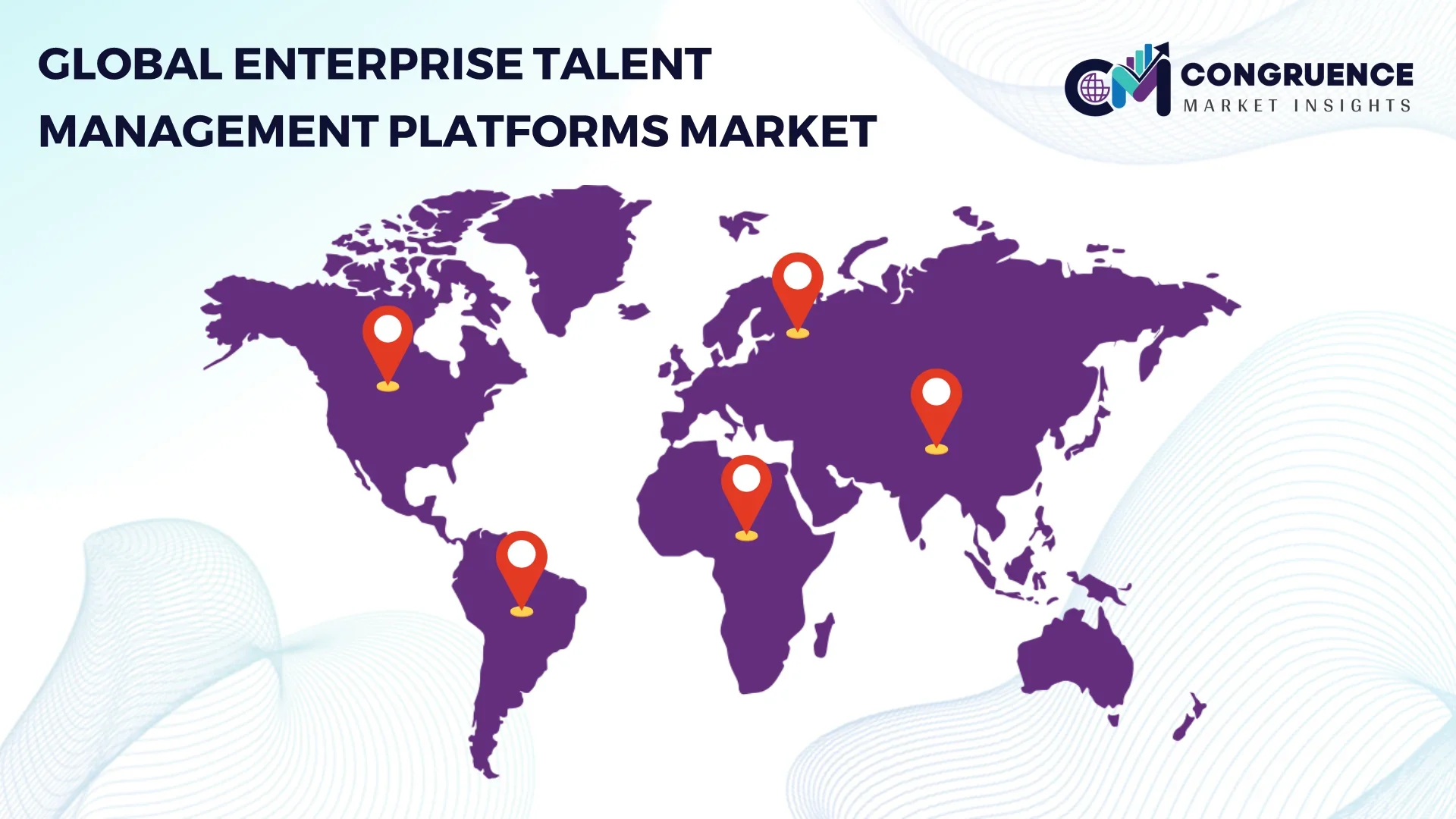
North America leads due to high enterprise SaaS penetration exceeding 75% among large corporations and strong digital HR transformation spending. Europe follows with approximately 27% share, supported by compliance-driven HR digitization across Germany, the UK, and France. Asia-Pacific holds nearly 23% share, driven by rapid enterprise cloud adoption exceeding 52% across key economies. South America contributes about 7%, while the Middle East & Africa account for roughly 5%, reflecting growing but comparatively early-stage adoption. Across regions, more than 68% of multinational enterprises are standardizing global workforce systems, and over 60% are integrating AI-based workforce analytics modules, reinforcing global demand uniformity with region-specific regulatory and digital maturity differences.
North America holds approximately 38% of the global Enterprise Talent Management Platforms Market, driven by strong enterprise IT spending and digital workforce modernization. The United States accounts for over 80% of the regional demand, followed by Canada with increasing SaaS-based HR adoption. Key industries include BFSI, healthcare, IT & telecom, and retail, where over 70% of large enterprises utilize integrated talent suites. Regulatory frameworks such as workforce transparency mandates and diversity reporting requirements encourage advanced analytics integration. Cloud-native deployment exceeds 75% among Fortune 1000 companies, with AI-enabled recruitment reducing hiring cycles by nearly 35%. Workday and ADP continue expanding AI-powered skills intelligence modules, enhancing internal mobility visibility by more than 28%. Regional consumer behavior reflects higher enterprise adoption in healthcare and finance, where compliance reporting automation reduces audit preparation time by up to 30%.
Europe represents approximately 27% of the global market, led by Germany, the United Kingdom, and France, which collectively account for over 65% of regional deployments. Strict labor laws and GDPR-driven data governance policies compel enterprises to adopt compliant, explainable HR platforms. Over 74% of large European enterprises prioritize privacy-by-design HR architectures. Germany’s manufacturing sector and the UK’s financial services industry are major demand contributors. AI-driven workforce analytics adoption has increased by nearly 32% across Western Europe. SAP SuccessFactors continues strengthening localized compliance modules, enabling automated workforce documentation aligned with EU directives. Regional behavior shows regulatory pressure leading to demand for explainable AI-based performance evaluation systems, with over 58% of enterprises requiring algorithmic transparency before deployment.
Asia-Pacific accounts for roughly 23% of global market volume and ranks as the fastest-growing region. China, India, and Japan are the top consuming countries, collectively representing over 70% of regional demand. Enterprise cloud adoption in India has surpassed 55% among mid-to-large firms, while Japan demonstrates strong integration with ERP-linked workforce analytics systems. Expanding IT services, manufacturing modernization, and large-scale workforce digitization projects drive adoption. Regional innovation hubs in Bengaluru, Shanghai, and Tokyo foster AI-enabled HR solutions, improving workforce productivity metrics by up to 26%. Darwinbox, an Asia-based HR technology provider, has expanded AI-led talent management modules across more than 1,000 enterprises. Consumer behavior in this region shows growth driven by mobile-first enterprise applications and multilingual workforce management tools.
South America contributes nearly 7% of global market share, with Brazil and Argentina leading regional adoption. Brazil accounts for over 60% of regional deployments, supported by financial services, energy, and telecommunications sectors. Government-backed digital transformation initiatives and labor compliance modernization programs are accelerating HR software investments. Cloud-based HR system penetration in Brazil has crossed 48% among large enterprises. Local technology firms are enhancing Portuguese-language AI recruitment tools to address regional hiring needs. Workforce analytics usage in the media and retail sectors has improved productivity tracking efficiency by 21%. Consumer behavior indicates demand tied to multilingual capabilities and regional labor law compliance automation.
The Middle East & Africa region accounts for approximately 5% of global demand, with the UAE and South Africa as leading markets. Digital transformation strategies linked to economic diversification programs are increasing enterprise HR technology investments. Over 45% of large enterprises in the UAE have adopted integrated HR platforms aligned with workforce nationalization initiatives. Oil & gas, construction, and government sectors remain primary adopters. Technological modernization efforts include AI-driven performance dashboards and automated payroll compliance systems. Regional enterprises report up to 24% improvement in workforce reporting accuracy through centralized platforms. Consumer behavior reflects rising adoption in government and infrastructure sectors, with increased preference for cloud-hosted, Arabic-language supported solutions.
United States – 34% Market Share: Dominates due to high enterprise SaaS penetration, strong IT infrastructure, and advanced AI-driven workforce analytics adoption across Fortune 500 companies.
Germany – 9% Market Share: Leads in Europe, supported by manufacturing sector digitization, strict labor compliance frameworks, and strong adoption of GDPR-aligned HR systems.
The Enterprise Talent Management Platforms Market is moderately consolidated, with the top five vendors collectively accounting for approximately 52–55% of global market share in 2025. The competitive environment includes over 120 active global and regional vendors, ranging from large enterprise SaaS providers to specialized AI-native HR technology firms. Market leaders differentiate through integrated cloud HCM suites, AI-powered workforce analytics, and deep ERP interoperability.
Tier-1 vendors focus on full-suite talent ecosystems covering recruitment, performance, learning, compensation, and succession within a unified architecture. Approximately 68% of large enterprises prefer single-vendor integrated suites, reinforcing consolidation among dominant players. Strategic initiatives include AI copilot launches, vertical-specific modules for healthcare and BFSI, and cross-border compliance automation enhancements. In 2024–2025, multiple vendors expanded generative AI integration into recruitment workflows, improving candidate screening accuracy by over 30%.
Mergers, acquisitions, and partnerships remain frequent, particularly targeting skills intelligence platforms and workforce analytics startups. Cloud-native SaaS deployment now represents more than 72% of new implementations, intensifying competition in AI-driven automation, API extensibility, and real-time workforce dashboards. The competitive landscape is innovation-led, with increasing emphasis on ESG workforce reporting tools, predictive attrition modeling, and skills-based talent marketplaces. Vendors investing in explainable AI and compliance-ready architectures are gaining stronger enterprise procurement preference.
ADP
Cornerstone OnDemand
UKG (Ultimate Kronos Group)
Ceridian (Dayforce)
BambooHR
iCIMS
Eightfold AI
Darwinbox
Zoho People
Infor
SumTotal Systems
Talentsoft
PeopleStrong
Technological advancement is fundamentally reshaping the Enterprise Talent Management Platforms Market, with artificial intelligence embedded across recruitment, learning, performance, and workforce analytics modules. Over 65% of large enterprises now utilize AI-assisted candidate screening tools capable of processing thousands of resumes per hour, reducing manual shortlisting efforts by nearly 40%. Predictive attrition analytics models improve retention forecasting accuracy by approximately 30–35%, enabling proactive workforce planning.
Generative AI copilots are increasingly integrated into HR dashboards, automating job description creation, performance feedback drafting, and employee engagement surveys. Cloud-native architectures dominate, accounting for more than 70% of deployments, offering scalability and multi-country compliance management. API-driven interoperability allows seamless integration with ERP, CRM, payroll, and collaboration platforms, enhancing cross-functional data accuracy by up to 28%.
Skills intelligence engines powered by machine learning are transforming workforce strategy, with nearly 60% of digital-first enterprises implementing skills taxonomies linked to internal mobility platforms. Blockchain-based credential verification tools reduce background verification time by around 40%, supporting secure hiring processes. Advanced analytics dashboards incorporating real-time KPI visualization improve executive decision-making speed by approximately 25%.
Emerging technologies include sentiment analysis engines for workforce engagement tracking, low-code HR workflow automation tools, and explainable AI frameworks to comply with global labor transparency regulations. Enterprises prioritizing modular, AI-first systems demonstrate up to 22% higher productivity alignment scores, reinforcing technology-driven competitive differentiation.
• In February 2025, Workday unveiled the Workday Agent System of Record, a centralized platform for managing AI agents across HR and workforce processes — enabling organizations to govern, monitor, and optimize both human and AI-driven work in one system, enhancing security and operational visibility. Source: www.newsroom.workday.com
• In April 2025, SAP SuccessFactors announced its 1H 2025 product release featuring more than 250 AI-enabled innovations, including the expansion of the Joule AI copilot across mobile and talent management features, redesigned recruiting and onboarding experiences, and enhanced performance management interfaces. Source: www.news.sap.com
• In October 2025, SAP SuccessFactors launched the 2H 2025 release with workforce intelligence and people insights enhancements, introducing People Intelligence dashboards for unified HR data analysis, AI-assisted performance and goals insights, and skills-based successor recommendations to help organisations make smarter talent decisions. Source: www.news.sap.com
• In May 2024, Oracle introduced “Oracle Grow for Business Leaders” within the Oracle Cloud HCM suite — an AI-powered talent development solution designed to help leaders dynamically align upskilling and career growth with business priorities, further driving workforce capability development. Source: www.oracle.com
The Enterprise Talent Management Platforms Market Report provides comprehensive coverage across product types, applications, deployment models, end-user industries, and geographic regions. The report evaluates integrated talent suites, recruitment platforms, learning management systems, performance analytics tools, compensation management systems, and succession planning modules. Deployment segmentation includes cloud-based and on-premise models, with cloud solutions accounting for over 70% of new enterprise implementations.
Application coverage spans recruitment and onboarding, performance management, workforce analytics, employee engagement, and leadership development programs. Industry focus areas include BFSI (approximately 22% adoption), IT & telecom (28%), healthcare (16%), manufacturing (14%), retail, government, and education sectors. The report analyzes enterprise size segmentation, identifying large enterprises as primary adopters while SMEs represent the fastest-expanding user base through SaaS subscription models.
Geographically, the scope includes North America (38% share), Europe (27%), Asia-Pacific (23%), South America (7%), and Middle East & Africa (5%). The study further examines regulatory frameworks influencing compliance-driven adoption, ESG-linked workforce reporting trends, AI-powered skills intelligence evolution, and enterprise digital transformation benchmarks. Emerging niche segments such as blockchain credential verification, generative AI HR copilots, and skills-based internal mobility platforms are also evaluated, offering strategic insights for technology vendors, investors, and enterprise decision-makers.
| Report Attribute / Metric | Details |
|---|---|
| Market Revenue (2025) | USD 8,584 Million |
| Market Revenue (2033) | USD 16,731.2 Million |
| CAGR (2026–2033) | 8.7% |
| Base Year | 2025 |
| Forecast Period | 2026–2033 |
| Historic Period | 2021–2025 |
| Segments Covered |
By Type
By Application
By End-User Insights
|
| Key Report Deliverables | Revenue Forecast; Market Trends; Growth Drivers & Restraints; Technology Insights; Segmentation Analysis; Regional Insights; Competitive Landscape; Regulatory & ESG Overview; Recent Developments |
| Regions Covered | North America; Europe; Asia-Pacific; South America; Middle East & Africa |
| Key Players Analyzed | Workday; SAP SuccessFactors; Oracle HCM Cloud; ADP; Cornerstone OnDemand; UKG (Ultimate Kronos Group); Ceridian (Dayforce); BambooHR; iCIMS; Eightfold AI; Darwinbox; Zoho People; Infor; SumTotal Systems; Talentsoft; PeopleStrong |
| Customization & Pricing | Available on Request (10% Customization Free) |




