
Reports
The Global Enterprise LLM Market was valued at USD 6800 Million in 2025 and is anticipated to reach a value of USD 52796.97 Million by 2033 expanding at a CAGR of 29.2% between 2026 and 2033. Growth is driven by enterprise migration toward AI-powered automation, private large language model deployments, and integration of generative AI into customer service, cybersecurity, software development, and knowledge management workflows.
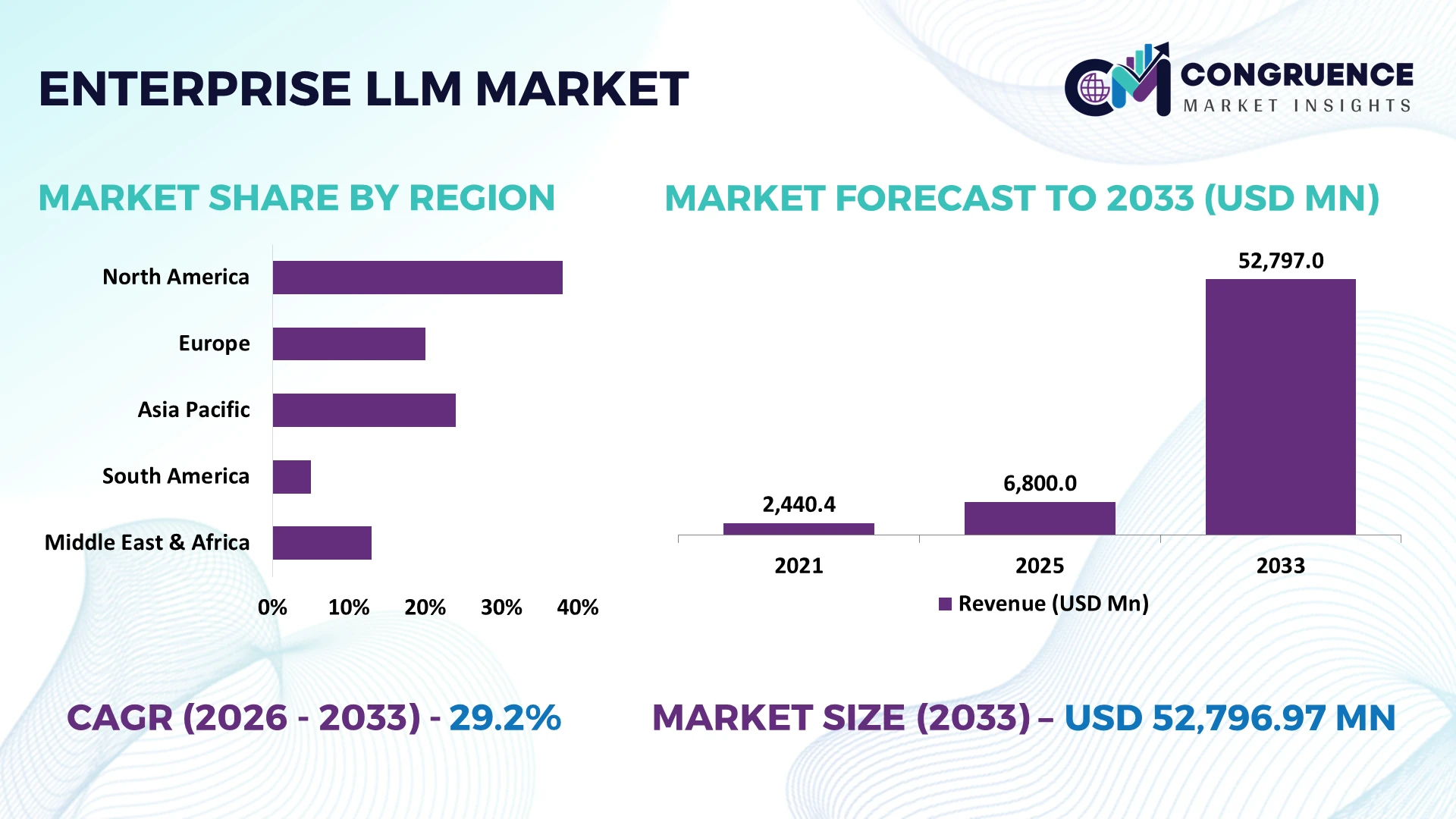
The United States dominates the Enterprise LLM Market with nearly 38% adoption share, supported by strong AI infrastructure investments exceeding USD 100 billion across data centers and cloud ecosystems. The technology sector, financial services, healthcare, and defense industries are leading deployments, with over 70% of large enterprises testing or implementing LLM-based solutions. Compared with Europe’s approximately 25% adoption level, the U.S. maintains a stronger position due to advanced semiconductor access and AI innovation ecosystems, while geopolitical competition with China accelerates domestic AI investments.
Strategic implication: enterprises prioritizing secure, scalable, and industry-specific LLM platforms will gain stronger productivity advantages and operational resilience through 2033.
Market Size & Growth: USD 6.8 billion in 2025 to USD 52.8 billion by 2033 at 29.2% CAGR, driven by enterprise AI automation and cloud-based LLM adoption.
Top Growth Drivers: 45% AI workflow automation growth, 35% demand from software development, and 30% expansion in enterprise knowledge management platforms.
Short-Term Forecast: By 2028, enterprise LLM deployments reduce operational costs by 20% and improve employee productivity by 30% through automated workflows.
Emerging Technologies: Advanced LLM agents, retrieval-augmented generation, multimodal AI, and domain-specific models reshape enterprise automation strategies.
Regional Leaders: North America reaches USD 20 billion+, Europe exceeds USD 13 billion, and Asia-Pacific approaches USD 12 billion with rapid cloud AI adoption.
Consumer/End-User Trends: Over 65% of large enterprises integrate AI assistants into customer support, analytics, and internal productivity operations.
Pilot/Case Example: In 2026, enterprise AI copilots improve software development cycles by 35% and reduce repetitive documentation workloads by 40%.
Competitive Landscape: Leading providers hold approximately 55% combined market influence, with competition among OpenAI, Microsoft, Google, Anthropic, Amazon, and Meta.
Regulatory & ESG Impact: AI governance frameworks reduce compliance risks by nearly 25% through improved model monitoring, transparency, and data controls.
Investment & Funding: Enterprise AI investments surpass USD 80 billion globally, driven by cloud partnerships, infrastructure expansion, and strategic AI acquisitions.
Innovation & Future Outlook: Next-generation enterprise LLMs focus on autonomous agents, industry customization, and secure private AI ecosystems for competitive differentiation.
The Enterprise LLM Market is experiencing accelerated demand from organizations seeking intelligent automation, faster decision-making, and specialized AI capabilities across business functions. Recent innovations in smaller efficient models, AI agents, and secure deployment architectures are improving enterprise adoption rates by nearly 35%. Increasing regulatory focus on responsible AI and operational data control is shaping deployment strategies, creating a transition toward customized enterprise-grade language models and strategic AI transformation initiatives.
The Enterprise LLM Market is becoming strategically important as companies compete through AI-driven productivity, faster decision cycles, and intelligent automation rather than traditional operational advantages. The shift toward private AI infrastructure, sovereign data management, and regulated enterprise deployments is reshaping investment priorities, especially after global concerns around data security and AI governance.
Enterprises are replacing legacy automation systems with large language model platforms that improve knowledge retrieval speed by nearly 50% and reduce manual information-processing costs by 20–30%. The United States leads advanced deployments through large-scale cloud AI ecosystems, while European companies emphasize compliance-focused models under stricter AI regulations. Over the next 2–3 years, enterprise adoption will accelerate as organizations integrate LLMs into software engineering, customer operations, and decision intelligence.
Companies are increasing partnerships with cloud providers, model developers, and infrastructure firms to build customized AI environments. For example, financial institutions are deploying internal LLM assistants to analyze documents and automate reporting workflows while maintaining data controls. Strategic success will depend on combining AI capability, governance readiness, and scalable infrastructure to secure long-term competitive positioning.
Enterprise AI automation is the primary growth driver as organizations prioritize productivity improvements and operational efficiency. More than 60% of large enterprises are actively evaluating LLM-based solutions, while automated knowledge workflows improve employee efficiency by 25–35%. The expansion of AI-enabled software development, customer support, and analytics platforms is accelerating adoption across industries. The United States, Japan, and Germany are investing heavily in AI infrastructure modernization to support enterprise workloads. Companies are responding through strategic partnerships, private model development, and cloud expansion initiatives. A key shift is the move from general-purpose AI tools toward industry-specific LLM systems designed for measurable business outcomes.
Enterprise LLM adoption faces constraints from high computing requirements, regulatory complexity, and data management challenges. Advanced AI infrastructure costs remain significant, with specialized computing resources accounting for nearly 40% of deployment expenses in large-scale environments. European enterprises encounter stricter compliance requirements, while emerging markets face limited access to high-performance AI infrastructure. Interoperability issues between existing enterprise systems and new AI platforms slow deployment timelines by 20–25%. Companies are reducing risks through hybrid cloud strategies, localized data processing, and long-term infrastructure agreements. The critical operational challenge is balancing AI scalability with security, compliance, and cost control.
Industry-focused LLM solutions create significant opportunities as enterprises demand customized intelligence rather than broad AI applications. Healthcare, banking, manufacturing, and legal sectors are increasing AI investments, with specialized models improving workflow accuracy by 30% or more in targeted applications. Emerging markets such as India and Southeast Asia are expanding AI adoption through digital transformation programs and enterprise automation initiatives. Advances in smaller efficient models, multimodal AI, and AI agents are opening new business models. Companies are positioning through research partnerships, domain-specific model development, and ecosystem collaboration. The strongest opportunity lies in creating secure AI platforms tailored to complex industry workflows.
Enterprise LLM deployment remains challenging due to cybersecurity risks, integration complexity, and workforce readiness gaps. Around 45% of organizations identify data security as a major barrier to wider AI implementation, while nearly 30% face difficulties connecting AI systems with existing enterprise applications. Countries such as the United States and South Korea are accelerating AI infrastructure investments, but enterprises still require skilled teams for model management and governance. Companies are addressing these issues through AI training programs, security frameworks, and strategic technology partnerships. Long-term competitiveness will depend on building reliable AI ecosystems that support consistent performance, responsible usage, and scalable deployment across business operations.
Private AI Deployment Accelerates: Enterprises are shifting toward private and hybrid LLM architectures, with nearly 55% of large organizations prioritizing controlled AI environments and 35% increasing investment in internal model customization. Data governance regulations in Europe and cybersecurity concerns in financial services are accelerating this transition. Companies are expanding secure AI infrastructure partnerships to improve compliance, reduce external data exposure, and maintain operational control.
AI Agent Integration Expands: Autonomous AI agents are becoming a major workflow transformation trend, with enterprise adoption increasing by around 40% across software, customer operations, and analytics functions. Companies are moving beyond chatbot-based systems toward multi-step automation that reduces repetitive tasks by 25–30%. U.S. technology firms and global enterprises are scaling agent-based platforms to improve response speed and workforce efficiency.
Industry Models Gain Traction: Domain-specific enterprise LLMs are replacing broad AI tools as organizations demand higher accuracy and specialized outputs. Adoption of customized models has increased by approximately 30%, particularly in healthcare, banking, and manufacturing. A non-obvious shift is that smaller optimized models are gaining preference due to lower computing requirements, enabling companies to reduce infrastructure costs while maintaining performance.
Enterprise AI Governance Evolves: Regulatory changes and responsible AI requirements are reshaping deployment strategies, with more than 60% of enterprises implementing AI monitoring frameworks. Companies are integrating explainability, model auditing, and security controls into AI operations. Organizations are restructuring AI teams and partnerships to balance innovation speed with compliance readiness across global markets.
Hybrid Enterprise LLM deployments represent the leading segment, accounting for approximately 45% market share due to their balance between cloud scalability and on-premises data control. Large enterprises prefer hybrid models because they support sensitive workloads while enabling access to advanced AI capabilities. Cloud-Based solutions hold nearly 35% share and remain widely adopted by startups and digital-first companies because of faster deployment, lower infrastructure requirements, and flexible scaling. On-Premises models account for around 20% share, mainly serving regulated industries requiring maximum data sovereignty. Hybrid adoption is expanding fastest, growing by nearly 30% as companies combine private infrastructure with external AI capabilities. Organizations are increasing investments in customized architectures, security frameworks, and enterprise AI platforms to improve operational resilience.
Software Development leads Enterprise LLM applications with approximately 30% market share as companies use AI coding assistants, testing automation, and developer productivity platforms. Customer Service follows with nearly 25% share due to automated support systems and intelligent response management. Knowledge Management and Business Analytics are expanding as enterprises improve information access and decision-making capabilities. Content Generation remains important but is shifting toward specialized enterprise communication workflows. Software Development is also the fastest-growing application, with adoption increasing by around 35% as organizations address developer shortages and accelerate digital transformation. Companies are integrating LLM tools into existing platforms, expanding automation capabilities, and creating internal AI ecosystems. The operational shift is moving from isolated AI tools toward embedded intelligence across business processes.
BFSI remains the leading Enterprise LLM end-user segment with approximately 32% market share due to intensive demand for fraud analysis, customer engagement, compliance automation, and financial intelligence. IT & Telecom follows with nearly 28% share, supported by large-scale digital infrastructure and software development requirements. Healthcare is emerging as the fastest-growing segment, expanding by around 35% as providers adopt AI for clinical documentation, research support, and administrative automation. Retail and Manufacturing are increasing deployments through customer personalization, supply-chain optimization, and operational analytics. Companies are targeting these sectors through industry-specific solutions, strategic partnerships, and customized AI platforms. The buying pattern is shifting from experimental pilots toward measurable productivity improvements and integrated enterprise workflows.
North America accounted for the largest market share at 38% in 2025 however, Asia-Pacific is expected to register the fastest growth, expanding at a CAGR of 32% between 2026 and 2033.
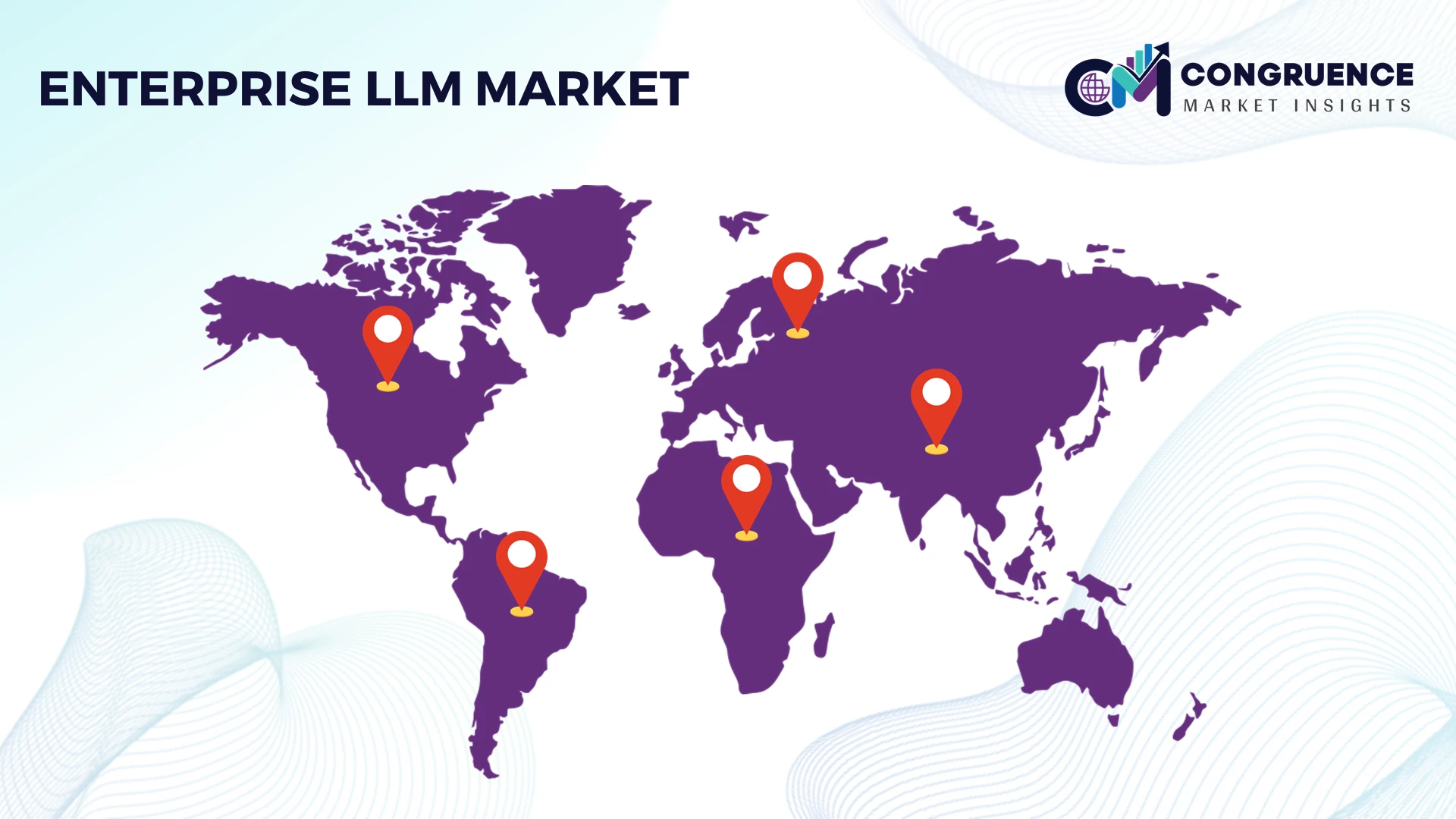
Enterprise AI Infrastructure Expansion Drives Market Leadership
North America leads the Enterprise LLM Market due to strong cloud infrastructure, advanced AI research ecosystems, and high enterprise adoption across finance, technology, healthcare, and defense sectors. The region contributes nearly 38% of global deployment activity, supported by large-scale data center expansion and increasing private AI investments. More than 70% of large enterprises in the United States are actively testing or deploying generative AI solutions. Companies are accelerating partnerships with AI platform providers and semiconductor firms to improve model performance, security, and scalability. The rapid shift toward customized enterprise AI solutions is strengthening regional competitiveness.
United States Market Outlook: The United States remains the dominant country due to its technology ecosystem, AI infrastructure capacity, and enterprise innovation leadership. Over 60% of major U.S. corporations are integrating AI assistants into business workflows, while investments in advanced computing infrastructure continue expanding across cloud, software, and enterprise automation sectors.
Regulated AI Adoption Reshapes Enterprise Deployment
Europe is developing a strong Enterprise LLM ecosystem driven by regulatory compliance, responsible AI frameworks, and digital modernization across manufacturing, banking, and public sectors. The region represents approximately 25% of enterprise AI adoption, with Germany, the United Kingdom, and France leading deployments. The implementation of stricter AI governance requirements is encouraging companies to invest in transparent, secure, and industry-specific language models. European enterprises are increasing spending on AI infrastructure upgrades and data management systems, with adoption rising across regulated industries. The market shift toward sovereign AI capabilities is becoming a strategic priority for organizations seeking greater control over sensitive business information.
Germany Market Outlook: Germany holds a leading position through its industrial automation strength and enterprise technology adoption. More than 50% of large manufacturers are exploring AI-driven process optimization, particularly in engineering, production planning, and supply-chain management. Strong industrial data ecosystems support customized LLM deployment.
Large-Scale Digital Transformation Accelerates AI Deployment
Asia-Pacific is becoming the fastest-expanding Enterprise LLM market due to rapid digitalization, growing cloud infrastructure, and increasing enterprise automation demand. Countries including China, India, Japan, and South Korea are expanding AI capabilities across manufacturing, technology services, and financial sectors. The region contributes nearly 22% of current enterprise LLM adoption, supported by rising AI infrastructure investments and local model development. More than 50% of large organizations are increasing AI experimentation to improve productivity and operational efficiency. Companies are building localized AI platforms, strengthening semiconductor partnerships, and expanding data center capacity to support growing enterprise workloads.
China Market Outlook: China remains a major AI deployment hub with strong domestic model development, manufacturing integration, and cloud ecosystem expansion. Over 40% of large enterprises are implementing AI-powered solutions across industrial automation, customer platforms, and analytics operations, supported by significant investments in computing infrastructure.
Digital Infrastructure Modernization Expands Enterprise Adoption
South America is gradually increasing Enterprise LLM adoption as businesses modernize digital operations and improve automation capabilities across banking, retail, and telecommunications. The region accounts for approximately 8% of global enterprise deployments, with Brazil leading demand due to its large technology services sector. Cloud accessibility improvements and expanding data infrastructure are supporting broader AI implementation. Around 35% of large companies are evaluating generative AI applications to improve customer engagement and operational efficiency. However, limited advanced computing availability and infrastructure gaps influence deployment speed. Companies are responding through cloud partnerships, managed AI services, and localized implementation strategies.
Brazil Market Outlook: Brazil represents the strongest regional opportunity due to its expanding digital economy and enterprise technology adoption. More than 30% of large businesses are adopting AI-based automation tools, particularly in financial services, retail operations, and customer experience management.
AI Infrastructure Investment Accelerates Digital Transformation
Middle East & Africa is emerging as a strategic Enterprise LLM market through government-led digital transformation programs, cloud infrastructure expansion, and AI-focused investments. Countries such as the United Arab Emirates and Saudi Arabia are prioritizing AI adoption across government services, energy, finance, and enterprise operations. The region contributes nearly 7% of global enterprise LLM deployments but is increasing investment momentum through large-scale technology initiatives. More than 40% of enterprises in leading Gulf economies are exploring AI automation solutions to improve operational efficiency. Companies are forming technology partnerships and expanding AI infrastructure to support regional innovation objectives.
United Arab Emirates Market Outlook: The United Arab Emirates is positioning itself as a regional AI innovation center through advanced infrastructure and enterprise adoption programs. Over 45% of large organizations are implementing AI solutions across government, finance, and service industries, supported by strong digital transformation initiatives.
The Enterprise LLM Market competition is shaped by global AI platform leaders, cloud providers, and specialized model developers competing for enterprise workloads. Technology innovators such as OpenAI, Google, Anthropic, and Meta compete with cloud giants Microsoft and Amazon through advanced models, infrastructure integration, and enterprise ecosystems. The top five players collectively control nearly 55% market influence, driven by model performance, cloud availability, and enterprise partnerships. Competition is shifting toward customization, with industry-specific models improving operational accuracy by 20–30%, while optimized deployment reduces AI operating costs by around 25%. Players are expanding through strategic alliances, private AI solutions, and vertical integration across software and computing infrastructure. Regional AI developers compete through localization, pricing flexibility, and regulatory alignment. High computing requirements, specialized talent shortages, and data security demands remain major entry barriers. Winning companies will combine superior models, scalable infrastructure, trusted governance, and industry-focused solutions.
OpenAI
Microsoft
Anthropic
Amazon Web Services
Meta Platforms
IBM
Oracle
NVIDIA
Cohere
Mistral AI
Databricks
Snowflake
Hugging Face
Enterprise LLM technology is advancing through retrieval-augmented generation (RAG), domain-specific models, and AI agent frameworks that improve business automation. RAG adoption is expanding across enterprises, improving information accuracy by 20–30% compared with traditional chatbot systems. Companies are integrating LLMs with enterprise databases, customer platforms, and analytics tools to deliver faster decision support. Cloud-based AI infrastructure and specialized computing platforms are improving model deployment efficiency by nearly 25%.
Emerging technologies such as multimodal LLMs, smaller efficient models, and autonomous AI agents are reshaping enterprise operations. Smaller optimized models reduce computing requirements by approximately 30% compared with large general-purpose models while maintaining competitive performance. Financial services, healthcare, and software companies benefit most from customized AI systems that improve workflow automation and reduce manual processing time.
From 2026 to 2028, disruptive technologies including AI orchestration platforms, secure private LLM environments, and self-improving enterprise agents will become critical competitive differentiators. Organizations adopting integrated AI ecosystems will gain advantages in productivity, customer experience, and operational agility. Companies combining proprietary data, advanced models, and strong governance frameworks will lead enterprise AI transformation.
October 2025 Google introduced Gemini Enterprise, expanding agent-based AI deployment for workplace automation through its enterprise platform. The solution integrated AI agents with company workflows and data systems, helping organizations move beyond chatbot adoption. The launch strengthened Google’s position in enterprise AI transformation. Source: blog.google
December 2025 Anthropic expanded its partnership with Accenture to accelerate enterprise Claude deployments. Around 30,000 Accenture professionals received Claude training, creating a large implementation ecosystem. The collaboration improved enterprise AI adoption readiness across software engineering and business operations. Source: anthropic.com
December 2025 Anthropic and Snowflake announced a strategic AI partnership valued at USD 200 million to deliver agentic AI capabilities. The integration extended Claude availability across platforms serving more than 12,600 global customers, improving enterprise data intelligence and secure AI deployment. Source: anthropic.com
May 2025 Google Cloud advanced enterprise AI infrastructure through distributed inference improvements using vLLM support across Cloud TPU, Vertex AI, and Compute Engine. The technology transition improved scalable AI processing efficiency, enabling enterprises to deploy high-demand LLM workloads more reliably. Source: cloud.google.com
The Enterprise LLM Market Report covers comprehensive segmentation across Cloud-Based, On-Premises, and Hybrid deployment models, along with applications including Customer Service, Content Generation, Software Development, Knowledge Management, and Business Analytics. The analysis evaluates adoption patterns across BFSI, Healthcare, IT & Telecom, Retail, and Manufacturing sectors, highlighting enterprise priorities and operational transformation trends.
The report provides regional insights across North America, Europe, Asia-Pacific, South America, and Middle East & Africa, while assessing key technologies such as AI agents, retrieval-augmented generation, multimodal models, and customized enterprise platforms. Covering major market participants and emerging innovation areas, the study supports investment decisions, competitive positioning, expansion planning, and strategic AI adoption pathways from 2026 to 2033.
| Report Attribute/Metric | Report Details |
|---|---|
Market Revenue in 2025 | USD 6800 Million |
Market Revenue in 2033 | USD 52796.97 Million |
CAGR (2026 - 2033) | 29.2% |
Base Year | 2025 |
Forecast Period | 2026 - 2033 |
Historic Period | 2021 - 2025 |
Segments Covered | By Type
By Application
By End-User
|
Key Report Deliverable | Revenue Forecast, Growth Trends, Market Dynamics, Segmental Overview, Regional and Country-wise Analysis, Competition Landscape |
Region Covered | North America, Europe, Asia-Pacific, South America, Middle East, Africa |
Key Players Analyzed | OpenAI, Microsoft, Google, Anthropic, Amazon Web Services, Meta Platforms, IBM, Oracle, NVIDIA, Cohere, Mistral AI, Databricks, Snowflake, Hugging Face |
Customization & Pricing | Available on Request (10% Customization is Free) |




